Minor Pieces 48: Alice Elizabeth Hooke Part 1

In the last two Minor Pieces (here and here) you met George Archer Hooke. Mention was made of his sister, Alice Elizabeth Hooke, who was also a competitive player: not as strong as her brother, but of more historical significance.

Alice was born on 20 October 1862, and, as expected was living at home in 1871 and 1881, although no occupation is listed for her on the 1881 census. By 1891, still at home, she was, like several of her siblings, working as a clerk (the details aren’t very legible). Presumably she, like George, had learnt chess from her father, but in those days chess clubs weren’t seen as places for women. Some clubs, like Twickenham, specified in their advertisements that they welcomed ‘gentlemen’. No plebs, and no ladies either.

But views on the role of women in society were changing. If men could have chess clubs, why couldn’t women?
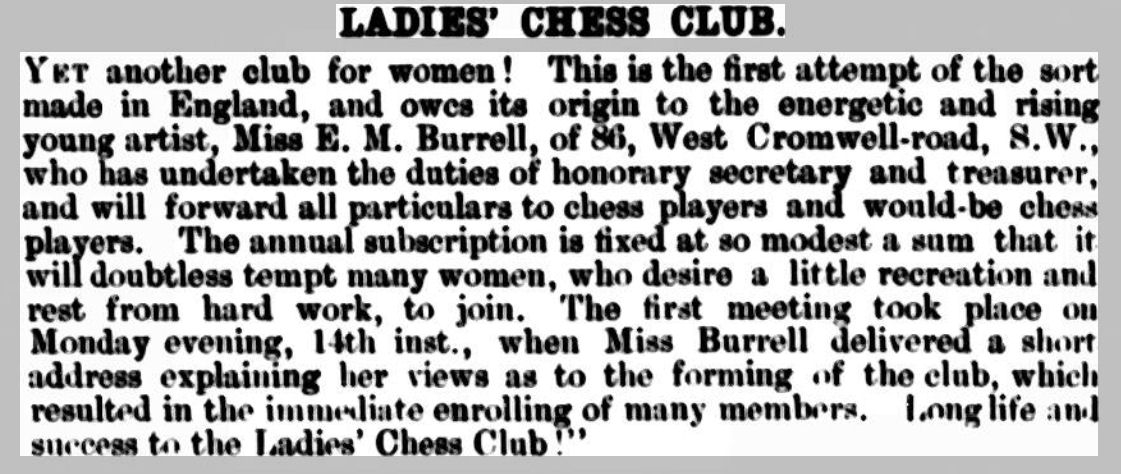
The Queen 19 January 1895

Well, it certainly wasn’t the first Ladies’ Chess Club in England, and portrait painter Edith Mary Burrell (1858-1906) wasn’t all that young either, but the club, as you’ll see, would become very popular and successful.They soon found a venue in the Strand opposite Charing Cross Station and, by May, were playing their first match.
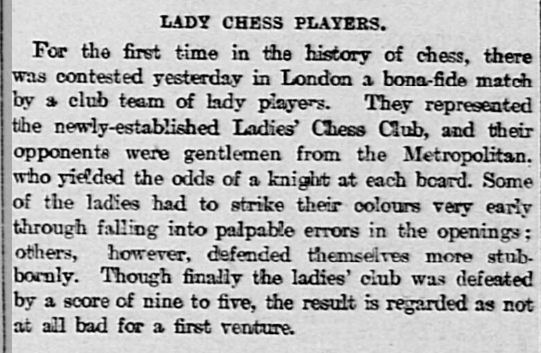
Sheffield Evening Telegraph 24 May 1895

Alice, a keen social chess player, had wasted no time in joining, playing top board in this match. As you’ll see, the gentlemen of the Metropolitan club, as well as giving knight odds, were only their third team players, which suggests that most of the ladies were, at this point, not very strong players.
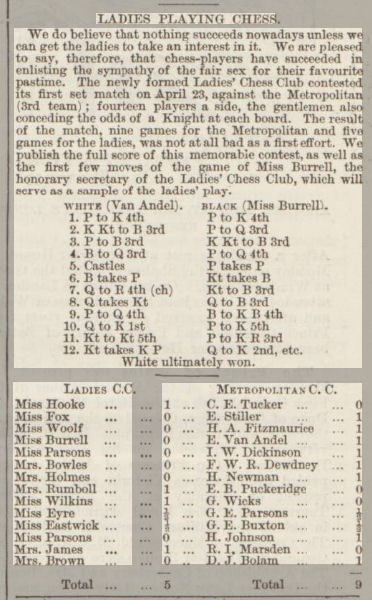
Penny Illustrated Paper 01 June 1895

The following month their first Annual General Meeting took place. Miss Alice Elizabeth Hooke was elected Hon Secretary and Treasurer.
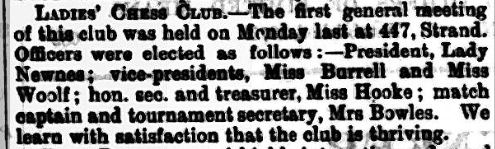
Barnet Press 22 June 1895

Most importantly, Mrs Rhoda Bowles was elected match captain and tournament secretary. All chess clubs are only as good as their organisers, and, in Rhoda Bowles, they had an organiser and publicist of exceptional energy and talent, with, I’d imagine, Alice Hooke doing the backroom work with considerable efficiency.

The club continued to thrive, offering a bewildering whirl of activities: internal tournaments, simultaneous displays, including one from Harry Nelson Pillsbury, fresh from his success at Hastings, and matches against other clubs. By October, with their membership having grown to 75, they found more commodious premises in Great Russell Street, close to the British Museum.
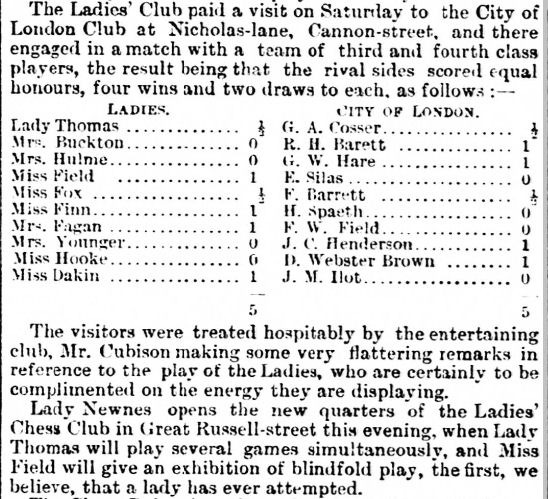
Morning Post 21 October 1895

Lady Thomas was the mother of the future Sir George Thomas, and herself a strong player. Alice had been relegated from top board to board 9 by now, partly because of an influx of strong new members. The four players on the middle boards, all, coincidentally, with surnames beginning with F, would go on to play important roles in the Ladies’ Chess Club over the next few years. For the remarkable Louisa Matilda Fagan, I’ll refer you to Martin Smith’s articles referenced below. I hope to write about Gertrude Alison Beatrice Field, Rita Fox and Kate Belinda Finn at some point in the future.

Within a few months they were up to 100 members. Pillsbury visited again and Lasker looked in whenever he was in town.

In 1896 the Ladies’ Chess Club entered the London League as well as continuing their programme of internal competitions, friendly matches, such as the one below, against other clubs and simuls, in this case by Herbert Levi Jacobs.
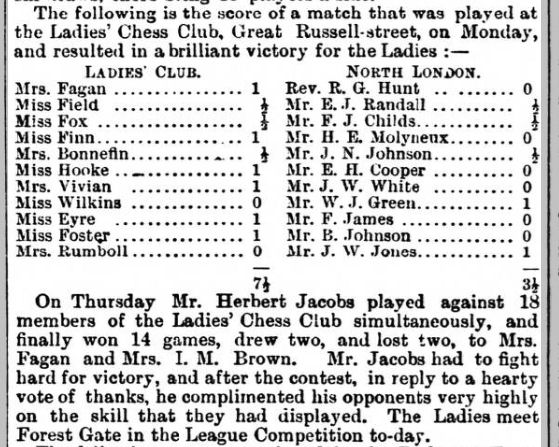
Morning Post 07 December 1896

Here, you see the F-squad in place on the top four boards, with the Belgian Marie Bonnefin on board 5 and Alice on board 6. By now they seem to have established their correct board order. While, for many of their members, the club probably served a social function, their strongest players were intensely competitive.

They had even bigger plans in store for 1897 when, to mark Queen Victoria’s Diamond Jubilee, they planned to hold an International Ladies’ Chess Tournament at the Hotel Cecil in London.

The strongest lady players from around the world were invited, and, naturally enough, these included several of their club members. Alice Elizabeth Hooke was originally a reserve, but when one of the American invitees withdrew, she was granted a place in the competition.

I’ll refer you to two excellent articles (links at the foot of this post) which provide much more information. The tournament, just like the club, predictably attracted a lot of interest in the press and several of the games were published. Alice’s score of 10 points (8 wins over the board, 2 by default and 9 losses) was more than respectable for a reserve.
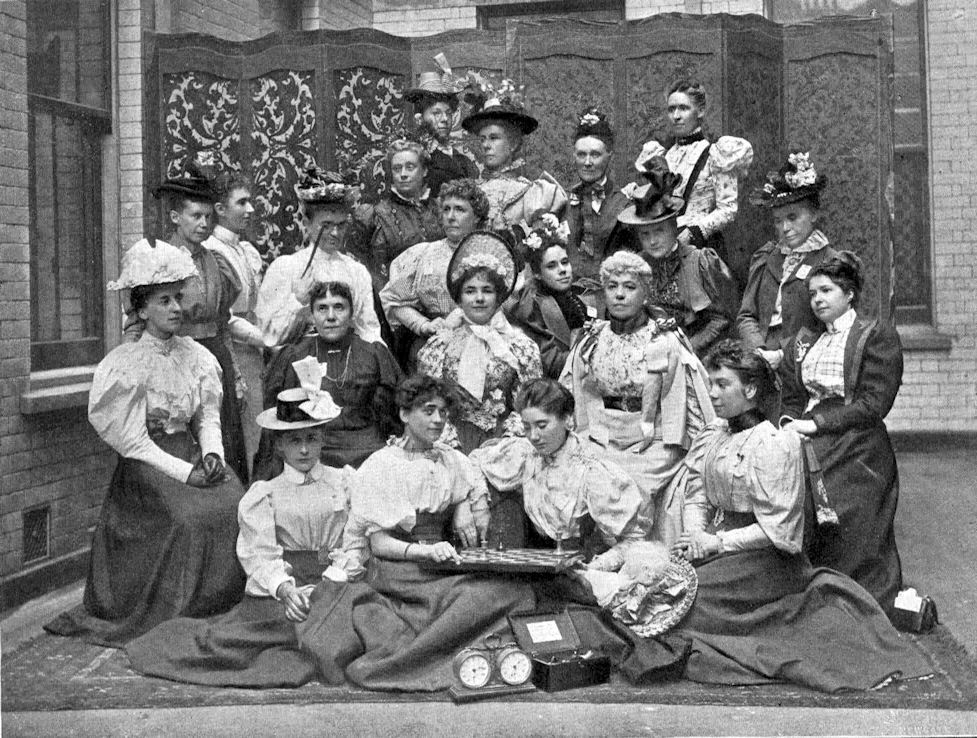
Here’s a photograph of the competitors. Alice, wearing a hat, is standing right at the back against the screen.

In this game against one of the German representatives (her first name is not known, at least to me, but she may well have been related to the organist and composer Carl Müller-Hartung (1834-1908)), her opponent failed to take advantage of an oversight at move 15, after which a poor choice at move 18 allowed Alice to demonstrate some impressive attacking skills. Click on any move in any game in this article for a pop-up board.

[pgn]

[Event “London Women International”]
[Site “London (Hotel Cecil)”]
[Date “1897.06.23”]
[Round “2”]
[White “Hooke, Alice Elizabeth”]
[Black “Müller-Hartung”]
[Result “1-0”]
[ECO “B00”]
[Annotator “Tactical Analysis 5.2 (1s)”]
[PlyCount “51”]
[EventDate “1897.06.23”]
[EventType “tourn”]
[EventRounds “19”]
[EventCountry “ENG”]
[SourceTitle “EXT 2018”]
[Source “ChessBase”]
[SourceDate “2017.10.13”]
[SourceVersion “1”]
[SourceVersionDate “2017.10.13”]
[SourceQuality “1”]

1. e4 e5 2. d4 Nc6 3. d5 Nce7 {[#]} 4. Nc3 $146 ({Predecessor:} 4. Nf3 Ng6 5.
Be3 Bb4+ 6. c3 Ba5 7. Bd3 Bb6 8. O-O N8e7 9. Qd2 d6 10. c4 O-O 11. Nc3 Ba5 12.
Ne1 f5 13. f4 fxe4 14. Bxe4 Bf5 15. Bxf5 Nxf5 16. fxe5 Nxe3 {0-1 (16) Williams,
E-Kennedy,H London 1848}) 4… d6 5. Be2 a6 6. f4 {& White is more active. B00:
Queen’s Fianchetto Defence, Nimzowitsch Defence.} exf4 7. Bxf4 Ng6 8. Qd2 {
The position is equal.} Be7 9. Nf3 Nf6 10. O-O-O Ng4 11. Rhf1 N6e5 $2 {[#]} (
11… Nxf4 $17 12. Qxf4 Bf6) 12. Bxe5 $2 (12. h3 $16 Nxf3 13. gxf3 (13. Bxf3
Ne5 $11)) 12… Nxe5 $11 13. Kb1 Bd7 14. Rf2 h6 $2 (14… Bf6 $17) 15. Rdf1 $2
{[#]} (15. Nxe5 $14 {stays ahead.} dxe5 16. Qe3) 15… Bf6 $2 ({Black should
play} 15… Ng4 $19 16. Bd3 Nxf2 17. Qxf2 O-O) 16. Nxe5 $16 dxe5 17. Bh5 Qe7
18. d6 Qe6 (18… Qxd6 $16 19. Qxd6 cxd6) 19. dxc7 $18 ({Not} 19. Nd5 Qxd6 20.
Bxf7+ (20. Nxf6+ gxf6 21. Qxd6 cxd6 $16) 20… Kxf7 $18) 19… Rc8 (19… Bc6
$142 20. Nd5 Bxd5) 20. Nd5 Bc6 21. Nxf6+ {White mates.} gxf6 22. Rxf6 Qd7 23.
Bxf7+ Qxf7 24. Rxf7 Bxe4 25. Qd6 Rg8 26. Qe7# {Weighted Error Value: White=0.
86/Black=1.20} 1-0

[/pgn]

Against her Belgian clubmate Marie Bonnefin, Alice lost a vital central pawn, after which her opponent’s passed pawns enabled her to bring the game to a neat conclusion.

[pgn]

[Event “London Women International”]
[Site “London (Hotel Cecil)”]
[Date “1897.06.24”]
[Round “4”]
[White “Bonnefin, Marie”]
[Black “Hooke, Alice Elizabeth”]
[Result “1-0”]
[ECO “C84”]
[Annotator “Tactical Analysis 5.2 (1s)”]
[PlyCount “95”]
[EventDate “1897.06.23”]
[EventType “tourn”]
[EventRounds “19”]
[EventCountry “ENG”]
[SourceTitle “EXT 2018”]
[Source “ChessBase”]
[SourceDate “2017.10.13”]
[SourceVersion “1”]
[SourceVersionDate “2017.10.13”]
[SourceQuality “1”]

1. e4 e5 2. Nf3 Nc6 3. Bb5 a6 4. Ba4 Nf6 5. O-O Be7 6. d3 O-O 7. c3 d6 8. h3 {
[#] C84: Closed Ruy Lopez: Unusual White 6th moves.} Bd7 $146 ({Predecessor:}
8… h6 9. Be3 b5 10. Bb3 d5 11. Nbd2 Be6 12. Re1 Qd7 13. exd5 Nxd5 14. d4 exd4
15. Bxd4 Rfe8 16. Ne4 Nf4 17. Ne5 Bxb3 18. axb3 Nxe5 19. Bxe5 Qxd1 20. Raxd1
Ne6 {1/2-1/2 (20) Bauer,J-Englisch,B Vienna 1890}) 9. Bc2 d5 10. b3 {White is
better.} d4 11. Bb2 Bc5 12. Nbd2 Be6 13. Nc4 Bxc4 14. bxc4 Nd7 15. Nh2 $2 {[#]}
(15. Ba4 $14 {keeps the upper hand.}) 15… f5 $2 (15… dxc3 $17 16. Bxc3 Bd4
17. Bxd4 Nxd4) 16. Kh1 (16. exf5 {feels hotter.} Rxf5 17. Ba4 dxc3 18. Bxc3 Qf6
19. Ng4) 16… fxe4 17. cxd4 Nxd4 {aiming for …Qh4.} 18. dxe4 Rf7 (18… Nxc2
$6 19. Qxc2 Qe7 20. Rad1 $11) 19. f3 $2 (19. Rb1 $11) 19… c6 {And now …Nf6
would win.} 20. Ng4 Qb6 21. Rb1 Qc7 22. Nf2 (22. Bxd4 $5 Bxd4 23. Qd2 $15)
22… Raf8 ({Of course not} 22… Nxc2 23. Qxc2 Bd4 24. Bxd4 exd4 25. c5 $14 (
25. Qb2 Ne5 $11)) 23. Nd3 Nxc2 24. Qxc2 Bd6 25. Ba1 $2 (25. c5 $18 Be7 26. Qc4)
25… Nf6 $2 (25… Nc5 $11) 26. Kg1 $2 (26. c5 $18) 26… b5 $2 (26… Qe7 $16
{was called for.}) 27. c5 $18 Qa7 28. Bxe5 Be7 (28… Bc7 29. a4 Re8) 29. Rbc1
Rd8 30. Nb4 Qa8 31. Rfd1 Rxd1+ 32. Rxd1 ({Not} 32. Qxd1 a5 $16) 32… a5 33.
Nd3 {White is clearly winning.} Nd7 34. Bd6 Qf8 (34… Qe8 $142 35. a4 h6 36.
axb5 cxb5) 35. e5 Rf5 36. Qb3+ Kh8 37. Qe6 Bxd6 38. cxd6 Rf7 39. Qg4 Nb6 40.
Nc5 Nd5 41. Rc1 Nf4 42. Kh1 g6 43. Ne6 h5 {[#]} 44. Qxf4 $3 Rxf4 45. Nxf8 Rxf8
46. Rxc6 {Threatening mate with e6.} Kg7 47. Rc7+ Kg8 48. d7 {Weighted Error
Value: White=0.97/Black=1.01} (48. e6 $142 Rd8 49. e7 Re8 50. d7 Kf7 51. d8=Q
h4 52. Qd6 g5 53. Rc6) 1-0

[/pgn]

Alice’s game against one of the F-squad, Gertrude Field, had an interesting finish. Gertrude played an enterprising and correct piece sacrifice on move 25, but missed the immediate Nf3 on move 27. Defending in chess is always difficult, and Alice could have stayed in the game by playing 28… Ne7.

[pgn]

[Event “London Women International”]
[Site “London (Hotel Cecil)”]
[Date “1897.06.26”]
[Round “7”]
[White “Field, Gertrude Alison Beatrice”]
[Black “Hooke, Alice Elizabeth”]
[Result “1-0”]
[ECO “C51”]
[Annotator “Tactical Analysis 5.2 (1s)”]
[PlyCount “75”]
[EventDate “1897.06.23”]
[EventType “tourn”]
[EventRounds “19”]
[EventCountry “ENG”]
[SourceTitle “EXT 2018”]
[Source “ChessBase”]
[SourceDate “2017.10.13”]
[SourceVersion “1”]
[SourceVersionDate “2017.10.13”]
[SourceQuality “1”]

1. e4 e5 2. Nf3 Nc6 3. Bc4 Bc5 4. b4 Bb6 5. c3 a6 6. Qb3 {[#] C51: Evans
Gambit: Declined and Accepted without 5…Ba5.} Qf6 $146 ({Predecessor:} 6…
Qe7 7. O-O d6 8. d4 exd4 9. b5 Na5 10. Qa4 Bd7 11. Bd3 axb5 12. Bxb5 c6 13. Bd3
{0-1 (38) Barnett,J-Perrin,F New York (Cafe Europa) 1869}) 7. d3 h6 (7… Qg6 {
looks sharper.} 8. O-O d6 9. a4 Nf6) 8. O-O {White is slightly better.} d6 9.
Be3 Nge7 10. Nbd2 O-O 11. Bxb6 cxb6 12. h3 Qg6 {aiming for …b5.} 13. Nh4 Qf6
14. Nhf3 Bd7 15. Qd1 Rac8 16. Nh2 Kh8 17. Ng4 Qg6 18. f4 {Hoping for f5.} h5 $4
{[#]} (18… f5 $19 {and all is fine.} 19. exf5 Nxf5) 19. f5 $18 Qh7 20. Ne3
Qh6 21. Rf3 b5 22. Bd5 Ng8 23. Rg3 Nf6 24. Qe1 g6 25. Bxf7 Rxf7 26. Rxg6 Qh7 {
[#]} (26… Qf8 $16) 27. Qh4 $2 (27. Nf3 $1 $18) 27… Rcf8 $11 28. Nf3 $36 {
And now Ng5 would win. White has the initiative.} Rg7 $2 29. Rxf6 $18 Rxf6 30.
Qxf6 Qg8 31. Qxd6 Qe8 32. Nh4 Rg3 33. Qh6+ Kg8 34. Ng6 {Qh8+ would kill now.}
Qd8 35. Qh8+ {White mates.} Kf7 36. Qh7+ Kf6 37. Nd5+ Kg5 38. Nh8 {Never
resign too early! Weighted Error Value: White=0.78/Black=0.87} (38. Qg7 $142
Rxh3 39. gxh3 Qg8 40. h4+ Kg4 41. Nxe5+ Kh3 42. Nf4+ Kxh4 43. Nf3#) 1-0

[/pgn]

Her best result came in round 8, with a win against Louisa Fagan, who eventually finished in second place. Only a short extract is available, but the opening must have been a Centre Game (1. e4 e5 2. d4 exd4 3. Qxd4), a favourite of both Alice and her brother George. It’s interesting to note that the two siblings frequently played the same rather unusual openings.

[pgn]

[Event “London Women International”]
[Site “London (Hotel Cecil)”]
[Date “1897.06.26”]
[Round “8”]
[White “Hooke, Alice Elizabeth”]
[Black “Fagan, Louisa Matilda”]
[Result “1-0”]
[Annotator “Tactical Analysis 5.2 (1s)”]
[SetUp “1”]
[FEN “r1bqk1nr/p1p2ppp/1pnp4/8/3bPB2/2N3Q1/PPP2PPP/2KR1BNR b kq – 0 1”]
[PlyCount “12”]
[EventDate “1897.06.23”]
[EventType “tourn”]
[EventRounds “19”]
[EventCountry “ENG”]
[SourceTitle “EXT 2018”]
[Source “ChessBase”]
[SourceDate “2017.10.13”]
[SourceVersion “1”]
[SourceVersionDate “2017.10.13”]
[SourceQuality “1”]

1… Bxc3 {White has a decisive advantage.} 2. Qxc3 Bb7 3. Qxg7 Qf6 4. Qxf6
Nxf6 5. f3 O-O-O $2 {[#]} (5… h5 6. Ne2 h4) 6. Bg5 $18 Nxe4 7. Bxd8 {Weighted Error Value:
White=0.45/Black=1.73} 1-0

[/pgn]

Finally, we have a quick win against Miss Eschwege, who, overlooking that her d-pawn was pinned, blundered a piece and immediately resigned. It’s frustrating that, for many years, the press didn’t see fit to use initials for women. Here, again, we don’t know Alice’s opponent’s first name. Her chess playing father, Hermann, was born in Germany, but lived in London. He had three daughters: Kathleen had married by 1897, but either Ida or Nina would be possible. If you know, do get in touch.

[pgn]

[Event “London Women International”]
[Site “London (Hotel Cecil)”]
[Date “1897.07.01”]
[Round “15”]
[White “Hooke, Alice Elizabeth”]
[Black “Eschwege”]
[Result “1-0”]
[ECO “C22”]
[Annotator “Tactical Analysis 5.2 (1s)”]
[PlyCount “29”]
[EventDate “1897.06.23”]
[EventType “tourn”]
[EventRounds “19”]
[EventCountry “ENG”]
[SourceTitle “EXT 2018”]
[Source “ChessBase”]
[SourceDate “2017.10.13”]
[SourceVersion “1”]
[SourceVersionDate “2017.10.13”]
[SourceQuality “1”]

1. e4 e5 2. d4 exd4 3. Qxd4 Nc6 4. Qe3 d6 5. Nc3 Nf6 6. Be2 {C22: Centre Game.}
Be7 7. Bd2 {[#]} Bg4 $146 ({Predecessor:} 7… O-O 8. O-O-O Re8 9. f4 Bf8 10.
Bf3 d5 11. Be1 d4 12. Qe2 Bd7 13. Nb5 Bc5 {1/2-1/2 (26) Hunter,A-De Visser,W
Cable 1895}) 8. Bxg4 {White is better.} Nxg4 9. Qg3 Qd7 10. h3 Nb4 11. O-O-O
Ne5 12. Bf4 ({But not} 12. Qxg7 $6 O-O-O $16) ({Don’t do} 12. a3 $6 Nbc6 $16)
12… Bf6 13. Nf3 O-O-O $2 {[#]} (13… Nxf3 $11 14. gxf3 g6) 14. Nxe5 Bxe5 (
14… Qe6 $142 15. Ng4 Bxc3) 15. Bxe5 {Weighted Error Value: White=0.62/
Black=1.34} 1-0

[/pgn]

The experience of intensive competitive chess, with two games a day over ten days, must have been an educational experience for Alice and the other lady chess players.

Here’s a game she played the following year, where she crowns a strong attack (she did seem to like castling queenside) with a brilliant rook sacrifice.

[pgn]

[Event “Ladies CC v Athenaeum”]
[Site “?”]
[Date “1898.02.??”]
[Round “?”]
[White “Elliott, Arthur Campbell”]
[Black “Hooke, Alice Elizabeth”]
[Result “0-1”]
[ECO “B01”]
[Annotator “Tactical Analysis 5.2 (1s)”]
[PlyCount “42”]
[EventCountry “GBR”]
[SourceVersionDate “2022.09.29”]

1. e4 d5 2. exd5 Nf6 3. Nf3 Nxd5 4. Bc4 {[#]} Nc6 $146 ({Predecessor:} 4… c6
5. d4 Bf5 6. O-O e6 7. Nc3 Nxc3 8. bxc3 Bd6 9. Re1 O-O 10. Bg5 Qc7 11. Rb1 Nd7
12. h3 Nf6 {1-0 (27) Crane,W-Higgs,J Melbourne 1888}) 5. c3 Bg4 6. d4 {
Prevents Ne5. B01: Scandinavian Defence.} Qd6 7. O-O O-O-O 8. Be2 {Threatening
b4. White is better.} Bxf3 9. Bxf3 {And now Nd2 would win.} e5 10. c4 Nf4 11.
d5 Qf6 12. Qa4 $2 ({Not} 12. dxc6 Rxd1 13. cxb7+ Kb8 14. Bxd1 (14. Rxd1 $2 {
loses.} Nh3+ 15. gxh3 Qxf3 $19) 14… Ne6 $17) (12. g3 $16) 12… Nd4 $15 {
& Black is more active. Pair of Knights!} 13. Bg4+ ({White should play} 13. Bd1
$15) 13… Kb8 $19 {Threatens to win with …Nxg2!} 14. Be3 Bc5 (14… h5 $19 {
has better winning chances.} 15. Bd1 h4) 15. Nc3 $2 {[#] White does not
recover from this.} (15. Qd1 $17 {keeps fighting.}) 15… h5 $1 16. Bd1 (16.
Ne4 {[#]} hxg4 $1 17. Rfb1 Qh6 $19) 16… Qg6 17. Bxf4 exf4 18. b4 $2 {[#]} (
18. Kh1 h4 19. Rg1) 18… f3 $1 19. g3 {[#]} (19. Bxf3 Nxf3+) 19… h4 $1 {
( -> …hxg3!)} 20. bxc5 (20. Qc2 Nxc2) 20… hxg3 21. fxg3 {[#]} Rxh2 $1 {
Decoy. Weighted Error Value: White=1.50/Black=0.23 (precise) Source:
Westminster Gazette 26 February 1898} 0-1

[/pgn]

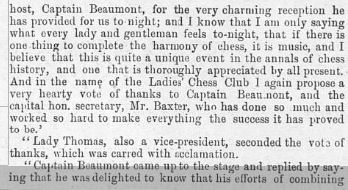
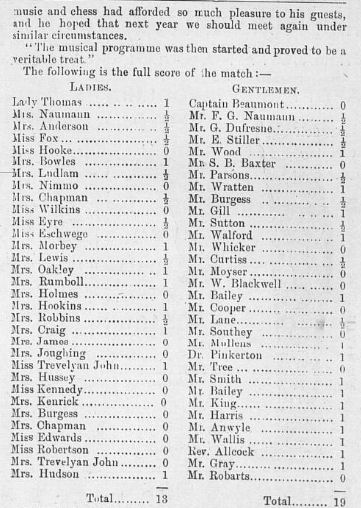
Later that year the Ladies’ Chess Club visited Anerley, near Crystal Palace in South East London, for a combined chess and musical programme.
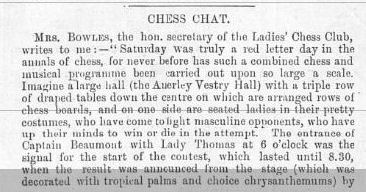
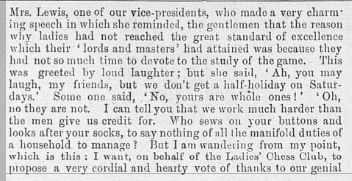
Illustrated Sporting and Dramatic News 03 December 1898

Captain Alexander Beaumont’s name lives on in the Beaumont Cup, which has, since 1895-96, been the name of the second division of the Surrey Chess League. Frank Gustavus Naumann would later become the first President of the British Chess Federation before losing his life on the Lusitania. Mrs Anderson, on Board 3 for the ladies, was the former Gertrude Alison Beatrice Field, who had just married Donald Loveridge Anderson.

In January 1899 their 4th birthday party’s guests included Lasker, Gunsberg, and, appropriately enough, Antony Guest. As the 20th century approached there was no stopping the Ladies’ programme of matches and social events.

At this time we can find Alice in the 1901 census, living at 27 Croxted Road, Herne Hill with her widowed mother Harriett, and working as a clerk in the General Post Office. This was just 2.3 miles up the A2199 from Anerley Village Hall, and close to Dulwich College School.

At Whitsun that year Alice, along with her clubmates Louisa Matilda Fagan, Kate Finn and Rita Fox, took part in the open section of the Kent County Chess Association Tournament. I haven’t been able to find the full results, but Miss Finn did well to finish in second place.

In 1902 she visited Norwich for the British Amateur Championship, playing in the 3rd Class section along with the Misses Foster and Oakley from the Ladies’ Chess Club (and my favourite chess playing clergyman, Rev W E Evill). Miss Finn, Mrs Anderson and a new member of the Ladies’ Chess Club, Mrs Frances Dunn Herring (née Gwilliam) took part in the 2nd Class section.

In 1903 Alice played in the Kent congress in Canterbury, playing in Section A of the ‘Extra’ (2nd Class) section and sharing 2nd place with a score of 4½/7.

The British Chess Championships took place for the first time in 1904, and from the start, the top places in the British Ladies’ Championship were usually taken by members of the Ladies’ Chess Club. Alice Elizabeth Hooke took part for the first time in Shrewsbury in 1906, winning five games and losing six.

In this game against Scotland’s Agnes Margaret Crum, she lost quickly using the Dutch Defence, an opening also favoured by her brother George.

[pgn]

[Event “British CF-03 Women”]
[Site “Shrewsbury/ Shropshire”]
[Date “1906.08.11”]
[Round “6”]
[White “Crum, Agnes Margaret”]
[Black “Hooke, Alice Elizabeth”]
[Result “1-0”]
[ECO “A82”]
[Annotator “Tactical Analysis 5.2 (1s)”]
[PlyCount “51”]
[EventDate “1906.08.06”]
[EventType “tourn”]
[EventRounds “11”]
[EventCountry “ENG”]
[SourceTitle “EXT 2017”]
[Source “ChessBase”]
[SourceDate “2016.10.25”]
[SourceVersion “1”]
[SourceVersionDate “2016.10.25”]
[SourceQuality “1”]

1. d4 f5 2. e4 d6 3. Bd3 {[#]} c6 $146 ({Predecessor:} 3… fxe4 4. Bxe4 Nf6 5.
Bd3 Bg4 6. Nf3 Nbd7 7. h3 Bh5 8. g4 Bf7 9. Nc3 e5 10. dxe5 Nxe5 11. Nxe5 dxe5 {
1/2-1/2 (48) Salvioli,C-Zannoni,F Milan 1881}) 4. Nf3 fxe4 5. Bxe4 Nf6 6. Bd3 {
& White is more active. A82: Dutch Defence: Staunton Gambit.} Bg4 7. Nbd2 Nbd7
8. c4 {0-0 is the strong threat. White is clearly better.} e5 9. Qc2 exd4 10.
O-O Qb6 {Loses the game.} 11. Re1+ Kd8 12. Ng5 {[#] Hoping for Nf7+.} Bh5 {
Prevents Nf7+.} 13. Ne6+ Kc8 14. Ne4 Nxe4 15. Rxe4 c5 16. Bf4 {[#] Against Ne5.
Black must now prevent Ree1.} h6 $2 (16… a5 17. f3 Bg6) 17. a3 $18 Nf6 18.
Ree1 Bf7 19. Bf5 Bxe6 20. Rxe6 ({Weaker is} 20. Bxe6+ Kc7 21. b4 Re8 $16) 20…
Kc7 21. b4 Re8 22. Rae1 Rxe6 23. Rxe6 {Threatens to win with Bh3.} ({Not} 23.
Bxe6 Kb8 $16) 23… cxb4 $2 (23… Kb8 24. Qa4 a6) 24. c5 {White wants to mate
with cxd6+.} Qa6 25. cxd6+ Kd7 26. Re7+ {Sources: Manchester Guardian, 17 Aug
1906; Falkirk Herald, 19 Sept 1906. Miss A E Hooke from London, Miss Crum from
Helensburgh. The FH mentions that she was the daughter of John Crum, veteran
Glasgow player. BMD shows John Crum as b 1842, d 1922, with a daughter Agnes
Margaret Crum, b 10 Mar 1879, d 3 Oct 1961, Edinburgh. (Alan McGowan, Chess
Scotland website). Weighted Error Value: White=0.43/Black=0.97} 1-0

[/pgn]

She was back again in Crystal Palace (she wouldn’t have had far to travel) the following year, with a similar result: four wins, one draw and six losses. She was, at this point, and by now in her mid 40s, some way below the best lady players in the country.

Here she is, pictured in the Daily Mirror, on the left in the lower photograph. Her opponent ‘s name was Agnes Lawson, not Lawrence.
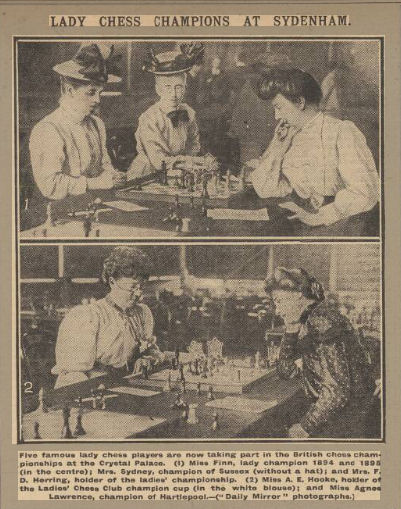
Daily Mirror 14 August 1907

By 1909, Alice had joined a new club, the Imperial Colonial Club, whose chess players seemed mostly to be connected with the Ladies’ Chess Club. There will be a lot more to say about this club in future Minor Pieces.
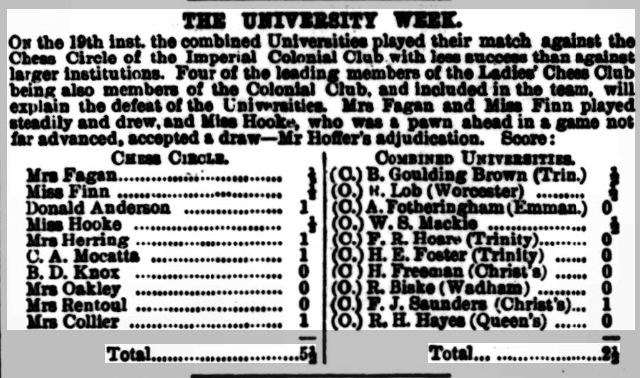
Field 27 March 1909

I’m not sure why boards 7 and 8 were reported as a loss for both players.

In July, the Imperial Review (perhaps connected with the Imperial and Colonial Club) published a feature on Alice Elizabeth Hooke, with the information that she’d won the Ladies’ Chess Club for the third year in succession, thus acquiring the cup in perpetuity (I wonder what happened to it) but had had to relinquish her post as secretary for health reasons. We also have a rather fine photograph.
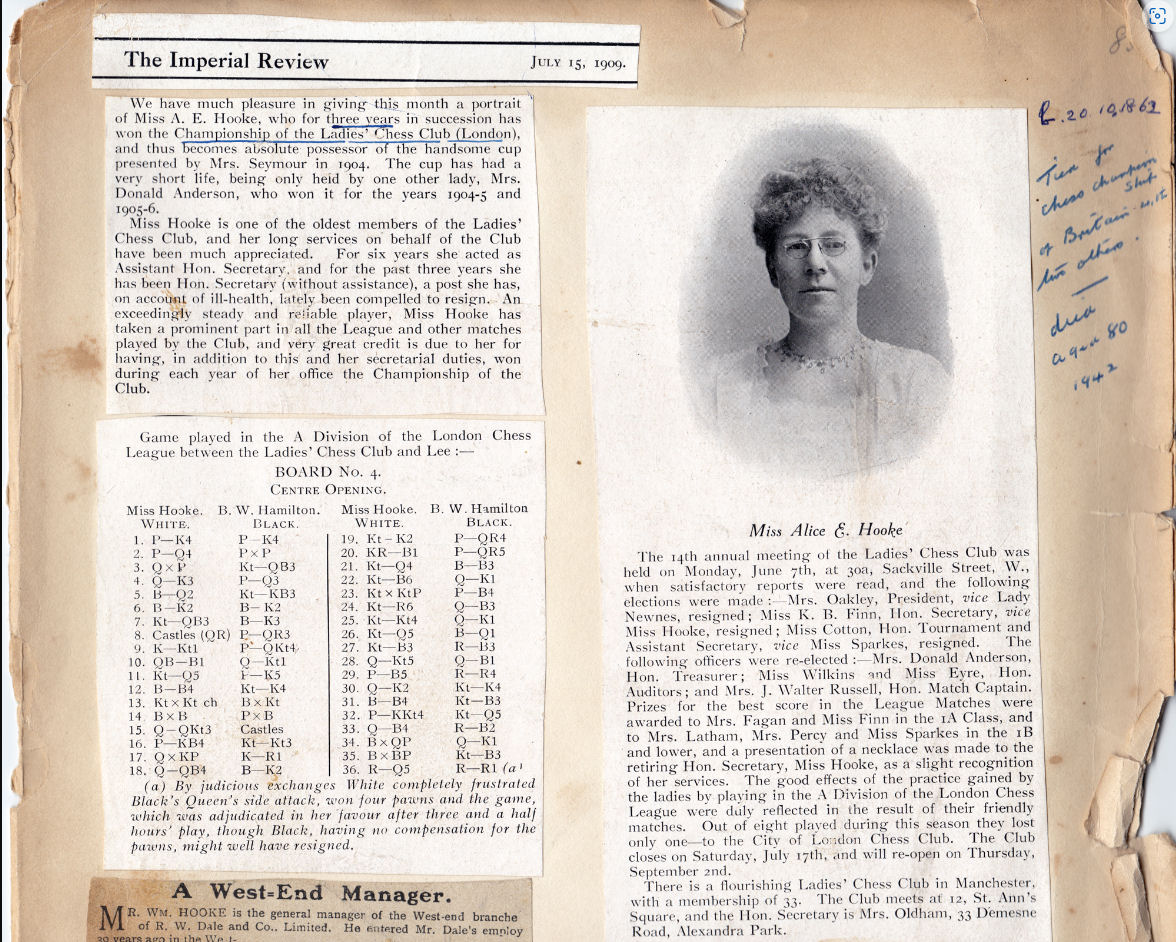
From the Hooke Family Archives

Here’s the game for you to play through: you’ll notice the opening variation is the same as that from Alice’s game against Miss Eschwege from 12 years earlier.

[pgn]

[Event “Ladies’ Chess Club v Lee B4”]
[Site “?”]
[Date “1909.??.??”]
[Round “?”]
[White “Hooke, Alice Elizabeth”]
[Black “Hamilton, Benjamin William”]
[Result “1-0”]
[ECO “C22”]
[Annotator “Tactical Analysis 5.2 (1s)”]
[PlyCount “72”]
[EventDate “1928.07.02”]
[SourceVersionDate “2022.09.29”]

1. e4 e5 2. d4 exd4 3. Qxd4 Nc6 4. Qe3 d6 5. Bd2 Nf6 6. Be2 {C22: Centre Game.}
Be7 (6… g6 $5) 7. Nc3 {[#]} Be6 $146 ({Predecessor:} 7… Bg4 8. Bxg4 Nxg4 9.
Qg3 Qd7 10. h3 Nb4 11. O-O-O Ne5 12. Bf4 Bf6 13. Nf3 O-O-O 14. Nxe5 Bxe5 15.
Bxe5 {1-0 (15) Hooke,A-Eschwege London (Hotel Cecil) 1897}) 8. O-O-O {Hoping
for Be1. White is slightly better.} a6 {White now steadily converts the win.}
9. Kb1 b5 10. Bc1 Qb8 11. Nd5 b4 12. Bc4 {Black must now prevent Nf3.} Ne5 13.
Nxf6+ Bxf6 14. Bxe6 fxe6 15. Qb3 O-O 16. f4 Ng6 17. Qxe6+ Kh8 18. Qc4 Be7 19.
Ne2 {[#] aiming for h4!} a5 $2 (19… Qb5 20. Qxb5 axb5) 20. Rhf1 (20. h4 $142
Rg8 21. h5) 20… a4 21. Nd4 Bf6 22. Nc6 Qe8 (22… Qb7 23. Nxb4 c5) 23. Nxb4
$18 c5 24. Na6 (24. Nd5 $142 a3 25. b3) 24… Qc6 25. Nb4 Qe8 (25… Qb7 26.
Nd3 Rae8) 26. Nd5 {White is clearly winning.} Bd8 27. Nc3 Rf6 28. Qb5 Qf8 29.
f5 Ra5 30. Qe2 Ne5 31. Bf4 Nc6 32. g4 Nd4 33. Qc4 Rf7 {[#]} 34. Bxd6 $1 Qe8 (
34… Be7 35. Bc7) 35. Bxc5 Nc6 36. Rd5 Ra8 {Weighted Error Value: White=0.63/
Black=0.99 Source: Imperial Review July 15 1909} 1-0

[/pgn]

Although the Ladies’ Chess Club was still growing, its activities were receiving less publicity in the press. Perhaps the novelty had worn off. It seems that Alice Hooke was less active at this time, perhaps partly because of ill health, and partly because she was having to care for her increasingly frail elderly mother.

By the 1911 census Harriett and Alice had moved to 12 Eatonville Road, Upper Tooting, just a 12 minute walk from Alice’s brother George’s rather more substantial house in Drakefield Road. Alice was now described as a Clerk in the Civil Service.

Harriett died in December 1912, but it wouldn’t be until 1914 that Alice resumed her chess career.

The British Championships took place in Chester that year, and Alice Elizabeth Hooke was back in the Ladies’ Championship, but without much success, winning four games and losing seven.

One game is available, but it doesn’t show her in a good light. She seemed unfamiliar with her opponent’s sharp opening variation, and, after only six moves, had a very bad position. Mrs Holloway was able to offer a bishop sacrifice for a swift victory.

[pgn]

[Event “British CF-11 Women”]
[Site “Chester/ Cheshire”]
[Date “1914.08.15”]
[Round “6”]
[White “Holloway, Edith Martha”]
[Black “Hooke, Alice Elizabeth”]
[Result “1-0”]
[ECO “C56”]
[Annotator “Tactical Analysis 5.2 (1s)”]
[PlyCount “35”]
[EventDate “1914.08.10”]
[EventType “tourn”]
[EventRounds “11”]
[EventCountry “GBR”]
[SourceTitle “EXT 2017”]
[Source “ChessBase”]
[SourceDate “2016.10.25”]
[SourceVersion “1”]
[SourceVersionDate “2016.10.25”]
[SourceQuality “1”]

1. e4 e5 2. Nf3 Nc6 3. Bc4 Bc5 4. O-O Nf6 5. d4 exd4 6. e5 {[#]} Ng8 {[#] C56:
Two Knights: 4 d4 exd4 5 0-0 Nxe4.} (6… d5 $1 $11) 7. Re1 $146 {Black must
now prevent Ng5.} ({Worse is} 7. Bg5 Nge7 $11) ({Predecessor:} 7. Ng5 Nxe5 8.
Re1 d6 9. Nxf7 Qh4 10. Nxe5 dxe5 11. Rxe5+ Be7 12. Bxg8 Rxg8 13. Bg5 Bg4 14.
Rxe7+ Kf8 15. Qd2 {1-0 (15) De Con,J-C Brooklyn 1868}) 7… Nge7 $2 {[#]} (7…
Kf8 8. Ng5 Nh6) 8. Ng5 $1 $18 O-O {White is clearly winning.} 9. Qh5 h6 10.
Nxf7 Rxf7 11. Qxf7+ Kh8 12. Re4 {Threatening mate with Bxh6!} Nf5 13. Nd2 Nce7
14. Rg4 d6 15. Nf3 {Strongly threatening Bxh6!} Bd7 {[#]} 16. Bxh6 $1 Qf8 {[#]}
(16… Qg8 17. Bxg7+) 17. Bxg7+ $1 Nxg7 (17… Qxg7 18. Rxg7) 18. Rh4+ {
Source: 1914 BCF Yearbook. White took control after the opening. Weighted
Error Value: White=0.32/Black=1.91} 1-0

[/pgn]

By now she had moved out of London, to Cobham, near Esher in Surrey. Electoral rolls give her address as White Lodge, Cobham. There are two houses of that name in Cobham, about a mile apart. I’d guess it was more likely to be this one than this one. As it was just her and a servant, the smaller and more centrally located property would have been more than adequate. Neither was close to the station, so I wonder how she travelled to work. Jumping ahead for the moment, she was still there in 1921, working as a civil servant in the Post Office Savings Bank in West Kensington.

But then, of course, World War 1 broke out, and, like many others, the Ladies’ Chess Club decided to close its doors for the duration.

As you probably already know from her brother George’s story, this was not the end of Alice Elizabeth Hooke’s chess career. You’ll find out what happened subsequently in the next Minor Piece.

But meanwhile, if you’re interested, there’s a lot more reading material for you.

There’s a lot of information about the Ladies’ Chess Club and the 1897 tournament available in various online sources.

The excellent Batgirl (Sarah Beth Cohen) has written a number of articles on the Ladies’ Chess Club on chess.com.

The Ladies’ Chess Club: The First Year

The Ladies’ Chess Club: Early Years

The Ladies’ Chess Club: Middle Years

Rhoda Bowles: Part 1

Rhoda Bowles: Part 2

Louisa Matilda Fagan

The 1897 Ladies’ Tournament

An article by Rhoda Bowles

See here for a full list of her articles on women’s chess.


My good friend Martin Smith has written a wonderful series of articles about Louisa Matilda Fagan. You can read the first of the series here: there are links to the subsequent articles at the end.


There’s a well-researched article by Joost van Winsen concerning the 1897 Ladies’ Chess Tournament on the Chess Archaeology website here.

Another informative article on the same event by Tim Harding can be found on the Chess Café website here.


Sources and acknowledgements:

ancestry.co.uk

findmypast.co.uk

chessgames.com: Alice’s page here.

Britbase (John Saunders): British Championship links here.

EdoChess (Rod Edwards): Alice’s page here.

chess.com

Justin Horton’s blog (no longer active)

Chess Archaeology

Google Maps

Hooke Family History

ChessBase/MegaBase 2022/Stockfish 15