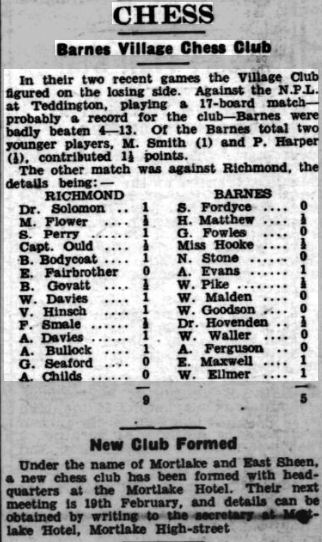
You might remember this from the last Minor Piece. This is a match between Richmond and Barnes Village from 1948. You saw Beatrix Hooke on Board 4 for Barnes, and this time I want to introduce you to Richmond’s Board 5: B Bodycoat.
Way back in 1967, 55 years ago, I won my first chess trophy: the BC Bodycoat Cup. This was the second division of the Richmond & Twickenham Chess Club Championship, for weaker and less experienced players, and continued until sometime in the mid 1970s.
I can’t see that I deserved to win. I played five games, four against weaker opponents, winning two and drawing three. My only strong opponent was Ken Norman, then, as now, a better player than me. It looks from my scorebook as if I won a couple of games by default, one of which may have been against Keith Southan, who’ll be introduced later.
This game wasn’t very distinguished. I won a pawn in the opening, and, instead of capturing another pawn I chickened out by trading queens into a level ending. I then made a horrendous blunder which should have lost a piece, but fortunately for me Ken didn’t notice. Click on any move in any game in this article for a pop-up window.
I had no idea who BC Bodycoat was. Was he Benjamin or Bernard? Brian or Barry? Bertram or Basil? Once I started getting interested in genealogical research I determined to find out. I could never have imagined what a strange story it would turn out to be. Strange in more ways than one.
In fact Mr Bodycoat, during a sadly short life, used three or four different first names and two different surnames. I’ve been waiting some years to tell his story, and the online appearance of the Richmond Herald up to 1950 gives me the opportunity.
It has nothing at all to do with chess, though, so please bear with me as we embark on a journey that will take us around the world.
Our story starts, for want of a better time and place, in the Leicestershire village of Tur Langton in the year 1844.
A few miles north of the town of Market Harborough you’ll find a group of villages collective known as the Langtons. Tur Langton is the furthest north. A mile to the south is Church Langton, and, just a bit further down the road are its associated hamlets, West Langton and East Langton. You’ll then find Thorpe Langton a mile or so to the east of East Langton.
We’re going to meet William Bodycoat and his family. William, like most villagers at the time, was an illiterate agricultural labourer. Born in 1811, he married Elizabeth Gibbins in 1833. They had two sons, Thomas and Joseph. Elizabeth died in 1840, and on Christmas Day 1841 William married her sister Mary, taking on her illegitimate daughter Charlotte.
In 1844 they made a decision that would change their lives (and perhaps my life as well). They emigrated to Australia on an assisted immigration scheme, along with Mary’s sister Lucy, her husband William Bamford, and their children.
Here they are, on board a ship named the Abberton.

They may not have been the first of their family to emigrate to Australia. In 1830, Thomas Bodycoat, who, I suspect, was William’s brother, was transported there for stealing a rabbit, receiving his freedom in 1849. I haven’t yet been able to find out what happened to him.
William Bodycoat and his family, in spite of their humble origins, did very well for themselves. They settled first in Collingwood, Melbourne, before moving out to Wollert (it means, delightfully, ‘where possums abound’). You’ll find Bodycoats Road there today.
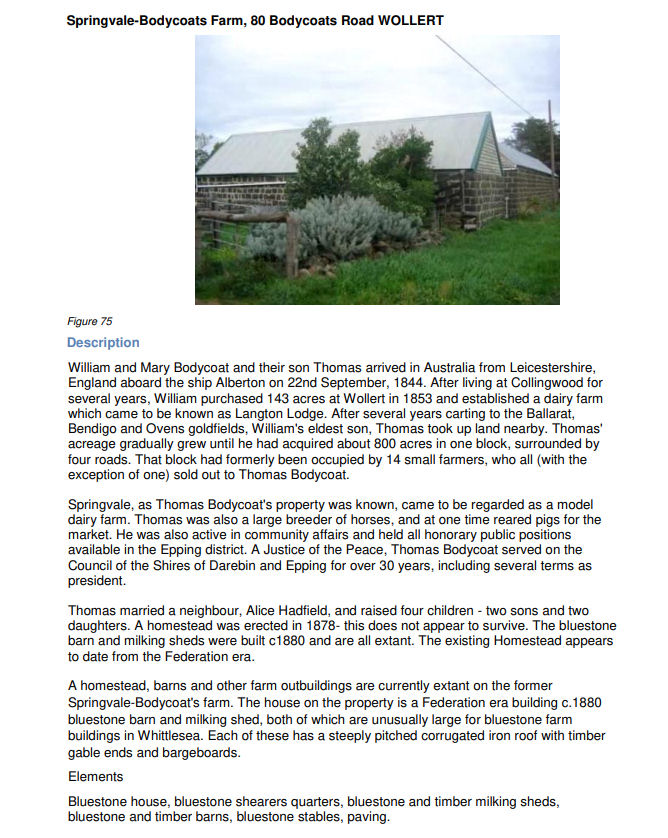
When you’re researching family history you often come across stories like this of families who prospered in Australasia or North America. On the one hand, you admire their courage and hard work, and how emigration enabled them to achieve success they could never have dreamt of back at home. On the other hand, you realise that this happened at the expense of the indigenous populations of those continents.
William lived on until 1892, and, 40 years after his death, a local paper published some family reminiscences, which are not necessarily accurate.
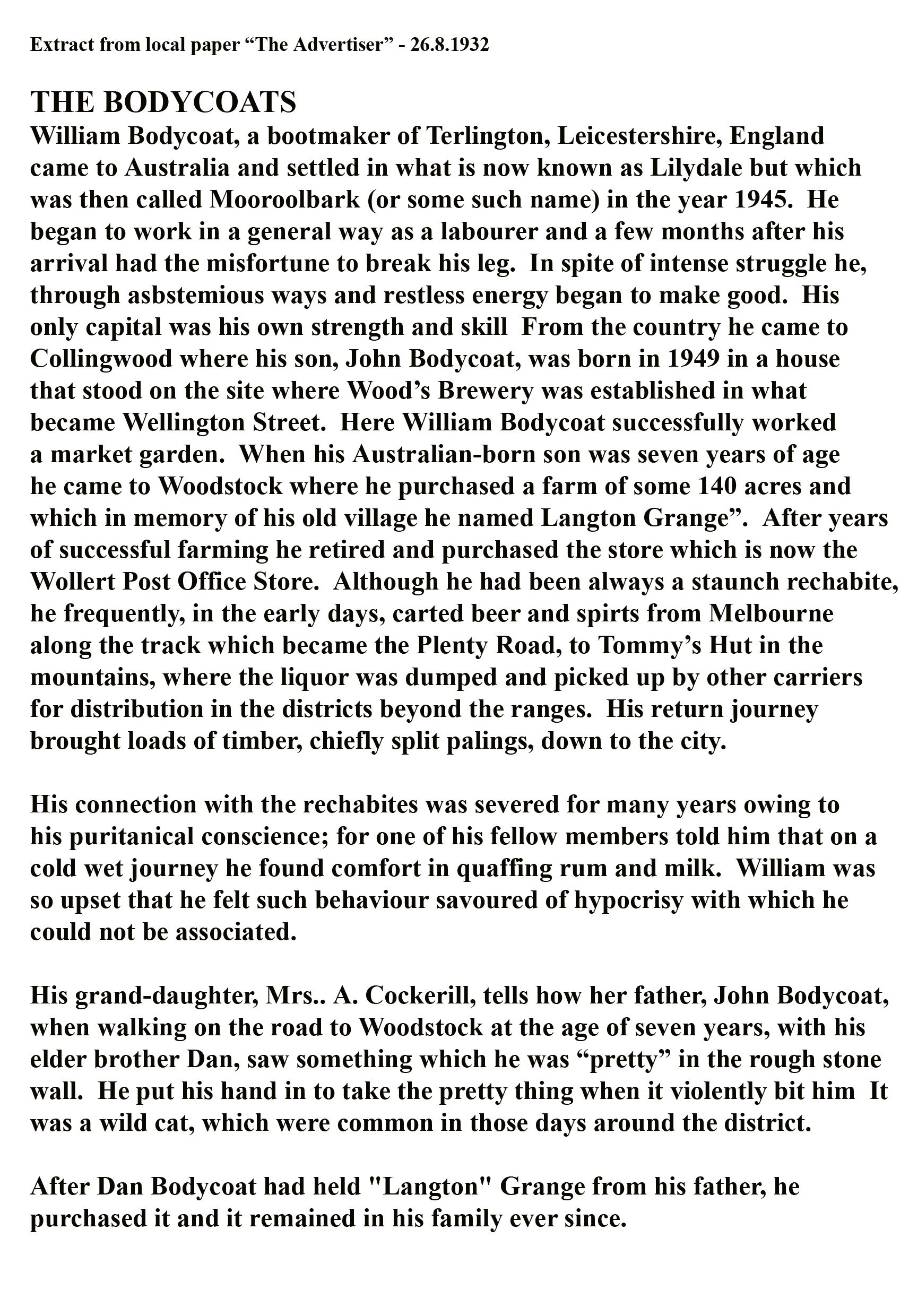
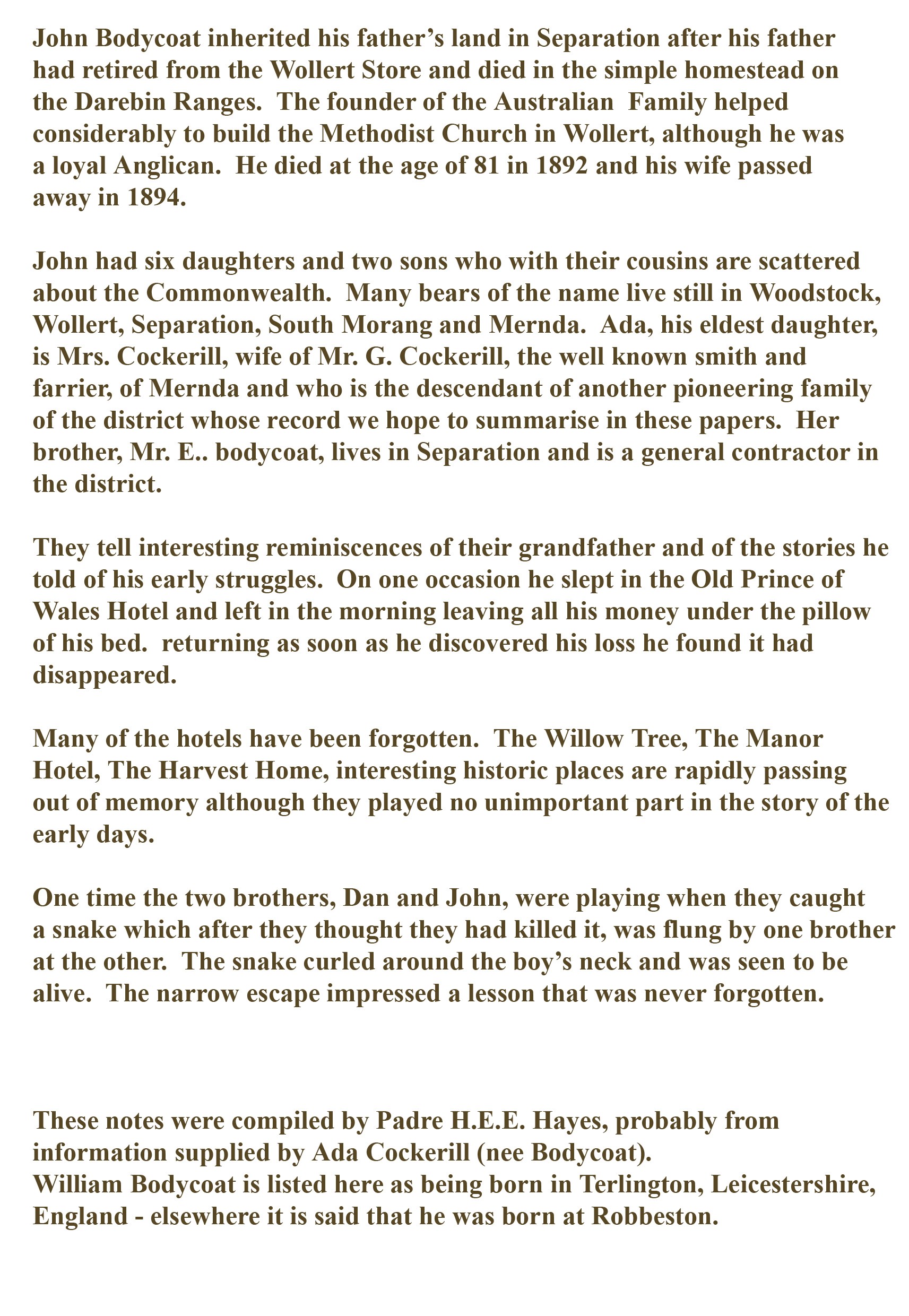
And here he is, a fine looking fellow he was as well.
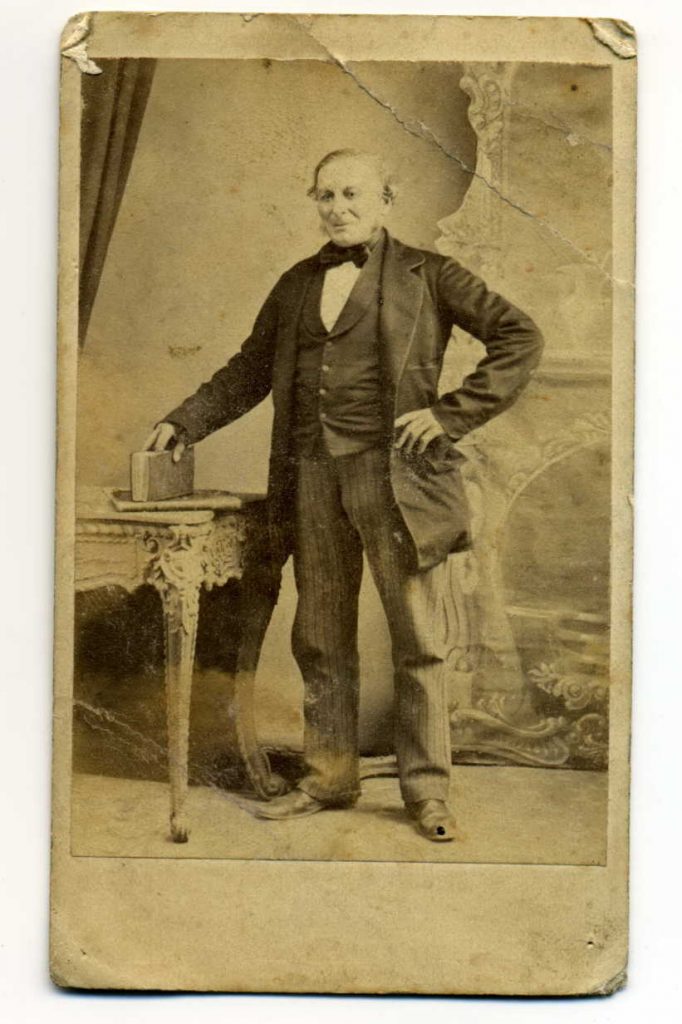
However, it’s William’s youngest son, Walter, known to the family as Walt, born in 1858, to whom we must now turn our attention.
In 1851 gold was discovered in Victoria, and mines were established in places like Ballarat and Bendigo. A gold rush ensued. Melbourne and the surrounding areas became extremely prosperous as a result. You saw above that Thomas was working as a carter to the goldfields for a time. Perhaps his brother Walter was also involved.
In 1893, three Irish prospectors discovered gold in Kalgoorlie, Western Australia. There were fortunes to be made there as well. Perhaps this was the reason why, in 1897, Walter and his family made the trek to the other side of the continent.
He might possibly have settled in Perth at first, where his younger children were born, but later moved to Kalgoorlie, working there as a labourer.
You can read more about Walt here.
Walt’s eldest son, born in 1886 shared his name, but was known as Wally. He must have been a bright boy, as he studied at the School of Mines in Kalgoorlie in 1909, training as a gold assayer, testing minerals to determine the amount of gold in them.
He led an adventurous life, travelling to Uruguay before settling in London, where, I suppose, he must have been working for some sort of mining company. This involved a trip to Peru, and then four trips to West Africa, Ghana (it was the Gold Coast then), Cameroon and, in 1913, two more visits to Ghana. These must have been exciting times for young Wally, but he wanted something else in his life. While in London he formed a relationship with a young widow named Ada Eliza Strange (née Hawkins), and, in the short gap between his two 1913 stints in Ghana, a son was conceived.
Ada had a daughter, Lucy Gertrude (usually known by her middle name) from her marriage to William John Strange, whose death had been registered in the 4th quarter of 1912. Gertrude seems to have been what would then have been called a showgirl, and had what might best be described as a very colourful life. If you’d like to find out more, as I’m sure you do, you should read this paper from the Epsom & Ewell History Explorer.
Anyway, moving very swiftly on, Walter and Ada’s son’s birth was registered in Paddington in the 3rd quarter of 1914. He was given the names Walter Charles Bodycoat Strange. Named, you will see, after both his father and grandfather.
This, then, was our man, after whom the Bodycoat Cup was named. But where did the B come from?
The relationship between Wally and Ada didn’t last. Wally returned England on 23 July 1914, perhaps in time to witness the birth of his son, and sailed back to Australia on 12 February the following year. In 1916 he joined the Australian Imperial Force and returned to England, serving in France, where he was wounded in action and awarded the Military Medal.
He was discharged in 1919 and returned to mining, again travelling backwards and forwards to Ghana. In 1920 he married Katie Burt, from Cornwall (perhaps he’d also been involved in mining there) and they eventually returned to Australia, where he bought a farm they named Trevose after a Cornish headland, where they brought up their children Kenneth, Gordon and Barbara. You can read a lot more about Wally (with links to Katie and Ken) here.
The Bodycoats were a sporting family, playing cricket, tennis and golf, but I can’t find any mention of them playing chess. Judging from online family trees, Wally’s children may not have been aware of his guilty secret. They probably are now.
While we’re discussing Cornwall it’s time for another game, this time against Cornwall born Fred Daymond, captain of Richmond & Twickenham’s London League 2nd team for many years. He soon lost a lot of material here.
Now we need to continue the story of the third Walter Bodycoat.
At present I haven’t been able to find him, his mother or his half-sister in the 1921 census. Nothing under Bodycoat and also nothing obvious under Strange.
He only reappeared, or rather disappeared, in 1930, where he made the local and national papers.
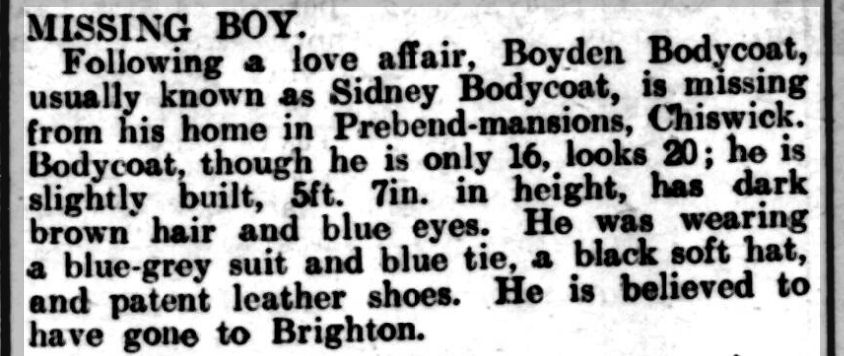
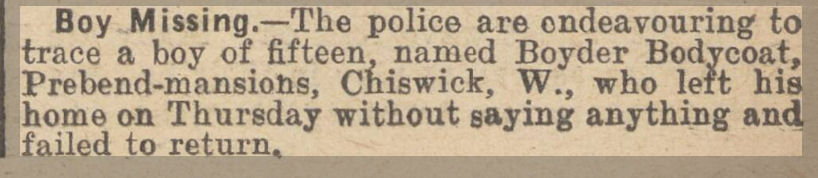
Walter? Boyder? Boyden? Sidney? Aged 15 or 16? Who knows? By this time he was using his father’s surname rather than his mother’s surname. Had they fallen out? Perhaps he didn’t want to be thought of as strange.
Boyder is not otherwise known as a name, and Boyden is very rare. Boyd, yes, but not Boyder and hardly ever Boyden. I suppose Boyder might have been a contraction of ‘Boy Walter’ to distinguish him from his father Wally and grandfather Walt. I’d speculate that he preferred to be known as Boyder, and appearances of ‘Boyden’ were due to misreading someone’s handwriting.
Prebend Mansions is a block of mansion flats on Chiswick High Road, near Stamford Brook Station. If you walk in an easterly direction, you’ll eventually reach Hammersmith Broadway, and then Olympia, a part of the world very familiar to the Hooke family.
I presume he returned home at some point: at least nothing else appeared in the press. Sadly, six months later, his mother died, leaving him alone, his father in Australia and his sister in a rather dodgy relationship.
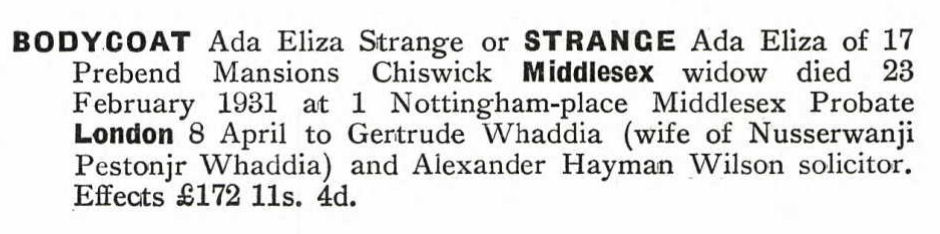
Although Ada and Wally only had a brief affair and never married, she sometimes used his surname. The 1930 electoral roll lists no one at 17 Prebend Mansions: seemingly she hadn’t registered to vote. That’s her daughter who was granted probate.
Nottingham Place is in London’s medical district, not far from Harley Street (and also not far from 44 Baker Street), and was used by members of the London School of Medicine for Women. I presume number 1, Treborough House on the corner of Paddington Street, was a private clinic at the time: it’s now converted into very expensive flats.
Young Boyder (or whatever) was clearly a ladies’ man, and it was in 1937 that he married Hilda Lilian Simmonds in Finsbury. Hilda wasn’t from Brighton, but from Mile End. Her father was a Russian Jew who had anglicised his name and seemingly converted to the Church of England. The marriage was recorded twice, with his name as Walter CB Strange and Walter C Bodycoat. A daughter, Diane Bodycoat, was born a year later.
Here are the happy (at the time) couple.
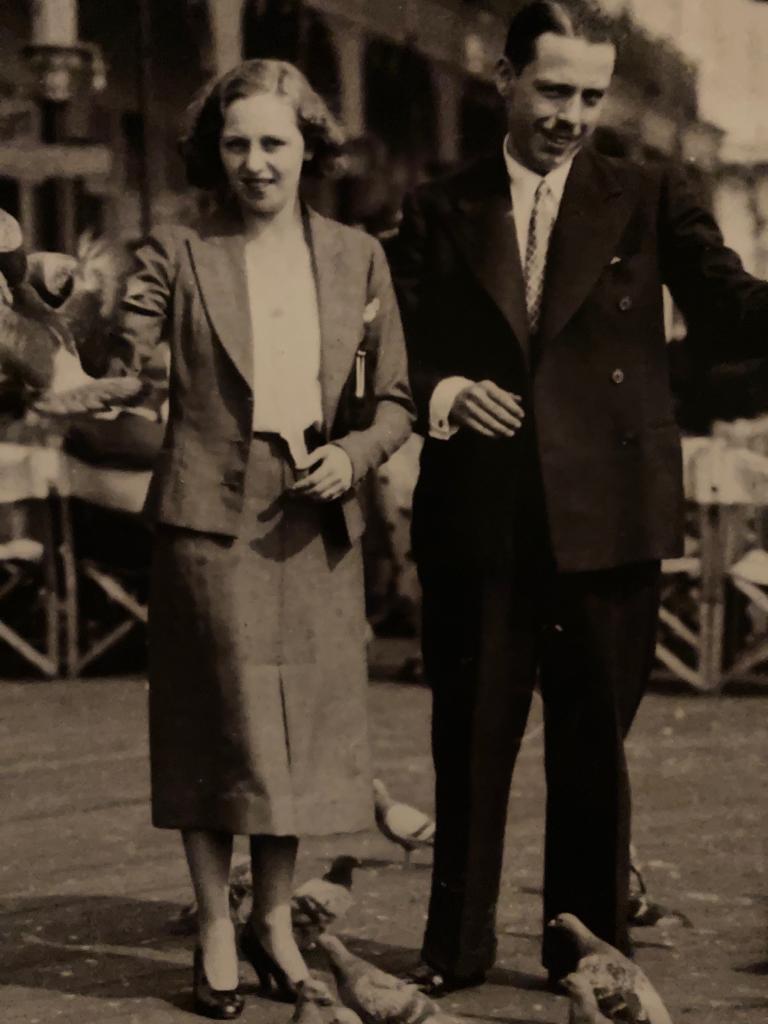
It looks like the marriage didn’t last long. The 1939 Register found Hilda and Diane in St Albans, while Boyder was nowhere to be seen. It’s possible their marriage had already broken up, but it’s also possible his wife and daughter had moved to St Albans to avoid possible future aerial attacks on London. My mother moved from Teddington to nearby Harpenden for that reason.
Hilda and Diane later moved to Cornwall, while, in 1944, Boyder married again, to Bernice Gloria Holmes. This marriage was registered in Surrey North-East, which would have been Richmond or thereabouts. This time he was only Walter C Bodycoat.
I’ve no idea where and when he learnt to play chess. Very often sons learn from their fathers, but this wouldn’t have been the case for Boyder. Anyway, when Richmond Chess Club reopened its doors in 1947 after a break for the war, he would have been one of its first members. As he often played on a fairly high board he must have been a decent club standard player.
His first appearance, though, wasn’t so successful. Playing against a weaker Barnes Village team he lost his game on Board 9.
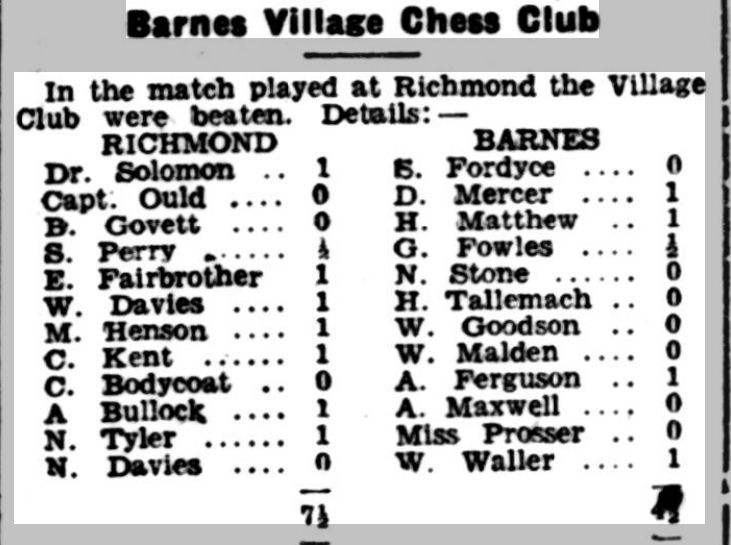
He wasn’t the only player with an incorrect initial. On Board 11, defeating girl champion Phyllis Prosser, would have been Harold Augustus Tyler. The first time my father took me to Richmond & Twickenham Chess Club, Harold was the first person we saw. My father knew him from work but didn’t realise he was a chess player.
Here’s our Bodycoat Cup game. Harold didn’t put up much resistance, losing a lot of material in the opening.
Boyder must have been really keen as he also joined the new Shene (or Sheen if you prefer) Chess Club, but he was again unsuccessful in this match.
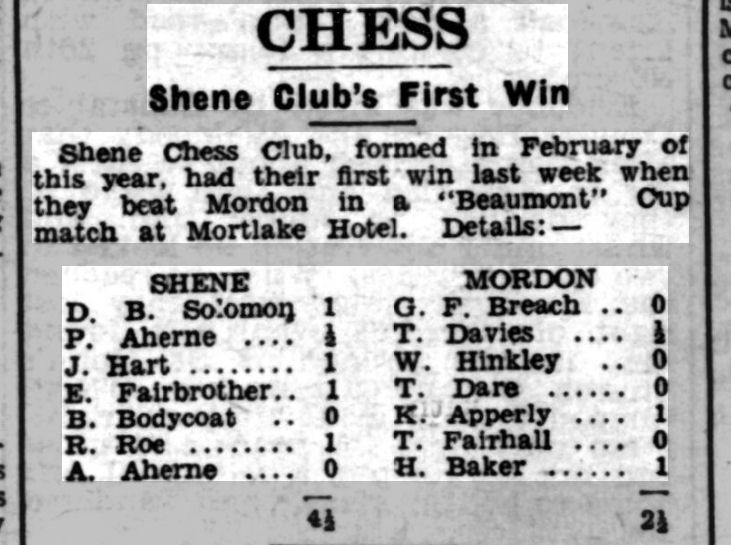
At least he was granted his preferred initial on this occasion, unlike Dr John David Solomon on top board. There was a considerable overlap in membership between Richmond and Shene, and the former subsumed the latter a few years later.
The following month the two clubs met, with Boyder playing for Richmond and winning his game.
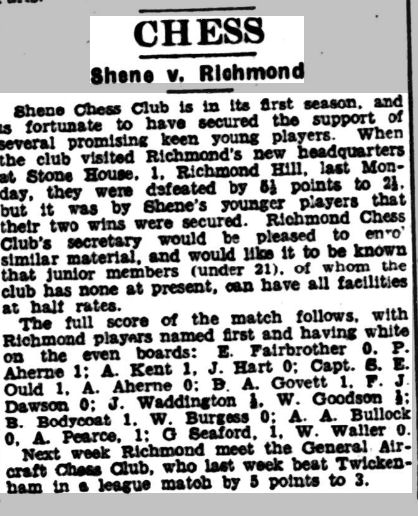
It’s interesting to note that Shene, unlike Richmond was attracting younger players at the time. By the 1960s there would be a lot of teenagers in what was by then Richmond & Twickenham Chess Club.
In February he scored another win in a Thames Valley League match against Staines.
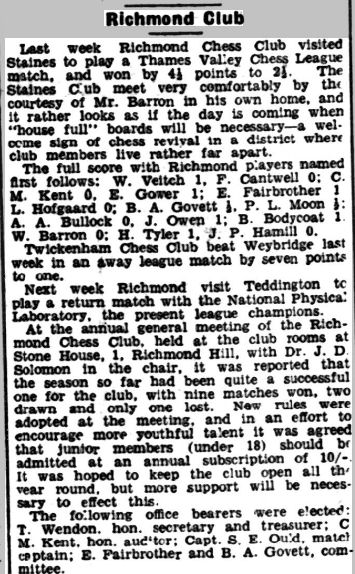
Richmond had Walter Veitch (about whom more, perhaps, another time) on top board for this match. He and JD Solomon were two of the strongest London amateurs in the late 1940s. It’s interesting to note that this was a 7-board match. Harold Tyler was this time allotted his correct initial. His opponent, John Hamill, would, some 30 years later, run a chess club at Richmond Community Centre. Percy Moon, the Staines board 4, played twice against me in 1968 and 1972. All this, again, even though I was yet to be born, is my history as well as Boyder Bodycoat’s history.
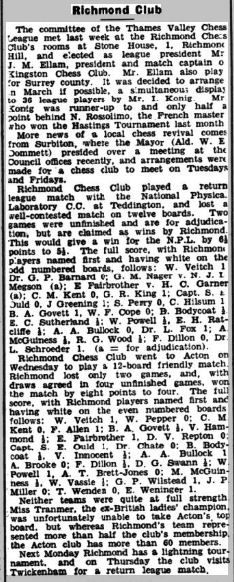
There were two draws for him in these two matches, one against another of my future opponents, Edwin Sutherland, plus news of the foundation of Surbiton Chess Club and a forthcoming simul.
I played Edwin Sutherland on 20 December 1966, and it was on 15 June 1967 that I played my first Bodycoat Cup game. It resulted in a draw, but I had a winning advantage at various times. Curiously, all three of my black games in this competition featured the same opening variation.
March 1949 witnessed two local derbies, with Shene playing Barnes Village and Richmond playing Twickenham.
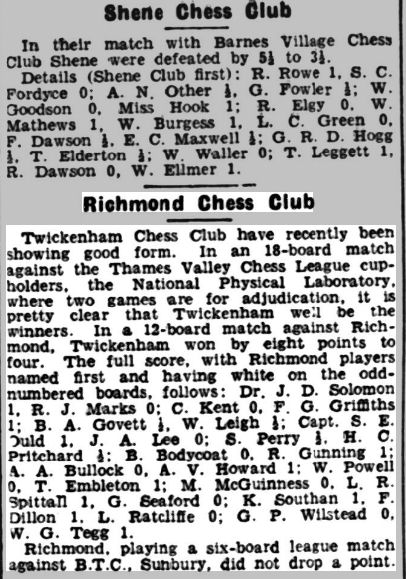
More names from my past: George Hogg moved from Barnes Village to Richmond in the 1960s, while John (Jock) Lee and Keith Southan, both in the Twickenham team here, would play for Richmond & Twickenham into the 1970s. Keith was a classics master at Tiffin School, and would often give me lifts to away matches when I first joined the club.
The promised simul duly took place, and Boyder managed to draw his game, also scoring a draw against Barnes Village.
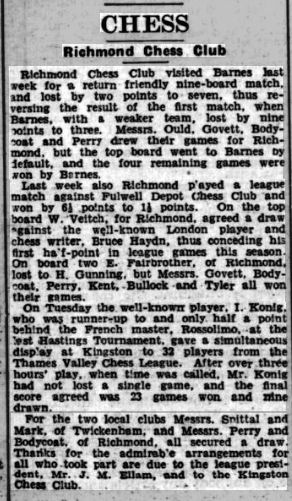
At this point it seems that Barnes were stronger than Richmond, but the roles would soon be reversed.
Chess was very popular amongst the London Bus community (they even had their own magazine for some years), and, in days when works chess teams were very common, it wasn’t surprising to see Fulwell (Bus) Depot in the Thames Valley League, with prominent chess author Bruce Hayden (not Haydn: he was a composer) on top board.
By the autumn of 1949 it was time for another season to start, and here Twickenham and Richmond were in friendly opposition. In the absence of some of the big names, Boyder Bodycoat found himself on top board.
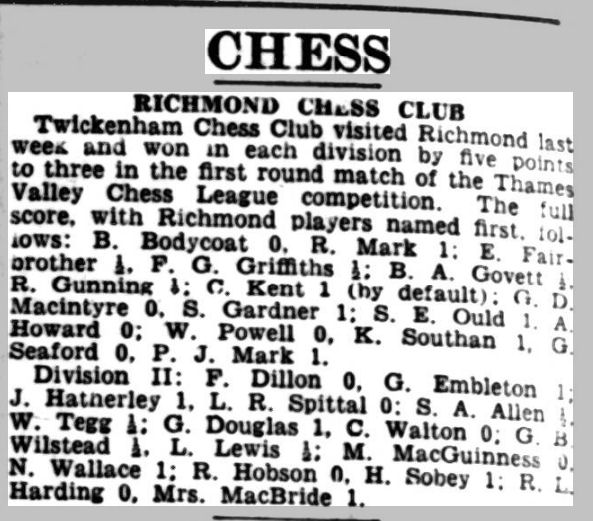
I never met Robert Mark, who must have left Richmond & Twickenham at about the time I joined, but I seem to recall that he was still the club auditor. On the other hand, I did know Ted Fairbrother, Keith Southan, George Seaford and, vaguely, FG (Griff) Griffiths.
In 1950 Richmond and Shene shared the points, but unfortunately what would have been an interesting top board encounter between Veitch and Solomon didn’t materialise
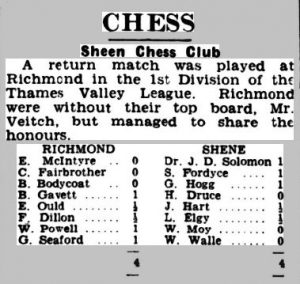
This suggests, though, that, after a shaky start to his chess career, Boyder Bodycoat, now in his mid 30s, was a decent club standard player, I’d guess around 1800 in new money or 150 in old money. He could hope to make further progress with more experience.
But the world was changing. The Richmond Herald was less consistent in reporting chess results. And, in July that year, Howard and Betty James welcomed their first son into the world.
As he was about to enjoy his first Christmas there was some more news.
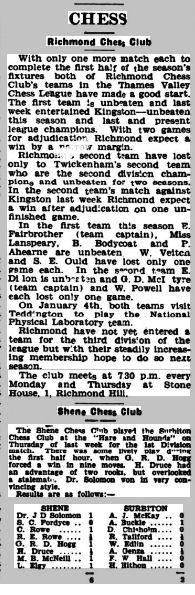
We see that Mr Bodycoat was unbeaten playing for the first team, as was the otherwise unknown Miss Lanspeary (she, like all of us, had her story: you’ll meet her next time).
Surbiton, losing here to Shene, were still getting going, but at least two of their players had long careers at the club. I beat Donald Chisholm in 1973 and drew with Russell Tailford in 1980.
It’s good to see Richmond with female representation in their first team. For many years our most prominent lady player was Hella Kaufmann, who translated Leonard Barden’s book on the Ruy Lopez into German. Hella lived in Barnes, and had also been a member of Barnes Village: I guess she joined shortly after 1950.
Here’s our Bodycoat Cup game from 1967. Her translation work for Leonard must have been the reason for choosing the Marshall Gambit here. If I’d been aware of this I’d no doubt have chosen a different opening. As it was I held onto the pawn but lost it back by playing too passively, ending up in a level ending.
In Spring 1951 Boyder and Gloria decided to take a holiday in Bermuda. They sailed from London on 14 April on the Loch Garth, a ship of the Royal Mail Lines which also had some cabin space, arriving back in Plymouth travelling third class on the Reina del Pacifico, a ship belonging to the Pacific Steam Navigation Company, on 15 June. Their address was given as 3 Sheen Court, Richmond, and they were both hairdressers (as was, I seem to remember, Boyder’s clubmate George Seaford: there may be some connection there). Sheen Court is a prominent block of mansion flats on the Lower Richmond Road near North Sheen Station.
Former Prime Minister Ramsay MacDonald had died on board the Reina del Pacifico in 1937, and Boyder very nearly joined him. They probably travelled back from Plymouth to Richmond by train, and, back at home the very next day, he sadly died at the age of only 36.
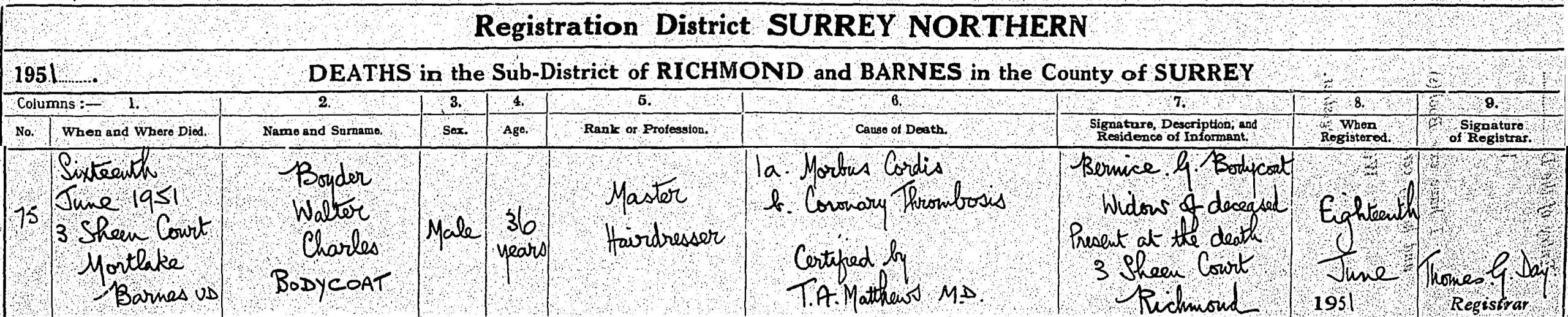
The cause of death is given as Morbus Cordis & Coronary Thrombosis: heart disease, specifically a blood clot leading to a heart attack.
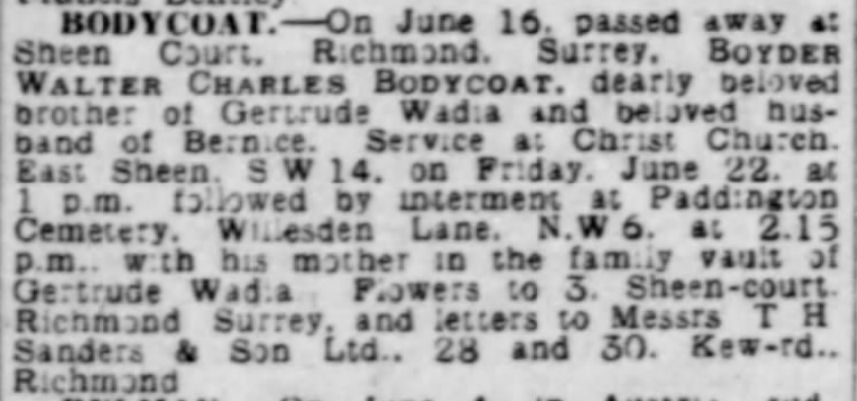
The death notice in the Daily Telegraph mentions his wife and sister, but not his first wife or their daughter.

The probate record tells is he left almost £700, a small amount of which would have gone, either directly or indirectly. to Richmond Chess Club. They decided to commemorate their member by purchasing a trophy in his name: the trophy I would win in 1967.
Bernice wasted little time in remarrying: her second husband was a Greek Cypriot communist and freedom fighter named Michael Economides. You can find out more about him, and again I’d advise you to do so, here. Yet another colourful character in a story full of them.
To return to my story, my father, Howard James, had been born in Leicester in 1919, but his grandfather, John James, had been born in 1841 in Thorpe Langton, just a mile and a half or so across the fields from Tur Langton, from where, three years later, William Bodycoat would emigrate to Australia. His family were all from various villages in the area and I’ve managed to put together a family tree with a possible link between the two families.
It’s another golden chain. The ancestors of the man whose trophy I won would have been tilling the same fields, drinking in the same pubs (perhaps not in William’s case as he was a Rechabite) and worshipping in the same churches as my ancestors back in the 18th and 19th centuries. The story that links our lives takes us round the world to Australia and back again, visiting South America and Africa along the way. We’re all connected, and chess is the wonderful game that brings some of us together.
The Bodycoat Cup continued to take place until round about the late 1970s: by that time, with so many opportunities for league and tournament chess, there was less appetite for internal competitions in most chess clubs in the London area.
There’s one more Bodycoat Cup game in my files.
In this appropriately strange game Mike Fox lost in only 14 moves by doing exactly what he told Richmond Junior Club members not to do every Saturday morning: bringing out his queen too soon and going pawn hunting.
I’ve no idea what happened to the trophy, or indeed the club championship trophy. If you have information, do please get in touch.
Thanks to Walter/Boyder/Boyden/Sidney for being, posthumously an influence on my chess career. Thanks to Wally and Ada for having an affair. Thanks to Walt for deciding to move to Western Australia. Thanks to William and his family for emigrating to Melbourne.
And thanks to you for reading this. You, too, are part of that golden chain.
Acknowledgements:
ancestry.co.uk
findmypast.co.uk
British Newspaper Library
academia.edu
Carnamah Historical Society & Museum
Epsom & Ewell History Explorer
Ships Nostalgia
Wikipedia
Google Maps
FIDE ratings