Richmond Junior Chess Club 1975-2006: Part 3

By 1986 I’d developed some strong views about education and how they related to chess.

Something else happened as well. I was sitting in my London office one Feburary day wondering how I was ever going to be able to leave a job with no prospects of promotion or doing anything else when the phone rang.

It was my old friend Mike Fox, calling from Birmingham. “This phone call will change your life”, he said. And it did.

He’d been commissioned by Faber & Faber to write a book about chess trivia and invited me to join him as co-author. This would become The Complete Chess Addict (1987) and later The Even More Complete Chess Addict (1993), as well as the Addicts’ Corner column in CHESS which ran for 14 years. I decided that I could make as much money in less time by working freelance, while having time to help Mike with researching and writing the book and having more time to develop RJCC.

In order to improve Richmond Junior Club the first thing I wanted was to be able to find out everything I could about how every member of the club played chess, so that I could provide individual advice to all children and parents.

My view also was that, when teaching younger children and, more generally, less experienced players, everything we did had to happen for a very specific reason. I didn’t want to provide random lessons demonstrating random brilliant games to a random collection of children. Nor did I want to push children into doing too much too soon: using clocks and scoresheets and taking part in external tournaments before they were ready.

What I did (some of this was explained last time) was this:

  • I split the club into two sections: a morning group lasting two hours for primary school children, and an afternoon group lasting three hours for secondary school children, to which stronger primary school players would also be invited.
  • I introduced an internal grading system which was revised every few weeks, including all internal games (excluding blitz) so that I could select teams objectively in order of strength and identify when morning group players were ready to move up to the afternoon group. This included a very crude but reasonably effective measure to avoid grading deflation, based on the principle that, at any point, our members will either be improving or stationary.
  • Although I’d been collecting scoresheets of games played in our tournaments and training days for almost a decade, I now collected all afternoon group games (excluding blitz again) and played through them myself at home. There was no need to collect games played in the morning group as they were played at a lower level and usually decided by the number of pieces left en prise.

Beyond that, I wanted to ensure that our members would be able to try out a wide range of different openings, play games at different time controls, and play different opponents every week.

The primary school age children in our morning group were divided into divisions according to their internal grade. When new members joined we’d do a quick assessment. If they were obviously beginners they’d start in the lowest division. If we already knew about them because they’d played in one of our tournaments we’d already have given them a grade so would be able to put them in the correct division. Otherwise, we’d give them a quick friendly game against a player in a middle division and see how they got on.

I also used the same divisional system in schools for many years to ensure that children played different opponents of a similar strength to themselves every week (until the divisions were changed). This system also catered for the fact that some children played fast and would get through several games in one session while others played slowly and would only play one game. I found this worked much better than a Swiss tournament where everyone played one game a week and children who had finished their games would sometimes interfere with the games still in progress.

Every few weeks, by which time some of the faster and more regular attenders would have played most of the other players in their division, we ran the results through the grading program and restarted the divisions, with the most successful players gaining promotion.

We knew that if we taught children opening principles and then left them to their own devices many games would start with boring Giuoco Pianissimos or Spanish Four Knights, which, because they led to closed positions with few opportunities for pawn breaks, were only superficially good for less experienced players.

So we developed a system which would enable children in this group to experience a range of different openings and position types. Our first rule was that all games in the morning group would start with the moves 1. e4 e5. Over the course of the year (September to July) we’d  work through the major open games, starting with simple Four Knights type positions and gradually moving through to the King’s Gambit and (the favourite of many of our members) the Danish Gambit. We’d give a short introductory talk before the games started and expect players to start the game with the moves displayed on the demonstration board.

Ray Keene’s column in the Times always provided a simple tactical puzzle on Saturdays to encourage readers to compete for a prize, and we’d display this on the demo board so that children could attempt to solve it as they arrived. We’d go through the solution in front of the whole class before introducing them to the opening of the week.

We also wanted to ensure that children were introduced to clocks and scoresheets at the appropriate time in their chess development to prepare them for promotion to the afternoon group. As each of these adds a level of complexity to an already difficult game we wanted to do them one at a time, so players in the second division were asked to play their games on clocks (30 minutes per player per game) and, when they reached the top division they were required to notate their games (down to the last five minutes) as well.

For some of our members, the Morning Group was all they wanted and they’d drop out after a year or two. But others would be ambitious to play competitively and move up to the Afternoon Group, which was designed, in the first instance, for players of round about 1000 to 1500 strength. We assumed that, at that point, they’d move on to bigger and better things, but, as our system developed, we were attracting players up to getting on for 2000 strength.

In order to give our Afternoon Group members the chance to try out a wide range of different openings we developed a system involving games using set openings.

It took a few years for this to be fully implemented, but what we did was to divide all the major openings into ten groups, featuring one group every half term. We built a three-year cycle, with some groups happening every year, some twice in three years and some once in three years.

We also wanted to provide a range of different time limits. For younger players up to about 1500 who tend to play fast there’s no real need for slower games, while we also decided that anything less than 10 minutes per player would lead to too many blunders. So our main termly structure eventually looked like this:

  1. Freestyle 30 minute games (3 games in the 3 hour session)
  2. Coach and play – introductory lesson on the openings to be played over the next few weeks followed by two 45 minute games, consulting the opening books
  3. 10 minute blitz tournament (in groups with promotion/relegation) with opening variation picked out of the ‘hat’)
  4. 30 minute games (3 games in the 3 hour session) using the set openings
  5. Freestyle 10 minute blitz tournament (in groups with promotion/relegation)

Over the year we’d run 12 sessions with 3 30-minute games (at first in groups of 4 (quad tournaments) or 6 (Scheveningen system tournaments) – six freestyle and 6 with set openings. All games would be recorded down to the last five minutes and all scoresheets would be handed it. We used duplicate scoresheets for this purpose so that they all had a copy of their games to take home. I’d then play through all the games again at home, and, once ChessBase became available I’d enter them all into a database.

We’d also run 11 sessions with 10-minute games (as many as they could play in the time available), five freestyle and six with set openings.

We’d run 6 Coach and Play sessions to introduce the openings to be played in the next rapid and blitz sessions.

We also ran one simultaneous display a term. Sometimes we’d use visiting masters, sometimes our own coaches, members of our parent chess club or former RJCC members. We considered these a vital part of our programme for several reasons:

  • They promoted chess as an adult game, not just a game for young children
  • They gave our members the chance to meet and play against titled players
  • They forced our members to slow down and think while the simul giver was going round the room moving on the other boards

Other weeks were filled up with activities such as training games at slower time limits, endgame practice and puzzle solving, while the last week of each term gave our members the chance to enjoy chess variants such as Exchange (Bughouse) and Kriegspiel.

The idea was that each week would have one activity, which would vary from week to week. Very different from the way most junior clubs run, with two activities (lesson and game) a week and the same structure most weeks.

If you want to use our methods, our stationery (now rebranded as Chess Heroes rather than RJCC) is available to download here and here while our opening books (recently updated slightly to include the currently popular London System) can be downloaded here.

Coincidentally, several other important things happened at about this time.

A local primary school, Sheen Mount, appointed a new Headteacher, Jane Lawrence, who was passionate about introducing all her pupils to chess, teaching them the moves and giving them the chance to play competitively at school every day. Many of her pupils joined Richmond Junior Club, and, as you’ll see, two of them, Richard Bates and Tom Hinks-Edwards, went on to become International Masters.

Ray Cannon, whom I vaguely knew from the London chess circuit, brought his young son Richard along to the club. Ray was (and still is) an excellent chess coach and his views on chess teaching were (and still are) very similar to mine, and he soon started to play a vital role in the club, helping with the Afternoon Group as well as spending his Sundays visiting tournaments and passing on the results of our members so that I could incorporate them in our internal grading list.

The other player who played an invaluable part in our successes for many years was Gavin Wall, later an IM, one of our early members who, on returning from University joined our coaching team, working mostly in the Morning Group. Gavin and Ray were both integral to the club for many years: I can’t thank them enough.

Over the next few years we again became very strong, and the system we used in the Afternoon Group undoubtedly played its part.

As it happened, the summer of 1986 witnessed our first ever British Champion when Irfan Nathoo took the national Under 9 title.
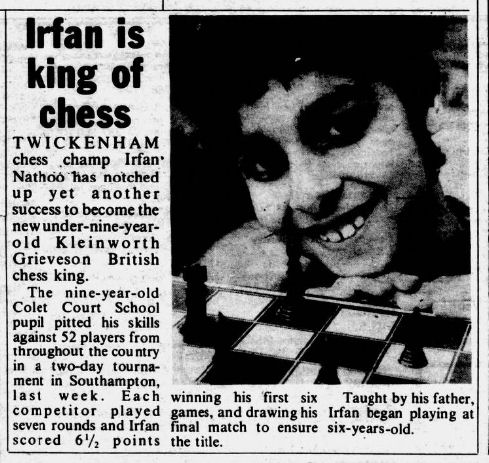
Richmond Informer 14 August 1986

Here’s a game from later in the year. To play through this or any other game in this article click on any move and a pop-up window will appear.

[pgn]

[Event “RJCC Grading”]
[Site “?”]
[Date “1986.11.01”]
[Round “?”]
[White “McGrath, Christopher”]
[Black “Nathoo, Irfan”]
[Result “0-1”]
[ECO “C62”]
[Annotator “Tactical Analysis 6.1”]
[PlyCount “64”]

1. e4 e5 2. Nf3 Nc6 3. Bb5 d6 4. Nc3 Bg4 {[#]} 5. d3 $146 ({Predecessor:} 5. h3 Bxf3 6. Qxf3 a6 7. Ba4 b5 8. Bb3 Nf6 9. Ne2 Na5 10. O-O c5 11. d3 Be7 12. Bg5 Nxb3 13. axb3 {½-½ Tabor,J-Myagmarsuren,L WchT Students 08th Helsinki 1961 (6.4)}) 5… Nge7 6. b3 {C62: Ruy Lopez: Steinitz Defence.} (6. h3 $16 Bd7 7. Be3) 6… a6 $11 7. Bc4 (7. Bxc6+ $11 {keeps the balance.} Nxc6 8. h3 Bxf3 9. Qxf3) 7… Nd4 ({Black should try} 7… f6 $17) 8. Bb2 $2 {[#]} (8. Bxf7+ $1 $11 {and White has nothing to worry.} Kxf7 9. Ng5+ Ke8 10. Qxg4) 8… g6 $2 (8… Bxf3 $19 9. gxf3 b5) 9. h3 $2 {White does not recover from this.} (9. Bxf7+ $1 $11 {and White stays safe.} Kxf7 10. Ng5+ Ke8 11. Qxg4) 9… Bxf3 $19 10. gxf3 Bg7 $2 (10… b5 11. Nd5 Nc8) 11. Nd5 c6 12. Nxe7 Qxe7 ({Worse is} 12… Kxe7 13. c3 $15) 13. Bxd4 (13. c3 $17 {is a better defense.} Ne6 14. Bxe6) 13… exd4 14. b4 d5 15. Bb3 Qxb4+ 16. Kf1 dxe4 17. fxe4 a5 {[#] …Qa3 is the strong threat.} 18. Rb1 Qd6 {Threatens to win with …a4.} 19. Qf3 (19. a4 {might work better.}) 19… O-O 20. Kg2 $2 (20. a4) 20… a4 {Black is clearly winning.} 21. Bc4 b5 22. Bxb5 cxb5 23. Rxb5 Qc6 24. Rb2 Qc3 25. Rhb1 a3 26. Rb7 Qxc2 27. Ra1 Rab8 28. Ra7 Rb2 29. Rxa3 Bh8 30. Ra7 Qe2 31. Qg3 (31. Qxe2 $142 Rxe2 32. a4) 31… Be5 $1 32. Qf3 Qc2 {Weighted Error Value: White=0.90/Black=0.71.} 0-1

[/pgn]

With our new system in place we were able to promote the club in the local press, announcing an exciting season ahead.
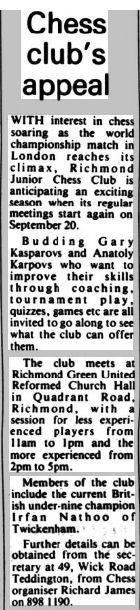
Middlesex Chronicle 04 September 1986

We were actively looking for sponsorship at this point. We received donations from two local charities at various times, and here we found sponsorship from the Richmond branch of Midland Bank.
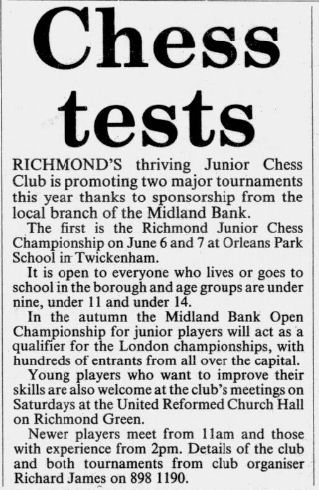
Richmond Informer 04 June 1987

We were also competing successfully in team competitions against other London junior clubs. Barnet Knights, of course, are still going strong today.
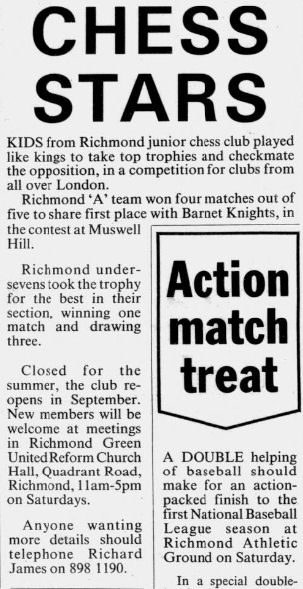
 

Richmond Informer 13 August 1987

One of our new members was a talented Scottish junior, Jonathan Rowson, who had moved from Aberdeen into the same road as me. He used to come round to my house for a game after school, but sadly for us he didn’t stay in the area very long.

In this game from one of our monthly quad tournaments, he demonstrated his class by outplaying Richard Bates in a pawn ending.

[pgn]

[Event “RJCC Quads”]
[Site “?”]
[Date “1988.01.16”]
[Round “?”]
[White “Bates, Richard”]
[Black “Rowson, Jonathan”]
[Result “0-1”]
[ECO “B00”]
[Annotator “Tactical Analysis 6.3”]
[PlyCount “91”]
[SourceVersionDate “2020.10.20”]

1. e4 d6 2. d4 Nc6 3. Nf3 Bg4 4. d5 Ne5 5. Nbd2 $146 ({Predecessor:} 5. Be2 Bxf3 6. gxf3 g6 7. f4 Nd7 8. Qd4 f6 9. Be3 c5 10. Qd2 Qc7 11. Nc3 a6 12. h4 O-O-O {1-0 Vera Gonzalez Quevedo,R (2380)-Agudelo,A (2300) Havana Juventud Rebelde 3rd 1978 (16)}) 5… e6 6. dxe6 {B00: Queen’s Fianchetto Defence, Nimzowitsch Defence.} fxe6 ({Black should try} 6… Bxe6 $14 7. Nd4 Bd7) 7. Be2 Nf6 $2 {[#]} (7… Nxf3+ $16 {was called for.} 8. Nxf3 (8. Bxf3 Bxf3 9. Nxf3 Nf6 $14) 8… Nf6) 8. Nxe5 $1 $18 {White is clearly better.} Bxe2 9. Qxe2 dxe5 10. O-O Qd7 {Inhibits Qb5.} 11. b3 (11. Nc4 $18) 11… O-O-O (11… Bb4 $16 {was necessary.}) 12. Nf3 Be7 (12… Bd6 {is a better defense.} 13. Bb2 Qc6) 13. Bb2 ({Not} 13. Nxe5 Qd4 14. Nd3 (14. Bf4 Qxe4 15. Qxe4 Nxe4 $14) 14… Qxa1 $14) 13… Bd6 14. Nxe5 ({Resist} 14. Bxe5 $6 Bxe5 15. Nxe5 Qe7 $16) 14… Bxe5 15. Bxe5 {Strongly threatening Qc4.} Rhf8 (15… Qc6 $142 16. Rfe1 Qc5) 16. Rad1 Qc6 17. Rxd8+ Rxd8 18. Bxf6 gxf6 19. Rd1 $2 (19. g3 $18) 19… Rxd1+ $11 20. Qxd1 {Hoping for Qd3.} Qxe4 {Endgame KQ-KQ} 21. g3 b6 22. Qd3 Qxd3 23. cxd3 {KP-KP} Kd7 {White must now prevent …Kd6.} 24. Kg2 Kd6 {aiming for …Kc5.} 25. Kf3 f5 26. h4 {Kf4 is the strong threat.} e5 27. Ke3 h5 28. f4 $2 {White is on the road to losing.} (28. Ke2 $11) 28… c5 $19 29. Kf3 Kd5 30. fxe5 Kxe5 31. Ke3 {[#]} b5 $1 32. a3 a5 33. Ke2 f4 34. a4 bxa4 35. gxf4+ Kxf4 {Black mates.} 36. bxa4 {K3P-K3P} Kg4 37. Ke3 Kxh4 {K3P-KPP} 38. Ke4 Kg3 39. Kd5 h4 40. Kxc5 {KPP-KPP} h3 41. d4 h2 42. d5 h1=Q 43. d6 Qc1+ 44. Kb6 Qc4 45. d7 Qd4+ ({Worse is} 45… Qxa4 46. d8=Q $11) 46. Kc7 {Weighted Error Value: White=0.68/Black=0.19 (very precise)} 0-1

[/pgn]

During this period I was doing a lot of private tuition. Jonathan was by no means the only one of our members who would visit my house for lessons, either on a regular or an occasional basis. Judging from both individual and team results it must have had some effect on them.

By 1989 Sheen Mount players were making names for themselves on the national stage. Here are future IM Richard Bates and Tom Davey playing for England’s Primary Schools team in a match against Scotland.
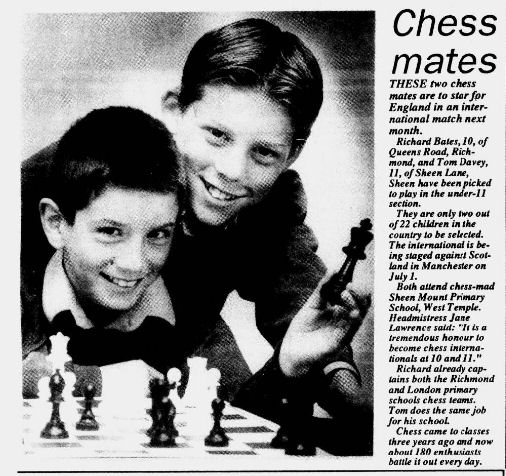
Richmond Informer 16 June 1989


Also in June 1989 we were invited to play a match against a visiting team from Arizona. As we had so many strong players by now we split our players into three teams and played a four-way match.

Here’s Richard Cannon’s game against the American board 1.

[pgn]

[Event “RJCC v Arizona”]
[Site “?”]
[Date “1989.06.25”]
[Round “?”]
[White “Cannon, Richard”]
[Black “Fazio, Brian”]
[Result “1-0”]
[ECO “C01”]
[Annotator “Tactical Analysis 6.1”]
[PlyCount “73”]
[SourceVersionDate “2020.10.20”]

1. e4 e6 2. d4 d5 3. Nc3 Nf6 4. exd5 exd5 5. Nf3 Bd6 6. Be2 O-O 7. O-O Re8 {C01: French: Exchange Variation.} 8. Bg5 {[#] Hoping for Nxd5.} c6 {[#]} 9. Qd2 $146 ({Predecessor:} 9. a3 Bg4 10. b4 Nbd7 11. Rb1 Qc7 12. g3 h6 13. Bxf6 Nxf6 14. Qd3 Ne4 15. Rb3 {0-1 Merino Caballero,M-Vila Dupla,M Valladolid San Mateo op 04th 1986 (1)}) 9… Bf5 {Black is slightly better.} 10. Rfe1 Nbd7 11. Rad1 Qc7 12. Bd3 {Against b5} (12. g3 $17) 12… Bxd3 ({Black should play} 12… Bg4 $19 {Threatens to win with …Bxf3.} 13. h3 Bxf3 14. gxf3 Rxe1+ 15. Rxe1 h6) 13. Qxd3 $15 h6 14. Bh4 Be7 15. Bg3 Bd6 16. Bxd6 Qxd6 17. h3 Nb6 18. Rxe8+ Rxe8 19. Re1 $2 {[#]} (19. b3 $11 {and White has nothing to worry.}) 19… Rxe1+ $19 20. Nxe1 Qf4 ({Better is} 20… Qb4 $19 21. Qd2 Qxb2) 21. Ne2 $11 Qe4 22. Qxe4 Nxe4 {Endgame KNN-KNN} 23. f3 Nd6 24. Kf2 Nbc4 25. Nd3 Nf5 26. b3 Ncd6 27. g4 Ne7 28. Ke3 g5 29. f4 Kg7 30. Ng3 Kg6 31. f5+ Kh7 32. Ne5 f6 33. Nd7 Nb5 $2 (33… Kg7 $16 {was worth a try.}) 34. Nxf6+ $18 Kg7 35. Nd7 Kf7 36. Ne5+ Kf6 $2 (36… Kf8 $18 37. a4 Nd6) 37. Nh5# {Never resign too early! Weighted Error Value: White=0.25 (precise) /Black=0.70} 1-0

[/pgn]

By the summer of 1989 it was time to move. The church in central Richmond where we met was being redeveloped so we had to find new premises. Richmond & Twickenham Chess Club moved to London Welsh Rugby Club, while Richmond Junior Club found a new home in a large Victorian house in East Twickenham, where we’d meet for more than 15 years.
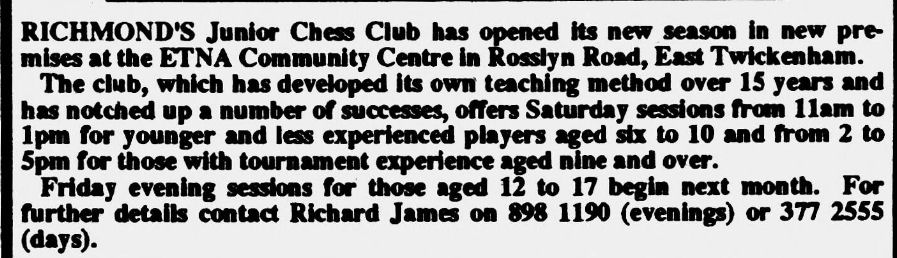
Richmond Informer 29 September 1989

We also set up a separate group for older children enabling us to enter teams in the Thames Valley League. We played our home matches in Friday evening sessions and scheduled our away matches, as far as possible, during the school holidays.

Jane Lawrence was now running Richmond teams in the English Primary Schools Chess Association inter-area competitions, with players from schools around the Borough taking part. Andrew Bamford, like many of the players in these teams, was a member of Richmond Junior Club.
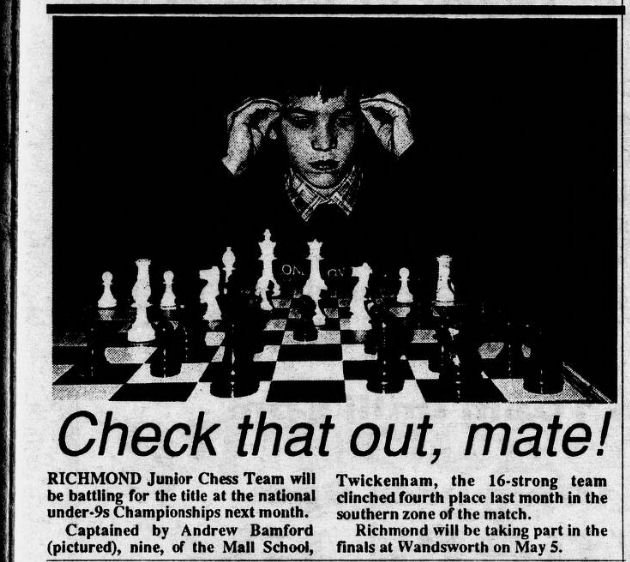
Richmond Informer 20 April 1990

In this game from our 1990 Under 11 Championship a speculative sacrifice proved successful.

[pgn]

[Event “Richmond U11 Ch (3)”]
[Site “?”]
[Date “1990.07.07”]
[Round “?”]
[White “Rich, Max”]
[Black “Bamford, Andrew”]
[Result “0-1”]
[ECO “C68”]
[Annotator “Tactical Analysis 6.3”]
[PlyCount “76”]

1. e4 e5 2. Nf3 Nc6 3. Bb5 a6 4. Bxc6 dxc6 5. d3 Bd6 6. h3 {C68: Ruy Lopez: Exchange Variation, sidelines.} Nf6 ({Black should try} 6… Ne7 $15) 7. O-O $146 ({Predecessor:} 7. Bg5 h6 8. Bxf6 Qxf6 9. Nbd2 Be6 10. Qe2 O-O 11. d4 Rfe8 12. dxe5 Bxe5 13. Nxe5 Qxe5 {1-0 Langner,M-Wink,A Schleswig Holstein-ch HT-A 43rd Gluecksburg 1988 (6)}) 7… O-O 8. Bg5 {White has an edge.} h6 9. Bh4 Be6 (9… Qe7 $11) 10. Re1 {Strongly threatening d4.} g5 11. Bg3 Nd7 12. d4 (12. Nbd2 $16) 12… Qf6 (12… exd4 $11 {remains equal.} 13. Bxd6 cxd6) 13. d5 $2 {[#]} (13. Nbd2 $16 {keeps the pressure on.}) 13… Bxh3 $1 14. gxh3 (14. dxc6 Bxg2) 14… cxd5 15. exd5 Qf5 (15… Qg7 {is a better defense.} 16. Nc3 f5) 16. Kh2 $2 (16. Nbd2 $18) 16… e4 $14 17. Bxd6 cxd6 {[#]} 18. Nxg5 Qxf2+ (18… Qxg5 $2 19. Rg1 $18 (19. Rxe4 Kh7 $11) (19. Rxe4 Kh7 $14)) 19. Kh1 hxg5 20. Nc3 Qf3+ (20… f5 $19 {and Black stays clearly on top.} 21. Qh5 Qf3+ 22. Qxf3 exf3) 21. Kh2 $2 (21. Qxf3 $17 {was the crucial defense.} exf3 22. Re7) 21… Qf4+ 22. Kg2 Nf6 ({Not} 22… e3 23. Qf3 $17) 23. Qd4 {Black must now prevent Rf1.} Nh5 24. Nxe4 $2 (24. Qxe4 Qg3+ 25. Kf1) 24… f5 $19 25. Qd1 Qh4 ({Weaker is} 25… fxe4 26. Qxh5 Kg7 27. Rf1 Qd2+ 28. Kg1 $17 (28. Kh1 Qxd5 29. c4 Qe5 $17)) 26. Nf2 Nf4+ 27. Kf3 Nxh3 28. Nxh3 Qxh3+ 29. Kf2 Qh2+ 30. Kf1 Qh3+ 31. Kf2 f4 {…Qh2+ would be deadly.} 32. Rh1 {Repels Qh2+} Qg3+ 33. Kf1 {Threatens to win with Qh5.} f3 34. Qd2 {Repels Qg2+} Rae8 {( -> …Re2)} 35. Rh2 {[#] Deflects Re2} Re2 $1 {Black mates.} 36. Qd3 (36. Re1 f2) 36… Rxh2 37. Qg6+ Kh8 38. Rd1 Rh1# {An exciting game. Weighted Error Value: White=1.02/Black=0.68} 0-1

[/pgn]

Wanting to provide top level coaching for our strongest players, we appointed GM Daniel King as our club professional in 1990. We were also able to enter a third team in the Thames Valley League.
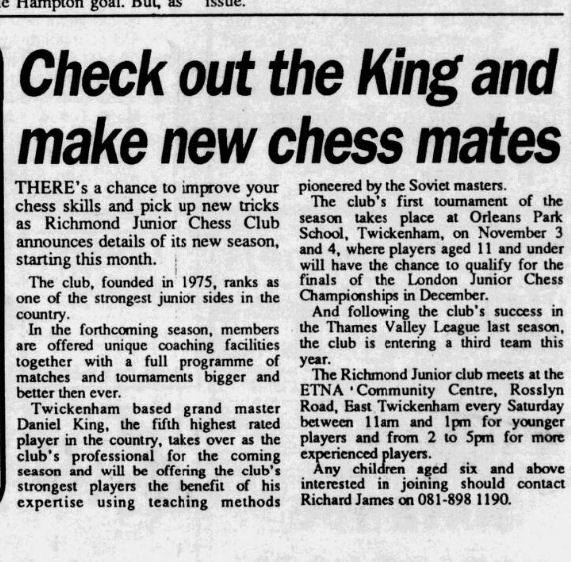
Richmond Informer 14 September 1990


In just a few years since 1986 the club had made tremendous progress, and we were able to bill ourselves, without fear of contradiction, as ‘England’s leading club for young players’. This is Chris A Baker, who hasn’t played competitively for a long time, not to be confused with long-standing Richmond & Twickenham Chess Club member Chris B Baker, who was also a pupil at Hampton School, or indeed IM Chris W Baker.
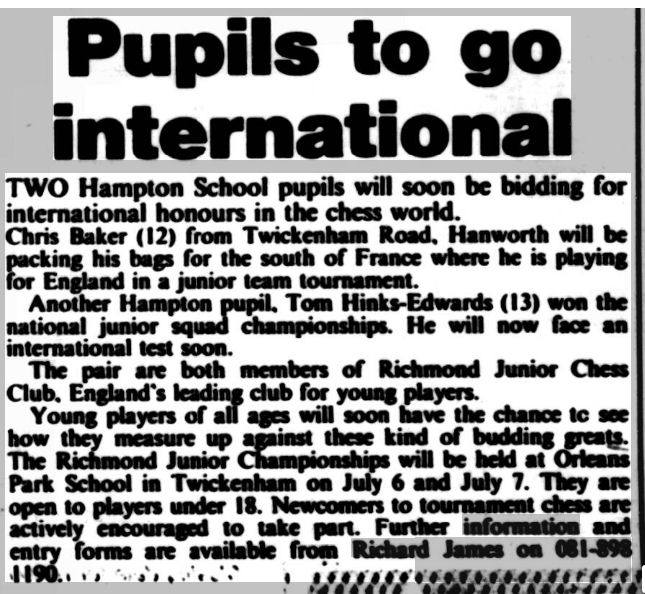
Middlesex Chronicle 20 June 1991

In this game Tom had the chance to play a Greek Gift sacrifice against an opponent with insufficient experience of the French Defence.

[pgn]

[Event “Richmond Junior Championship”]
[Site “?”]
[Date “1992.07.04”]
[Round “1”]
[White “Hinks-Edwards, Thomas”]
[Black “Boase, Mansur”]
[Result “1-0”]
[ECO “C16”]
[Annotator “Tactical Analysis 6.3”]
[PlyCount “71”]

1. e4 e6 2. d4 d5 3. Nc3 Bb4 4. e5 Ne7 5. a3 Bxc3+ 6. bxc3 O-O ({Better is} 6… c5 $14) 7. Nf3 {[#] C16: French: 3 Nc3 Bb4 4 e5: Lines without …c5.} (7. Bd3 $18 {has better winning chances.}) 7… b6 $146 {[#]} (7… c5 $16 {was worth a try.}) ({Predecessor:} 7… Nf5 8. a4 Nd7 9. Bd3 h6 10. h4 f6 11. g4 fxe5 12. gxf5 e4 13. fxe6 Rxf3 14. exd7 Bxd7 15. Be2 Rxc3 16. Be3 Qf6 17. Qd2 Rc6 18. Bb5 {1-0 Daum,H-Heidmann,H Koblenz RM SC op 1991}) 8. Bd3 (8. h4 $1 $18) 8… c5 $2 {[#]} (8… h6 $16) 9. Bxh7+ $1 $18 {Decoy. White is clearly winning.} Kxh7 10. Ng5+ Kg8 11. Qh5 Re8 12. Qxf7+ (12. Nxf7 Qd7 $16) 12… Kh8 13. Qh5+ ({Not} 13. Nxe6 Bxe6 14. Qxe6 Qd7 15. Qxd7 Nxd7 $17) 13… Kg8 14. Qh7+ Kf8 15. h4 {Strongly threatening Qh5.} Nf5 16. g4 Nh6 17. Qh8+ Ng8 18. h5 {h6 is the strong threat.} Qd7 19. h6 Ke7 20. h7 ({Less strong is} 20. hxg7 Kd8 21. Nh7 Ba6 $16) 20… Nh6 21. Qxg7+ Kd8 22. h8=Q Rxh8 23. Qxh8+ Kc7 24. Rxh6 Qc6 25. Qg7+ Bd7 26. Nxe6+ Kb7 27. Nd8+ Ka6 28. Nxc6 Bxc6 29. dxc5 bxc5 30. Qc7 {White mates.} Kb5 31. a4+ Kc4 32. Rxc6 Nxc6 33. Qxc6 Rh8 34. Bd2 Rh1+ 35. Ke2 Rxa1 36. Qb5# {Black did not feel at home in the position after the opening. Excellently played by Hinks-Edwards! Weighted Error Value: White=0.45/Black=1.64} 1-0

[/pgn]

And here’s Chris Baker, beating one of his regular rivals in a club game.

[pgn]

[Event “RJCC Quads 7-3-92”]
[Site “?”]
[Date “1992.03.07”]
[Round “?”]
[White “Baker, Christopher A”]
[Black “Bamford, Andrew”]
[Result “1-0”]
[ECO “E73”]
[Annotator “Tactical Analysis 6.3”]
[PlyCount “67”]
[SourceVersionDate “2020.10.20”]

1. d4 Nf6 2. c4 g6 3. Nc3 Bg7 4. e4 d6 5. Be2 O-O 6. Bg5 h6 7. Be3 e5 8. d5 Ne8 (8… c6 $16 {was worth a try.}) 9. Qd2 $18 {E73: King’s Indian: Averbakh Variation without 6…c5.} Kh7 {[#]} 10. f4 $146 ({Better is} 10. f3 $18) ({Predecessor:} 10. O-O-O f5 11. exf5 gxf5 12. f4 Nd7 13. Nf3 Nef6 14. g3 Ng4 15. Bg1 exf4 16. gxf4 Nc5 17. Bxc5 dxc5 {1-0 Zaiatz,E (2230)-Arribas Robaina,M (2105) Wch U20 Girls Adelaide 1988 (6.4)}) 10… f5 $2 (10… exf4 $15 {stays ahead.} 11. Bxf4 Nf6) 11. Nf3 (11. exf5 $142 Bxf5 12. Nf3) 11… fxe4 $16 12. Nxe4 {And now fxe5 would win.} Bf5 (12… Nd7 $14) 13. Nf2 {fxe5 is the strong threat. White is much more active.} e4 {Loses the game.} (13… exf4 $16 {keeps fighting.} 14. Bxf4 Qf6) 14. Nd4 {[#] Strongly threatening g4.} Qe7 (14… c5 {was necessary.}) 15. g4 $18 Bd7 16. O-O-O {Black must now prevent h4.} c6 17. h4 cxd5 18. cxd5 Na6 19. h5 Rc8+ 20. Kb1 {Threatens to win with hxg6+.} gxh5 21. g5 (21. gxh5 Nec7 $11) (21. Rxh5 Nf6 $18) 21… Nec7 (21… Bxd4 $142 22. Bxd4 (22. Qxd4 Ng7 $16) 22… Ng7) 22. Nb3 (22. Bxh5 Nxd5 23. Bg4 Nxe3 24. Qxe3 Nb4 25. Bxd7 (25. Qxe4+ $2 Qxe4+ 26. Nxe4 Bxg4 $19) 25… Qxd7 $18) 22… b5 (22… Be8 $142 23. Bxh5 Na8) 23. Rxh5 Be8 24. Rh2 b4 25. Ng4 h5 26. Nf2 (26. Rg1 $142 Nxd5 27. Qxd5) 26… Qd7 (26… Kg8 $142 27. Bxh5 (27. Bxa7 Nb5 $16) 27… Rf5) 27. Bxh5 Bxh5 28. Rxh5+ Kg8 29. Rdh1 (29. Bxa7 Nb5 30. Bd4 Nc3+ 31. bxc3 bxc3 $14) 29… Qa4 (29… Nb5 $142 30. Nd4 Rc4 31. Nxb5 Qxb5) 30. Bd4 Nb5 31. Bxg7 {Intending Rh8+ and mate.} Kxg7 32. Rh7+ Kg8 33. Nxe4 {Threatening mate with Qh2.} Rc4 {[#]} 34. Qh2 $1 {An interesting game. Weighted Error Value: White=0.96/Black=1.27} 1-0

[/pgn]

Every summer during this period the parents of our stronger players got together to book accommodation for the British Championships. From 1991 onwards we were rewarded with successes like these:

1991 Richard Bates U14 shared, Luke McShane U9

1992 James Clifford/Luke McShane U14 Andrew Bamford U11

1993 Tom Hinks-Edwards U16 shared

One of our favourite simul givers at the time was Ukrainian IM Petr Marusenko, a regular visit to Hastings (he’s there again this year) who would drop in to visit us after the congress.

In this game James Clifford outplayed him in the ending.

[pgn]

[Event “RJCC Simul 18-1-92”]
[Site “?”]
[Date “1992.01.18”]
[Round “?”]
[White “Marusenko, Petr”]
[Black “Clifford, James”]
[Result “0-1”]
[ECO “E65”]
[Annotator “Tactical Analysis 6.3”]
[PlyCount “122”]

1. Nf3 Nf6 2. g3 g6 3. Bg2 Bg7 4. O-O O-O 5. d4 d6 6. c4 Nbd7 7. Nc3 c5 8. d5 Re8 {E65: King’s Indian: Fianchetto: 6…c5 7 0-0 without d5 by White.} 9. Bg5 $146 ({Predecessor:} 9. Qd3 Ng4 10. b3 Nde5 11. Nxe5 Nxe5 12. Qc2 a6 13. Bb2 Bf5 14. e4 Bg4 15. f3 Bd7 16. Ne2 {1-0 Thomas,C-Hazzard,W Plymouth ch-MI op 1984}) 9… Nb6 10. Qd3 (10. b3 $1 $16) 10… Bg4 (10… h6 $11 11. Bd2 e6) 11. h3 $16 Bxf3 12. Bxf3 (12. exf3 $142 Nfd7 13. b3) 12… Nfd7 13. Bf4 (13. b3 $1 $16) 13… h6 ({Black should play} 13… Ne5 $14 14. Bxe5 Bxe5) 14. b3 g5 15. Bd2 {Bg2 would be deadly.} Ne5 16. Qc2 ({White should try} 16. Qe4 $16) 16… Nxf3+ $14 17. exf3 {Hoping for Rae1.} Qc8 (17… Qd7 $14) 18. Kg2 $18 Nd7 $2 (18… e6) 19. f4 (19. h4 $142) 19… f6 (19… gxf4 20. Bxf4 Ne5) 20. fxg5 fxg5 21. Rae1 ({Weaker is} 21. Qg6 Ne5 22. Qe4 Kh8 $16) 21… Nf8 22. Re2 e6 23. dxe6 Rxe6 24. Rfe1 Rxe2 25. Rxe2 Qc6+ 26. Nd5 Re8 {Against Re7} 27. Rxe8 Qxe8 28. Be3 Nd7 29. Qf5 Qf7 30. Qxf7+ Kxf7 {Endgame KBN-KBN} 31. Kf3 a6 32. a4 Ne5+ 33. Ke2 $2 (33. Ke4 $18) 33… Ke6 {[#]} (33… Nc6 $14) 34. Bd2 $1 Nc6 35. Be3 (35. Kd3 $16) 35… Na5 $11 36. b4 $2 (36. Kd3 $11) 36… Nxc4 $19 37. Nc7+ Kd7 38. Nd5 cxb4 39. Nxb4 Nb2 40. a5 Bc3 41. Nd5 Bxa5 42. Nf6+ Ke6 43. Ng8 Bd8 44. Nxh6 a5 45. f4 (45. Bd4 $142 Nc4 46. Kd3) 45… gxf4 46. gxf4 Be7 (46… Kd5 $142 47. Bd2 Nc4) 47. f5+ {[#]} Ke5 (47… Kd5 $1 $19 {Threatens to win with …a4.} 48. Ng4 Bh4) 48. Kf3 $2 (48. Bd2 $17 Nc4 49. Bc3+ Kd5 50. f6) 48… Bf8 49. Ng4+ (49. Bf4+ $142 Kd4 50. f6) 49… Kxf5 50. Bd4 Nc4 51. Ke2 Ne5 52. Nf2 Nf7 53. Nd3 (53. Nd1 {was called for.}) 53… Ke4 {Black is clearly winning.} 54. Bb2 b5 55. h4 Ne5 56. Nf2+ Kf5 57. h5 Kg5 58. Ne4+ Kxh5 59. Nf6+ Kg6 60. Nd5 Nc4 61. Bd4 Kf5 {Weighted Error Value: White=0.81/Black=0.60} 0-1

[/pgn]

Richard Bates, now at Tiffin School, continued to be successful in 1992, and was rated one of the world’s top players of his age.
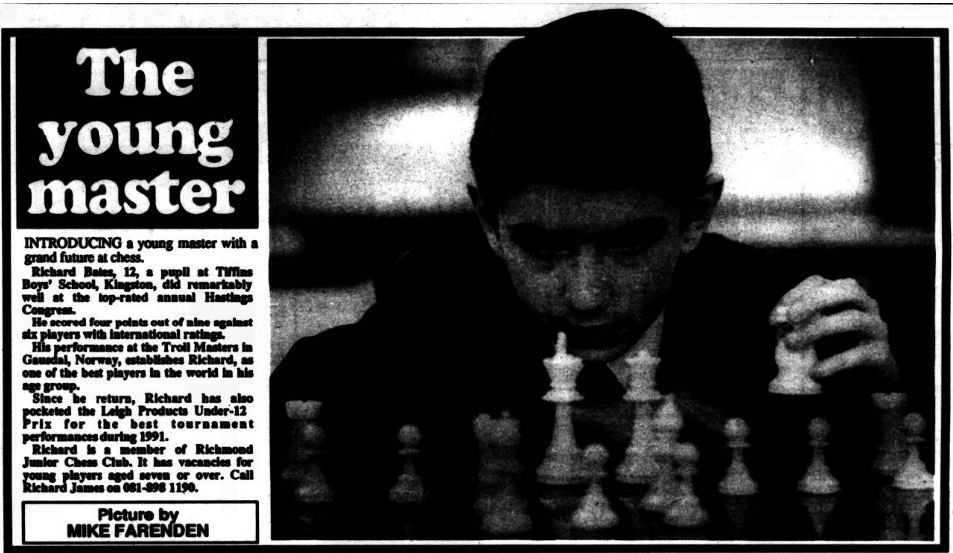
Kingston Informer 31 January 1992


But by that time we had a new member whose feats would outshine even Richard’s. This was Luke McShane, who, at the age of only 8, took the World Under 10 Championship in 1992.
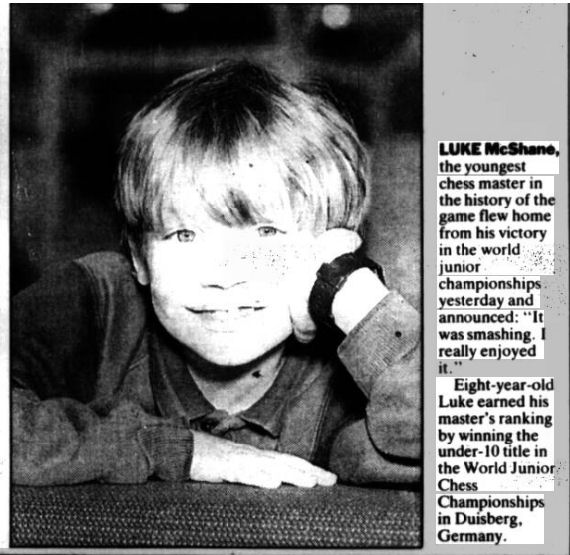
Newcastle Journal 14 July 1992

Luke scored victories against future stars such as Bacrot, Aronian and Grischuk in this event. He was perhaps fortunate to escape from lost positions in the first two of these games, but here’s his win against the Russian representative.

[pgn]

[Event “World U10 Championship”]
[Site “Duisburg”]
[Date “1992.??.??”]
[Round “6”]
[White “McShane, Luke”]
[Black “Grischuk, Alexander”]
[Result “1-0”]
[ECO “C09”]

[Annotator “Tactical Analysis 6.3”]
[PlyCount “67”]
[EventDate “1992.??.??”]
[EventType “swiss”]
[EventRounds “11”]
[EventCountry “GER”]

1. e4 e6 2. d4 d5 3. Nd2 c5 4. exd5 exd5 5. Ngf3 Nc6 6. Bb5 Bd6 7. O-O Nge7 8. dxc5 Bxc5 9. Nb3 Bd6 10. Bg5 O-O 11. c3 Bg4 12. Be2 Qc7 13. h3 {C09: French Tarrasch: 3…c5 4 exd5 exd5 5 Ngf3 Nc6.} Bh5 14. Nfd4 Bxe2 15. Qxe2 $146 {White is slightly better.} ({Predecessor:} 15. Nxe2 h6 16. Bxe7 Nxe7 17. Nbd4 a6 18. Qd3 Rfe8 19. Rfe1 Rad8 20. Rad1 Qb6 21. Qc2 Nc6 22. Qb3 Qa7 23. Nxc6 bxc6 24. Nd4 Rxe1+ 25. Rxe1 Rc8 26. Re2 {½-½ Honos,A (2300)-Anka,E (2355) HUN-chT Hungary 1991}) 15… Rfe8 16. Qh5 {White is more active.} (16. Nb5 $5 Qd7 17. Qd2 $14) 16… Bf4 17. Rad1 h6 18. Bxf4 Qxf4 19. Qf3 Qg5 20. Qd3 Ne5 21. Qb5 {Strongly threatening f4!} (21. Qd2 {simplifies} Nc4 22. Qxg5 hxg5 23. Rb1) 21… N7g6 22. Ne2 (22. Qxd5 $2 Nf4 23. Qxb7 Rab8 $19) (22. g3 $11) 22… Nf3+ (22… Nh4 $15 23. Ng3 (23. Qxd5 $2 Nef3+ $19 {Discovered Attack}) 23… f5) 23. Kh1 $11 Nfh4 ({Don’t do} 23… Ngh4 24. Ng3 Qe7 25. Qc5 (25. gxf3 Qe6 $11) 25… Qxc5 26. Nxc5 $16) (23… Rad8 $11) 24. Rg1 (24. g3 $1 $14) 24… Qf5 (24… Qf6 $15) 25. Nbd4 Qxf2 (25… Qf6 $11) 26. Rdf1 $36 {Black is under strong pressure.} ({Of course not} 26. Qxb7 Rab8 27. Qxd5 Rxb2 $17) 26… Qe3 27. Qxb7 ({Much weaker is} 27. Qxd5 Ne5 $11) (27. Rxf7 $5 Re7 28. Rxe7 Nxe7 29. Qxb7 $16) 27… Ne5 {Threatens to win with …Rab8.} 28. Qb3 (28. b4 $14) 28… Nd3 ({Better is} 28… Rab8 $17 29. Qc2 Nd3) 29. Qxd5 $11 Nf2+ 30. Kh2 {Qh5 is the strong threat.} Rad8 (30… Rab8 $11) 31. Qh5 $14 {Really sharp!} Re4 {[#]} (31… g5 $1 $14) 32. Ng3 $1 $18 Qf4 {[#]} (32… Rde8) 33. Rxf2 $1 Qxf2 34. Nxe4 {Nicely played by McShane. Weighted Error Value: White=0.35/Black=0.41} 1-0

[/pgn]

In January 1993 we were privileged to host a junior team from Kiev (now Kiiv), whose top players were, as you might imagine, very strong. We arranged four events: a simul given by Daniel King, a match against a team from Richmond & Twickenham Chess Club, a match against a Richmond Junior Club team and a match against a junior team representing the Southern Counties Chess Union, which included three RJCC players.

Another of our very strong players, Aleksandar Trifunovic, great nephew of Grandmaster Petar Trifunovic, scored an exciting win on board three of the RJCC v Kiev match. His opponent here is now an American IM.

[pgn]

[Event “RJCC v Kiev Juniors”]
[Site “?”]
[Date “1993.01.24”]
[Round “?”]
[White “Zilberstein, Dmitry”]
[Black “Trifunovic, Aleksandar”]
[Result “0-1”]
[ECO “A48”]
[Annotator “Tactical Analysis 6.3”]
[PlyCount “90”]

1. d4 Nf6 2. Nf3 g6 3. c4 Bg7 4. Nc3 d6 5. Bf4 O-O 6. e3 Nbd7 7. Be2 c6 8. O-O Qe8 9. h3 e5 10. Bh2 Qe7 11. Qb3 {A48: 1 d4 Nf6 2 Nf3 g6: Torre, London and Colle Systems.} Ne8 12. Qa3 f6 $146 (12… f5 $16) ({Predecessor:} 12… f5 13. dxe5 Nxe5 14. Rad1 Nxf3+ 15. Bxf3 Be5 16. Bxe5 Qxe5 17. Na4 Rb8 18. c5 d5 {1-0 Hamdouchi,H (2390)-Al Modiahki,M (2310) Olympiad-29 Novi Sad 1990 (4)}) 13. b4 $18 {White is clearly better.} Kh8 (13… e4 $16 {was necessary.}) 14. b5 Nb6 $2 {[#]} (14… c5 $16) 15. Rfd1 $2 (15. bxc6 $18 bxc6 16. Rab1) 15… Qf7 $2 (15… c5 $16) 16. c5 dxc5 17. dxc5 (17. Qxc5 exd4 18. Nxd4 Nd7 $16) 17… Nd5 18. Bc4 ({White should try} 18. Nxd5 $18 cxd5 19. b6) 18… Be6 $16 19. Bxd5 (19. bxc6 $18 {is more deadly.} bxc6 20. Ne4) 19… Bxd5 $2 (19… cxd5 $16 20. c6 Rc8) 20. e4 $2 (20. Nxd5 $18 cxd5 21. b6) 20… Bc4 $14 21. bxc6 bxc6 22. Qa4 Rc8 (22… Nc7 $5) 23. Rab1 Be6 24. Rb2 g5 (24… Qe7 $5) 25. Ne1 h5 26. Nd3 g4 27. hxg4 hxg4 28. f4 $2 (28. Nb4 $11 {and White is okay.} Qe7 29. Rc2 (29. Nxc6 $2 Qxc5 30. Nb4 Qxc3 $19)) 28… gxf3 $19 29. gxf3 Qh5 $2 (29… Bh6 $19 {has better winning chances.} 30. Rg2 Rg8 31. Rxg8+ Qxg8+ 32. Kh1 Be3 33. Nxe5 fxe5 34. Bxe5+ Ng7) 30. Ne1 $2 (30. Bf4 $17 Kg8 31. Bc1) 30… Bh6 31. Rd3 Rg8+ 32. Rg2 Rc7 (32… Qh4 33. Rxg8+ Kxg8 34. Ng2 $17) 33. Ne2 Rcg7 (33… Qh4 34. Bg3 Qh5 35. Rh2 $11) 34. Bg3 Bh3 35. Kf2 Bxg2 36. Nxg2 Qh3 (36… Rxg3 $142 37. Nxg3 Qh2) 37. f4 exf4 38. Nexf4 Bxf4 (38… Qh1 39. Rd1 $18) 39. Nxf4 Qh6 {( -> …Rxg3!)} ({Don’t go for} 39… Qh1 $2 40. Ne2 $19) 40. Ne2 {[#]} Rb7 $2 ({Stronger than} 40… Qh1 41. Qxc6 Re7 42. Rf3 $17) (40… f5 $1 $19 {White must now prevent …Nf6.} 41. exf5 Rf8) 41. Qa3 $2 ({Only move:} 41. Qxc6 $15 Rb2 42. e5) 41… Qg6 42. e5 Re7 43. Qc3 Reg7 ({But not} 43… Qe4 $2 44. Rd4 Qf5+ 45. Rf4) (43… Qf5+ $19 44. Rf3 Qe6) 44. Rf3 $17 f5 45. Rf4 (45. Qd3 $17 {was worth a try.}) 45… Qe6 {An exciting game. Weighted Error Value: White=0.87/Black=0.90} 0-1

[/pgn]

Richard Bates scored a win and a draw against the top two Kiev players. He drew with Spartak Vysochin, now a grandmaster, in the RJCC match and won this game from the SCCU Juniors match.

[pgn]

[Event “SCCU Juniors v Kiev Juniors”]
[Site “?”]
[Date “1993.01.24”]
[Round “?”]
[White “Ianovsky, Alexander”]
[Black “Bates, Richard”]
[Result “0-1”]
[ECO “E87”]
[Annotator “Tactical Analysis 6.3”]
[PlyCount “130”]

1. d4 Nf6 2. c4 g6 3. Nc3 Bg7 4. e4 d6 5. f3 O-O 6. Be3 e5 7. d5 Nh5 8. Qd2 f5 9. O-O-O Nd7 10. Nge2 a6 (10… Nb6 $14) 11. Kb1 {E87: King’s Indian: Sämisch: 6…e5 7 d5.} (11. exf5 $16 gxf5 12. Ng3) 11… Ndf6 12. h3 {[#]} ({White should play} 12. exf5 $16 gxf5 13. Nc1) 12… b5 $146 ({Predecessor:} 12… fxe4 13. fxe4 b5 14. g4 Nf4 15. cxb5 axb5 16. Bxf4 exf4 17. Qc2 b4 18. Nb5 Bd7 {0-1 Soln,P-Jirovsky,P (2280) EU-ch U14 Rimavska Sobota 1992}) 13. g4 (13. cxb5 $16 {g4 is the strong threat.} fxe4 14. Nxe4) 13… Nf4 $2 (13… b4 $1 $11) 14. Ng3 $2 (14. cxb5 fxe4 15. fxe4 axb5 $11) (14. Bxf4 $18 exf4 15. exf5 (15. cxb5 fxe4 16. Nd4 e3 $15) (15. Qxf4 $2 b4 $19)) 14… b4 $11 15. Nce2 (15. Na4 $14) 15… Nxe2 16. Nxe2 fxe4 17. fxe4 (17. f4 $15) 17… Nxe4 $19 18. Qe1 Ng5 (18… Rf3 $19 19. Bg1 h5) 19. Qxb4 $17 a5 20. Qa3 Ne4 $36 {Black is more active.} 21. Nc3 $1 Ng3 ({Of course not} 21… Nf2 $6 22. Bxf2 Rxf2 23. Ne4 $15) 22. Rg1 Rf3 ({Better is} 22… Nxf1 $17 23. Rdxf1 Qh4 24. Rxf8+ Bxf8) 23. Ne2 $2 {Black continues to play with concentration.} (23. Nb5 $1 $11 {and White has nothing to worry.}) 23… Nxf1 $19 24. Rdxf1 Qf6 ({Worse is} 24… Rxh3 25. Bg5 Rxa3 26. Bxd8 $17) 25. Rxf3 Qxf3 26. Ng3 (26. Qd3 Rb8 27. b3) 26… e4 {Strongly threatening …Rb8.} 27. Bd2 Rb8 $1 28. Qxf3 Rxb2+ ({Inferior is} 28… exf3 29. b3 $15) 29. Kc1 exf3 30. Rf1 Rxa2 31. Rxf3 Ba6 32. Ne4 Bxc4 33. Nf6+ Bxf6 34. Rxf6 Bxd5 {Endgame KRB-KRB} 35. Bh6 Bf7 36. Rf3 {Dodges Ra3} Re2 37. Rc3 Re7 38. Bg5 Rd7 39. Ra3 Kg7 40. Rxa5 c5 41. Kd2 Bd5 42. Bf4 Kf7 43. h4 (43. Ra3 $142 Bg2 44. h4) 43… Bf3 44. g5 Ke6 45. Ra6 Bg4 46. Ke3 Kd5 47. Kd2 Ke6 48. Kc3 Bf3 49. Kd3 $2 (49. Rb6) 49… Bb7 50. Rb6 Kd5 51. Bh2 Bc6 52. Bg3 Ra7 {Threatens to win with …Ra3+.} 53. Bf4 Ra4 54. Ke3 c4 55. Rb8 c3 56. Rb1 Re4+ 57. Kf3 c2 58. Rc1 Ba4 59. Bxd6 Rxh4 60. Bf4 {[#]} Rxf4+ $1 61. Kxf4 Kd4 62. Kf3 Kd3 63. Ra1 {[#]} Kd2 $1 64. Ra2 (64. Rxa4 c1=Q) 64… Bb3 65. Rb2 Kc3 {Trapped Piece. Weighted Error Value: White=0.62/Black=0.36} 0-1

[/pgn]

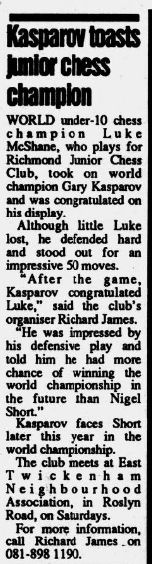
As a result of his performance in the World Junior Championship, Luke was given the opportunity to play a game against Garry Kasparov, in London to discuss the arrangements for his forthcoming World Championship match against Nigel Short.
Richmond Informer 05 March 1993

Here’s the game.

[pgn]

[Event “Casual game”]
[Site “London, England”]
[Date “1993.02.17”]
[Round “?”]
[White “McShane, Luke”]
[Black “Kasparov, Garry”]
[Result “0-1”]
[ECO “B56”]
[Annotator “Tactical Analysis 6.3”]
[PlyCount “100”]
[EventDate “1993.??.??”]

1. e4 c5 2. Nf3 d6 3. d4 cxd4 4. Nxd4 Nf6 5. Nc3 e5 6. Nb3 Be6 7. Be3 a6 8. Qd2 Nbd7 9. O-O-O b5 10. f3 Nb6 {[#]} 11. Na5 $146 {B90: Sicilian Najdorf: Unusual White 6th moves, 6 Be3 Ng4 and 6 Be3 e5.} (11. Qf2 $5 Nfd7 12. f4 $11) ({Predecessor:} 11. Qf2 Nc4 12. Bxc4 bxc4 13. Nc5 Qc7 14. N5a4 Rb8 15. Kb1 Be7 16. h4 O-O 17. Bg5 Qc6 18. a3 Rfd8 {1-0 Zaichik,G (2500)-Kuczynski,R (2450) Rubinstein Memorial 27th Polanica Zdroj 1989 (5)}) 11… Qc7 {Against Nb7. Strongly threatening …b4.} 12. g4 $2 {[#]} (12. a3 $11 {and White is okay.}) 12… Nfd7 $2 (12… b4 $1 $19 13. Ne2 d5) 13. Nd5 $16 {White is clearly better.} Bxd5 14. exd5 Rc8 {[#]} (14… Be7 $16 {keeps fighting.}) 15. Nc6 $2 (15. Kb1 $1 $18) 15… Nxd5 $1 $11 {Remove Defender} 16. Qxd5 {aiming for Nb4.} Qxc6 17. Qxc6 Rxc6 18. Bd3 (18. Bg2 $14) 18… Be7 (18… Nc5 $1 $15) 19. g5 (19. Be4 $11 Rc7 20. g5) 19… d5 20. h4 d4 21. Be4 Rc7 22. Bf2 Nc5 {And now …Nxe4 would win.} (22… h6 $5 23. g6 Nf6 $15) 23. Bg3 $2 (23. Rhe1 $11) 23… f6 $2 ({Black should play} 23… Nxe4 $19 24. fxe4 Bd6) 24. gxf6 Bxf6 ({Much worse is} 24… Nxe4 25. Bxe5 (25. fxg7 Rg8 $15) 25… Bd6 26. Rxd4 $14 (26. Bxd4 $2 {too greedy.} Nxf6 27. Bxf6 Bf4+ 28. Kb1 gxf6 $19) (26. fxg7 Rg8 $17)) 25. Rxd4 exd4 26. Bxc7 {This pair of bishops is nice.} Kd7 {Prevents Bc6+.} 27. Bf4 Nxe4 {Black converts the advantage convincingly.} 28. fxe4 $17 {Endgame KRB-KRB} Re8 29. Re1 (29. e5 $17 Bxe5 30. Bxe5 Rxe5 31. Rg1) 29… Bxh4 $19 {Black is clearly winning.} 30. Rh1 g5 31. Bd2 Rxe4 32. c3 dxc3 33. Bxc3 Ke6 34. Kd2 Kf5 35. Kd3 Re6 36. Bd2 h5 37. Be3 Kg6 38. Ke2 Bg3 {…Bf4 would be deadly.} 39. Kf3 g4+ 40. Kxg3 Rxe3+ {KR-KR} 41. Kf4 Rf3+ 42. Ke4 Kg5 43. Rd1 Rf4+ 44. Ke3 g3 {Threatens to win with …Kg4.} 45. Rd5+ Kg4 {…g2 is the strong threat.} 46. Rd8 Rf5 47. Rd4+ Kh3 48. Ke4 Rf8 49. Rd1 g2 {White must now prevent …h4.} 50. Ke3 Rf1 {Weighted Error Value: White=1.00/Black=0.49} 0-1

[/pgn]

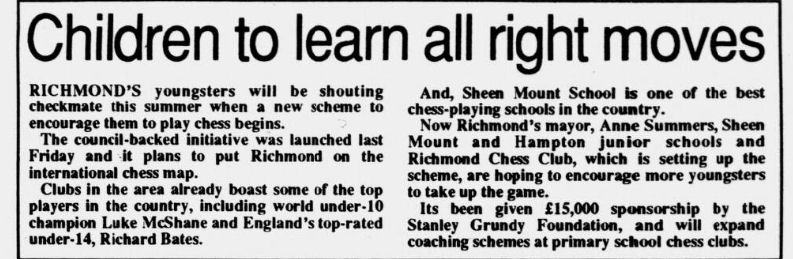
In May 1993, buoyed by these successes, we were asked to be involved in the Richmond Chess Initiative, which, in essence, did very much what Chess in Schools & Communities is doing now, but on a local rather than national level.
Richmond Informer 14 May 1993

Children would learn all the right moves, but would they play them in the right order? You’ll find out in the next part of the history of Richmond Junior Chess Club.