Minor Pieces 52: Wilfred Hugh Miller Kirk

Wilfred Hugh Miller Kirk was perhaps Richmond Chess Club’s strongest player between 1925 and 1937, as well as playing an important administrative role in the club.

Wilfred was born in Culmstock, Devon on 18 May 1877, where Teddington novelist, market gardener and chess player RD Blackmore also lived for a time. His family were originally from London,  but his father was working in Devon as a Schools Inspector at the time of his birth. The family later returned to London, where young Wilfred joined the Civil Service on leaving school. He would remain there for his entire working life.

In 1899 he married 20 year old Mabel Ellen Gannaway. Wilfred and Mabel had four children, Talbot (1902), Beatrice (1903), Evelyn (1907) and Ruby (1908).

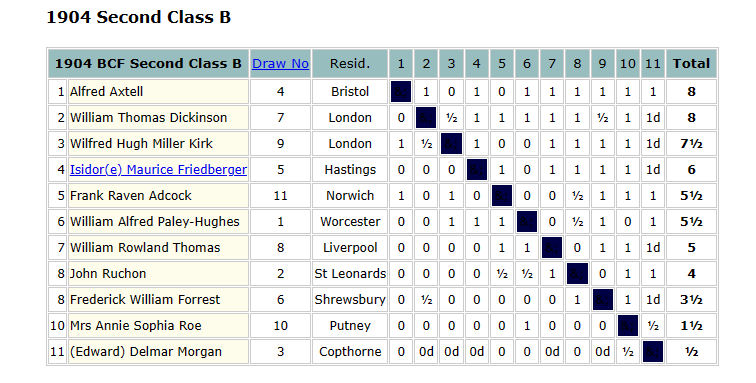
We hear of him as a chess player for the first time only in 1904, at the age of 27, when he took part in the Second Class B section of the inaugural British Championships at Hastings. He did pretty well for a newcomer to competitive chess, finishing in third place, just half a point behind the joint winners.
The following year he took part in the Kent Open Amateur 2nd Class A tournament, held that year at Crystal Palace, where he shared first place with his old rival WT Dickinson.

Shortly afterwards, leaving his wife and two young children at home, he crossed the channel to Ostend, where a mammoth tournament was taking place. The master event had no less than 36 entrants, with a complex group structure, and, below that, there were two amateur sections which attracted a number of British participants. Wilfred played in the Amateur B section, scoring a very respectable 11/17.

He didn’t take part in another tournament until 1908, when he again played in the Kent congress, that year held in Sevenoaks. This time Wilfred was promoted to the 1st Class Open Section 2. He found 1st class competition a lot tougher than the 2nd class, scoring only 1½/6, The leading scores in this section were Harold Godfrey Cole (5), Kate Belinda Finn and Percy Rawle Gibbs (4½). Miss Finn wasn’t the only (fishy) lady in the section: Mrs Frances Dunn Herring brought up the rear on 1/6.

Although he wasn’t very active in tournament play at the time, he was very much involved in Civil Service chess. He may well have been playing for the Local Government Board before his first tournament, and, when the Civil Service Chess League was founded in 1904 he was appointed to the post of Secretary.

When the British Championships were held in Richmond in 1912 he returned to the fray. This time he was in the 1st Class Amateurs B section, and, from the result, it was clear that he was a lot stronger now than a few years earlier.
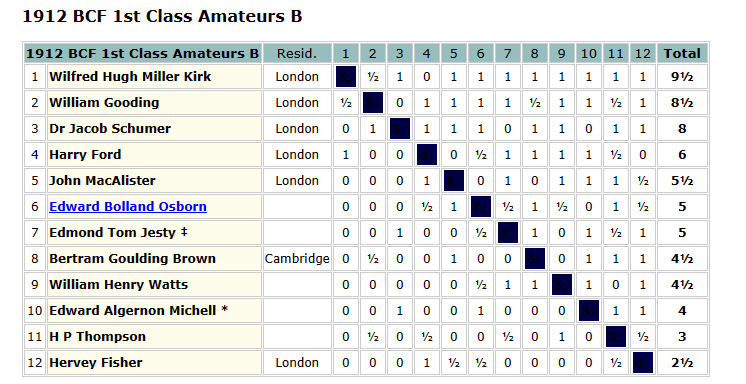
The British Chess Magazine (October 1912) remarked that Mr. W. H. M. Kirk (Putney) is a well-known fine player in the Civil Service League, but does not play much otherwise. With work and family commitments, it was understandable that he wouldn’t have had much time for tournament play.

Unfortunately the only game of his from this event that appears to be extant was his only defeat. For all games in this article, click on any move for a pop-up window.

[pgn]

[Event “BCF-ch 9th First Class B”]
[Site “Richmond, Surrey”]
[Date “1912.08.19”]
[Round “?”]
[White “Ford, Harry”]
[Black “Kirk, Wilfred Hugh Miller”]
[Result “1-0”]
[ECO “C12”]
[Annotator “Tactical Analysis 6.3”]
[PlyCount “53”]
[SourceVersionDate “2023.01.13”]

1. e4 e6 2. d4 d5 3. Nc3 Nf6 4. Bg5 Bb4 5. e5 h6 6. Bd2 Nfd7 {[#]} ({Black should try} 6… Bxc3 $14 7. bxc3 Ne4) 7. Bd3 $146 {C12: French: Classical System: McCutcheon Variation.} ({Predecessor:} 7. Nce2 Bxd2+ 8. Qxd2 c5 9. c3 O-O 10. g3 b6 11. Bg2 Nc6 12. f4 f5 13. Nf3 Ba6 14. h4 Bxe2 15. Kxe2 {½-½ Jeansen,T-Richter,F Goteborg-B Gothenburg 1909}) 7… a6 (7… c5 $16) 8. Qg4 $1 $18 Bf8 {[#]} 9. Nce2 $1 {White is clearly better.} c5 {[#]} 10. c3 Nc6 11. Nf3 Qe7 (11… Nb6 $142 12. O-O g6) 12. O-O g5 13. Qh5 Bg7 14. Ne1 Kd8 15. f4 f6 16. Nf3 cxd4 17. cxd4 (17. Nexd4 Kc7 $16) 17… gxf4 (17… Kc7 $142 18. Qg6 Kb8) 18. Rac1 {aiming for Rxc6!} ({Weaker is} 18. Bxf4 fxe5 19. dxe5 (19. Nxe5 Ndxe5 20. dxe5 Bd7 $14) 19… Kc7 $16) 18… fxe5 $2 {[#]} (18… Kc7 19. exf6 (19. Bxf4 f5 $18) 19… Bxf6 20. Nxf4 (20. Bxf4+ Kb6 $18) 20… Kb8) 19. Rxc6 $1 {Ba5+ would be deadly. Remove Defender} e4 (19… a5 20. Ba6) 20. Bxe4 dxe4 {[#]} 21. Nxf4 $1 bxc6 (21… Re8 22. Rxe6) 22. Ba5+ Nb6 23. Bxb6+ Kd7 24. Ng6 {White wants to mate with Nfe5+.} exf3 25. Nxe7 {Intending Qf7 and mate.} Kxe7 26. Bc5+ Kd8 27. Qf7 {Black got outplayed after the opening. Ingenious play by Ford! Weighted Error Value: White=0.17 (very precise) /Black=0.92} 1-0

[/pgn]

Kirk took part in the Surrey Championship that year, where he finished in first place with a score of 4½/5. This time we do have one of his wins, which his opponent, a dentist usually known as Frank St J Steadman, generously submitted to the British Chess Magazine. It was published in their December 1912 issue.

[pgn]

[Event “Surrey County Championship”]
[Site “?”]
[Date “1912.??.??”]
[Round “?”]
[White “Kirk, Wilfred Hugh Miller”]
[Black “Steadman, Sidney Francis St Jermain”]
[Result “1-0”]
[ECO “C12”]
[Annotator “Tactical Analysis 6.3”]
[PlyCount “87”]

1. e4 e6 2. d4 d5 3. Nc3 Nf6 4. Bg5 Bb4 5. e5 h6 6. Bd2 Bxc3 7. Bxc3 Ne4 8. Bd3 (8. Bd2 $11) 8… Nxc3 $15 {C12: French: Classical System: McCutcheon Variation.} 9. bxc3 {[#]} c5 $1 {[#]} 10. Qg4 $146 (10. Qd2 Nc6) ({Predecessor:} 10. Nf3 Qa5 11. Qd2 Nc6 12. Be2 Bd7 13. Rb1 b6 14. Bb5 Nxe5 15. Bxd7+ Nxd7 16. O-O {0-1 Giersing/Pritzel-Capablanca,J Capablanca consultation Copenhagen 1911}) 10… O-O {And now …Qa5 would win. Black is slightly better.} 11. Qf4 ({Better is} 11. dxc5 $15 Nd7 12. Nf3) 11… c4 (11… Qa5 $17 12. Qd2 (12. Ne2 $2 c4 $19) 12… Nd7) 12. Be2 Nc6 13. Nf3 b5 {Strongly threatening …Qa5.} (13… Qa5 $5 14. Qd2 a6 $15) 14. a3 Bd7 15. O-O Qe7 16. Qe3 Rab8 17. h3 Rb6 18. Nh2 Ra6 19. Qc1 f6 20. f4 (20. exf6 $1 $11 Qxf6 21. Ng4) 20… f5 ({Black should play} 20… Be8 $1 $17) 21. Nf3 Kh7 22. g4 g6 23. g5 h5 24. Nh4 Rb8 25. Rf2 (25. Qb2 $15) 25… Be8 26. Rg2 Ra4 27. Bxh5 gxh5 28. g6+ Kg7 29. Rg5 {[#]} Qf8 $4 (29… Bd7 $1 $19 {and all is fine. Hoping for …Rh8.} 30. Rxh5 Rh8 31. Rxh8 Kxh8) 30. Qd1 Ne7 (30… Rxa3 $2 31. Rxa3 a5 32. Qf3 $18) 31. Qxh5 (31. Rxh5 $2 Nxg6 32. Rg5 Kh7 33. Nxg6 (33. Qh5+ $2 Qh6 $19) 33… Bxg6 $19) (31. Kh2 $18) 31… Qh8 $17 32. Kh2 $2 {[#]} (32. Qf3 Qxh4 33. Rh5 Rxa3 {Deflection} 34. Rxa3 Qe1+ 35. Kh2 Qd2+ 36. Kg3 Nxg6 37. Qf2 Qxf2+ 38. Kxf2) 32… b4 $5 (32… Qxh5 $1 33. Rxh5 Bxg6 $19) 33. Rag1 {Threatens to win with Qh7+. Dancing on a razor blade.} ({But not} 33. Qxh8+ $2 Kxh8 34. cxb4 (34. g7+ $2 Kg8 $19) 34… Rbxb4 35. axb4 Rxa1 $19) (33. Qf3 Rxa3) 33… bxa3 {…Qxh5 would be deadly.} 34. Qh7+ {Decoy} Qxh7 35. gxh7+ Kxh7 (35… Kh8 {is a self mate.} 36. Rg8+ Kxh7 37. R1g7+ Kh6 38. Rxe7) 36. Rg7+ Kh8 37. Rxe7 a2 $2 (37… Ra6 $11 38. Rgg7 (38. Reg7 Bh5 39. R7g5 (39. R1g5 a2 40. Re7 Be8 41. Rgg7 a1=Q 42. Rh7+ Kg8 43. Reg7+ Kf8 44. Rc7 Kg8 45. Rcg7+ $11) 39… Bf7 $19) 38… a2 39. Rh7+ Kg8 40. Reg7+ Kf8 41. Rc7 Kg8 $11) 38. Rxe6 $18 Rb7 39. Rxe8+ {White mates.} Kh7 40. Rgg8 ({Stronger than} 40. Ra1 Rb1 41. Re7+ Kg8 $11) 40… a1=Q 41. Rh8+ Kg7 42. Nxf5+ Kg6 (42… Kf7 43. Rhf8+ Kg6 44. Rf6+ Kh5 45. Rh6#) 43. Nh4+ (43. Ref8 Rf7 (43… Rh7 44. Rf6+ Kh5 45. Rxh7#) 44. Nh4+ Kg7 45. Rfg8#) 43… Kg7 44. Ref8 {Quite a comeback for White. Excellently played by Kirk! Weighted Error Value: White=0.54/Black=0.56 Threat: Nf5+ Kg6 Rf6#} 1-0

[/pgn]

Wilfred entered the 1st Class Open in the 1913 Kent & Sussex Congress but had to withdraw before the start of the tournament. However, he did play in the Major Open section of the 1913 British Championship, making a respectable showing in a strong tournament.
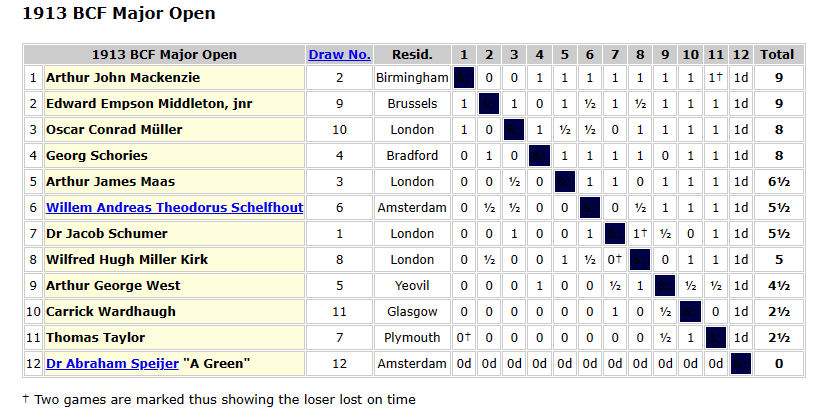
Here’s a loss against the German born but English resident Georg Schories, a regular Major Open competitor whose nationality precluded his participation in the championship.

[pgn]

[Event “British CF-10 Major Open”]
[Site “Cheltenham/ Gloucestershire”]
[Date “1913.08.21”]
[Round “10”]
[White “Kirk, Wilfred Hugh Miller”]
[Black “Schories, Georg”]
[Result “0-1”]
[ECO “C50”]
[Annotator “Tactical Analysis 6.3”]
[PlyCount “44”]
[EventDate “1913.08.11”]
[EventType “tourn”]
[EventRounds “11”]
[EventCountry “GBR”]
[SourceTitle “EXT 2017”]
[Source “ChessBase”]
[SourceDate “2016.10.25”]
[SourceVersion “1”]
[SourceVersionDate “2016.10.25”]
[SourceQuality “1”]

1. e4 e5 2. Nf3 Nc6 3. Bc4 Bc5 4. Nc3 Nf6 5. d3 d6 6. O-O Bg4 7. Be3 Bb6 (7… Nd4 $15) 8. Ne2 {C50: Hungarian Defence and Giuoco Pianissimo.} (8. h3 $11 {remains equal.} Be6 9. Nd5) 8… Bxf3 $17 9. gxf3 Nh5 {[#]} 10. f4 $146 ({Better is} 10. c3 $15) ({Predecessor:} 10. Ng3 Nf4 11. Bb5 Qh4 12. Bxc6+ bxc6 13. Kh1 g6 14. c3 h5 15. d4 f6 16. a4 {½-½ Minckwitz,J-Metger,J DSB Kongress-06 Meisterturnier Breslau 1889 (3)}) 10… Qh4 $19 11. Bxb6 axb6 12. f5 g6 {…gxf5 is the strong threat.} 13. Ng3 (13. Kh1) 13… Nf4 {[#] ( -> …Qh3)} 14. Kh1 Rg8 $2 (14… Qh3 15. Rg1 Nd4) 15. c3 $2 (15. Rg1 {might work better.}) 15… gxf5 ({Don’t go for} 15… Qh3 $2 16. Rg1 $19) 16. exf5 (16. Rg1 Rg6 17. f3) 16… d5 17. Bb5 O-O-O 18. Bxc6 bxc6 19. a4 (19. Re1 $142 Qh3 20. Qf3) 19… Qh3 20. Rg1 {Deflects Qg2+} Rg4 {Black mates.} 21. a5 {[#]} Qxh2+ $3 {Decoy} 22. Kxh2 Rh4# {White got outplayed after the opening. Beautiful play by Schories! Weighted Error Value: White=1.52/Black=0.50} 0-1

[/pgn]

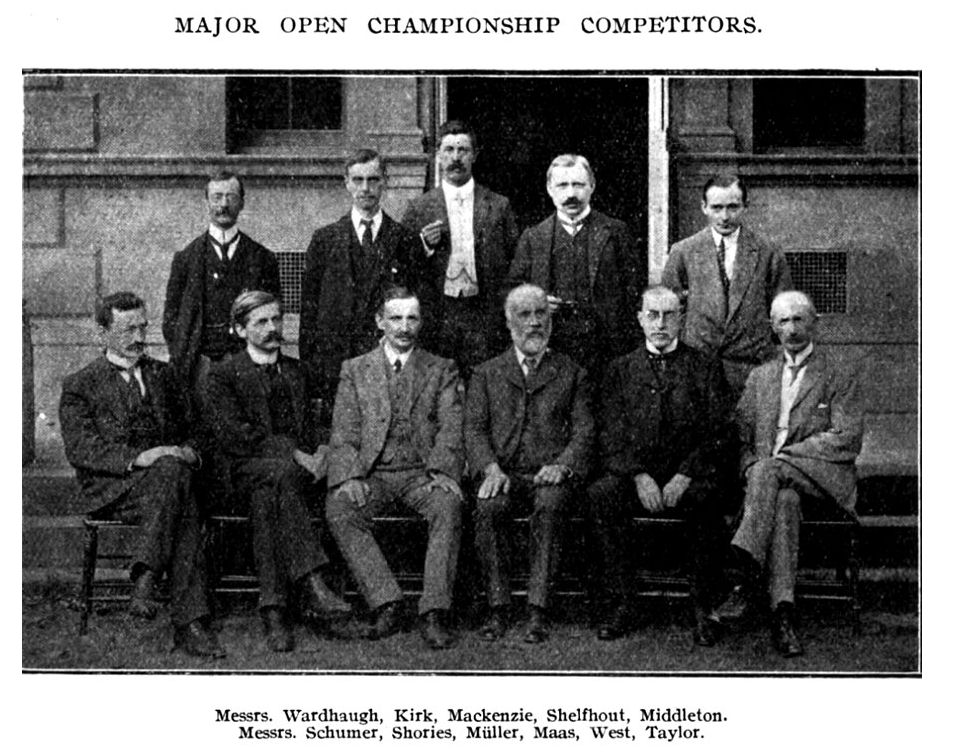
In this photograph of the competitors in this section, Kirk is the good looking youngish man (he was now 35) standing second on the left. He doesn’t look very happy, does he? But then they rarely did in those days.
And then World War 1 intervened. The Civil Service Chess League continued in 1915, but then stopped for the duration, only resuming in 1919.

The British Championships were also suspended, again resuming with a Victory Congress at Hastings in August that year. The British title itself wasn’t awarded, the top section being a semi-international event with visiting stars Capablanca and Kostic taking the first two places, well ahead of Sir George Thomas and Yates. The Major Open went to Edward Guthlac Sergeant, and, below that were three parallel First Class sections. Kirk was in the C section, finishing in first place, beating, amongst others, future World Champion Max Euwe. The enforced break had done nothing to dull his chess strength.
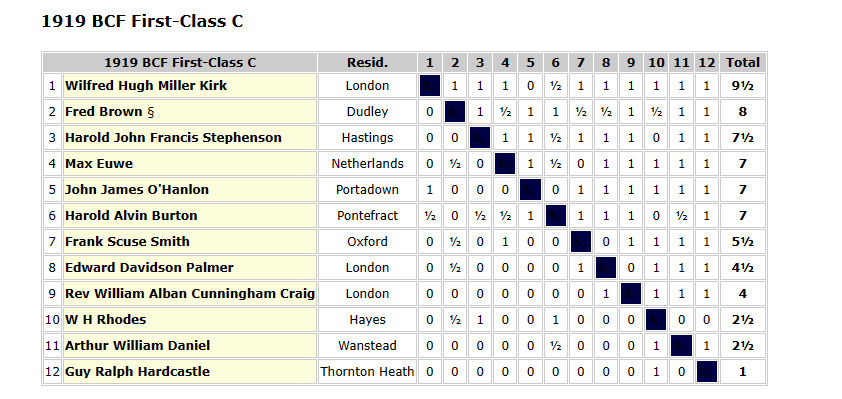
Again, his only loss, against Irish champion John James O’Hanlon, is the only one of his games from this event I’ve been able to locate.

[pgn]

[Event “Victory Congress First Class-C”]
[Site “Hastings”]
[Date “1919.08.??”]
[Round “?”]
[White “O’Hanlon, John James”]
[Black “Kirk, Wilfred Hugh Miller”]
[Result “1-0”]
[ECO “D60”]
[Annotator “Tactical Analysis 6.3”]
[PlyCount “75”]
[EventDate “1919.08.11”]
[EventType “tourn”]
[EventRounds “11”]
[EventCountry “ENG”]
[SourceTitle “EXT 1999”]
[Source “ChessBase”]

1. d4 d5 2. c4 e6 3. Nc3 Nf6 4. Bg5 Nbd7 5. e3 Be7 6. Nf3 O-O 7. Qc2 c6 8. Bd3 dxc4 9. Bxc4 Nd5 10. Bxe7 Qxe7 11. O-O h6 $146 ({Predecessor:} 11… Nxc3 12. Qxc3 c5 13. Rfd1 a6 14. a4 b6 15. Ne5 Bb7 16. Nxd7 Qxd7 17. Be2 Qe7 18. dxc5 Rfc8 19. Qb4 Qxc5 20. Qxc5 Rxc5 {1-0 Michell,R-Sergeant,E British CF-06 Championship Scarborough/ North Yorkshire 1909 (4)}) 12. e4 {D60: Queen’s Gambit Declined: Classical: Unusual White 7th moves.} Nf4 13. Qd2 (13. Rfd1 {simplifies} e5 14. Ne2 Nxe2+ 15. Bxe2 exd4 16. Nxd4 Nf6 17. f3) 13… e5 14. Bb3 {dxe5 is the strong threat. White is slightly better.} Qf6 15. Rad1 Qg6 (15… exd4 $11 {keeps the balance.} 16. Qxd4 Qxd4 17. Rxd4 (17. Nxd4 Ne5 $11) 17… Nc5) 16. g3 $16 (16. Nxe5 $2 Qxg2#) 16… Qg4 $2 {Loses the game.} (16… Qh5 $1 $14) 17. Nxe5 $18 ({Worse is} 17. dxe5 Qxf3 18. Qxf4 (18. gxf4 Nxe5 19. f5 b5 $17) 18… Nxe5 19. Qxf3 (19. Qxe5 Bh3 20. Bxf7+ Kh8) 19… Nxf3+ 20. Kg2 Ng5 $15) 17… Nh3+ {[#]} 18. Kg2 $1 {The board is on fire.} Nxe5 19. dxe5 ({Not} 19. f3 Nxf3 20. Rxf3 Qh5 $11) 19… Ng5 (19… Qh5 {keeps fighting.} 20. f4 Bg4) 20. f4 {White is clearly winning.} Nh7 (20… Qh5 $142 21. fxg5 Bh3+ 22. Kh1 Bxf1) 21. f5 {Active counter play!} Qg5 22. Qxg5 Nxg5 23. h4 Nh7 24. e6 fxe6 25. fxe6 Re8 26. e7+ Kh8 27. Rd8 Bg4 28. Rxa8 Rxa8 29. Bf7 Bd7 30. Rd1 Nf6 31. e5 Nd5 32. Nxd5 cxd5 33. Bxd5 {KRB-KRB} Re8 34. e6 Bb5 35. Be4 Rxe7 36. Rd8+ Re8 37. Rxe8+ Bxe8 38. Bxb7 {Weighted Error Value: White=0.14 (very precise) /Black=0.97. } 1-0

[/pgn]

In 1919 he also entered the City of London Chess Club Championship: the only time he took part in this prestigious event. He finished in 6th place with 6/11 behind Sir George Thomas, a clear winner on 9½, Michell, Walker, EG Sergeant and Blake, whom he beat in this game: a notable scalp.

[pgn]

[Event “City of London Ch 1919-20”]
[Site “?”]
[Date “1920.01.20”]
[Round “?”]
[White “Blake, Joseph Henry”]
[Black “Kirk, Wilfred Hugh Miller”]
[Result “0-1”]
[ECO “C27”]
[Annotator “Tactical Analysis 6.3”]
[PlyCount “64”]
[SourceVersionDate “2020.10.20”]

1. e4 e5 2. Nc3 Nf6 3. Bc4 Bc5 4. d3 c6 5. Qe2 {[#]} O-O $146 ({Predecessor:} 5… d6 6. Bg5 h6 7. Bh4 g5 8. Bg3 Bg4 9. f3 Bh5 10. Nh3 Nbd7 11. Nf2 Bg6 12. h4 Nh5 {1-0 Leonhardt,P-Trimborn,C NED SB International-04 Scheveningen 1905 (4)}) 6. Nf3 {C27: Vienna Game: 2…Nf6 3 Bc4 Nxe4.} d5 7. Bb3 Bg4 ({Black should play} 7… d4 $15 8. Nb1 Nbd7) 8. Bg5 (8. h3 $14 Bxf3 9. Qxf3) 8… d4 $15 9. Nd1 (9. Nb1 $1 $11) 9… h6 10. Bd2 Nbd7 11. h3 Be6 12. Bxe6 fxe6 13. O-O (13. b4 $5 Bd6 14. O-O $11) 13… Qe8 14. Nh2 (14. b4 $5 Bd6 15. Rb1 $11) 14… Nh5 15. g3 {Prevents Nf4.} Ndf6 16. Ng4 Bd6 17. Kg2 Qg6 18. f3 Nh7 19. h4 Rf7 20. Ndf2 Kh8 ({Of course not} 20… Raf8 21. Nh3 $15) 21. Nh3 N7f6 22. Rf2 Raf8 23. Raf1 Nd7 24. Rg1 (24. Kh2 {simplifies} a5 25. a4 Bb4 26. Bxb4 axb4 27. Rg2) 24… Kh7 25. Kf1 Be7 (25… a5 $5) 26. Ke1 $2 {[#] White does not recover from this.} (26. b3 $14 {keeps the upper hand.}) 26… Nxg3 $1 $19 {Remove Defender} 27. Rxg3 (27. h5 Qxh5) 27… Bxh4 28. Nxh6 Qxg3 {Trapped Piece, Double Attack} ({Not} 28… Bxg3 29. Nxf7 Bxf2+ 30. Qxf2 Rxf7 31. Ng5+ Kg8 32. Nxf7 Kxf7 33. Qh2 $15) 29. Nxf7 Rxf7 30. Qf1 (30. Kd1) 30… Rxf3 {Black is clearly winning.} (30… Qxf3 $2 31. Ng5+ Kg8 32. Nxf3 $18) 31. Ng5+ (31. Ke2 $142 Rxf2+ 32. Nxf2) 31… Bxg5 32. Qh1+ Bh4 {Weighted Error Value: White=0.81/Black=0.20 (precise)} 0-1

[/pgn]

Throughout much of his life, Wilfred Kirk seemed to move house every two or three years. He had previously lived in Putney and Wimbledon, but by this time had moved to North London, playing for Hampstead Chess Club and winning the Middlesex Championship in 1920. He had also moved departments in the Civil Service, from the Local Government Board to the Ministry of Health.

Then, in Autumn 1925, he moved to Richmond, living in several addresses in Richmond and Twickenham in the following 12 years or so. He wasted no time in joining Richmond Chess Club, but, in his first match, was only playing on Board 3.
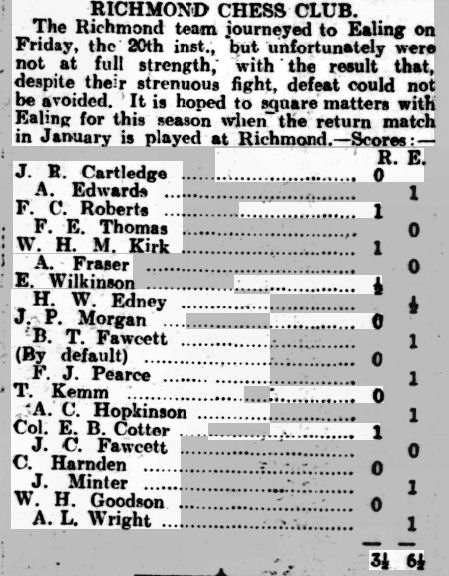
Richmond Herald 28 November 1925

He also entered the Surrey Championship, in 1926 regaining the title he had previously won 14 years earlier.

As an able administrator he was soon appointed secretary of his new club, as reported here, where, on top board, he was successful against our old friend George Archer Hooke.
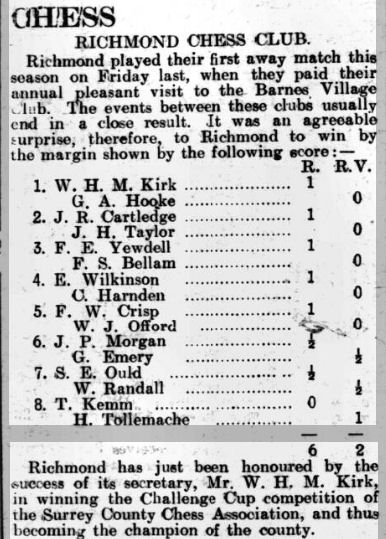
Richmond Herald 20 November 1926

His addresses at this point included 17 The Barons, St Margarets in 1927 and 27 Richmond Hill in 1928.

In the 1928-29 season Kirk swept the board, winning not just the club championship (you’ll see PGL Fothergill in 3rd place: he only seemed to play in internal competitions rather than club matches), but the handicap tournament (one wonders how the scores were calculated) and the prize for the best percentage score in matches.
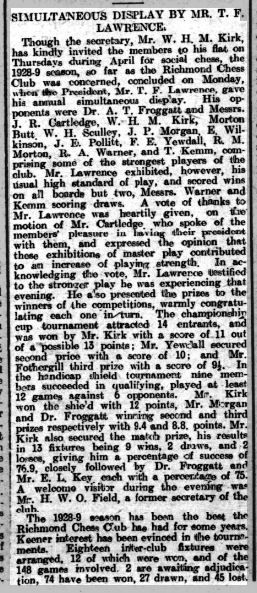
Richmond Herald 30 March 1929

That summer he took part in a Living Chess game against Reginald Pryce Michell at Asgill House in Richmond to raise money for the local hospital.
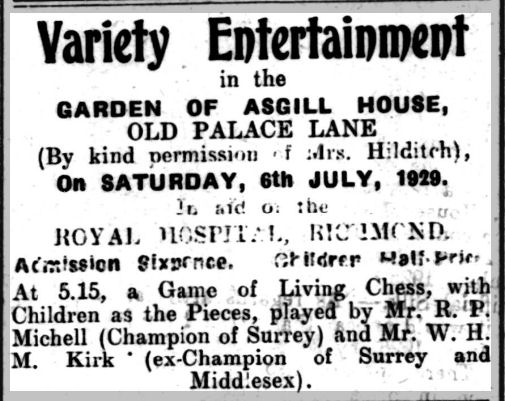
Richmond Herald 22 June 1929

Wilfred was very much involved in charitable endeavours of all sorts, promoting chess at the Star and Garter Home for disabled ex-Servicemen, donating money to a fund for distressed miners, and, later in life. helping at a local home for the blind.

That summer, by then in his 50s,  he unexpectedly received an invitation to take part in the British Championship, held that year in Ramsgate.
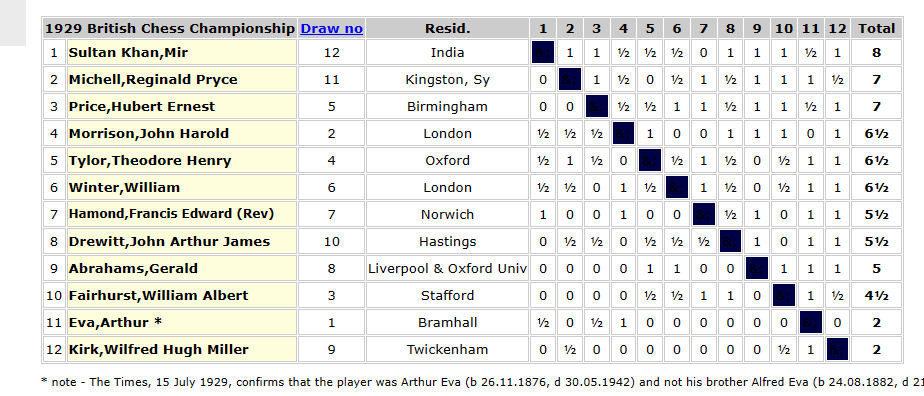
Wilfred was a very effective player top level club opposition, but here, against mostly master standard opponents, he was rather out of his depth.

He lost in 19 moves to Gerald Abrahams: a game which attracted some attention at the time. Abrahams, rather typically, played a speculative sacrifice which Kirk should have accepted, but instead declined it and resigned the next move.

[pgn]

[Event “BCF-ch 22nd Ramsgate”]
[Site “?”]
[Date “1929.08.01”]
[Round “4”]
[White “Abrahams, Gerald”]
[Black “Kirk, Wilfred Hugh Miller”]
[Result “1-0”]
[ECO “C14”]
[Annotator “Tactical Analysis 6.3”]
[PlyCount “37”]
[EventDate “1929.07.29”]
[EventType “tourn”]
[EventRounds “11”]
[EventCountry “ENG”]
[SourceTitle “EXT 2017”]
[Source “ChessBase”]
[SourceDate “2016.10.25”]
[SourceVersion “1”]
[SourceVersionDate “2016.10.25”]
[SourceQuality “1”]

1. e4 e6 2. d4 d5 3. Nc3 Nf6 4. Bg5 Be7 5. e5 Nfd7 6. h4 a6 7. Qg4 Kf8 8. Rh3 $146 {White has more active pieces.} (8. Nf3 $16) ({Predecessor:} 8. Nh3 c5 9. dxc5 Nxe5 10. Bxe7+ Qxe7 11. Qh5 Nbc6 12. f4 Nd7 13. Ng5 Nf6 14. Qe2 Qxc5 15. O-O-O Bd7 {1-0 Boyce,C-Purdy,C AUS-ch Sydney 1926 (7.2)}) 8… c5 $1 $14 {C14: French: Classical System: 4 Bg5 Be7 main line.} 9. Be3 (9. Nf3 $11) 9… cxd4 $15 10. Bxd4 Nc6 {[#] aiming for …h5. Black is slightly better.} 11. Nf3 Nxd4 (11… h5 $5 12. Qf4 Nxd4 13. Qxd4 Qb6 14. Qxb6 Nxb6 $15) 12. Qxd4 Bc5 (12… Qb6 $15 {keeps the upper hand.} 13. Qxb6 Nxb6) 13. Qf4 $16 Qb6 (13… f6 $16 {was called for.}) 14. O-O-O $18 ({Not} 14. Ng5 f6 15. exf6 Nxf6 $11) 14… Qc7 15. h5 {Hoping for h6.} f6 (15… h6 $142) 16. h6 g6 17. Re1 {Threatens to win with Ng5.} Ke8 {[#]} 18. Nxd5 $2 Qd8 (18… exd5 $11 19. exf6+ Kd8 20. Qh4 Nb6 21. f7+ Be7 22. Rxe7 Qxe7 23. Qd4 Rf8 24. Qxb6+ Qc7 25. Qf6+ Qe7 26. Qb6+ $11) 19. exf6 {Weighted Error Value: White=0.60/Black=0.42} 1-0

[/pgn]

Here’s his draw against future Scottish champion and bridge designer William Albert Fairhurst.
[pgn]

[Event “BCF-ch 22nd Ramsgate”]
[Site “?”]
[Date “1929.08.08”]
[Round “?”]
[White “Kirk, Wilfred Hugh Miller”]
[Black “Fairhurst, William Albert”]
[Result “1/2-1/2”]
[ECO “C42”]
[Annotator “Tactical Analysis 6.3”]
[PlyCount “67”]
[SourceVersionDate “2020.10.20”]

1. e4 e5 2. Nf3 Nf6 3. Nc3 Bb4 4. d3 d5 5. exd5 Nxd5 6. Bd2 Nc6 {[#]} 7. Nxd5 $146 {C42: Petroff Defence: 3 Nxe5 and unusual White 3rd moves.} ({Predecessor:} 7. a3 Nxc3 8. Bxc3 Bxc3+ 9. bxc3 Qf6 10. Nd2 Qg6 11. Qf3 O-O 12. Qg3 Qd6 13. Qe3 f5 14. f3 Be6 {0-1 Bauer,C-Alekhine,A Alekhine sim La Plata 1926}) 7… Qxd5 8. Be2 O-O 9. O-O Bg4 10. Bxb4 Nxb4 11. Qd2 Nc6 12. h3 Bh5 13. Qg5 Bg6 14. Nh4 Nd4 15. Bd1 Rae8 16. Re1 ({Don’t play} 16. Bf3 Qb5 17. Qd2 Qxb2 $17) 16… f6 (16… Qb5 $11) 17. Qg3 {aiming for c3.} Nf5 {[#]} 18. Nxf5 ({White should play} 18. Bf3 $1 $16 Qd4 19. Nxf5 Bxf5 20. Bxb7) 18… Bxf5 $11 19. Bf3 Qb5 20. b3 (20. a4 $5 Qxb2 21. Rab1 $11) 20… b6 21. Re2 Qb4 22. Rae1 Rd8 23. Be4 Bxe4 24. Rxe4 Qc3 25. R1e2 Rd4 26. Rxd4 Qxd4 {Endgame KQR-KQR} 27. a4 Rd8 {The position is equal.} 28. Qe3 Qa1+ 29. Re1 Qc3 30. Re2 Rd4 31. g3 h6 32. Qf3 a5 33. Qf5 Qc6 34. h4 {Weighted Error Value: White=0.12 (very precise) /Black=0.15 (very precise)} 1/2-1/2

[/pgn]

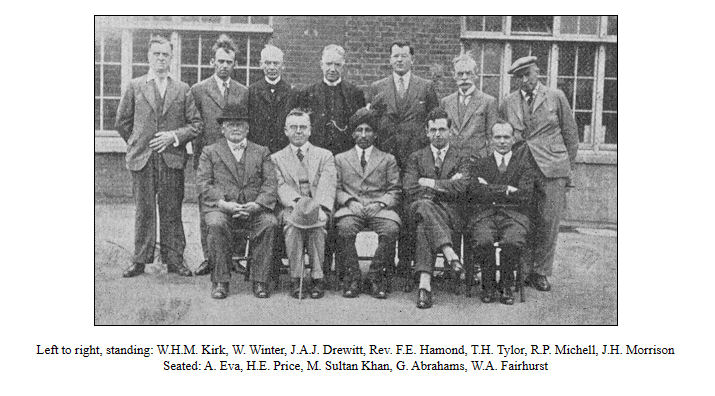
In this group photograph, Kirk is standing on the left next to the permanently disheveled William Winter.

That year there was a merger between Richmond and Kew chess clubs, who, however, continued to meet at both venues on different days of the week. Kirk now had a serious rival in Kew star Ronald George Armstrong, about whom more in a future Minor Piece.

Meanwhile, in 1933, Kirk’s service to chess in the Civil Service was marked by a presentation.
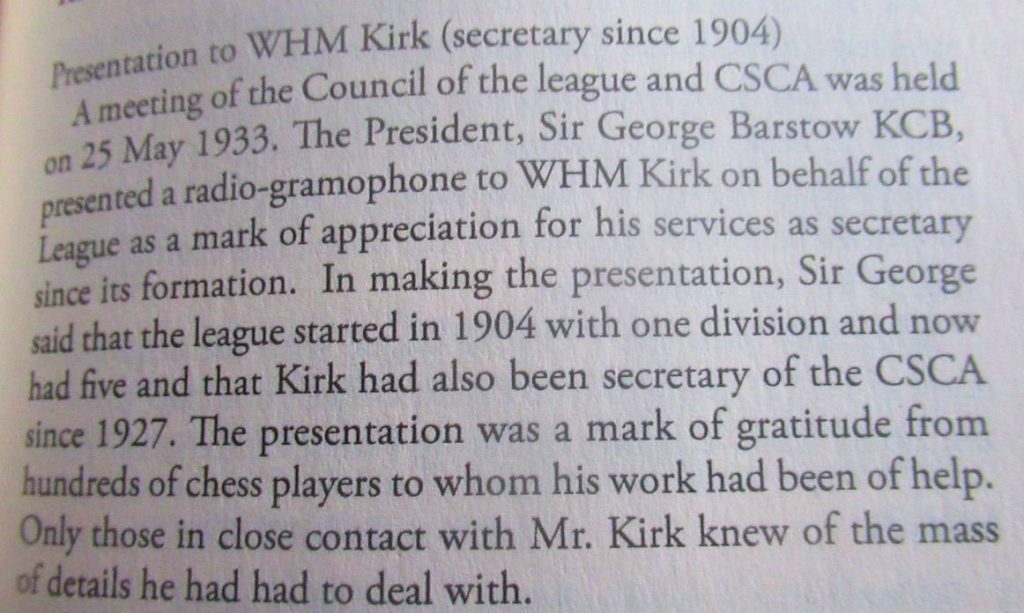
A History of Chess in the English Civil Service (Kevin Thurlow)

This 1934 match must have been a surprise result.
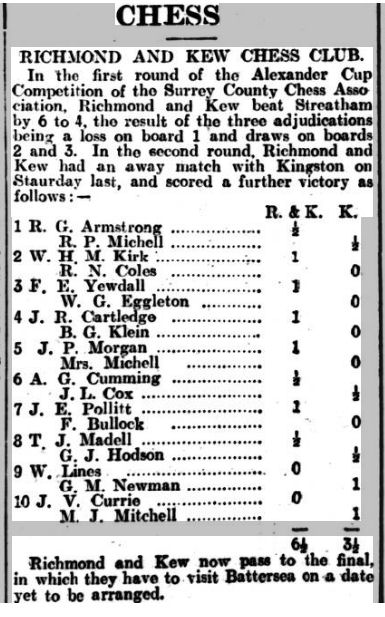
Richmond Herald 21 April 1934

Richmond & Kew were a second division team, playing in the Beaumont Cup, while Kingston, who had won the Surrey Trophy two years earlier, were a genuine first division team. Unfortunately, they lost to Battersea in the final of the Alexander Cup.

Armstrong must have been very pleased with his draw against Michell, while Kirk also shared the point with (Richard) Nevil Coles, who later became a celebrated chess author and who beat me in a Richmond v Guildford Surrey Trophy match in 1972.
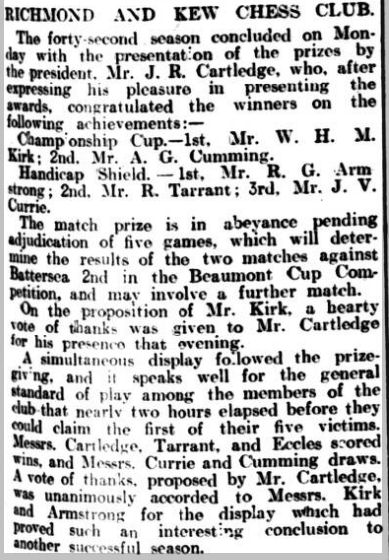
Richmond Herald 06 April 1935

In the 1934-35 season Kirk won the club championship while Armstrong took the handicap shield: they gave a tandem simul at the end of season prizegiving.
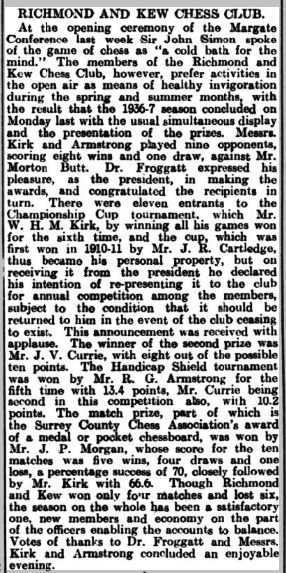
Richmond Herald 10 April 1937

It was the same story in 1937, with Kirk taking the club  championship for the sixth time with a 100% score, and Armstrong again preferring the handicap shield. Wilfred was now entitled to hold the cup in perpetuity, but generously returned it for future years. I wonder what happened to it.

At this point, though, Wilfred Kirk retired from the Civil Service, spending some time travelling round Europe playing chess before moving, like many retired chess players of the time, to Hastings.

However, he competed in the 1938 British Championships in Brighton, now down in the First Class B section, where he shared first place on 7/11, winning this miniature.

[pgn]

[Event “British CF-31 First Class B”]
[Site “Brighton/ East Sussex”]
[Date “1938.08.11”]
[Round “?”]
[White “Kirk, Wilfred Hugh Miller”]
[Black “Knight, A(rthur?) H(enry?)”]
[Result “1-0”]
[ECO “C67”]
[Annotator “Tactical Analysis 6.3”]
[PlyCount “27”]
[EventDate “1938.08.08”]
[EventType “tourn”]
[EventRounds “11”]
[EventCountry “GBR”]
[SourceTitle “EXT 2017”]
[Source “ChessBase”]
[SourceDate “2016.10.25”]
[SourceVersion “1”]
[SourceVersionDate “2016.10.25”]
[SourceQuality “1”]

1. e4 e5 2. Nf3 Nc6 3. Bb5 Nf6 4. O-O Nxe4 5. Re1 Nc5 $146 {[#]} (5… Nd6 $14 6. Bf1 Be7 7. Nxe5 Nxe5 8. Rxe5 O-O) ({Predecessor:} 5… f5 6. d3 Nd6 7. Bxc6 dxc6 8. Rxe5+ Kf7 9. Bg5 Qd7 10. Re7+ Bxe7 11. Ne5+ {1-0 Pearsall,A-White corr 1935}) 6. d4 $1 $18 {White is clearly winning. C67: Ruy Lopez: Berlin Defence: 4 0-0 Nxe4.} ({Less strong is} 6. Nxe5 Ne6 $16) 6… Na6 (6… f6 $142 7. dxc5 Bxc5) 7. d5 {Deflection} ({Weaker is} 7. dxe5 Nc5 $16) 7… Ne7 8. Nxe5 {Threatens to win with Qf3.} c6 9. Bxa6 {aiming for d6!} bxa6 10. Qf3 Qa5 11. Qxf7+ Kd8 12. Bd2 Qc5 {[#]} 13. d6 $1 {Deflection} Qxd6 14. Ba5+ {White took control after the opening. Weighted Error Value: White=1.20/Black=3.61}1-0


[/pgn]

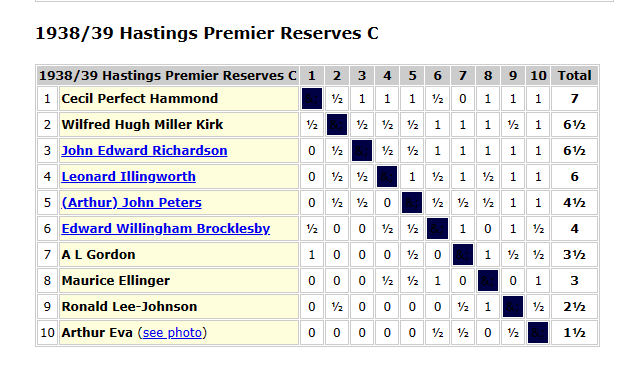
He was soon involved in administration again, both at Hastings Chess Club, and with their annual tournament. He also found time to compete in the 1938-39 event, sharing second place in the Premier Reserves C section.
He also threw himself into county chess, here losing to another former Civil Service player Bernard Henry Newman Stronach.
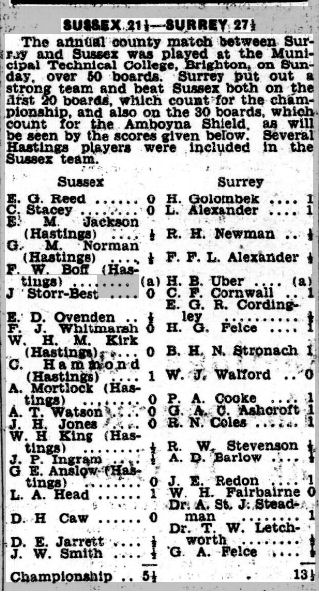
Hastings and St Leonards Observer 15 April 1939

By now the world was at war again, but Hastings managed to arrange their annual tournament that winter, with Kirk taking part in the Premier.
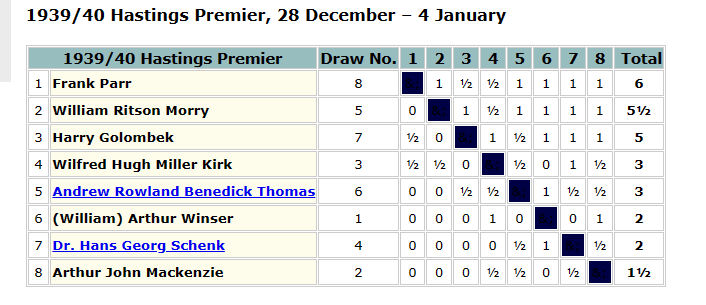
In this game he held the tournament winner Frank Parr to a draw, sacrificing a knight for a perpetual check.

[pgn]

[Event “Hastings Premier 1939/40”]
[Site “?”]
[Date “1940.01.01”]
[Round “?”]
[White “Kirk, Wilfred Hugh Miller”]
[Black “Parr, Frank”]
[Result “1/2-1/2”]
[ECO “B73”]
[Annotator “Tactical Analysis 6.3”]
[PlyCount “55”]
[SourceVersionDate “2020.10.20”]

1. e4 c5 2. Nf3 d6 3. d4 cxd4 4. Nxd4 Nf6 5. Nc3 g6 6. Be2 Bg7 7. Be3 O-O 8. O-O Nc6 9. Nxc6 bxc6 {[#]} 10. Qc1 $146 {B73: Sicilian Dragon: Classical System without 9 Nb3.} ({Predecessor:} 10. Qd2 Re8 11. Rad1 Qc7 12. h3 Rb8 13. b3 Rd8 14. e5 Ne8 15. Bf4 Bf5 16. exd6 exd6 17. Na4 Be5 18. Bxe5 dxe5 {0-1 Kraemer,A-Seitz,J Dortmund International-01 1928 (2)}) 10… Qc7 11. Bh6 Rb8 {And now …Bxh6 would win.} (11… Bxh6 {looks sharper.} 12. Qxh6 Qb6 13. Rfb1 a5) 12. Bxg7 Kxg7 13. Bf3 Rd8 14. Rd1 e5 (14… d5 {is interesting.} 15. exd5 Bg4 16. Rd3 Bxf3 17. d6 exd6 18. Rxf3 d5) 15. b3 Be6 16. Qe3 {[#]} (16. Re1 $11 {keeps the balance.}) 16… d5 $1 $17 {aiming for …d4.} 17. Qe1 d4 18. Ne2 (18. Nb1 $17) 18… c5 $19 19. Ng3 Bd7 ({Black should try} 19… c4 $19 {White must now prevent …a5.} 20. Qd2 Rdc8) 20. Be2 $17 Rf8 (20… Be6 $17 {Threatens to win with …c4.} 21. Qd2 h6) 21. f3 Ne8 22. Bd3 Nd6 23. Qd2 c4 ({Better is} 23… f6 $17) 24. bxc4 $11 Nxc4 25. Bxc4 Qxc4 {[#]} 26. Nh5+ $1 Kh8 {[#]} (26… gxh5 $5 27. Qg5+ $8 Kh8 28. Qf6+ Kg8 29. Qg5+ Kh8 30. Qf6+ Kg8 31. Qg5+ Kh8 $11) 27. Qh6 gxh5 28. Qf6+ {Weighted Error Value: White=0.33/Black=0.30} 1/2-1/2

[/pgn]

Although it was no longer possible to run formal competitions, Hastings Chess Club remained active during the war, with friendly matches against local rivals Eastbourne and Bexhill.

His opponent in this game, George Edward Anslow, a Gas Company clerk, was a member of both Eastbourne and Hastings Chess Clubs for many years. He beat me in a 1974 friendly match between Hastings and Richmond & Twickenham Chess Clubs.

[pgn]

[Event “Eastbourne v Hastings”]
[Site “?”]
[Date “1940.04.06”]
[Round “?”]
[White “Anslow, George Edward”]
[Black “Kirk, Wilfred Hugh Miller”]
[Result “0-1”]
[ECO “D66”]
[Annotator “Tactical Analysis 6.3”]
[PlyCount “62”]
[SourceVersionDate “2020.10.20”]

1. d4 Nf6 2. c4 d5 3. Nc3 e6 4. Nf3 Nbd7 5. Bg5 Be7 6. e3 O-O 7. Rc1 c6 8. Bd3 Re8 9. O-O dxc4 10. Bxc4 Nd5 11. Bxe7 Qxe7 12. Qd2 {[#] D66: Queen’s Gambit Declined: Classical: Main Line (7 Rc1 c6 8 Bd3).} N5f6 $146 ({Black should try} 12… Nxc3 $14 13. Qxc3 (13. Rxc3 e5 $14) 13… e5) ({Predecessor:} 12… Nxc3 13. Qxc3 e5 14. Qb3 e4 15. Ng5 Rf8 16. Nh3 Nb6 17. Nf4 Nxc4 18. Qxc4 g5 {½-½ Rebnord,S-Cruz Bulnes,D Olympiad-08 Preliminaries D Buenos Aires 1939 (1)}) 13. Rfd1 e5 14. Ng5 {White is better.} Rf8 15. Nge4 Nxe4 16. Nxe4 exd4 17. Qxd4 Nb6 (17… c5 $5 18. Qd3 Ne5 $11) 18. Bb3 Bg4 19. f3 Be6 20. Bxe6 Qxe6 21. b3 Nd5 22. Rd3 Rfe8 23. Nc5 Qe7 24. e4 $2 {[#]} (24. Rcd1 $11 {and White has nothing to worry.}) 24… Nf4 $19 25. Rd2 {Inhibits Ne2+.} Rad8 26. Qc3 Qg5 $40 {Black is up to no good.} (26… Rxd2 $17 27. Qxd2 Qg5) 27. Kf1 {This costs White the game.} (27. Rcc2 $11) 27… Rxd2 28. Qxd2 Rd8 29. Qc2 {[#]} Nxg2 $1 {Deflection} 30. Qc3 (30. Qf2 Qxc1+) 30… Nf4 {( -> …Qg2+)} 31. Kf2 b6 {Weighted Error Value: White=1.31/Black=0.35} (31… Nh3+ $142 32. Kf1 Qg1+ 33. Ke2 Nf4#) 0-1

[/pgn]

Frederick William (Fred) Boff, whom he defeated in this game, seems to have been an interesting character both on and off the chessboard.

[pgn]

[Event “Hastings v Bexhill”]
[Site “?”]
[Date “1943.11.13”]
[Round “?”]
[White “Boff, Frederick William”]
[Black “Kirk, Wilfred Hugh Miller”]
[Result “0-1”]
[ECO “C58”]
[Annotator “Tactical Analysis 6.3”]
[PlyCount “74”]
[SourceVersionDate “2020.10.20”]

1. e4 e5 2. Nf3 Nc6 3. Bc4 Nf6 4. Ng5 d5 5. exd5 Na5 6. Bb5+ c6 7. dxc6 bxc6 8. Qf3 {[#]} Bb7 $146 {[#]} (8… cxb5 $15 {keeps the upper hand.} 9. Qxa8 Bc5) ({Predecessor:} 8… Qc7 9. Bd3 Bd6 10. Nc3 h6 11. Nge4 Nxe4 12. Bxe4 Bd7 13. Nb5 Qb8 14. Nxd6+ Qxd6 15. b3 O-O-O 16. Bb2 Rhf8 17. Bf5 {1-0 Van Steenis,H-Wijnans,A Hoogoveens (6-players) Beverwijk 1942 (1)}) 9. Be2 {C58: Two Knights: 4 Ng5 d5 5 exd5 Na5 sidelines.} (9. Ba4 $1 $16) 9… c5 $2 (9… Be7 $1 $11 {and Black stays safe.}) 10. Bb5+ $18 Ke7 11. Qc3 (11. Qe2 $18 Qd4 12. Nf3) 11… Qc7 $16 12. b4 (12. O-O $18) 12… Nd5 $14 13. Qxc5+ ({Much weaker is} 13. Qf3 $6 Nf4 14. Qc3 Bxg2 $11) 13… Qxc5 14. bxc5 Nf4 15. f3 {[#] aiming for d4!} f6 16. Ne4 Nxg2+ 17. Kf2 Nh4 (17… Bxe4 $142 18. fxe4 Nf4) 18. d3 Ke6 19. Nbc3 ({Better is} 19. Nbd2 $16) 19… Rc8 $36 {Against d4. Black is pushing.} 20. Ba3 {White is now going downhill.} (20. d4 $11 exd4 21. Re1) 20… f5 $19 {The board is on fire.} 21. Ng5+ (21. Nd2 {might work better.} Bxc5+ 22. Bxc5 Rxc5 23. Nc4 Bxf3 24. Rhb1) 21… Kf6 22. c6 (22. d4 $142 exd4 23. Ne2) 22… Bxa3 {Black is clearly winning.} ({Stronger than} 22… Kxg5 23. Bc1+ (23. cxb7 $2 {perishes.} Rxc3 24. b8=Q Bc5+ {Discovered Attack} 25. Bxc5 Rxc2+ 26. Kf1 Rxb8 $19) 23… Kh5 24. cxb7 Nxb7 25. Ne2 $17) 23. Nce4+ fxe4 24. Nxe4+ Ke7 25. cxb7 Rxc2+ 26. Kg3 Nf5+ 27. Kg4 Ne3+ 28. Kh3 Nxb7 {…Nc5 would be deadly.} 29. Ba4 Rc7 30. Rab1 Rf8 31. Kg3 Nd6 32. Rhe1 Ndf5+ 33. Kf2 Nc2 34. Rg1 g6 35. Rb5 Bd6 36. Rgb1 Nfd4 37. Rb7 Rxf3+ {An entertaining game by Kirk. Weighted Error Value: White=0.79/Black=0.30} 0-1

[/pgn]

He was still very active locally as the war finally came to an end, and was involved in the administration of the 1945-46 Hastings Congress as Treasurer and Assistant Secretary. In June that year, still playing regularly in club events, he was taken ill with appendicitis. The operation, sadly, proved unsuccessful.
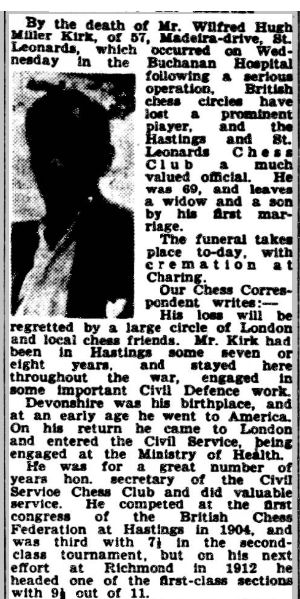
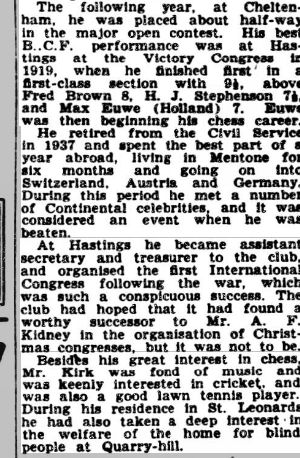
Hastings and St Leonards Observer 22 June 1946

There’s more information in this pen picture from Kevin Thurlow’s book on chess in the English Civil Service.
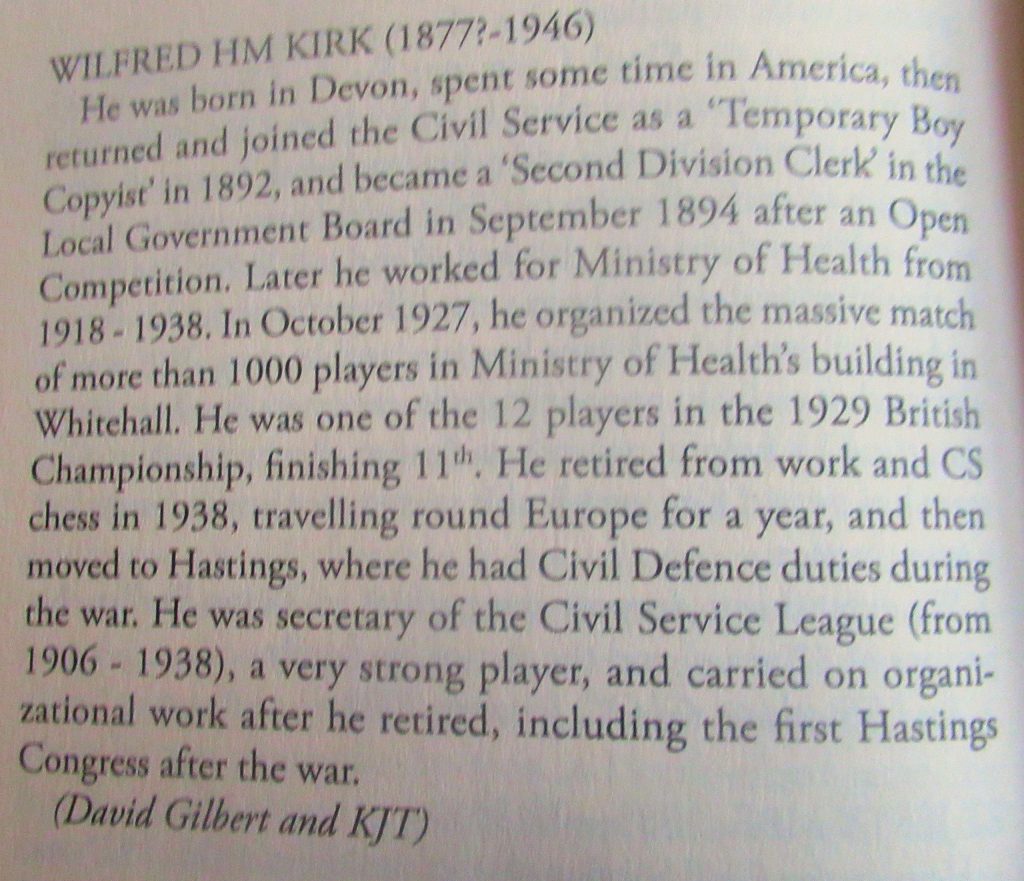
A History of Chess in the English Civil Service (Kevin Thurlow)

Wilfred Hugh Miller Kirk, then, was a strong player (2261 at his peak according to EdoChess) and a highly efficient administrator. He seems to have  been well respected at work and was also devoted to various charitable causes.

His family life, though, wasn’t happy.

In the 1901 census we see Wilfred and Mabel, only recently married, and living in Pimlico.

They soon moved south of the river, the births of their first three children being registered in Wandsworth, and the youngest in Balham.

By 1911 the family had split up. Wilfred was living on his own in Streatham, a Second Division Clerk in the Civil Service. Mabel didn’t appear to be around. Talbot, Beatrice and Evelyn (aged 9, 7 and only 4) were boarding at a school in Wimbledon, while 2-year-old Ruby was living with Wilfred’s mother in Battersea.

Then, in 1914, Mabel filed a petition for judicial separation. She was represented by her solicitor, PR Gibbs, who, I’d imagine, was the same Percy Rawle Gibbs who had played Wilfred at Sevenoaks in 1908.

Mabel’s petition, citing eight addresses, mostly in the Wandsworth area, at which they lived during their marriage, listed dates and places, from 1906 onwards, when and where Wilfred had assaulted her, and treated her with coldness and neglect. He had punched her on her body and head, thrown her against the furniture and onto the floor, grabbed her by the collar and dragged her upstairs. Wilfred denied the charges of cruelty, claiming that Mabel had become mentally deranged and assaulted him violently, and he was only acting in self-defence. On other occasions she had become hysterical and behaved in an ill tempered and unreasonable manner, causing him to lose his temper.

It was also revealed that, from late 1910, she had been a patient at St Luke’s Hospital: she was probably still there at the time of the 1911 census.

The separation was granted, with Mabel having custody of the two older children and Wilfred the two younger children. Would a man who had assaulted his wife, even with provocation, be given custody of two young girls today?

Was he a violent and abusive wife beater whose behaviour had driven his wife to the lunatic asylum, or a good man who found it difficult to cope with his wife’s mental health problems? I don’t know: I wasn’t there and it’s far from me to pass judgement.

The ramifications continued for a decade (the papers are available online at ancestry.co.uk).

The 1921 census found Wilfred now living in Islington with Evelyn and Ruby, who were both at school. Mabel and Beatrice, now an art student, were the other side of London, in South Norwood. Meanwhile, Talbot had emigrated to the USA, where he married in 1927 and had two sons, Fred (1928-76) and Jack (1929-67).

His marriage didn’t last and he returned to England. The 1933 Electoral Roll shows Mabel, Talbot and Beatrice sharing a house right by Hampstead Heath.

Then, in 1934, Wilfred sued Mabel for divorce on the grounds of adultery.
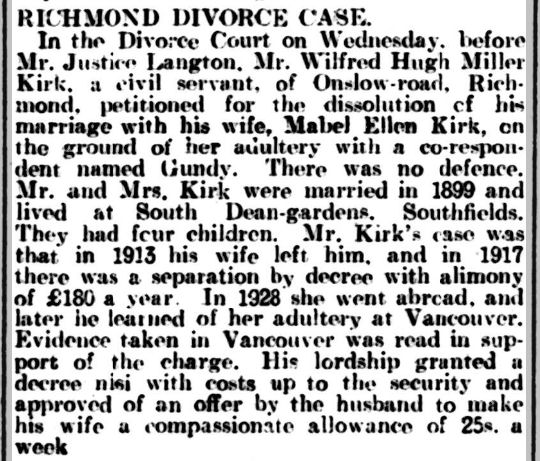
Richmond Herald 03 February 1934

Well, I don’t know. In September that year he married Olive Emily Holmes. Was he committing adultery as well? Again, I wasn’t there.

What happened to the rest of his family? Talbot remarried in 1941 in Brentford, at some point moving to Yorkshire, where he died in 2006 at the extraordinary age of 104.

Beatrice never married: by 1939 she was working as a typist in the Ministry of Food, and died in Hastings at the age of 78.

Evelyn married young, in 1926, to a man almost twice her age, George Arthur Tomlinson, who seems to have been a mechanical engineer working at the National Physical Laboratory in Teddington. They lived with Wilfred for a time after the marriage before moving to North London where two sons, Brian (1928) and Robin (1930) were born. George died in 1944, but Evelyn, like her brother, lived a long life, dying in Bath at the age of 96.

Ruby married in 1939, like Evelyn to a much older man: a divorcee with the impressive name Bernard de Lerisson Cazenove. She had no children and, again like Evelyn, lived into her 90s: she was 91 when she died in Warwickshire.

The report of Wilfred’s cremation leaves some questions unanswered. You might have wondered why the local paper mentioned that he left a son, but failed to note his daughters.
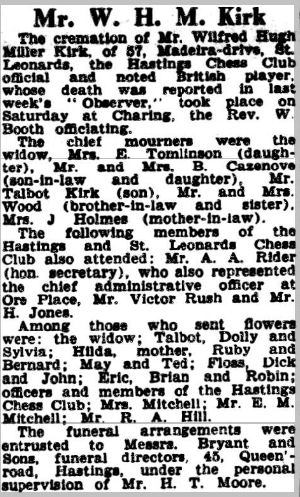
Hastings and St Leonards Observer 22 June 1946

At the cremation, Talbot, Evelyn and Ruby were there, but there was no mention of Beatrice as a chief mourner. Did the paper forget her? Or had they become estranged?

Talbot, Dolly and Sylvia sent flowers, but who were Dolly and Sylvia? There were also flowers from Eric, Brian and Robin. Brian and Robin were his grandsons, but who was Eric? And why wasn’t Evelyn included? Her second marriage, in 1948, would be to Ernest (Vokes), not to Eric. Or was ‘Eric’ a misreading of ‘Evelyn’?

There’s one further family tragedy to report.
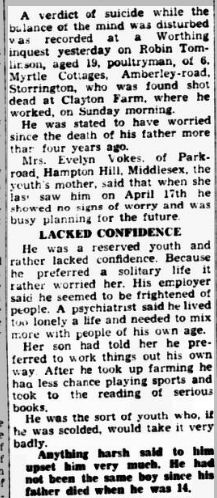
Worthing Gazette 26 April 1950

This is Wilfred and Mabel’s grandson Robin taking his own life in 1950, at the age of 19.

Had he inherited mental health problems from his mother? Impossible to tell, of course.

Although Wilfred Hugh Miller Kirk was a formidable club player and respected administrator, it seems that his family life was unsettled (moving house every couple of years) and unhappy. I can only hope that the game of chess brought him some comfort.


Sources:

ancestry.co.uk

findmypast.co.uk

British Newspaper Library

Wikipedia

BritBase (John Saunders)

EdoChess (Kirk’s page here)

chessgames.com (Kirk’s page here)

British Chess Magazine 1912

A History of Chess in the English Civil Service (Kevin Thurlow: Conrad Press)

The City of London Chess Club Championship (Roger Leslie Paige: Publish & be Damned)

Hastings & St Leonards Chess Club website (Brian Denman article here)