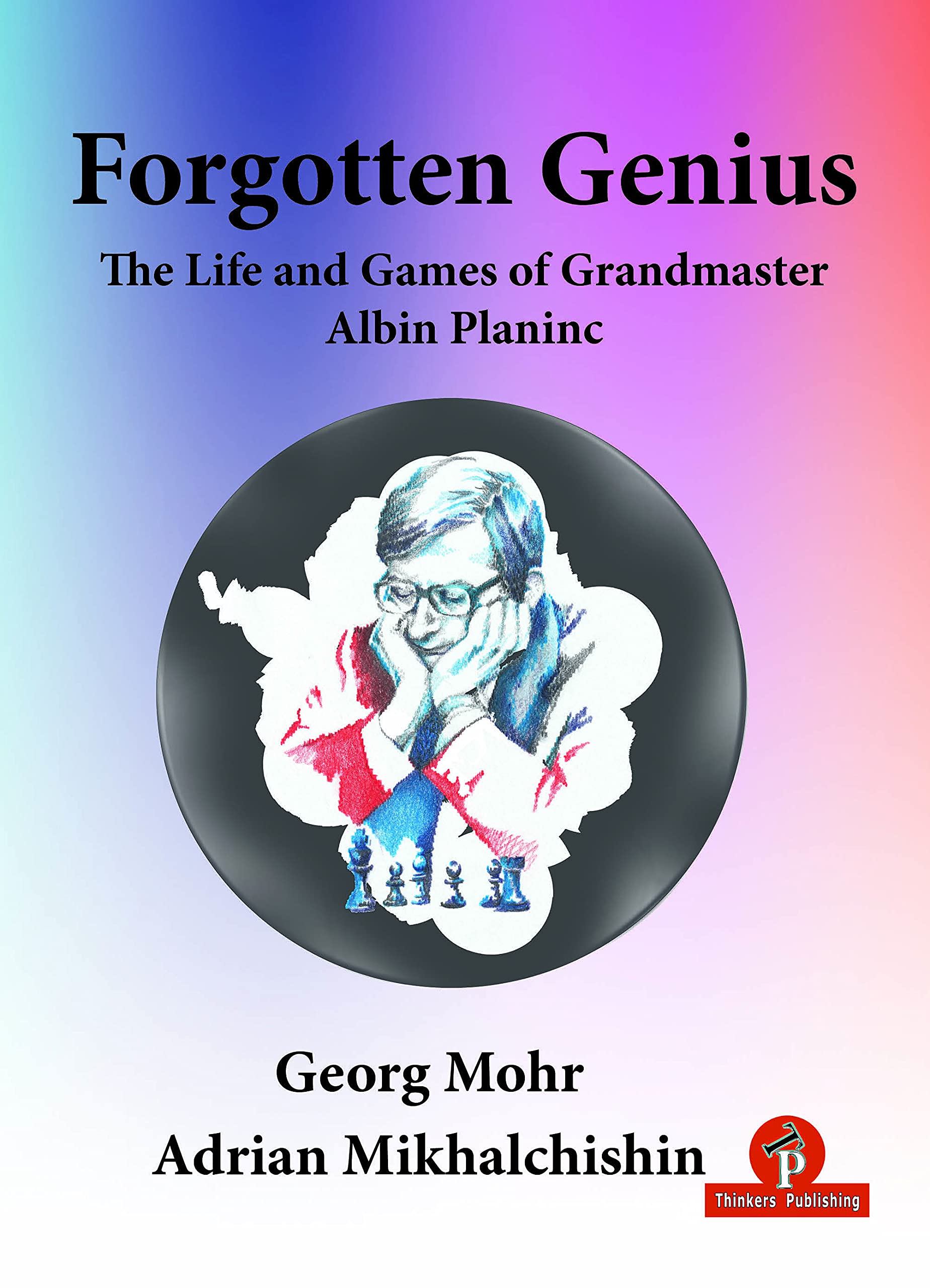
Forgotten Genius – The Life and Games of Grandmaster Albin Planinc, Georg Mohr & Adrian Mikhalchishin, Thinker’s Publishing, 20th September 2021, ISBN-13 : 978-9464201291
From the publisher we have:
“Albin Planinc was born in the middle of the Second World War, on 18th April 1944, in the little village of Briše, near the small town of Zagorje ob Savi, approximately 30 kilometers from Ljubljana, the capital of Slovenia. He spent his childhood with his mother Ljudmila (unofficially Milka), a simple, uneducated woman who earned money from various unskilled jobs’.
This fascinating biography of over eighty-five annotated games and stories are being presented by grandmasters Georg Mohr and Adrian Mikhalchishin. It covers Planinc’ entire life and chess career, including his most fascinating games. This fitting tribute of a forgotten chess genius should be found in anyone’s chess library. Thanks to this colorful book Albin Planinc will continue to inspire us all and will keep his spirit alive.”
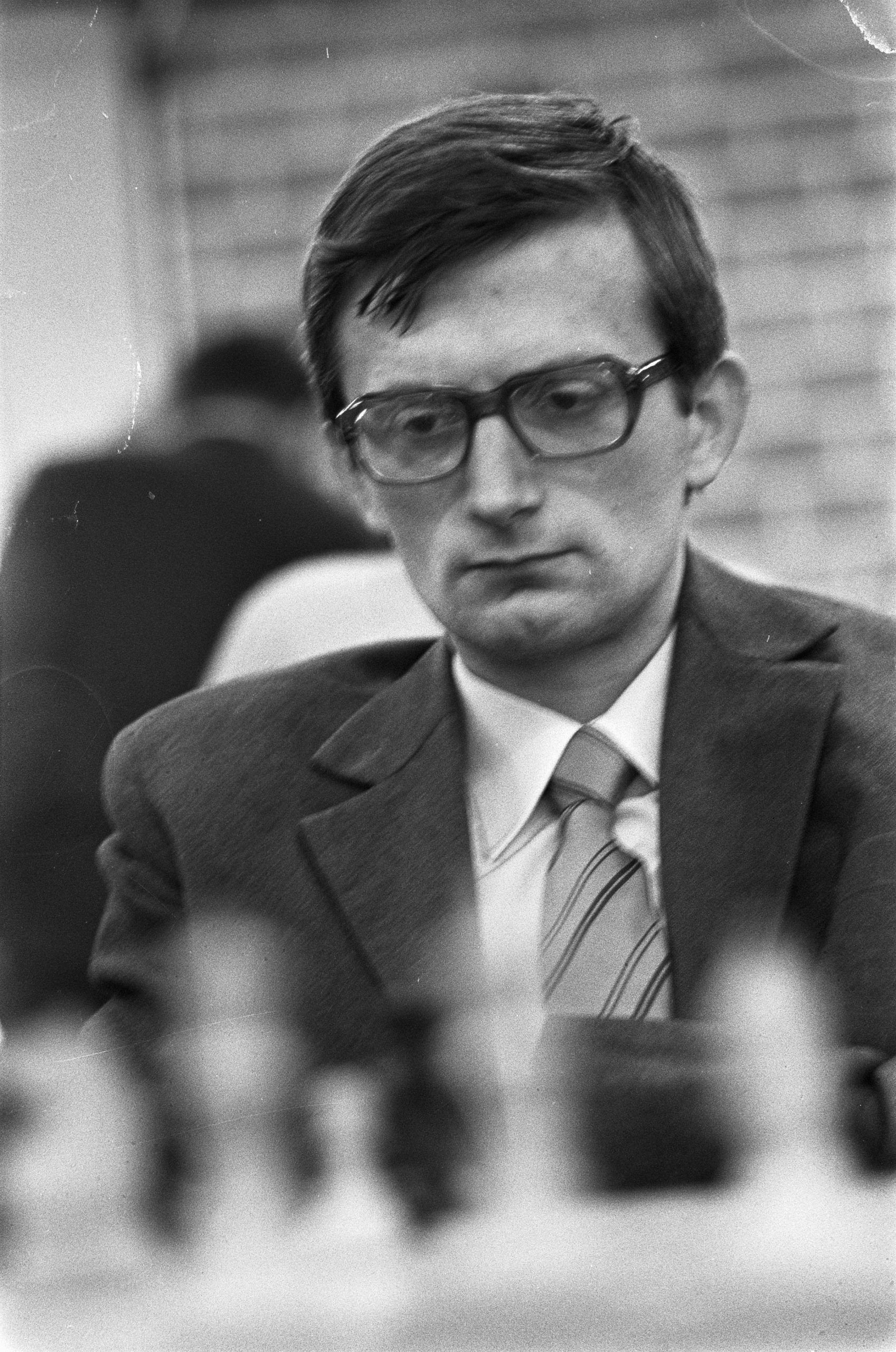
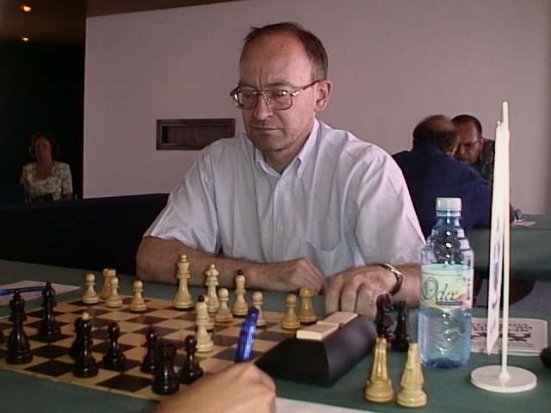
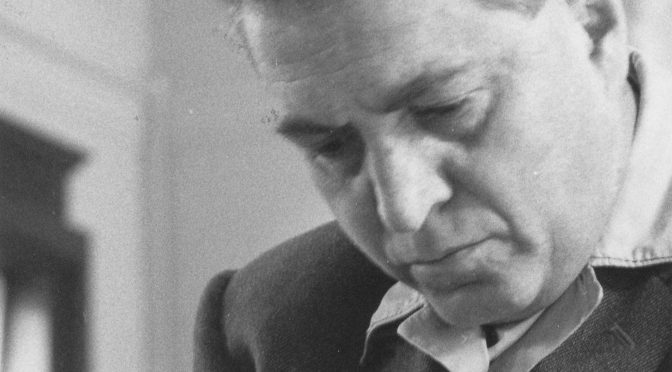
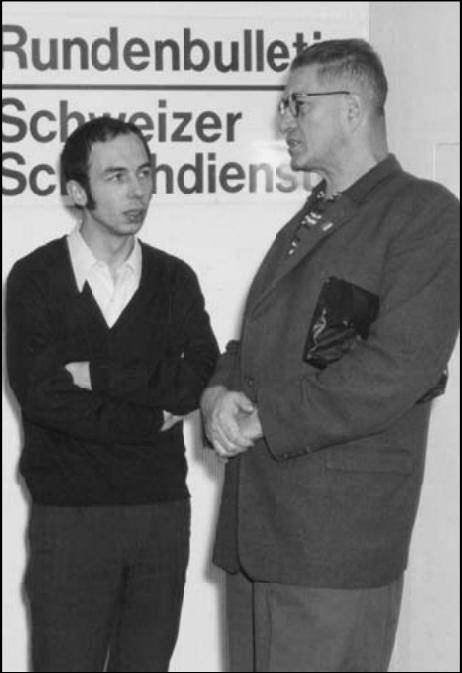
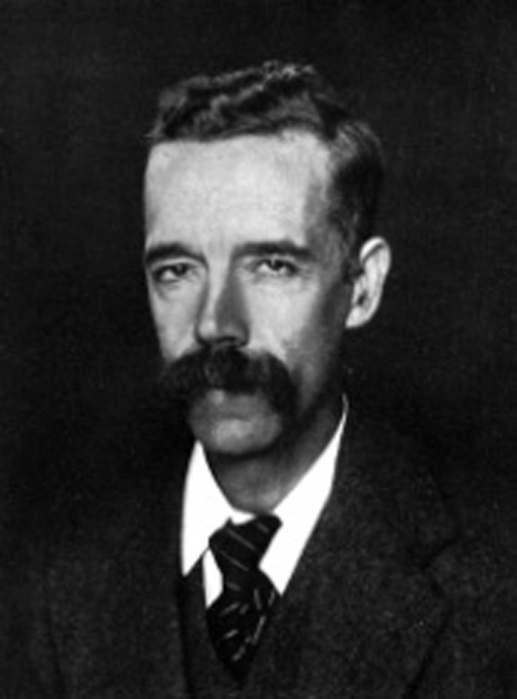
GM Albin Planinc, circa 1973
About the authors we have:
“Georg Mohr was born in Maribor, Slovenia in 1965 becoming a Grandmaster in 1997. He joined as a member of the FIDE Trainers Commission from 2002, becoming a FIDE Senior Trainer in 2004 and a FIDE International Organizer in 2011. Georg has been a professional chess trainer for many years. He was coach and captain of Slovenian national team from 2003 – 2010 and since 2011 he has been Turkish national youth trainer. He is a chess writer and was editor of Slovenian chess magazine Šahovska Misel from 1999 and editor of Fide Trainers Commission trainers’ surveys. He is also an organiser of chess events acting as tournament director of the European Club Cup (Rogaška Slatina 2011), the World Youth Championship (Maribor 2012) and the World Senior Championship (Bled 2018). This is his second book for ‘Thinkers Publishing’.
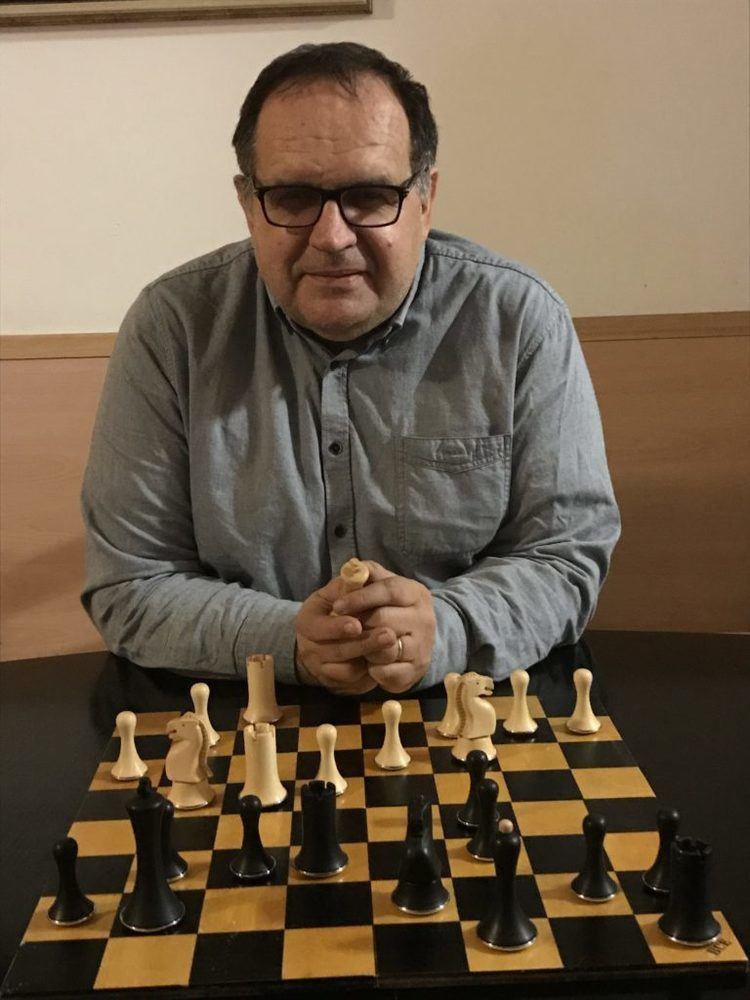
FIDE Senior Trainer Georg Mohr
Adrian Bohdanovych Mikhalchishin was born in Lvov, Ukraine in 1954 and became a Grandmaster in 1978. In 1995 he took Slovenian citizenship and became a FIDE Senior Trainer from 2002 and was chairman of FIDE Trainers Commission from 2009. Adrian was a trainer of many famous chess players. Amongst others he was in Anatoly Karpov’s team during matches with Garry Kasparov. He has worked with Maja Chiburdanidze, Nana Aleksandria, the Polgar sisters, Alisa Maric and Nana Dzagnidze. He was coach and captain of the national teams of Slovenia and the Netherlands. In recent years he has been coach of the Turkish woman team. He has written many chess books and thousands of articles for many chess magazines. This is his second book for ‘Thinkers Publishing’.”
FIDE Senior Trainer GM Adrian Mikhalchishin
Albin Planinc (1944-2008), the late Slovenian grandmaster, was an extraordinary chess player and so the title ‘Forgotten Genius’ is not hyperbole.
Planinc’s games are characterised by enormous energy and by creative, daring sacrificial play. Mohr and Mikhalchishin have selected eighty-six of his best games for this volume.
They assert rightly on page 9 that ‘the reader of this book will soon discover that these games are not commonplace. They are imbued with incredible energy, interwoven with so many imaginary climaxes, with so much of what most people think of as beautiful in chess’.
It is very much a labour of love as Mohr, himself a Slovenian grandmaster, sees Planinc as the player who inspired him to dedicate his life to chess. However the book is not only games; plenty of biographical material is provided.
Indeed, the book starts with a brief synopsis of Albin’s childhood positing that Albin’s unidentified father may well have been a German soldier. Hence it is reasonable to speculate that Albin’s childhood was clouded by shame and stigma as well as being marred by the evolving mental illness of his mother, Ljudmila.
Parallels with a certain Robert James Fischer are suggested. Both players nursed their troubled childhoods with a love of chess. However the authors suggest on page 27 that ‘there was an important difference between him [Planinc] and Fischer. While the American was content with victories, Planinc was never content with victory itself. It needed an accessory, an aesthetic input, preferably one that would turn chess games into works of art’.
The next sections of the book offer a year by year selection of games from 1961-1979 interspersed with further biographical material. All the classics are there (v Bogdanovic 1965, v Matulovic 1965, v Ljubojevic 1971,
{[%evp 0,44,19,9,42,-10,1,29,-4,-30,4,4,11,9,1,-19,-5,-25,-16,-9,-5,-9,-9,-9,
-13,-13,-26,16,28,-10,-26,-7,-9,-9,57,74,32,65,60,60,507,39,9,9,-19,-523,-558]
Scheinbar sind die beiden Kontrahenten von sehr unterschiedlicher Klasse –
Vaganian war später WM-Kandidat und schaffte es bis unter die Top Ten,
Planinec wird seit 1979 mit Elo 2415 geführt. Doch zum Zeitpunkt der Partie
war der Slowene für jedermann ein gefährlicher Gegner. Seinen größten
Erfolg errang er beim IBM-Turnier in Amsterdam 1973: punktgleich mit Petrosian,
aber vor einer ganzen Reihe renommierter Großmeister inkl. Spassky. Für
Vaganian wie auch Planinec gilt: Sie könnten in dieser Partienauswahl mit
mehreren Partien vertreten sein, so genial trugen sie manchmal ihre Angriffe
vor.} 1. d4 Nf6 2. c4 c5 3. Nf3 cxd4 4. Nxd4 e6 5. Nc3 Bb4 6. Ndb5 O-O 7. a3
Bxc3+ 8. Nxc3 d5 9. Bg5 h6 10. Bxf6 ({Relevant:} 10. Bh4 g5 11. Bg3 d4 12. Nb5
Nc6 13. e3 dxe3 14. fxe3 e5 15. Bd3 Bg4 16. Qc2 e4 17. Be2 Qa5+ 18. Kf2 Bxe2
19. Kxe2 Rac8 20. Nd6 Ra8 21. Rad1 Nh5 22. Be1 Qb6 23. g4 Nf6 24. Bc3 Nxg4 25.
Qxe4 f5 26. Qe6+ Kh7 27. Nxf5 Nce5 28. Rd7+ Nxd7 29. Qxd7+ Kg6 30. h4 h5 31.
Ne7+ Kh6 32. hxg5+ Kxg5 33. Qd5+ {1-0 (33) Reshevsky,S-Polugaevsky,L Palma de
Mallorca 1970}) 10… Qxf6 11. cxd5 $6 exd5 12. Qxd5 ({Wie schon einen Zug
zuvor sollte} 12. e3 {folgen, doch an weißen Vorteil ist nicht zu denken.})
12… Rd8 {Schwarz hat natürlich Kompensation für den Bauern, ob mehr, ist
fraglich.} 13. Qf3 Qb6 14. Rd1 Rxd1+ 15. Nxd1 Nc6 {[#]} 16. Qe3 $146 {Danach
steht Schwarz klar besser, vielleicht sogar auf Gewinn.} ({Gespielt wurde schon
} 16. e3 Be6 17. Be2 Rd8 18. b4 $2 (18. O-O Rd2 $13) 18… Nxb4 19. O-O (19.
axb4 Qxb4+ 20. Kf1 Rxd1+ 21. Bxd1 Bc4+ $19) 19… Nc6 $17 {Uhlmann,W-Barcza,G/
Havana 1963/MCD/0-1 (46)}) ({Predecessor:} 16. e3 Be6 17. Be2 Rd8 18. b4 Nxb4
19. O-O Nc6 20. Qe4 Qb3 21. a4 Rd2 22. Bf3 Ra2 23. Qf4 Rxa4 24. Qd6 Ra1 25.
Bxc6 bxc6 26. Qd4 Qb1 27. e4 Bc4 28. Qxc4 Qxd1 29. f4 Qxf1+ 30. Qxf1 Rxf1+ 31.
Kxf1 g5 32. g3 gxf4 33. gxf4 a5 34. Ke2 a4 35. Kd3 Kg7 36. Kc4 c5 37. h3 Kg6
38. Kc3 Kf6 39. Kc4 Ke6 40. h4 h5 41. Kc3 Kd6 42. Kc4 Kc6 43. Kc3 Kb5 44. e5
Kc6 45. f5 Kd5 {Uhlmann,W-Barcza,G Havana 1963 0-1}) 16… Nd4 $1 17. Qe8+ {
Die Dame entzieht sich mit Schach und fesselt Ra8 und Bc8 an ihre Plätze.} Kh7
18. e3 (18. Qxf7 Bf5 19. e3 Nc2+ 20. Kd2 Bg6 21. Qe7 Rd8+ 22. Kc1 Na1 $19) (18.
e4 $5) 18… Nc2+ 19. Kd2 {Was kann Weiß jetzt schon noch passieren, im
nächsten kommt ja Bd3 mit Schach?} Bf5 $3 (19… Qd6+ 20. Kc1 (20. Bd3+ $2
Qxd3+ $1 21. Kxd3 Bf5+ 22. e4 Rxe8 23. Nc3 Bxe4+ 24. Nxe4 f5 $11) 20… Qxd1+
21. Kxd1 Bg4+ 22. Kxc2 Rxe8 23. Bd3+ {hat Weiß einen gesunden Mehrbauern.}) 20.
Qxa8 Qd6+ 21. Kc1 {Alternativen sind nicht besser.} ({Mit Hilfe von Fritz
lässt sich} 21. Kc3 $5 {vortrefflich widerlegen:} Qe5+ $1 {(Nunn)} 22. Kb3 (22.
Kc4 Qc7+ 23. Kb3 Be6+ 24. Ka4 Qc6+ 25. Bb5 Qe4+ 26. b4 Na1 $19) (22. Kd2 Qd5+
23. Kc3 (23. Kc1 Na1 $19) 23… Qa5+ $1 24. b4 (24. Kb3 Na1+ 25. Kc4 Qa4+ $19)
24… Qxa3+ 25. Kd2 Qxb4+ 26. Nc3 (26. Kc1 Na1 $19) 26… Na3 27. Ke2 Qxc3 28.
Qd8 Nc4 $19) 22… Na1+ $1 23. Kb4 (23. Ka2 Qd5+ $19) (23. Kc4 Qe4+ 24. Kc3
Qc2+ 25. Kb4 Qb3+ 26. Kc5 Qb6+ 27. Kd5 Nb3 $19) 23… b6 24. Qc6 Bd7 $1 $19)
21… Na1 {[#]} 22. Qxb7 $6 {Ein von Vaganjan selbst (in Informator 19) nicht
gewürdigter Patzer.} ({Nach} 22. Bc4 {ist der Gewinn viel schwerer zu erzielen:
} Qc6 23. Nc3 Qxc4 24. Qd8 $1 {Weiß hat immer nur einen Zug, Schwarz hat auch
nicht viel Auswahl.} Nb3+ 25. Kd1 Qg4+ 26. Ne2 {Bis hier ist die Variante
beiderseits forciert.} (26. Ke1 $2 Qxg2 27. Rf1 (27. Qd5 Qxd5 28. Nxd5 Be4)
27… Bh3 28. Qd3+ f5 29. Qc4 a6 $19) 26… Qe4 $1 (26… Qxg2 {nimmt den
Bauern zusätzlich mit, aber der weiße Turm ist dann frei:} 27. Rg1 Qe4 28. Ke1
Qb1+ 29. Qd1 Qxb2 $17) 27. Ke1 Qb1+ 28. Qd1 Qxb2 {Weiß hat nun erstmals wieder
freie Zugauswahl, aber die Stellung scheint verloren zu sein:} 29. Qd6 (29. Ng3
Qc3+ 30. Kf1 (30. Ke2 Qc4+ 31. Ke1 Bc2 32. Qd8 Bd3 $19) 30… Nd2+ 31. Kg1 Bg4
$19) (29. Nd4 Nxd4 30. Qxd4 (30. exd4 Qxa3 31. Kf1 b5 32. Kg1 (32. h4 b4 33. g4
Be4 34. Rh2 Qc3 {/\ b3-+}) 32… b4 {der b-Bauer ist nicht richtig aufzuhalten.
}) 30… Qc1+ 31. Qd1 Qxa3 {auch hier läuft einfach der Bauer b7 los.}) (29. f3
Bc2 $19) 29… Nc1 $1 30. Nxc1 Qxc1+ 31. Qd1 Qxa3 {siehe B2b}) 22… Qc7+ $1 {
Quelle: John Nunn “101 Brilliant Chess Miniatures” Gambit 1999} (22… Qc7+ 23.
Qxc7 Nb3# {Für eine praktische Partie ist das schon ein sehr ungewöhnliches
Mattbild.}) 0-1
[/pgn]
The games are annotated with plenty of explanation. It should also be noted that the book is sumptuously produced with plenty of photographs and a typeface and layout pleasing to the eye. However more diagrams would have been appreciated. Furthermore an index of players would have been most useful.
The book ends with the revelation that Albin spent the last 20 years of his life in and out of institutions playing very little chess. This part of the book is handled sensitively and compels me to dig deeper into the creative genius of Albin Planinc. This tome is hence a welcome addition to chess literature.
Forgotten Genius – The Life and Games of Grandmaster Albin Planinc, Georg Mohr & Adrian Mikhalchishin, Thinker’s Publishing, 20th September 2021, ISBN-13 : 978-9464201291
Continuing my series about Arthur Towle Marriott’s Leicester opponents, we reach W Withers, almost certainly William. Apologies to those of you who’ve been eagerly awaiting this article, but I’ve been busy on other projects. You’ll find out more later.
Great song, and I hope you all have a lovely day, but this wasn’t William Harrison Withers Jr.
W Withers, sometimes WJ Withers (or were they two different people?), first appeared in Leicester chess records in 1874, when he was elected Club Secretary, and continued his involvement, representing Leicester, and the smaller club, Granby, in matches against other Midlands towns and cities, until 1900. But who was he?
Withers is a surprisingly common name in the East Midlands. One of James Towle’s fellow Luddites bore the name William Withers, but his family were from Nottingham rather than Leicester and seem not to have been related to the chess player.
There were several gentlemen named William Withers in Leicester at the time. We can assume, because, as a young man he was the club secretary, that he came from an educated background. The only W Withers who fits the bill is William John Withers, who lived most of his life in Leicester, although his birth was registered in the St Pancras district of London in the second quarter of 1853, and who died in the Harrow/Hendon area on 23 December 1934.
William’s father, George Henry Withers, was the son of John Withers, born in the chess town of Hastings. John had a varied career. Originally a lace maker, he joined the police, rising to the rank of inspector. He then went to work on the railways, first as a station master, and then as a railroad contractor, before becoming a commission agent, and, finally, a clerk at a coal wharf. Was there any job he couldn’t turn his hand to? In between times, he found time to father eight children: seven sons and a daughter. Not for the first time in Minor Pieces, his seventh son was named Septimus.
George Henry Withers was John’s eldest son. Born in about 1830, he followed his father into the railways, a very common occupation at the time. When he married Mary Ann Caunt in 1849, he was a railway clerk, living in the Leicestershire town of Melton Mowbray, famous for its pork pies. He was described as being ‘of full age’: it’s not certain that this was true. By the 1851 census he was a station master living in Orston, Nottinghamshire.
This was presumably Elton Station, now called Elton and Orston, half way between those two villages, which had only opened to passenger traffic the previous year. In 2019/20, it was the second least used station in the country.
He didn’t stay there long. By 1853, when our man William was born, he was in the St Pancras area of London, perhaps working at one of the London railway termini: St Pancras itself, Kings Cross next door, or nearby Euston.
Just a few months later he’d moved again. Sadly, the death of his oldest child, Albert, was recorded in Grantham, and he was buried in the nearby village of Great Gonerby, whose inhabitants are known as ‘Clockpelters’, from their habit of trying to strike the face of the church clock with stones or snowballs.
We pick him up again in 1857, when, now working as a bailiff, he was appointed a Freeman of the City of Leicester. Later census records see him working as a commission agent, an accountant, a bookkeeper and a gardener. Like his father, a many of many skills and occupations.
It’s more than time to find out more about William John Withers. His first job was as a clerk in a coal office, and when he married in 1873, he was still in the same job. His wife, Annie Clarke, was the daughter of a house painter, the same occupation that was followed by my grandfather Tom Harry James. Their first child, Horace, was born the following year, when William was also elected to the post of Secretary of Leicester Chess Club. It seems that he didn’t stay in that post long, though.
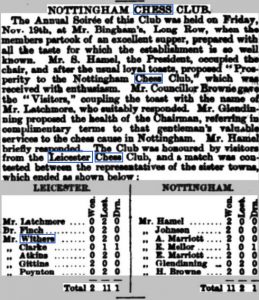
On 29 October 1880, he represented Leicester in a match against a visiting team from Nottingham Chess Club, where he faced Minor Pieces hero Arthur Towle Marriott.
The Leicester Chronicle (6 November 1880) reported what sounds like a convivial affair. Half way through, they all stopped playing to witness a presentation to Mr Sharland, the Leicester Club Secretary, who, in less than five years, had increased the club membership from 18 to 61. Various speeches were made before the gentlemen of Leicester and Nottingham resumed their games.
It seems that only one game was played on top board, while the other boards played two games each. Arthur Towle Marriott, the only Nottingham player to win both his games, seems to have been playing on too low a board.
Here’s his game with White.
[pgn]
[Event “Leicester v Nottingham”]
[Site “Leicester”]
[Date “1880.10.29”]
[White “Marriott, Arthur Towle”]
[Black “Withers, William John”]
[Result “1-0”]
[ECO “C52”]
[Annotator “Richard”]
The game followed well known (at the time) Evans Gambit theory for some way. Black’s 7th move is brave: 7… Nge7 and 7… d6 are most often played, but the engines like 7… Nf6 8. e5 d5. 10… b5 was also a bold choice: again 10… Nge7 would have been more circumspect. Marriott had stronger, but difficult, options on move 13, but his choice proved successful when the Leicester man blundered horribly in reply.
Three weeks later the Leicester chessers visited Nottingham for the return match, this time with a much weaker team. Mr Bingham’s restaurant provided an excellent supper, with speeches and toasts, before play started. Arthur Marriott, after his success in the earlier match, had been promoted to board 3, and again found himself facing William Withers.
The Nottingham Journal (27 November 1880) reported on an overwhelming victory for the home team. 11½-2½ was very different from the earlier 5-8 defeat.
These matches appear to have been social events rather than the competitive inter-club matches with which we’re all familiar. Although there was considerable interest in the result, the eating and drinking seemed just as important. Perhaps that’s how club matches should be.
Again, we have the game where Marriott played White against Withers.
[pgn]
[Event “Nottingham v Leicester”]
[Site “Nottingham”]
[Date “1880.11.19”]
[White “Marriott, Arthur Towle”]
[Black “Withers, William John”]
[Result “1-0”]
[ECO “C57”]
[Annotator “Richard”]
[PlyCount “35”]
This time, Withers chose to avoid the Evans Gambit, but playing 3… Nf6 without knowing the theory isn’t a good idea. Even then, it was known that 5… Nxd5 wasn’t best, giving White a choice of two strong options, 6. d4 and that primary school favourite, 6. Nxf7, the Fried Liver Attack.
Engines now confirm that 8… Ne7 in the Fried Liver is losing, but 8… Nb4 might just keep Black in the game. Marriott missed a couple of better moves, but Withers panicked on move 13, losing even more quickly and horribly than three weeks earlier.
By today’s standards, the chess of William John Withers makes a poor impression: a player with a patchy knowledge of opening theory along with tactical vulnerability.
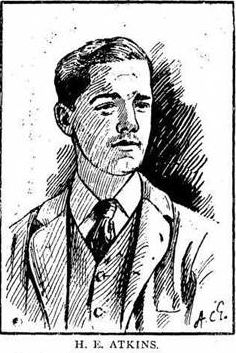
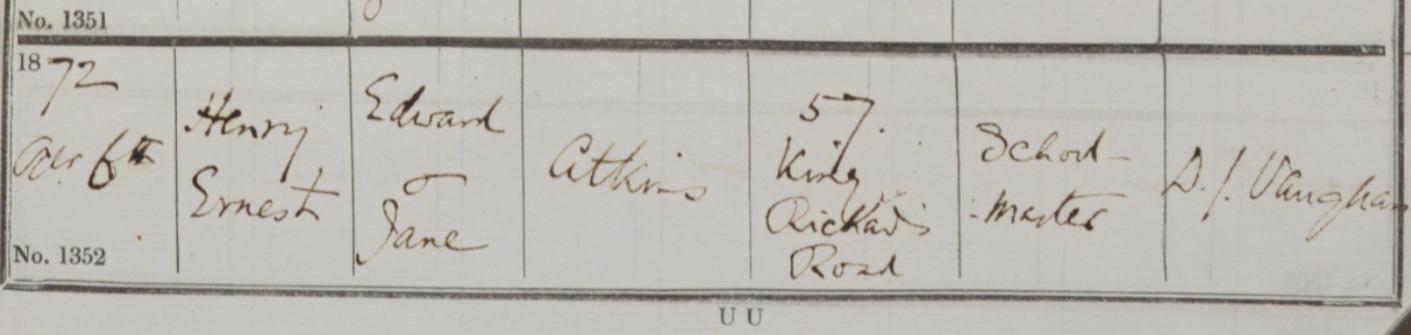
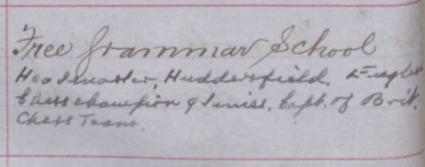
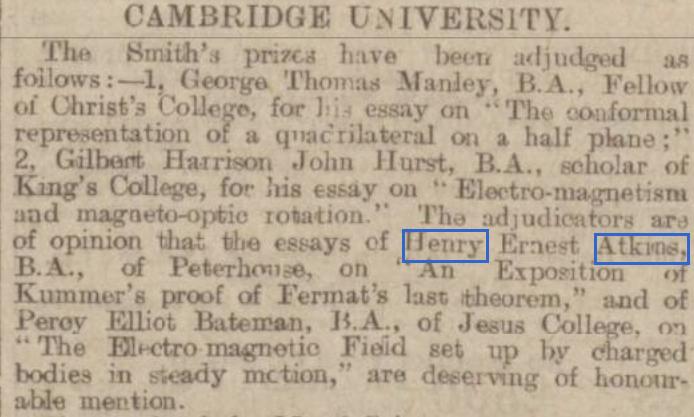
Note that A F Atkins, who played for Leicester in these matches, was Arthur Frederick Atkins, originally from Coventry, and no relation to the great Henry Ernest Atkins, about whom more next time.
By now William had a new job: the 1881 census told us he was a bookseller in Loseby Lane, Leicester, only a few yards away from where a later and stronger Leicester chess player would, several decades later, also run a bookshop. You may well meet him in a future article. He was also just a short walk from what is now De Montfort University, the new home of the English Chess Federation library and also, as it happens, my alma mater.
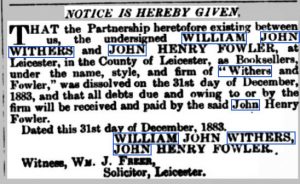
An announcement in the Leicester Journal (5 January 1884) suggests that his bookselling business hit a problem.
It was time for him to turn over a new leaf. By 1891 he was an antiques dealer, having moved just round the corner to Silver Street, and doing well enough to employ a servant. The 1901 and 1911 censuses told the same story: in the latter year he styled himself a ‘dealer in genuine antiques’.
At some point after that, perhaps after the death of his father in 1913, he moved to London. The 1921 census, due for release next January, will reveal more.
We can pick William up again in 1932, when he made his last will and testament, granting generous bequests to his children and grandchildren. Still working as an antique dealer, his address was given as 48 George Street, Manchester Square, WC1, only a few minutes’ stroll from 44 Baker Street, where, had he been able to travel through time, he’d have been able to stock up on the latest chess books.
His antique dealing had clearly been very successful. He died in 1934, and probate records reveal that he left effects to the value of £15,240 17s 9d, which, depending on how you calculate it, amounts to anywhere between one and seven million pounds in today’s money.
So there you have it. While his chess playing didn’t impress, he played an important role in chess life in Leicester. Away from the board, in both business and family life, he seems to have done very well for himself. Well played, William John Withers!
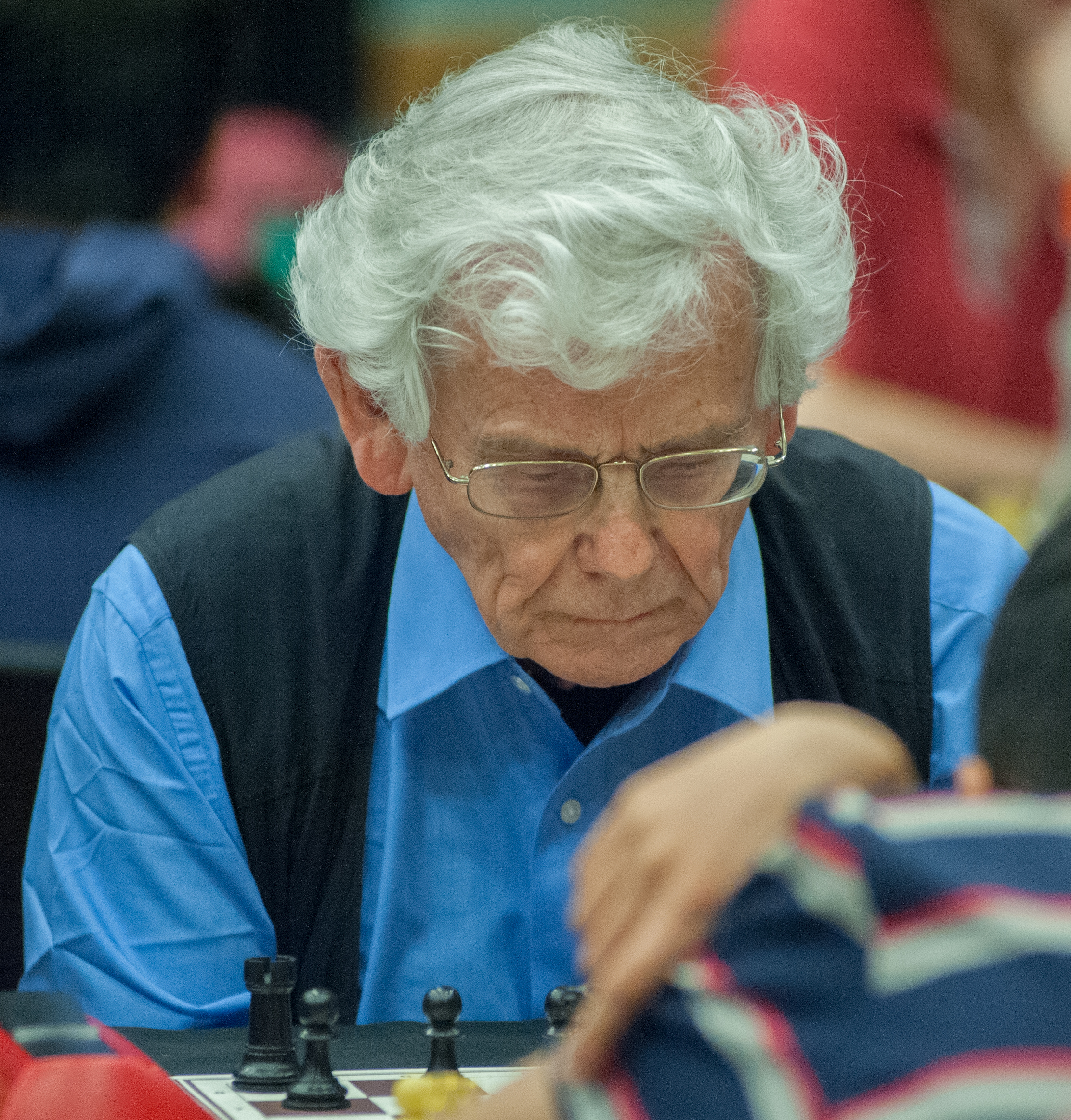
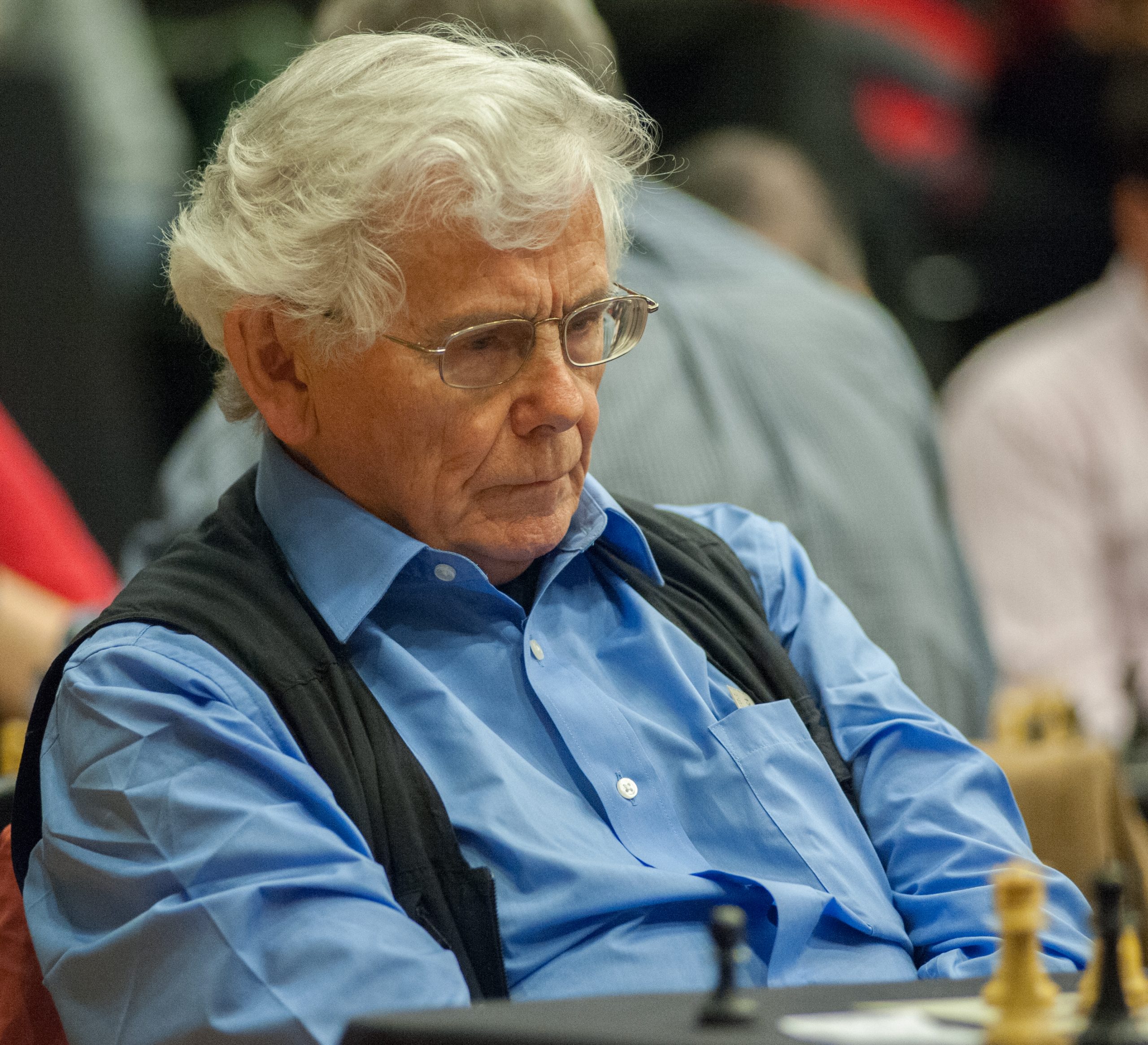
Prof. Julian Farrand at the King’s Place Rapidplay, 2013, courtesy of John Upham Photography
BCN remembers Dr. Julian Farrand who passed on Friday, July 17th, 2020. He was 84 years of age.
Julian Thomas Farrand was born August 13th, 1935 in Doncaster in the West Riding of Yorkshire.
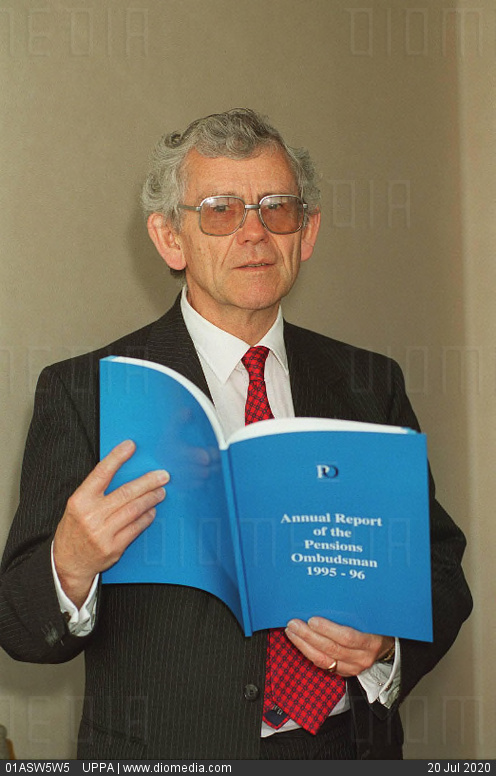
Dr. Farrand QC(Hon), formerly the Insurance Ombudsman, became the Pensions Ombudsman, and he had been a Law Commissioner and a University Professor of Law at the University of Manchester where he was Dean of the faculty.
His first recorded game in Megabase 2020 was white at the 1968 British Championships in Bristol against life-long friend CGM Keith Bevan Richardson. Together with Raymond Brunton Edwards, Julian and Keith were long-time trustees of the BCFs Permanent Invested Fund (PIF).
Julian played for Pimlico, Cavendish and Insurance in the London League and he maintained a standard play grading of 172A in 2020 as well as a FIDE rating of 1943 for standard play. He also played in the London Public Services League, the Central London League and the City Chess Association League. He made regular appearances in the Bronowski Trophy competition and the World Senior’s Team Tournament.
His (according to Megabase 2020) peak Elo rating was 2238 in April, 2004 aged 69. It is likely to have been higher than that if it was measured.
Julian joined Barbican following its merger with Perception Youth to become Barbican Youth in the Four Nations Chess League (4NCL).
His favourite openings with white were : The Richter-Veresov Opening in later years and the English/Barcza Opening in earlier times.
With Black he enjoyed the Czech System and the Lenningrad Dutch.
His son, Tom, is a strong player and a successful barrister with expertise in Intellectual Property Rights, Trademarks and Copyright law.
His wife (married in 1992), Baroness Hale of Richmond, served as President of the Supreme Court of the United Kingdom from 2017 to 2020, and serves as a member of the House of Lords as a Lord Temporal.
Julian Farrand with Lady Hale at a Buckingham Palace reception. Photo : Press Association
Memorial messages have been posted on the English Chess Forum and many will, no doubt, follow. Included are older games from John Saunders not found in the online databases.
In 2015 Julian (together with fellow trustees Keith Richardson and Ray Edwards) received the ECF President’s Award for services to the Permanent Invested Fund.
Here is the citation from the 2015 award :
“Julian is best known as the first*-ever English ombudsman (in insurance). He is the husband of law lord Baroness Hale. I (SR) first met him at about the age of 12 year old when playing for my school. He is about four years older. Both Ray and Julian are members of the Book of the Year Committee and have been reviewing books for this purpose for many years. Both are quite strong chess players, indeed playing for England in the same team in the European 60+ Team Championship in Vienna 11-20 July 2015. Keith was to have been a member of the same team, but his wife’s ill-health forced him to withdraw.”
*On January 15th 2022 we received the following electronic email message from Heather Ridge, a legal assistant as follows:
Dear Sir
Julian Farrand was most certainly NOT the first Insurance Ombudsman. The late James Haswell OBE was appointed the first Insurance Ombudsman in 1981.
I know this as I had the privilege of being his first Senior Legal Assistant. Please correct this immediately.
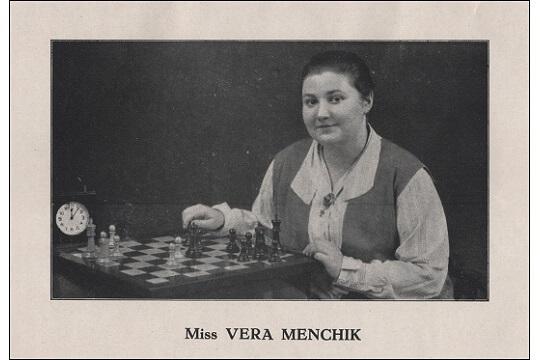
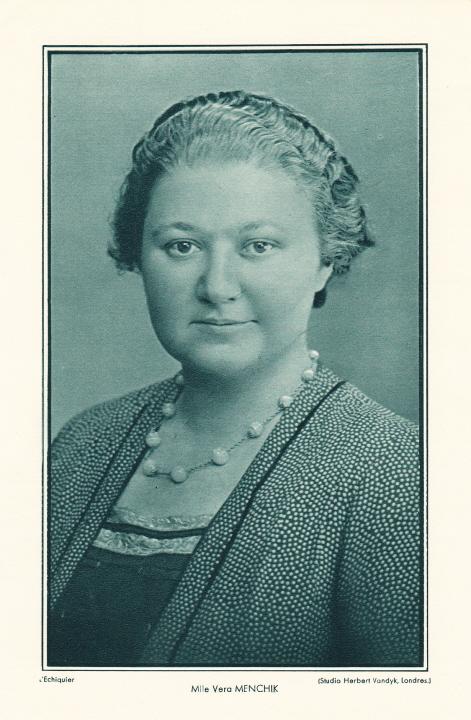
Few people know the story of Vera Menchik yet it deserves to be told. She was the first women’s world chess champion in 1927 and retained the title undefeated until her untimely death at the age of 38 in 1944 during a rocket attack on London. She is more properly compared with the great male players of her era against whom she scored creditably. The absence of a full biography of Vera in English reflects the peculiar circumstances of her life and death.
Vera was, in modern terminology, a refugee and essentially a stateless person for much of her life. She was born in Moscow in 1906 during the period of the Russian Empire to an expatriate family who was forced to flee when she was 15 following the Russian Revolution having lost their livelihood. As they passed through Europe, her father and mother split up in his homeland Czechoslovakia which had been created out of the ruins of the Austro-Hungarian empire. She arrived in England and took up residence in the seaside town of Hastings. (The fact that Hastings had hosted the world’s longest series of annual chess tournaments since 1895 was a happy coincidence.) Vera never attained British nationality until near the end of her life even though she had been domiciled in England from 1921. She won the first-ever Women’s World Championships held in London in 1927 under a Russian flag; thereafter she nominally represented Czechoslovakia until finally she represented England in 1939 following her marriage to a senior official within the British Chess Federation.
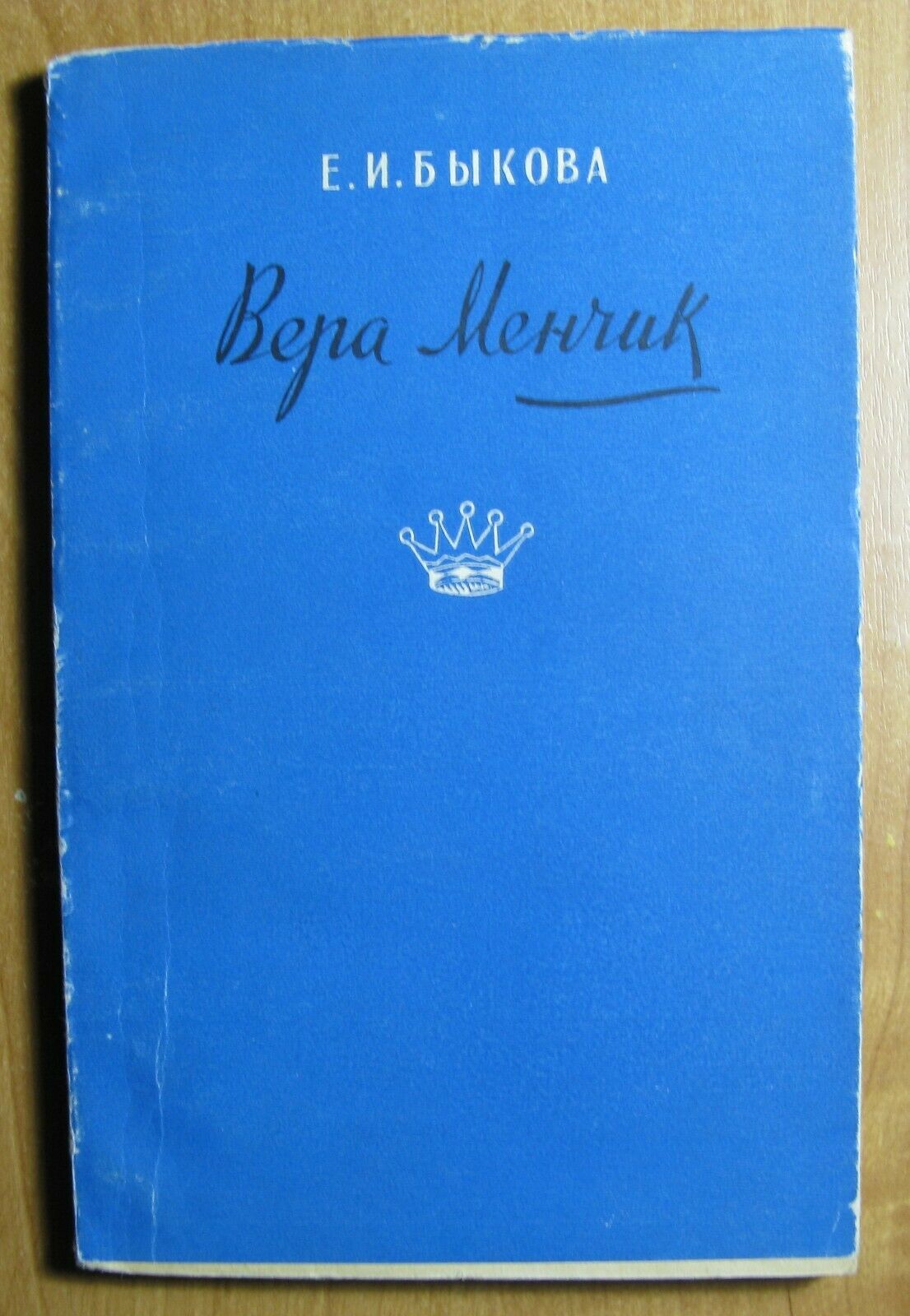
Vera Menchik., EI Bykova, Moscow, 1957, 176 pages, 4s 7d.
Vera’s grandfather was Arthur Illingworth, a wealthy trader from Lancashire who had set up business in Moscow where his Anglo-Russian daughter Olga married František Menčik. He was a successful estate manager. Vera learned chess from her father and performed well at school. Her younger sister Olga was also a good chess player and the sisters remained close throughout their lives.
Vera was a woman in a man’s world – she had to struggle harder to achieve the kind of recognition which was accorded to men. She appeared like a comet in the sky and it would be many years until other women were able to reach her level. At her first major international tournament at Karlsbad in 1929, she was the only female participant in a tournament of 22 great players. Even as women’s world champion, some of the male players objected to her participation. The Viennese master Albert Becker joked that anybody who lost to her should belong to the Vera Menchik Club. By an irony of history, he became its first member losing to her in the third round. She beat many other grandmasters during her career including the Dutchman Max Euwe in 1930 and 1931 (both at Hastings) who was to become world champion in 1935.
Although she is often portrayed as being Russian or Czech or latterly British, she was a true cosmopolitan. She knew that life could be unstable in any country. She had lived through the Russian Revolution; one parent was left behind in Czechoslovakia; she had moved westwards across Europe and embraced different cultures and languages at formative stages of her life. It is no wonder that she learned also to speak Esperanto which was designated to be the world’s lingua franca before English achieved its dominance. As a leading chess player, she travelled back to Moscow and to Czechoslovakia several times as well as to South America for her final match to retain the women’s world champion title in 1939. She needed to be self-sufficient and was obtained roles as the games editor of a chess magazine as well as being appointed the manager of the National Chess Centre in Oxford Street which was destroyed during the Blitz in 1940.
She survived most of the war and now a widow moved in with her mother and sister to a house in south London. They took the precaution of going down to the cellar during bombing raids. Tragically the house received a direct hit from a flying bomb and the entire family was wiped out. Hardly any of her possessions remained save for one dented trophy. The records at the national chess centre were destroyed as were her personal effects including her chess memorabilia. At least there remains a record of the moves played in her games which serve as testimony to her remarkable career as not only the first women’s world chess champion but also a woman who broke boundaries wherever she went and demonstrated that a woman is capable of standing on her own feet professionally and leading a full and eventful life.
The Bomb Attack
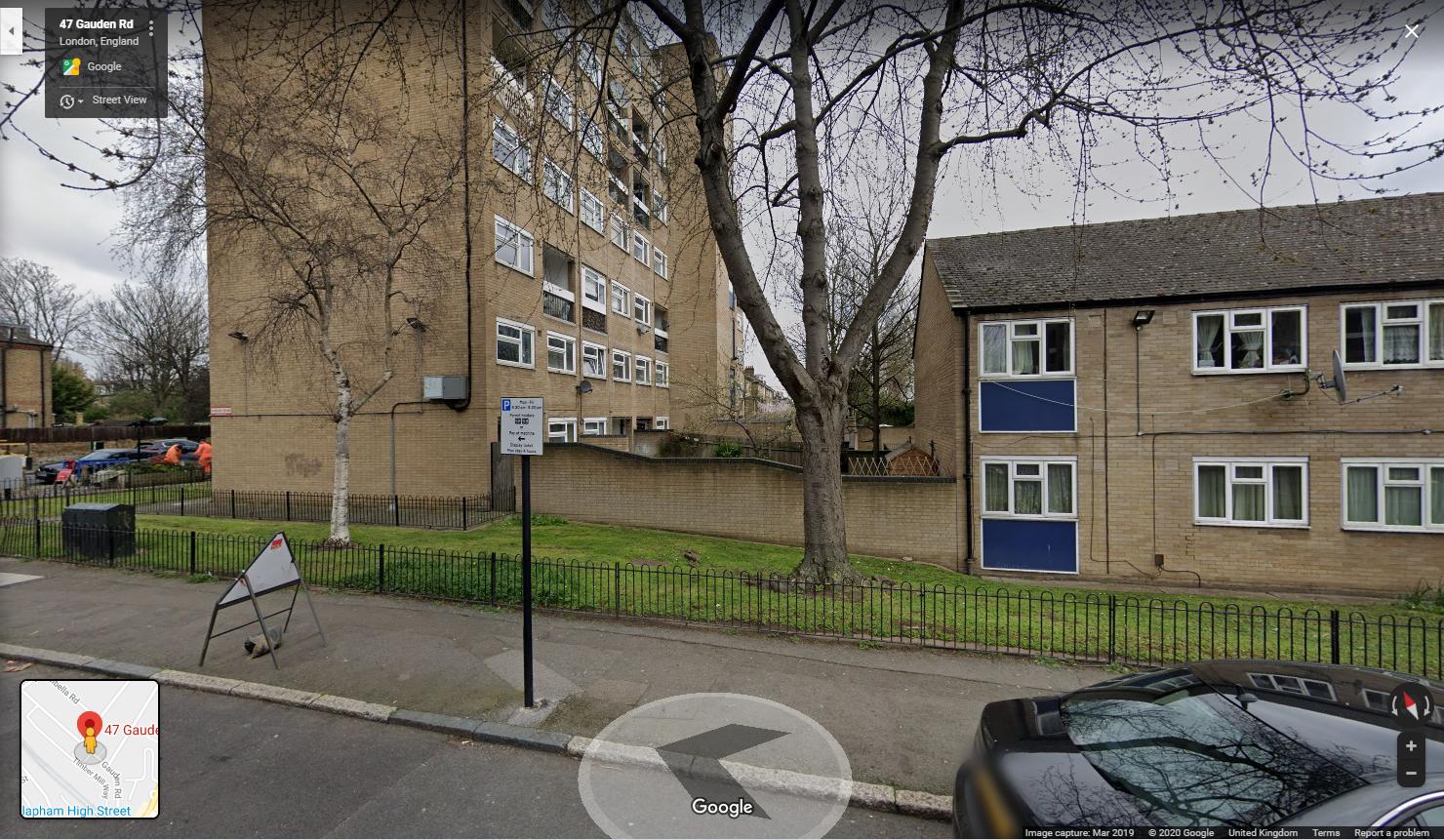
BCN remembers that in the early morning of Tuesday, June 27th, 1944 (i.e. 77 years ago) Vera Menchik, her sister Olga, and their mother were killed in a V-1* flying bomb attack which destroyed their home at 47 Gauden Road in the Clapham area of South London.
We now know that the V1 in question landed at 00:20 hrs on the 27th and led to the death of a total of 11 people including the Menchik household. Here is a summary of recorded V1 and V2 landings in the Clapham, SW4 area.
(*The V-1 was an early cruise missile with a fairly crude guidance system.)
47, Gauden Road, Clapham, SW4 6LW in more modern times.
All three were cremated at the Streatham Park Crematorium on 4 July 1944. Vera was 38 years old.
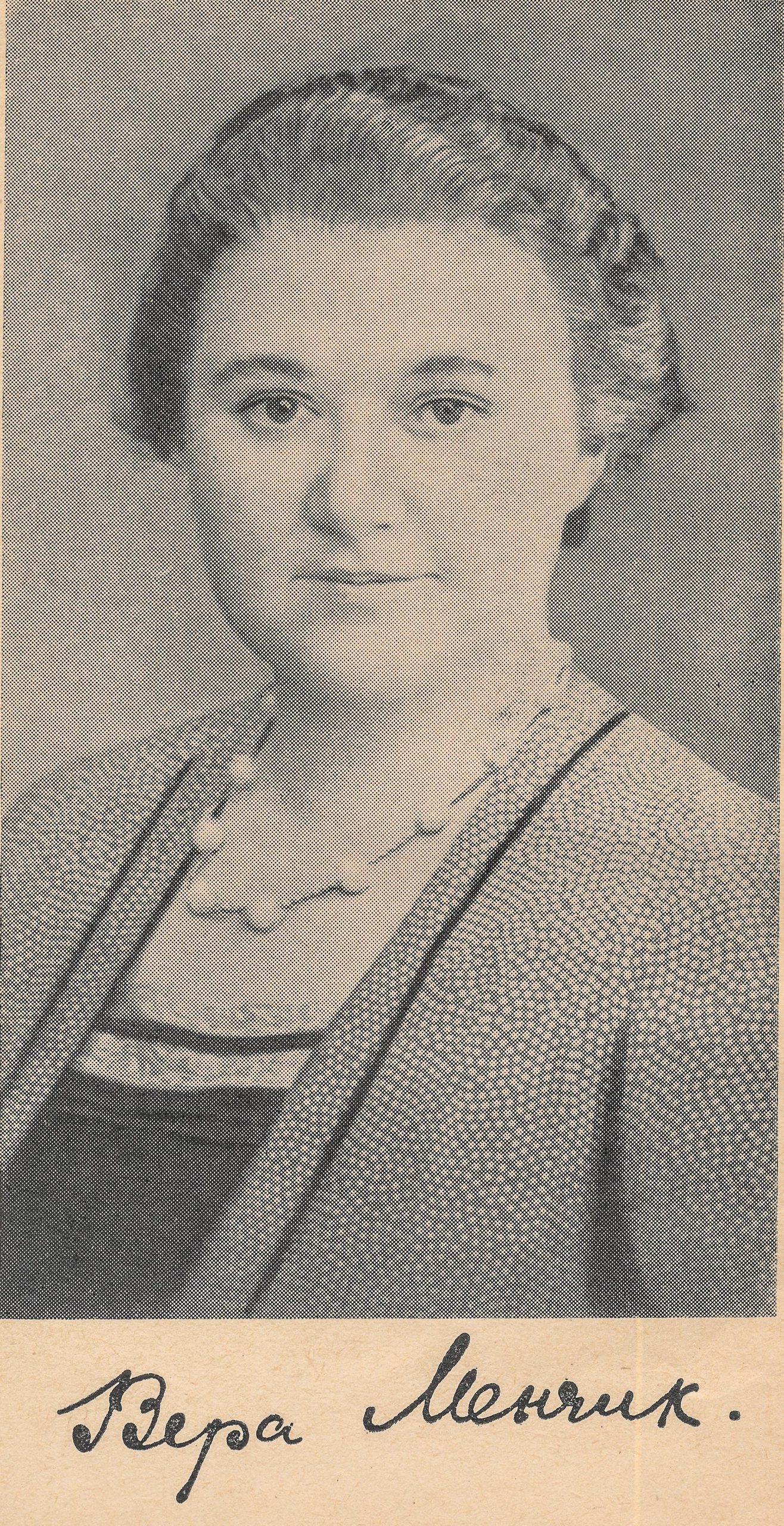
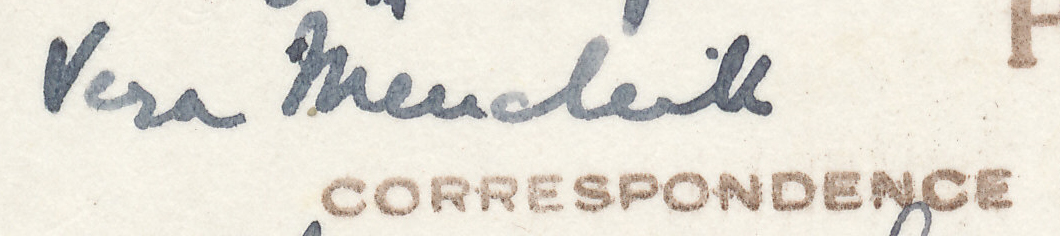
Signature of Vera Menchik from a Brian Reilly “after dinner” postcard from Margate 1936.
Vera’s Parents and Sister
Vera Frantsevna Menchik (or Věra Menčíková) was born in Moscow on Friday, 16th February, 1906. Her father was František Menčik, was born in Bystrá nad Jizerou, Bohemia. František and Olga were married on June 23rd 1905 in Moscow and notice of this marriage appeared in British newspapers on July 22nd 1905. Vera’s sister was Olga Rubery (née Menchik) and she was born in Moscow in 1908. Olga Menchik married Clifford Glanville Rubery in 1938. Vera married Rufus Henry Streatfeild Stevenson on October 19th 1937.
Her Maternal Roots
Our interest in unearthing her maternal English heritage / roots has led to the following:
Her mother was Olga (née Illingworth (1885 – 27 vi 1944). Olga’s parents were Arthur Wellington Illingworth and Marie Illingworth (née ?). Arthur was born in October 1852 in the district of Salford, Lancashire, his parents were George Illingworth (1827-1887) and Alice Whewell (1828-1910).
In the 1861 census Arthur is recorded as being of eight years of age and living in the Illingworth household.
In the 1871 census Arthur is recorded as being of eighteen years of age and living in the Illingworth household of nine persons at 5, Lancaster Road, Pendleton, Lancashire. Arthur’s occupation is listed as being a merchants apprentice. In fact, he was a stock and share broker.
Arthur died in Moscow on February 21st 1898. Probate was recorded in London on July 6th, 1900 as follows:
Illingworth Arthur Wellington of Moscow Russia merchant died 21st February 1898 Probate London 6th July to Walter Illingworth stock and share-broker Effects £4713 7s
£4713 7s in 1898 equates roughly to £626,600.00 in 2020 so it would appear that Arthur was considerably successful and almost certainly left money to Olga Illingworth.
What do we conclude from all of this? Quite simply that Vera’s maternal roots were from Salford in Lancashire.
BCM Announcement
The August 1944 British Chess Magazine (Volume LXIV, Number 8, page 173 onwards) contained this editorial from Julius du Mont:
Julius du Mont, Editor of British Chess Magazine from 1940 to 1949
“British Chess has suffered a grievous and irreparable loss in the death by enemy action of Mrs. R.H.S. Stevenson known through all the world where chess is played as Vera Menchik.
We give elsewhere (below : Ed.) an appreciation of this remarkable woman. Quite apart from her unique gifts as a chess-player-the world may never see her equal again among women players-she had many qualities which endeared her to all who knew her, the greatest among them being here great-hearted generosity.
We sympathise with our contemporary “CHESS” : Vera Menchik was for some years their games editor. Few columns have been conducted with equal skill and efficiency and none, we feel sure, with a greater sense of responsibility.
The news of this remarkable tragedy will be received by the chess world with sorrow and with abhorrence of the wanton and useless robot methods of a robot people.
One shudders at the heritage of hatred which will be theirs, but their greatest punishment will come with their own enlightenment.”
BCM Contemporary Obituary from EGR Cordingley
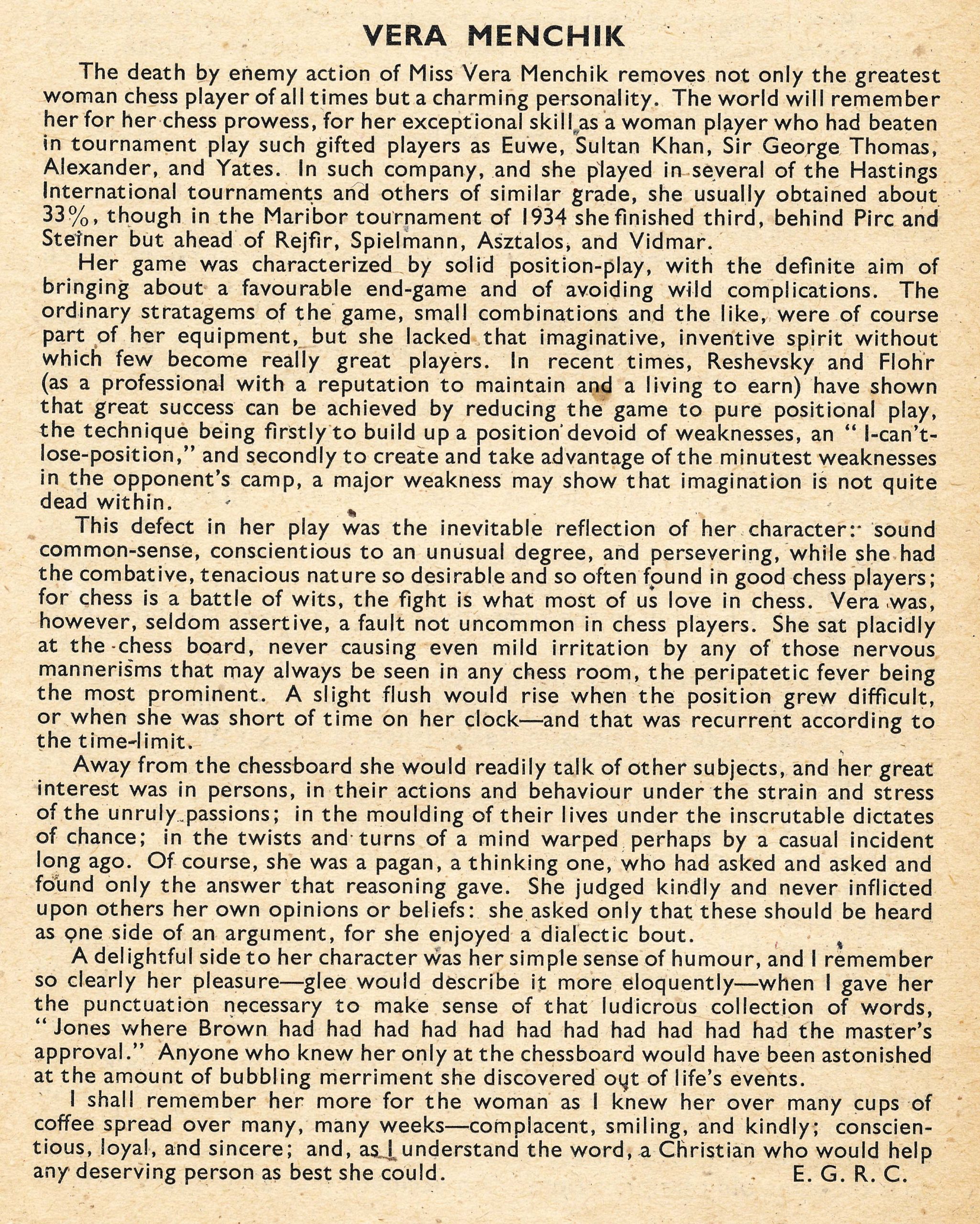
From page 178 of the same issue we have an obituary written by EGR Cordingley :
“The death by enemy action of Miss Vera Menchik removes not only the greatest woman chess player of all times but a charming personality.
The world will remember her for her chess prowess, for her exceptional skill as a woman player who had beaten in tournament play such gifted players as Euwe, Sultan Khan, Sir George Thomas, Alexander and Yates. In such company, and she played in several of the Hastings International tournaments and other of similar grade, she usually obtained about 33%, though in the Maribor tournament of 1934 she finished third, behind Pirc and Steiner but ahead of Rejfir, Spielmann, Asztalos and Vidmar.
Her game was characterised by solid position-play, with the definite aim of bringing about a favourable end-game and of avoiding wild complications. The ordinary stratagems of the game, small combinations and the like, were of course part of her equipment, but she lacked that imaginative, inventive spirit without which few become really great players.
In recent times, Reshesvky and Flohr (as a professional with a reputation to maintain and a living to earn) have shown that great success can be achieved by reducing the game to pure positional play, the technique being firstly to build up a position devoid of weaknesses, an ‘I can’t lose position,’ and secondly to create and take advantage of the minutest weaknesses in the opponent’s camp, a major weakness may show that imagination is not quite dead within.
This defect in her play was the inevitable reflection of her character: sound common-sense, conscientious to an unusual degree, and persevering, while she had the combative, tenacious nature so desirable and so often found in good chess players; for chess is battle of wits, the fight is what most of use love in chess. Vera was, seldom assertive, a fault not uncommon in chess players. She sat placidly at the chess board, never causing even mild irritation by any of those nervous mannerisms that may always be seen in any chess room, the peripatetic fever being the most prominent. A slight flush would rise when the position grew difficult, or when she was short of time on her clock – and that was recurrent according to the time-limit.
Away from the chessboard show would readily talk of other subjects, and her great interest was in persons, in their actions and behaviour under the strain and stress of the unruly passions; in the moulding of their lives under the inscrutable dictates of chance; in the twists and turns of a mind warped perhaps by a casual incident long ago. Of course, she was a pagan, a thinking one, who had asked and asked and found only the answer that reasoning gave. She judged kindly and never inflicted upon others her own opinions or beliefs: she asked only that these should be heard as one side of any argument, for she enjoyed a dialectic bout.
A delightful side to her character was her simple sense of humour, and I remember so clearly her pleasure – glee would describe it more eloquently – when I gave her the punctuation necessary to make sense of that ludicrous collection of words, ‘Jones where Brown had had had had had had had had had had had the master’s approval’ Anyone who knew her only at the chessboard would have been astonished at the amount of bubbling merriment she discovered of of life’s events.
I shall remember her more for the woman as I knew her over many cups of coffee spread over many, many weeks – complacent, smiling, and kindly; conscientious, loyal, and sincere; as I understand the word, a Christian who would help any deserving person as best she could. E. G. R. C.
”
and here is the original article as printed:
British Chess Magazine, Volume LXIV (1944), Number 8, August, Page 178
BCM 1958 Appreciation by Peter Clarke
From British Chess Magazine, Volume LXXVIII (78, 1958), Number 7 (July), page 181 onwards) we have this retrospective from Peter Clarke:
“The night of June 27th,1944, Vera Menchik, World Woman Champion, was killed when an enemy bomb demolished her home in London; with her perished her mother and sister Olga. In these tragic circumstances the chess world lost its greatest woman player, still undefeated and at the height of her powers.
Vera Francevna Menchik was born in Moscow on February 16th, 1906, of an English mother and Czech father. There she spent her childhood, showing a love for literature, music, and, of course, chess, which at the age of nine she was taught by her father. She had a natural bent for the game and when only fourteen shared second and third places a schoolboys (!) tournament. The following year, 1921, the family came to England, where Miss Menchik lived the rest of her life.
As if by some fortunate coincidence, the Menchiks settled in Hastings, though it was not until the spring of 1923 that Vera joined the famous chess club. Her natural shyness and lack of knowledge of English caused this delay. However, they did not handicap her too much
as she herself afterwards wrote: ‘Chess is a quiet game and therefore the best hobby for a person who cannot speak the language.”
She studied the game eagerly, and very soon her talent caught the attention of the Hungarian grandmaster, Géza Maróczy, who was resident at Hastings at that time. Thus there began the most important period in her development as a player; a sound and mature understanding of positional play-and a thorough knowledge of a few special openings and defences: in particular the French Defence. The influence of
the grandmasters ideas was clearly apparent in her style throughout the whole of her career.
Miss Menchik’s rise to fame was meteoric: by 1925 she was undoubtedly the strongest player of her sex in the country, having twice defeated the Champion, E. Price, in short matches; and only two years later she won the first Women’s World Championship in London with the terrific score 10.5-0.5. She was just twenty-one, but already in a different class from any other woman in the world. For seventeen years until her death Vera Menchik reigned supreme in women’s chess, defending her world title successfully no less than seven times (including a match with Sonja Graf at Semmering in 1937, which Miss Menchik won 11.5-4.5. In the seven tournaments for the World Championship she played 83 games; winning 78, drawing 4, and losing 1 only! However, what was more remarkable was that she was accepted into the sphere of men’s chess as a master in her own right, a feat which no woman had done before or has done since. Up to then, women’s chess had been a very poor relation of the masculine game, but here was a woman who was a worthy opponent for the strongest masters.
Flohr wrote of her: ‘Vera Menchik was the first woman in the world who played chess strongly…who played like a man.’ It was as the ambassador extraordinary, so to speak, of the women’s game that Miss Menchik really made her greatest contribution to chess. Wherever she went, at home and abroad, she aroused great interest among her sex; others were eager to follow her, to identify themselves with her. Nowadays women’s chess is well organized, and much of the credit for this must go to Vera Menchik for first bringing it into the light. Among her many personal successes in international tournaments perhaps the greatest was at Ramsgate in 1929: as one of the foreign masters (she was still of Czech nationality) she shared second and third places with Rubinstein, * point behind Capablanca and above, among others, her tutor Maróczy.
Even the greatest masters recognized Miss Menchik’s ability; Alekhine himself, writing on the Carlsbad Tournament of 1929, said: ‘Vera Menchik is without doubt an exceptional phenomenon among women. She possesses great aptitude for the game…The chess
world must help her develop her talent!’
The Vera Menchik Club
An amusing incident occurred at this tournament. There were naturally sceptics among the masters over the lady’s participation. Flohr recalls how one of these, the Viennese master Becker, suggested:
‘Whoever loses to the Woman Champion will be accepted as a member of the Vera Menchik Club which I intend to organize.’
Becker was the first to lose to her, and that evening the masters chided him: “Professor Becker, you did not find it very difficult to join the club. You can be the Chairman.’ And forthwith he was chosen as Chairman for three years. Everyone wished that the new club would soon obtain more members! Indeed, the Vera Menchik Club has many famous names on its lists-Euwe, Reshevsky, Colle, Yates, Sultan Khan, Sir G. A. Thomas, Alexander, to mention a few.
In 1935 Miss Menchik returned to the country of her birth to take part in the great international tournament in Moscow. To be truthful, she had very little success, but she was everywhere treated with respect and sympathy by masters and spectators alike. The Soviet master l. Maiselis, writing in CHESS in 1944.(Shakhmaty za 1944 god), related the following entertaining anecdote from the tournament: One day a group of players and organizers were discussing the chances of Alekhine and Euwe in the forthcoming match. Flohr said: ‘It is quite clear that I will be World Champion.’ We looked at him inquiringly.
‘It’s very simple,” continued Flohr, ‘Euwe wins a match against Alekhine, Vera Menchik beats Euwe (at that time her score against Euwe was +2, =1, -1) and I will somehow beat Miss Menchik.’
We laughed at this good-natured joke, and we laughed all the more the next day when Flohr was unable, despite every effort, to defeat her in a vital game.
ln 1937 Miss Menchik married R. Stevenson, but in chess she continued to use her maiden name, made famous by so many victories. Her husband, a well-known organizer, became, Secretary of the B.C.F: in the following year and remained so until his death in 1943.
Since the days of Vera Menchik women’s chess has taken great strides forward; now there is a special committee of F.I.D.E. to look after its needs.- Only last year the first lnternational Women’s Team Tournament took place ln Emmen, Holland; the new World Champions, the U.S.S.R., became the first holders of the Vera Menchik Cup. So chess goes onwards, but the name of its first Queen will ever be remembered.”
From The Encyclopaedia of Chess (Robert Hale, 1970 & 1976) by Anne Sunnucks :
“Woman World Champion from 1927 to 1944. Vera Menchik was born in Moscow on 16th February 1906 of an English mother and a Czech father. Her father taught her to play chess when she was 9.
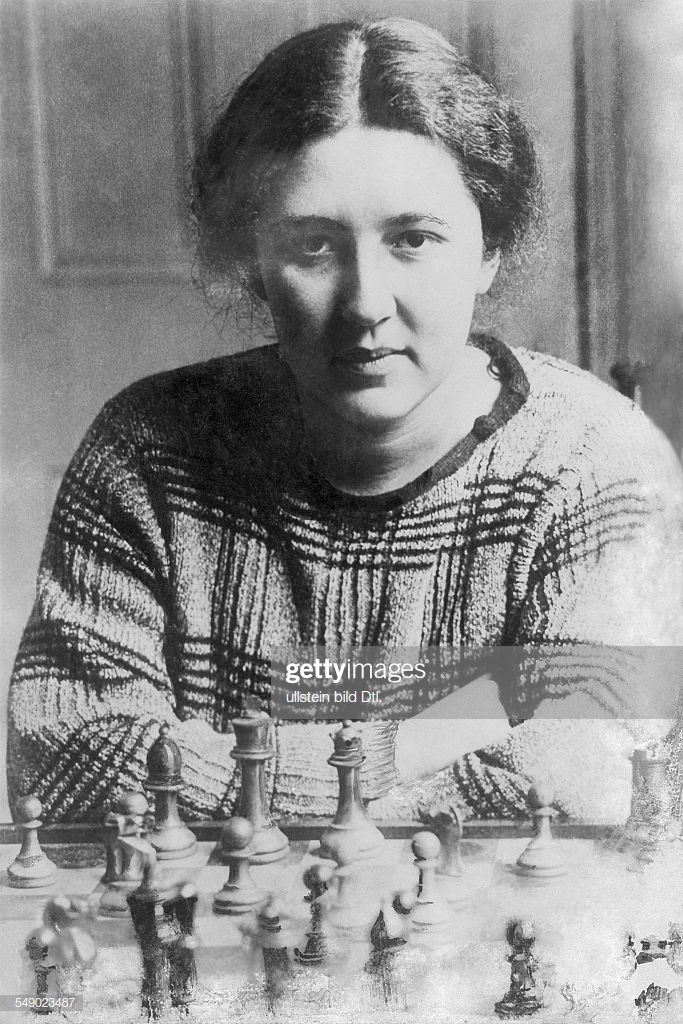
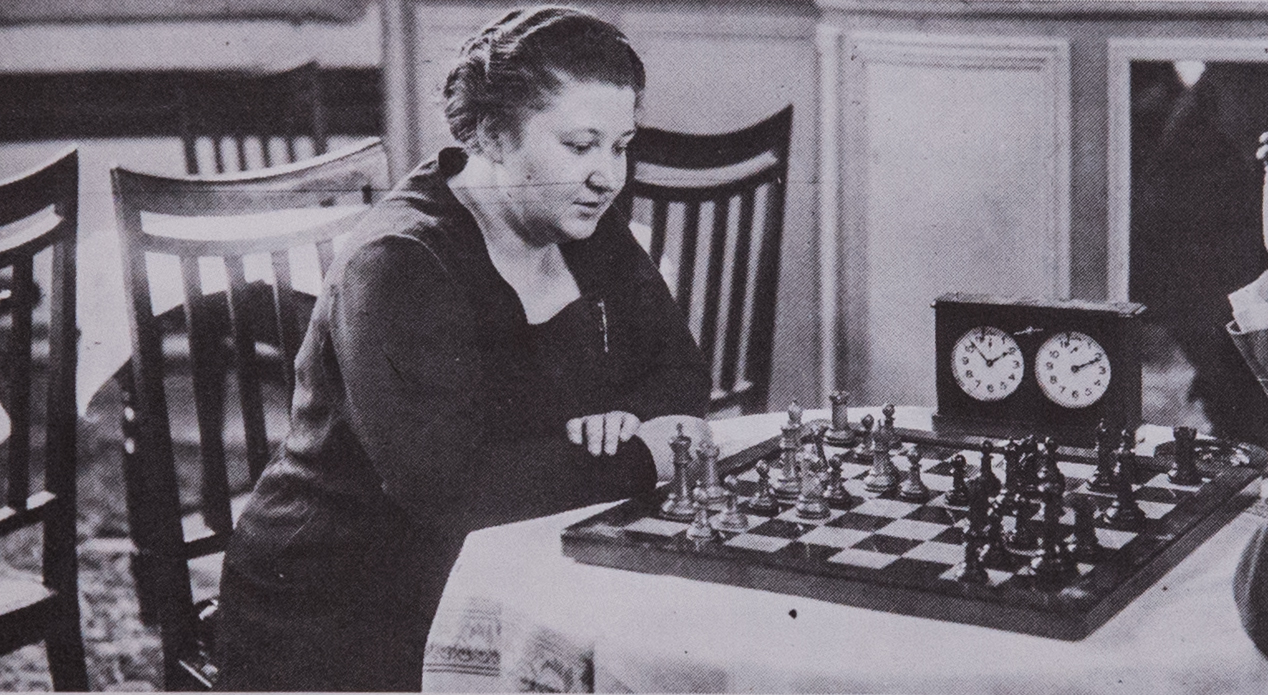
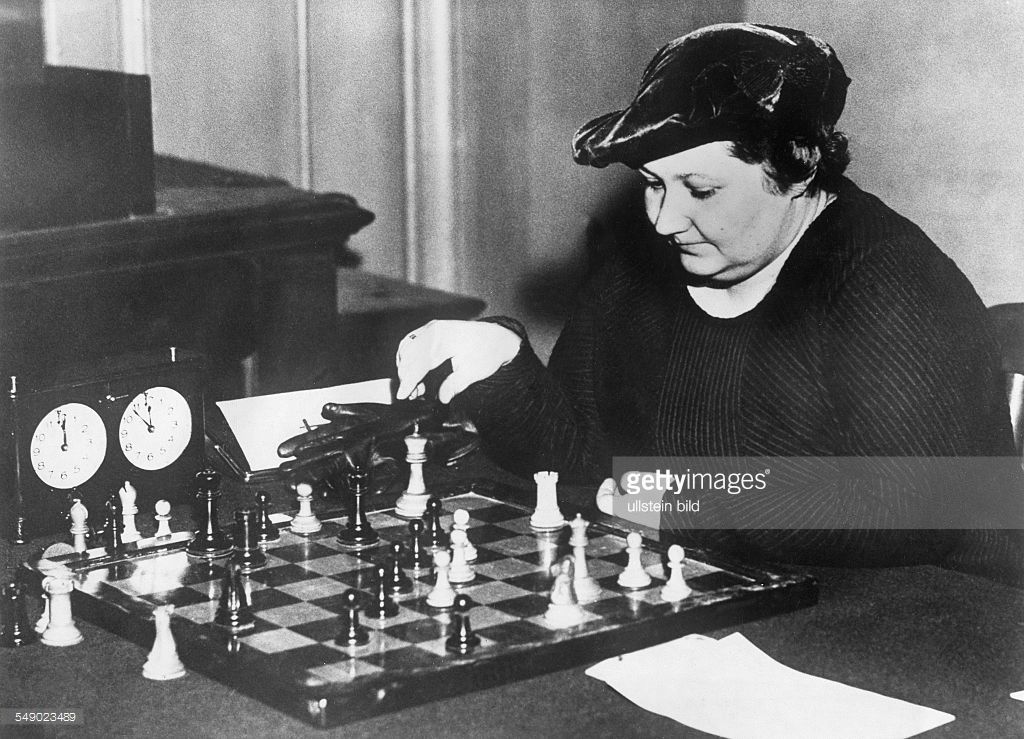
Vera Menchik 1906-1944 chess playerin, CZ / GB portrait with chess board late twenties (Photo by ullstein bild / ullstein bild via Getty Images)
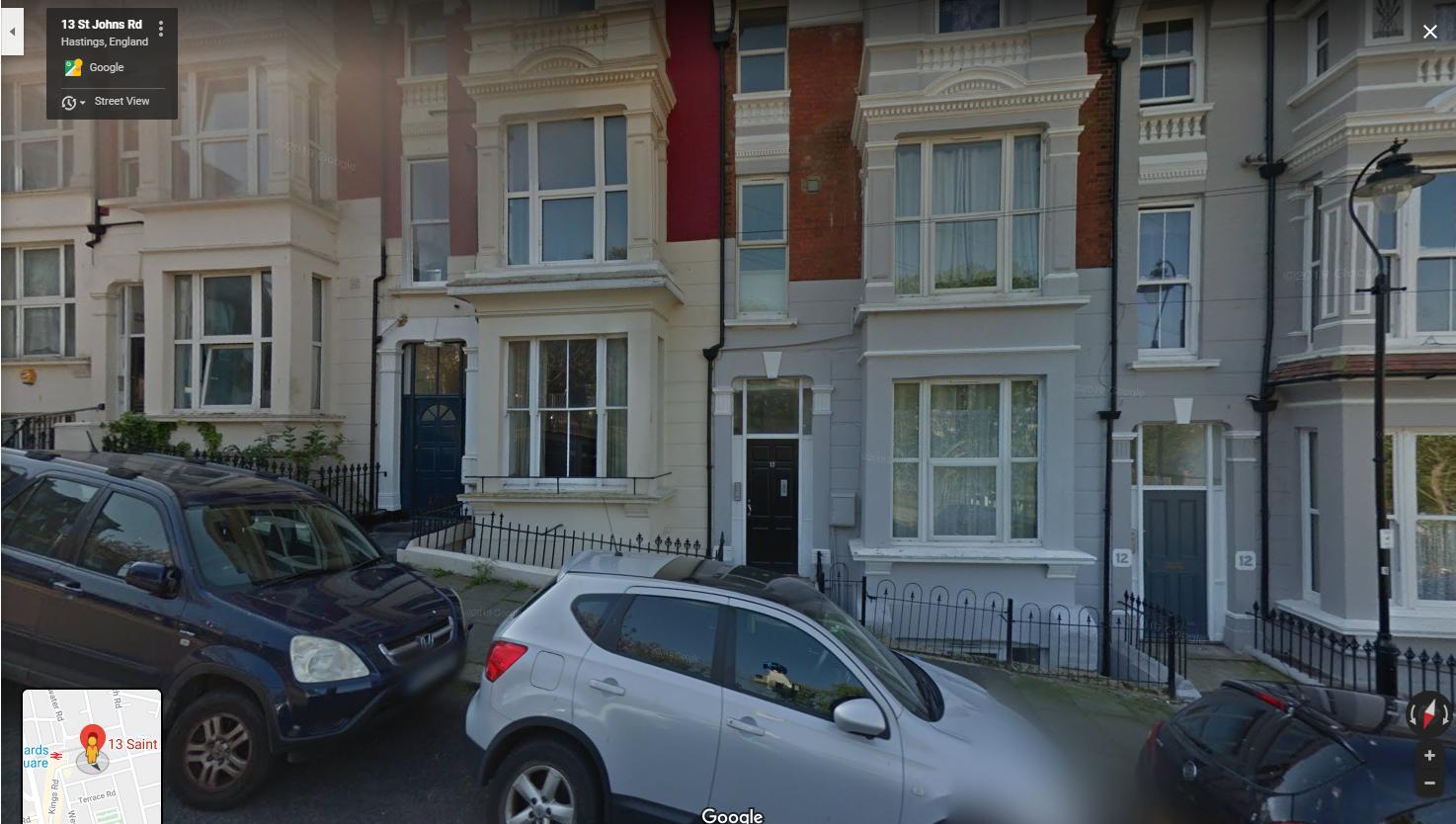
In 192l her family came to England and settled in Hastings (at 13, St. John’s Road, St. Leonards-on-Sea, TN37 6HP) :
13, St. John’s Road, St. Leonards-on-Sea, TN37 6HP
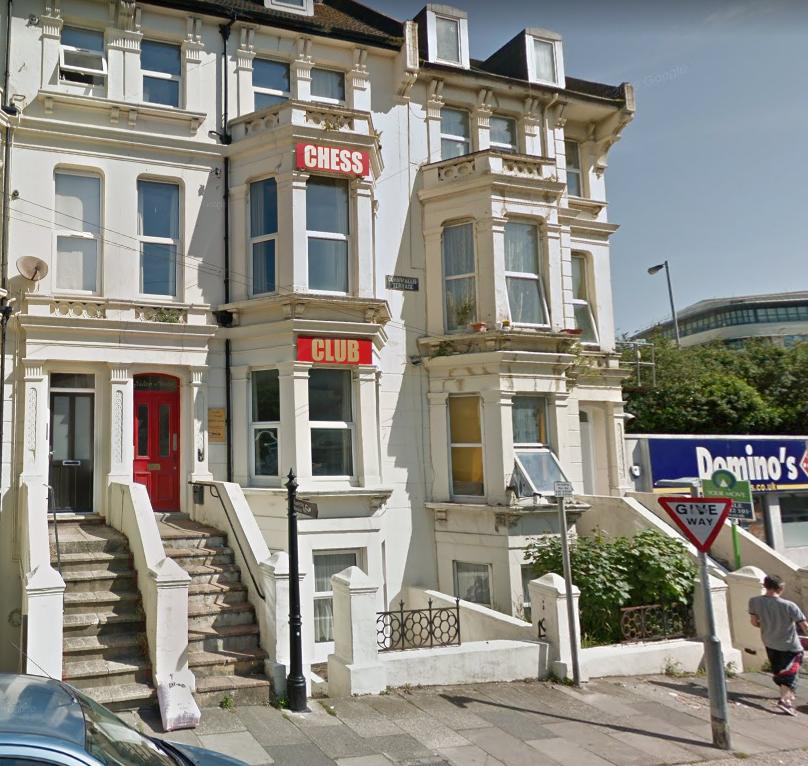
Two years later, when she was 17, Vera joined Hastings Chess Club,
Hastings Chess Club : 2 Cornwallis Terrace, Hastings TN34 1EB
where she became a pupil of Geza Maroczy. The first Women’s World Championship was held in 1927. Vera Menchik won with a score of 10.5 out of 11. She defended her title successfully in Hamburg in 1930, in Prague in 1931, in Folkestone in 1933, in Warsaw in 1935, in Stockholm in 1937 and in Buenos Aires in 1939. She played 2 matches against Sonja Graf, her nearest rival, in 1934 when she won +3 -1 and in 1937, in a match for her title when she won +9 -1 =5.
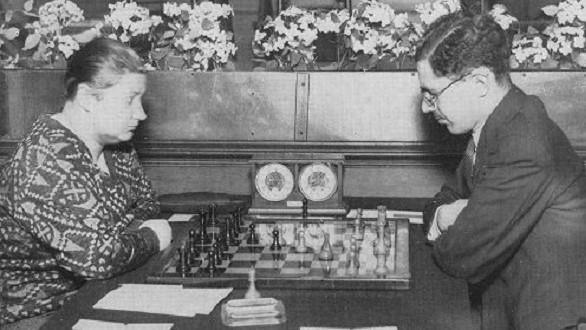
Isaac Kashdan plays Vera Menchik during the Hastings Congress on December 28th, 1931. Kashdan won in 45 moves in a classical French.
The first woman ever to play in the British Championship and the first to play in a master tournament, Vera Menchik made her debut in master chess at Scarborough 1928 when she scored 50 per cent. The following year she played in Paris and Carlsbad, and it was at Carlsbad that the famous Menchik Club was formed. The invitation to Vera Menchik to compete among such players as Capablanca, Euwe, Tartakower and Nimzowitch was received with amusement by many of the masters. The Viennese master, Becker was particularly scornful, and in the presence of a number of the competitors he suggested that anyone who lost to Vera Menchik should be granted membership of the Menchik Club. He himself became the first member. Other famous players who later joined the club were Euwe, Reshevsky, Sultan Khan, Sir George Thomas, C. H. O’D. Alexander, Colle and Yates.
Her greatest success in international tournaments was at Ramsgate in 1929, when she was =2nd with Rubinstein, half a point behind Capablanca and ahead of Maroczy. In 1934 she was 3rd at Maribor, ahead of Spielmann and Vidmar. In 1942 she won a match against Mieses +4 -l -5. In 1937 Vera Menchik married R. H. S. Stevenson, who later became Hon. Secretary of the British Chess Federation. He died in 1943. She continued to use her maiden name when playing chess. On her marriage she became a British subject.
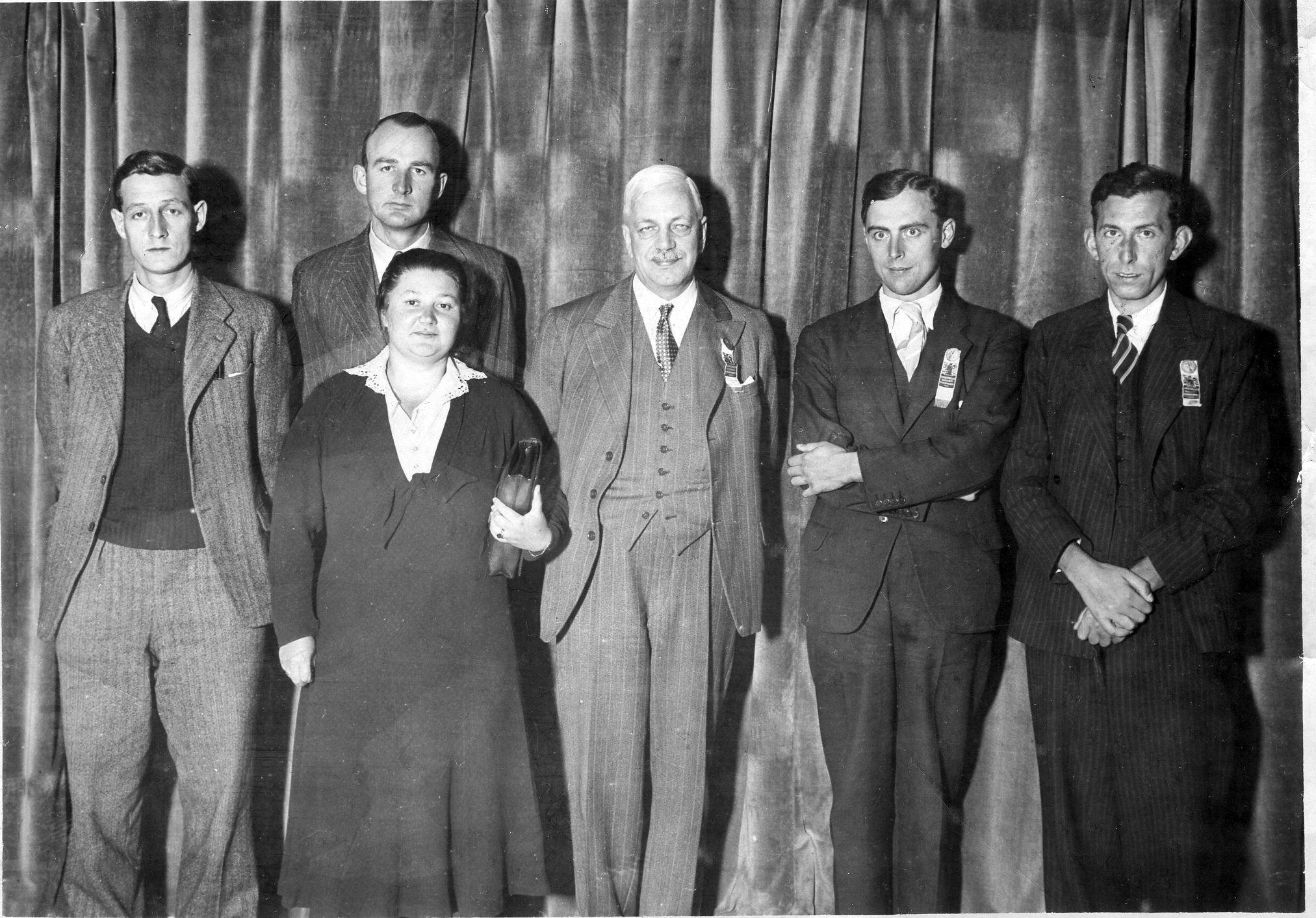
Left to right Baruch H Wood, Philip Stuart Milner-Barry, Vera Menchik (playing in the women’s world championship held concurrently with the Olympiad which she won with 17 wins and 2 draws), Sir George Thomas, Conel Hugh O’Donel Alexander and Harry Golombek. England withdrew after their preliminary group due to the outbreak of war despite qualifying for the top final. Thanks to Leonard Barden
From 1941 until her death she was Games Editor of CHESS. She also gave chess lessons and managed the National Chess Centre, which opened in 1939 at John Lewis’s in Oxford Street, London and was destroyed by a bomb in 1940.
In 1944 Vera Menchik was a solid positional player, who avoided complications and aimed at achieving a favourable endgame. Her placid temperament was ideal for tournament play. Her main weakness was possibly lack of imagination. Her results have made her the most successful woman player ever.”
Vera Menchik
From The Encyclopaedia of Chess, (BT Batsford, 1977) by Harry Golombek :
Probably the strongest woman player in the history of the game, Vera Menchik was born in Moscow and, though her father was a Czechoslovak and her mother English, she played for most of her
life under English colours.
In l92l her family came to Hastings in England and there Vera became a pupil of the great Hungarian master, Geza Maroczy. This was to have a dominating influence on her style of play which was solidly classical, logical and technically most well equipped. Such a style enabled her to deal severely not only with her fellow women players but also with contemporary masters and budding masters. Vera did extremely well, for example, against C. H. O’D. Alexander
and P. S. Milner-Barry, but lost repeatedly to H. Golombek who was able to take advantage of her lack of imagination by the use of more modern methods.
Vera was soon predominent in women’s chess. In the first Women’s World Championship tournament, at London in 1927, she won the title with a score of 10.5 out of 11 and retained the championship with great ease at all the subsequent Olympiads (or International Team tournaments as they were then known more correctly) at Hamburg 1930, Prague 1931, Folkestone 1933, Warsaw 1935, Stockholm 1937 and Buenos Aires 1939.
Vera Menchik at Margate 1935, photographer unknown
With Sonja Graf, the player who came nearest to her in strength among her female contemporaries, she played two matches and demonstrated her undoubted superiority by beating her in 1934 (+3-l) and again in a match for the title in l937 (+9-l=5).
In 1937 Vera officially became a British citizen by marrying the then Kent and later B.C.F. Secretary, R. H. S. Stevenson (Rufus Henry Streatfeild Stevenson: ed).
(Rufus Henry Streatfeild Stevenson was home news editor of the British Chess Magazine, secretary of the Southern Counties Chess Union and match captain of the Kent County Chess Association).
Oddly enough, Sonja Graf, many years later, also became a Mrs Stevenson by marrying an American of that name some years after the Second World War.
Vera Menchik also played and held her own in men’s tournaments. She did well in the British championship and her best performance in international chess was =2nd with Rubinstein in the Ramsgate Team Practice tournament ahead of her old teacher, Maroczy. She also had an excellent result at Maribor in 1934 where she came 3rd, ahead of Spielmann and Vidmar.
Her husband died in 1943 and Vera herself, together with her younger sister Olga and her mother, was killed by a V1 bomb that descended on the Stevenson home in London in 1944.
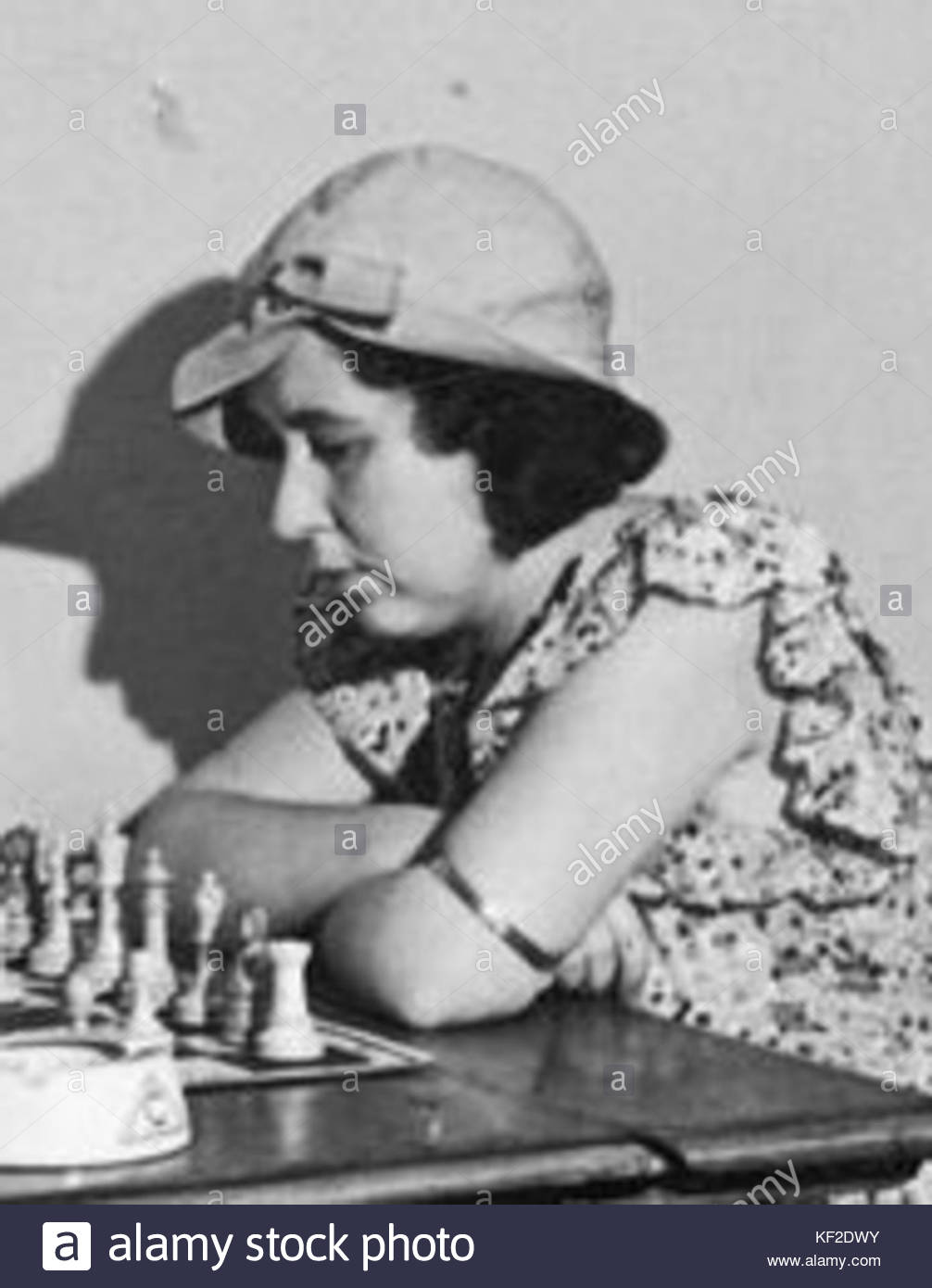
Vera Menchik, circa 1935, Historic Collection / Alamy Stock Photo
This was a sad and premature loss, not only for British but for world chess, since there is no doubt she would have continued to dominate the female scene for many years.
As a person Vera was a delightful companion, jolly and full of fun and understanding. As a player she was not only strong but also absolutely correct and without any prima donna behaviour. Generous in defeat and modest in victory, she set a great example to all her contemporaries.
An example of Vera’s attacking play at its best against her nearest rival, Sonja Graf, is shown by the following game which was played in her 1937 match at Semmering in Austria :
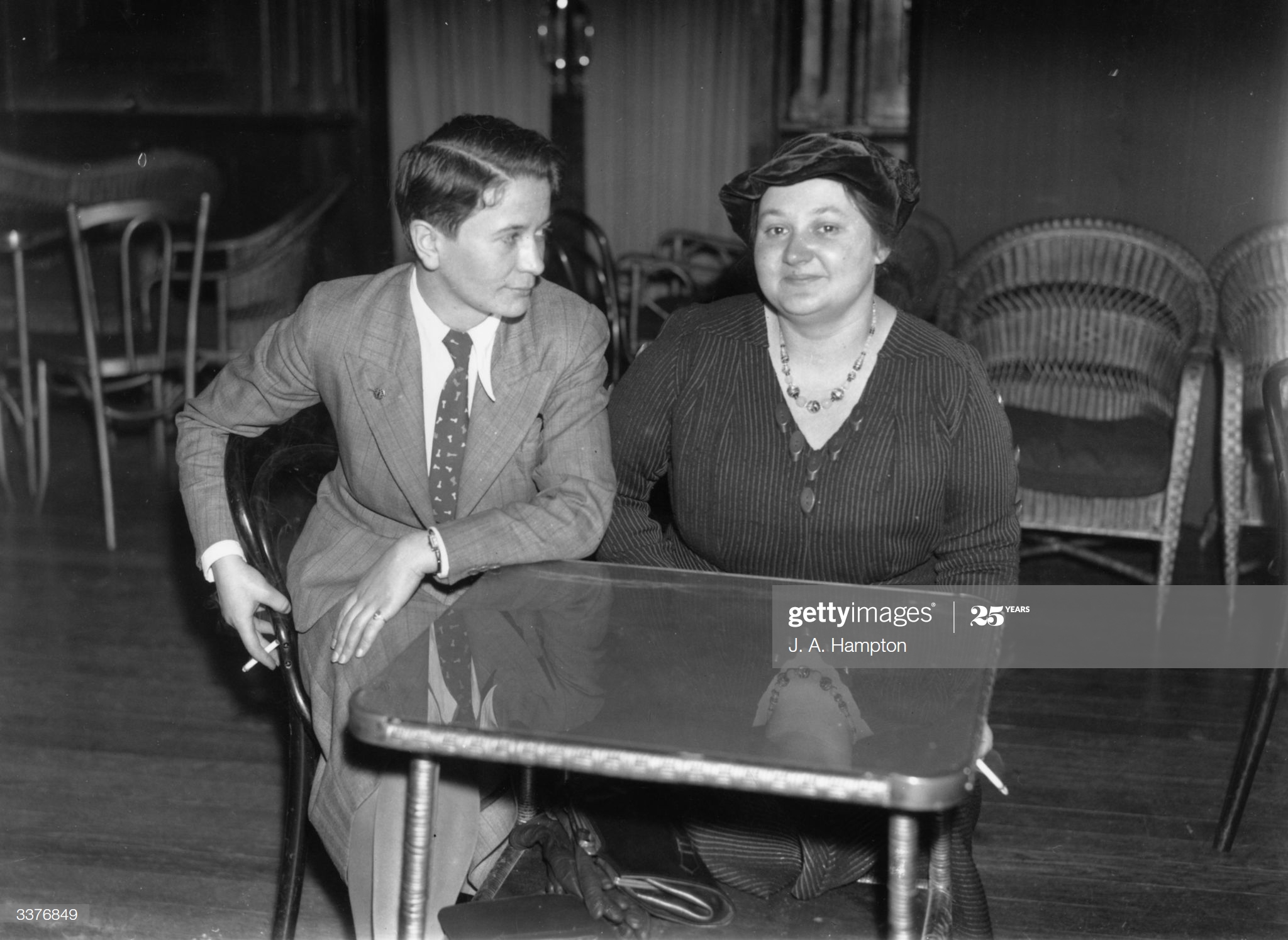
27th November 1936: Britain’s world chess champion Vera Menchik (right) and challenger Sonja Graf after signing a contract at the Bloomsbury Hotel, London, to play for the championship of the world over 16 games. (Photo by J. A. Hampton/Topical Press Agency/Getty Images)
From The Oxford Companion to Chess, (Oxford University Press, 1984) by Hooper and Whyld :
“Woman World Champion from 1927 until her death. Daughter of a Czech father and an English mother, Menchik was born in Moscow, learned chess when she was nine, settled in England around
1921, and took lessons from Maroczy a year or so later. In 1927 FIDE organized both the first Olympiad and the first world championship tournament for women. These events were run concurrently, except in 1928, until the Second World War began, and Menchik won the women’s tournament every time; London 1927 (+10=1); Hamburg 1930 (+6=1 — 1); Prague 1931 (+8);
Folkestone 1933 ( + 14); Warsaw 1935 (+9); Stockholm 1937 (+14); and Buenos Aires 1939 ( + 17=2). She played in her first championship tournament as a Russian, the next five as a Czech,
and the last as a Briton. She also won on two matches against her chief rival, the German-born Sonja Graf (c. 1912-65): Rotterdam, 1934 (+3-1), and Semmering, 1937 (+9=5—2),
Vera Menchik in a pre-event posed picture in which she faces unstoppable checkmate in one from Hastings 193? She was about to play Sir GA Thomas.
In international tournaments which did not exclude men Menchik made little impression; one of her best results was at Maribor 1934 (about category 4) when she took third place alter Pirc and L. Steiner ahead of Spielmann. In 1937 she married the English chess organizer Rufus Henry Streatfeild Stevenson (1878-1943), A chess professional, she gave lessons, lectures, and displays, and was appointed manager of the short-lived National Chess Centre in 1939. In 1942 she defeated Mieses in match play (+4=5-1), She, her younger sister Olga (also a player), and their mother were killed in a bombing raid.
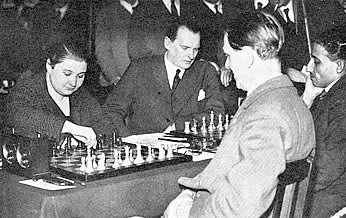
From left to right: Vera Menchik, Alexander Alekhine, Géza Maróczy and Sultan Khan. From London International Masters, 1st February, 1932, French Defence, drawn in 32 moves.
Her style was positional and she had a sound understanding of the endgame. On occasion she defeated in tournament play some of the greatest masters, notably Euwe, Reshevsky, and Sultan Khan. Men she defeated were said to belong to the Menchik club. When world team championships for women (women’s chess Olympiads) were commenced in 1957 the trophy for the winning team was called the Vera Menchik Cup.”
BCM 1994 Appreciation by Bernard Cafferty
From British Chess Magazine, Volume CXIV (114, 1994), Number 8 (August), page 424 onwards) we have this retrospective from Bernard Cafferty:
Fifty yezus ago the chess world was tragically robbed of its most talented female representative of the first half of this century. A Vl rocket (ed: The V1 was not a rocket but a flying bomb) fell on a house in Gauden Road, Clapham, London, that was the residence of Russian-born Vera Menchik, her younger sister and their mother. The trio were sheltering in the cellar, as they usually did during the Nazi air raids on London. The house was completely destroyed. The air-raid shelter in the garden was all that was left.
Vera Menchik was born in Moscow on 16 February 1906, and died on 26 June 1944. The date of death is usually given as 27 June, but Ken Whyld has seen the death certificate and tells us the tragedy occurred before midnight, not after.
The young Vera grew up in a cosmopolitan family in Moscow, where her Czech father and English mother lived in a six-room flat, which they had to share, after 1917, with families from ‘the lower depths’ (the name of a famous play by Gorky which could also be translated as ‘on Skid Row’). In autumn 1921 the family left Soviet Russia and came
to England where they lived in Hastings.
Botvinnik recalls that he visited the Menchik household in Hastings in 1935, where he met Vera’s grandmother. Then, in 1936, he visited the other house in London, after the Nottingham 1936 tournament. At that time the Soviet Embassy arranged a reception in an attempt to counter the awful image of a country deep in the throes of the show trials and widespread repression. However, only Botvinnik, Menchik, Capablanca and Lasker turned up.
Vera Menchik was taught the moves of chess by her father, Franz, when she was nine years old. However, she only took the game seriously from the age of 17, when she joined the Hastings and St Leonards Chess Club, which at that time had its famous extensive sea-front premises near the pier.
According to the 1957 book in Russian by Bykova, on which this account is largely based, Vera only knew Russian when she cam to England, and one of the reasons for her to join the chess club was that a fluent knowledge of English was not necessary for her to be able to benefit from such a silent activity as chess.
The young Vera was fortunate in that the Hungarian grandmaster, Géza Maróczy, had a professional engagement with the Hastings club at this time, and the young lady became his most famous pupil. Her sound style with no fear of long endgames was a mirror of her mentor. She was also helped by Professor JAJ Drewitt, another Hastings club member, in the study of openings, particularly the closed openings.
Vera was initially counted as a Russian and did not enter the British Women’s Championship at the traditional August BCF Congress. However, she made her debut in international chess at a lower section of the 1923-24 Hastings Congress. In 1925 she beat the leading English player Edith Price by a score of +5 =2 -3 in two private matches. She duly took part in the Hastings Congresses, year after year. In the 1926-27 event she scored her first big success by sharing first place with the young Milner-Barry on 6.5(9) in the Premier Reserves.
By 1927, VM was ready to enter the first Women’s World Championship, which was played at the 4th FIDE Congress, alongside the Olympiad in London. She conceded only one draw in her eleven games and so took the title which she was to retain with ease from that day, when she was just 21, till her death 17 years later. In her first title attempt, she
was counted as a Russian, but at the next five (at the Hamburg 1930, Prague 1931,
Folkestone 1933, Warsaw 1935 and Stockholm 1937 Olympiads) she played as a representative of Czechoslovakia. It was only after her marriage to the prominent English organiser R. H. S. Stevenson in 1937 that she was counted as British and played under the Union Flag in her last title defence at Buenos Aires 1939.
Her dominance can be gauged from the fact that she won all eight games at Prague, all 14 at Folkestone, all 9 at Warsaw, all 14 at Stockholm and conceded just two draws in 19 games in 1939. The most serious challenge came in a title match at Semmering-Baden with Sonja Graf, then of Germany. Here too it was largely one-sided: +9 =5 -2.
She made her debut against male masters in an international tournament at Scarborough in 1928, finishing equal 7-8 in a field of 10, but in only the following year, at the Kent Easter Congress, she had one of her best results.
It was decided to run a Scheveningen tournament at Ramsgate with seven foreign masters pitted against seven home representatives. As was only to be expected, Capablanca came top of the ‘external examiners’, yet the next placing was a sensation: Capablanca 5.5(7) followed by Miss Menchik and Rubinstein 5, Koltanowski and Maroczy 4.5, Soultanbeieff 4 and Znosko-Borovsky 3. Sir George Thomas, whom Menchik beat, scored 3 to head the English team of Yates, Winter, Michel, Tylor and E. G. Sergeant.
Naturally enough, after this it was inevitable that foreign invitations should follow. Later in 1929 the young ‘Russian’ took part in a Paris tournament and then in the great Carlsbad tournament, the last of a wonderful series. Her presence here created some scepticism, and on the eve of the first round the Austrian theoretician Becker suggested that a Vera Menchik club be formed, membership of which would be granted only to those who lost to the lady. According to Flohr, there was an expectation that it would be a small select club, but Becker was quickly proved wrong for he became its first member in the third round! His only consolation was that the club proved far more extensive and democratic as the years rolled by. In fact the club came to include grandmasters such as Euwe (who earned a two-fold qualification) Sultan Khan and Reshevsky as well as masters such as Saemisch, Colle, Golombek, Sir George Thomas, Alexander…
However, Miss Menchik could not make much of the universally strong opposition and made only three points out of 20, finishing last, three points behind Sir George Thomas. With further experience she was to have more impressive results, such as her 8th place at London 1932, won by Alekhine, where she came ahead of Milner-Barry, Sir George, Burger and Winter.
{[%evp 0,47,26,26,26,4,22,22,22,37,37,10,8,12,26,13,45,11,40,44,48,27,27,26,31,
30,50,3,32,27,46,52,66,18,120,41,51,122,114,114,738,1053,1361,1203,29987,1551,
29989,29990,29995,29996]} 1. d4 Nf6 2. c4 g6 3. Nc3 Bg7 4. e4 d6 5. f3 O-O 6.
Be3 e5 7. Nge2 {[#]} b6 $146 (7… a6 {spielte Frau Menchik drei Jahre spater
in Moskau gegen Herrn Capablanca – und bekam eine Lektion in brettumfassender
Strategie verabreicht. Es sollte noch einige Jahre dauern, bis die Schwarzen
verstanden, wie sie dem von Sir George Alan Thomas Zeitgenossen Fritz Samisch
ausgeklugelten System begegnen sollten.} 8. Qd2 Bd7 9. d5 Ne8 10. g4 h6 11. h4
Kh7 12. Ng3 c5 13. Bd3 Qa5 14. Qe2 Rh8 15. a3 Qd8 16. b4 b6 17. Qb2 Bc8 18. Ke2
Nd7 19. Rag1 Rb8 (19… cxb4 20. axb4 a5) 20. b5 a5 21. Kd1 Kg8 22. Qd2 {
Capablanca,J-Menchik,V/Moscow 1935/HCL/1-0 (32)}) ({Relevant:} 7… Nc6 8. Qd2
Nd7 9. d5 Ne7 10. g3 f5 11. Bg2 fxe4 12. fxe4 Nf6 13. h3 b6 14. b3 Kh8 15. g4
Neg8 16. Ng3 Bd7 17. O-O-O h6 18. g5 hxg5 19. h4 Bg4 20. hxg5+ Nh5 21. Nce2 Ne7
22. Rh4 Qd7 23. Rdh1 Kg8 24. Rxg4 Qxg4 25. Bh3 Qf3 26. Rf1 Nxg3 27. Be6+ {
1-0 (27) Botvinnik,M-Alatortsev,V Moscow 1931}) 8. Qd2 $146 Nc6 9. d5 Ne7 10.
g4 Nd7 11. Rg1 a5 12. O-O-O Nc5 13. Ng3 Bd7 14. h4 a4 15. h5 {Wieder bahnt
sich eine instruktive Klatsche fur Sir Thomas an. Weis tragt in aller Ruhe
seinen Konigsangriff vor, Schwarz steht ohne Gegenspiel da.} Qb8 16. Bh6 Qa7 {
Black’s slow play, hoping to gain some pressure on the Q-side, is now swiftly
punished.} 17. Bxg7 Kxg7 18. Nf5+ Nxf5 $2 {Black had to take with the bishop.}
(18… Bxf5) 19. gxf5 a3 20. f6+ $1 Kh8 21. Qh6 axb2+ 22. Kb1 Rg8 23. hxg6 fxg6
{[#]} 24. Qxh7+ $1 {Willkommen im Club.} 1-0
[/pgn]
A high spot of the 1930s for Vera was her participation in the 1935 Moscow tournament, but her return to her native city was so taken up with social engagements that she was unable to give of her best, and she scored only one and a half points from 19 games though she did take a draw off the winner of second prize, Flohr.
Vera had to eke out a living from teaching chess, adjudications and simultaneous exhibitions. After her return from Buenos Aires she lived in London. She was appointed administrator of the new National Chess Centre at John Lewis’s store in Oxford Street, which, alas, was destroyed by enemy action in 1940.
Her last great success was a match with the veteran GM, Jacques Mieses who was a refugee from anti-Semitic German. Played in 1942, the result was +4 =5 -1.
In 1943 Vera’s husband died. In 1944 she was playing in the championship of the West London Club, a strong event which included Sir George Thomas, PM List, EG Sergeant and Mieses amongst the players. Doubtless she was looking forward to the resumption of International chess activity after the war. It was not to be. We live in an age when the achievements of women players such as Gaprindashvili, Chirburdanidze, Xie Jun and the Polgar sisters have built on the pioneer work of Vera Menchik. Yet the path of the pioneer is always the hardest.
Finally, by all accounts of contemporaries, Vera was a cultured and sympathetic person who never gave cause for offence amongst the many players she met. Had she lived, she would have continued to be a jewel in the crown of British chess, which had to drag itself up from the boot straps after the devastation of war. What a tragic loss.
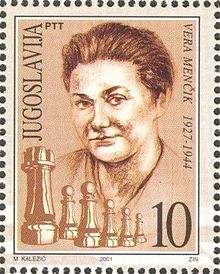
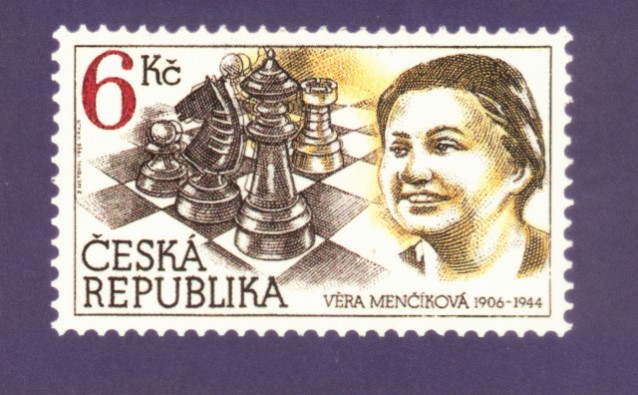
Vera Menchik commemorated on a postage stamp from the Czech Republic
She was inducted to the World Chess Hall of Fame in 2011.
BCN remembers Nancy Elder MBE who passed away on Wednesday, March 4th 1981, i.e. forty years ago in Perth, Western Australia.
Nancy Conchar Gordon was born on Tuesday, May 25th 1915. On the same date was born Robin Day in High Wycombe who went on to design the polypropylene stacking chair.
Nancy was born in Kirmabreck, Kirkcudbrightshire in the Dumfries and Galloway council area of Scotland.
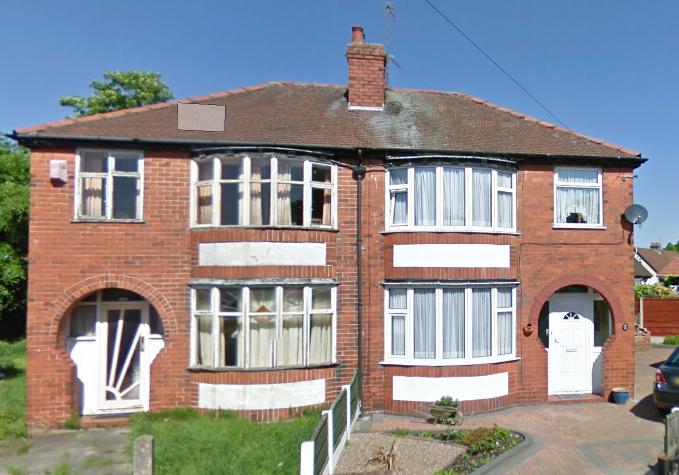
In the 1939 register Nancy was living at 18 Thornton Avenue, Urmston, Manchester, M41 5DJ with a married couple, William Furnish (a railway time keeper) and Gertrude Furnish who performed unpaid domestic duties. Presumably Nancy was their lodger.
18 Thornton Avenue, Urmston, Manchester, M41 5DJ
Her occupation was given as a teacher of music and physical training. At this time she was single at the age of twenty-four.
In the mid-1940s Nancy relocated from Manchester to Dundee where she continued her teaching career at Dundee High School. During that time she encouraged and coached a number of players some of whom represented Scotland.
In 1950 in Tealing, Angus, Scotland Nancy married David Livie Elder. They had a daughter Christine who played chess as a junior. Tealing has a strong connection with the Elder family.
According to Alan McGowan (Chess Scotland): “She was the main instigator in forming both the Schools’ and Primary League in Dundee, and she assisted in the organisation of the Dundee 1967 International Centenary Tournament.”
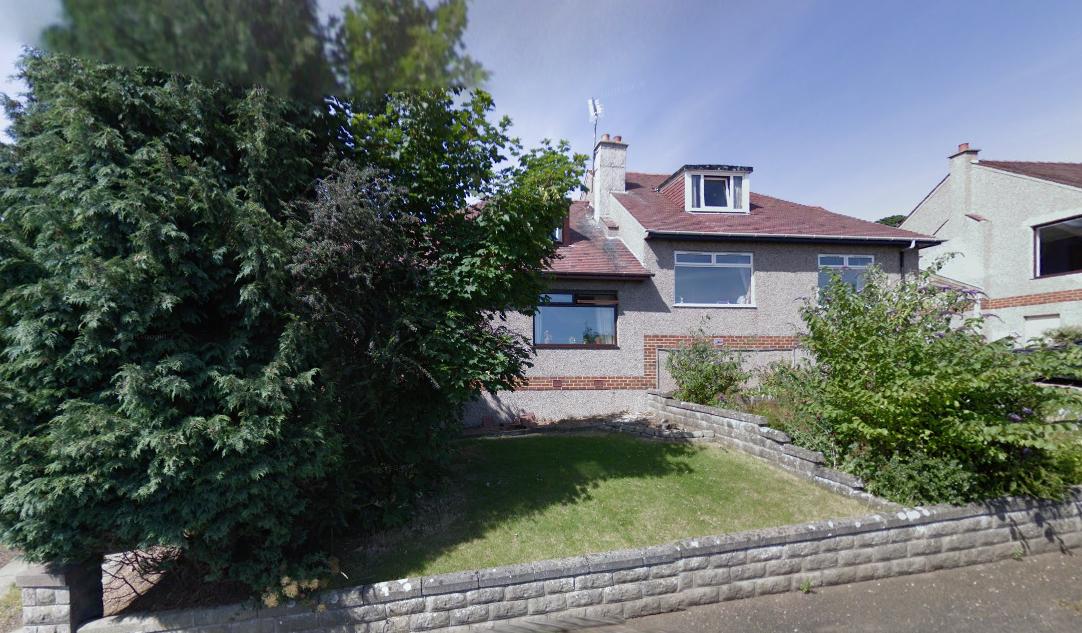
When she passed away Nancy was living at 39 Whitefauld Road, Dundee, DD2 1RJ :
39 Whitefauld Road, Dundee, DD2 1RJ
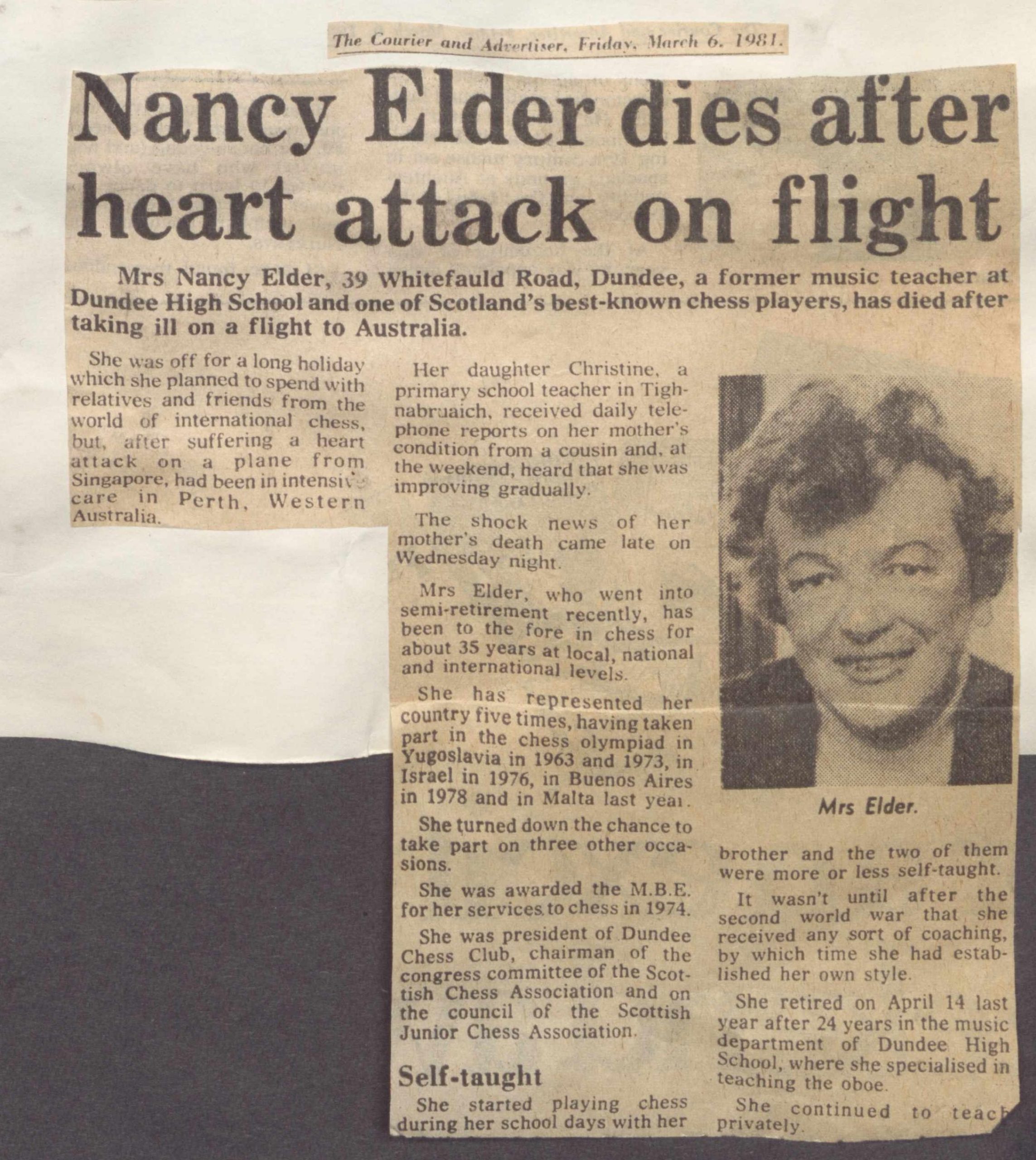
Her passing was reported in the Dundee Courier and Advertiser on March 6th 1981 as follows :
Nancy Elder dies after heart attack on flight
Mrs Nancy Elder 39 Whitefauld Road, Dundee, a former music teacher at Dundee High School and one of Scotland’s best known chess players, has died after taking ill on a flight to Australia.
She was off for a long holiday which she planned to spend with relatives and friends from the world of international chess, but, after suffering a heart attack on a plane from Singapore, had been in intensive care in Perth, Western Australia.
Her daughter Christine, a primary school teacher in Tighnabruaich, received daily telephone reports on her mother’s condition from a cousin and, at the weekend, heard that she was improving gradually.
The shock news of her mother’s death came late on Wednesday night.
Mrs. Elder, who went into semi-retirement recently, has been to the fore in chess for about 35 years at local, national and international levels.
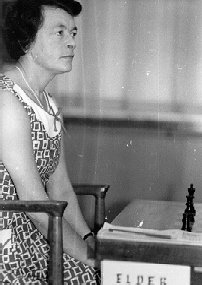
Nancy Elder MBE. Source : Milos Petronic
She has represented her country five times, having taken part in the chess Olympiad in Yugoslavia in 1963 and 1973, in Israel in 1976, in Buenos Aires in 1978 and in Malta last year.
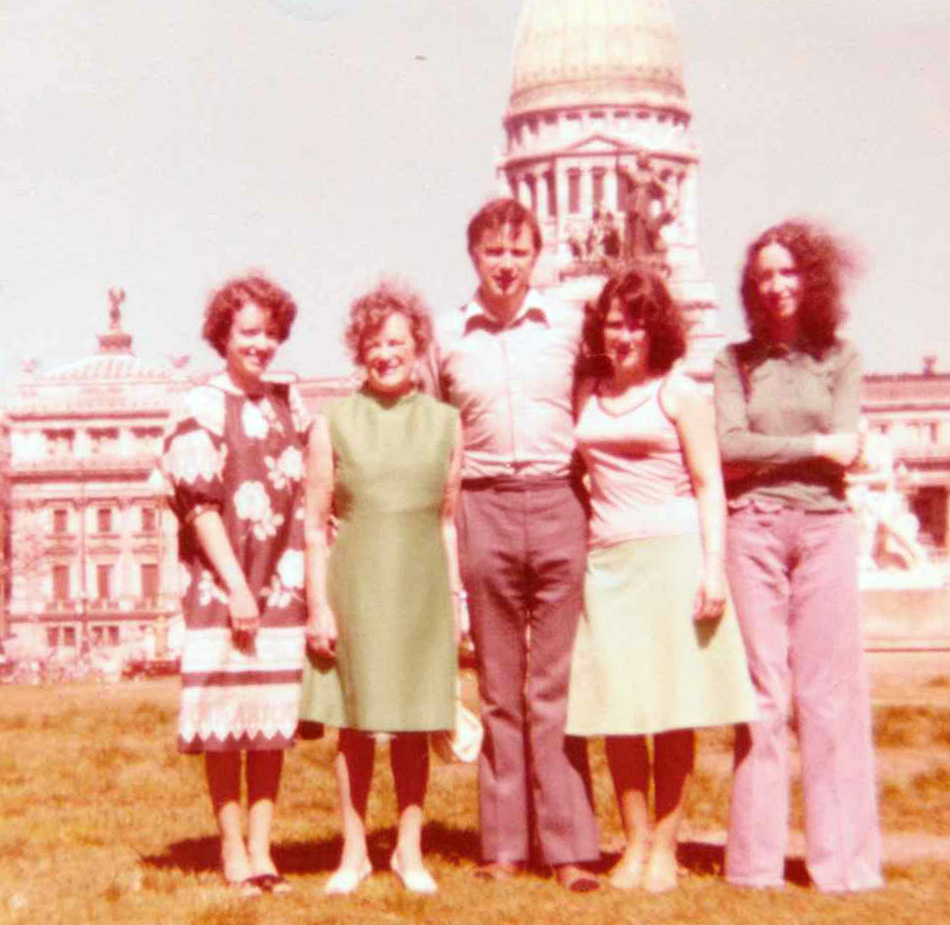
Buenos Aires Olympiad 1978. From left: Morag McGhee, Nancy Elder, Owen Hindle, Kathleen Hindle and Lynne Houston. Courtesy of Chess Scotland
She turned down the chance to take part on three other occasions.
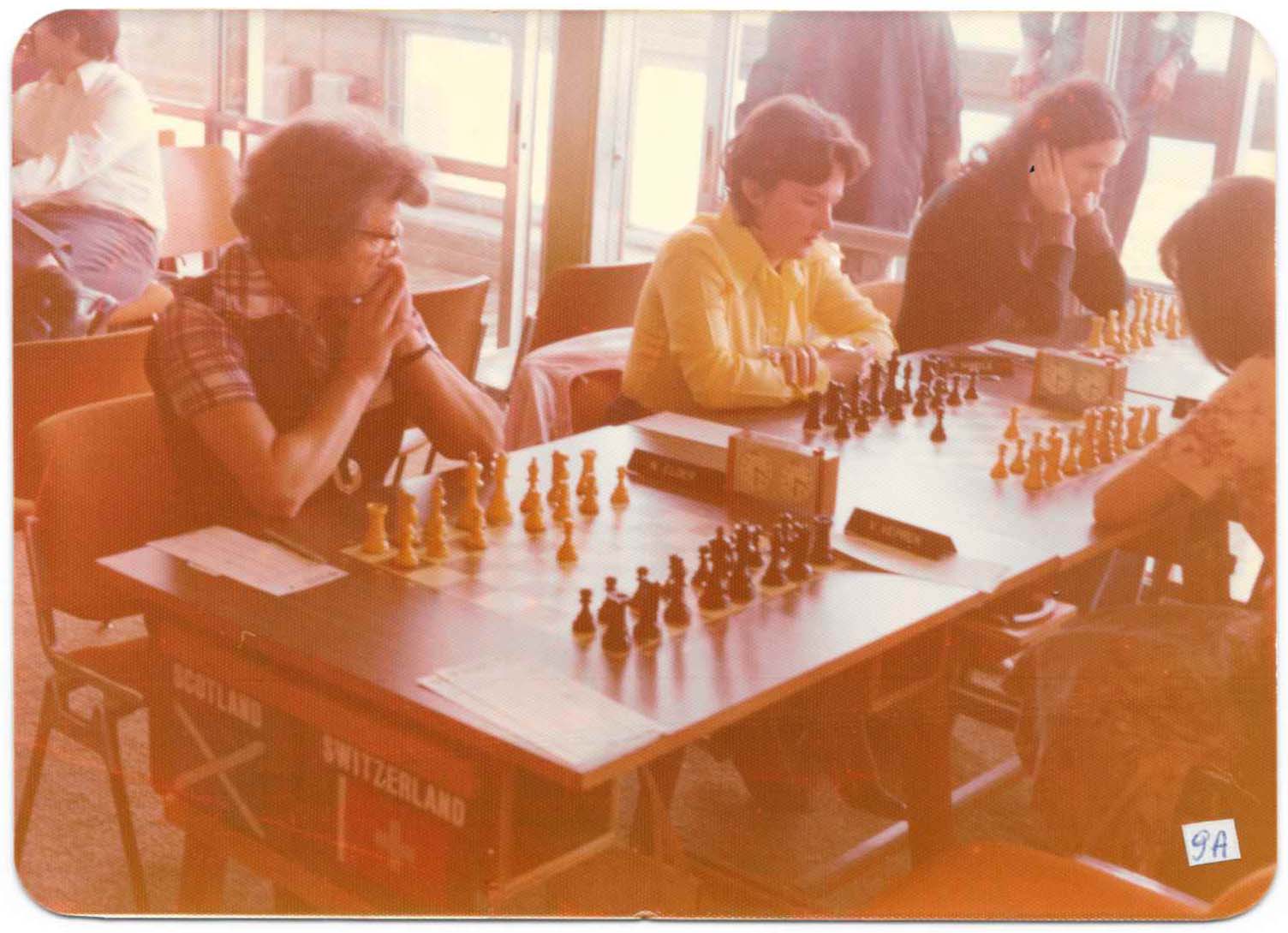
Haifa Olympiad 1976 – Scotland v Switzerland. From left: Nancy Elder, Kathleen Hindle, Lynne Houston. Courtesy of Chess Scotland
She was awarded the MBE for her services to chess in 1974.
She was President of Dundee Chess Club, chairman of the congress committee of the Scottish Chess Association and on the council of the Scottish Junior Chess Association.
Self-taught
She started playing chess during her school days with her brother and the two of them were more-or-less self taught.
It wasn’t until after the Second World War that she received any sort of coaching, by which time she had established her own style.
She retired on April 14th last year after 24 years in the music department of Dundee High School, where she specialised in teaching the oboe.
She continued to teach privately.
Dundee Courier and Advertiser, March 6th 1981
From British Chess Magazine, Volume CI (101, 1981), Number 6 (June), pp. 219-220 we have this obituary from Bernard Cafferty :
“Nancy C. Elder, MBE, died in Perth, Western Australia on March 4th 1981. Mrs. Elder had recently retired after a lifetime of teaching, her last post being in Dundee. I well remember her account of teaching under difficult conditions in World War 2 in Manchester. 15 Scottish Women’s Champion (the record for the event which she set-up at Troon in 1980).
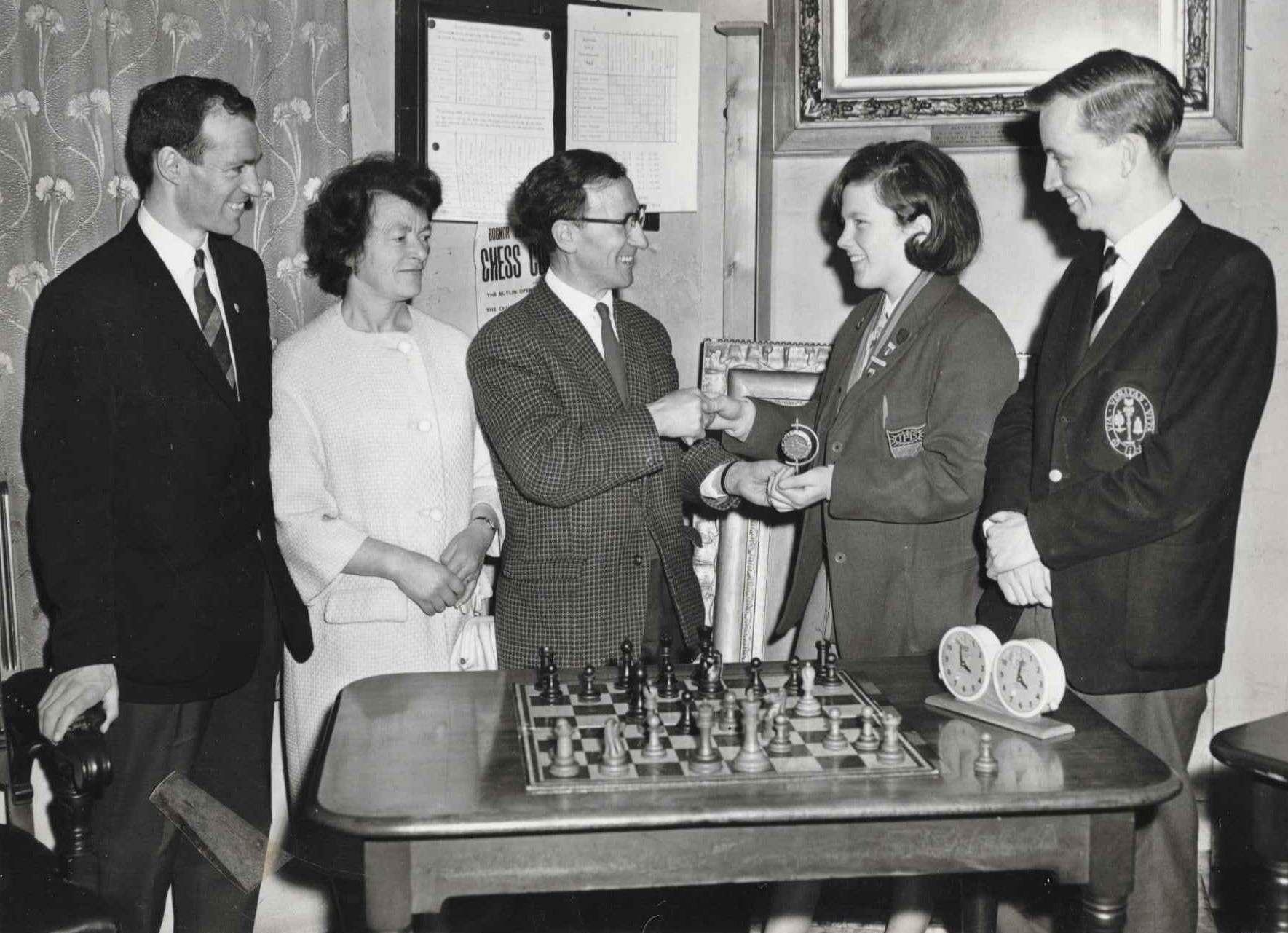
Prizegiving at the 1966 Scottish Championships. From the left: Michael Fallone, Nancy Elder, W.P. McColl, President of Dundee Chess Club, Kathleen Patterson, Gerald Bonner. Courtesy of Chess Scotland
Mrs Elder was a regular competitor in the British Women’s Championship (sometimes in rivalry with her daughter Christine) and showed her playing strength with a score of 5.5/12 on board two for Scotland at the Women’s Chess Olympiad, Malta, 1980.
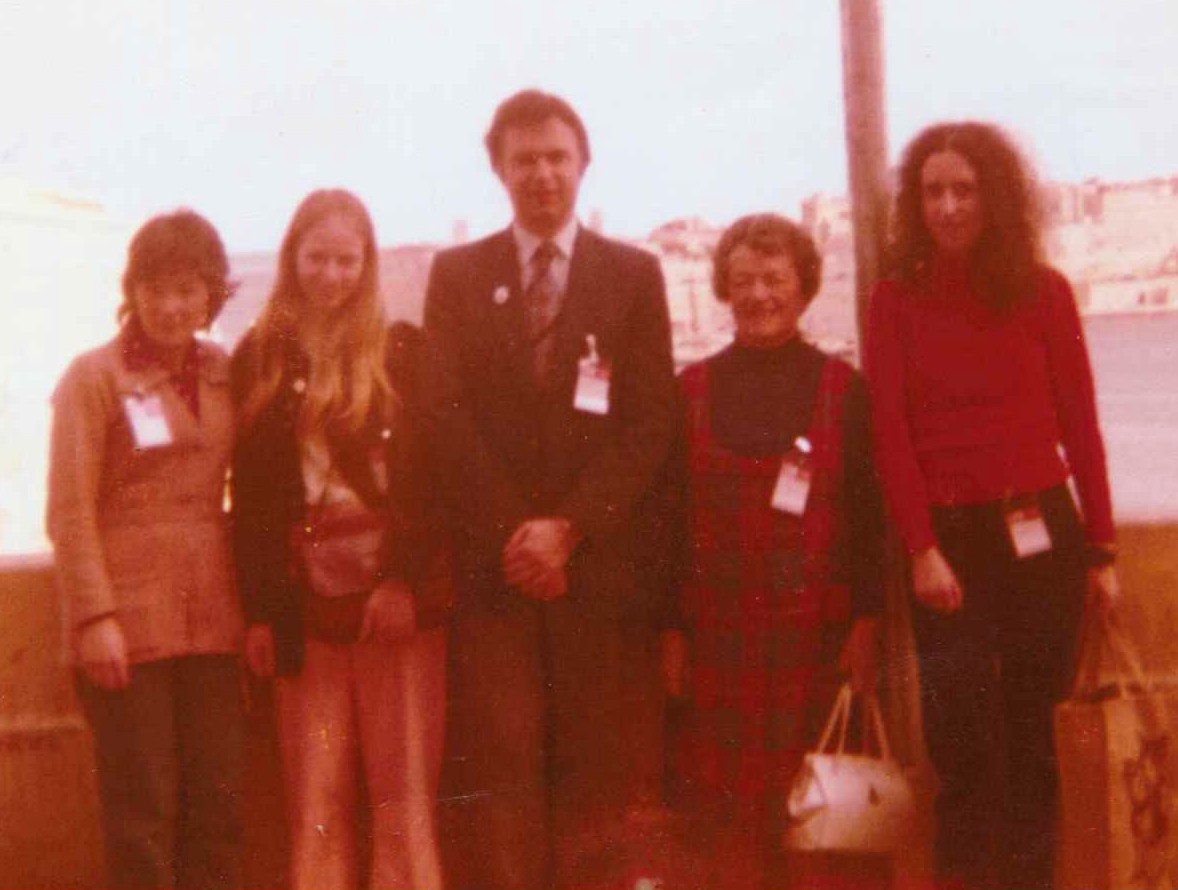
Malta Olympiad 1980 Left-right: Kathleen, Rosie Giulian, Owen Hindle (Team Captain), Nancy Elder, Lynne Houston. Courtesy of Chess Scotland
I am sure she will be best remembered though for her decades of effort in the organising of chess in Scotland, particularly for juniors and in schools, in recognition of which she was awarded the MBE, the only such honour ever given for services to chess ‘north of the border’ as Alan Borwell puts it in his Newsflash obituary.”
{[%evp 0,71,19,31,72,53,51,40,38,35,42,42,41,21,45,40,44,31,38,44,43,35,37,37,
56,37,60,54,156,124,220,183,183,139,160,91,90,96,101,80,101,0,5,0,6,0,1,16,1,5,
21,25,38,2,28,0,37,8,42,20,45,6,202,261,285,366,920,931,29993,29994,29995,
29996,29997,29998]} 1. e4 c5 2. Nf3 Nc6 3. d4 cxd4 4. Nxd4 Nf6 5. Nc3 d6 6. Be2
g6 7. Be3 Bg7 8. O-O O-O 9. h3 {A choice of Smyslov and Kudrin.} ({A more
modern way to proceed is} 9. Nb3 Be6 10. f4 Qc8 11. Kh1 Rd8 12. Bf3 Bc4 13. Rf2
e5 14. Rd2 Qe6 15. fxe5 Nxe5 16. Nd4 Qe7 17. b3) 9… a6 (9… Bd7 10. Qd2 Rc8
11. f4 a6 12. Rad1 b5 13. a3 Qc7) 10. Qd2 Qc7 11. f4 Rd8 12. Rad1 Nxd4 13. Bxd4
e5 $2 $146 {[#] The only game to feature this position.} (13… Be6) 14. Bxe5
$18 Qb6+ 15. Kh2 (15. Bd4 {Appears more natural.}) 15… Be6 16. Bxf6 (16. Bd4)
16… Bxf6 17. Nd5 {White immediately seeks exchanges.} Bxd5 18. Qxd5 Rac8 19.
Bc4 Qc7 20. Bb3 (20. Bd3) 20… Bxb2 21. a4 Qe7 {Black has equalised after the
earlier blunder.} 22. Rf3 Rc5 23. Qd3 Rc3 24. Qe2 Rdc8 25. Rxc3 Bxc3 26. Rd3
Kf8 27. Qf3 Bb4 28. g4 Rc5 29. Kg2 h6 30. Kf1 {[#]} f5 $2 {after all of
Black’s efforts lashing out is not a good idea.} (30… b5 {was reasonable.})
31. gxf5 gxf5 32. Qh5 $1 {and Black is busted.} fxe4 33. Qxh6+ Qg7 34. Qxd6+
Qe7 35. Qh6+ Qg7 36. Rd8+ {and Black resigned.} 1-0
[/pgn]
Chess Scotland award the Nancy Elder Cup annually for an individual competition for “club level” players.
We are grateful to Helen Milligan who told BCN :
My most memorable incident was when I refused to play in the Scottish Ladies at the annual Congress, preferring to try to improve my chess by playing in the Open section (really the B-Grade, below the Championship proper). I got given a piece of Nancy’s mind for that – she did not approve!
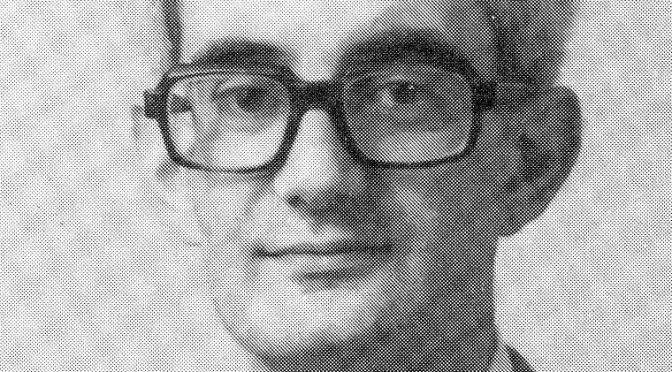
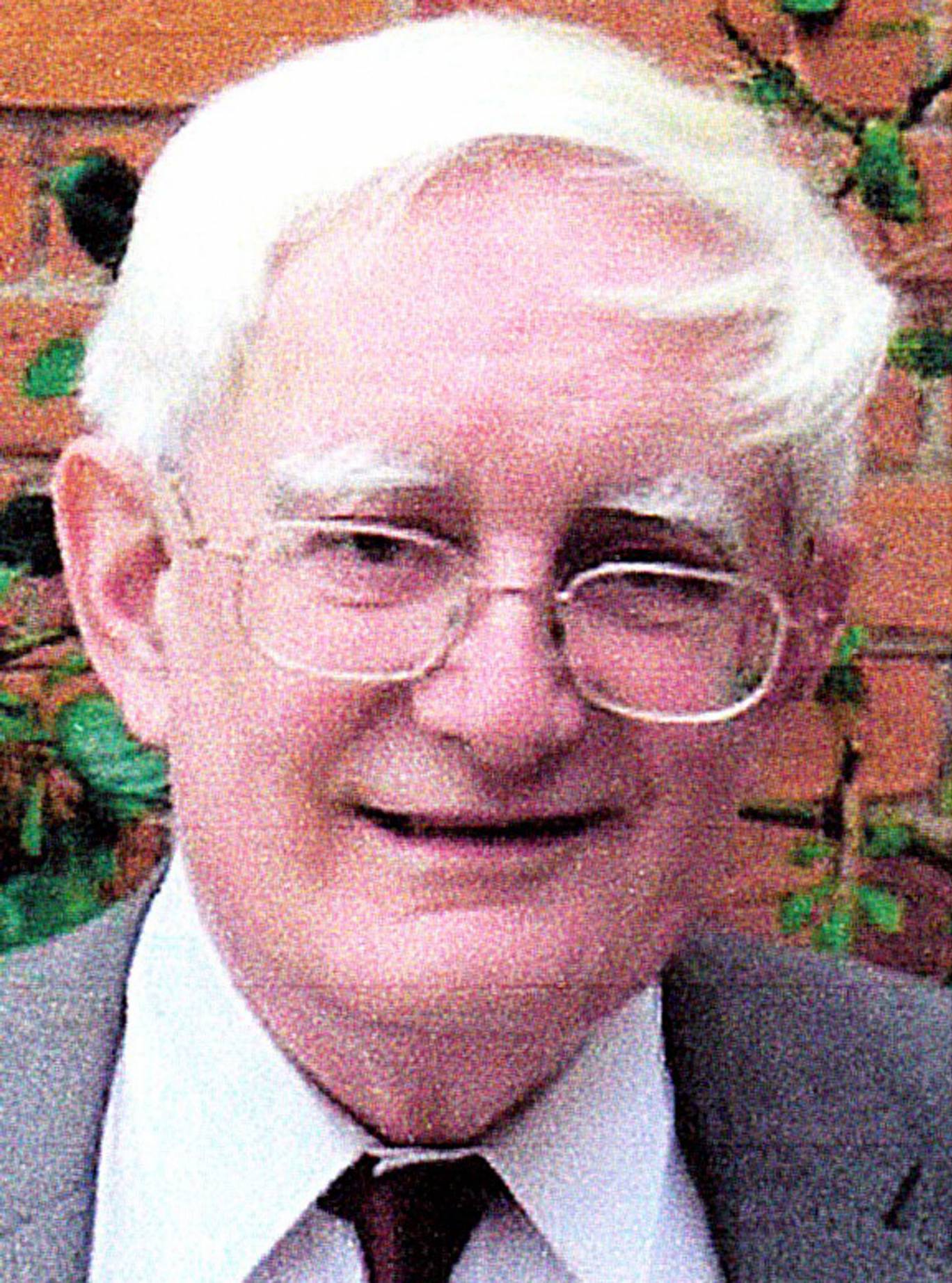
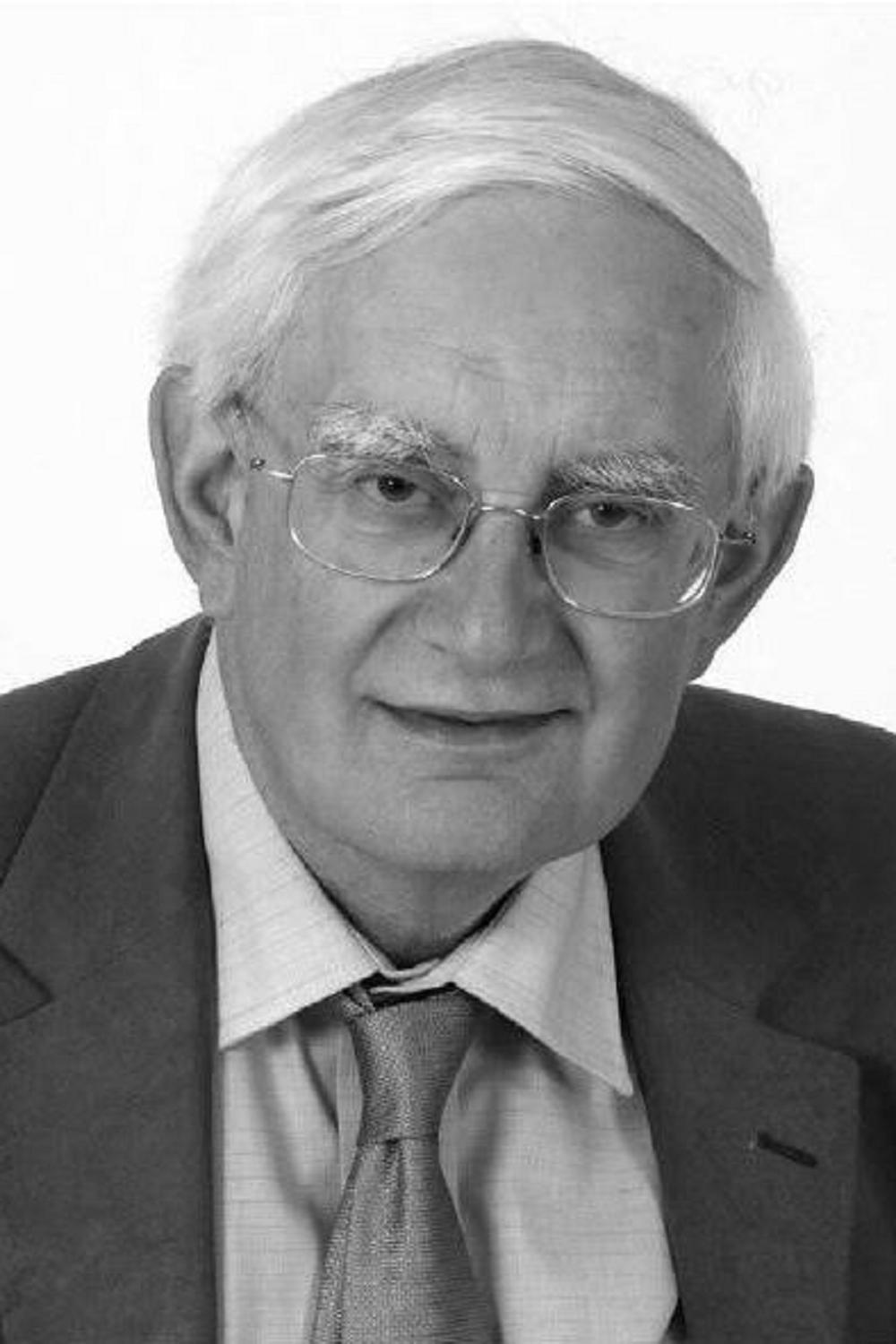
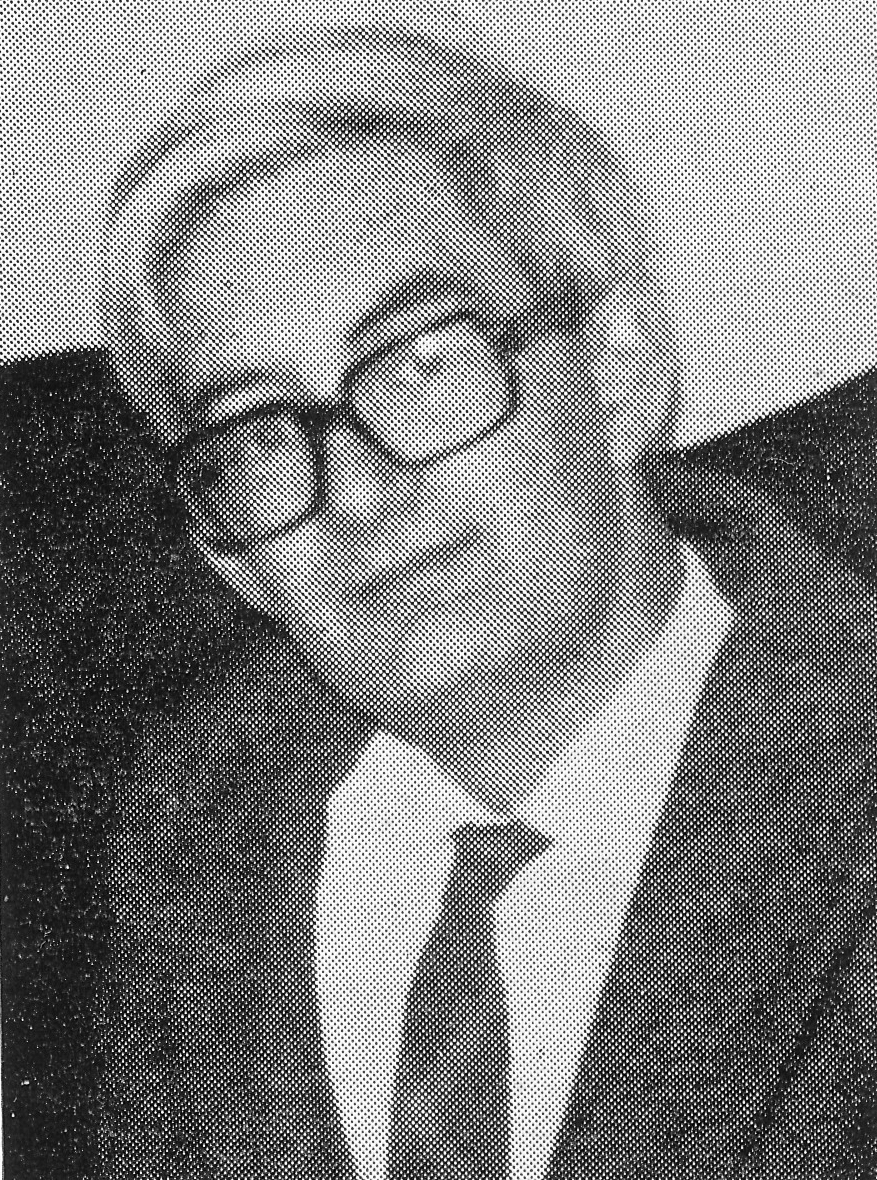
BCN remembers CGM Adrian Hollis who passed away in Wells, Somerset on Tuesday, February 26th 2013 at the age of seventy-two.
Adrian Swayne Hollis was born in Bristol, Avon on Friday, August 2nd 1940. During this critical period the Luftwaffe was wisely extending its Battle of Britain targets to include Britain’s airfields. Furthermore, Bristol was bombed heavily between June 1940 and May 1944. The longest period of regular bombing, known as the ‘Bristol Blitz’ began in autumn 1940 and ended the following spring. The first bombs of the Bristol Blitz fell at around 6 pm on Sunday 24 November 1940.
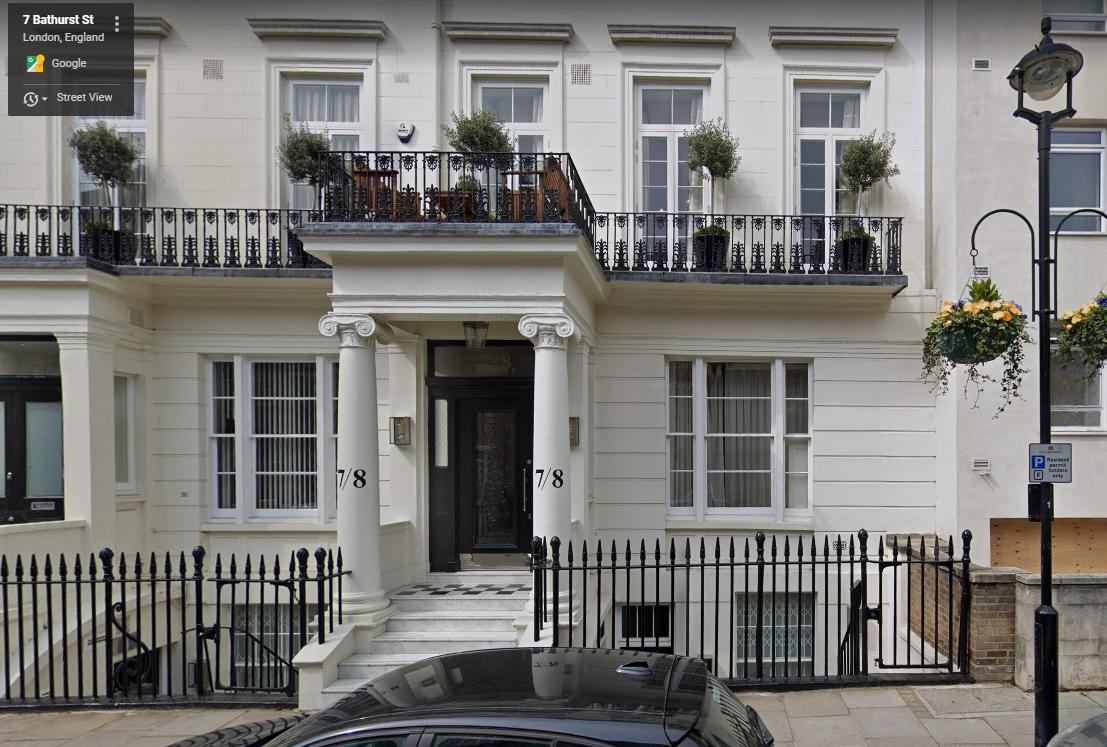
Adrian was the only child of MI5 director general Roger Henry Hollis KB CBE (later to become Sir Roger Hollis) and Evelyn Esme Hollis (née Swayne) who was Roger’s first wife. Roger was from Wells and Evelyn from Burnham-on-Sea and they were married on July 17th 1937 in Wells Cathedral with Evelyn’s father performing the ceremony.
Adrian won a scholarship in classics to Eton College and then went up to Keble College, Oxford where he took a first in mods and greats. Whilst at Keble Adrian represented Oxford in four varsity matches between 1959 and 1962. Indeed, his support for varsity matches was maintained for many years attending a large number into and beyond the Lloyds Bank era. Stalwart organiser Henry Mutkin would always be sure to extend an invitation.
In 1961 Adrian become the youngest ever West of England Champion at the age of 21.
Adrian met Margaret Mair Cameron Edwards in 1967 at St. Andrew’s University where he taught Classics and she taught German. They married in the parish of St. Leonards in St. Andrews and had two daughters, Jennifer Margaret M (b. 1974) and Veronica Swanye (b. 1977) and a son, Michael David C.
He was the Games Editor for the British Correspondence Chess Association (BCCA) resigning in 1969.
In 1984 Adrian was forced to endure allegations against his father by Chapman Pincher (in CPs book Too Secret too Long) that Sir Roger had been a Soviet spy / mole. These allegations were demonstrated to be false. He may well also have been aware of allegations against his friend and chess mentor Graham Mitchell earlier in 1963. Ironically, it was Adrian’s father who initiated the investigation into Graham. Again, the rumours were shown to be unfounded.
Adrian became a director of the company Centre for Medieval and Renaissance Studies Limited on the September 1st 1996 and resigned on May 12th 2007. He was also a Vice President of the West of England Chess Union (WECU).
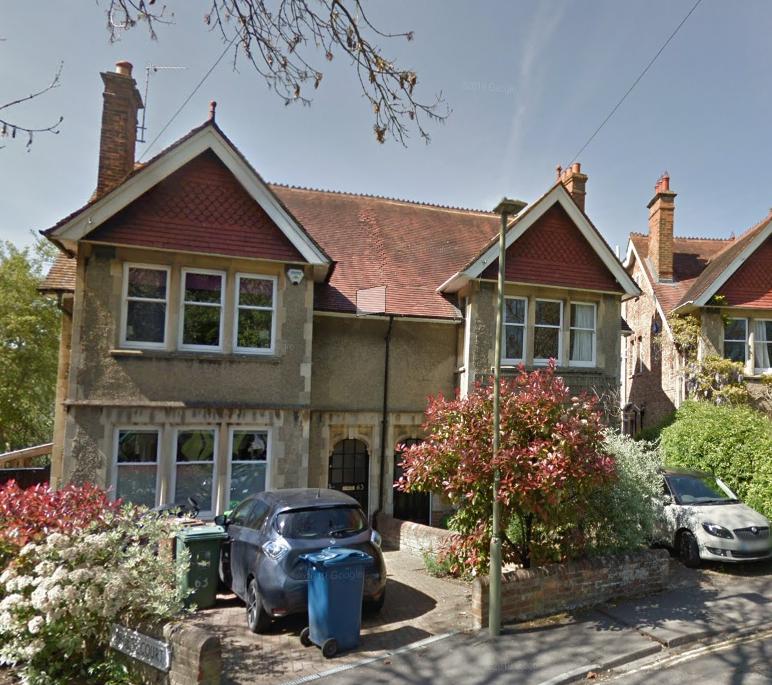
Between 2003 and 2007 (according to the Electoral Roll) Adrian lived at 63, Bainton Road, Oxford, OX2 7AG :
63, Bainton Road, Oxford, OX2 7AG
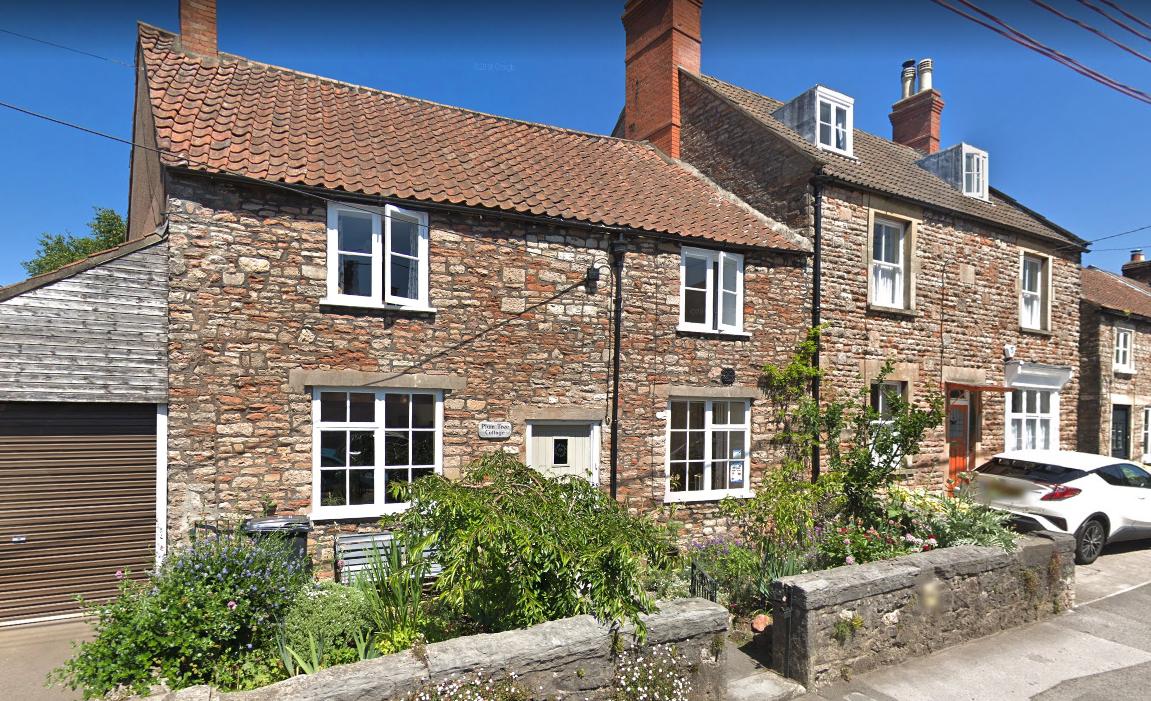
and following his retirement (and the time of the 2008 electoral roll) Adrian had moved to Pound House, Southover, Wells, BA5 1UH :
Pound House, Southover, Wells, BA5 1UH
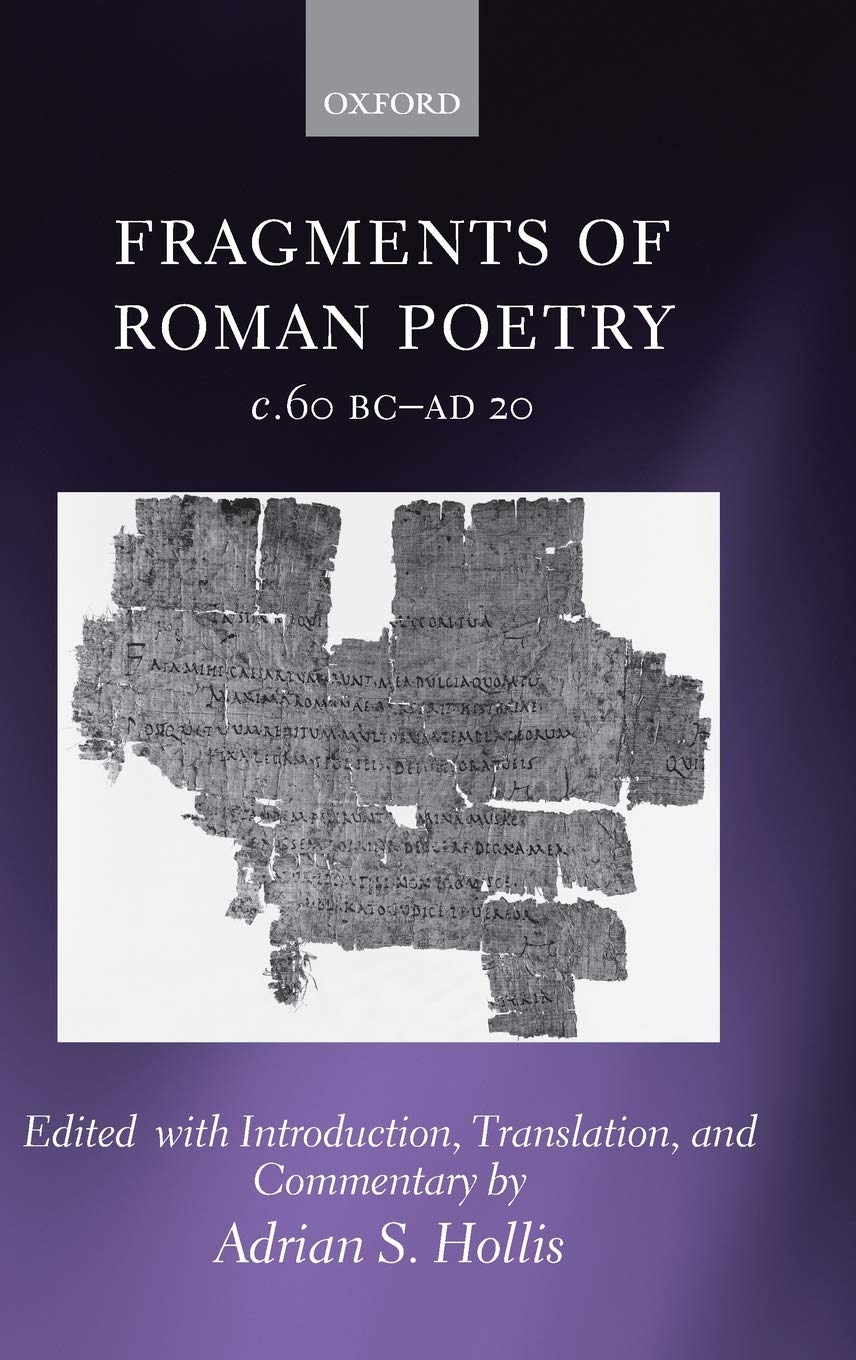
Adrian has written many learned papers and has had two books published :
Fragments of Roman Poetry C.60 BC-Ad 20, AS Hollis, Oxford University Press, 2007
and
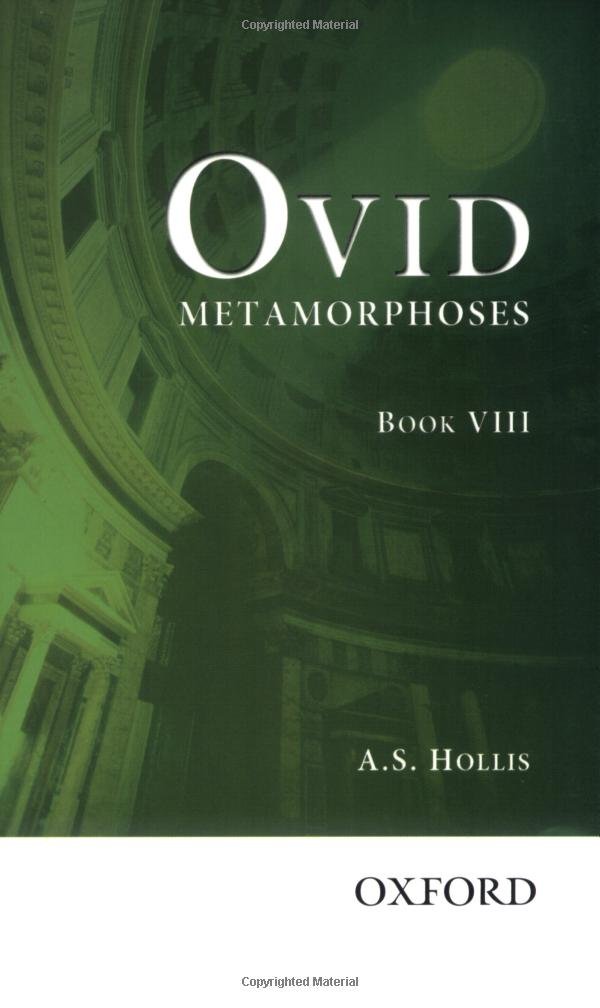
Ovid Metamorphoses VIII (Schools Edition): Bk. 8, AS Hollis. Oxford University Press, 2008
Julian was a personal student of Adrian’s and was kind enough to tell us :
I do remember Adrian well. He could quote Latin verse ad infinitum. He was an expert on Ovid.
In terms of chess he had a huge pile of Informators in his study still in their cardboard packaging. He was very kind to me and insisted I play above him for Keble in the intercollegiate matches.
I gave him a copy of Developments in the Orthodox QGD which I had written in 1987. He was quite taken back when I didn’t want any money for it. He seemed to have quite a lot of respect for me.
I once asked him why he had given me a place at Oxford. He replied that he couldn’t have rejected someone with my passion and enthusiasm.
I kept in touch with Adrian until his passing. He gave me a lovely reference when I resumed my studies in 2007 at Kingston University.
I remember him as a kind and unassuming man. He became a lifelong friend.
CGM Adrian Hollis
From British Chess (Pergamon Press, 1983) Botterill, Levy, Rice and Richardson :
“I was born on August 2nd, 1940, educated at Eton and Christ Church, Oxford and now teach Classics at Keble College, Oxford. I learned the moves at the advanced age of thirteen from a cousin* who himself could have made a good chess player had he not been seduced by Philosophy and brain-teasers; all that remains in the mind from these encounters is a vision of perpetually losing my rooks to fianchettoed bishops.
*We are grateful to John Clarke who informed us that
“The cousin would have been Martin Hollis, who contributed the “Tantaliser” column to the New Scientist for many years. I always enjoyed his puzzles, which for me at any rate were at just the right level of difficulty – neither trivial nor totally impossible.”
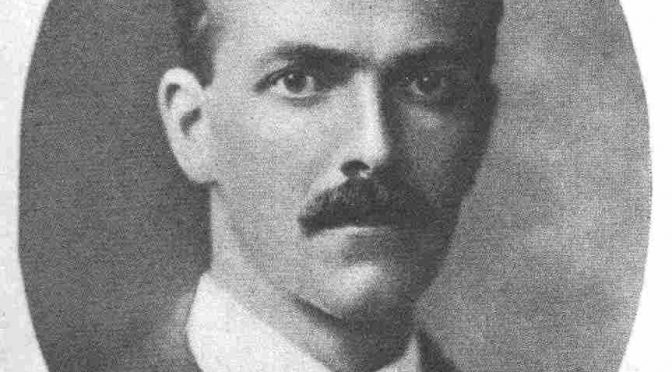
Adrian Hollis. Source : The Potter Memorial
My first ever tournament was the London Boys’ Championship 1956-7. In the opening round fate allotted me Black against David Rumens. As it happened, the brochure included a game of his from the previous year in which he had answered 1.d4 with 1…Nc6, quite enough, in my opinion, to condemn him utterly.
[fen]r1bqkbnr/pppppppp/2n5/8/3P4/8/PPP1PPPP/RNBQKBNR w KQkq – 0 1[/fen]
(Ed: The above position did not impress Adrian hugely.)
This view seemed confirmed when within twelve moves of an advance French I was two pawns up. Then, however, aided by my over confidence he worked up a fierce attack, and I just escaped with a draw. Nevertheless, I won the tournament; an opponent remarked how quickly I played my moves.
Thereafter the game was never so easy, but I did reasonably, well, winning the championships of the British Universities, West of England and East of Scotland, and playing for England quite regularly during the 1960s (including 7.5/12 in six Anglo-Dutch matches).
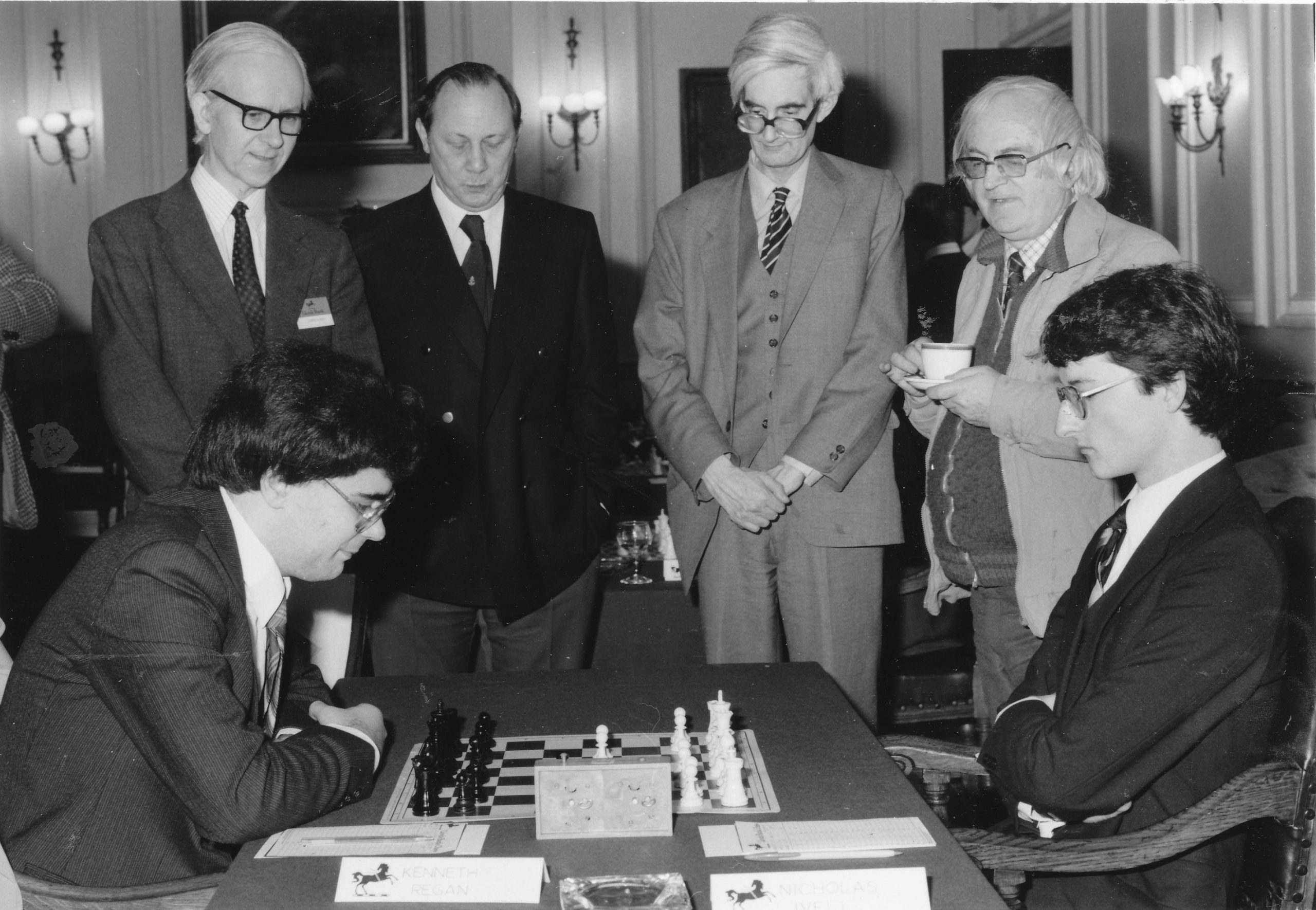
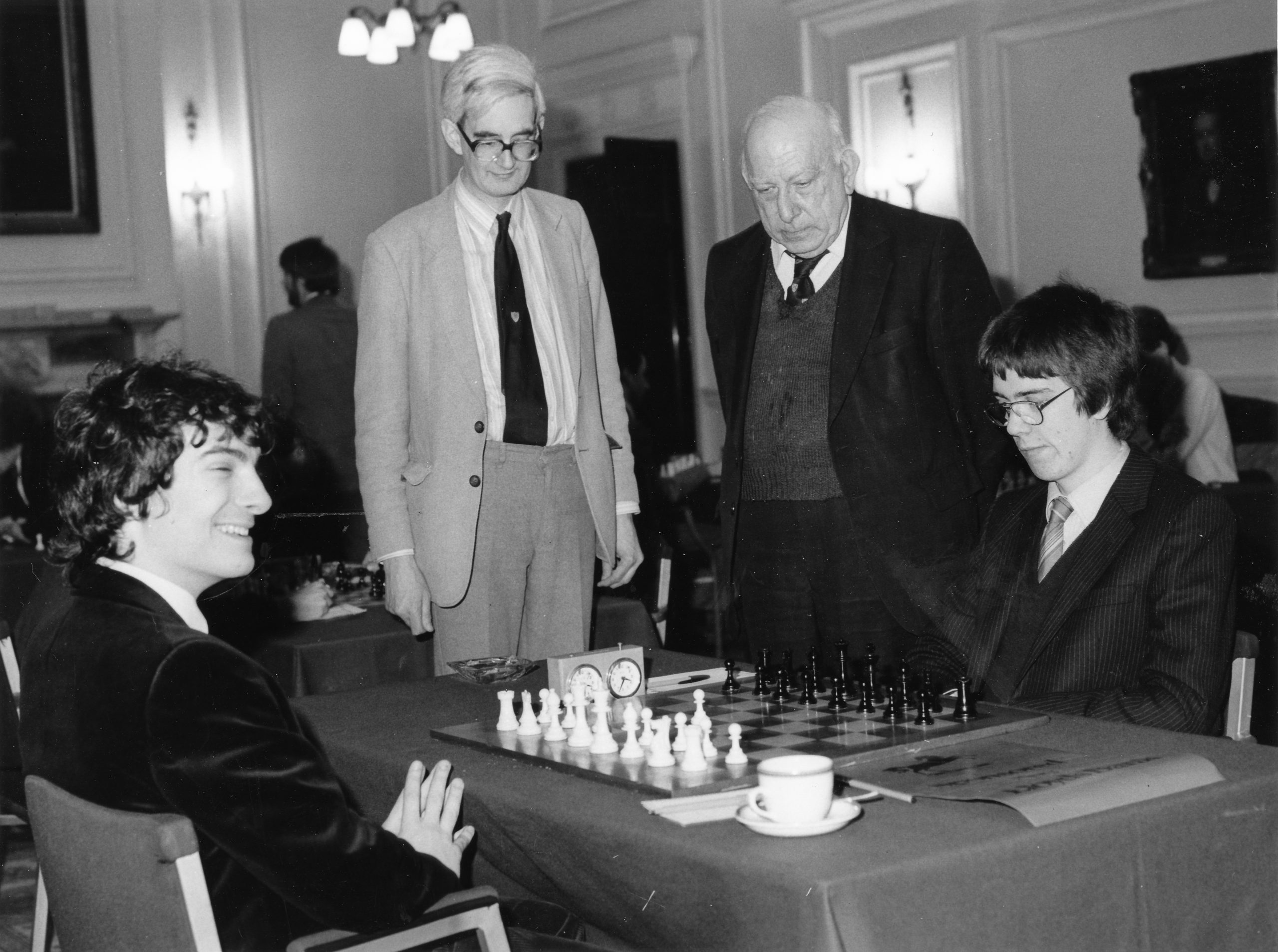
Leonard Barden, Henry Mutkin, Adrian Hollis and Bob Wade observe Nick Ivell vs Ken Regan at the 1983 Varsity match
The high spot of my over-the-board chess was the series of World Student team championships from 1960 to 1964 in glamorous places (Leningrad, Helsinki, Mariánské Lázně, Budva and Cracow); most enjoyable of these being Budva, 1963 where one could bathe every day in the Adriatic and I won the (?) gold medal on Board 1 with 7.5/9., the year after Spassky (this must look good in the records, unless they happen to reveal that for the first time in preliminary and final sections, and that England did not qualify for the top final).
My best chess was probably played at Mariánské Lázně, 1962, where in successive rounds I had favourable draws with Radulov and Hort, coming close to beating the latter. Ironically, I was awarded the British Master title after I had virtually retired from over-the-board chess.
{[%evp 0,18,19,-22,0,-31,-9,-5,9,-19,-25,-22,-34,-17,-10,5,21,21,31,5,13]} {
This game appeared in The Spectator, April 20th, 2013 as part of an obituary
from Ray Keene. The original source was British Chess Magazine, 1966, page 302,
game #14,225.} 1. g3 Nf6 2. Bg2 d5 3. Nf3 g6 4. b4 {ASH : This set-up, in fact
a primitive form of the Reti, has been patronised recently by Smyslov, among
others. RDK : This set-up, a form of the Reti, has been championed by,
amongst others, Vassily Smyslov.} Bg7 5. Bb2 O-O 6. O-O a5 ({BCN : Nowadays}
6… c6 7. d3 a5 8. a3 axb4 9. axb4 Rxa1 10. Bxa1 Qb6 11. c3 Nbd7 12. Nbd2 e5
13. e4 Re8 {is the modern (2020) continuation.}) 7. b5 ({ASH :} 7. a3 {, or}) (
{even} 7. c3 {came into consideration here.}) 7… c5 $146 {BCN : This was the
first game to feature this position.} 8. d3 (8. bxc6 {ASH: was quite possible.}
) 8… b6 $146 {BCN : This is the only recorded game with this move.} 9. c4 e6
{ASH : Black decides to maintain a pawn centre, without worrying if the pawns
should hang. RDK : Black decides to create a pawn centre without worrying if
the pawns will end up hanging.} 10. Qc2 Bb7 11. Nbd2 Nbd7 {[#]} 12. e3 {
RDK : White has to prevent … d4 and … e5.} Qc7 13. Rad1 ({ASH : Harston
later preferred RDK: Hartston later preferred} 13. Rac1 Rad8) 13… Rad8 14.
Qb1 e5 {ASH : Somewhat risky, but the only way to progress. RDK : Somewhat
risky, but the only way to make progress.} 15. cxd5 Nxd5 16. Nc4 Rfe8 17. Qa1
f6 18. Rc1 Nf8 19. d4 exd4 20. exd4 Ne6 21. Rfd1 {[#]} Ndf4 $1 $17 {ASH :
Seizing his chance. This sacrifice is necessary because the central position
is beginning to look rickety, and appears to be sound. White has terrible
weaknesses and his queen is marooned far away. RDK : Seizing his chance.
This sacrifice is necessary because the central position is beginning to look
rickety. The sacrifice looks sound as White has terrible weaknesses and his
queen is miles away.} 22. gxf4 Nxf4 23. Ne3 (23. Bh1 Qd7 {ASH : is too slow.})
(23. d5 {ASH : Might be a shade better – see next note.}) 23… Nxg2 $19 24.
Kxg2 Be4 $1 (24… Qf4 {ASH : is also possible but the win would not be so
easy after} 25. d5 Rxd5 26. Rxd5 Bxd5 27. Nxd5 Qg4+ {ASH : etc}) 25. Nf1 Qf4
26. Rc3 cxd4 27. Rcd3 Rd5 28. Qc1 Qg4+ 29. Ng3 Rf5 30. h3 {ASH : There is
nothing better} Bxf3+ 31. Kh2 Rh5 32. Rxf3 Qxf3 33. Nxh5 {ASH : The rest is
straightforward} Qxf2+ {RDK : Now it’s straightforward for Black.} 34. Kh1
Qf3+ 35. Kg1 gxh5 36. Bxd4 Qg3+ 37. Kh1 Qxh3+ 38. Kg1 Qg4+ 39. Kh1 Rc8 40. Qd2
Rd8 {and White resigned.} 0-1
[/pgn]
In 1964 I decided that henceforth for me ‘serious’ chess would mean correspondence, while OTB became a pleasant social activity. My introduction to the postal game had been made about 1955 by a colleague of my father’s, International Master Graham Mitchell, to whom I owe an enormous debt for the patience and kindness with which he played a series of games, bearing with me when I lost interest in worsening positions. The switch to postal play was caused by a number of factors, negative and positive : an impending move to Scotland, where there was less OTB chess, frustration at constantly spoiling good positions through mistakes in time pressure – on the other hand a feeling that correspondence chess should suit an academic temperament, and a particularly fascinating game played in 1963-4 with Michael Haygarth (see below) on which I spent so much time and energy that I almost feared it would ruin my post-graduate exams.
{[%evp 0,20,19,38,40,41,66,77,66,55,55,20,70,53,40,34,30,28,47,32,47,-3,30]} 1.
e4 c5 2. Nf3 d6 3. d4 cxd4 4. Nxd4 Nf6 5. Nc3 g6 6. Be3 Bg7 7. f3 O-O 8. Bc4 (
8. Qd2 Nc6 9. O-O-O d5 10. exd5 Nxd5 11. Nxc6 bxc6 12. Bd4 e5 13. Bc5 Be6 14.
Ne4 Re8 15. h4 h6 16. g4 Qc7 17. g5 h5 18. Bc4 Red8 19. Qf2 {is modern
practise.}) 8… Nc6 9. Qd2 Bd7 10. h4 (10. O-O-O Rc8 11. Bb3 Ne5 12. h4 h5 13.
Bg5 Rc5 14. Kb1 b5 15. g4 hxg4 16. h5 Nxh5 17. Nd5 Re8 18. Rxh5 gxh5 19. Qh2
Rxd5 20. Bxd5 Qb6 21. Qxh5 e6 22. Bb3) 10… Rc8 {ASH : At that time people
always played the queen’s rook to c8. Later it became the custom to play …
Qa5 and …Rfc8. Later still fashion swung back.} 11. Bb3 Ne5 (11… h5 12.
O-O-O Ne5) 12. Bh6 {ASH : Of all the attacking possibilities, White chooses a
relatively ineffective one.} ({The modern way is} 12. O-O-O h5 13. Bg5 Rc5 14.
Kb1 b5 15. g4 hxg4 16. h5 Nxh5 17. Nd5 Re8 18. Rxh5 gxh5 19. Qh2 Rxd5 20. Bxd5
Qb6 {transposes to a previous line.}) 12… Nc4 {ASH : A nice little finesse.}
13. Bxc4 Bxh6 ({more usual is} 13… Rxc4 14. Bxg7 Kxg7 15. h5 Qa5 16. hxg6
fxg6 (16… hxg6 $4 17. Qh6+ Kg8 18. Qh8#) 17. O-O-O) 14. Qxh6 ({Believe it or
not,} 14. Bxf7+ $4 Kg7 $1 {ASH : Resigns, has actually occurred in an
international (over-the-board!) tournament. BCN : It was, in fact, Zuidema
– Lee, Zurich Junior, 1964.} (14… Kxf7 $2 15. Qxh6) (14… Rxf7 $2 15. Qxh6
$14)) 14… Rxc4 15. O-O-O Rxc3 16. bxc3 Qa5 {ASH : Black has carried out his
exchange sacrifice under unusually favourable circumstances.} 17. Kb2 Rc8 {[#]}
18. Rd3 ({ASH : In a later game (British Correspondence Championship 1965-6).
S.Milan played against me} 18. Qd2 Rc4 19. Nb3 {, keeping more active chances
(the game was drawnin 50 moves).}) 18… Bb5 19. Nxb5 {The exchange of minor
peices suite Black.} (19. Qg5 Rc5 {would be ingenious but not better.}) 19…
Qxb5+ 20. Ka1 Rc5 21. Rb1 Qa6 22. Qc1 Ra5 23. Rb2 b6 24. Qb1 Nd7 25. Rb4 Ne5
26. Re3 Nc4 {[#] ASH : Black’s knight has reached ideal squares, and for the
next few moves makes the White rooks dance to his tune.} 27. Rd3 Rc5 28. Qe1
Ra5 29. Qb1 Ne5 30. Re3 ({ASH : Not} 30. Rd5 Rxd5 31. exd5 Qe2 {and White’s
position collapses.}) 30… Rc5 31. Rb3 b5 32. Qd1 Qc6 33. Qd4 Nc4 34. Rd3 a5
35. g4 {ASH : Natural, but in the end providing a target.} a4 36. Rb4 Ne5 37.
Re3 Qc8 $1 38. Kb1 {[#] ASH : Something must fall so White decides to return
the exchange.} h5 $1 39. gxh5 Nc6 40. Qd3 Nxb4 41. cxb4 Rxh5 42. e5 {Unable to
protect his weaknesses, White tries to break out.} Rxe5 43. Rxe5 dxe5 44. Qxb5
Qc3 45. Qxa4 Qxf3 46. b5 e4 47. b6 e3 48. Qb3 Qf1+ 49. Kb2 e2 50. b7 e1=Q 51.
b8=Q+ Kh7 52. Q8b6 Qc1+ 53. Kc3 Qcf4 {White resigns. A remarkable position,
with four queens on the board. Material is level, but the exposed White king
is helpless. This game was played just before I left Oxford to teach in
Scotland (where, at that time, over-the-board chess was not so strong as it
has since become), and it was to a great extent responsible for turning my
main interest to postal chess.} 0-1
[/pgn]
In 1964-5 I qualified for the British Championship by winning a candidates’ section with 100%, and then competed three times in the British Championship itself (1965-6, 1966-7, 1970-71), winning on each occasion (the first time jointly with S. Milan) and remaining unbeaten. International play also proved successful, and I soon collected the two norms necessary for the IM title (Ed: awarded in 1970).
Linda Brownson (Newnham & Basildon), left, playing Maria Eagle (Pembroke & Formby) being observed by John Nunn, Adrian Hollis and Harry Golombek posing for the obligatory “staring at the board” picture for the 1981 Varsity Match sponsored by Lloyds Bank.
The first chance for the Grandmaster title came on Board 1 in the Seventh Olympiad final. Despite a rare loss with the White pieces(my only defeat with white for a stretch of 15 years), things went well, including a lucky win against the reigning World Champion, Horst Rittner, and the enticing prospect beckoned if only I could beat the Russian Moiseyev. He held a slight advantage since the opening, but I thought I saw the chance of tempting him to an incorrect sacrifice. Back came his move; he had indeed made the sacrifice and the envelope burnt a hole in my pocket during an important meeting (my mind was elsewhere). After a mere two days’ thought I sent my reply. The post between England and the USSR takes about a month for the return trip. Soon after posting my move, as I was walking from the Ashmolean Museum to Keble, just passing the front gate of St. John’s, the realisation of what I had overlooked hit me, and there followed an inexorable wait for the death blow which I now saw only too clearly.
So no Grandmaster title, but Great Britain still took the bronze medals, and I scored 6/9 (+5=1-2).
Bob Wade, Harry Golombek and Adrian Hollis observe Penny Coxon (Newnham) and Anita Rakshit (St. Hilda’s) during the 1983 Varsity match sponsored by Lloyds Bank
Another opportunity came when the British Postal Chess Federation organised a tournament (1974-6) in memory of its former secretary RJ Potter. This started inauspiciously for me with a heavy defeat at the hands of Grandmaster Endzelins of Australia., a country which has so far provided my least favourite opposition (not only is the postage extremely expensive, but my score to date is 0/2).
Adrian Hollis (far right) as Club President of the 1985 Oxford team of Peter Wells, Karl Bowden, Anita Rakshit, Kenny Shovel, IM Colin McNab, IM Jon Levitt, FM Neil Dickinson and FM John Hawksworth
From The Potter Memorial, Ken Messere, Chess (Sutton Coldfield), 1979 we have this potted biography from Ken Messere :
The Potter Memorial, Ken Messere, Chess (Sutton Coldfield), 1979
“Adrian Hollis is 36, was educated at Eton and Oxford, has written two books on the poet Ovid and is a Fellow and Tutor in Classics at Keble College, Oxford. He is a British Master at over the board chess and has been Champion of British Universities, West of England and East Scotland.
In 1964, he went to teach at St. Andrews University where his wife, Margaret, taught German. They were married and moved to Keble College in 1967 and now have two daughters. Jennifer is nearly five and Veronica is two.
Adrian began to concentrate on correspondence chess in 1964 and won the British Correspondence Chess Championship jointly in 1966 and outright in 1967 and 1971. He won the I.M. title in 1970 and his fine score of 6/9 on top board for Great Britain in the I.C.C.F. VIIth Correspondence Chess Olympiad Final contributed to the team’s winning the bronze medal in this event.”
and now back to Adrian’s British Chess article…
Thereafter my fortunes improved; one opponent accepted too trustingly some faulty analysis by Szabo in Informator (for a while it seemed that the Hungarian might earn me not one but two points). The East German Dr. Baumbach failed to find an improvement in a line with which I had been successful in the Seventh Olympiad Final.
Also, I had a win with the Black pieces against the Russian Kopylov. The result was a score of 9/12 (+8=2-2), which sufficed for the grandmaster title and first place half a point ahead of the Finn Kauranen.
Since then I have played quite well on second board behind Keith Richardson in the Eighth Olympiad Final (+5=7-0), and very badly indeed (scoring just about 50% in the Heilimo Memorial Tournament organised from Finland (I was much impressed by the strength of the Finnish players, most of whom I had not encountered before). Having twice narrowly failed, I would still like to qualify for the Final of the Individual World Championship. Of course life becomes increasingly busy, but the examples of Hugh Alexander and Graham Mitchell encourage me to believe that one can continue to play well at postal chess longer than over-the-board. So perhaps around the year 2000, when the children are grown up….”
Adrian Hollis and Harry Golombek observer Andrew Dyson (Trinity) having played 1.d4 versus IM William Watson (Merton) during the 1984 Varsity match sponsored by Lloyds Bank
{[%evp 0,121,18,26,36,-22,54,32,37,19,27,28,30,3,26,19,17,42,20,13,27,31,31,31,
19,24,27,11,47,61,50,85,90,77,66,63,67,54,73,53,40,43,55,36,46,65,45,46,49,49,
48,54,48,69,83,93,102,102,103,112,98,89,114,100,99,91,98,98,94,79,79,82,90,87,
91,85,91,82,78,76,96,101,96,75,100,91,92,103,118,118,118,118,118,118,121,139,
179,182,206,240,191,212,205,205,205,192,192,192,192,183,192,104,155,96,96,96,
100,527,537,28911,29983,29984,29985,29986]} 1. d4 Nf6 2. c4 g6 3. Nf3 Bg7 4. g3
d5 5. cxd5 Nxd5 6. Bg2 O-O ({ASH : It is rather more challenging for Black to
postpone castling, and to organise an immediate attack on White’s d-pawn with}
6… Nb6 7. Nc3 Nc6) 7. O-O Nb6 8. Nc3 Nc6 9. d5 Na5 ({ASH : I have never yet
found an opponent to accept the pawn with} 9… Bxc3 $6 {too risky to accept P}
10. dxc6 Bg7 11. Qc2 bxc6 12. Rd1 Bf5 13. Qb3 Qe8 14. Nd4 Bd7 15. Qc2 {BCN :
is a typical line.}) 10. Bf4 c6 11. dxc6 {ASH : Such are the subtleties of
transposition that, although occasionally played before, this line does not
appear in the Grunfeld books of Hartston or Richardson and Boyd.} Nxc6 ({
ASH : In Olympiad VIII Finals (1977) Dr. S. Aarseth (Norway) played against me
} 11… Qxd1 12. Rfxd1 Nxc6 13. Nd2 $1 Bf5 (13… Be6 {Hollis}) 14. Rac1 Rac8
15. Nde4 Nc4 16. b3 Na3 $6 (16… N4e5 {wastes two tempi}) 17. Nd5 Rfe8 (17…
Kh8 18. Nxe7 $1 Nxe7 19. Bd6) 18. Bg5 Kf8 (18… f6 $5 {although Hollis says
it “hardly appeals”}) 19. Nxe7 Nxe7 20. Nd6 b6 (20… Rxc1 21. Bxc1 {xNa3}) 21.
Nxc8 Bxc8 22. Bxe7+ Kxe7 23. Rc7+ Kf6 24. Bc6 Rf8 25. Rxa7 Nc2 26. Be4 $18 {
Hollis-Aarseth, corr-CCOL8 fin 1975-77}) 12. Qc1 e5 13. Be3 {13 Rd1 was theory
but why drive Black Q where she wants to go?} Nd4 {An outpost which cannot be
maintained.} 14. Rd1 Be6 15. Nxd4 exd4 16. Bxd4 Bxd4 17. e3 Bxe3 18. Qxe3 $14 {
[#] ASH : So White emerges with a small but clear advantage (better placed
pieces, pressure on the b-pawn and on the Black squares).} Qe7 19. Ne4 Bd5 20.
Qc5 Qxc5 21. Nxc5 Bxg2 22. Kxg2 Rac8 $6 {ASH : A difficult decision. Black
surrenders a pawn for some counterplay.} ({ASH : He might have had better
chances of a draw with the passive} 22… Rab8 {better drawing chance despite}
23. Nd7 Nxd7 24. Rxd7 {not sufficient to win}) 23. Nxb7 Rc2 24. b4 Re8 25. Rd8
Rxd8 26. Nxd8 Na4 27. a3 Rc3 28. Re1 Kf8 29. Re5 Rc7 30. h4 h6 31. Ra5 Nc3 32.
Ra6 {threat Nc6 forces play} Rd7 33. Nc6 Rd6 34. a4 Nxa4 35. Rxa4 Rxc6 36. Rxa7
Rc3 37. b5 Rb3 {See page 80 in Essential Chess Endings by Howell.} 38. Rb7 Kg7
39. b6 h5 {This move produces a model endgame as analysed by Hollis etc. [#]
cf ending in Portisch-Petrosian [INF 17-0568] after Portisch’s 47th move.
White plan is to play K to d-file, Black captures f-pawn but then K goes to
c-file and R cannot return behind passed P (only works with b-pawn)} ({Hollis
suspected Black should have played} 39… g5 $5 {not fearing h4-h5}) 40. Kf1 {
The general case of a draw is threatened but not overturned. Averbakh
“Comprehensive Chess Endings” vol 5 (Pergamon ed) analyses both the Hollis and
Portisch endgames (see pp291-292)} Rb2 41. Ke1 Kf6 {As White threatens to
support the advance of his passed P with his K, it is very important for Black
to seek counterplay on the other wing – Averbakh} 42. f3 Rb3 43. Kd2 Rxf3 44.
Kc2 {ASH : The idea is realized.} Rf5 $2 (44… Ke6 $2 45. Rc7 $1 (45. Re7+ $6
Kxe7 46. b7 Rf5 47. b8=Q {hard to see how White can win}) 45… Rf5 {see game})
(44… Rxg3 $6 45. Rc7 $1 {Howell wrongly attributes this move to Hollis but I
don’t find it in Hollis’ notes. Averbakh claims as his?} (45. Rxf7+ Kxf7 46. b7
{Hollis said this may win as Pg6 weak but Averbakh gives:} Rg2+ $1 47. Kc3 Rg3+
48. Kc4 Rg4+ 49. Kc5 Rf4 $1 50. b8=Q Rf5+ 51. Kd6 Kg7 $1 {“Black creates an
impregnable fortress” – Averbakh}) 45… Rg2+ $140 46. Kb3 Rg1 47. Kb2 Rg2+ 48.
Rc2 $1 Rg4 49. Rc3 Rxh4 50. Ka3 Re4 51. b7 Re8 52. Rc8 Re3+ 53. Kb2 Re2+ 54.
Kc3 Re3+ 55. Kc2 Re2+ 56. Kd3 Rb2 57. b8=Q Rxb8 58. Rxb8 Kf5 59. Rf8 f6 60. Ke3
g5 61. Kf3 $18 {Averbakh}) (44… Re3 $3 {is the right plan:} 45. Rc7 Re8 46.
b7 Rb8 {Hollis thought White could now win:} 47. Kd3 Kf5 $1 48. Rxf7+ Kg4 49.
Rf4+ $1 Kxg3 50. Rb4 {[#]} g5 $1 {The saving move not considered in Hollis
article, but later discovered by Russian analysts. Black creates a
countervailing passed pawn.} (50… Kh3 $2 51. Ke2 $1 Kg3 (51… Kg2 52. Rb3) (
51… Re8+ 52. Kf2 Rf8+ 53. Ke3 Rb8 54. Kf3 {as in main line}) 52. Ke3 Kh3 53.
Kf3 Rf8+ 54. Ke4 Rb8 55. Ke5 $18) 51. hxg5 h4 52. g6 (52. Ke2 h3 53. Kf1 h2 54.
Rb3+ Kf4 55. Kg2 Kxg5 $11) 52… h3 53. g7 h2 54. Rb1 Kg2 $11 {Averbakh}) 45.
Rc7 Rb5 46. b7 {“The outwardly active position of Black R prevents his K from
approaching the pawns” – Averbakh} Ke6 (46… Kf5 {according to Fine’s recipe
(idea 47 Rxf7+? Kg4) but..} 47. Kc3 $1 {threat 48 Rxf7+ Kg4 49 Rf4+ and 50 Rb4;
prevents …Kg4 by same idea} f6 $140 (47… Kg4 48. Rc4+ $1 Kxg3 49. Rb4 Rxb7
50. Rxb7 Kxh4 (50… f5 51. Rg7) 51. Rxf7 Kg3 52. Kd2 g5 53. Ke1 $18) 48. Kc4
Rb1 49. Rc5+ Kg4 50. Rb5) 47. Kc3 f6 48. Kc4 Rb1 49. Kc5 Kf5 50. Rd7 $1 $18 {
prevents Kg4 and threatens Rd5+ followed by either Rd6+ or Rd4+ and then
inserting R on b-file} Rc1+ 51. Kd6 Rb1 52. Kc7 Rc1+ 53. Kd8 Rb1 54. Kc8 Kg4
55. Rd6 g5 56. Rxf6 gxh4 57. gxh4 Kxh4 58. Rg6 $1 Kh3 59. Kc7 {According to
Howell, Black resigned here but Hollis gives further moves, see e.g. ‘British
Chess’ pp105-107} Rxb7+ 60. Kxb7 h4 61. Kc6 {ASH : It would be extremely rash
to claim this ending as a theoretical win. The outcome nearly always depends
on a single tempo, and may be swayed by secondary factors (e.g. it proved
vital in the above for White’s rook to be on the seventh rather than the
eighth). But at least this game can be added to the example for future
research. Perhaps this is the kind of problem that one day computers might be
able to solve.} 1-0
[/pgn]
From British Chess Magazine, Volume CXXXIII (133, 2013), Number 4 (April), pp.194-5 we have this obituary written by James Pratt :
Adrian Swayne Hollis (2 viii 1940 Bristol – 26 ii 2013 Wells), British Master and Correspondence Grandmaster (1976), three times British Correspondence Champion, has died. He played most of his OTB chess as a young man, finishing seventh equal at the British Aberystwyth, 1961, when he beat, amongst others, A.R.B. Thomas and former champion, Alan Phillips. He gave future champion, Jonathan Penrose, a tough fight in the last round before conceding the half-point. He played in the Hastings Premier, 1962/3 and emerged with a plus score in the Anglo-Dutch matches. He was an occasional reviewer for BCM.
From the 1985 Varsity Match : Laura Cohen (Newnham), Brian Reilly (BCM), Bill Hartston (Cambridge), Adrian Hollis (Oxford), Anita Rakshit (St. Hilda’s), Leonard Barden (The Guardian etc) and Bob Wade (BCF)
It was, of course, in the realm of postal player that he shone most brightly!
In 1966 we see him playing board two for England, below Slade Milan, and, two years later, Adrian scored 9/12 in a World Postal Qualifier, narrowly missing a place in the final. In 1971 he won the British Correspondence Championship, easily outdistancing a tough field. He played top board for England in the 1972-7 Olympiad. In 1974-6 he won the Reg Potter Memorial. In the ninth Olympiad – 1982-5 – Adrian Hollis was undefeated on board two. And England took the Gold Medal!
BCN remembers Stanley Kipping who passed away in Walsall on February 17th 1964 at the age of 72 who was always known by friends and family as Stanley.
BCN was fortunate to receive the following part email from John Kipping, a resident of Christchurch, New Zealand.
None of the Kipping family from around that time were referred to by their first name. His brother was Barry (my grandfather), and two sisters, Esme who made jigsaw puzzles and Frieda, named after Frieda Weekly (nee von Richtofen).
(Cyril Henry) Stanley Kipping was born on Saturday, October 10th, 1891 in 7 Milborne Grove, South Kensington, London, SW10 9SN.
7 Milborne Grove, South Kensington, London, SW10 9SN.
His parents were Frederic Stanley Kipping (28) and Lillian Kipping (24, née Holland) : they married in 1888. Stanley was baptised on May 8th, 1892 in West Brompton, London. Frederic died on 30 April 1949 in Pwllheli, Caernarvonshire, at the age of 85 and Lilian passed away on 4 September 1949 in Pwllheli, Caernarvonshire, at the age of 82.
Frederic was Professor of Chemistry at The University of Nottingham. He undertook much of the pioneering work on silicon polymers and coined the term silicone. He was elected a Fellow of the Royal Society in 1897.
Frederic Stanley Kipping, FRS
In the 1901 census the family lived at Clumber Road West, Nottingham and brother Frederic Barry Kipping was born on April 14th 1901 and his sister Kathleen Esme was born on 3rd May 1904 also in Nottingham. Kathleen died on 30 August 1951 in Pwllheli, Caernarvonshire.
In 1902 Stanley started at Nottingham High School excelling in mathematics and science and in 1906 he obtained the Oxford and Cambridge Board’s Lower Certificate.
On March 2nd 1908 the Sheffield Daily Telegraph published a matriculation list for London University and CHSK was listed as being in the second division. Following that in 1909 Stanley obtained a Oxford and Cambridge Higher Certificate.
CHS Kipping
As of the 1911 census the household now included Stanley’s maternal Grandmother, Florence Holland (59) plus a parlourmaid, a housemaid, a cook and a nurse. Stanley was recorded as being a 19 year old science student and they lived at 40, Magadala Road, Nottingham which appears to have been replaced by residential flats. Curiously the address on the Census record was obscured by green insulation tape but insufficiently for it to readable.
“He left school in July 1910 and went to Trinity Hall in Cambridge where he read for the National Sciences Tripos. He played tennis for his college and launched into the composition of chess problems.
He obtained a First in Part I of the Tripos in 1912, a First in Part II in 1913, and was awarded the degree of Bachelor of Arts on 7 June 1913. He began researching in organic chemistry at Cambridge, but in September 1914 decided instead to take a teaching appointment at Weymouth College.”
In 1914 The London Gazette announced that Stanley was promoted within the Chaplain Department of the British Army to Second Lieutenant with a service number of 10940.
On December 23rd 1914 The London Gazette announced the following :
The London Gazette, December 22nd 1914, part one
and
The London Gazette, December 22nd 1914, part two
On the 9th October 1918 The London Gazette announced :
The London Gazette, 8th October 1918
Again, according to Stephen C. Askey :
“In January 1919 he took his Master of Arts degree at Cambridge, and joined the teaching staff of Bradfield College in Berkshire. But by the summer of that year he became an assistant master at Pocklington School in Yorkshire, where he spent five happy years.
There he used his talent for juggling in 1920 to train a troupe of jugglers who gave a display at a school concert. This popular performance was repeated annually at Pocklington. Meanwhile be continued to compose chess problems and in 1923 published a book for beginners called The Chess Problem Hobby.”
In the 1939 register Stanley was recorded as residing at 67 Wood Green Road, Wednesbury, Staffordshire, England with Martha Partridge (born 29th June 1886) who was his Housekeeper.
Wood Green Road, Wednesbury, Staffordshire
His probate record appears in the England & Wales Government Probate Death Index 1858-2019 as :
1964 Probate record for Cyril Henry Stanley Kipping
From The Encyclopaedia of Chess (Robert Hale 1970 & 1976), Anne Sunnucks :
“International Master of the FIDE for Chess Compositions (1959) and International Judge of the FIDE for Chess Compositions (1957). Born on 10th October 1891. Died on 17th February 1964. Kipping was famous as a composer and an editor which he combined with is duties as Headmaster of Wednesbury High School from 1925 to 1956.
19th November 1934: An inter-form chess match for the pupils is in progress at Wednesbury High School for Boys, supervised by Mr C S Kipping, their headmaster. (Photo by William Vanderson/Fox Photos/Getty Images)
His editorial duties extended over more than forty years, and included the problem sections of Chess, Chess Amateur, and, for 32 years, the specialist magazine The Problemist from 1931. He was noted for his encouragement of beginners. His pamphlet ‘The Chess Problem Hobby‘ is an excellent beginner’s introduction. His other books included Chess Problem Science, The Chessmen Speak and 300 Chess Problems.
Chess Problem Science, CS Kipping, Whitehead & Miller, 1938
Kipping was one of the most prolific composers of all time, with over 7,000 problems to his credit. Many of his strategic three-movers have become classic. He was leading authority on halfpin two-movers. In his latter years, Kipping affectionately known as CSK – was Chairman of the International Problem Board which is now the FIDE Problem Commission.”
The Chessmen Speak, CS Kipping, The Chess Amateur, Stroud, 1932The Chessmen Speak, CS Kipping, The Chess Amateur, Stroud, 1932
From British Chess Magazine, Volume LXXXIV (84, 1964), Number 4 (April), pp. 122-123 by John Rice:
“CS Kipping, one of the most famous of all British problemists, died during February at the age of seventy-two. As a composer, editor, writer and critic Kipping was without equal. It is impossible to do justice in only a few lines to his vast and unique contribution to chess problems: a few factual notes. most of them kindly supplied by RCO Matthews, must suffice.
Kipping was born in London on October 10th, 1891, After completing his studies, he took up teaching as a career, and in 1924 he was appointed the first headmaster of the newly-opened Wednesbury High School, which post he held until his retirement in 1956. He was a bachelor, and, especially during the later years of his life, his interests were centered mainly on the school and on chess problems.
Most readers will know of Kipping as the editor of The Problemist, the bi-monthly journal of the British Chess Problem Society. Before he took over The Problemist in 1931, he had been in charge of the problem section of the Chess Amateur, which he edited with great energy and enthusiasm. As well as The Problemist, he edited the problem pages of Chess from its first appearance. in 1936 until the section was suddenly discontinued without warning or explanation a few years ago. He also edited other columns at various times. He always took great care to help and encourage beginners, and it is probably true that every composer in this country below the age of about fifty came under his influence at one time or another.
CHS Kipping
As a young man, Kipping was a fierce avant-garde controversialist, championing the the cause of strategy in the three-mover in opposition to the then dominant model-mate school in this country. His attitude to the two-mover, as readers of The Problemist will know, was always a good deal more conservative; he would not tolerate at any price what he called ‘camouflage force,’ even in the modern problem. Yes, he appreciated the aims of the modern two-move composer much more than his writings on the subject suggest, being always ready to applaud excellence in any type of problem.
CHS Kipping
Kipping’s output numbered over 7,000 problems, probably a record. Many of his two-moves especially his ‘aspect’ tasks, were published under pseudonyms, of which the best was known was C.Stanley. He concerned himself little with artistic finish : once he had found a workable setting of a them he was engaged on, he would take little trouble over economy and presentation. Themes in which he interested himself include half-pin (in the two-mover), white King themes, interferences, and the grab theme (in the three-mover), and maximum tasks of all kinds, the subject of one of his books, Chess Problem Science. His other books include 300 Chess Problems (1916), and The Chessmen Speak (1932), in the AC White Christmas series.
300 Chess Problems, CS Kipping, The Chess Amateur, Stroud, 1916
In addition to all his other problem activities, Kipping was chairman of the International Problem Board, and curator of the half-pin section of the White-Hume Collection, which he took over on Hume’s death in 1936.
The majority of Kipping’s best problems were three-movers, three of the most famous of which are quoted here.”
Manchester City News, 1911
[fen]k7/8/N1N5/3B4/K7/8/4p1r1/8 w – – 0 1[/fen]
Mate in three
1 Ka5
First Prize
Dutch East Indies Chess Association Tourney, 1928
[fen]8/BR1pKp1P/k1B1n1P1/3P2Nr/N7/4R1P1/1r2qb2/5Q2 w – – 0 1[/fen]
Mate in three
1 Ra3
First Prize
BCM, 1939 (II)
[fen]1br5/1r5Q/3N2PB/5Pp1/q4pk1/p2p1p1R/B4P1K/1R1N4 w – – 0 1[/fen]
Mate in three
1 Be6
The first problem above was given in The Complete Chess Addict by Mike Fox and Richard James in the Desert Island Chess chapter. It is also given in a discussion of the Steinitz Gambit by ASM Dickins and H Ebert in 100 Classics of the Chessboard. Colin Russ on page 138 of Miniature Chess Problems from Many Countries gives the first problem as does John Rice on page 44 of Chess Wizardry : The New ABC of Chess Problems.
Stanley was the first President of Walsall Kipping Chess Club which includes amongst its members and former members David Anderton OBE and Jana Bellin. We have been provided with the following information by Mike Groombridge:
CS Kipping, strictly speaking, was not the founder of the club, but was involved immediately at the formation of the club, which was originally called The Kipping Chess Club*. [*By March 1945, the club had 3 branches and only then did it formally split into 3 -Walsall, Wolverhampton, and a school (Municipal Secondary School Wolverhampton?) for the purpose of playing in the newly formed Wolverhampton League. Walsall Kipping Chess Club only formally took its name in May 1948, and was separated by then from The Wolverhampton Kipping Chess Club!] The Walsall Club’s minute book contains clippings from a local newspaper of 1942 reporting on the formation of the club. Here are copies:-
‘Walsall’s New Chess Club.-The new chess club, members of which will meet in the evenings for play and social intercourse, already promises to be very successful. The organiser, Mr.A.E.Parsons, of England & Sons, The Bridge (where meetings will be held for the time being) is acting as secretary pro tem, and he has secured as the first president Mr.C.S.Kipping, Headmaster of the Wednesbury High School for Boys, well known as an expert and for the innovation of chess in the curriculum of his school. Mr.Kipping has given valued assistance by the initial provision of boards and pieces. Members will meet on Monday evenings at 6.30 and the club will rely, in the first place, on voluntary subscriptions’. [5.9.42]
and
‘Walsall Chess Club.-Members of the recently formed Chess Club in Walsall had their first meeting on Monday [7th Sept 1942]. They decided to call the club “The Kipping [Chess] Club,” after their president, Mr.C.S.Kipping. Mr. F.D.Fox was appointed chairman, Mr.Gordon Farrell treasurer, and Mr.A.E.Parsons honorary secretary. Mrs.Wright and Miss Powell provided refreshments and were warmly thanked for their contribution to the success of the launching of the club. Mr.H.Lee was subsequently appointed vice-president after occupying the chair for the evening.’ [12.9.42]
Also, here is a copy of a brief sketch of CSK’s chess involvement, penned by David Anderton, for the Club’s Jubilee Chess Tournament:-
C S KIPPING, PRESIDENT 1942-1964
C S Kipping was the editor of the Problemist between 1931 and his death on 17th February 1964 at the age of 72 years. He also edited a problem column in Chess between 1935 and 1960. He [was] one of the most prolific of composers with some 7,000 problems to his name. He pioneered the introduction of strategic three movers in Great Britain and was the leading authority on half pin two movers. He was the Headmaster of Wednesbury Boys High School and introduced chess into the curriculum there in 1927. He gave evidence in the Chancery Division in the case of Re: Dupree’s Trusts in 1944 to the effect that chess teaches concentration, self reliance and reasoning and is a most useful training for the mind. Relying on this evidence, the Court upheld a bequest to establish a junior tournament as charitable and the case still forms the basis of English law on this point.
On a web site now only accessible via the WayBack Machine there is a treasure trove of reminisces and memories of CHSK from himself, friends and pupils.
From The Encyclopaedia of Chess (Batsford, 1977), Harry Golombek OBE, John Rice writes:
“British problemist, enormous output of over 6,000, mainly three-movers but also many two-movers, some published under pseudonyms (e.g. C. Stanley, of Nottingham). Editor of The Problemist, 1931-64. Elected international master honoris causa (1959).”
BCN remembers IM Čeněk Kottnauer (24-ii-1910 14-ii-1996)
Čeněk (pronounced CHEnek) Kottnauer was born in Prague on Thursday, February 24th, 1910. Čeněk was employed in the Ministry of Education in Prague.
Whilst playing in the Lucerne International tournament (28-xii-1952 03-i-1953) he sought political asylum :
From the Milwaukee Journal, January 3, 1953 we have
“Czech Chess Star Asks for Asylum
Lucerne, Switzerland – Cenek Kottnauer, 42, Czecho-Slovakian chess champion and an employee of the ministry of education in Prague, announced Saturday that he would not return to Czech-Slovakia and would request political asylum in Switzerland. Kottnauer had been participating in a chess tournament.
He said that the political situation in his country had grown “more and more critical” and he wanted “to leave before it is too late”. He said that he had been divorced recently and had no children in Czech-Slovakia”.
In a January 2009 post to the English Chess Forum Leonard Barden wrote :
“Cenek Kottnauer defected from Czechoslovakia during the Lucerne New Year tournament of 1952-3 (I am precise on this because I was present). His wife Daniela joined him there, having been smuggled from Prague in the boot of a diplomat’s car. Kottnauer had been a water polo player of international standard before 1939 so came into serious chess only his mid-30s. He made his name with his good showing in the Prague v Moscow match of 1946 and his Bxh7+ win then against Kotov. He competed in great tournaments like Groningen 1946 and Moscow 1947; his first visit to England was in 1947 when the Czech team came here.
Čeněk Kottnauer plays Friedrich Sämisch during the Duras Memorial in Prague. December 7th 1942, The game was a Slav drawn after 42 moves
In the 1940s he had a job in the Czech sports ministry but got implicated in the purges following the Slansky trial. He also believed that Pachman and Opocensky were involved in the campaign against him.”
Čeněk married Daniela (née Horska, also Czech, having met in Austria) and they had a son Daniel VR Kottnauer. Daniela was born in 1934 and was 24 years younger than Čeněk. She died on February 20th 2008 in a hospice in Essen, Germany close to where Daniel currently resides. Daniel has been a pianist and singer for 30 years, an event manager for 19 years and a coach and VIP limousine driver for 5 years and may be found on LinkedIn.
Daniel Kottnauer
We thank Daniel for providing photographs.
Čeněk became a British citizen on 16th December 1960 when he obtained naturalisation certificate BNA64338.
In 1965 Čeněk and Daniela were living at Flat 2, 7-8 Bathurst Street, London, W2.
7-8, Bathurst Street, London, W2
In Kings, Commoners and Knaves (Russell Enterprises, 1999), page 108, Edward Winter wrote :
“The obituaries of Čeněk Kottnauer (1910-1996) have, in common with all of the encyclopaedia entries on him, been strangely wanting in pre-1940s references to his chess career. Czech magazines of the 1930s contain occasional games by ‘Kottnauer’ (no forename or initial given), including the following :
Source : Československý šach, January, 1932, page 9. The score was also given, with notes, by Vera Menchik, on page 153 of the April 1932 issue of The Social Chess Quarterly. ”
From Šachový Týdeník, 25th February, 2010 we learnt that Čeněk was twice Prague lightning champion.
In 1943 Čeněk was a clear first overall with 10.5/13 in the Zlin tournament.
Crosstable for the Zlin (Czechoslovakia) 1943 tournamentČeněk Kottnauer plays Svetozar Gligorić during the Chigorin Memorial, Moscow, November 26th 1947.
From Bronstein on the King’s Indian, Everyman Chess, 1999, game 25 we have :
“This game is from our hisotoric match with the Czechoslovak team, which took place half in Prague and half in Moscow.
My opponent, an intelligent, clever, athletic man, also played water polo. Then at some point he travelled to a tournament in England, fell in love with a beautiful Englishwoman, and decided to settle down there.”
From The Oxford Companion to Chess (OUP, 1984), David Hooper & Ken Whyld :
International Master (1950), International Arbiter (1951), a Czech player who emigrated to England in 1953 and was naturalised in 1960. He played in Olympiads for Czechoslovakia (1950*, 1952), on the second occasion making the best score (+10=5) on the fourth board, and in two Olympiads for England (1964, 1968). In 1961 he won the Beverwijk Masters tournament (not the concurrent grandmasters event) with a clean score, a fine achievement.
*Ed : In fact, this is not true since Czechoslovakia did not send a team to Dubrovnik 1950. This was the last year the event was limited to sixteen countries.
Incomplete crosstable for Beverwijk 1961
James Pratt, Basingstoke provides the full results from Gino de Felice, Chess Results, 1961 – 1963, Macfarland, 2013 :
Consulting the 2nd edition (1992) of Hooper & Whyld may cause disappointment since there is no entry for CK.
Čeněk Kottnauer from Šachový Týdeník, 25th February, 2010
From The Encyclopaedia of Chess (Robert Hale 1970 & 1976), Anne Sunnucks :
“International Master (1950) and International Judge (1951).
Born on 24th February 1910. Kottnauer represented Czechoslovakia in the 1952 Olympiad in Helsinki. In the years after the war his successes in international tournaments included 3rd at Beverwijk 1947, =2nd at Vienna 1947, 4th at Bad Gadstein 1948 and 1st at Lucerne 1953.
Crosstable for Lucerne 1952/1953
After the Lucerne tournament he sought political asylum in Switzerland. He later settled in England and became a naturalised British citizen. He played for the British Chess Federation in the Olympiads of 1964 and 1968.
Kottnauer has played in the British Championship twice. In 1961 he came =4th, and in 1962 he came =3rd.”
IM Čeněk Kottnauer
From The Encyclopaedia of Chess (Batsford, 1977), Harry Golombek OBE (entry written by Bill Hartston):
“Born in Czechoslovakia, Kottnauer played for that country in many events including the 1952 Olympiad. He emigrated in 1953 and subsequently took British nationality, representing England in the Olympiads of 1964 and 1968. Awarded FIDE titles of international master in 1950 and International Judge in 1951. Winner of Lucerne 1953 International tournament.
Čeněk Kottnauer plays Frans Kuijpers during the 1964 Anglo-Dutch match at Vlissingen on September 19th
Co-author with TD Harding and GS Botterill of The Sicilian Sozin, Batsford, London, 1974.”
The Sicilian Sozin, TD Harding, GS Botterill, C. Kottnauer, Batsford, 1974
James Pratt, Basingstoke revealed : He would look through opening analysis often proclaiming: ‘What will the master play now?’
From British Chess (Pergamon Press, 1983) we have this insight from Tim Harding :
“At a time when home-grown International Masters were thin on the ground in Britain (the 1950s and 1960s) this Czech-born IM brought a lot of valuable experience to BCF teams.
Amsterdam 1950, first day; Gideon Stahlberg versus Cenek Kottnauer Date: November 11, 1950
After emigrating to England in 1953, he became naturalized and subsequently represented the BCF in the Tel Aviv, 1964 and Lugano, 1968, Olympiads. On board one in 1964 he scored +8 =7 -3 (63.9%) on board two below Penrose in 1968 (with some board one games) he scored 41.7: +3 =5 -4.
Čeněk Kottnauer
When FIDE rating lists appeared in the early 1970s, Kottnauer was listed at 2370 but by this time had more or less retired from active play at the top level, although he took (and still takes) a keen interest in coaching promising young players, He was one of the most regular and most valuable coaches at the one-day junior training events organised by the London Chess Association at the Mary Ward Centre in Bloomsbury, London in the mid-1970s.
IM Čeněk Kottnauer, event unknown
At this time he also wrote many articles for his friend Grandmaster Pachman, who had been freed to live in West Germany where he became editor of Schach-Archiv, and also made a major contribution to the Batsford opening theory work. The Sicilian Sozin, written in collaboration with George Botterill and Tim Harding, and published in 1974.
Kottnauer’s most active years as a player were however 1946-53; in the year that he came to England he took first prize in the Lucerne, 1953 International tournament. Had he been a professional player throughout the the 1950s, there is little doubt that he would have become a grandmaster.
As early as the end of the war, when regular play resumed, he was almost of that strength (as wins against Kotov and Smyslov in the February, 1946 Prague v Moscow match showed) but lacking in experience at the top level, which told against him at Groningen, 1946, when he was placed 13th with 9 points out of a possible 19 in a very strong field. This was the first great post-war tournament, with nine Master and eleven Grandmasters (including Botvinnik and former world champion Euwe).
Players at the 1946 Groningen Tournament
Also in 1946 Kottnauer scored wins against Simagin (in Prague) and Levenfish (in Leningrad) and was clearly one of the up-and-coming stars in a strong Czech team that included Filip and Pachman. In 1950 he was one of the first players to be awarded the FIDE title of International Master.
The following year he was also made a FIDE International Judge (now known as FIDE Arbiter).
Unfortunately there was no Czech representation at the Dubrovnik, 1950 Olympiad, but in 1952, one of his last appearances for Czechoslovakia, Kottnauer achieved a remarkable record playing board four (below Filip, Pachman and Sajtar) at the Helsinki Olympiad. He went through unbeaten with ten wins and five draws (83.3%) and easily won the board prize.
Kottnauer shortly thereafter came to England where he eventually made a successful career as an executive with Trust House Forte’s hotel group; he has also helped with the BBC overseas service Czech-language broadcasts. He lives in West Central London with his wife and their son.
The following is undoubtedly Kottnauer’s most famous win.
{[%evp 0,55,19,-12,7,-14,-4,-6,41,25,43,54,55,54,37,42,20,26,24,-1,1,-36,-25,
-38,-20,-4,0,6,12,-6,17,-5,-35,-39,0,-47,-47,-149,-60,-60,-60,-43,-27,-28,230,
-144,216,300,740,360,1161,1448,1448,1517,1517,1583,1664,1664]} {Source : BCM,
1946, page 193, game #9649.} 1. c4 ({Megabase 2020 has this as the move order
(which is incorrect).} 1. d4 d5 2. c4 c6 3. Nf3 Nf6 4. Nc3 e6 5. e3 Nbd7 6. Bd3
dxc4) 1… e6 2. d4 d5 3. Nc3 c6 {The so-called Triangle Variation and a
potential prelude to the Abrahams-Noteboom Variation.} 4. Nf3 Nf6 5. e3 Nbd7 6.
Bd3 dxc4 {The Meran Defence} 7. Bxc4 b5 8. Bd3 a6 9. e4 c5 10. e5 ({TDH :
Nowadays (1983)} 10. d5 {is usually preferred but that move was little
analysed at the time. The text leads to a very sharp middle-game in which both
players followed up-to-date theory, which was changed by this game!}) 10…
cxd4 {[#]} 11. Nxb5 $1 axb5 ({TDH : Sozin’s} 11… Nxe5 {is now that approved
recipe for Black. BCM : The latest move is from Euwe v. Walthuis, Amsterdam.}
12. Nxe5 axb5 13. Bxb5+ Bd7 14. Nxd7 Qa5+ 15. Bd2 Qxb5 16. Nxf8 Kxf8 17. a4
Qxb2 18. O-O Ne4) 12. exf6 Qb6 13. fxg7 Bxg7 14. O-O O-O 15. Qe2 (15. Re1 Bb7
16. Bf4 Bd5 17. Ne5 Nxe5 18. Bxe5 Bxe5 19. Bxh7+ Kxh7 20. Qh5+ Kg7 21. Qg5+ {
is a well-known GM agreed draw variation}) 15… Nc5 $6 {[#] TDH : Probably
losing with best play.. White’s next may have surprised Kotov, or perhaps he
thought it was unsound.; Kottnauer says he played the sacrifice ‘without much
thinking’. Stockfish 12 gives this as the top move allowing the Greek gift.} (
15… Ba6 {is SF12’s next top move.}) ({TDH : A few months later, Kotov
reached the same position against Kottnauer at Groningen, varied with the
better move} 15… Bb7 {but went wrong later.} 16. Bxh7+ $2 Kxh7 17. Ng5+ Kg8
18. Qh5 Nf6 $19) 16. Bxh7+ $1 {At this stage SF12 sees no more than a draw for
White but cannot find anything better.} Kxh7 17. Ng5+ Kg6 ({TDH : A game by
Satjar in 1944 had gone instead} 17… Kg8 $2 18. Qh5 Rd8 19. Qxf7+ Kh8 20.
Qh5+ {with a draw} ({In fact} 20. Qg6 Kg8 21. Bf4 $1 $18 {is crushing}) ({
but Kottnauer intended to improve on this by} 20. Bf4 $1 {‘with an
irresistible attack’.})) 18. Qg4 f5 19. Qg3 {Now it is time to “pause the
video” as [#] we reach a critical position.} Kf6 {SF12 rates this as second
best.} ({SF12 gives} 19… Rg8 $1 {as the best defence for Black.} 20. Nxe6+
Kf7 21. Ng5+ Kf8 22. Nh7+ Ke8 23. Re1+ Be6 24. Bh6 Qb7 $11) ({After the game}
19… Rf7 {was recommended for Black, and tried the following year by Pachman
against Kottnauer in the Chigorin Memorial in Moscow.} 20. Bf4 {was played ,
leading to equality,} ({but Vukovic’s} 20. b4 {seems stronger.})) {Kottnauer
opted for ‘power play’ using the maximum activity of his pieces!} 20. Bf4 $1 ({
In the present game, both players had moved very quickly but now Kottnauer
thought for three quarters of an hour, rejecting the theoretical recommendation
} 20. Qh4 {(which at best draws,} {and would have been met by Keres’s idea} e5
$1 {which Kotov knew about).}) 20… Ke7 21. Rac1 Ra7 22. Rfe1 Bd7 (22… Bf6 {
loses to} 23. Nh7 Rf7 ({or} 23… Ne4 24. Rxe4) 24. Nxf6 Rxf6 25. b4 {but
after Kotov’s move ‘I saw in a flash the final breakthrough’, wrote Kottnauer.}
) 23. b4 $1 Na6 $2 ({Against} 23… Na4 {Kottnauer would have had to win in
the endgame, although this would not have been difficult.} 24. Nxe6 Bxe6 25.
Qxg7+ Rf7 26. Bg5+ Kd7 27. Qh8 {Black could then play here} Nc3 {when
Kottnauer gives as best} 28. Rxe6 Qxe6 29. Qxd4+ Kc8 30. Rxc3+ Rac7 31. Rxc7+
Rxc7 32. h4 {winning the ending.}) 24. Nxe6 Bxe6 25. Qxg7+ Rf7 26. Bg5+ Kd7 27.
Qh8 $1 {Now you can see why 23…Na4 was superior -} Qb8 ({Black cannot block
the c-file with} 27… Rc7 {because of} 28. Qd8#) (27… Nc7 28. Qd8#) 28.
Qxd4+ {Black resigned.} 1-0
[/pgn]
and here we have the same game analysed by Tryfon Gavriel :
From British Chess Magazine, Volume CXVI (116, 1996), Number 4 (April), pp 202-203 we have this obituary by Bernard Cafferty :
Čeněk Kottnauer, the Czech/British IM, and the first chess defector died in St. Margaret’s Hospital, London, on 14th February after heart trouble and abdominal cancer.
A giant of a man, a fine athlete and swimmer, he was born on 24th February 1910 and came to prominence in the 1942 tournament in Prague in which Alekhine took part. He extended the great man to 70 moves before resigning. His wins against Kotov and Smyslov in the Moscow-Prague match of 1946 and his 13th place in the great Groningen tournament of the same year confirmed his status, as did his excellent showing for Czechoslovakia in the 1952 Olympiad at Helsinki (+10=5-0 on fourth board). He also took part in the 1947 Chigorin Memorial in Moscow, and won a tournament at Lucerne in early 1953, the same year in which he emigrated to Britain.
Hoogovens, Beverwijk, 1962. In the opening round (played 11th January), Theo van Scheltinga (Netherlands) faces Čeněk Kottnauer (England, formerly ČSSR). (Photo credit: W. van Rossem, ANEFO, via http://gahetna.nl. Courtesy of Douglas Griffin
On this form he would have gained the GM title had he continued playing, but he had to take a full-time job (with Trusthouse Forte) to support his family.
Čeněk had met his much younger wife in Austria, though she too was Czech. They had a son. The master’s appearences were therefore limited to London League matches and other sporadic events. That he had lost none of his skill was shown when he played top board for England at the 1964 Tel-Aviv Olympiad (Penrose was not available) and made +8=7-3. His only other big event was the Lugano Olympiad of 1968 when he was on second board and made +3=5-4.
The 1964 England Olympiad (Tel Aviv) Team : Owen Hindle, Čeněk Kottnauer, Peter Clarke, Michael Franklin, Norman Littlewood & Michael Haygarth
Čeněk (pronounced CHEnek) Kottnauer was one of the early professionals in the German Bundesliga; on a visit to his Bayswater flat in 1995 by Murray Chandler and myself, Čeněk told us about the great transport difficulties he had in those days. He mentioned that he had recently had a heart bypass operation and showed us the medication he had to take on a regular basis, opining that after Golombek and Milner-Barry he would be the next to go.
Hugh Alexander, Čeněk Kottnauer, Michael Franklin and Owen Hindle
Čeněk was involved in junior coaching in London for many years, wrote extensively for the Dutch and German press and in recent years was a regular visitor to the Lloyds Bank Masters to see old friends and acquaintances. Amongst those he coached were Julian Hodgson, William Watson and Dharshan Kumaran, as well as Stuart Conquest.
IM Čeněk Kottnauer in Argentina during the 1981 World Under-16 Championship
In Stuart’s case he came regularly to Hastings to do the coaching which was financed by the Slater Foundation and by Lloyds Bank.
The fruit of his effort was Stuart’s 1981 World U-16 title in Argentina, where Čeněk’s great physical strength came in handy when the huge trophy had to be carried back to Britain.
IM Čeněk Kottnauer with Stuart Conquest during the World Under-16 Championship in Argentina.
All his pupils and friends will attest to his wonderful manner. A great personality has left us.”
According to Leonard Barden “Čeněk’s students included Demis Hassabis, then aged six. He once told me that Dharshan Kumaran, then seven, was the more talented of the pair but that Demis was also ‘very clever and tricky’ ”
Daniel tells us that Nigel Short visited his family home for coaching and we believe that both Anita and Mira Rakshit were CKs students. Doubtless there were many more…
{[%evp 0,78,19,28,40,40,81,18,33,-24,16,-13,2,-20,-43,-39,-34,-42,-42,-84,-66,
-47,-42,-64,-51,-46,-33,-50,-45,-46,-30,-34,-69,-70,-68,-68,-44,-89,-70,-91,
-68,-105,-144,-146,-155,-182,-182,-175,-175,-185,-177,-262,-282,-298,-314,-308,
-227,-236,-254,-267,-267,-337,-350,-361,-277,-280,-364,-338,-326,-373,-328,
-415,-425,-403,-416,-486,-479,-515,-495,-796,-819]} 1. e4 c5 2. Nf3 d6 3. c3
Nf6 4. Bd3 Bg4 5. Bc2 {TDH : Incorrect. BCN : In 2021 Bc2 is the most popular
move in Megabase 2020 but h3 scores slightly better among the top players.} ({
TDH : Pfeiffer-Kottnauer, earlier in the same event, went} 5. h3 Bh5 6. Bc2 {
when} d5 {would be met by} 7. e5 Nfd7 8. g4 Bg6 9. Bxg6 hxg6 10. e6 $1 fxe6 11.
Ng5 {with a promising attack, according to Kottnauer.}) 5… d5 $146 {was a
novelty in 1952 but has not really caught on since.} ({BCN : More usual is}
5… Nc6 6. d3 e6 7. Nbd2 {This position resembles a reversed Hanham Variation
with the bishop on c2 instead of e2.} Be7 8. h3 Bh5 9. Nf1 d5 10. Ng3 Bg6 11.
Qe2 Qc7 12. O-O Bd6) 6. e5 (6. d3) 6… Nfd7 7. d4 e6 8. Be3 Qb6 $15 {[#] TDH :
The position is similar to the 3.e5 variation of the French, except that
Black’s main worry in that line (his queen’s bishop) is here developed
satisfactorily.} 9. b3 cxd4 10. cxd4 Bb4+ 11. Kf1 ({TDH : Not} 11. Nbd2 Bc3 12.
Rc1 Bxf3 {when Black wins a pawn.}) 11… Nc6 $17 12. a3 Be7 13. Nc3 $6 (13.
Nbd2) 13… Rc8 14. Na4 $6 (14. Ne2) 14… Qc7 15. Bd3 f6 16. exf6 Bxf6 17. Rc1
Qd6 18. b4 O-O 19. Be2 a5 20. b5 $2 (20. Nc5) 20… Ne7 21. Nc5 {[#]} Nf5 22.
Nxd7 ({TDH : If} 22. Nxb7 Qxa3 {threatening Nxe3+}) 22… Qxd7 23. Rxc8 Rxc8
24. a4 Qd6 25. Ng1 Qa3 26. Bd2 {TDH : Black was threatening 26…Nxe3+ 27 fxe3
Rc1} Bxe2+ 27. Nxe2 Nxd4 28. Bxa5 Nb3 29. Be1 Qxa4 {TDH: The rest is just
mopping-up :} 30. g4 Qxb5 31. Kg2 Rc4 32. h3 d4 33. Ng3 Qd5+ 34. Qf3 d3 35. Nf1
Bg5 36. Qxd5 exd5 37. f4 Bxf4 38. Bg3 d2 39. Nh2 Bxg3 0-1
[/pgn]
Leonard added :
“After he retired he did chess coaching and, although never named in the BCF’s list of coaches, was the most successful of all in terms of achievements by those he taught. He normally did weekly sessions of a couple of hours and got results through his challenging and sceptical approach to ideas from his pupils.
Kottnauer pupils included Hodgson, Watson, and Kumaran, who all became grandmasters. When he came to our junior invitation tournaments in the mid-seventies I used to give a prize of a game and session with him to exceptional talents. So he played Nigel Short in spring 1975 (probably Short’s first one-to-one with an IM) and was enthusiastic about his promise.
In 1981 when Stuart Conquest was going to the the world U16 championship in Argentina Cenek coached him for several months beforehand and went with him to the event. No news reports were available during the tournament so the first I knew was when Cenek phoned me on his return to London and complained that he was tired having to carry this enormous trophy home (Stuart had broken his arm before the event and played in a sling) and how the food had been terrible but that Eliskases, who was involved in the organisation, had sworn him to secrecy.
IM Čeněk Kottnauer in Argentina during the 1981 World Under-16 Championship
I used to visit him a couple of times a month for talk and blitz sessions and have warm memories. A great guy, and a significant figure in the long departed English chess boom.”
“Cenek Kottnauer was born in Prague. He was awarded the IM title in 1950 and became an International Arbiter in 1951. Kottnauer played the Helsinki Olympiad 1952 on board 4 for Czechoslovakia, scoring +10 =5 -0. In 1953 he won the Lucerne international tournament. That same year, he emigrated to England, and eventually became a naturalized citizen and played for England in the Olympiads of 1964 and 1968. In the 1970s he became one of England’s top coaches of young players.”
Edith Elina Helen Winter-Wood was born, probably in 1859*, to Thomas Winter-Wood, a writer and poet, and Eliza Ann (née Sole) Winter-Wood in Boulogne, France.
(*Despite 22nd February 1859 appearing in Wikipedia we are unable to locate a primary source for this date. Contemporary secondary sources always just gave 1859 as her year of birth. Census records imply that she was born between April 1859 and March 1860. Her marriage record from 1st December 1880 describes her as being ‘of full age’: at least 21 years old, so born before December 1859. However, her death record from 1st February 1924 gives her age as 63, implying that she was born between February 1860 and January 1861. Either her death record is incorrect or she added a couple of months to her age when she married. )
Many secondary and tertiary sources incorrectly give the Winter-Wood family home of Hareston Manor (now a venue for weddings) near Brixton, Plymouth, Devon as her birthplace.
Hareston Manor near Plymouth
The family was resident in Boulogne in at least 1858 (as discussed below) and a UK birth certificate for Edith does not appear to exist. Having said that, a French birth certificate has yet to be located. Both Brian Denman and Chris Ravilious are satisfied that Edith was born in Boulogne and various census records attest to this. Ed: both Richard James and myself (JEU) have examined the evidence carefully and Boulogne would appear to be correct.
Thomas Winter-Wood was born in Har(e)ston, Devon in 1819 and was himself a strong player having been educated at Plympton Grammar School (now known as Hele’s School). Thomas was the son of John Wood-Winter who, in 1824, reversed the order of the family surname. Thomas sold the family estate leaving the Winter-Woods with substantial means, with each family member able to pursue their leisure interests whilst retaining a number of domestic staff.
Thomas Winter-Wood (1819-1905) in 1903.
Thomas taught all of his family to play chess and Edith learnt at an early age. Both Edward J and Carslake W also learnt early on, Edward (aged 11 in 1858) played members of Boulogne Chess Club giving them rook odds and ten years later Edward joined London Chess Club.
According to Tartajubow :
“(Edward) played in several tournaments and in blindfold simuls he drew two games against Lowenthal and one against Blackburne. In 1878 he joined the Croydon Chess Club and once in one of their tournaments scored 23-7. He also enjoyed success in many other club tournaments, correspondence chess and problem solving tournaments. Many of his problems appeared in leading publications of the day.”
and, also according to Tartajubow :
“Her other brother, Carslake W. Wood (1849 – 1924), lived with his mother’s brother, Major Sole of the 5th Militia of West York, in Torquay. While travelling Europe with the Soles, he also developed a taste for painting and on many occasions donated his paintings as prizes in chess tournaments.”
The Doge’s Palace, Venice 1880s by Carslake W Winter-Wood
According to F. R. Gittins (in The Chess Bouquet 1897):
“The moves came to her, as she says, by a kind of instinct before she was out of her first decade. She did not, however, commence composing problems until some years after her marriage, which took place in 1880, to Deputy Inspector-General W. J. Baird, M.D., R.N., whose distinguished services have been mentioned in despatches and rewarded with four medals and two clasps. Eight years later she composed her first problem, and commenced a wonderful series of successes, having gained eleven first, nine second, and six third prizes, and been honourably mentioned nine times.”
Edith Baird (née Winter-Wood)
According to the old ChessDevon web site (sadly only available via the WayBack Machine)
“In 1893, for instance, she entered The Hackney Mercury 3-mover tournament, with a limit of 6 pieces. Most of the great composers of the time had entered, – B. G. Laws, P. H. Williams and James Raynor among them, but she won 1st prize. As one American critic observed, ‘The fact that the tourney assumed an almost international character rendered the triumph of the distinguished lady victor as noteworthy as it was creditable’.”
Here is this first prize (1):
Baird, Edith Elina Helen Hackney Mercury, 1893 1st Prize
[fen]8/8/8/2k5/2P5/2N5/2N3Q1/3K4 w – – 0 1[/fen]
The problem solutions may be found at the foot of this article.
She very quickly progressed and was soon producing problems that were described as being “exceedingly pretty” and which ‘displayed unmistakable aptitude for the intricacies of chess.’ Her work 700 Chess Problems was published by Henry Sotheran Ltd in 1902 and took her 14 years to complete.”
Seven Hundred Chess Problems. Selected from the compositions of Mrs. W. J. Baird, WJ Baird, 1902Seven Hundred Chess Problems
Edith also had a brief career in chess competitions in the 1890s, winning the 1897 Sussex Ladies Championship without losing a game.
Few samples of her play survive, but they show her to be a proficient player with, as you might expect from a problemist, a keen tactical eye. In this game she finishes neatly with a queen sacrifice.
[pgn]
[Event “The Public Chess Room, Brighton”]
[Site “?”]
[Date “1896.??.??”]
[Round “?”]
[White “Unknown”]
[Black “Baird, Edith Elina Helen”]
[Result “0-1”]
[ECO “C65”]
[PlyCount “40”]
[EventDate “1896.??.??”]
In this game, from a blindfold simul against the London-based Dutch organist and chess master Rudolf Loman (1861-1932), she uses a tactic to reach an equal ending.
[pgn]
[Event “6 board blindfold simul at Brighton”]
[Site “Brighton”]
[Date “1896.01.29”]
[Round “?”]
[White “Loman, Rudolf Johannes”]
[Black “Baird, Edith Elina Helen”]
[Result “1/2-1/2”]
[ECO “C66”]
[PlyCount “46”]
[EventDate “1896.??.??”]
1. e4 e5 2. Nf3 Nc6 3. Bb5 Nf6 4. O-O d6 5. d4 Bd7 6. Nc3 a6 7. Bxc6 Bxc6 8.
dxe5 Nxe4 9. Re1 d5 10. Nd4 Be7 11. Nxc6 bxc6 12. Nxe4 dxe4 13. Qxd8+ Rxd8 14.
Bf4 O-O 15. Rxe4 f5 16. exf6 Bxf6 17. c3 Rb8 18. Re2 Rxb2 19. Rxb2 Bxc3 20. Bc1
Re8 21. g3 a5 22. Rab1 Re1+ 23. Kg2 Bxb2 {Sources: The Western Morning News of
13.2.1896, Dublin Evening Mail of 27.2.1896, Brighton Society of 29.2.1896 and
the Bristol Mercury.} 1/2-1/2
[/pgn]
According to the 1871 census the Winter-Wood household lived at “Hareston”, Tavistock Road, Croydon, Surrey and consisted of Thomas (52 and Landowner), Eliza (44) plus Edith’s brothers Edward J (23 and Banker) and Carslake W (22 and retired banker), Marie A (17), Edith (11) plus three (!) domestic servants.
In 1880 (‘of full age’) Edith married the Deputy Inspector-General of Fleets and Hospitals, William James Baird, MD, of the Royal Navy, in the parish church of St George Hanover Square. (You’ll see that she married under the surname Wood rather than Winter-Wood.) William was almost thirty years her senior, having been born in Londonderry in 1831. The 1881 census found them in lodgings in Durham House, Hotspur Street, Tynemouth, North Tyneside: presumably William was there in connection with his work. Later the same year, their only child, Lilian Edith Baird, was born in the same place.
William and Edith’s marriage recorded in the Parish Register of St George Hanover SquareWilliam Baird and Edith (Winter-)Wood’s marriage bonds
Lilian would become a child prodigy whose first problem was published before she was 10 years old. She was also an accomplished poet and painter like her mother. Although she had over 70 problems published by the age of thirteen, Lilian gave up chess composing while still in her teens.
Lilian Edith Strong (née Baird)
(Lilian merits a full article in this place in her own right : added to ToDo list!)
By 1891 William had retired and the family had settled in Brighton living at 14 College Terrace, where they employed a servant, Louisa Howard (23). In 1901 the census enumerator found them at the same address, their servant now being Lilian Millard (25).
14 College Terrace, Brighton, East Sussex. BN2 0EE
William died in 1907, and Lilian had married in 1910: the 1911 census found Edith living in a boarding house named Mountcoombe in Surbiton. The house no longer exists, but its name, minus a letter, survives in Mountcombe Close, now a location for residential flats. Shortly afterwards, she joined her brothers in Paignton, Devon, close to her family’s ancestral roots.
Returning to Edith’s family, by the time of the 1881 census the Winter-Wood household (bar Edith) had relocated to “Mariestead”, Netley Abbey, Southampton and had shrunk to Thomas, Eliza and a mere two servants. Edith gave this address when she married William Baird.
Edith Baird (née Winter-Wood)
In the 1891 census the Winter-Wood household consisted of Thomas (72), Eliza (64) plus Edith’s brothers Edward (43) and Carslake (42) all of whom were described as “living on means”. They had returned to three domestic servants : Mary Scoble (65), Carrie Stephens (22) and Kate Truman (just 12). They lived at 14, The Crescent, Plymouth, PL8 2AP. Nothing remains of this property, it would appear. By 1901, the family had moved again, to “Kenwick”, Paignton, Devon. They were back down to two servants: Florence Gagg (18) was the housemaid and Sarah Chambers (59) the cook. Thomas died in 1905, and the 1911 census gives their address as “Hareston”, Totnes Road, Paignton. Eliza, Edward and Carslake’s servants were now Laura Ellen Gagg (25 – presumably related to Florence) and Sarah Tulley.
In an interview with the Westminster Gazette (1st September 1894) Edith was asked why chess has always been a man’s game.
“Frivolous and fashionable women would begrudge the time and thought it requires; busy mothers of families could not, of course, spare time for it, and the great majority of unmarried girls have not, I’m afraid, the necessary patience. Then, too, it is, I must confess, an unsociable game. It is most suitable for quiet and reflective people, and for invalids. It seems always to have attracted clever strategists like military and naval commanders, and also great politicians. I wish girls would take to it more, because it is such excellent mental discipline, and brings out one’s patience. It would also be a useful corrective to the tendency to jump at conclusions which many women have. The great charm is that it is a home accomplishment. A woman is not expected to leave her fireside for the sake of chess. It is a stable kind of amusement for which she never need sully her womanliness or her good reputation. Many of the outdoor sports, innocent and healthy enough, lead to a great deal of flirtation and general frivolity.”
F.R. Gittins (op. cit.) described her as follows:
“Mrs. Baird, however, is something more even than the Queen of Chess-problem composers. She is, for example, an enthusiastic and skilful archer, and, living as she does in Brighton, has for some time been a prominent member of the Furze Hill Archery Club, of which she is a member of the committee, and in which, she has, for two years in succession, taken the medal for the highest aggregate score of the season. She also paints and illuminates charmingly, and has a pretty inherited talent for writing verse. Her book of illuminations, in fact, is described as “so chaste and delicate in design as to recall the ancient illuminated books which are treasured in museums and art galleries.” In politics she is a staunch Liberal, while the modern movement against all cruelty to animals – whether inflicted under the name of sport or in the interests of science – finds in her one of its most ardent champions. Besides the déclassement derived from chess, she is also a great believer in girls making themselves independent of marriage, from a monetary point of view, by having a definite occupation. When it is added that she never allows chess, painting, or any other favourite pursuit to occupy her time until all the domestic matters of home have been seen to, we have said sufficient to show how finely-rounded and complete a life this brilliantly clever woman leads. It is only left to add that her manner is kind and charming, and that she is thoughtfulness and considerateness itself to all her friends. She is, moreover, the most loving of mothers, and has been heard to declare that if anything were to happen to “Lily”, she would never compose another chess problem.”
Edith was also an avid bicyclist who was known to have ridden 25 miles (on one of those old style bicycles) to discuss an adjourned chess game.
Edith Elina Helen Baird
On Friday, February 1st, 1924 Edith passed away. The probate record is dated April 29th and was granted to Herbert Percy Strong, a Lieutenant-Colonel in the Indian Army, who was Lilian’s husband. The initial value of the effects was £18110 5s 7d which was subsequently resworn to £16627 13s 11d.
Probate record for Edith Baird (1924)
Both Sunnucks and Golombek are silent on Edith. This is somewhat surprising since Anne liked to mention female players and problemists.
From The Oxford Companion to Chess by Hooper & Whyld :
EDITH ELINA HELEN (née Winter Wood) (1859-1924), British problem composer. Her parents, two brothers, and daughter were all good players or clever problemists.
She composed over 2,000 problems which were not profound but were noted for their soundness; only a dozen or so were faulted. Her Seven Hundred Chess Problems was published in 1902. She became deeply absorbed in retractors, and her other book The Twentieth Century Retractor appeared in 1907. They are two of the most beautiful chess books ever to appear, printed and bound by the King’s printer Henry Sotheran, and sold at less than cost.
The Twentieth Century RetractorThe Twentieth Century Retractor, Chess Fantasies, and Letter Problems: Being a Selection of Three Hundred Problems, Mrs WJ Baird, London: Henry Sotheran and Co. 1902.
The Twentieth Century Retractor may be read online here.
The dedication for The Twentieth Century Retractor was somewhat unusual :
“Dedicated to The Sun The Glorious Orb which Animates and Beautifies The Earth By Giving It Warmth, Light and Life”
and Edward Winter discusses the beauty of the book in Chess Note 3164.
From British Chess Magazine, Volume XLIV, (44, 1924), page 103 we have this brief obituary notice written by RC Griffth :
“We much regret to hear of the death, at Paignton, on February 1st, of Mrs. W.J. Baird, much of the distinguished of women problem composers throughout the world. As our problem editors will no doubt deal fully with her work and her triumphs, we shall say no more here that she took a keen interest in chess over-the-board also, and in 1897 secured the county championship of Sussex among players of her own sex. By birth she was a Winter-Wood and thus a member of a distinguished West of England chess family”
From British Chess Magazine, Volume XLIV, (44, 1924), page 125 we have this obituary written by RC Griffth :
“A deep shadow has been cast over the chess world by the death of Mrs. W.J. Baird, which occurred on 1st February last at Paignton. The end was most unexpected, but it is a comfort to her relatives that the passing away was peaceful. She was the daughter of Mr. T. Winter-Wood, who and whose family have been identified with chess for generations. She was born in 1859 and composed her first problem in 1888, and it was not long after this date that she was given the title of the “Queen of Chess,” since not only did she distinguish herself in a happy way as a prolific composer, but proved a valiant opponent over the board, testified by her securing the ladies’ championship of Sussex in 1897.
[fen]8/4pb1N/3BkN2/1p3p2/1Qp5/K6B/8/8 w – – 0 1[/fen]
Mate in Two (2)
Among her other accomplishments were painting, particularly illuminating, poetry (which may have been inherited from her gifted father) and archery, in which sport she was skilful. Her chess problems were generally of the light texture order never profound, but always pleasing to the ordinary solver. She must have composed over 2,000 problems of one sort or another, and this large output in about thirty-five years could not be conducive to highest results. Her problem tourney honours were numerous, though she did not as a rule see these, generally entering her problems to oblige admiring conductors of competitions.
[fen]8/4PpN1/2pkBP2/P7/3N4/3R1P2/2Q4K/8 w – – 0 1[/fen]
Mate in Two (3)
In 1902 she published Seven Hundred Chess Problems and in 1907 The Twentieth Century Retractor, Chess Fantasies and Letter Problems, 320 illustrations (Sotheran & Co.). Both were editions de luxe. Mrs. Baird was credited with the being the originator of the complicated retractor of which she was a proficient exponent, but since she ceased composing these fancies, interest in them has waned.
[fen]1Q6/8/4p3/KP1PB3/N3k3/4p3/4P3/8 w – – 0 1[/fen]
Mate in Three (4)
During the last few years her activity, after a period of quiescence has been marked, her attention being directed principally to ‘Mutates’ and Picture or Letter Problems. In addition to the enthusiasm which, shown by her actual work, she has generously promoted several competitions, one still current in the Morning Post, particulars of which we announced last month. A remarkable feature of the deceased’s problems was their soundness less than one per cent. being cooked after leaving her hands, evidence of painstaking application!
[fen]1K3Q2/8/8/4k3/8/N7/N7/7B w – – 0 1[/fen]
Mate in Three (5)
There is now, since the decease of Mrs. Baird’s father, Mr. T. Winter-Wood and her brother, Mr. E.J. Winter-Wood, only Mr. Carslake Winter-Wood left to represent the family in the chess circle, Mrs. Strong, her daughter, who at one time promised to emulate her mother, having apparently abandoned the game and its problems. There can be no question that Mrs. Baird stood in front of all lady composers, her nearest rival probably being the late Mrs. T. B. Rowland, and indeed a number of her compositions rank high in the world’s collection. We have not space this month to quote specimens, but hope to do so next issue.
[fen]R7/3B4/P7/1p3K2/1P6/1k6/1P4Q1/8 w – – 0 1[/fen]
Mate in Three (6)
Since the above was in type we have been informed of the sudden death of Mr. Carslake Winter-Wood on the 24th February.”
The Late Mrs. W. J. Baird,
The Masters said:-
“Lay by the board, the problem is not sound;
There’s none can solve unless a Morphy’s found.”
* * *
A knight I saw, his royal head bowed;
Methought a bishop moved and prayed aloud.
The Queen, alas, and their attendants gone,
Only did the Kings linger sadly on.
And roaming far afield a Rook forlorn,
And here and there a long-forgotten pawn.
“Oh! is there none who can this problem solve?”
“Seek her round who our highest hopes revolve”
And so we brought it to our ‘Problem Queen’
Who faced the field with heart and eye serene.
* * *
“Go leave me now and I will rest awhile,”
Then hand outstretched and swift triumphant smile :
“The Bishops move! with him the key,” she cried –
“Life’s problem solved at last! I’m satisfied.”
M.S.M.
[fen]8/8/1N3p2/1Nk5/4K3/8/4B3/8 w – – 0 1[/fen]
White retracts his last move; then plays. Black moves so that White can mate at once. (7)
(Please note that there are factual errors in most of the sources quoted below.)
More from Sarah Beth Durst (aka BatGirl), quoting from Gittins.
Via the Wayback Machine Chess Devon have this excellent article
British Chess News would like to thank Brian Denman for providing a file of Edith Baird’s games, and Tim Harding, for sending us the pdf of The Chess Bouquet.
HE Atkins from Westminster Budget (18/09/1896) from the Yorkshire Chess History web site
We remember Henry Atkins who passed away, Monday, January 31st, 1955.
Henry Ernest Atkins was born in Leicester on Tuesday, August 20th, 1872 to Edward (a schoolteacher) and Jane Atkins (née Threapland).
He was baptised on August 6th, 1872 in the Anglican Cathedral Church of St. Martin, Leicester. At the time of the baptism the Atkins family was living at 57, King Richard’s Road, Leicester. The address in 2021 appears to be occupied by an industrial premise for Sunco Knitwear Specialists. The signatory on the baptism record is that of DJ Vaughan.
Baptismal record for Henry Ernest Atkins
Henry was admitted to Wyggeston Boys Grammar School, Leicester on March 30th 1880 when eight years old. He was expected to leave at the end of the Winter Term in 1890.
School admission record for Henry Ernest Atkins
Curiously his school admission record includes the following addition (although we don’t know exactly when) :
Amendment to school admission record for HEA.
Henry, aged 18, went up to Peterhouse College, Cambridge in 1890 to study mathematics. From his year of entry he was ranked as 9th “Wrangler” studying for the Mathematical Tripos. As part of his Part II examinations he did well enough to be “mentioned” for the Smith’s Prize for examination performance.
Following University Henry became a teacher of mathematics at Northampton County Modern School and then returned to Wyggeston Boys Grammar School from 1902 – 1908. He then became the principal of Huddersfield College in 1909 and continued until 1915. Huddersfield College (founded in 1839) was merged with Hillhouse Technical School to form a new boys’ grammar school at a new campus at Salendine Nook with 950 boys.
According to Ranneforths Schach-Kalender (cited by C.N.), 1915, page 55, during the period at Huddersfield College Henry lived firstly at 49 New North Road, Huddersfield, Yorkshire :
49 New North Road, Huddersfield, Yorkshire, HD1 5NR
On June 1st, 1915 (aged 43) Henry was registered as a teacher whilst at Huddersfield College for the fee of one guinea :
Teacher registration form for Henry Ernest Atkins
Henry retired from teaching in 1936.
In the 1939 register Henry (now a retired schoolmaster) was recorded as living with his wife, Elspeth Skene Atkins (née Wilson) at 29 East Avenue, Leicester, Leicestershire :
29 East Avenue, Leicester, Leicestershire, LE2 1TE
Elspeth was born on August 5th 1880 and was therefore roughly eight years his junior. She carried out “unpaid domestic duties” but as a member of the Women’s Voluntary Service (WVS) she was a surgical dresser. The WVS transformed into the RVS. It would seem that Henry and Elspeth did not have children. She outlived Henry passing away in 1973 in Southampton.
On Monday, January 31st 1955 passed away in The Fielding Johnson Private Hospital :
Probate notice from March 26th 1955The Fielding Johnson Private Hospital
Henry was buried at Gilroes Cemetery and Crematorium, Groby Road, Leicester, Leicestershire, LE3 9QG.
In the October 1976 issue of Newsflash Badmaster (aka GH Diggle) wrote :
“… we well remember his giving a “simultaneous” at the Lincoln Chess Club in 1924, winning 17 and drawing two. One of his more elderly opponents (a notorious non-resigner) who for 30 moves had been wobbling along with a piece down until “time” had to be called, then proceeded to “demonstrate a draw” by concocting a continuation so optimistic that even clubmates with lifelong experience of his powers stood aghast. Atkins, with his greatcoat on ready to go home, made no attempt to refute this analytical masterpiece but merely remarked with great deference: “I don’t think we can play it quite like that!” and then beat a craven retreat “escorted by Club Officials”
From British Chess Magazine, Volume LXXV (75, 1955), Number 3 (March), pp.102-3 we have this obituary written by RN Coles :
“With the passing, on January 31st, at the age of eighty-two of Henry Ernest Atkins the chess world has lost a recognized international master, and British chess one of its strongest players of all time. Yet Atkins was the despair of chess enthusiasts because he played so little international chess and confined himself largely – and at that intermittently – to local affairs, where the strength of most of his opponents could hardly extend him. One leading player recently regretted that Atkins spent so much time “in the wilds,” but Atkins would have taken an opposite view and have considered that he was “in the wilds” if he had spent more of his time playing chess; teaching was his whole life, and the game of chess he insisted on treating as a game.
Consequently as a chess-player Atkins was almost always out of practice and playing below his true strength, yet in his five international events-Amsterdam, 1899; Hanover, 1902; London, 1922; London Team Tourney, 1927; and Warsaw Team Tourney, 1935-he scored 63.2 per cent, or if Amsterdam which was virtually a Hauptturnier is excluded, 53.5 per cent.
Full crosstable from Amsterdam 1899
Sir George Thomas considered that only lack of opportunity prevented him from establishing himself in the world championship class. As it is, he will be remembered chiefly by chess-players as the man who played eleven times in the British Championship and won it nine times, failing only at the first attempt in 1904 after a tie for first place, and at the last in 1937, at the age of sixty-five, when he shared third place, a record which has never been remotely approached by any other player and is not likely to be. Atkins played in a clear-cut strategical style which makes his games ideal studies for the beginner, and he finished them with the elegance to enchant the artist; like the Etudes of Chopin, they provide technical exercises and works of art in one.
But I believe that if Atkins had his wish – and this wish I am sure he will have – he would wish to be remembered by his many pupils, whether they be pupils of the chess master or of the schoolmaster, not for any practical achievements but for being a true guide, philosopher, and friend to all who came under his tutelage.-R. N. C.”
{[%evp 20,83,12,-8,0,0,25,2,8,-33,-33,-31,-18,-30,-33,-31,-29,-45,-46,-39,-50,
-57,-57,-58,-67,-60,-57,-81,-91,-93,-36,-92,-118,-200,-58,-123,-147,-138,-92,
-238,-233,-1269,-1312,-2155,-2148,-1709,-1307,-1700,-1457,-29992,-29993,-29994,
-29995,-29995,-29996,-29996,-29997,-29997,-29995,-29996,-29995,-29997,-29997,
-29998,-29999,-29999] C55: Two Knights: 4 d3, 4 d4 exd4 5 e5 and Max Lange
Attack Sources: Tartakower & du Mont, 500 Master Games of Chess, pp. 49-50;
Maroczy: London, 1922, pp. 66-67 The elemental power of Rooks commanding open
lines is well illustrated In this beautiful game.} 1. e4 e5 2. Nf3 Nc6 3. Bc4
Nf6 4. Nc3 ({Maroczy: An alternative and perhaps preferable continuation for
White is} 4. d3 {, bringing about the regular Giuco Piano.}) 4… Nxe4 5. Nxe4
d5 6. Bd3 dxe4 7. Bxe4 Bd6 8. d4 ({Maroczy:} 8. Bxc6+ {, doubling the c-pawn
would not gave been good for White, as his opponent’s two bishops would have
been too powerful.}) 8… Nxd4 9. Nxd4 exd4 10. Qxd4 O-O {Marcozy: Black has
now the advantage in development, as White cannot castle at once because of
Bxh2+, winning the queen.} 11. Be3 ({Not} 11. O-O {on account of} Bxh2+ {
. But now White puts his trust in his cluster of forces in the centre.}) 11…
Qe7 {Preventing 12.0-0, as 12….Be5 would be awkward for White.} 12. O-O-O {
Maroczy: There is generally an element of danager in castling queenside, as
the king is there more exposed to attack than after castling on the kingside.
12….} Re8 13. Bd5 {As this helps Black’s counter-play (14….c6)} ({the best
course was} 13. Bf3 $144 {with level chances.}) ({A magnificent trap would be}
13. Rhe1 Qxe4 14. Bh6 Bf4+ 15. Kb1 {, and wins. But Black coolly replies 13….
Be6, obtaining the better game.}) 13… Be5 14. Qa4 $146 c6 {Gradually Black
obtains the initiative.} 15. Bf3 {Maroczy: Both Black’s bishops are now
bearing on the white king’s entrenchment, whereas White’s bishops are
threatening nothing. 15….} Be6 16. Kb1 a5 {A strong move, threatening 17.Qb4.
Maroczy: The storming of the enemy’s position commences with the move.} 17. Bd4
Bd6 18. Bb6 Bb4 19. c3 Ra6 20. Be3 Bf5+ 21. Ka1 b5 22. Qb3 Bd6 23. a4 {Instead
of further compromising his position, he should have resorted to the patient
manoeuvre 23.Rd2. 23….} Rb8 {Now Black definitely has the better game.
Maroczy: All Black’s pieces are now well posted for the attack.} 24. Rd2 Be6
25. Qd1 Be5 26. Bd4 {[#]} Bf4 27. Be3 Bxe3 28. fxe3 b4 {The decisive advance,
forcibly opening up the position.} 29. cxb4 {[#]} Rab6 {Black conducts the
attack with superb élan. Maroczy: Better than recapturing the pawn at once.} (
{Both the following lines would have been premature: 29….Rxb4 or} 29… Qxb4
{(because of} 30. Rd8+ {)}) ({and} 29… axb4 {, on account of} 30. b3 {
, again closing up the critical a-file.}) 30. Rd6 {[#]} ({The following
variation loses beautifully:} 30. bxa5 Ra6 31. b4 Rxa5 32. bxa5 Qa3+ {,
followed by mate.}) 30… Rxb4 {Threatening not only 31….Rxa4+, but also 31..
..Bb3, followed by Rxa4+.} 31. Bxc6 Rxb2 32. Bb5 Ra2+ 33. Kb1 Rxa4 34. Kc2 ({
The white King attempts to escape. If} 34. Qxa4 Qxd6 {, the bishop is lost.})
34… Ra2+ 35. Kc3 Rc8+ 36. Bc6 {[#]} Rxc6+ {This curious break-through
sacrifice is a crowning touch to a powerfully conducted game.} 37. Rxc6 Qb4+
38. Kd3 Qb5+ 39. Kd4 Qxc6 40. Ke5 Qc5+ 41. Kf4 Qf5+ 42. Kg3 Qf2# {Maroczy: A
very fine game played by Atkins in his best style.} 0-1
[/pgn]
From The Oxford Companion to Chess by Hooper & Whyld
English player, born in Leicester, International Master (1950), schoolmaster. Between 1895 and 1901 he played in seven minor tournaments, winning four, taking second place in three, and losing only three out of 70 games. In one of these events, Amsterdam 1899, he made a clean score against 15 opponents. In his first international tournament, Hanover 1902, he came third (+8=7-2) after Janowski and Pillsbury ahead of Mieses, Chigorin, and Marshall. Emanuel Lasker believed that Atkins would have joined the leading grandmasters had he continued his international career, but Atkins played in only one more big tournament (London 1922). He had a genuine concern for his profession, and preferred not to give more of his life to chess. He played in 12 of the Anglo-American cable matches, won the British Championship nine times (1905-11, 1924, 1925), and represented the British Chess Federation in the Olympiads of 1927 and 1935.
International Master (1950) and nine times British Champion. Born in Leicester on 20th August 1872, Atkins learned the game at school in Leicester at the age of 12. When he was 15, he joined Leicester Chess Club and within two years was playing on top board. In 1890 he went up to Peterhouse, Cambridge, and played top board for the University. On leaving Cambridge he became a schoolmaster.
His first appearance in the British Championship was in 1904, when he came 2nd. The following year he won the championship and repeated his success every year up to and including 1911. He did not compete between 1912 and 1923, and on reappearing in the event in 1924, he regained his title and held it the following year. His final appearance in the British Championship was in 1937, when at the age of 65 he came =3rd.
In the five international events in which he played – Amsterdam 1899, Hanover 1902, London 1922 and the Chess Olympiads of 1927 and 1935 – he scored over 60 per cent.
His devotion to teaching and his insistence on treating chess as merely a game was all that prevented him from becoming one of the leading players in the world.
He died on 31st January, 1955.
H. E. Atkins Doyen of British Chess Champions by R. N. Coles
In the above book RN Coles points out that Atkins regularly played f4 or …f5 early in the game and claims this was HEAs pet or signature move.
British international master and regarded by many as Britain’s more talented player in the history of the game. Born in Leicester and never very fond of leaving England. Atkins was a schoolmaster and devoted relatively little time to chess, and yet he became one of the strongest amateurs every known to chess. He was known on the Continent as “the little Steinitz“.
His record in British Championship is unique; out of eleven appearances he won the event nine times : 1905, 1906, 1907, 1908, 1909, 1910, 1911, 1924 and 1925. I t should be added that in 1904 (his first attempt) he finished 1st= and only lost to Napier after a play-off and in 1937 (his last championship) he finished =3rd at the age of 65!
The British Chess Championship Trophy
His international career comprises only six events. In 1895 Atkins was placed =2nd behind Maróczy in the Hastings Minor Tournament and in 1899 he won the Amsterdam tournament, leading the field by 4 points. At Hanover 1902 he scored his most notable result : 3rd prize behind Janowski and Pillsbury but ahead of Chigorin and Marshall among others. At London 1922 he finished only 10th of 16 but still claimed Rubinstein and Tartakower among his victims. He represented the B.C.F. in the Olympiads of 1927 and 1935.
Atkins was retrospectively awarded the title of international master in 1950 on his pre-war record. (Ray Keene).
According to chessgames.com : “He graduated from Cambridge and taught mathematics at Northampton and Wyggeston. In 1909, he was appointed Principal of Huddersfield College.”
Here is an article from the Yorkshire Chess History site