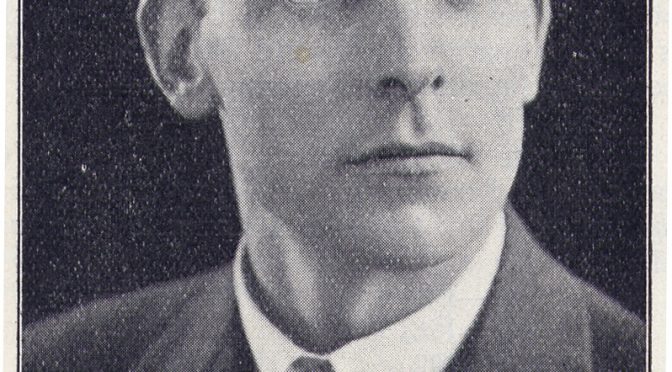
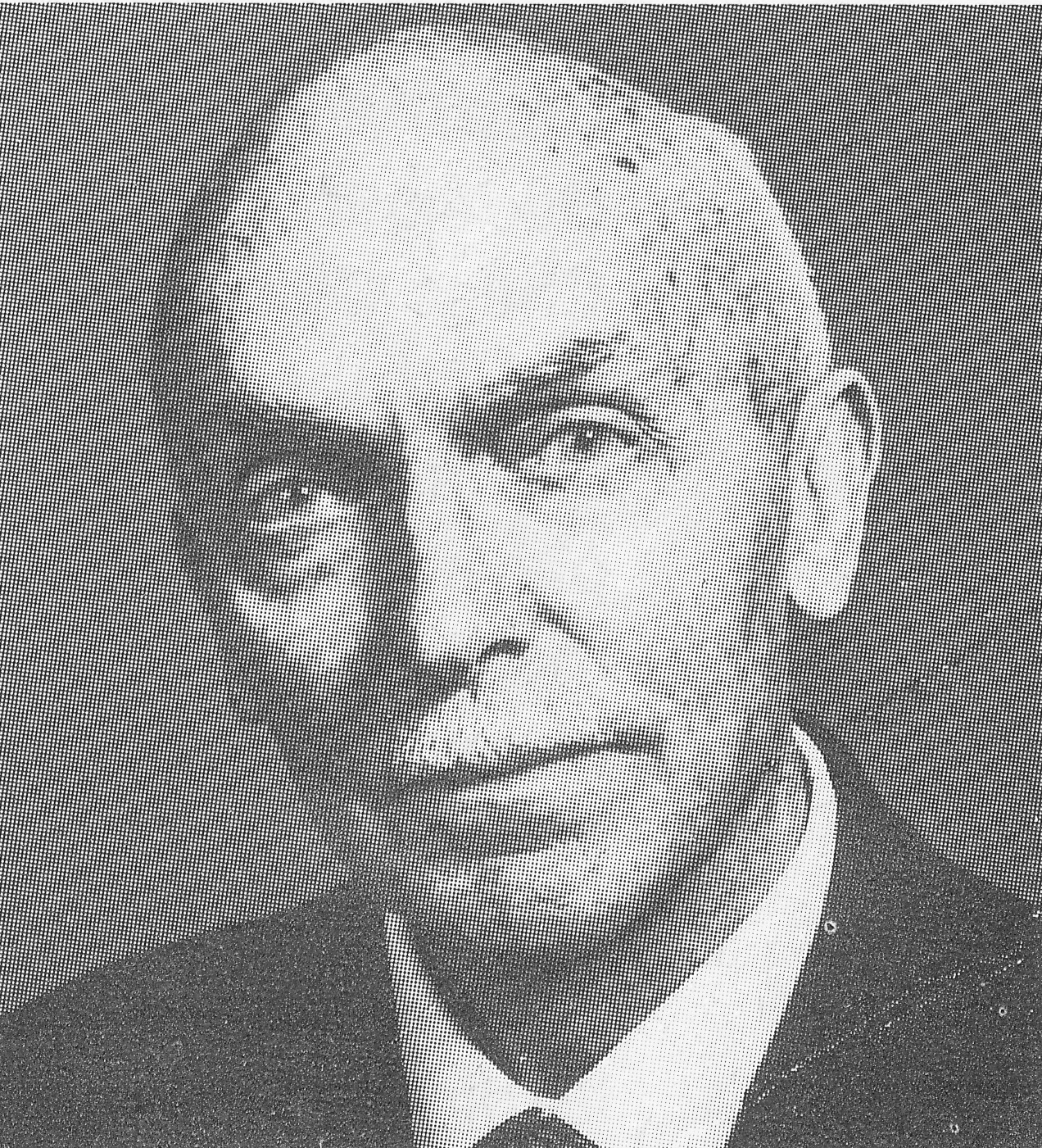
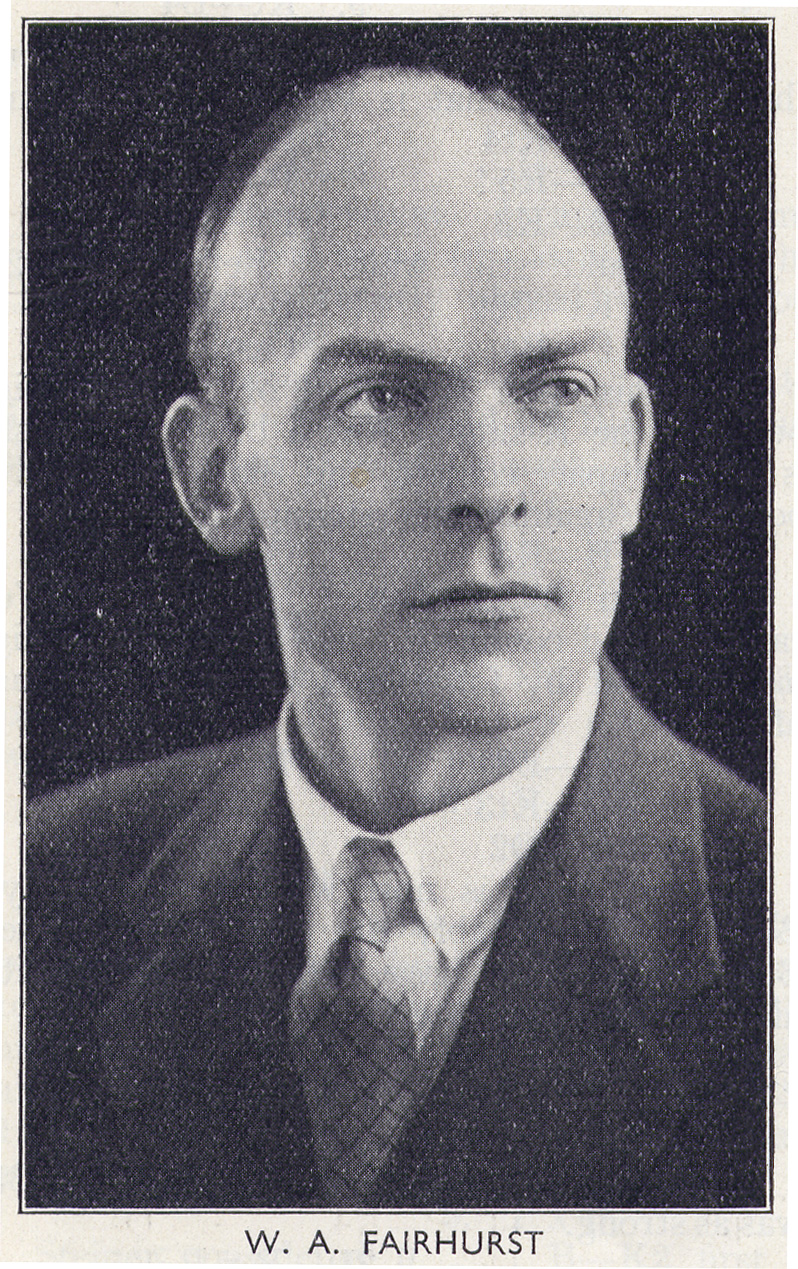
Remembering IM William Fairhurst CBE (21-viii-1903 13-iii-1982)
From The Anglo-Soviet Radio Chess Match by Klein and Winter :
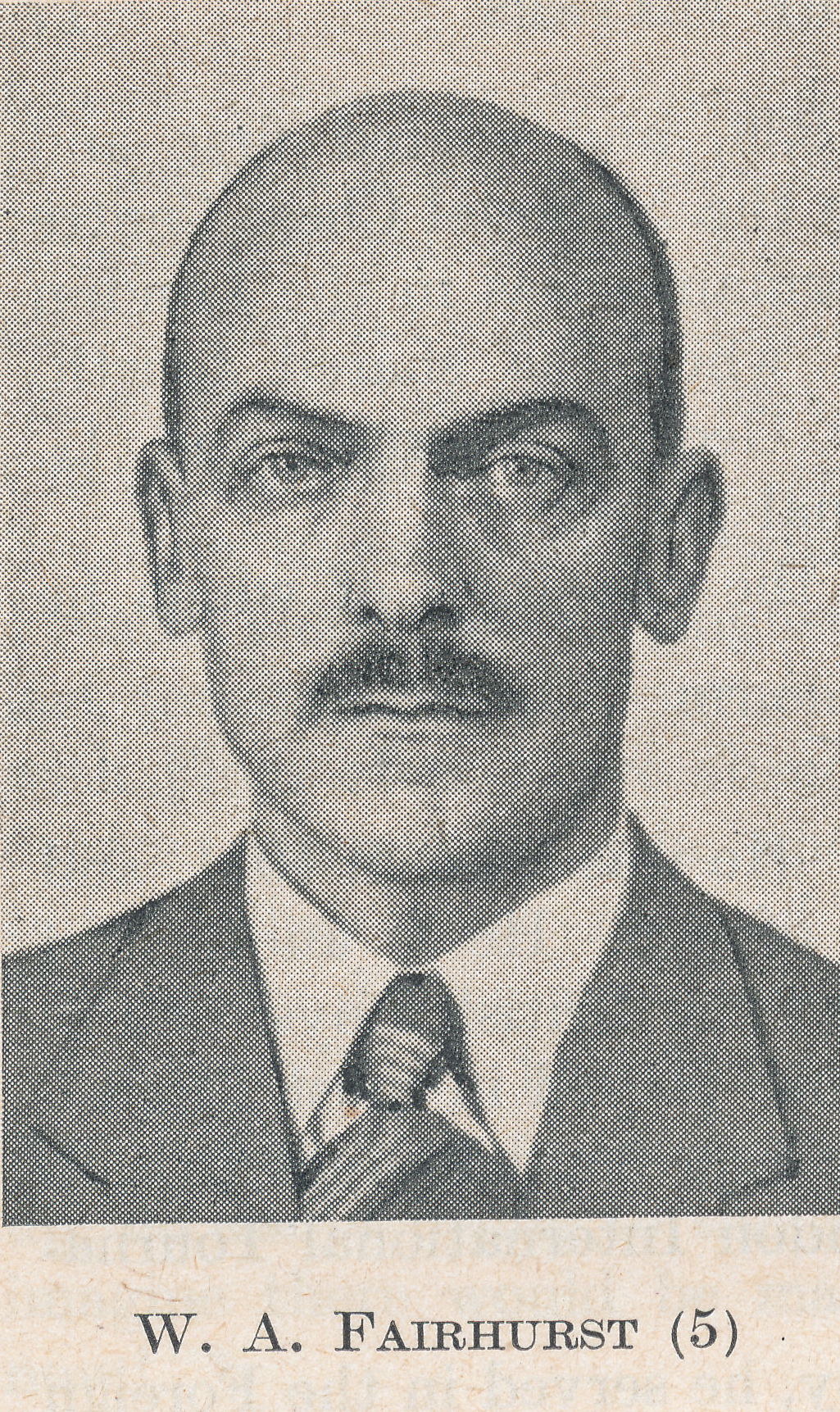
“WA Fairhurst is a North Country man, born in Cheshire in 1903, but he has lived the best part of his life in Scotland. He has been Scottish Champion of many years running, and once captured the British Championship. In his last tournament, London, 1946 he failed to get into the prize list. He is, however, a fine tactician, original in opening play and a dangerous opponent to contend with.
By profession he is a civil engineer and has left his mark as a designer of a special framework for pre-fabricated houses.”
IM William Albert Fairhurst CBE (21-viii-1903 -13-iii-1982) Source : The Anglo-Soviet Radio Chess Match
From The Encyclopedia of Chess by Anne Sunnucks :
“International chess master, British Champion in 1937 and Scottish Champion in 1932, 1933, 1934, 1936, 1937, 1938, 1946, 1947, 1948, 1949 and 1962.
Born in Alderney Edge in Cheshire on 21st August 1903, Fairhurst taught himself to play chess from books on the game, when he was 13, when he was 18 he won the Cheshire Championship.
His first major international success was at Scarborough in 1927, where he tied for Yates for 2nd prize, ahead of Bogoljubov, Sir George Thomas, Buerger, among others.
In 1931 he went to live to Scotland, quickly established himself as a leader of Scottish chess and played a major role in agreements between the British Chess Federation and the Scottish Chess Association. In 1932 he gave a blindfold simultaneous display, winning nine games and drawing three, in the Polytechnic Club in Glasgow, and in 1933 he drew match of six games against Eliskases.
Fairhurst has represented Great Britain in matches against Czechoslovakia and the USSR in 1946 and 1947; against the Netherlands in 1937, 1938, 1949 and 1952 and against the USSR in 1954. He also played in the Great Britain v. Australia radio match in 1947. He has represented Scotland in six chess Olympiads, those of 1933, 1956, 1958, 1964, 1966 and 1968.
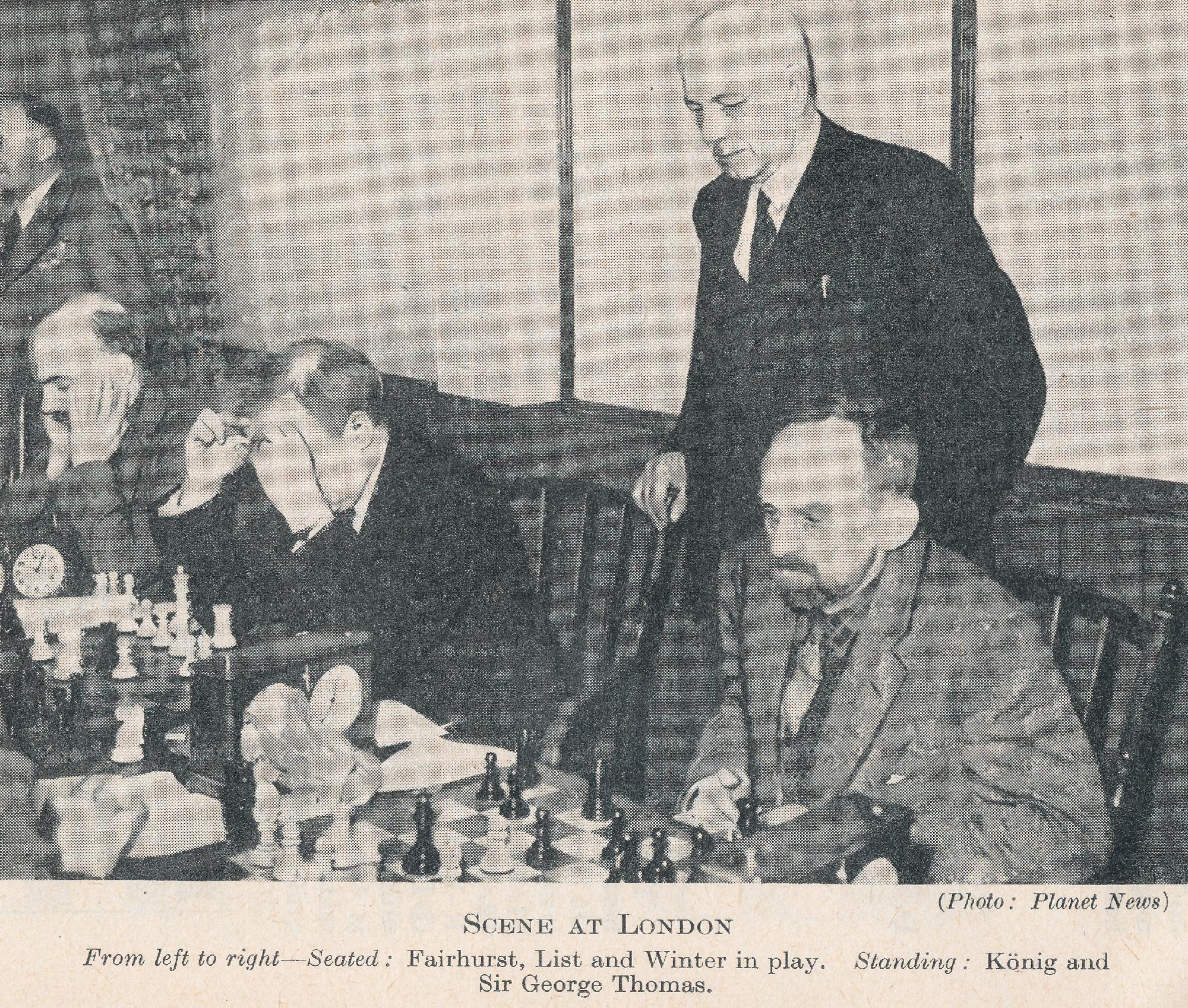
Scene at London. From left to right – Seated : Fairhurst, List and Winter in play. Standing König and Sir George Thomas
At Hastings in 1947 he came 5th and went through the tournament without losing a game.
IM William Fairhurst CBE (21-viii-1903 13-iii-1982)
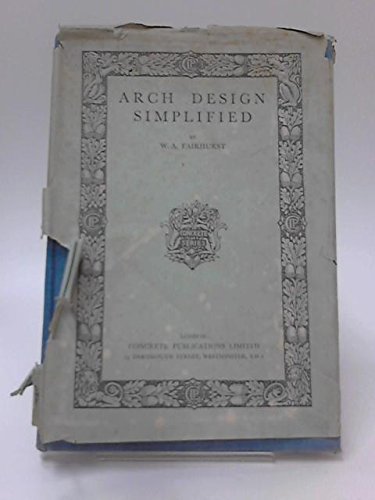
Senior partner of a leading firm of engineers and designer of the new bridge over the River Tay at Dundee (the longest river crossing in Europe), Fairhurst was Chairman of the Scottish Branch of the Institute of Structural Engineers and author of Arch Design Simplified. He was also a member of the Royal Fine Art Commission for Scotland.”
In the March issue of CHESS for 1963, (Volume 28, Number 427, pp.147-155) William Winter wrote this:
An Englishman turned Scot
Fairhurst, British champion in 1937, and umpteen times champion of Scotland is happily still in practice. He is a fine player well equipped in all departments of the game and would undoubtedly have done much more than he did but for the claims of business. Born in Lancashire he is now domiciled in Scotland and has become more Scottish than the Scots themselves. He caused me great trepidation during the Buxton congress in 1950, when he picked me up in his motor-car and drove at high speed down a spiral road with a precipice on one side while he declaimed about the tenets of the extreme wing of Scottish Nationalism. I have myself a good deal of sympathy, with the aspirations of the movement but I am sure this was not the way to make a convert. He still plays for Lancashire in the British Counties’ championship and it was in this competition that I met him at Manchester in 1953. I little thought as I sat down at the board that this was to be the last match-game I would ever play. I am glad to say that it was a good one.;
From The Oxford Encyclopedia of Chess by Hooper & Whyld :
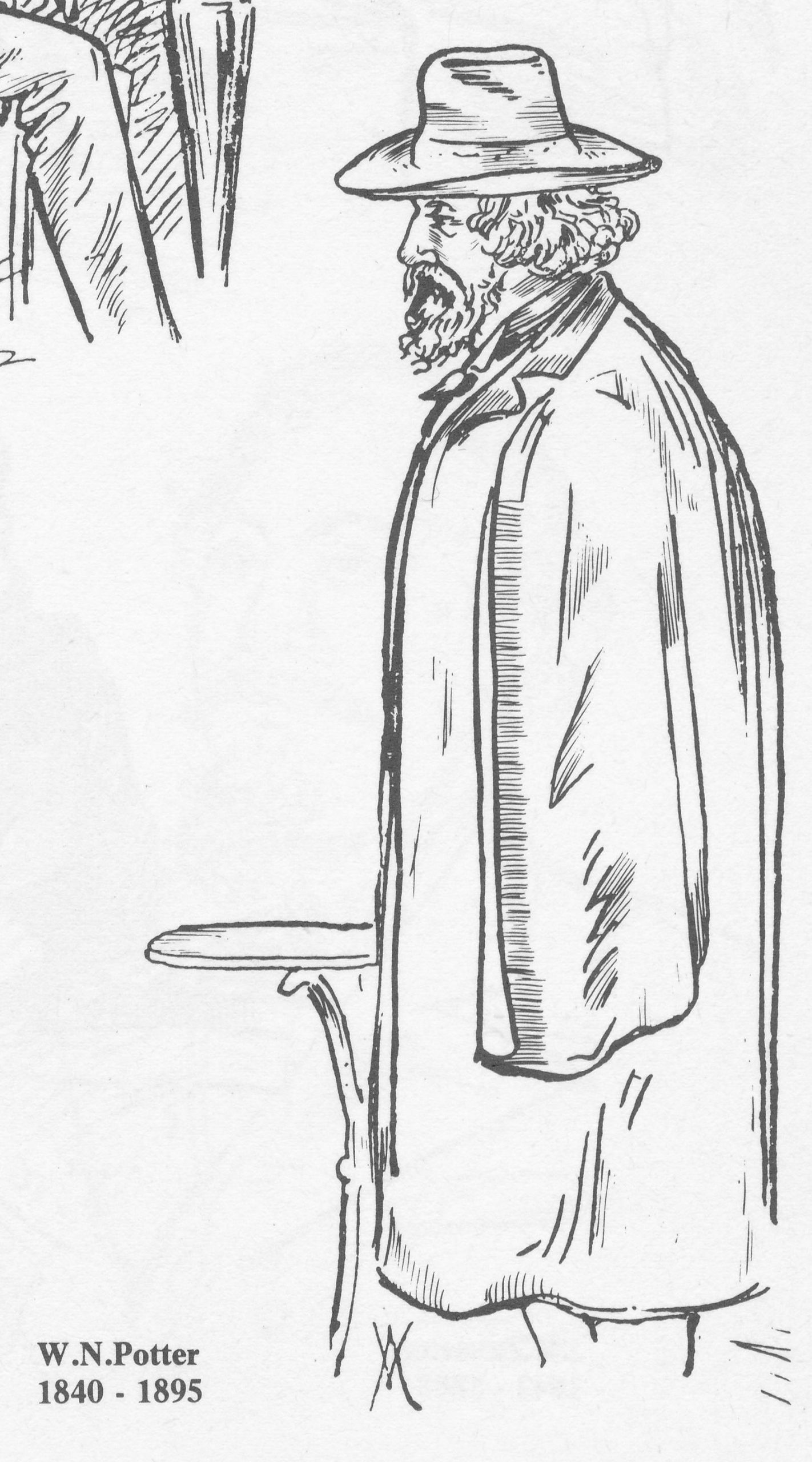
“Leading English player of the 1870s, barristers clerk. He met strong opposition in only one tournament, London 1876, when he took third place after Blackburne and Zukertort. In match
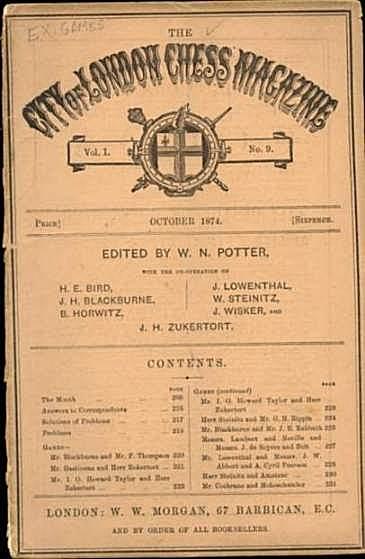
play he lost to Zukertort in 1875 ( + 2=8—4) and drew with Mason in 1879 ( + 5=11—5). Potter was editor of the London Chess Magazine (1874-6)
The London Chess Magazine
and wrote for the Westminster Papers and Land and Water, contributing annotations of a high standard to all three journals. He played a part in the development of new ideas attributed to Steinitz, with whom he established a firm friendship and to whom he may have shown the ideas of the English School (see schools of chess), in 1872 the London Chess Club, represented by Blackburne, Horwitz, Lowenthal, Potter, Steinitz, and Wisker, began a correspondence match of two games against a Viennese team led by Kolisch for stakes of £100 a side, (The moves were sent by telegraph and confirmed by letter.) Unable to accept the ideas of Potter and Steinitz, the rest of the London team soon withdrew, leaving these two to play on. They won the match. Subsequently Steinitz declared
that ‘modern chess’ began with these two games.
The City of London Chess Magazine
The Potter Variation in the Scotch is :
n.b. The Potter Memorial correspondence tournament was named after Reginald Potter, a past president of the BPCF.
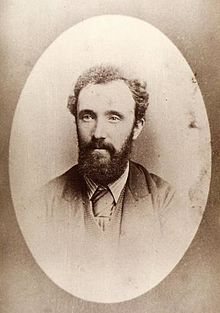
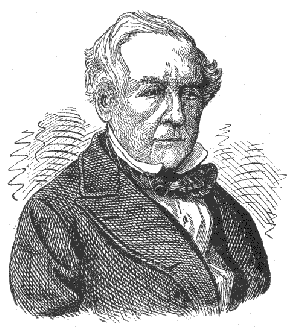
William Norwood Potter, (27-viii-1840 13-iii-1895) from Howard Staunton, The English World Chess Champion
“International chess master, British Champion in 1937 and Scottish Champion in 1932, 1933, 1934, 1936, 1937, 1938, 1946, 1947, 1948, 1949 and 1962.
Born in Alderney Edge in Cheshire on 21st August 1903, Fairhurst taught himself to play chess from books on the game, when he was 13, when he was 18 he won the Cheshire Championship.
His first major international success was at Scarborough in 1927, where he tied for Yates for 2nd prize, ahead of Bogoljubov, Sir George Thomas, Buerger, among others.
In 1931 he went to live to Scotland, quickly established himself as a leader of Scottish chess and played a major role in agreements between the British Chess Federation and the Scottish Chess Association. In 1932 he gave a blindfold simultaneous display, winning nine games and drawing three, in the Polytechnic Club in Glasgow, and in 1933 he drew match of six games against Eliskases.
Fairhurst has represented Great Britain in matches against Czechoslovakia and the USSR in 1946 and 1947; against the Netherlands in 1937, 1938, 1949 and 1952 and against the USSR in 1954. He also played in the Great Britain v. Australia radio match in 1947. He has represented Scotland in six chess Olympiads, those of 1933, 1956, 1958, 1964, 1966 and 1968.
At Hastings in 1947 he came 5th and went through the tournament without losing a game.
Senior partner of a leading firm of engineers and designer of the new bridge over the River Tay at Dundee (the longest river crossing in Europe), Fairhurst was Chairman of the Scottish Branch of the Institute of Structural Engineers and author of Arch Design Simplified. He was also a member of the Royal Fine Art Commission for Scotland.”
BCN remembers John Cochrane who passed away on March 3rd 1878.
From The Oxford Companion to Chess by Hooper & Whyld :
Scottish player, barrister, called to the bar in 1822. If the so-called romantic style existed then Cochrane has a claim to be regarded as its founder. A dashing player, he attacked at all costs often sacrificing pieces with abandon, a style that was successful in the England of the 1820s; but when in 1821 he went to Paris, then the world’s chess centre, he was beaten by both Deschapelles and Bourdonnais. Subsequently he studied the game but he did not change his style. In 1822 he published A Treatise on the Game of Chess, a popular book largely based on Traite des Amateurs (see Verdoni) and Lolli but with a few contributions of his own.
Although Cochrane came from an old Scottish family he led the London team in the famous correspondence match against Edinburgh, 1824-8. He persuaded his team to play the Scotch Gambit, but when London had obtained a fine position Cochrane left for India. Although the Londoners, led by Lewis, failed to carry the attack, the Scotch Gambit became fashionable for more than 15 years, and other lively attacking openings were developed.
Cochrane stayed in India until his retirement in 1869 except for one visit to England, 1841-3, when he played hundreds of friendly games against Staunton, who began by winning a large majority, Wilhelm Steinitz knew both contestants and states that their last encounter was a match of 12 games. Staunton conceding pawn and move for the first six- and that Cochrane made an even score when receiving odds but won (-1-3—2— !) when playing on even terms, John Cochrane should not be confused with James Cochrane (c, 1770-1830), co-author of a book on the Muzio gambit.
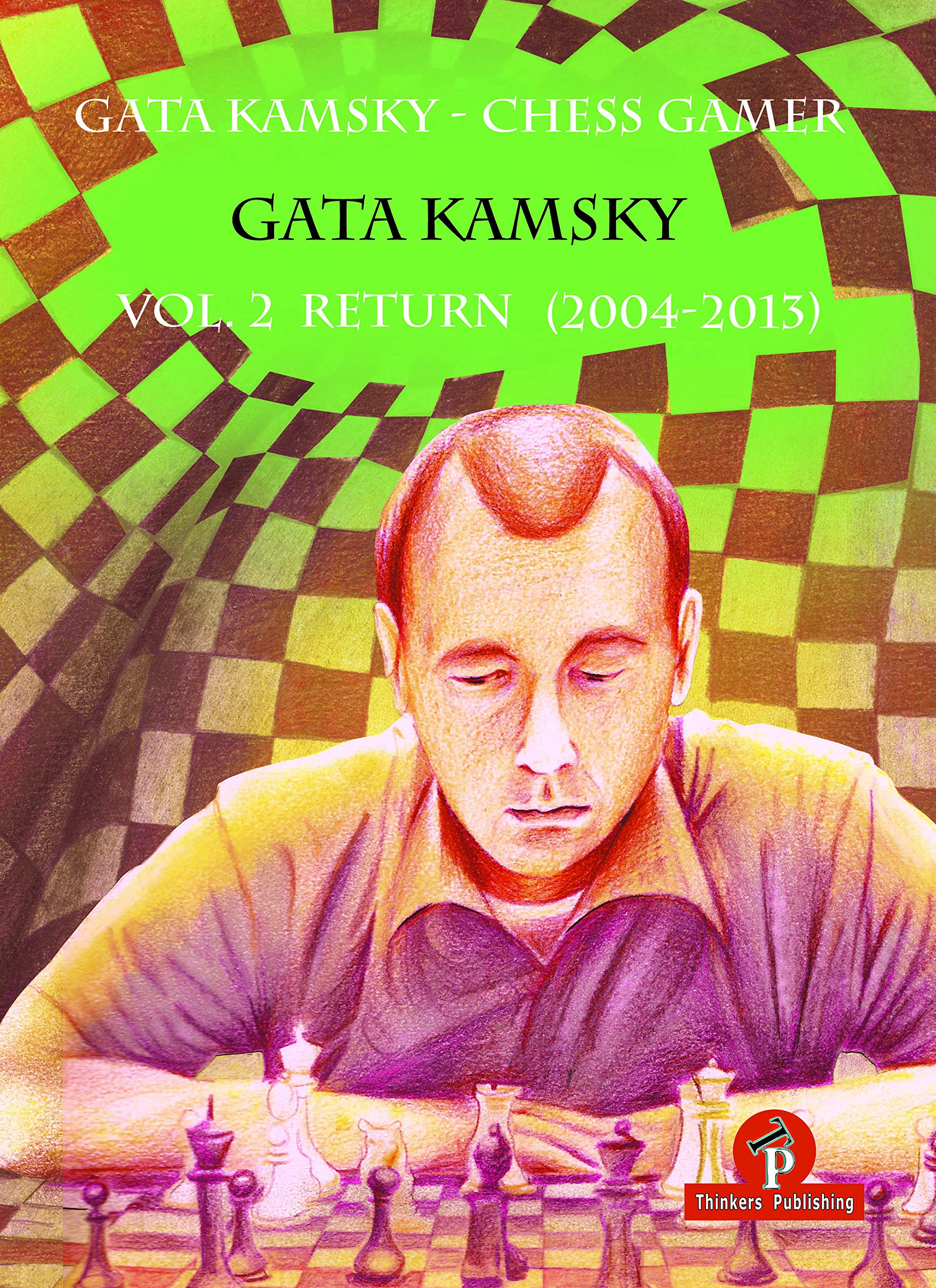
“Grandmaster Gata Kamsky, five times US champion, has one of the most extraordinary career trajectories of any chess player. In 1989 he arrived in New York, at the age of 15, with his father from his home country Russia. Just two years later he became for the first time US champion. He reached the top 10 at the very young age of 16 and played a World Championship match at the age of 22, losing to the reigning World Champion Anatoli Karpov. He then decided to stop playing chess for 8 years, studying Medicine and Law. In 2004 he reappeared as a full-time player, became again a world-elite player winning many international tournaments and supporting the US team for many successes.”
GM Gata Kamsky
What we have here is 22 annotated games (mostly wins, but there are a few draws as well) played by Gata Kamsky between 2004 and 2013, during which period he harboured aspirations towards the world championship.
Kamsky had White in 18 of the 22 games: perhaps it would have been good to learn more about his approach to playing the black pieces. His opponents included the likes of Carlsen, Anand, Aronian, Topalov, Karjakin and Grischuk.
22 games in 450 pages? Yes, that’s an average of about 20 pages per game, often with two or three pages devoted to just one move. There are annotations almost every move: lots of words, and lots of variations as well. Bobby Fischer managed to cram 60 Memorable Games into a lot less space, but then he didn’t have computers to help him.
To give you some idea of what to expect, let’s take a fairly random example: this is Kamsky-Carlsen from the 2007 World Cup in Khanty-Mansiysk.
In this position Carlsen played 17… Re6?
Kamsky comments:
“Probably Black’s only big mistake, but one that costs him the game. The rook is not the best blockader, and once I have figured out how to remove it (by re-routing the knight from g3 to h5, it will only help White accelerate his initiative on the kingside.
“17… Qb3! was perhaps the only move to stop White’s ambitious plans. Black gives up his weak d-pawn in order to open up the position for the rest of his pieces, especially the blocked-in f8-bishop, thus making the rest of his pieces much more effective.”
He then goes on to explain that he was planning to meet 17… Qb3! with 18. Qd2! We then have three pages of notes on this position, with one line ending up with White a pawn ahead on move 42 and another where White wins with a queen sacrifice on move 33.
Eventually returning to the game, we reach this position.
Carlsen has just given up the exchange hoping to set up a fortress. Kamsky explains:
“Black is down a whole exchange, but his structure looks very solid, and if he somehow manages to re-route his knight to f5, while building a strong pawn blockade on the queenside, he might stand a chance. However, White is an exchange up, which means he only needs to open one file for his rooks to infiltrate to win the game. And that is something that Black cannot prevent.”
Kamsky eventually managed, with some help from his opponent, to open the h-file for his rooks, winning on move 46.
The verbal explanations of positions and plans are, as you can tell, models of clarity but you might well think there are too many variations. You’re going to need at least two, more likely three chess sets to find your way through some of the thickets.
The games are not all you get for your money, though. Each game is put into context, and, Kamsky warns us in the introduction: “I must also caution that some of the views and comments expressed on subjects other than chess will sometimes be found to be quite controversial and not ‘correct’, in which case I would invite the reader to draw his or her own conclusions.”.
We are, perhaps fortunately, spared Kamsky’s views on Donald Trump and Brexit, but we do get his opinions of his opponents along with some flashbacks to his childhood.
You may well be aware of the reputation of his father, Rustam Kamsky. Gata’s descriptions of their relationship doesn’t make comfortable reading:
“… I had no education and was under the complete domination, in both body and soul, of my father. He literally threatened to kill me many times, including chasing me with a knife on numerous occasions after a terrible tournament…
“When I came home from the one and only occasion I went to the authorities for help, my father burned my hand to the bone and told me that if I told the authorities about him again, he would kill me. Being physically beaten was an everyday occurrence; it was the psychological attack with his words that made me feel very old and not want to live.”
Given this background it’s perhaps understandable that he has a jaundiced view of some of his fellow grandmasters, even including the universally respected Vishy Anand. He has the rather strange habit of referring to some of them, particularly, it seems, those with whom he has come into conflict in the past, as, for example, Mr Topalov.
In some respects, then, this is a very personal book: much more than just a games collection.
Every one of the games is fascinating, the annotations are superb, but you probably need to be round about 2200 strength to gain full benefit from following all the variations. Below that level, you might find yourself shouting “too much information, Mr Kamsky” and perhaps prefer to spend your money on something with more games and fewer variations.
The production standards, as usual from this publisher, are excellent. I noticed very few typos (a redundant check sign and Jeffrey rather than Jeffery Xiong). If you’re looking for a collection of grandmaster games with exceptionally detailed annotations, along with some very personal insights into the world of top level chess, this is the book for you.
BCN remembers GM Jacques Mieses who passed away on February 23rd, 1954 aged 88. He was buried on the 25th of February at the East Ham Jewish Cemetery in Section J, Row 18, Grave 1100. We hope to update his burial record with these details when we are allowed to do so.
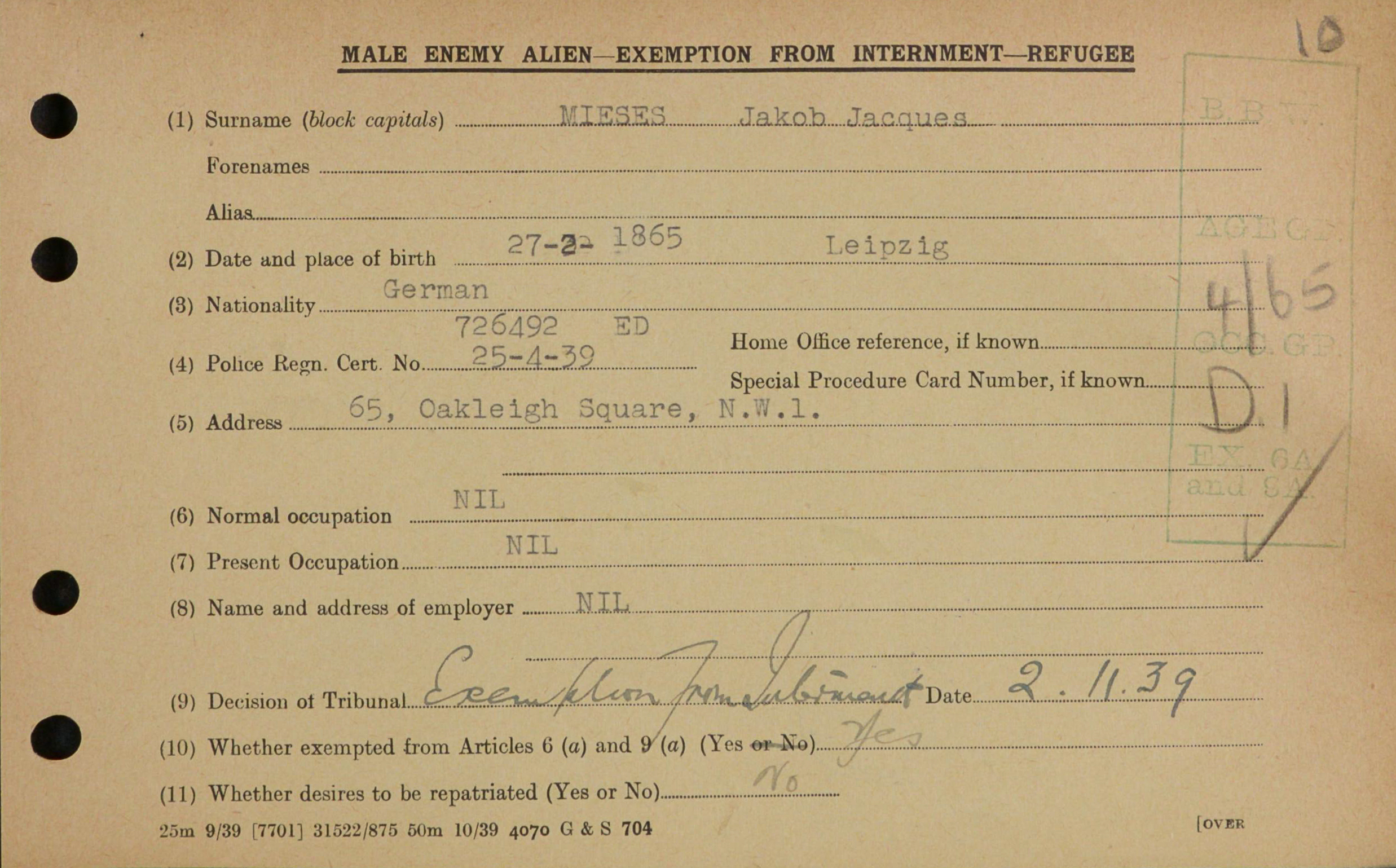
Jakob Jacques Mieses was born on Monday, February 27th 1865 in Leipzig in the German state of Saxony. He came to England in 1939 and was recorded in the UK Internees Index for 1939 – 1942 on 25th April 1939 :
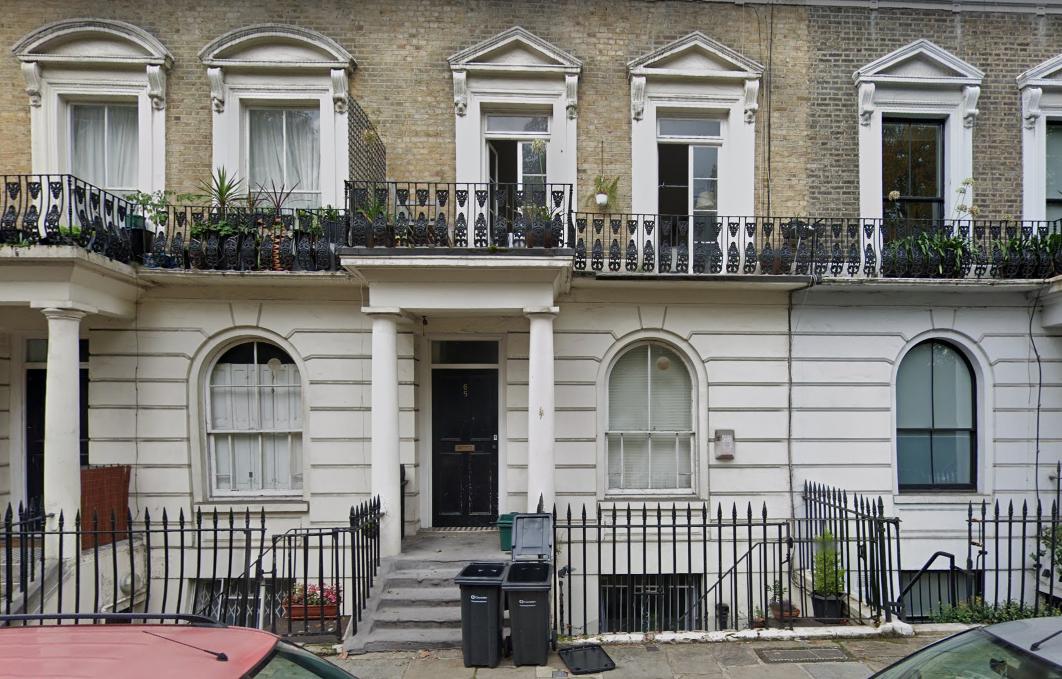
Home Office internment record for Jakob Jacques Mieses, 25th April 193965 Oakleigh (now Oakley) Square, London, NW1
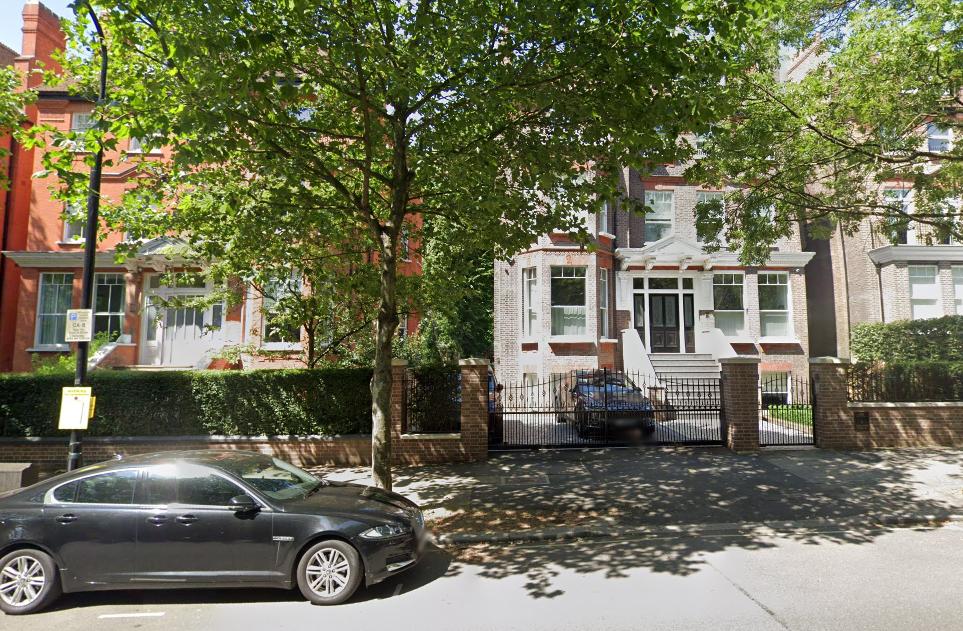
At the time of the 1939 register Mieses was recorded as living at 66, Oakley Square, St. Pancras, Camden, London, NW1 and he is listed as a Professional Chess Player.
By the time of Hastings 1945 (27th December) Jacques had relocated to :
8 Fitzjohns Avenue, London NW3 5NA
On June 7th 1947 he was granted Naturalisation Certificate AZ27326.
In 1950 he was one of the twenty-seven first players to be awarded the Grandmaster title by FIDE. He was therefore the first British National to be awarded the Grandmaster title for OTB play. The next (Tony Miles) would be twenty-six years later.
He has The Mieses Opening named after him :
which never really caught on to any significant degree.
In the Scotch Game (a favourite of his with both colours) we have The Mieses Variation :
and in the Vienna Game The Mieses Variation is :
and in the Centre Counter or Scandinavian Defence we have the Mieses Variation:
and finally, also in the Centre Counter or Scandinavian Defence we have the Mieses Gambit:
From The Encyclopaedia of Chess (Robert Hale, 1970 & 1976), Anne Sunnucks :
“International Grandmaster. Born in Leipzig on 27th February 1865, Jacques Mieses was educated at Leipzig University and in Berlin. He came to England as a refugee from Nazi Germany shortly before the 1939-1945 war and eventually became a naturalised British citizen.
The early part of his chess career was devoted mainly to the study of chess theory and to chess problems. It was not until he was 23 that his tournament career really started with a tie for 2nd place at Nuremberg 1888, followed by 3rd at Leipzig 1888.
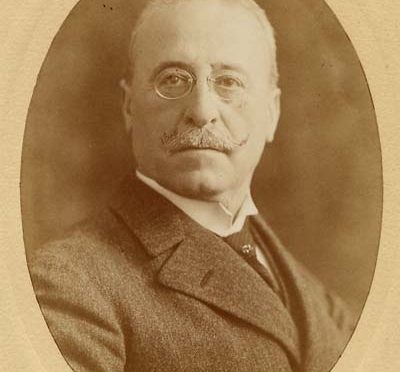
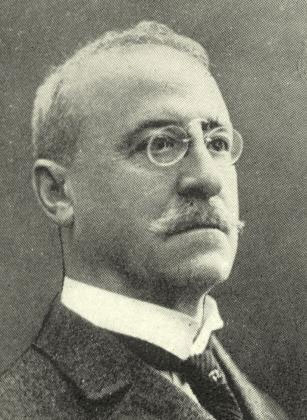
Jacques Mieses. Source : Chess Notes by Edward Winter
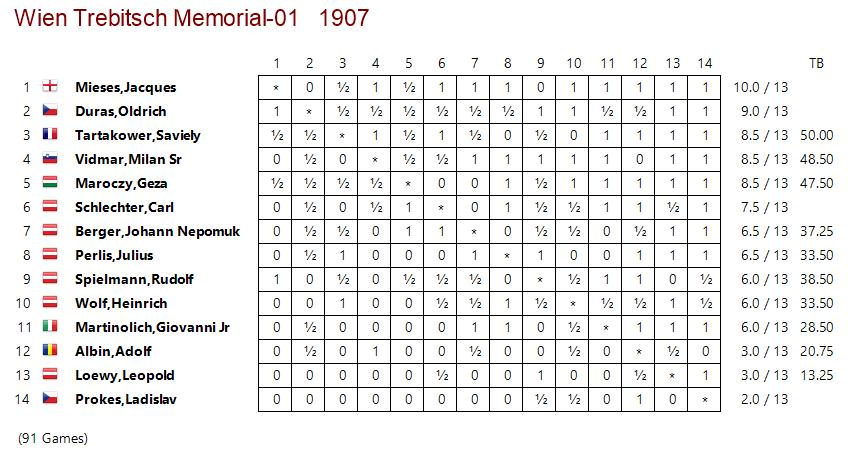
Over the next 50 years, he played in numerous tournaments with varying degrees of success. His addiction to speculative rather than sound openings and his attempts to combine playing in tournaments with reporting them were possibly responsible for his inconsistent results. Within a few months of one of the greatest performances of his career, when he came lst at Vienna 1907, ahead of Duras, Maróczy, Tartakover, Vidmar, Schlechter and Spielmann,
Full crosstable for Trebitsch Memorial, Vienna 1907
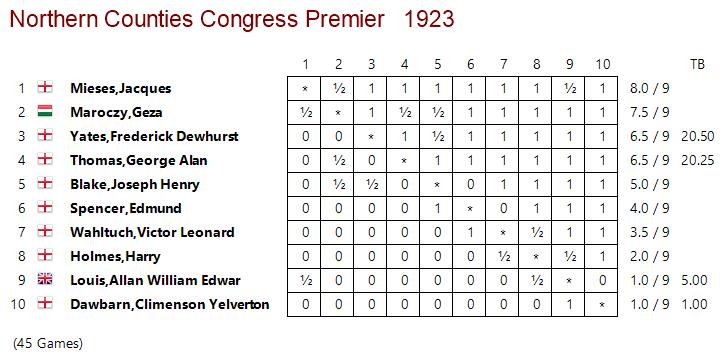
he came no higher than =16th at Carlsbad. In 1923 he achieved another great success when he came lst at Liverpool, ahead of Maróczy, Thomas and Yates.
Full crosstable for Northern Counties Congress Premier, Liverpool, 1923
While his style of play prevented him from reaching the greatest heights as a tournament player, it was also responsible for the numerous brilliancy prizes which came his way, one of the last being at the 1945 Hastings Congress, when he was 80.
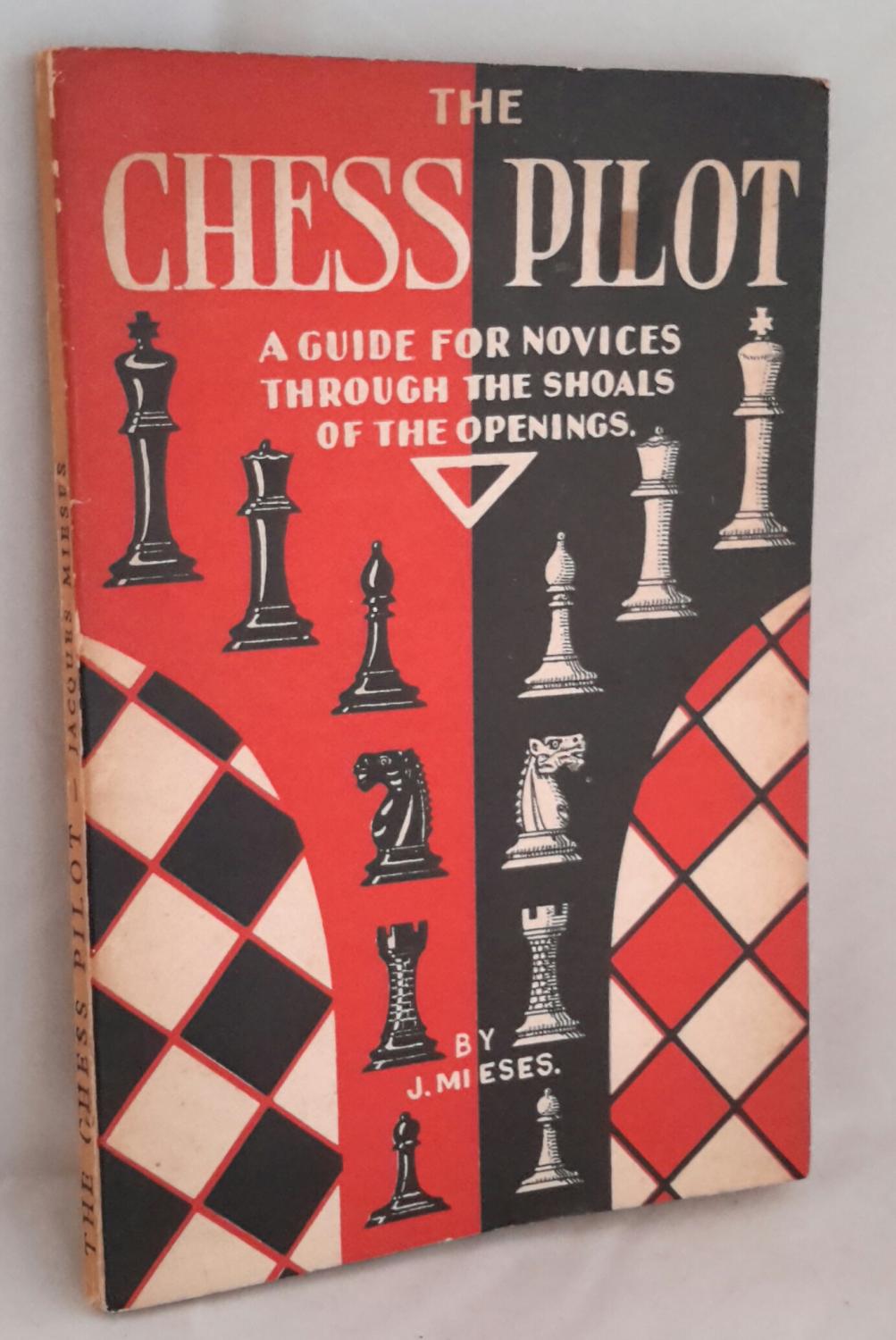
Among the many books which Mieses wrote were The Chess Pilot,
The Chess Pilot, Jacques Mieses, Williams & Norgate. London. 1947. First Edition
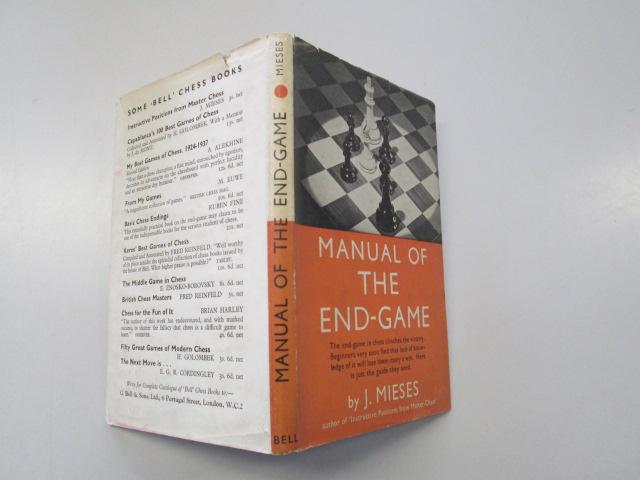
Manual of the End Game
Manual of the End Game, Jacques Mieses, G. Bell and Son Ltd., London, 1947
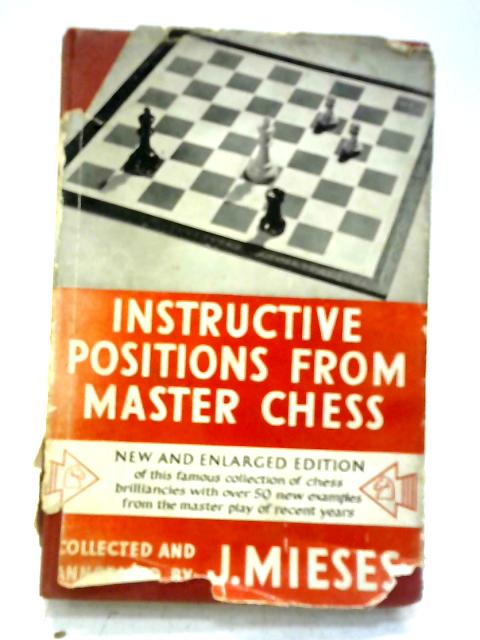
and Instructive Positions from Master Chess.
Instructive Positions from Master Chess, Jacques Mieses, George Bell and Sons Ltd., London, 1951
A very popular player, Mieses had a ready sense of humour. On one occasion, when he was in New York, he was asked by an American who mispronounced his name “Sind sie Mister Meises?”, ” No sir,” he promptly replied “Ich bin Meister Mieses.” On another occasion, when submitting an article in German to a British magazine, he could not resist asking ” Don’t you think my German is very good for an Englishman?”
On his eightieth birthday, a dinner was held in his honour in London and he was presented with a cheque by his numerous chess friends and admirers. The speech he made on this occasion was later quoted in most of his obituaries:
I have been told that a good many people never reach the biblical span of three score years and 10; and those who do-so some most reliable statistics assure us-are most likely to die between 70 and 80. Hence, I dare say, ladies and gentlemen, that I for one have now passed the danger zone and may well go on living for ever.
He lived for nearly nine more years, taking his daily swim in the Serpentine in Hyde Park or some open-air swimming pool, until only a few days before his death. He died in a London nursing home on 23rd February 1954 and was buried in the East London Jewish Cemetery.”
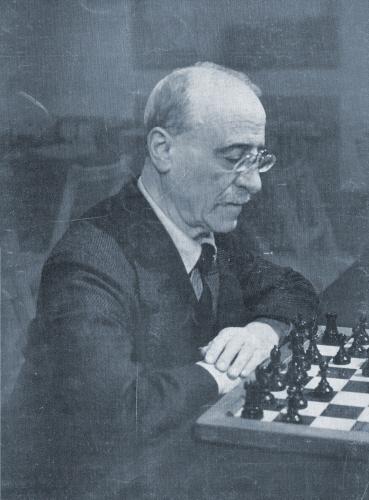
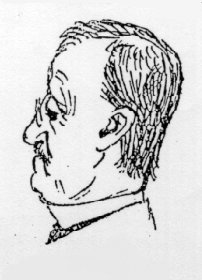
Jacques Mieses
From The Encyclopaedia of Chess (Batsford, 1977) Harry Golombek OBE we have this from Wolfgang Heidenfeld :
“Grandmaster, theorist, problemist, tournament organiser and chess journalist.
Mieses was a spectacular player who won many brilliancy prizes but suffered as many very short defeats. As a a result the German master achieved only one full success in important international tournaments (Vienna 1907), but occupied good places in such events as Breslau 1889 (3rd), Hanover 1902 (4th), Ostend 1907 (=3rd), as well as some smaller events.
In matches he showed a heavy preponderance of losses against the top-notchers, losing to Lasker, Tarrasch, Rubinstein, Marshall, Teichmann (twice) and Spielmann, but he drew with Walbrodt (1894), Janowski (1895) and Caro (1897) and beat Leonhardt, Taubenhaus, and (at the age of 81) Abrahams.
Here is the first game from October 29th 1945 annotated by Mieses from his match with Gerald Abrahams played in Glossop:
In keeping with his sharp style, Mieses preferred such openings as the Vienna Gambit, the Danish Gambit and the Centre Counter-Gambit. Among his lasting achievements are his brilliancy prize games against Janowksi (Paris 1900),
Reggio (Monte Carlo 1903),
Perlis (Ostend 1907)
and Schlechter (Vienna 1908).
Personally a very witty man (and something of a bon vivant) Mieses did not invest his writing with the same sparkle; both as a journalist and author he was rather dry and sober. He edited the eighth edition of the famous Handbuch, several editions of the ‘little Dufresne’, and published several primers as well as a treatise on blindfold play and an anthology Instructive Positions from Master Chess, London, 1938.
One of Mieses’s most important contributions to chess history was the payment of travelling and living expenses during a tournament, which he insisted on when running the famous tournament at San Sebastian 1911 – it was only thenceforth that this procedure became the norm.”
Jacques Mieses
Here is an obituary written by DJ Morgan from British Chess Magazine, Volume LXXIV (74, 1954), Number 4 (April), pp. 107-108 :
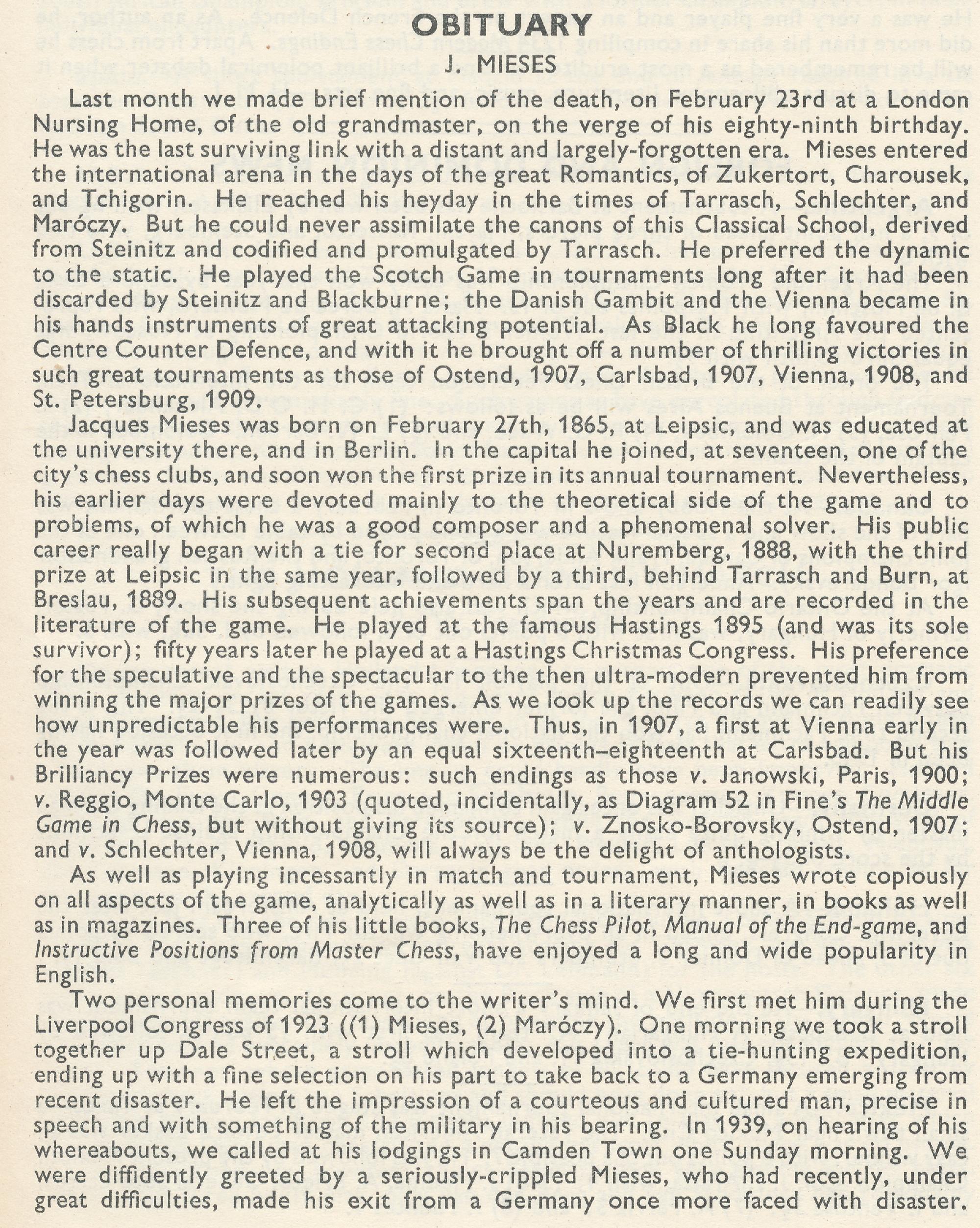
Last month we made brief mention of the death, on February 23rd at a London Nursing Home, of the old grandmaster, on the verge of his eighty-ninth birthday. He was the last surviving link with a distant and largely-forgotten era. Mieses entered the international arena in the days of the great Romantics, of Zukertort, Charousek, and Tchigorin. He reached his heyday in the times of Tarrasch, Schlechter, and Maróczy. But he could never assimilate the canons of this Classical School, derived from Steinitz and codified and promulgated by Tarrasch. He preferred the dynamic to the static. He played the Scotch Game in tournaments long after it hat been
discarded by Steinitz and Blackburne; the Danish Gambit and the Vienna became in his hands instruments of great attacking potential. As Black he long favoured the Centre Counter Defence, and with it he brought off a number of thrilling victories in such great tournaments as those of Ostend, 1907, Carlsbad, 1907, Vienna, 1908, and St. Petersburg, 1909.
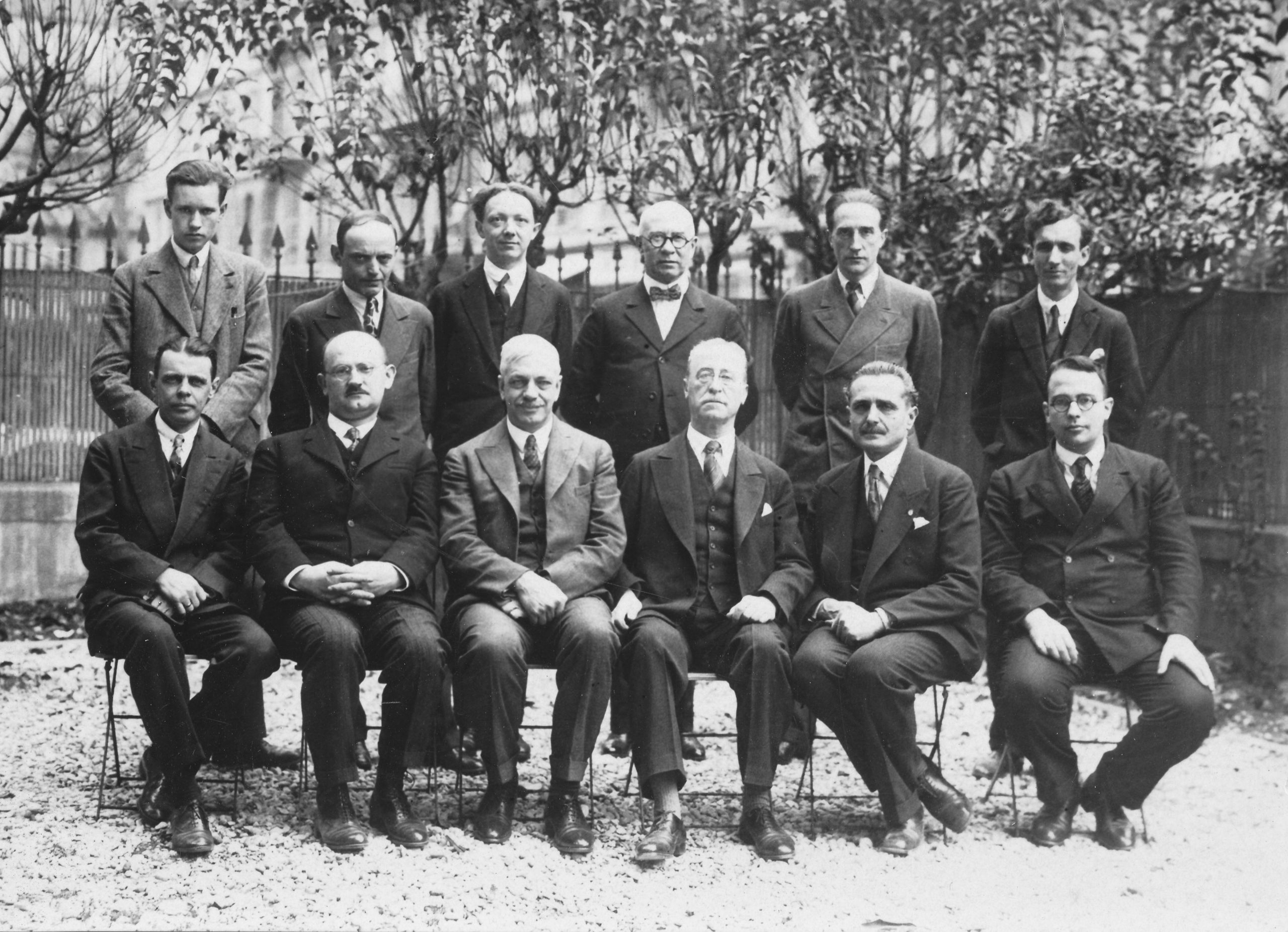
Nice Masters, 1931. Standing : Daniel Noteboom, Abraham Baratz, George Renaud (Organiser), Telling (Tournament Director), Marcel Duchamp, Brian Reilly (winner), Seated : Eugene Znokso-Borovsky,, Arpad Vajda, Sir George Thomas, Jacques Mieses, Stefano Roselli del Turco, Jacob Adolf Seitz. British Chess Magazine, 1931, page 201
Jacques Mieses was born on February 27th, 1865, at Leipsic, and was educated at the university there, and in Berlin. In the capital he joined, at seventeen, one of the city’s chess clubs, and soon won the first prize in its annual tournament. Nevertheless, his earlier days were devoted mainly to the theoretical side of the game and to problems of which he was a good composer and a phenomenal solver. His public career really began with a tie for second place at Nuremberg, 1888, with the third prize at Leipsic in the same year, followed by a third, behind Tarrasch and Burn, at Breslau, 1889. His subsequent achievements span the years and are recorded in the literature of the game. He played at the famous Hastings 1895 (and was its sole survivor); fifty years later he played at a Hastings Christmas Congress. His preference for the speculative and the spectacular to the then ultra-modern-prevented him from winning the major prizes of the games. As we look up the record’s we can readily see how unpredictable his performances were. Thus, in 1907, a first at Vienna early in the year was followed later by an equal sixteenth-eighteenth at Carlsbad. But his Brilliancy Prizes were numerous: such endings as those v. Janowski, Paris, 1900; v. Reggio, Monte Carlo, 1903 (quoted, incidentally, as Diagram 52 in Fine’s The Middle Game in Chess, but without giving its source); v. Znosko-Borovsky, Ostend, 1907; and v. Schlechter, Vienna, 1908, will always be the delight of anthologists.
Jacques Mieses
As well as playing incessantly in match and tournament, Mieses wrote copiously on all aspects of the game, analytically as well as in a literary manner, in books as well as in magazines. Three of his little books, The Chess Pilot, Manual of the End-game, and Instructive Positions from Master Chess, have enjoyed a long and wide popularity in English.
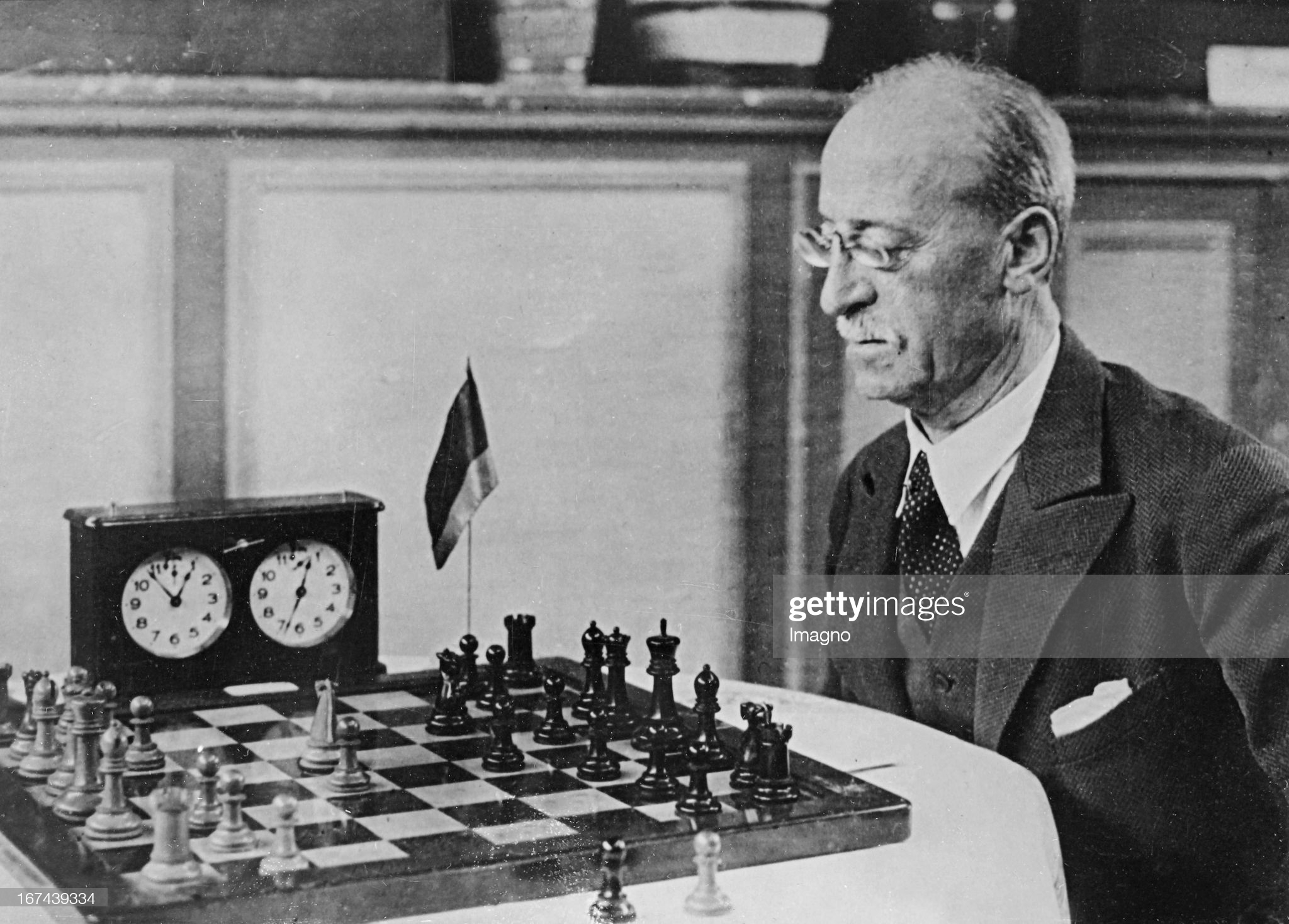
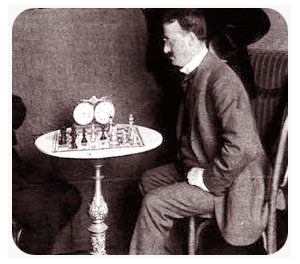
24th April 1935: J Mieses of Germany in play against PS Milner-Barry during the Premier Tournament of the Kent County Chess Association in the Grand Hotel, Margate. (Photo by F. Sayers/Topical Press Agency/Getty Images)
Two personal memories come to the writer’s mind. We first met him during the Liverpool congress-of 1923 ((1) Mieses, (2) Maróczy). one morning we took a stroll together up Dale Street, a stroll which developed into a tie-hunting expedition, ending up with a fine selection on his part to take back to a Germany emerging from recent disaster. He left the impression of a courteous and cultured man, precise in speech and with something of the military in his bearing. ln 1939, on hearing of his whereabouts, we called at his lodgings in Camden Town one Sunday morning. We were diffidently greeted by a seriously-crippled Mieses, who had recently, under great difficulties, made his exit from a Germany once more faced with disaster.
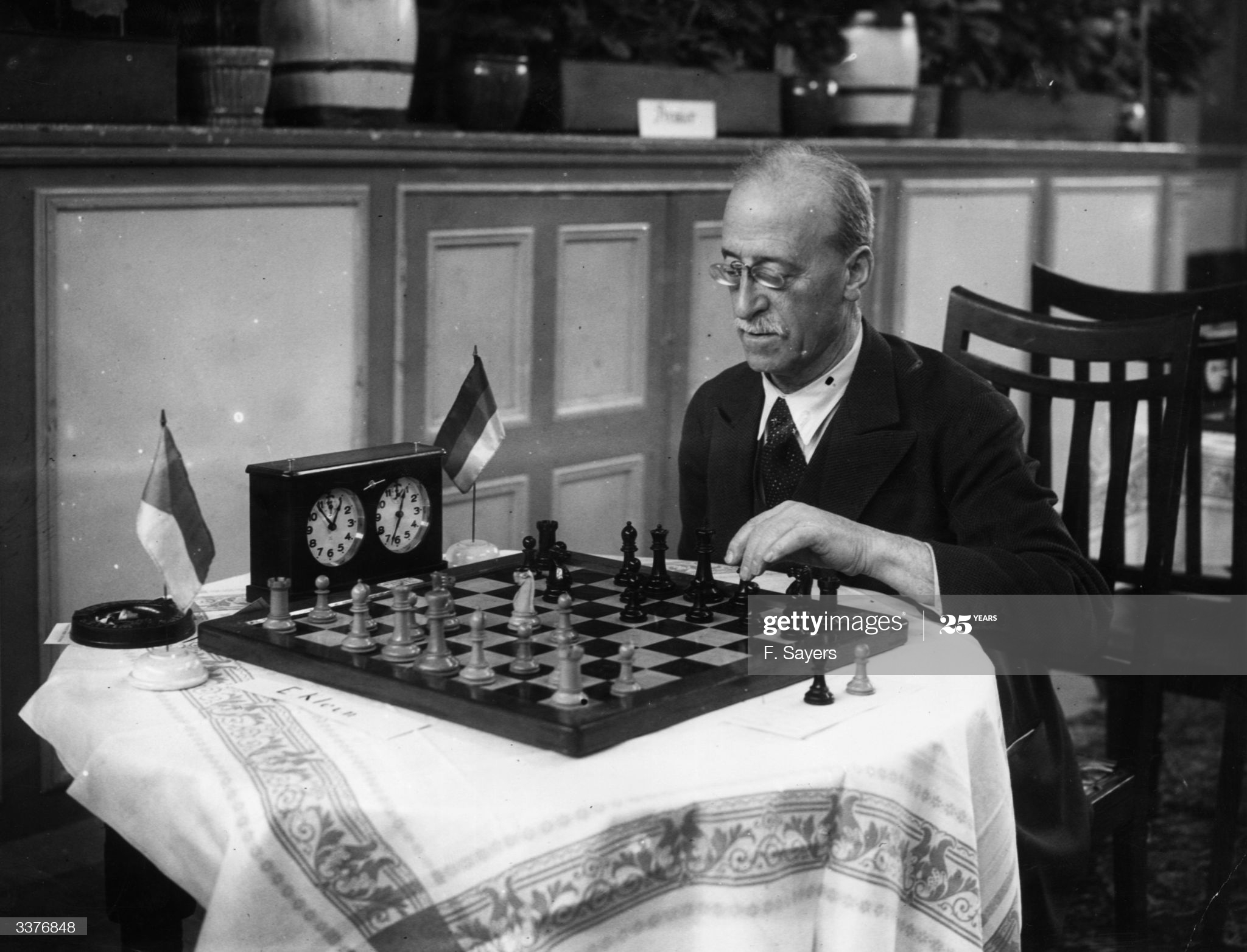
24th April 1935: J Mieses of Germany in play against PS Milner-Barry during the Premier Tournament of the Kent County Chess Association in the Grand Hotel, Margate. (Photo by F. Sayers/Topical Press Agency/Getty Images)
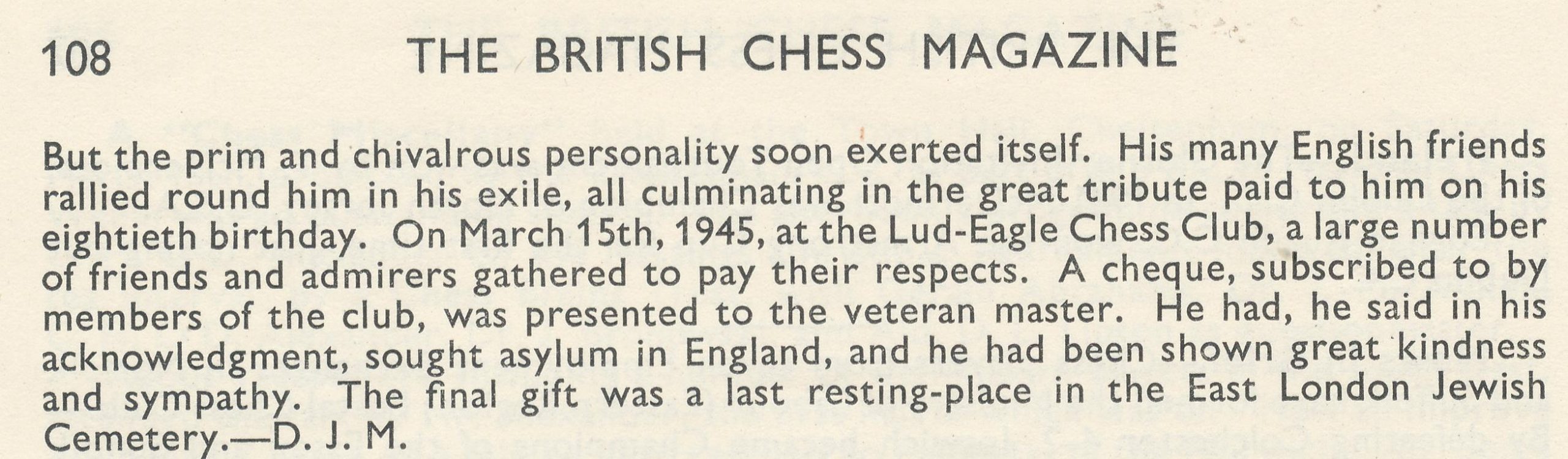
But the prim and chivalrous personality soon exerted itself. His many English friends rallied round him in his exile, all culminating in the great tribute paid to him on his eightieth birthday. Mon March 15th, 1945, at the Lud-Eagle Chess Club, a large number of friends and admirers gathered to pay their respects. A cheque, subscribed to by members of the club, was presented to the veteran master. He had, he said in his acknowledgement, sought asylum in England, and he had been shown great kindness and sympathy. The final gift was a last resting-place in the East London (Ed : we now know this to be East Ham) Jewish Cemetery. – DJM.
Obituary of Jacques Mieses by DJ Morgan. British Chess Magazine, Volume LXXIV (74, 1954), Number 4 (April), pp. 107-108.Obituary of Jacques Mieses by DJ Morgan. British Chess Magazine, Volume LXXIV (74, 1954), Number 4 (April), pp. 107-108.
“Jacques Mieses was born in Leipzig. He won the chess championship of Berlin at the age of 17, and in 1888 he placed joint second at Leipzig and third at Nuremberg.
In 1889 he came third at Breslau (1889). He was, however, rather eclipsed by two great emerging talents – Emanuel Lasker and Siegbert Tarrasch. Mieses was crushed by Lasker in a match – Lasker – Mieses (1889/90) in Leipzig (December 1889 to January 1890). He also performed poorly at 8th DSB Kongress (1893) coming only 7th out of 9 against a field which was relatively weak compared to previous DSB congresses.
1894-95 was a busy period for Mieses. He drew a match with Karl August Walbrodt. (+5, =3,-5) in Berlin (May-June 1894). Mieses then played in the extremely strong 9th DSB Kongress, Leipzig (1894) (3rd-14th September, 1894) coming 10th out of 18. He had then toured Russia giving simultaneous displays, before travelling to Paris to play a match with David Janowski (8th January to 4th February 1895).
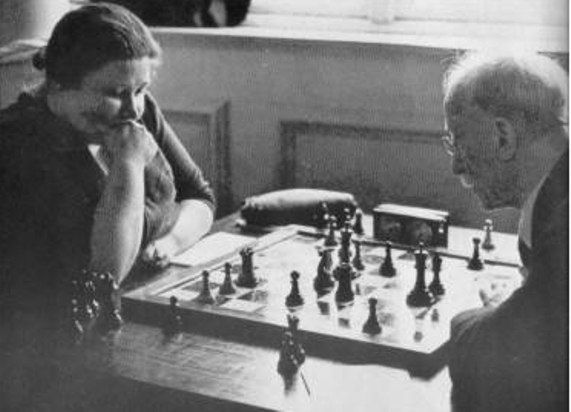
Vera Menchik plays Jacques Mieses in their match in 1942
Mieses then crossed the English Channel to play a short match against Richard Teichmann in London (16th – 21st February 1895) which he lost by +1 =1 -4. A month later he played this match, Mieses next professional engagement would be (which was his first tournament outside his own country) came at the famous Hastings event of 1895. Although he finished only twentieth (in a field of 22 players), he soon adapted to this level of play and in 1907 he took first prize at the Vienna tournament scoring ten points from thirteen games.
In 1909, Mieses played a short blindfold match with Carl Schlechter, winning it with two wins and one draw. The very next year Schlechter played Emanuel Lasker for the World Championship and drew the match 5-5.
Mieses tried his hand as a tournament organiser in 1911, putting together the San Sebastian event that marked the international debut of future World Champion Jose Raul Capablanca. Mieses was defeated by one of Lasker’s title challengers, Siegbert Tarrasch, in a match in 1916 (+2 -7 =4). In 1938 Mieses resettled in England and took British citizenship. He was awarded the grandmaster title in 1950.”
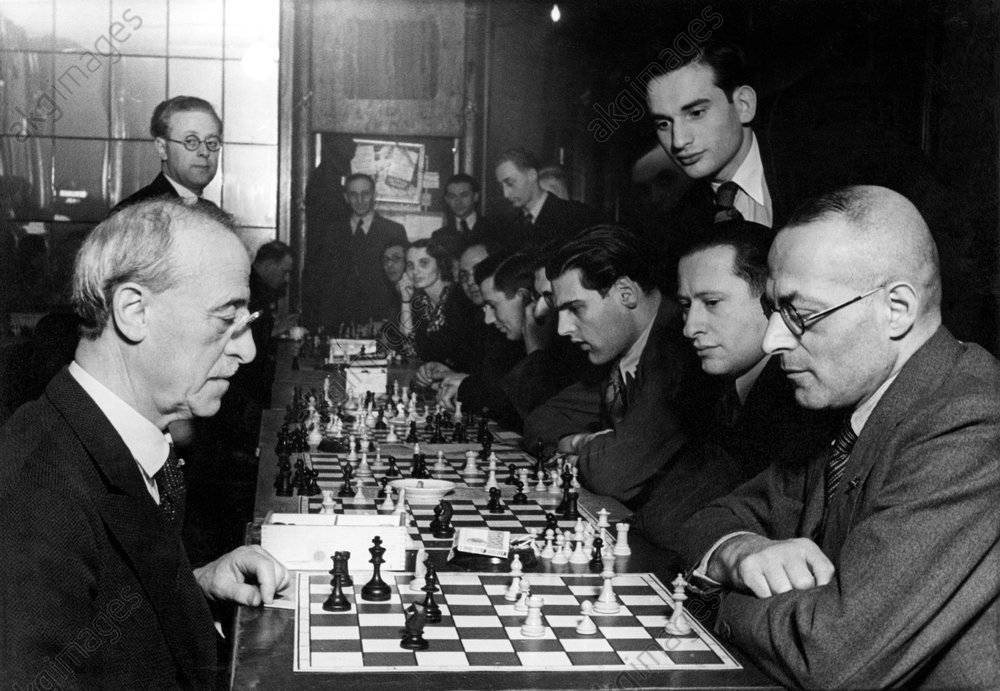
Jacques Mieses. Jewish chess master from Germany; 1938 Escape from the Naziregime to England. 27.2.1865 Leipzig – 23.2.1954 London. Simultaneous play in the Bar Kochba club against 25 chess players, in the foreground: Mieses (left) against Felix A. Theilhaber. Photo, undated, around 1935 (Abraham Pisarek).
From The Oxford Companion to Chess by Hooper & Whyld :
German-born Jewish player and author from Leipzig, International Grandmaster (1950), International Arbiter
(1951). He never assimilated the positional ideas of Steinitz and Tarrasch; instead he preferred to set up a game with the direct object of attacking the enemy king, a style that brought him many brilliancy prizes but few successes in high-level play. His best result was at Vienna 1907, the first Trebitsch Memorial tournament, when he won first prize ( +9 =2 —2) ahead of Duras, Maróczy and Schlechter. Later in the year he shared third prize with Nimzowitsch after Bernstein and Rubinstein in a 28-round tournament at Ostend. He played 25 matches, mostly short, and won six of them including a defeat of Schlechter in 1909 (+2-1).
Mieses reported chess events, edited chess columns, and wrote several books. In 1921 he published a supplement to the eighth edition of Bilguer’s Handbuch, and he revised several editions of Dufresne’s popular Lehrbuck des Schachspiels, He also organized chess events, including the tournament at San Sebastian in 1911 for which he insisted that competitors were paid for travel and board, a practice that later became normal.
After living in Germany for 73 years he escaped the clutches of the Nazis and sought refuge in England. A prim, courteous, and dignified old gentleman, still upright in bearing, he became widely liked in his adopted country. Asked about his lameness in one leg, caused by a street accident in 1937, he merely answered ‘it was my turn to move,’ Soon after naturalization he became the first British player to be awarded the International Grandmaster title. A generation before him his uncle Samuel Mieses (1841-84) had been a German player of master strength.
In the various publications of Edward Winter there are many and varied references to Mieses. We recommend you consult : Kings, Commoners and Knaves, Chess Facts and Fables and Chess Explorations to read them.
According to Edward Winter in Chess Notes JM lived at the following addresses :
Tauchaerstrasse, Leipzig, Germany (Wiener Schachzeitung, July 1904, page 211).
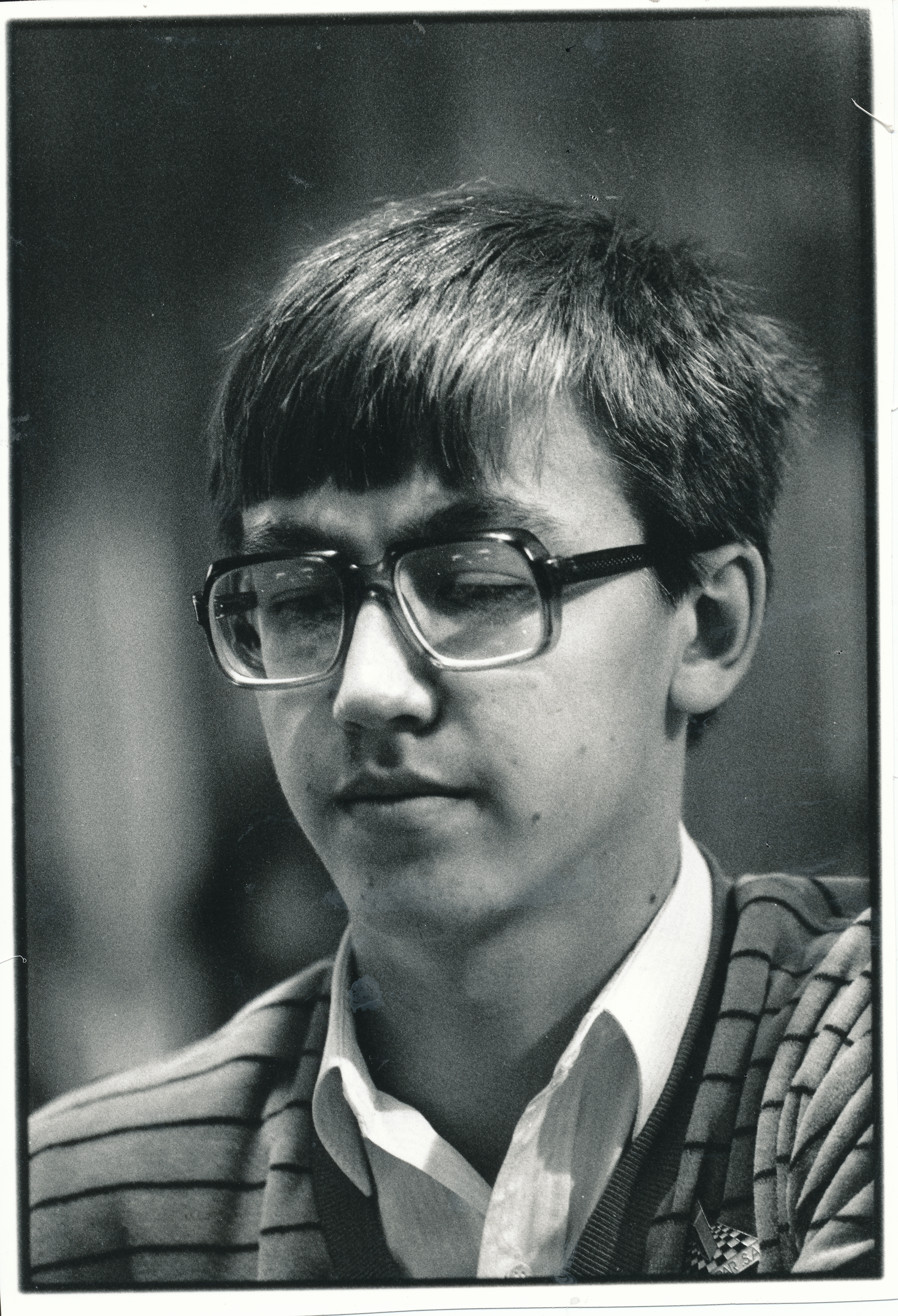
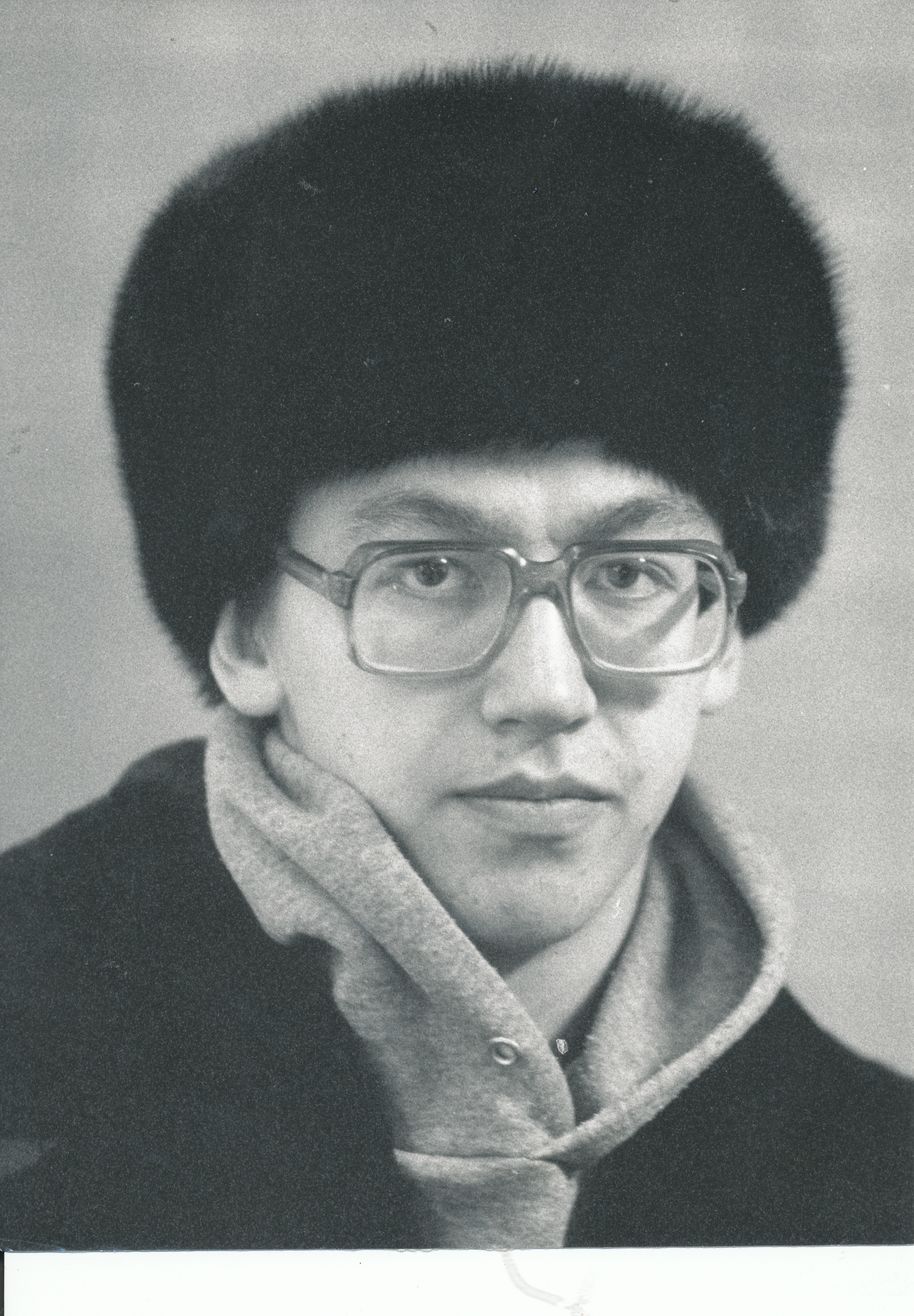
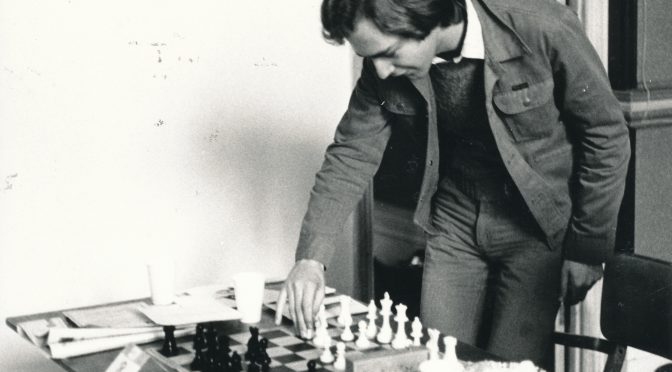
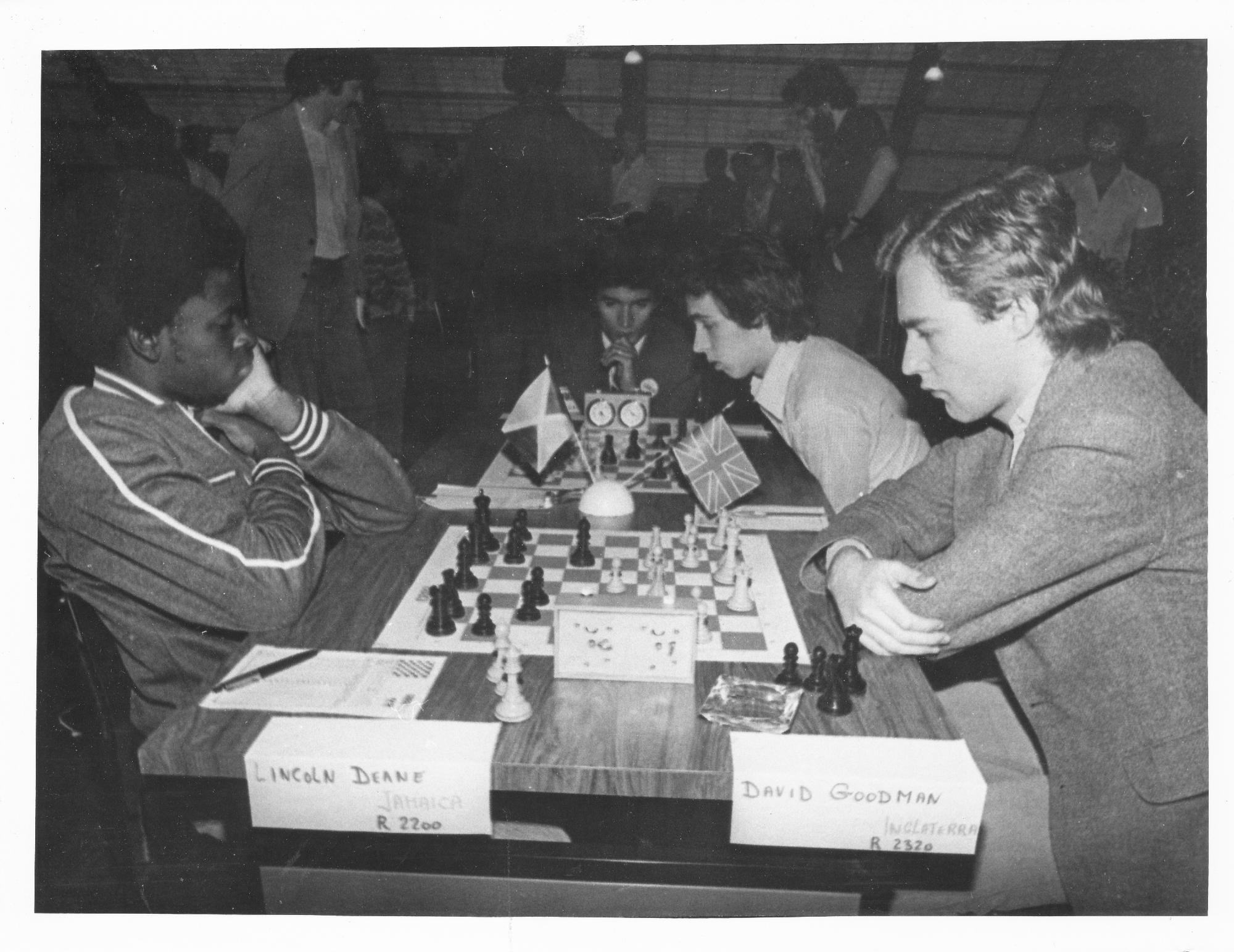
“David Simon Charles Goodman was awarded the IM title in 1983. He was World Under 18 Champion in 1975. He played #10 on the English national team in Moscow.
He currently resides in New York City where he is a chess trainer for promising young students.”
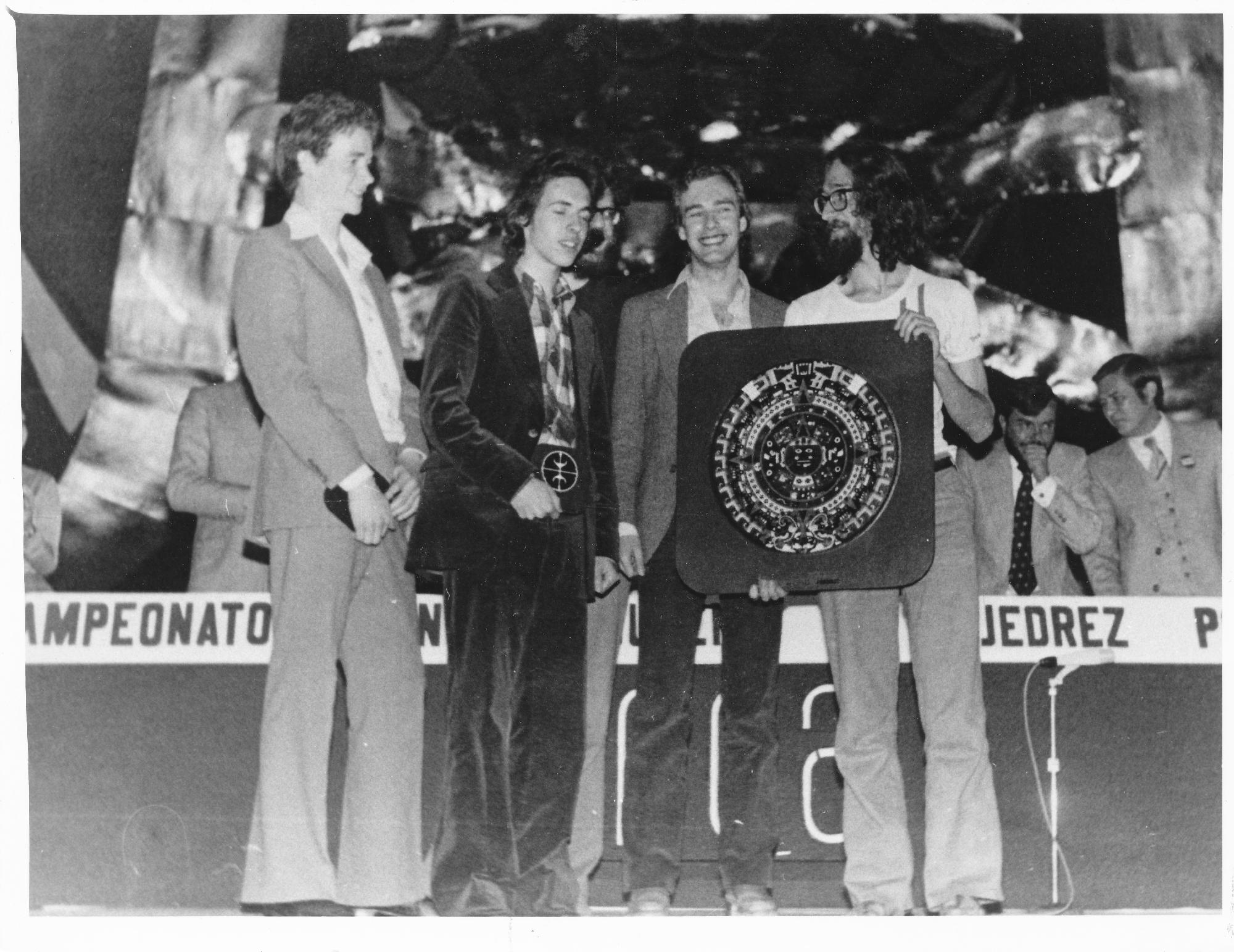
(from l-r) Jonathan Kinlay, Shaun Taulbut, Jonathan Speelman, David Goodman and Jonathan Mestel accepting 1st prize at the 1978 World U26 Student Olympiad in Mexico CityShaun Taulbut (upper right) and David Goodman (lower right) from the 1978 U26 Olympiad
“David Simon Charles Goodman was awarded the IM title in 1983. He was World Under 18 Champion in 1975. He played #10 on the English national team in Moscow.
He currently resides in New York City where he is a chess trainer for promising young students.”
(from l-r) Jonathan Kinlay, Shaun Taulbut, Jonathan Speelman, David Goodman and Jonathan Mestel accepting 1st prize at the 1978 World U26 Student Olympiad in Mexico CityShaun Taulbut (upper right) and David Goodman (lower right) from the 1978 U26 Olympiad
“David Simon Charles Goodman was awarded the IM title in 1983. He was World Under 18 Champion in 1975. He played #10 on the English national team in Moscow.
He currently resides in New York City where he is a chess trainer for promising young students.”
(from l-r) Jonathan Kinlay, Shaun Taulbut, Jonathan Speelman, David Goodman and Jonathan Mestel accepting 1st prize at the 1978 World U26 Student Olympiad in Mexico CityShaun Taulbut (upper right) and David Goodman (lower right) from the 1978 U26 Olympiad
“David Simon Charles Goodman was awarded the IM title in 1983. He was World Under 18 Champion in 1975. He played #10 on the English national team in Moscow.
He currently resides in New York City where he is a chess trainer for promising young students.”
(from l-r) Jonathan Kinlay, Shaun Taulbut, Jonathan Speelman, David Goodman and Jonathan Mestel accepting 1st prize at the 1978 World U26 Student Olympiad in Mexico CityShaun Taulbut (upper right) and David Goodman (lower right) from the 1978 U26 Olympiad
We focus on the British Chess Scene Past & Present!
This website uses cookies to improve your experience. We'll assume you're ok with this, but you can opt-out if you wish. Cookie settingsACCEPT
Privacy & Cookies Policy
Privacy Overview
This website uses cookies to improve your experience while you navigate through the website. Out of these cookies, the cookies that are categorized as necessary are stored on your browser as they are as essential for the working of basic functionalities of the website. We also use third-party cookies that help us analyze and understand how you use this website. These cookies will be stored in your browser only with your consent. You also have the option to opt-out of these cookies. But opting out of some of these cookies may have an effect on your browsing experience.
Necessary cookies are absolutely essential for the website to function properly. This category only includes cookies that ensures basic functionalities and security features of the website. These cookies do not store any personal information.