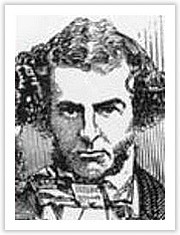
Remembering Marmaduke Wyvill (22-xii-1815 25-vi-1896)
Here is his Wikipedia entry
Here is an excellent article from the superb Yorkshire Chess History web site.
Interesting article from The Northern Echo
From The Oxford Companion to Chess by Hooper & Whyld :
He was winner of second prize in the first international tournament, London 1851. He developed his chess skill in the 1840s, meeting Dubois in Rome, Kieseritzky in Paris, and many players, including Buckle, in London, His style was that of the English school, and he understood well the positional ideas of the English opening and the Sicilian Defence. In 1847 he was elected Member of Parliament for Richmond, Yorkshire, a seat he held until 1868 except for a break of two years. The London 1851 tournament consisted of a series of knock-out matches. After defeating Williams (+4-3) in the third round and losing to Anderssen ( + 2=1-4) in
the fourth and final round, Wyvill was placed second. His score against Anderssen was better than that made by other players (Kieseritzky
“1—2, Szen +2—4, Staunton +1—4), Wyvill had
proved himself one of the leading players of his time. Although he played in no more tournaments he retained an interest in the game throughout his
life.
From The Encyclopedia of Chess by Harry Golombek :
Regarded by Staunton as “one of the finest players in England”. Wyvill was primarily an enthusiastic amateur of chess, yet in his sole tournament appearance at London 1851 he took second prize behind Anderssen, but ahead of Williams, Staunton, Horwitz, Szen, etc.
In the course of this event Wyvill defeated Lowe by +2-0, Kennedy by +4-3=1 and Williams by +4-3. In the final he succumbed to Anderssen by the honourable score of +2-4=1. At the time of the tournament Wyvill was Member of Parliament for Richmond, Yorkshire.
An adherent of the same playing style as Staunton and Williams, Wyvill possessed a fine appreciation of the English Opening and the Sicilian Defence, both of which he employed to deadly effect in the London tournament.
Long after he had retired from competitive play he retained a great interest in the game and his name appears as one of the members of the General Committee in the book of the London 1883 tournament, together with his contribution to the tournament funds of the sum of £100. £100 in 1883 would be worth £2,500 today.
Here is an example of the Wyvill pawn formation :
The Wyvill formation is a name given by Tarrasch to a pawn formation with doubled pawns as shown above. This formation was not unfamiliar to Wyvill but could with more justification have
been named after Winawer who so frequently doubled his opponent’s c-pawns that this and similar formations became known as his trademark. The technique for attacking the Wyvill formation was also understood by Neumann and before him by Carl Hamppe (1814-76), the leading
Viennese player of the 1850s.
 Save as PDF
Interesting that he proposed to Florence Nightingale When she was 20 years old. The offer was refused, but it is evidence of his discernment!