Cyrus Lakdawala is an IM and former US Open Champion who teaches chess and has written over 25 books on chess openings.
Writing a modern repertoire book on the Sveshnikov and keeping it below 500 pages is an achievement, but Cyrus Lakdawala has managed it.
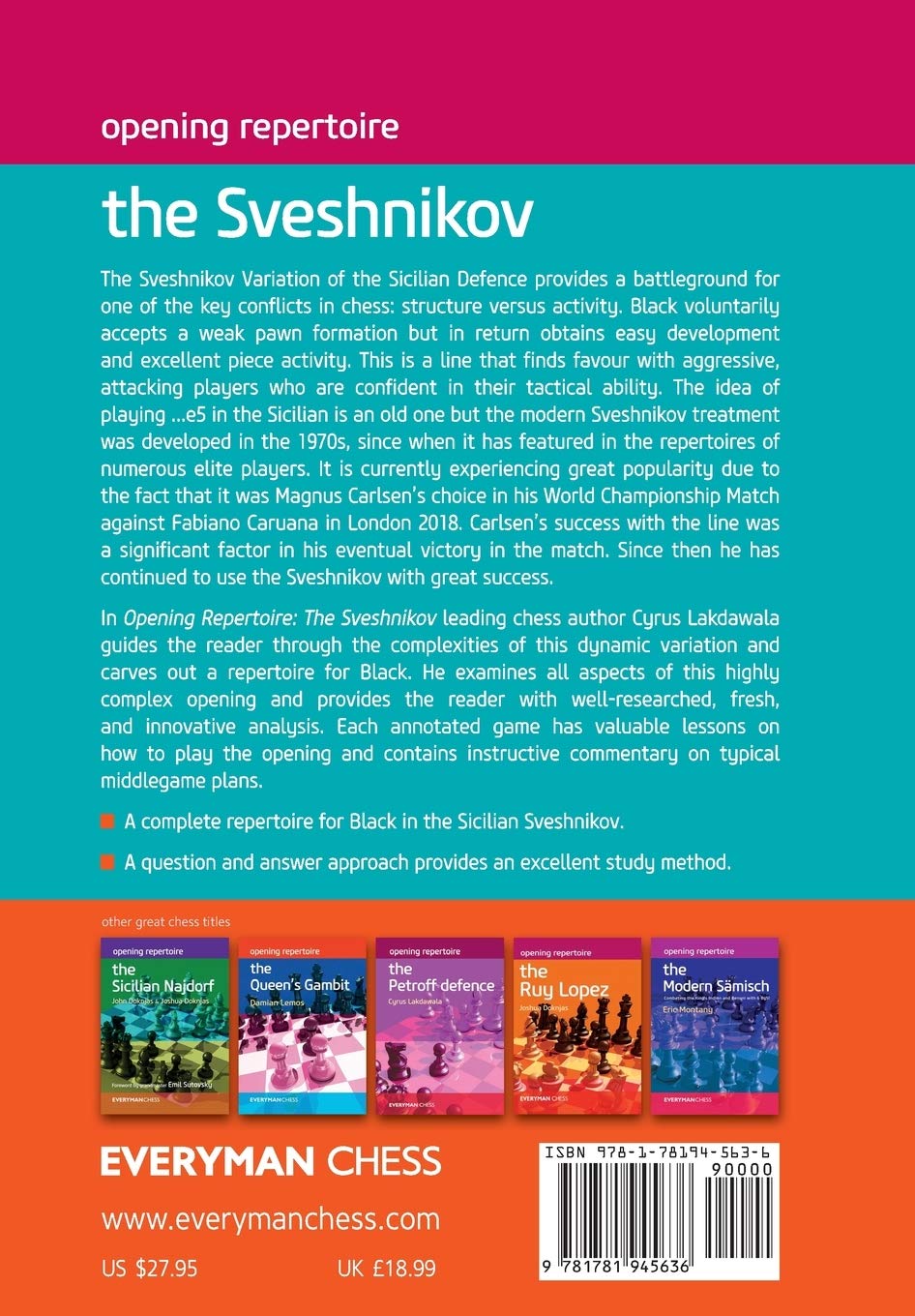
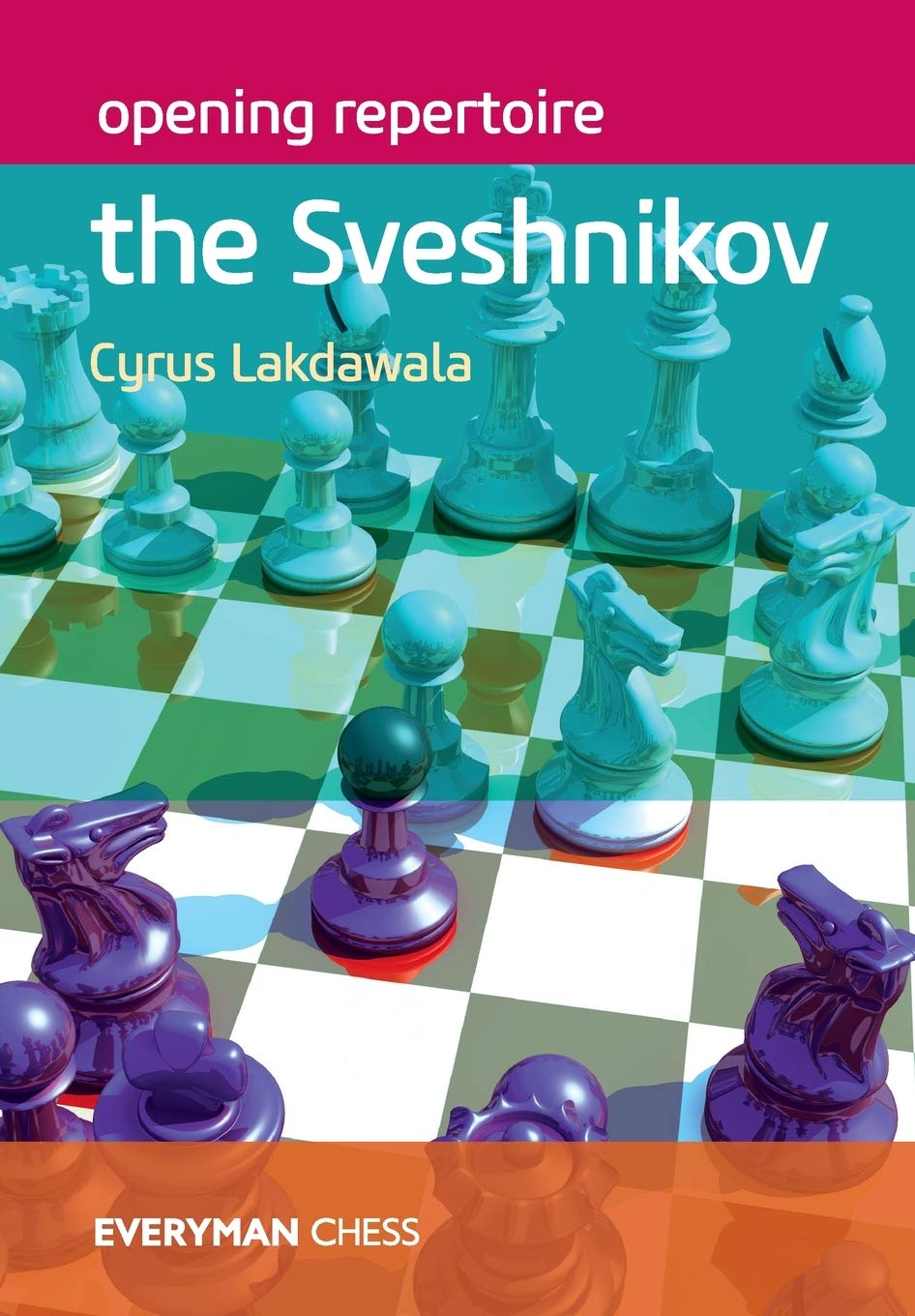
One of his latest books, Opening Repertoire – the Sveshnikov, is only 320 pages long, retailing at £18.99 in the UK and published by Everyman Chess (2020).
I say one of his latest books, as Cyrus regularly manages to write 3/4 books a year, all of good quality and they come thick and fast off the press. I can honestly say that I don’t know how he does it. His output is staggering and clearly the product of incredible self-discipline. As a fellow author, nowhere near his league, I salute him.
The Sveshnikov is a current Magnus Carlsen favourite and so if the book is any good at all, it should sell well.
[pgn]
[Event “Chessable Masters GpA”]
[Site “chess24.com INT”]
[Date “2020.06.20”]
[Round “2”]
[White “Harikrishna, Pentala”]
[Black “Carlsen, Magnus”]
[Result “0-1”]
[ECO “B33”]
[WhiteElo “2719”]
[BlackElo “2863”]
[Annotator “IM Andrew Martin”]
[PlyCount “170”]
[EventDate “2020.06.20”]
[EventType “tourn (rapid)”]
[EventRounds “10”]
[EventCountry “GER”]
[EventCategory “21”]
[SourceTitle “CB26_2020”]
[SourceDate “2020.05.05”]
[SourceVersion “1”]
[SourceVersionDate “2020.05.05”]
[SourceQuality “1”]
{[%evp 0,170,23,11,50,43,43,34,26,25,53,43,43,43,43,5,5,-22,25,13,-21,-10,2,
-27,4,4,16,23,30,4,4,8,12,0,15,16,37,32,26,22,21,26,51,51,52,27,42,10,4,12,0,0,
0,-4,0,25,6,9,12,12,12,6,31,13,30,25,22,19,1,0,43,-20,3,1,0,-62,-45,-39,-50,
-47,-26,-88,-107,-105,-103,-119,-115,-141,-120,-122,-72,-92,-82,-95,-85,-101,
-95,-95,-80,-86,-80,-80,-80,-80,-90,-100,-80,-90,-87,-100,-85,-95,-102,-102,
-80,-84,-80,-90,-64,-113,-103,-103,-101,-101,-101,-101,-83,-102,-101,-149,-105,
-120,-92,-93,-99,-101,-101,-101,-101,-101,-101,-101,-101,-101,-111,-129,-135,
-136,-125,-125,-125,-126,-133,-133,-133,-139,-133,-178,-162,-162,-168,-170,
-166,-172,-158,-170,-167,-173,-215,-212,-212,-929,-972]} 1. e4 c5 2. Nf3
Nc6 3. d4 cxd4 4. Nxd4 Nf6 5. Nc3 e5 6. Ndb5 d6 7. Bg5 a6 8. Na3 b5 9. Nd5 Be7
10. Bxf6 Bxf6 11. c4 b4 12. Nc2 a5 13. g3 g6 14. Nxf6+ Qxf6 15. Bg2 O-O 16. O-O
Bb7 17. Qd2 Nb8 18. Rfd1 Ra6 19. Qe3 Nd7 20. a3 Rb6 21. axb4 axb4 22. Ra4 b3
23. Ne1 Nc5 24. Ra3 Ra6 25. Rxa6 Bxa6 26. Bf1 Rc8 {[#] The position is
objectively equal. Carlsen typically settles in for a long grind.} 27. Nf3 Bb7
28. Nd2 Bc6 29. Ra1 Rb8 30. Ra3 Ba4 31. h4 h5 $2 (31… Qe7 $11) 32. Be2 $2 (
32. Rxa4 Nxa4 33. Qa7 {would have given White a substantial advantage.}) 32…
Kg7 33. Nb1 Qd8 34. Nd2 Ra8 35. Kh2 Ne6 36. Nf3 Bc6 37. Rxa8 Qxa8 38. Qxb3 Bxe4
{Black is getting on top.} 39. Qe3 Bb7 40. c5 Nxc5 41. Nxe5 Qa1 42. Nf3 Qxb2
43. Ng5 Bd5 44. Bf3 Bxf3 45. Qxf3 Qf6 46. Qe3 Ne6 47. Nf3 Qf5 48. Kg2 Qd5 49.
Kg1 Kf6 50. Qc3+ Ke7 51. Qe3 Qc5 52. Qd3 Qc1+ 53. Kg2 Qc6 54. Kg1 Nc5 55. Qe3+
Qe4 56. Qc3 Ne6 57. Qa3 Ke8 58. Kg2 g5 59. Kg1 g4 60. Ng5 Nxg5 61. hxg5 Qe1+
62. Kg2 Qe5 63. Qa8+ Ke7 64. Qg8 Qe4+ 65. Kg1 Qg6 66. Qc8 Qb1+ 67. Kh2 Qb6 68.
Kg2 Qc5 69. Qg8 Qf5 70. Qb8 Qe4+ 71. Kg1 d5 72. Qc7+ Kf8 73. Qd8+ Kg7 74. Qf6+
Kg8 75. Qd8+ Kh7 76. Qf6 Qg6 77. Qf4 Qe6 78. Qd4 Kg6 79. Kf1 Kxg5 80. Qg7+ Kf5
81. Qh8 Ke4 82. Qxh5 Kd3 83. Qh7+ Qe4 84. Qh6 Kc2 85. Qc6+ Qc4+ 0-1
[/pgn]
One of my first ports of call was to check out what Cyrus recommended against 7 Nd5, which featured in the Carlsen-Caruana World Championship match.
[pgn]
[Event “Moscow op-A 16th”]
[Site “Moscow”]
[Date “2020.01.30”]
[Round “6”]
[White “Pridorozhni, Aleksei”]
[Black “Tekeyev, Zaur”]
[Result “1-0”]
[ECO “B33”]
[WhiteElo “2601”]
[BlackElo “2384”]
[Annotator “IM Andrew Martin”]
[PlyCount “55”]
[EventDate “2020.01.25”]
[EventType “swiss”]
[EventRounds “9”]
[EventCountry “RUS”]
[SourceTitle “CB07_2020”]
[SourceDate “2020.02.12”]
[SourceVersion “1”]
[SourceVersionDate “2020.02.12”]
[SourceQuality “1”]
{[%evp 0,55,19,21,72,49,51,34,13,24,24,14,24,24,24,24,24,24,24,24,56,33,33,33,
43,32,24,24,24,24,105,95,128,143,137,80,81,80,108,74,111,89,96,101,111,102,243,
243,249,142,652,675,740,501,501,501,501,501]} 1. e4 c5 2. Nc3 Nc6 3. Nge2 Nf6 4.
d4 cxd4 5. Nxd4 e5 6. Ndb5 d6 7. Nd5 Nxd5 8. exd5 Ne7 {[#] Carlsen has
recently preferred this to 8…Nb8, but there are some critical lines, one of
which we see in this game.} (8… Nb8) 9. c4 Ng6 10. Qa4 Bd7 11. Qb4 Bf5 12.
Be3 Be7 13. Nxa7 O-O 14. Nb5 $1 {Tweaking the move order.} (14. Be2 Nf4 15.
Bxf4 exf4 16. Nb5 Bf6 17. O-O Be5 {is given in the book , after which Black
has compensation thanks to his dark-squared control.}) 14… e4 ({After} 14…
Nf4 15. Qd2 {I am not sure Black has full value for a pawn.}) 15. Be2 Nh4 16.
O-O Qd7 17. f4 exf3 18. Bxf3 Rfe8 19. Qd2 Bg6 20. b3 Bf6 21. Bd4 Nxf3+ 22. Rxf3
Bh4 23. Bxg7 Be4 24. Bc3 Qg4 25. Rf4 Qg5 26. Bf6 Qxf6 27. Rxf6 Bxf6 28. Rf1 1-0
[/pgn]
The problem with repertoire books is that they can become outdated very quickly under the gaze of the silicon genius. Having said that, the chapter on
7 Nd5 is very well written ,with a wealth of interesting suggestions.
I guess the biggest challenge that the Sveshnikov presents is the vast amount of theory that has accumulated. You have to know a lot to begin with and work very hard to keep up to date. This is not everyone’s cup of tea. For me, the Sveshnikov is great for strong players, but I am not so sure about club players. Some of the main line positions are very complex and tactical, where Black is relying on accurate move sequences to see him through. Having said that, when you do get this
opening right as Black, I imagine it can be very satisfying.
[pgn]
[Event “PNWCC Online blitz JP 10th”]
[Site “chess.com INT”]
[Date “2020.05.16”]
[Round “3”]
[White “Pichot, Alan”]
[Black “Gelfand, Boris”]
[Result “0-1”]
[ECO “B33”]
[WhiteElo “2630”]
[BlackElo “2676”]
[Annotator “IM Andrew Martin”]
[PlyCount “74”]
[EventDate “2020.05.16”]
[EventType “swiss (blitz)”]
[EventRounds “11”]
[EventCountry “USA”]
[SourceTitle “CB21_2020”]
[SourceDate “2020.05.20”]
[SourceVersion “1”]
[SourceVersionDate “2020.05.20”]
[SourceQuality “1”]
{[%evp 0,74,19,31,72,53,33,26,28,24,24,24,24,24,24,-5,-5,-5,-5,-5,-5,-5,9,-24,
-23,-23,-2,10,-9,-40,-43,-10,-12,-14,2,-6,37,37,42,33,37,17,13,5,22,9,-8,-47,
-40,-59,-35,-131,-27,-114,-50,-42,10,-39,-26,-81,-92,-71,-91,-83,-89,-89,-89,
-88,-109,-93,-83,-88,-83,-88,-94,-104,-106]} 1. e4 c5 2. Nf3
Nc6 3. d4 cxd4 4. Nxd4 Nf6 5. Nc3 e5 6. Ndb5 d6 7. Bg5 a6 8. Na3 b5 9. Bxf6
gxf6 10. Nd5 f5 11. g3 $5 {[#] Another pesky sideline to learn.} fxe4 12. Bg2
Bg7 13. Bxe4 Be6 14. O-O Rc8 15. c3 O-O 16. Nc2 f5 17. Bg2 Kh8 18. a4 bxa4 19.
Rxa4 a5 20. Rh4 Ne7 21. Nxe7 Qxe7 22. Ne3 Rb8 23. b4 axb4 24. cxb4 e4 25. Bh3
Be5 26. Qh5 Qf7 27. Qxf7 Rxf7 28. Rh6 Bd7 29. Nc4 Kg7 30. Nxe5 dxe5 31. Rd6
Rxb4 32. Rfd1 Bb5 33. Rb6 Be2 34. Rxb4 Bxd1 35. Rb5 Kf6 36. Rb6+ Kg7 37. Re6
Bf3 0-1[/pgn]
I enjoyed Lakdawala’s book and I think you will too. You will need time and energy to absorb it properly. There are extra chapters on the Anti-Sveshnikov, 3 Nc3 and an opening line Lakdawala calls ‘ the Mamba’, where Black substitutes 6…Bc5!? for 6 …d6.
[pgn]
[Event “Wch Seniors 65 27th”]
[Site “Acqui Terme”]
[Date “2017.11.14”]
[Round “7”]
[White “Gruzmann, Boris”]
[Black “Sveshnikov, Evgeny”]
[Result “0-1”]
[ECO “B33”]
[WhiteElo “2218”]
[BlackElo “2480”]
[Annotator “IM Andrew Martin”]
[PlyCount “98”]
[EventDate “2017.11.07”]
[EventType “swiss”]
[EventRounds “11”]
[EventCountry “ITA”]
[SourceTitle “CBM 181 Extra”]
[Source “ChessBase”]
[SourceDate “2017.12.12”]
[SourceVersion “1”]
[SourceVersionDate “2017.12.12”]
[SourceQuality “1”]
{[%evp 0,98,23,33,48,45,52,19,20,19,21,21,24,24,24,-7,-7,3,-4,-6,-5,-5,-6,-2,
13,9,13,10,15,10,18,25,34,18,23,22,16,19,13,3,12,7,16,17,16,2,12,7,-6,4,5,14,
-8,-10,0,0,0,0,0,0,0,-10,0,0,0,0,0,0,0,0,0,0,0,0,0,0,0,0,0,-30,-30,-37,-41,-41,
-41,-41,-41,-112,-68,-72,-79,-74,-75,-102,-88,-75,-97,-97,-79,-239,-239]} {
For the time being, let’s leave the last word to the Grandmaster from
a different era, whose phenomenal contribution to this opening came from blood,
toil,tears and sweat and not from the pressing of buttons.} 1. e4 c5 2. Nf3 Nc6
3. d4 cxd4 4. Nxd4 Nf6 5. Nc3 e5 6. Ndb5 d6 7. Bg5 a6 8. Na3 b5 9. Nd5 Be7 10.
Bxf6 Bxf6 11. c4 b4 12. Nc2 a5 13. g3 O-O 14. Bg2 Be6 15. O-O Rc8 16. b3 Bxd5
17. Qxd5 Nd4 18. Nxd4 exd4 19. Qh5 Qb6 20. Rad1 g6 21. Qe2 Bg7 22. Rd3 Rce8 23.
g4 f5 24. gxf5 Rxf5 25. Qg4 Rh5 26. f4 Qd8 27. Rh3 Rxh3 28. Qxh3 Kh8 29. Qg3
Qf6 30. Qg5 Qxg5 31. fxg5 Re5 32. h4 Re7 33. Kf2 Be5 34. Ke2 Bg3 35. Kf3 Be5
36. Ke2 Kg7 37. Rf3 h5 38. gxh6+ Kxh6 39. Rh3 Ra7 40. Bf3 a4 {[#] Deep in the
endgame, the veteran GM starts to show his class.} 41. Bg4 axb3 42. axb3 Ra1
43. h5 g5 44. Bf5 Rg1 45. Kf2 Rc1 46. Rf3 Rh1 47. Rh3 Rxh3 48. Bxh3 Kxh5 49.
Bf1 (49. Kf3 Kh4 50. Be6 d3 51. Ke3 Kg3 52. Kxd3 Kf3 {should win:} 53. c5 dxc5
54. Kc4 Bg7 $1 55. Kxc5 Bf8+ 56. Kd5 g4 57. e5 g3) 49… Kg4 0-1
[/pgn]
I rate this book excellent, 4.5/5 stars.

Andrew Martin, Bramley, Surrey, 5th August, 2020

Book Details :
- Paperback : 322 pages
- Publisher:Everyman Chess (1 Mar. 2020)
- Language:English
- ISBN-10:1781945632
- ISBN-13:978-1781945636
- Product Dimensions: 17.3 x 1.8 x 24.2 cm
The book is available as a physical book and as a Kindle version.
Official web site of Everyman Chess