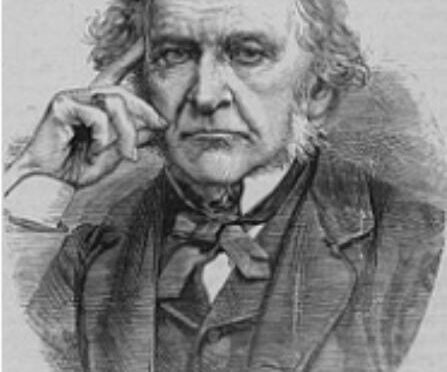
Remembering William Lewis (09-x-1787 22-viii-1870)

William Lewis
William Lewis

We note the passing today (August 22nd) in 1870 of William Lewis of the Lewis Counter Gambit.
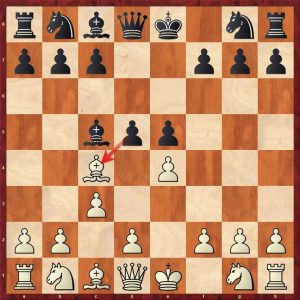
The Lewis Counter Gambit

From The Oxford Companion to Chess (OUP, 1984) by Hooper & Whyld :

“English player and author. He left his native Birmingham as a young man and worked for a time with a merchant in London. He learned much of his chess from Sarratt, a debt that was not repaid.

Around 1819 he was operator of the Turk, meeting all-comers successfully. With Cochrane he visited Paris in 1821, received odds of pawn and move from Deschapelles, and defeated him in a short match (+ 1=2), Lewis had already begun to write and of the more useful books he published around this time were translations of Greco and Carrera which appeared in 1819 and 1822 respectively.

Although he considered Sarratt’s A Treatise on the Game of Chess (1808) a poorly written book, Lewis published a second edition in 1822 in direct competition with Sarratt’s last book, published in 1821 by his impoverished widow, (In 1843 many Englishmen contributed to a fund for Mrs Sarratt in her old age, Lewis’s name is not on the subscription list,}
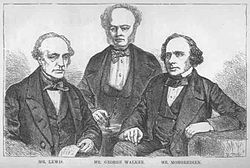
William Lewis, George Walker and Augustus Mongredien

In 1825 Bourdonnais visited England. Lewis recalled that they played about 70 games, and according to Walker seven of them constituted a match which Lewis lost (+2—5). With no significant playing achievements to his credit Lewis acquired such a high reputation that a correspondent writing to the weekly magazine Bell’s Life in 1838 was moved to call him grandmaster.

From 1825 he preserved this reputation by the simplest means: he declined to play on even terms. In the same year he opened a club where he gave lessons at half a guinea each. McDonnell and Walker were among his pupils. Speculating unwisely on a piano-making patent, Lewis went bankrupt in 1827, and the club closed. After three precarious years of teaching chess (rich patrons were becoming fewer) Lewis became actuary of the Family Endowment Society and enjoyed financial security
for the rest of his life.
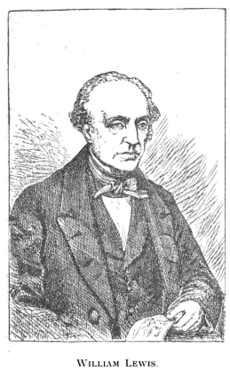
William Lewis
William Lewis

Circumstances now made it possible for him to concentrate on his writing and he published his two most important works: Series of Progressive Lessons (1831) and Second Series of Lessons (1832), both republished with various revisions. Lewis continued to write but gradually withdrew from other chess activities; his last notable connection with chess was as stakeholder for the Morphy-Lowenthal match of 1858.
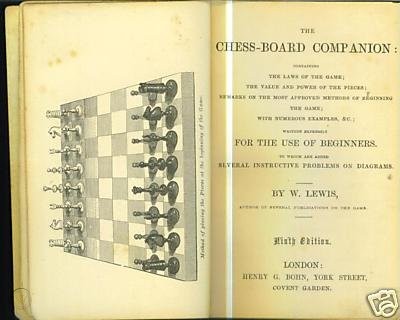
Chess Board Companion by William Lewis

Lewis’s Lessons contain extensive analyses of many opening variations, examined in the closeness of his study. Subsequent writers, notably Lasa, were influenced by these books, but more on account of the form than the content, which, adequate for the 1830s, were soon out of date.

Around 1840 writers no longer worked in isolation (a circumstance Lewis found unavoidable) and new positional ideas were being shaped. Because Lewis failed to assimilate these his judgements were faulty, and his voluminous Treatise on the Game of Chess (1844) was out of date when published.

Industrious rather than inventive, he made only one innovation, the Lewis Counter-Gambit; but it had no practical value in 1844, for simpler defences had already been discovered. Lewis’s work commands respect, but he is more aptly described as the last and one of the best of the ‘old’ writers than the first of the new, a more fitting description for Jaenisch and the authors of Bilguer’s Handbuch. ”

[pgn]
[Event “Cafe de la Regence Casual Games”]
[Site “Paris”]
[Date “1821.??.??”]
[Round “?”]
[White “Lewis, William”]
[Black “Deschapelles, Alexandre”]
[Result “1-0”]
[Annotator “British Chess News”]
[SetUp “1”]
[FEN “rnbqkbnr/ppppp1pp/8/8/8/8/PPPPPPPP/RNBQKBNR w KQkq – 0 1”]
[PlyCount “53”]
[EventDate “1821.??.??”]
[EventType “game”]
[EventCountry “FRA”]
[SourceTitle “EXT 2015”]
[Source “ChessBase”]
[SourceDate “2014.11.20”]
[SourceVersion “1”]
[SourceVersionDate “2014.11.20”]
[SourceQuality “1”]

{[%csl Gf7][%evp 0,53,148,134,136,144,147,149,148,131,119,150,150,152,152,151,
151,165,82,78,113,123,106,106,106,120,116,98,65,65,65,23,133,91,91,70,65,32,
132,273,582,582,582,572,740,349,378,97,526,523,975,1046,1162,1187,1216,1327]
George Walker, Chess Studies Comprising One Thousand Games, London 1844, p. 78,
chapter 8, game 3 (421)} 1. e4 Nc6 2. d4 e5 3. d5 Nce7 4. Bg5 Nf6 5. Bxf6 gxf6
6. Qh5+ Ng6 7. Nf3 Qe7 8. d6 Qxd6 9. Nh4 Bg7 10. Nxg6 hxg6 11. Qxg6+ Kf8 12.
Bc4 Qe7 13. O-O Rh6 14. Qg3 c6 15. Nc3 d6 16. Rad1 f5 17. f4 d5 18. Bb3 dxe4 $2
19. Nxe4 $1 fxe4 $4 20. fxe5+ Ke8 21. Bf7+ Qxf7 22. Rxf7 Kxf7 23. Qb3+ $2 (23.
Qf4+ $18) 23… Ke7 24. Qg8 Bf8 25. Qg5+ Kf7 26. Rf1+ Ke8 27. Qg8 {and Black
resigned} 1-0
[/pgn]

From The Encyclopedia of Chess (Robert Hale, 1970 & 1976) by Anne Sunnucks :

Chess theoretician, teacher, author and one of the leading players in England in the nineteenth century.

William Lewis was born in Birmingham on 9th October 1787. As a young man he went to London and took chess lessons from JH Sarratt. Within a short time he was making chess his principal means of livelihood.

In 1819 he was engaged as the player concealed in the chess-playing automaton, ‘The Turk’, when it was exhibited in London. In 1825 he opened some chess rooms in St. Martin’s Lane in London, where he taught chess. Among his pupils was Alexander McDonnell. After going bankrupt in 1827, the chess rooms were closed, and Lewis decided to put his lessons into a book. He soon became a highly-successful writer, His Chessboard Companion published in 1838 ran into nine editions, and his Series of Progressive Lessons of the Game of Chess has been described as one of the landmarks in the history of the game. This book included some completely new analyses of various chess openings and later formed the basis of the Handbuch des Schachspiels. Lewis also translated the work of Greco and Stamma and was author of The Elements of Chess (1882), Fifty Games of Chess (1832) and Chess for Beginners (1835).
Chess Board Companion by William Lewis

Towards the end of his life, Lewis rarely played chess, and his last public appearance in chess circles was 12 before he died, when he acted at stake-holder in the match between Morphy and Lowenthal in 1858. He died on 22nd August 1870.

From The Encyclopedia of Chess (Batsford, 1977) by Harry Golombek :

“Author of The Chessboard Companion, London, 1838, and several other popular works on chess (including translations of Greco and Stamma). Lewis was also a leading chess teacher – his most famous pupil was Alexdander McDonnell – and for a time he ran chess rooms in St. Martin’s Lane. In 1819 he operated the chess-playing automaton ‘The Turk’ when it was exhibited in London. The Lewis Counter-Gambit is 1.P-K4, P-K4; 2.B-B4 B-B4; 3.P-QB3,P-Q5!?”
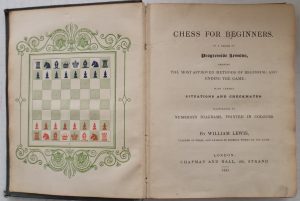
Chess for Beginners
Chess for Beginners

From “Chess : A History” by Harry Golombek there are two references to WL on pages 98 and 123 alluded to above.

Here is an interesting article from Chess.com

From Wikipedia :

“William Lewis (1787–1870) was an English chess player and author, nowadays best known for the Lewis Countergambit and for being the first player ever to be described as a Grandmaster of the game.

Born in Birmingham, William Lewis moved as a young man to London where he worked for a merchant for a short period. He became a student of chess player Jacob Sarratt, but in later years he showed himself to be rather ungrateful towards his teacher.

Although he considered Sarratt’s Treatise on the Game of Chess (1808) a “poorly written book”, in 1822 Lewis published a second edition of it three years after Sarratt’s death in direct competition with Sarratt’s own superior revision published posthumously in 1821 by Sarratt’s poverty-stricken widow. In 1843, many players contributed to a fund to help the old widow, but Lewis’ name is not on the list of subscribers.

Around 1819 Lewis was the hidden player inside the Turk (a famous automaton), meeting all-comers successfully. He suggested to Johann Maelzel that Peter Unger Williams, a fellow ex-student of Sarratt, should be the next person to operate inside the machine. When P. U. Williams played a game against the Turk, Lewis recognised the old friend from his style of play (the operator could not see his opponents) and convinced Maelzel to reveal to Williams the secret of the Turk. Later, P. U. Williams himself took Lewis’ place inside the machine.

Lewis visited Paris along with Scottish player John Cochrane in 1821, where they played with Alexandre Deschapelles, receiving the advantage of pawn and move. He won the short match (+1 =2).”

“Lewis’ career as an author began at this time, and included translations of the works of Greco and Carrera, published in 1819[5] and 1822[6] respectively.

He was the leading English player in the correspondence match between London and Edinburgh in 1824, won by the Scots (+2 = 2 -1). Later, he published a book on the match with analysis of the games. In the period of 1834–36 he was also part of the Committee of the Westminster Chess Club, who played and lost (−2) the match by correspondence with the Paris Chess Club. The other players were his students McDonnell and Walker, while the French line up included Boncourt, Alexandre, St. Amant and Chamouillet. When De La Bourdonnais visited England in 1825, Lewis played about 70 games with the French master. Seven of these games probably represented a match that Lewis lost (+2 -5).

Lewis enjoyed a considerable reputation as a chess player in his time. A correspondent writing to the weekly magazine Bell’s Life in 1838 called him “our past grandmaster”, the first known use of the term in chess.  Starting from 1825 he preserved his reputation by the same means that Deschapelles used in France, by refusing to play anyone on even terms. In the same year Lewis founded a Chess Club where he gave lessons to, amongst others, Walker and McDonnell. He was declared bankrupt in 1827 due to bad investments on a patent for the construction of pianos and his chess club was forced to close. The next three years were quite difficult until in 1830 he got a job that assured him of solid financial security for the rest of his life. Thanks to this job, he could focus on writing his two major works: Series of Progressive Lessons (1831) and Second Series of Progressive Lessons (1832). The first series of the Lessons were more elementary in character, and designed for the use of beginners; the second series, on the other hand, went deeply into all the known openings. Here, for the first time we find the Evans Gambit, which is named after its inventor, Capt. Evans.

The works of Lewis (together with his teacher Sarratt) were oriented towards the rethinking of the strictly Philidorian principles of play in favour of the Modenese school of Del Rio, Lolli and Ponziani.  When he realised that he could not give an advantage to the new generation of British players, Lewis withdrew gradually from active play (in the same way that Deschapelles did after his defeat against De La Bourdonnais).

After his retirement he wrote other chess treatises, but his isolation prevented him from assimilating the positional ideas of the new generation of chess-players. For this reason, Hooper and Whyld in their Oxford Chess Companion describe the last voluminous work of Lewis, A Treatise on Chess (1844), as already “out of date when published”.”

According to Edward Winter in Chess Notes Lewis lived at 12 Chatham Place, Blackfriars, London, England (Chess Player’s Chronicle, 1841, pages 9 and 34*)
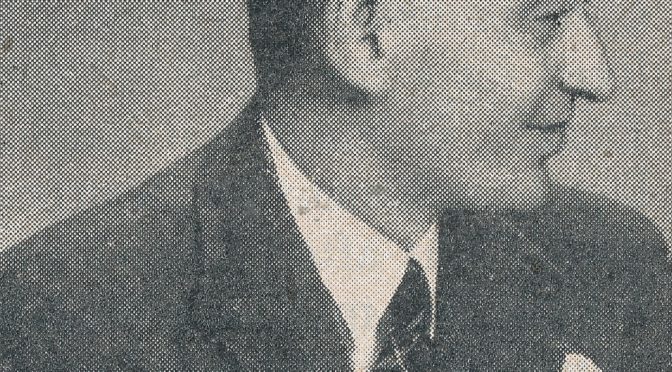
Remembering Ernst Klein (29-i-1910 22-viii-1990)
Ernst Ludwig Klein (29-i-1910 22-viii-1990)

Remembering Ernst Klein (29-i-1910 22-viii-1990)

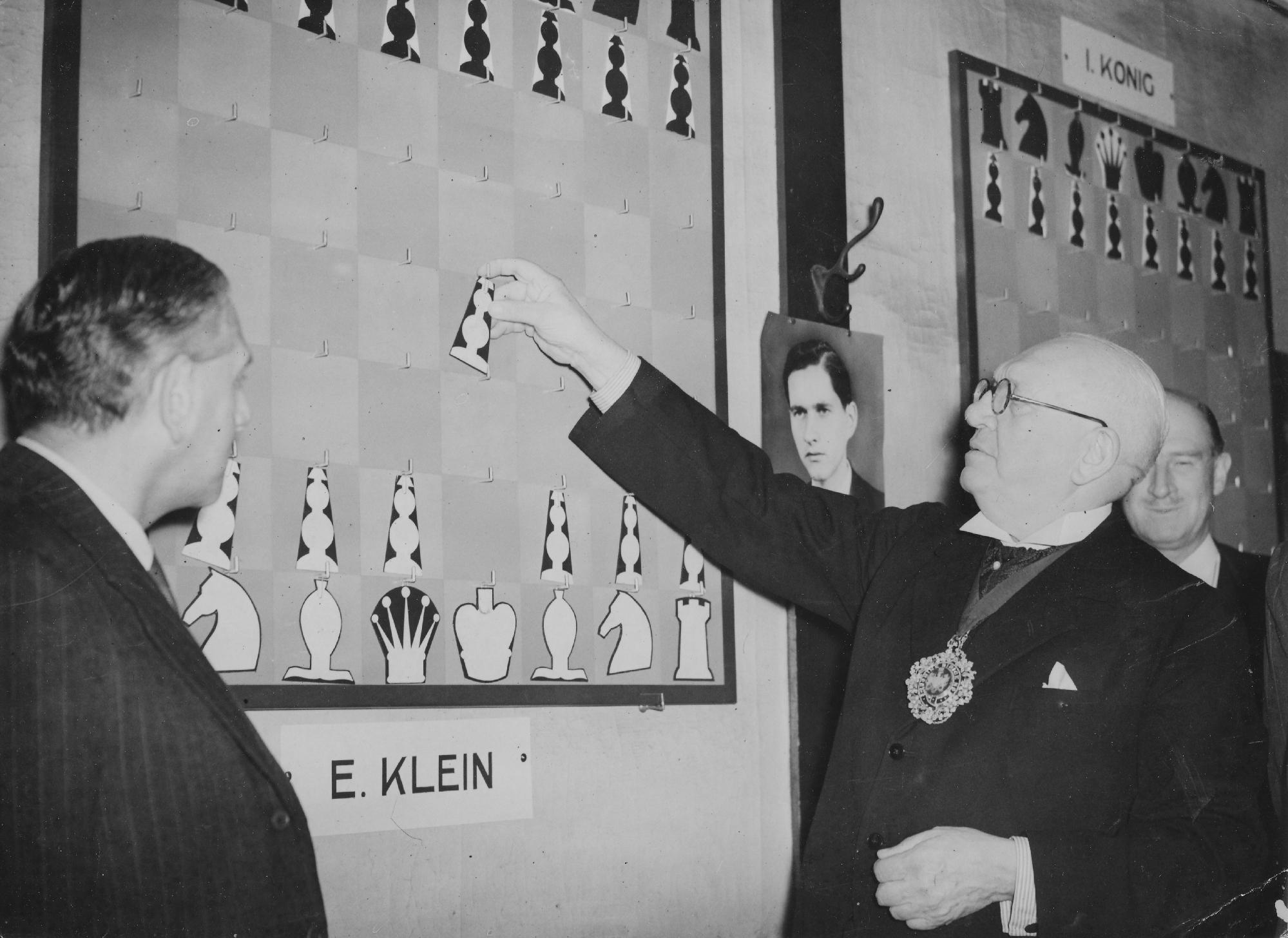
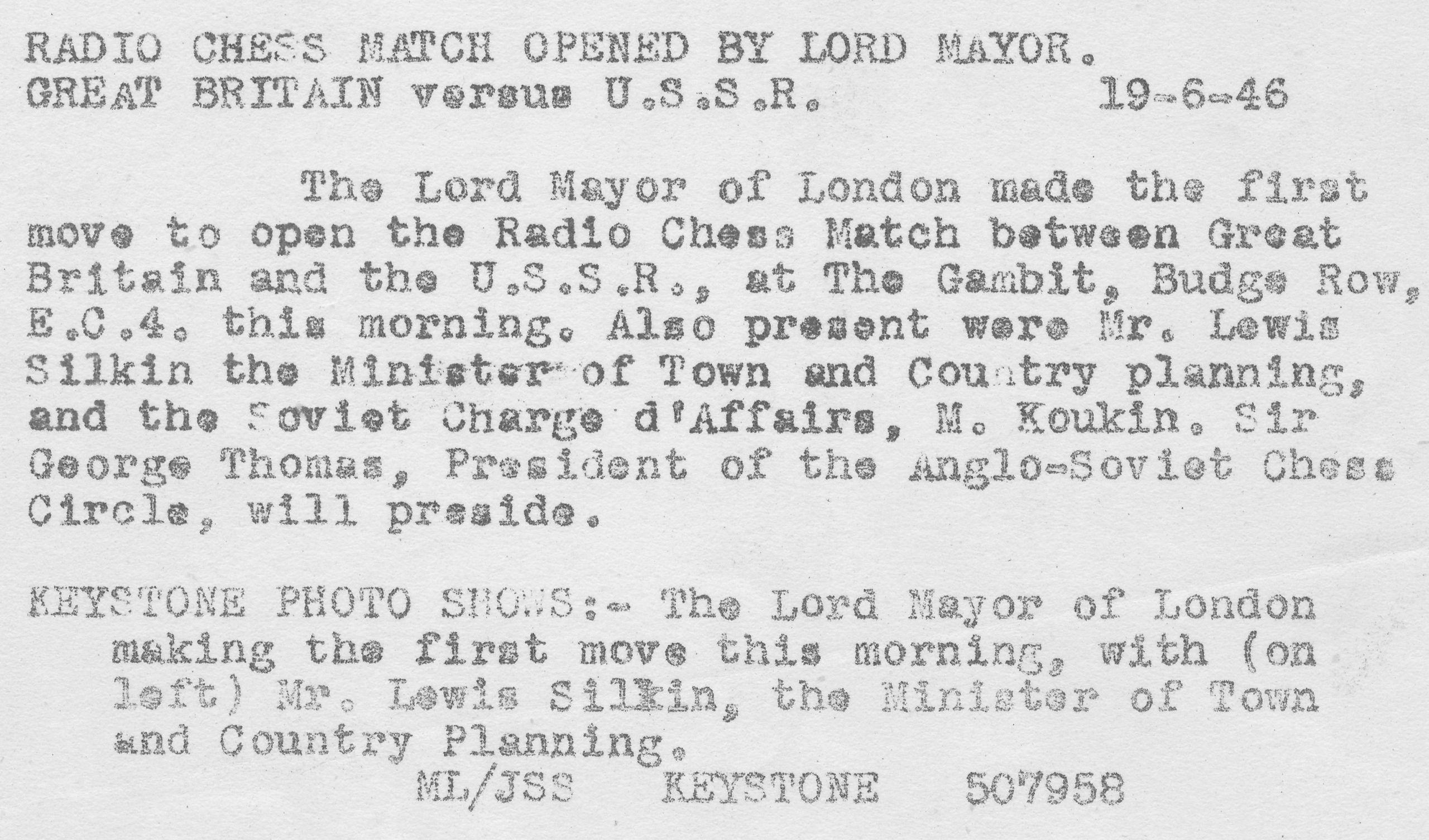
From CHESS, July 1946 (and also The Anglo-Soviet Radio Chess Match) :

Since Ernst Klein came to England in 1935 his play has earned our ungrudging admiration. Born in Vienna, 1910, he learned chess at the age of eleven. His grandmother taught him the moves, his father having died when he was eight. Steinitz was a frequent guest in his grandparents house. At eighteen, he shared first, second and third prizes in the Championship of Vienna. Before coming to England, he had lived for some years in Switzerland, France and Italy and his French, German and English are equally impeccable. In his last tournament at Bournemouth, in 1939, he finished equal with Flohr after Euwe ahead of König, Landau, Aitken and others. He met his wife, who is an Englishwoman, during the blitz. They were married in 1944. He holds a London University degree and teaches mathematics in Southend.

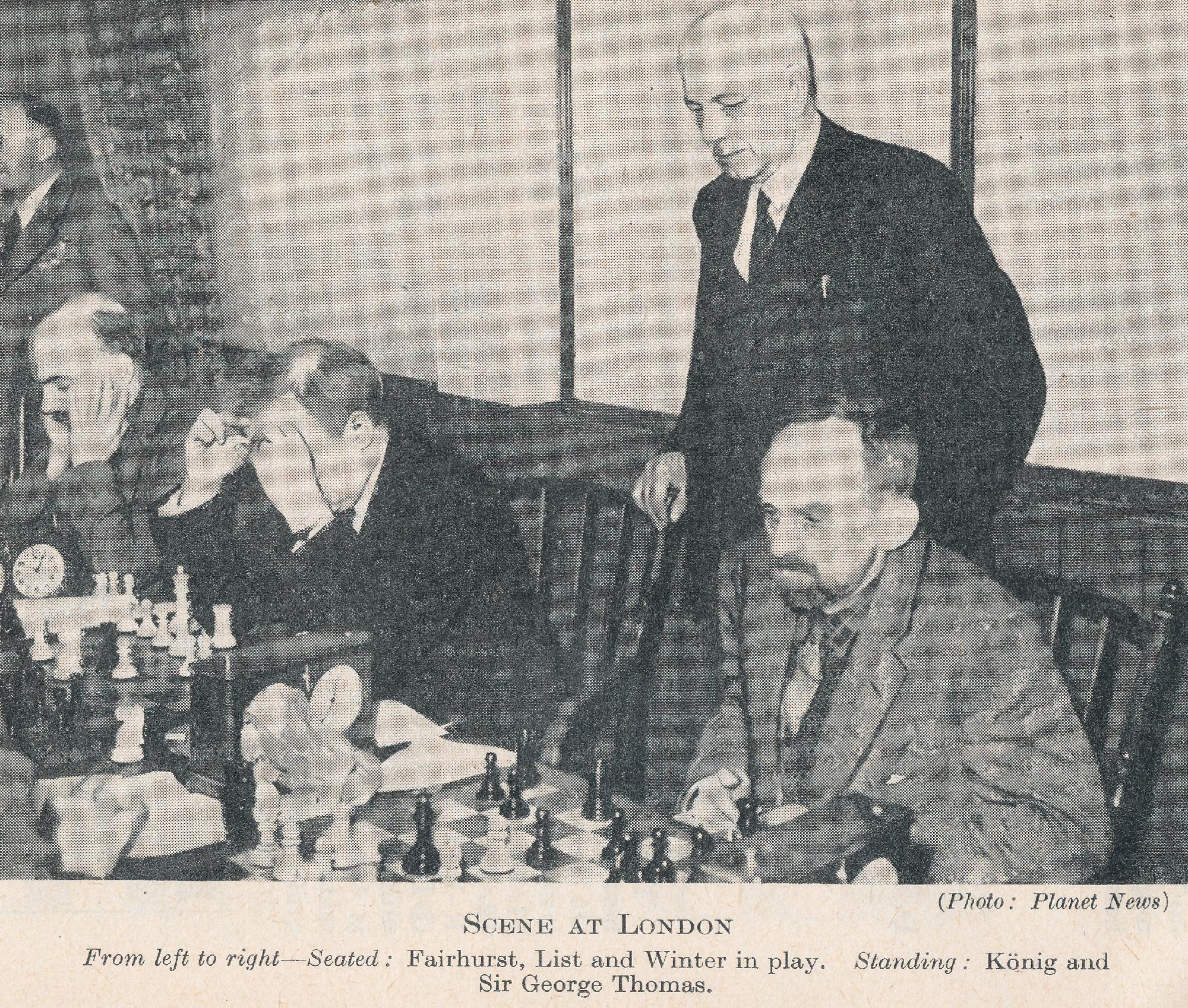
Scene at London. From left to right - Seated : Fairhurst, List and Winter in play. Standing König and Sir George Thomas
Scene at London. From left to right – Seated : Fairhurst, List and Winter in play. Standing König and Sir George Thomas

About 1940, he offered to give any opponent in Great Britain the odds of the draw.; his challenge was never taken up, no doubt owing to the conditions of the moment, but we imagine there would be many “takers” if it were repeated now.”

Later, Klein clarified matters by writing What I said was: “I am ready to accept the challenge of any player in this country and am prepared to give the odds of a draw in a contest at least twelve games if he so wishes. That is, I offered to concede victory on a score of 6 : 6 draws counting, which is the necessary and sufficient condition to justify my offer. It is still open.

See below photograph for caption
Caption for above photograph

[pgn]
[Event “London CC Invitation”]
[Site “London”]
[Date “1973.09.07”]
[Round “1”]
[White “Klein, Ernst Ludwig”]
[Black “Goodman, David SC”]
[Result “1-0”]
[ECO “A37”]
[Annotator “British Chess News”]
[PlyCount “57”]
[EventDate “1973.09.07”]
[EventType “swiss”]
[EventRounds “5”]
[EventCountry “ENG”]
[SourceTitle “EXT 2016”]
[Source “ChessBase”]
[SourceDate “2015.10.08”]
[SourceVersion “1”]
[SourceVersionDate “2015.10.08”]
[SourceQuality “1”]

{[%evp 0,57,14,14,71,36,36,40,18,11,7,6,24,36,23,8,27,16,17,5,-2,-3,21,4,31,0,
19,29,33,76,38,-1,43,59,65,53,76,79,98,90,259,335,467,503,503,277,272,218,211,
209,420,283,283,325,372,381,388,321,221,151]} 1. Nf3 g6 2. c4 Bg7 3. Nc3 c5 4.
g3 Nc6 5. Bg2 e6 6. O-O Nge7 7. e3 Nf5 {[#]} 8. Ne4 $146 ({Relevant:} 8. b3 O-O
9. Bb2 Rb8 10. Na4 Bxb2 11. Nxb2 Qf6 12. Na4 b6 13. Nc3 Rd8 14. g4 Ng7 15. Ne1
h5 16. gxh5 Nxh5 17. f4 Bb7 18. Ne4 Qe7 19. Ng3 Ng7 20. Qg4 d5 21. Nf3 dxc4 22.
Ng5 f6 23. Nf3 Qf7 24. Rf2 Nf5 25. bxc4 Kg7 26. Nxf5+ exf5 27. Qg3 Ne7 28. Nh4
Bxg2 29. Rxg2 Rh8 30. d3 Rh6 31. Kh1 Qe6 32. Re1 Rbh8 33. Nf3 Rh3 34. Qf2 Qd6
35. Qf1 Kf7 36. Qe2 Rd8 37. Rd1 Qe6 {Kholmov,R-Suetin,A Moscow 1970 0-1}) 8…
d6 9. d4 cxd4 10. Nxd4 Ncxd4 11. exd4 Nxd4 $6 12. Bg5 $1 Qb6 13. Nf6+ Kf8 14.
Qa4 Nc6 15. Ne4 (15. Rad1) 15… Be5 16. Rad1 Nd4 $2 (16… h6) 17. Rd2 (17. c5
$1) 17… Nf5 18. g4 Nd4 19. Be3 (19. c5 $1) 19… Bg7 20. Qa3 e5 21. Nxd6 Kg8
22. c5 Qc7 23. Bxd4 exd4 24. Bd5 Be5 25. f4 Bxd6 26. cxd6 Qd8 27. f5 Qg5 28.
Rg2 Bd7 29. Qb3 {and Black resigned.} 1-0
[/pgn]


Here is his Wikipedia entry

Edward Winter has written a detailed article here.

According to Edward Winter in Chess Notes Klein lived at 4 St George’s Drive, Westcliff-on-sea, Essex, England (The Times, 11 March 1978, page 13).

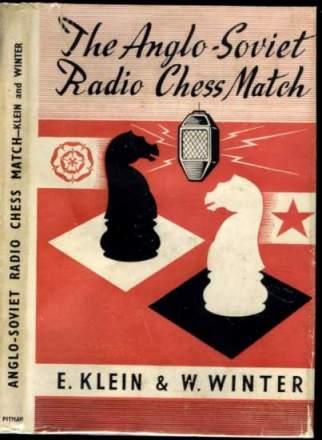
The Anglo-Soviet Radio Chess Match (1947, Pitman)

Happy Birthday WCM Dinah Norman (21-viii-1946)

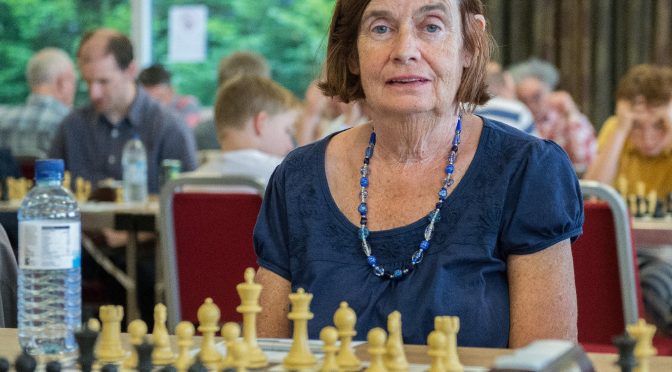
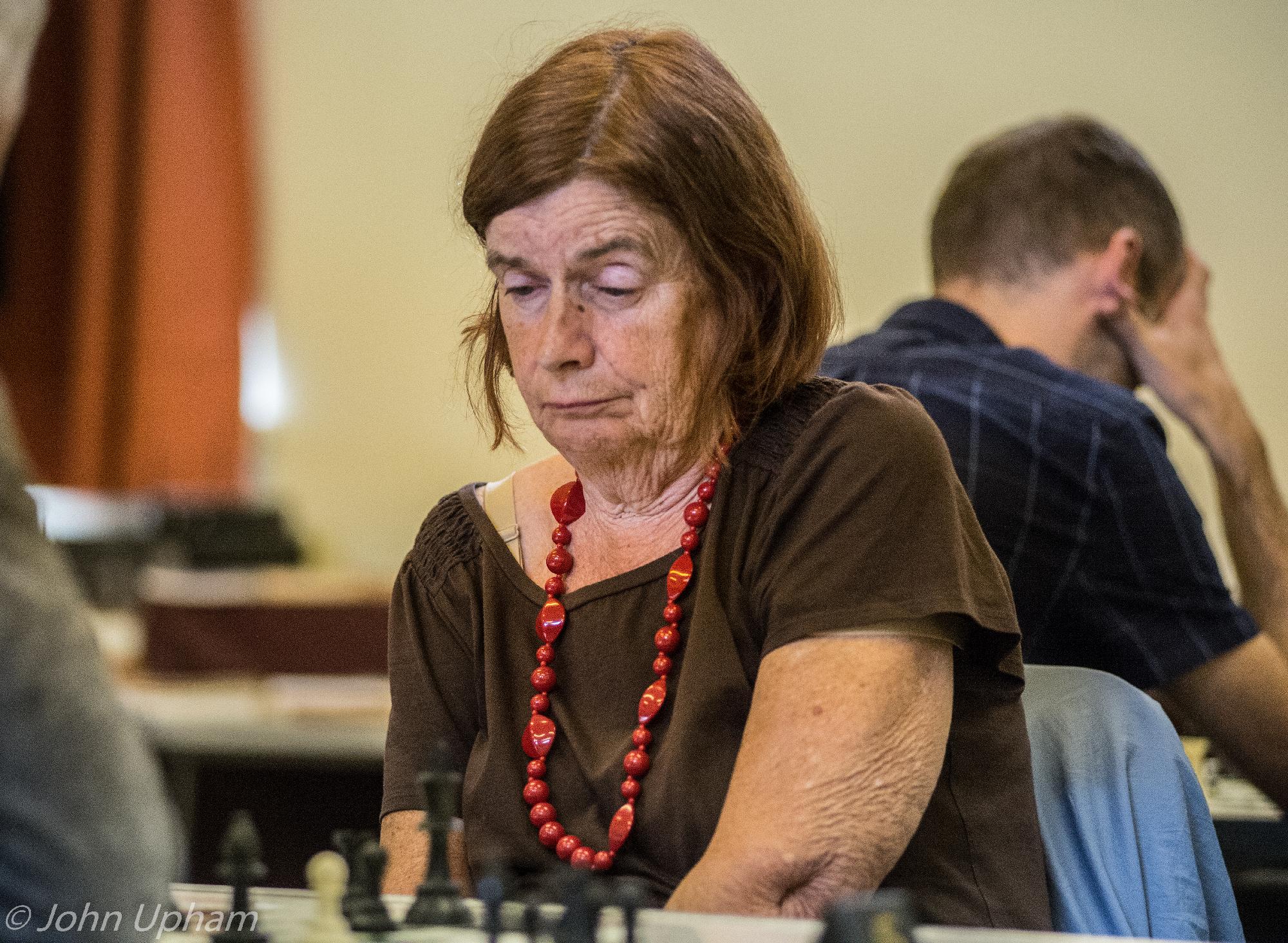
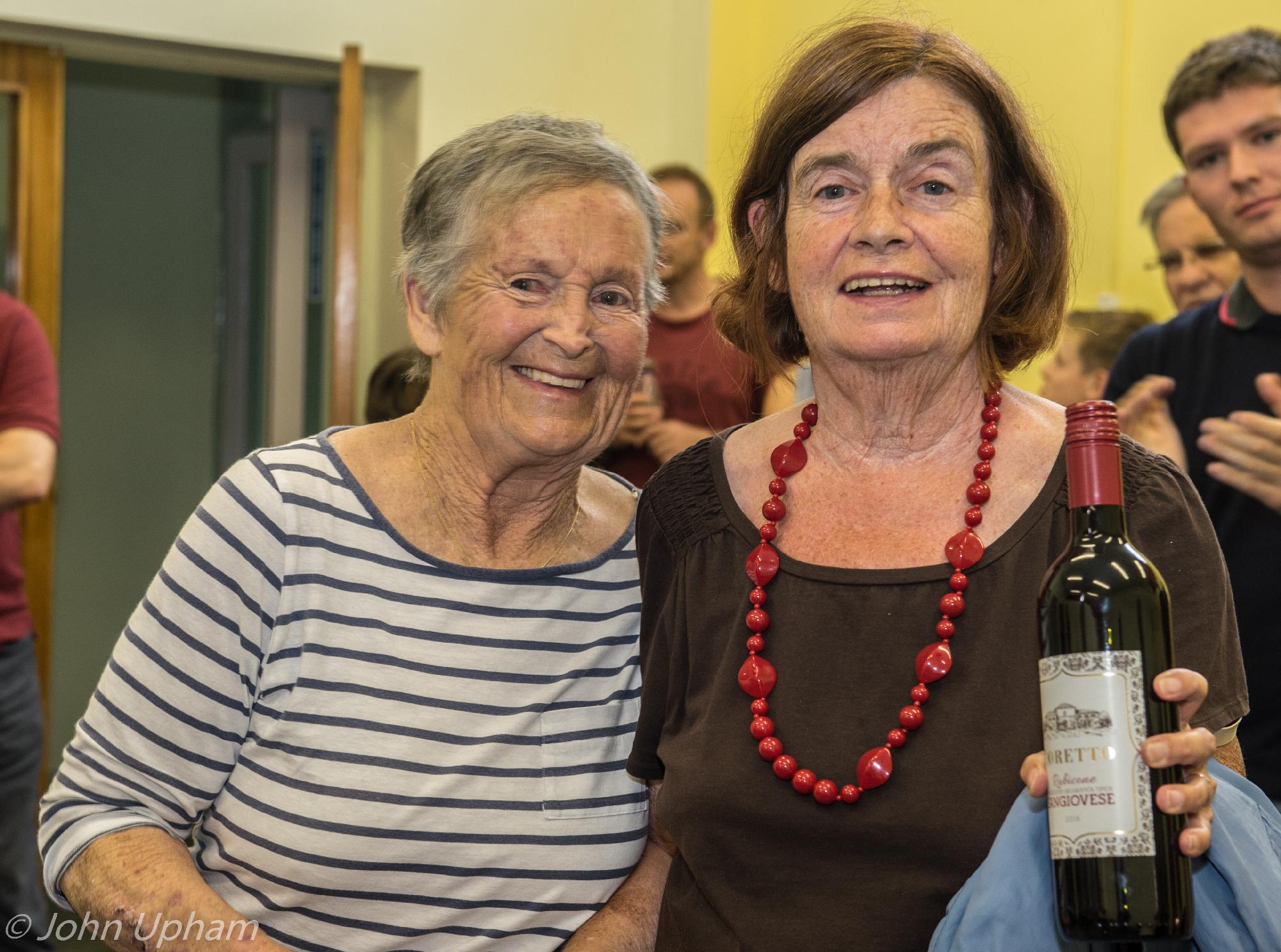
WCM Dinah Norman at the 2015 British Championships in Coventry, courtesy of John Upham Photography

BCN wishes Happy Birthday to Dinah Norman on August 21st

Dinah Margaret Dobson was born on Wednesday, August 21st 1946 in Exeter, Devon. Her parents were Leslie and Barbara Dobson (née Hayward).

She was taught to play Chess by her late father at the age of 9. Started playing seriously when she attended Rickmansworth Grammar School and Watford Chess Club. Her first tournament was the London Girls Championship which she won in 1962. Dinah was coached by Leonard Barden and Bob Wade.

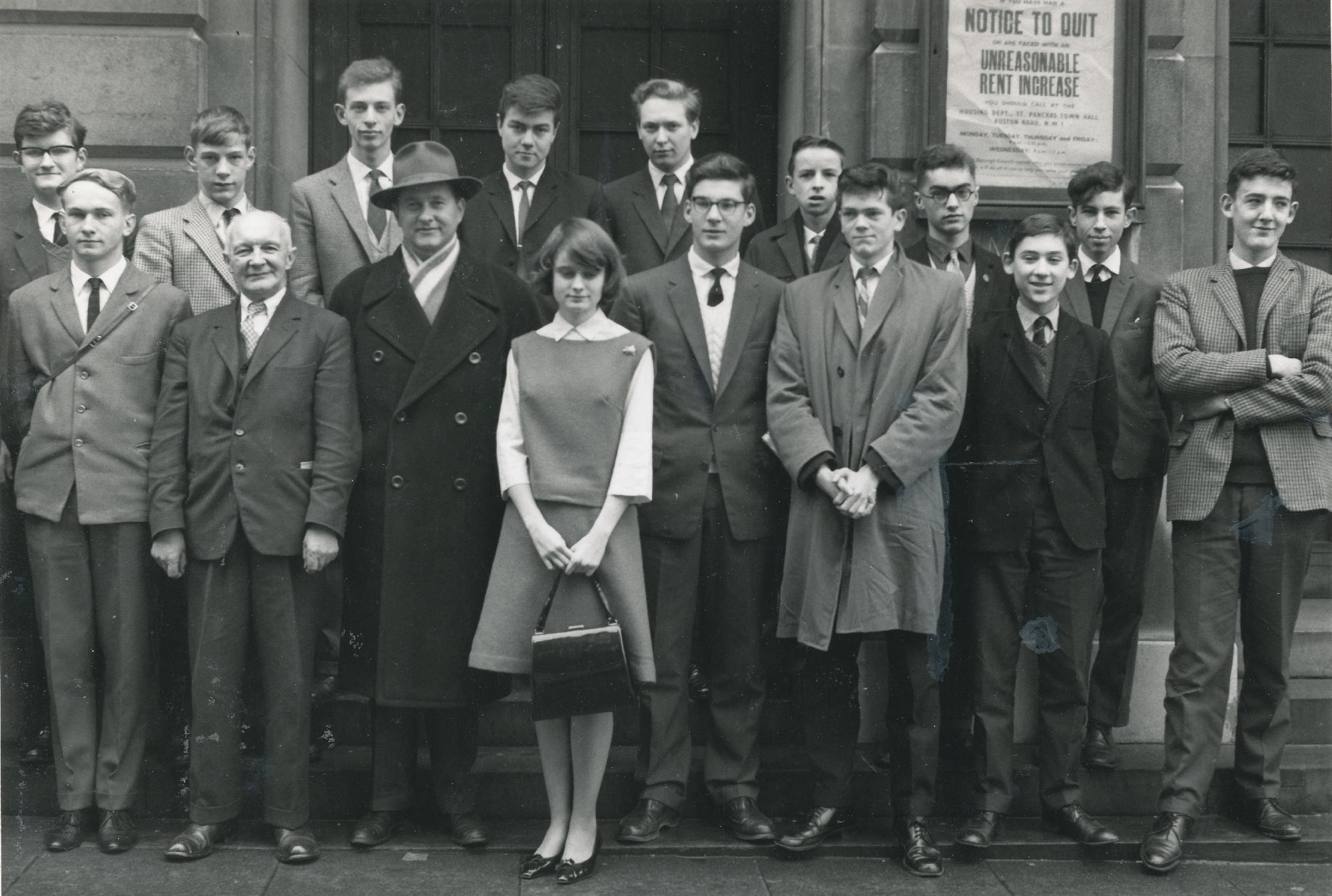
Some of the participants in the Paul Keres display on November 25th, 1962, at St Pancras Town Hall, London WC1. Back row : AJ. Whiteley, D. Floyer, PJ Collins, PJ Adams, RC Vaughan, KB Harman, D. Parr, DNL Levy, Front row : MV Lambshire, AE Hopkins (selector) Paul Keres, Miss D. Dobson, RE Hartley, BC Gillman, WR Hartston and PN Lee. Photograph by AM Reilly. Source : BCM, 1963, page 13

Dinah’s tournament successes were as follows :

1962 London Girls’ Champion
1963 Southern Counties (SCCU) Girls Champion
1963 Southern Counties (SCCU) Ladies’ Champion
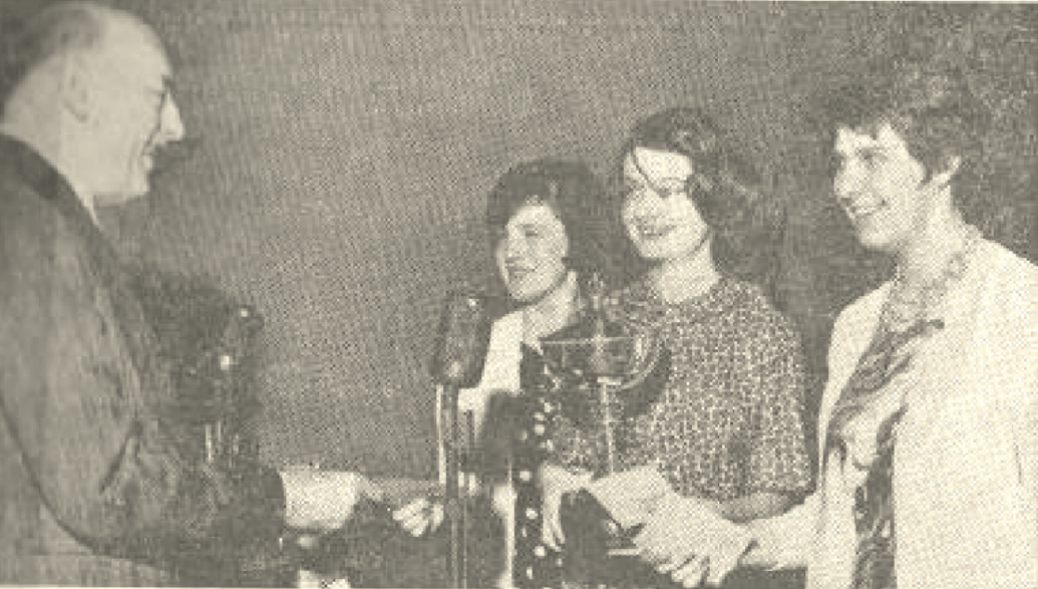
1964 Joint British Girls Champion (three way tie with Gillian Moore and Marcia Syme)

Marcia Syme, Dinah Dobson and Gillian Moore : 1964 joint British Girls's Champions
Marcia Syme, Dinah Dobson and Gillian Moore : 1964 joint British Girls’s Champions

Dinah played as 1st reserve for England in the third FIDE Women’s Olympiad in Oberhausen, Germany in 1966 and in 1969 she played board 1 in Lublin, Poland.

1967 and 1969 Joint British Lady Champion shared with Rowena Bruce after a 4 game playoff

1968 British Lady Champion
1970 American Open Ladies Champion
1975 Winner of first ever Female Grand Prix (as Dinah Wright)
1976 Winner of second Female Grand Prix
Dinah became a WCM in 2002.
She was 9th in the World Over 65 Ladies Championship held in Bled in November 2018.
She is current holder of the Gibraltar Cup.

According to chessgames.com : “Dinah Margaret Norman Dobson is a WCM. She was British champion (w) in 1967 (=Rowena Mary Bruce, Oxford), 1968 (Bristol) and 1969 (=Rowena Mary Bruce, Rhyl).”

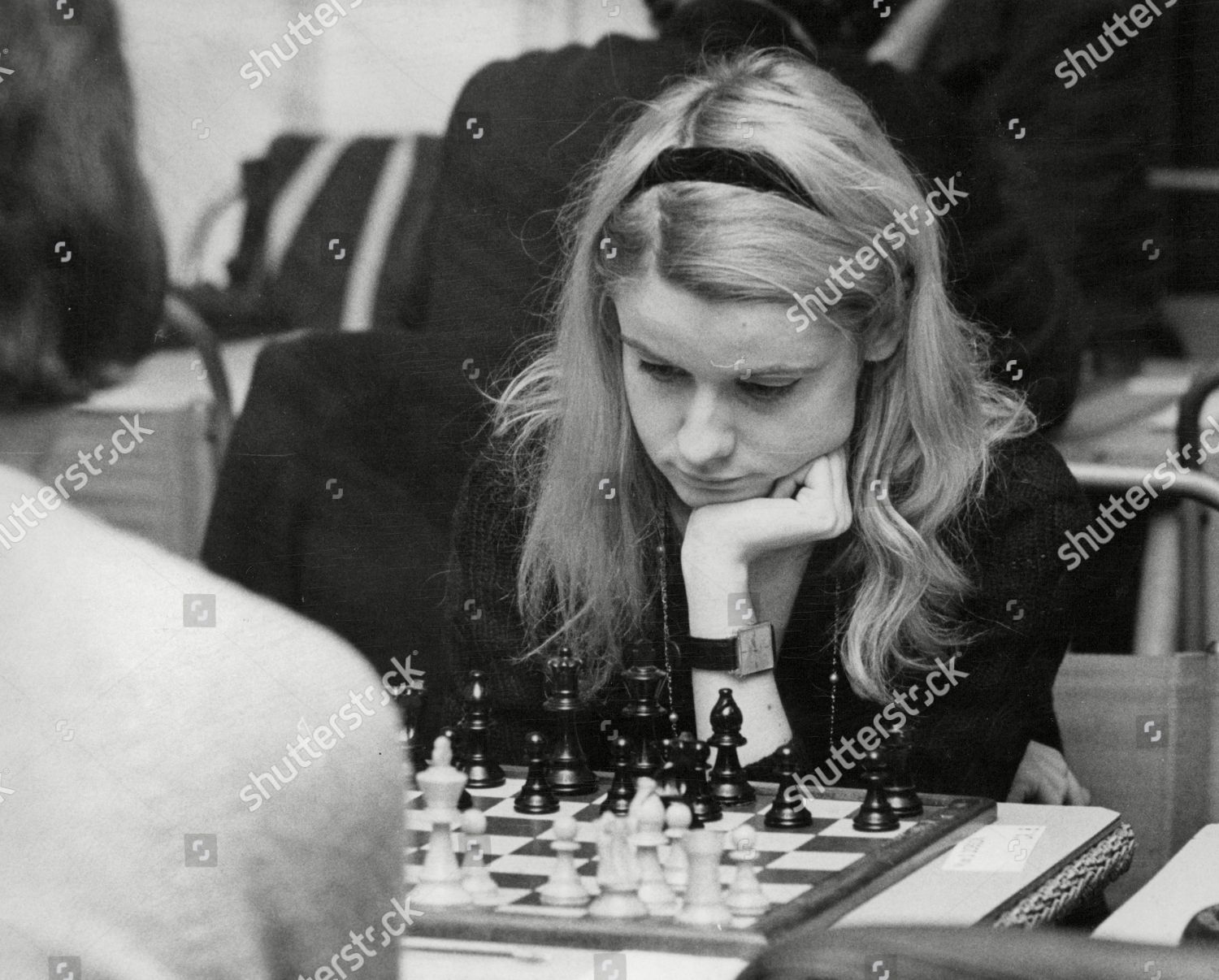
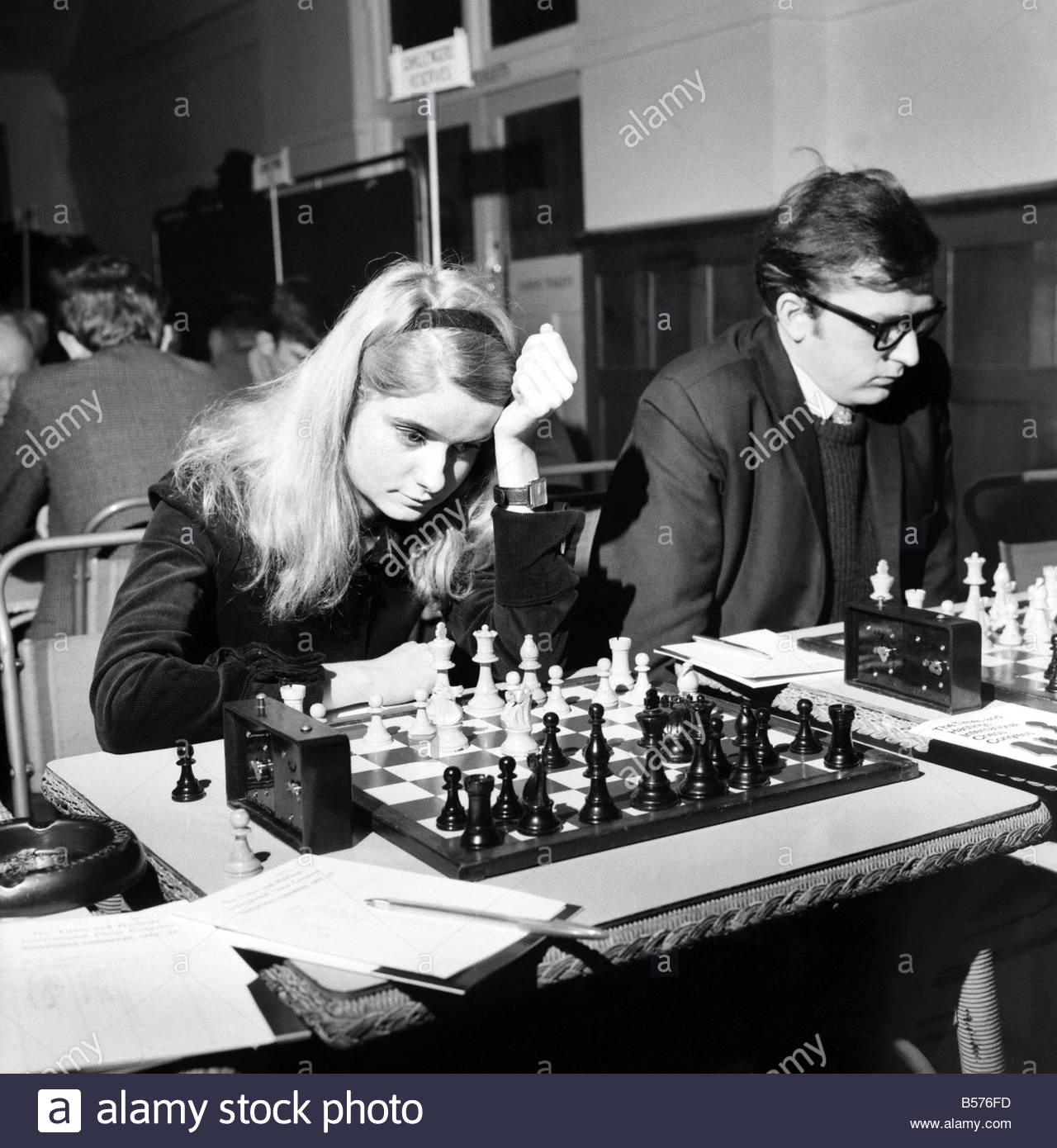
Dinah Dobson 22-year-old Champion British Chess Player Deep In Thought During Chess Competition In Hastings. Mandatory Credit: Photo by ANL/Shutterstock

[pgn]
[Event “Major Open”]
[Site “?”]
[Date “1997.07.12”]
[Round “1”]
[White “Norman, Dinah M”]
[Black “Thiruchelvam , Thiru Murugan.”]
[Result “1-0”]
[ECO “D05”]
[Annotator “British Chess News”]
[PlyCount “43”]
[SourceTitle “Dinah Norman email”]

{[%evp 0,39,22,15,22,22,22,8,22,12,15,2,7,1,-2,-33,-2,-38,5,4,13,16,13,1,1,-15,
20,-14,29,29,88,75,129,109,184,59,215,213,1510,1939,29999,-30000]} 1. d4 d5 2.
Nf3 Nf6 3. e3 e6 {very popular} ({but} 3… c5 4. c3 Nc6 5. Bd3 Bg4 {is a
better way to go for Black}) 4. Bd3 Be7 {the bishop is better on d6 to allow
e5 to be played by Black.} (4… c5 5. c3 Nc6 6. O-O Bd6 7. Nbd2 O-O 8. dxc5
Bxc5 9. e4 {is a critical modern (2020) main line.}) 5. Nbd2 c5 6. c3 O-O 7.
Ne5 (7. O-O Nc6) 7… Nc6 8. f4 Nd7 (8… cxd4 9. exd4 Bd7) 9. O-O Ndxe5 10.
fxe5 f6 11. exf6 Rxf6 12. Rxf6 $146 (12. Nf3) 12… Bxf6 13. Nf3 c4 $6 {
anti-positional} (13… Bd7 $11) 14. Bc2 $14 Qd6 (14… b5) 15. e4 $16 {
White has a typical Colle initiative} Qc7 $2 (15… e5 $1 {was the standard
response when White threatens e5}) 16. e5 $18 {White is winning.} (16. Ng5)
16… Be7 17. Bg5 (17. Ng5) 17… Bxg5 18. Nxg5 {[#]} h6 $2 {anti-positional
and losing but White was a lot better anyway.} (18… g6 $18) 19. Qh5 $1 Qe7 (
19… hxg5 20. Qe8#) 20. Rf1 Bd7 21. Qg6 $1 {and Black resigned} hxg5 22. Qh7#
1-0[/pgn]

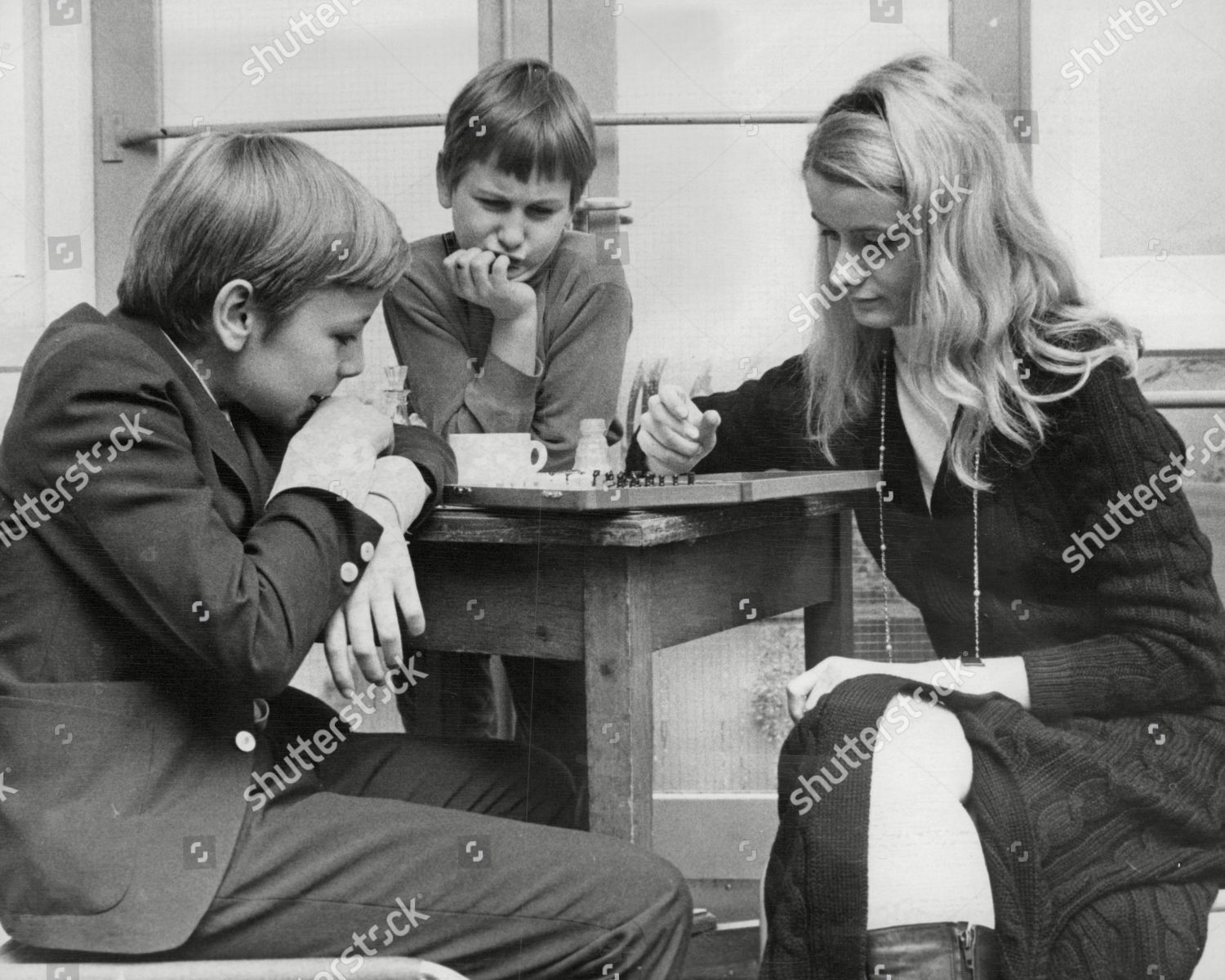
English Chess Champion Dinah Dobson Playing Against Two German Boys During Lunch-break At Chess Competition In Hastings. Box 658 221121512 A.jpg. English Chess Champion Dinah Dobson Playing Against Two German Boys During Lunch-break At Chess Competition In Hastings. Mandatory Credit: Photo by ANL/Shutterstock
English Chess Champion Dinah Dobson Playing Against Two German Boys During Lunch-break At Chess Competition In Hastings. Box 658 221121512 A.jpg.
English Chess Champion Dinah Dobson Playing Against Two German Boys During Lunch-break At Chess Competition In Hastings. Mandatory Credit: Photo by ANL/Shutterstock

She played in the 1968 Anglo-Dutch match on the Ladies board, which, at that time, did not count in the overall match result.

The Annual International Chess Championship opened today at Hasting. Dinah "Dobson," "23," of Northwood Middlesex. December 1969
The Annual International Chess Championship opened today at Hasting. Dinah “Dobson,” “23,” of Northwood Middlesex. December 1969

Now (1971) living in Northwood, Middlesex, she married Danny Wright in Westminster and in 1983 she married Ken Norman in Richmond.

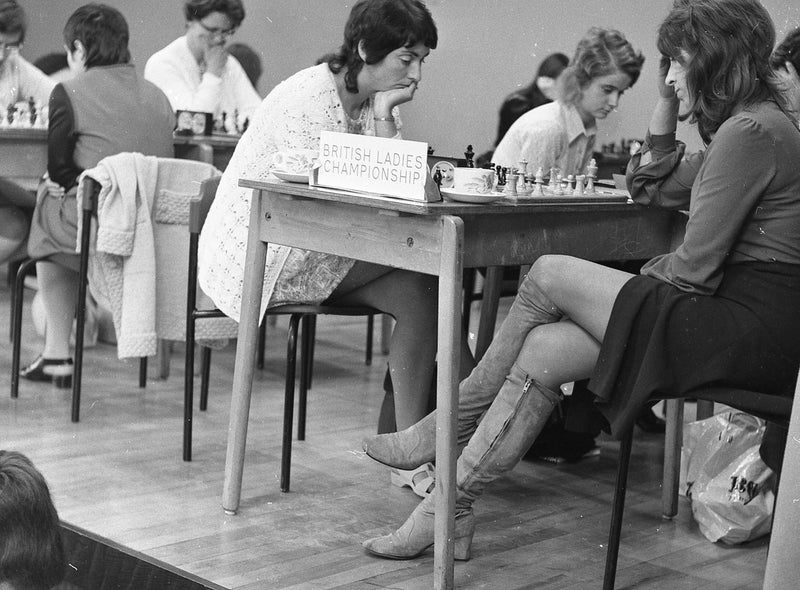
Dinah Wright (third from right) playing in the 1971 British Ladies Championship in Palatine School, Blackpool. Courtesy of Lancashire Evening Post.

[pgn]
[Event “Basingstoke”]
[Site “?”]
[Date “1992.06.07”]
[Round “5”]
[White “McShane, Luke”]
[Black “Norman, Dinah M”]
[Result “0-1”]
[ECO “B01”]
[Annotator “British Chess News”]
[PlyCount “96”]
[EventDate “1992.??.??”]

{[%evp 0,96,34,9,23,42,71,72,58,58,62,60,85,66,78,56,51,55,75,50,44,45,48,37,
48,48,56,28,18,18,18,-2,26,-23,-32,-22,13,15,33,-5,15,-6,-34,-34,-37,-30,-31,
-72,-31,-28,-30,-98,-39,-77,-69,-61,-42,-43,-43,-36,-28,-53,-29,-18,-24,-118,0,
-18,13,13,16,16,0,0,0,0,22,-101,-106,-133,-136,-168,-168,-264,-269,-269,-269,
-289,-220,-295,-307,-347,-339,-416,-325,-350,-331,-366,-357]} 1. e4 d5 2. exd5
Qxd5 3. Nc3 Qa5 4. Nf3 Nf6 5. Bc4 c6 6. O-O Bg4 7. a3 ({More main stream and
sensible is} 7. Re1 e6 8. d4 Be7 9. h3 Bh5 10. Qe2 Nbd7 $14) 7… e6 8. h3 Bh5
9. d4 ({Superior is} 9. d3) 9… Nbd7 10. Bf4 (10. Re1) 10… Be7 11. Re1 O-O
12. Bd3 Bg6 (12… Nd5 13. Nxd5 cxd5) 13. b4 Qd8 14. Bxg6 hxg6 15. b5 Nd5 16.
Nxd5 cxd5 17. a4 a6 18. Qd3 Nf6 19. Ne5 Nd7 20. Nxd7 Qxd7 21. b6 Bd6 22. Bd2
Rfc8 23. g3 Rc4 24. a5 Rac8 25. Rec1 (25. c3) 25… Qc6 26. Qe3 Ra4 27. h4 Rxa1
28. Rxa1 Qc4 $15 29. Kg2 Re8 30. Bc3 Bb4 31. Bxb4 Qxb4 32. Rh1 f6 (32… Qxa5
33. h5 Qxb6 34. hxg6 fxg6 35. Qd3 e5) 33. Qf4 Rc8 34. Qg4 Kf7 35. h5 g5 36. h6
g6 37. h7 Rh8 38. Qd1 $6 (38. Qf3) 38… Qxa5 $17 {[#]} 39. Qd3 Kg7 40. Qe3
Qxb6 41. Qc3 Rxh7 42. Rxh7+ Kxh7 43. Qc8 Qxd4 44. Qd7+ Kh6 45. Qf7 f5 46. Qf8+
Qg7 47. Qd6 Qf7 48. Qe5 Kh7 0-1
[/pgn]

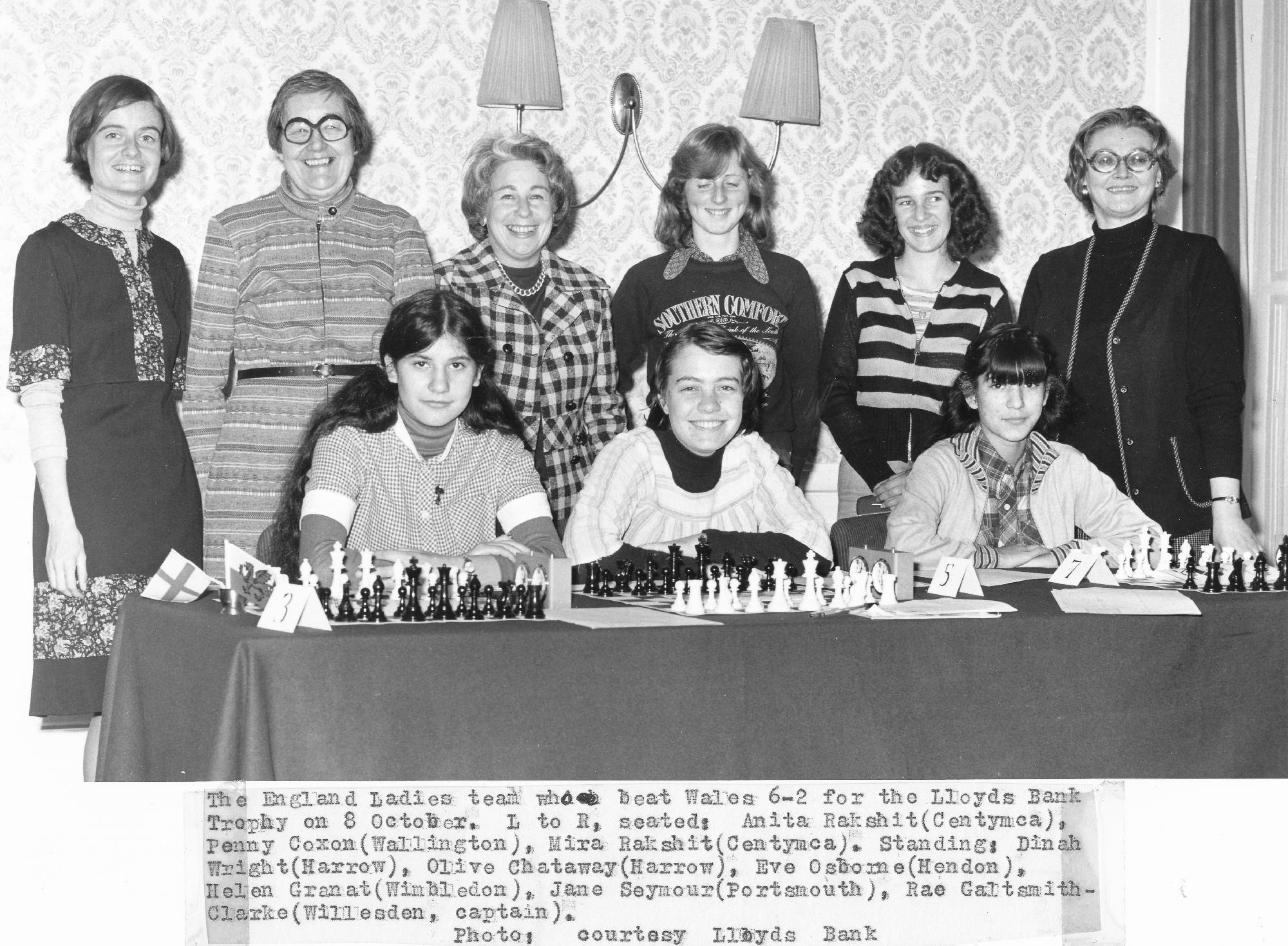
Dinah Wright (far left, standing) with her England team mates (see caption) for a Lloyds Bank sponsored match with Wales

Dinah has been a member of Crowthorne Chess Club and has played in the Berkshire League. She has represented 4NCL Iceni and Guildford in other competitions.

According to Megabase 2020 her highest FIDE rating was 2085 in July 1990 at the age of 44. However, it would have been higher than this in the late 1960s and 1970s had ratings been established then.

Dinah Norman at the 2017 Keith Richardson Memorial organised by Camberley Chess Club. Courtesy of John Upham Photographic

With the white pieces she has essayed the Colle-Koltanowki Opening for many years and as the second player she has played the Caro-Kann, Smyslov Variation and the Semi-Slav Defence.

Dinah Norman with Sandra Richardson at the 2017 Keith Richardson Memorial organised by Camberley Chess Club

Happy 92nd Birthday Leonard Barden (20-viii-1929)

Leonard Barden (Linda Nylind of the Guardian)

Ninety-two today is Leonard William Barden, born Tuesday, August 20th, 1929.

His mother’s maiden was Bartholomew and she became Elise EM Barden when she married Leonard’s father who was William C Barden (a dustman) and in 1939 they lived at 89, Tennison Road, Croydon.

89, Tennison Road, Croydon

From The Encyclopedia of Chess (Batsford, 1977) by Harry Golombek OBE:

“British Master and joint British Champion 1954. Barden was born in Croydon and learned to play at his school, Whitgift, which became a frequent producer of fine players.

In 1946 he tied for first place in the London Boys Championship and in the following year he tied with Jonathan Penrose for first place in the British Boys Championship, but lost the play-off.

In 1952 he came first at Paignton ahead of the Canadian Grandmaster Yanofsky and he reached his peak in 1954 when , after tieing for first place with the Belgian Grandmaster O’Kelly de Galway at Bognor, he tied for for first place in the British Championship at Nottingham with A. Phillips. The play-off was drawn and so the players became joint champions.

Alan Phillips and Leonard Barden are joint British Champions of 1954 in Nottingham, photographer unknown

He played for the BCF in four Olympiads from 1952 to 1962 and then abandoned competitive chess, applying all his energies to writing (he is chess correspondent of the Guardian, the Financial Times, the Evening Standard and the Field, and has written many books on the game.

He has also developed two special interests, in junior chess and in grading, working with utmost persistence and energy in both of these fields.

Leonard authored a series of articles on what was to become the Yugoslav Attack versus the Sicilian Dragon. Source : British Chess Magazine, Volume LXXXIII, Number 7 (July), page 208

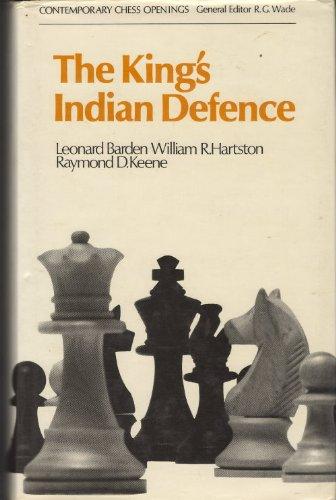
Amongst his best works are : a A Guide to Chess Openings, London, 1957; The Ruy Lopez, Oxford, 1963; The King’s Indian Defence, London, 1968.”

Disappointingly  Sunnucks Encyclopedia does not mention Barden at all and and surprisingly Hooper and Whyld’s usually excellent Oxford Companion only from a connection with Jim Slater.

Leonard Bardens’ Evening Standard column ends after 63 Years

Signature of LW Barden from a Brian Reilly "after dinner" postcard from Southsea 1951.
Signature of LW Barden from a Brian Reilly “after dinner” postcard from Southsea 1951.

Here is an in-depth article from Edward Winter

Leonard Barden’s Blunder Theory from Kingpin Magazine

54-Year-Old Chess Record established in 2009

From Wikipedia :

“Leonard William Barden (born 20 August 1929, in Croydon, London) is an English chess master, writer, broadcaster, organizer and promoter. The son of a dustman, he was educated at Whitgift School, South Croydon, and Balliol College, Oxford, where he read Modern History.

Travel Chess 2nd January 1951: British chess champions Jonathan Penrose and Leonard Barden ponder over a portable travel game in a restaurant. (Photo by Walter Bellamy/Express/Getty Images)
Travel Chess
2nd January 1951: British chess champions Jonathan Penrose and Leonard Barden prepare their openings over breakfast in the Yelton Hotel before the 9.30 am round start at Hastings 1950-51. (Photo by Walter Bellamy/Express/Getty Images)

He learned to play chess at age 13 while in a school shelter during a World War II German air raid. Within a few years he became one of the country’s leading juniors.[1] He represented England in four Chess Olympiads. Barden played a major role in the rise of English chess from the 1970s. As a chess columnist for various newspapers, his column in London’s Evening Standard is the world’s longest-standing chess column.

Leonard Barden (seated, second from right)
Leonard Barden (seated, second from right) Before Botvinnik’s 1981 Pergamon Press clock simul against England juniors, the final competitive event of the Patriarch’s career.
Standing: Stuart Conquest, Neil Dickenson. Gary Lane, Alan Byron,
Daniel King, John Hawksworth, Pergamon editor.
Seated: Julian Hodgson, Byron Jacobs, Mikhail Botvinnik, Leonard Barden, Bernard Cafferty.

In 1946, Barden won the British Junior Correspondence Chess Championship, and tied for first place in the London Boys’ Championship. The following year he tied for first with Jonathan Penrose in the British Boys’ Championship, but lost the playoff.

Barden finished fourth at Hastings in 1951–52. In 1952, he won the Paignton tournament ahead of the Canadian future grandmaster Daniel Yanofsky. He captained the Oxfordshire team which won the English Counties championship in 1951 and 1952.

Leonard William Barden (20-xiii-1929)
Barden making a move at Southend 1955.

In the latter year he captained the University of Oxford team which won the National Club Championship, and he represented the university in the annual team match against the University of Cambridge during his years there. In 1953, he won the individual British Lightning Championship (ten seconds a move).

Leonard Barden, First Holder of the British Lightning Championship title played at the Ilford Congress between May 22nd and May 25th, 1953

(ed: the above event was “won” by Dr. PM List with 15.5/18 but he was not allowed the title. Leonard together with AY Green and KR Smith scored 13/18 and won the play-off).

The following year, he tied for first with the Belgian grandmaster Albéric O’Kelly de Galway at Bognor Regis, was joint British champion, with Alan Phillips, and won the Southern Counties Championship.

Leonard Barden vs Victor Korchnoi, Leipzig Olympiad, 1960

He finished fourth at Hastings 1957–58, ranked by chessmetrics as his best statistical performance. In the 1958 British Chess Championship, Barden again tied for first, but lost the playoff match to Penrose 1½–3½.

Leonard Barden (centre) with Raaphi Persitz, JB Sykes, OI Galvenius and DM Armstrong, Ilford, May, 1953

[pgn]
[Event “British Lightning Championship, Ilford “]
[Site “?”]
[Date “1953.05.17”]
[Round “3”]
[White “Barden, Leonard William”]
[Black “Green, Arnold Yorvath”]
[Result “1-0”]
[ECO “C84”]
[Annotator “British Chess News”]
[PlyCount “39”]

{[%evp 0,39,19,31,34,19,13,4,13,-2,-9,3,20,2,19,-7,-7,-7,19,-79,35,27,22,51,34,
-22,17,-3,14,-42,91,49,96,104,104,104,2111,2604,29993,29994,29995,29994]} 1. e4
e5 2. Nf3 Nc6 3. Bb5 a6 4. Ba4 Nf6 5. O-O Be7 6. d4 exd4 7. e5 Ne4 8. Nxd4 Nc5
9. Nf5 g6 10. Nxe7 Qxe7 11. Bxc6 dxc6 12. Re1 $146 (12. Bh6) 12… Bd7 13. Nc3
O-O-O $15 14. Qf3 Rdf8 (14… Bf5) 15. Qg3 f5 16. Bg5 Qf7 17. Qe3 Ne6 $4 18.
Qa7 $18 Be8 19. Rad1 Nd4 20. Rxd4 {and Black resigned} 1-0
[/pgn]

LWB observes analysis between David Rumens and Murray Chandler from Brighton 1980
LWB observes analysis between David Rumens and Murray Chandler from Brighton 1980. Photograph courtesy of John Upham.

He represented England in the Chess Olympiads at Helsinki 1952 (playing fourth board, scoring 2 wins, 5 draws, and 4 losses), Amsterdam 1954 (playing first reserve, scoring 1 win, 2 draws, and 4 losses), Leipzig 1960 (first reserve; 4 wins, 4 draws, 2 losses) and Varna 1962 (first reserve; 7 wins, 2 draws, 3 losses). The latter was his best performance by far.

Leonard Barden (left) and Murray Chandler display the Lloyds Bank Trophy which the 19-year old New Zealander won ahead of 3 Grandmasters and 10 International Masters for his finest international success up to 1979. in the Lloyds Bank Masters

Barden has a Morphy number of 3, having drawn with Jacques Mieses in the Premier Reserves at Hastings 1948–49. Mieses drew with Henry Bird in the last round of Hastings 1895, and Bird played a number of games with Paul Morphy in 1858 and 1859.

Neil Carr (front right)
England’s under-12 junior teams finished first and second in the international Eumig Cup, 1981.
Front row: Peter Morrish (organiser), Jimmy Hockaday, Darren Lee, Neil Fox, Neil Carr. Second row: James Howell, Stuart Conquest, Teresa Needham. Far right: LB.

In 1964, Barden gave up most competitive chess to devote his time to chess organisation, broadcasting, and writing about the game. He has made invaluable contributions to English chess as a populariser, writer, organiser, fundraiser, and broadcaster.

Leonard Barden
Leonard Barden at Bob Wade’s 80th birthday party, 2001.

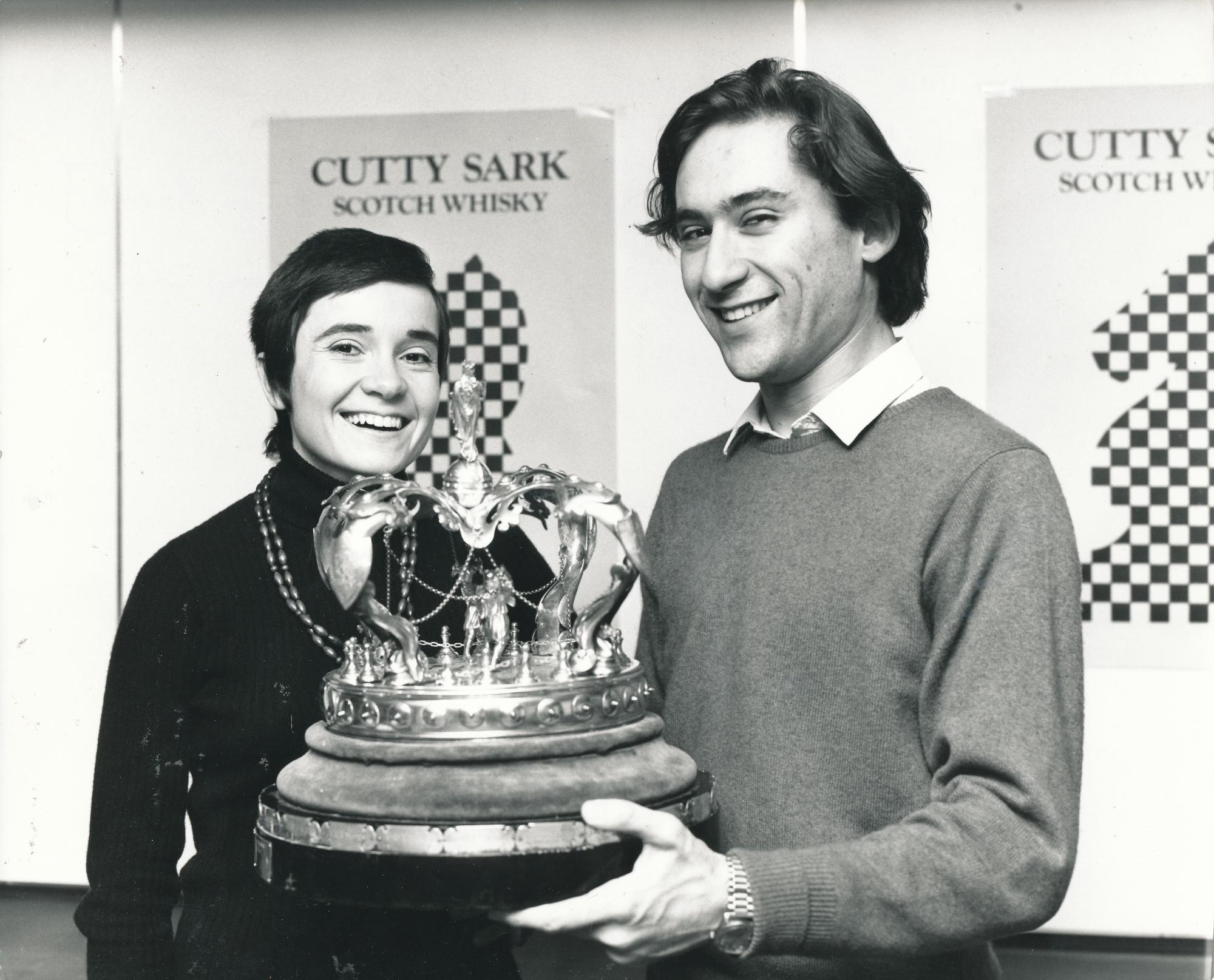
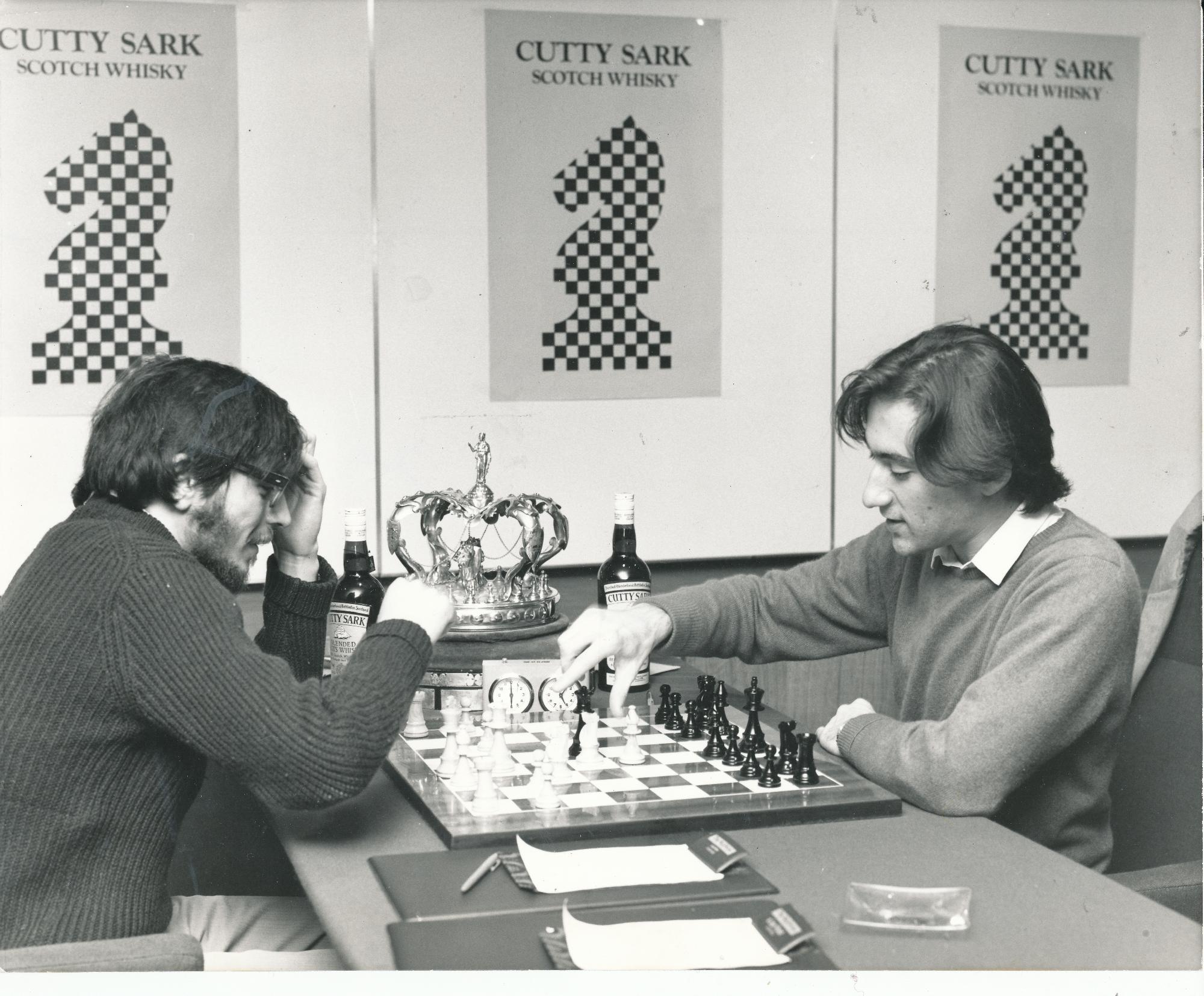
He was controller of the British Chess Federation Grand Prix for many years, having found its first sponsor, Cutty Sark. He was a regular contributor to the BBC’s Network Three weekly radio chess programme from 1958 to 1963. His best-known contribution was a consultation game, recorded in 1960 and broadcast in 1961, where he partnered Bobby Fischer against the English masters Jonathan Penrose and Peter Clarke. This was the only recorded consultation game of Fischer’s career. The game, unfinished after eight hours of play, was adjudicated a draw by former world champion Max Euwe. Barden gave BBC television commentaries on all the games in the 1972 world championship. From 1973 to 1978 he was co-presenter of BBC2’s annual Master Game televised programme.

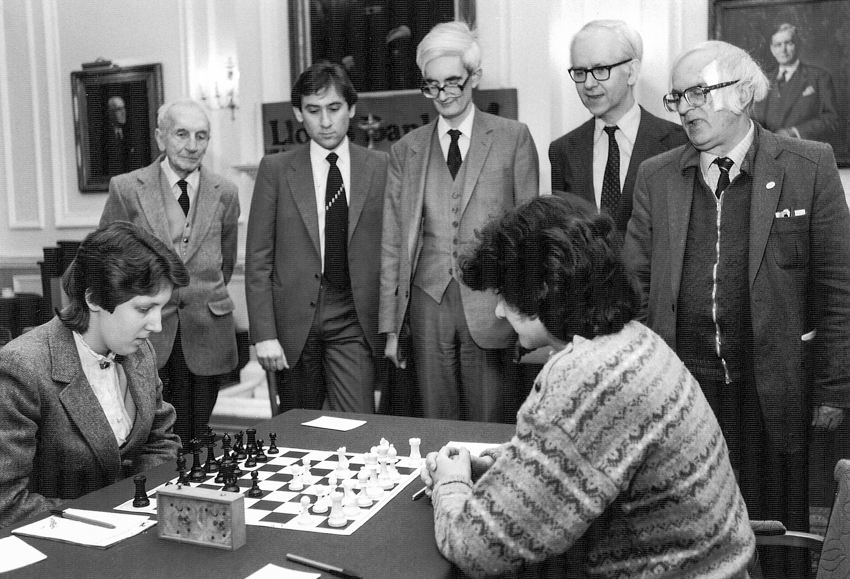
Julian and Nigel Short play Korchnoi in the Evening Standard 1976 simul. Leonard Barden observes.

As of 2021, his weekly columns have been published in The Guardian for 65 years and in The Financial Times for 46 years. A typical Barden column not only contains a readable tournament report, but is geared toward promoting the game. His London Evening Standard column, begun in summer 1956, is now the world’s longest running daily chess column by the same author, breaking the previous record set by George Koltanowski in the San Francisco Chronicle. Koltanowski’s column ran for 51 years, 9 months, and 18 days, including posthumous articles.”

Leonard Barden (Linda Nylind of the Guardian)

Leonard wrote this on the English Chess Forum in 2021 :

“I retired after Ilford 1964 when I finished a poor last in the England Olympiad team qualifier, returned at Hammersmith 1969 (equal 2nd behind Keene) and then played around 6-8 weekenders a year until 1972. My overall performance level between early 60s and early 70s dropped from around 225 to 215 BCF, so I wasn’t encouraged to pursue the comeback further.”

Leonard was Southern Counties (SCCU) champion in the 1953-54 season.

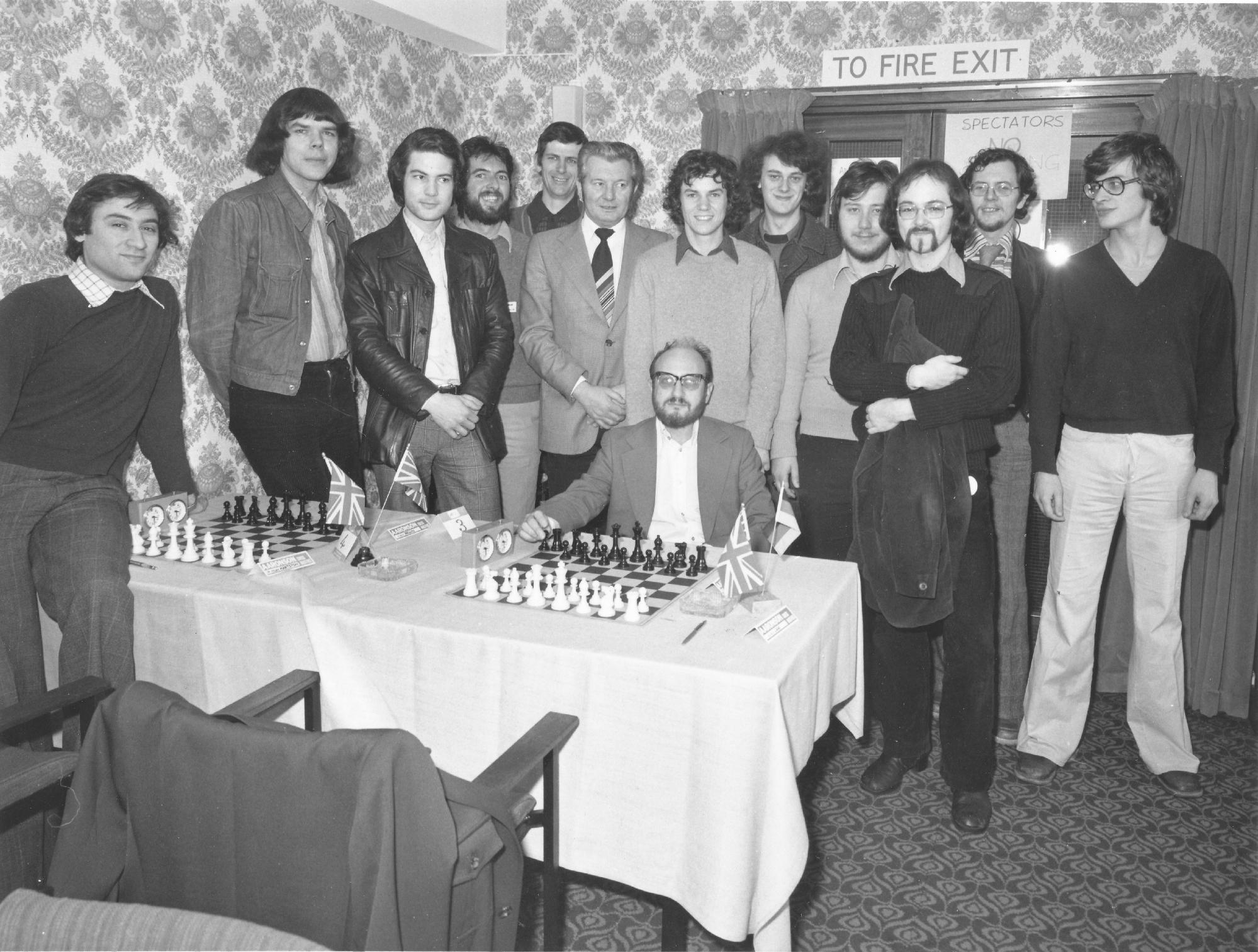
Leonard Barden, Stewart Reuben and Michael Franklin at the 1978 Aaronson Masters

Leonard reveals this as his best game :

[pgn]
[Event “Christmas Congress 1950-51-26 Premier”]
[Site “Hastings”]
[Date “1950.12.30”]
[Round “3”]
[White “Barden, Leonard William”]
[Black “Adams, Weaver Warren”]
[Result “1-0”]
[ECO “C57”]
[Annotator “ChessBase”]
[PlyCount “53”]
[EventDate “1950.12.28”]
[EventType “tourn”]
[EventRounds “9”]
[EventCountry “ENG”]
[SourceTitle “MCL”]
[Source “ChessBase”]
[SourceDate “1999.07.01”]
[SourceVersion “1”]
[SourceVersionDate “1999.07.01”]
[SourceQuality “1”]

{[%evp 0,53,19,38,25,7,30,27,23,32,18,-13,54,47,160,142,71,14,0,0,0,13,247,242,
199,5,11,81,88,93,88,86,73,66,107,114,98,212,184,267,311,302,560,534,581,605,
560,615,828,383,616,751,573,704,895,887]} 1. e4 e5 2. Nf3 Nc6 3. Bc4 Nf6 4. Ng5
d5 5. exd5 Nxd5 $2 (5… Na5 $1 6. Bb5+ c6 7. dxc6 bxc6 8. Be2 h6 9. Nf3 e4 $44
) 6. d4 $1 (6. Nxf7 Kxf7 7. Qf3+ Ke6 8. Nc3 Ncb4 $1 $13) 6… Bb4+ 7. c3 Be7 8.
Nxf7 Kxf7 9. Qf3+ Ke6 10. Qe4 $1 (10. O-O $6 Na5 11. Qg4+ Kf7 12. Qf3+ Ke6 $10)
10… Bf8 (10… Qd6 11. f4 Na5 12. f5+ $18) (10… b5 $5 11. Bxb5 Bb7 12. f4
$36) 11. O-O Nce7 12. f4 c6 13. fxe5 Kd7 14. Be2 Ke8 (
14… Kc7 15. c4 Nb6 16. Bf4 Ng6 17. Bg3 ) 15. c4 Nc7 16. Nc3
Be6? {[#]} 17. Bg5! Qd7 18. Rad1 Rc8 (18… Bf5 19. Qf3) (18… Rd8 19. Bxe7
Bxe7 20. d5 cxd5 21. cxd5 Bxd5 22. Rxd5 Nxd5 23. Bb5 $18) 19. Bxe7 Qxe7 (19…
Bxe7 20. d5 Bc5+ 21. Kh1 cxd5 22. cxd5 Bxd5 23. Rxd5) 20. d5 Qc5+ 21. Kh1 cxd5
22. cxd5 Bd7 (22… Bf7 23. Qf5) 23. e6 Bb5 24. Qf4 Kd8 (24… Be7 25. Qf7+ Kd8
26. d6 Bxd6 27. e7+ Kd7 28. e8=Q#) 25. Bxb5 Nxb5 26. Nxb5 Qxb5 27. d6 (27. d6
Rc4 28. Qxf8+ Rxf8 29. Rxf8+ Qe8 30. Rxe8+ Kxe8 31. d7+ Kd8 32. e7+ Kxe7 33.
d8=Q+) 1-0
[/pgn]

Leonard has authored or co-authored a number of highly regarded books, most of which are highly instructional to this day:

A Guide to Chess Openings (1957),

A Guide to Chess Openings

How Good Is Your Chess? (1957),

How Good is Your Chess ?

Chess (1959),
Introduction to Chess Moves and Tactics Simply Explained (1959),

An Introduction to Chess Moves and Tactics Simply Explained

Modern Chess Miniatures (with Wolfgang Heidenfeld, 1960),
Erevan 1962 (1963),
The Ruy Lopez (1963),

The Ruy Lopez
The Ruy Lopez

The Guardian Chess Book (1967),

The Guardian Chess Book

An Introduction to Chess (1967),

An Introduction to Chess

The King’s Indian Defence (1969),

The King's Indian Defence
The King’s Indian Defence

Chess: Master the Moves (1977),
Guide to the Chess Openings (with Tim Harding, 1977),

Guide to the Chess Openings

Leonard Barden’s Chess Puzzle Book (1977) (a collection of his Evening Standard columns),

Leonard Barden's Chess Puzzle Book
Leonard Barden’s Chess Puzzle Book

The Master Game (with Jeremy James, 1979),

The Master Game
The Master Game

How to Play the Endgame in Chess (1979),

How to Play The Endgame in Chess

Play Better Chess (1980),

Play Better Chess
Play Better Chess

Batsford Chess Puzzles (2002),

Batsford Chess Puzzles

One Move and You’re Dead (with Erwin Brecher, 2007) : Can you supply an image?

[pgn]
[Event “British CF-38 Championship”]
[Site “Swansea”]
[Date “1951.08.28”]
[Round “8”]
[White “Barden, Leonard William”]
[Black “Klein, Ernst Ludwig”]
[Result “1-0”]
[ECO “D93”]
[Annotator “Barden,L”]
[PlyCount “73”]
[EventDate “1951.08.20”]
[EventType “swiss”]
[EventRounds “11”]
[EventCountry “GBR”]
[SourceTitle “EXT 2018”]
[Source “ChessBase”]
[SourceDate “2017.10.13”]
[SourceVersion “1”]
[SourceVersionDate “2017.10.13”]
[SourceQuality “1”]

{[%evp 0,73,19,31,14,-14,43,38,70,32,37,37,70,60,63,33,40,33,80,67,86,68,86,54,
51,59,29,37,42,45,47,45,83,87,75,73,91,101,112,97,97,92,99,93,90,83,91,72,86,
99,303,299,304,302,311,305,313,273,277,280,285,285,294,296,297,283,289,288,296,
303,318,339,364,316,367,380]} 1. d4 Nf6 2. c4 g6 3. Nc3 d5 4. Bf4 c6 5. e3 Bg7
6. Nf3 O-O 7. Qb3 Qa5 ({I prefer this to the alternative} 7… dxc4 8. Bxc4
Nbd7 9. Ng5 $1 Qe8 10. Bc7 $1) 8. Ne5 b6 ({Better, and adequate for equality is
} 8… Nh5 {e.g.} 9. cxd5 Nxf4 10. exf4 cxd5 11. Qxd5 Qb6 {regaining the pawn
– Gligoric-Boleslavsky, Saltsjobaden 1948}) 9. Be2 Ba6 10. O-O Rc8 11. Rac1
Nbd7 12. Rfd1 Nxe5 13. Bxe5 dxc4 14. Bxc4 Bxc4 15. Qxc4 b5 16. Qb3 a6 17. Bxf6
Bxf6 18. Ne4 Bg7 19. Rc5 Bf8 20. Rdc1 e6 21. R5c2 Be7 22. h3 Qb6 23. Nc5 a5 24.
a4 Rab8 $4 ({An oversight which loses at once, but Black had a very difficult
game anyway:} 24… Bxc5 25. Rxc5) (24… b4 25.
Nxe6 $1 fxe6 26. Qxe6+ Kf8 27. d5 $1 $18) 25. Nd7 Qd8 26. Nxb8 Rxb8 27. Rxc6
bxa4 28. Qxb8 Qxb8 29. Rc8+ Qxc8 30. Rxc8+ Kg7 31. Ra8 Bb4 32. Ra7 g5 33. e4
Kg6 34. g4 f6 35. Kf1 h5 36. Ke2 hxg4 37. hxg4 {Sources: Universities Chess
Annual (2nd issue), Nov 1951; BCM, Oct 1951, p267} 1-0
[/pgn]

Remembering Thomas Wilson Barnes (1825 20-viii-1874)

Thomas Wilson Barnes (1825 10-viii-1874)

BCN remembers Thomas Wilson Barnes (1825 20-viii-1874)

From The Oxford Companion to Chess (OUP, 1984) by David Hooper and Ken Whyld :

“One of the strongest English players during the 1850s, He made little impression in his one and only tournament, London 1862, but is remembered for having scored more wins than anyone else in friendly play against Morphy in 1858. He reduced his corpulence by 130 pounds in ten months and as a result died. ”

He is perhaps most well know for having a reasonable score against Paul Morphy of -19 +8 which was a lot better than most !

[pgn]
[Event “Casuals Morphy-Barnes +19-7=0”]
[Site “London”]
[Date “1858.??.??”]
[Round “?”]
[White “Morphy, Paul”]
[Black “Barnes, Thomas Wilson”]
[Result “0-1”]
[ECO “C30”]
[Annotator “British Chess News”]
[PlyCount “106”]
[EventDate “1858.07.??”]
[EventType “game”]
[EventRounds “8”]
[EventCountry “ENG”]
[SourceTitle “EXT 1999”]
[Source “ChessBase”]
[SourceDate “1998.11.16”]
[SourceVersion “1”]
[SourceVersionDate “1998.11.16”]
[SourceQuality “1”]

{[%evp 0,106,23,30,30,-30,4,7,2,-16,-9,-20,-39,-95,-51,-57,-59,-111,-112,-138,
-158,-179,-275,-229,-66,-120,-92,-178,-83,-83,-7,-70,-70,-70,-70,-27,-12,-66,
-43,-106,-124,-135,-109,-86,-110,-146,-139,-134,-134,-192,-105,-38,0,-46,-52,
-46,-132,88,88,44,112,3,0,-203,-219,-219,-242,-244,-244,-244,-227,-231,-209,
-222,-145,-216,-139,-154,-166,-164,-218,-214,-214,-248,-274,-283,-245,-326,
-269,-417,-417,-436,-462,-457,-310,-310,-310,-288,-288,-288,-294,-294,-294,
-459,-472,-585,-665,-709,-1074]} 1. e4 e5 2. f4 Bc5 3. Nf3 d6 4. b4 Bb6 5. Bc4
Nf6 6. Qe2 Nc6 7. c3 O-O 8. d3 exf4 9. Bxf4 d5 10. Bb3 dxe4 11. dxe4 Bg4 12.
Nbd2 Nh5 13. Be3 Ne5 14. O-O-O Nd3+ 15. Kc2 Nhf4 16. Bxf4 Nxf4 17. Qf1 Qe7 18.
h3 Bh5 19. g4 Bg6 20. Kb2 Rad8 21. Nd4 Bxd4 22. Qxf4 Be5 23. Qe3 Qxb4 24. h4 h5
25. Nc4 Qe7 26. Rxd8 Rxd8 27. gxh5 Bxh5 28. Qg5 Qxg5 29. hxg5 Bf3 30. Rf1 Be2
31. Nxe5 Bxf1 32. g6 Kf8 33. gxf7 Rd6 34. Nf3 Rf6 35. Ng5 Rf2+ 36. Ka3 c5 37.
Bd5 b5 38. Nh7+ Ke7 39. f8=Q+ Rxf8 40. Nxf8 Kxf8 41. e5 g5 42. Bf3 Bh3 43. c4
bxc4 44. Kb2 g4 45. Bd5 g3 46. Kc3 Be6 47. Bf3 Ke7 48. a3 Bd7 49. Bd5 Be6 50.
Bf3 Kd7 51. Kd2 Bh3 52. Ke3 Ke6 53. Be2 c3 0-1
[/pgn]

[embedyt] https://www.youtube.com/watch?v=qzPR5utx2fY[/embedyt]

According to chessgames.com :

“Thomas Wilson Barnes was one of the strongest English players in the 1850s. His only tournament appearance was in London 1862 but he did not do himself justice. He’s best remembered for having more wins against Paul Morphy in friendly play than anyone else. Being overweight he decided to reduce his size, but the loss of 130 pounds in 10 months was more than his system could handle and resulted in his death in 1874.”

The Barnes Opening, was played by T. W. Barnes. This opening move has no particular merit but he liked to avoid book lines, to which end he
sometimes answered 1 e4 by 1…f6.

[fen]rnbqkbnr/ppppp1pp/5p2/8/4P3/8/PPPP1PPP/RNBQKBNR w KQkq – 0 1[/fen]

He died at 68, Cambridge Street, Pimlico.

His death was registered in the St George, Hanover Square district.

He was buried on August 25th, 1874 in Brompton Cemetery (plot number 76449). According to the burial records he had a “Private Grave” the plot of which measured 113.3 x 18.3 and “no extra depth” was required.

Happy Birthday Peter Griffiths (15-viii-1946)

Peter Griffiths (15-viii-1946)

BCN sends Happy birthday wishes to Peter Griffiths

Peter Charles Griffiths was born on Thursday, August 15th, in 1946 in Birmingham, Warwickshire. His mother’s maiden name was Ward.

Peter was a strong player active from the 1960s until 1989. He played in the British Championships more than once and was a professional coach and writer. He wrote the column “Practical Chess Endings” which appeared in the British Chess Magazine. The column commenced in the December 1972 issue and columns became less frequent until around 1991.

Peter Griffiths (far left)

He wrote Exploring the Endgame

Exploring the Endgame

and co-authored Secrets of Grandmaster Play with John Nunn.

Secrets of Grandmaster Play

and wrote Improving Your Chess

Improving Your Chess

and Better Chess for Club Players

Better Chess for Club Players
Peter Griffiths (far left)

Happy Birthday IM John Pigott (15-viii-1957)

IM John Pigott at the 2020 Gibraltar Masters. Photograph courtesy of John Saunders

BCN wishes IM John Pigott all the best on his birthday (15-viii-1957)

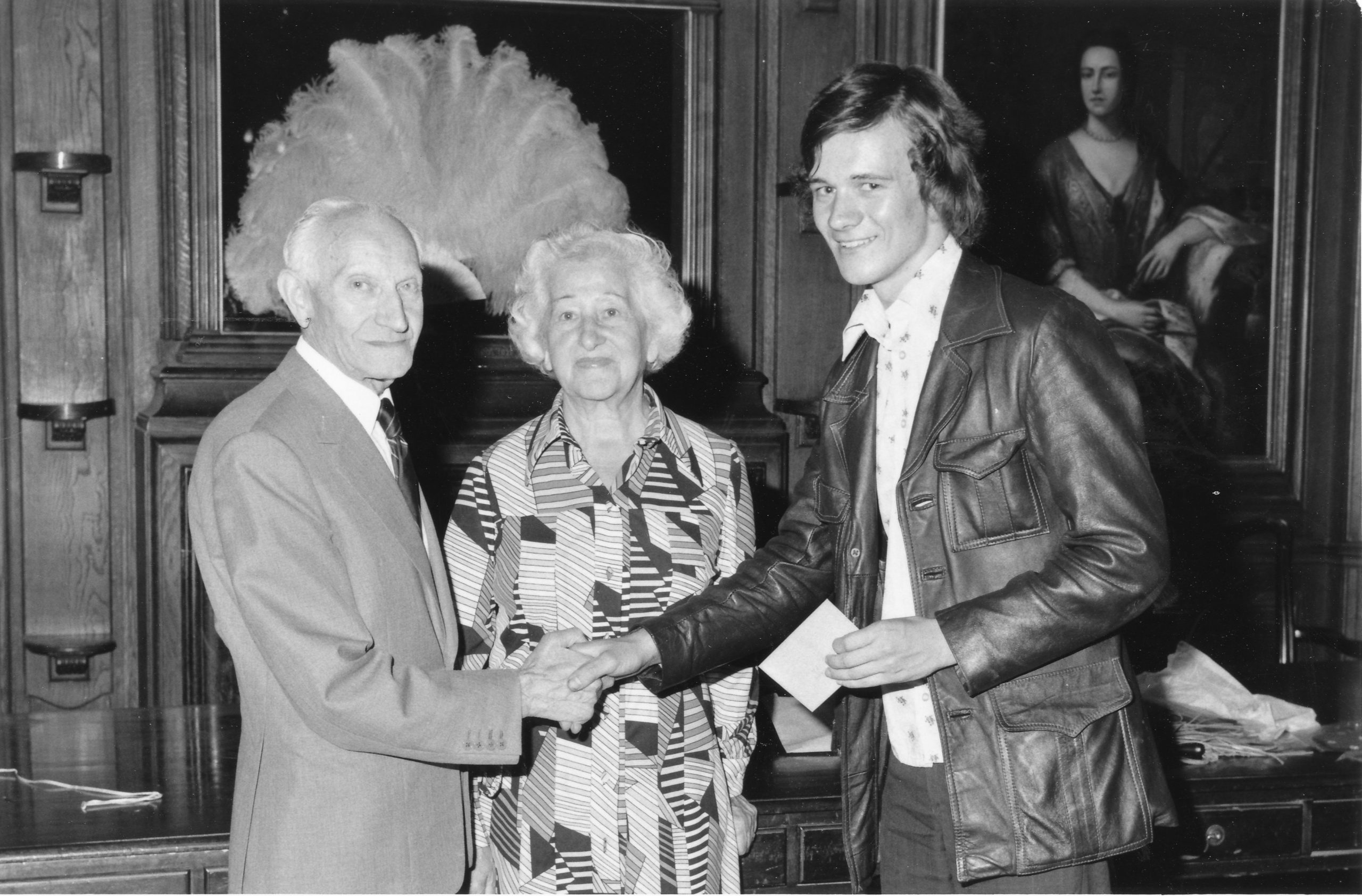
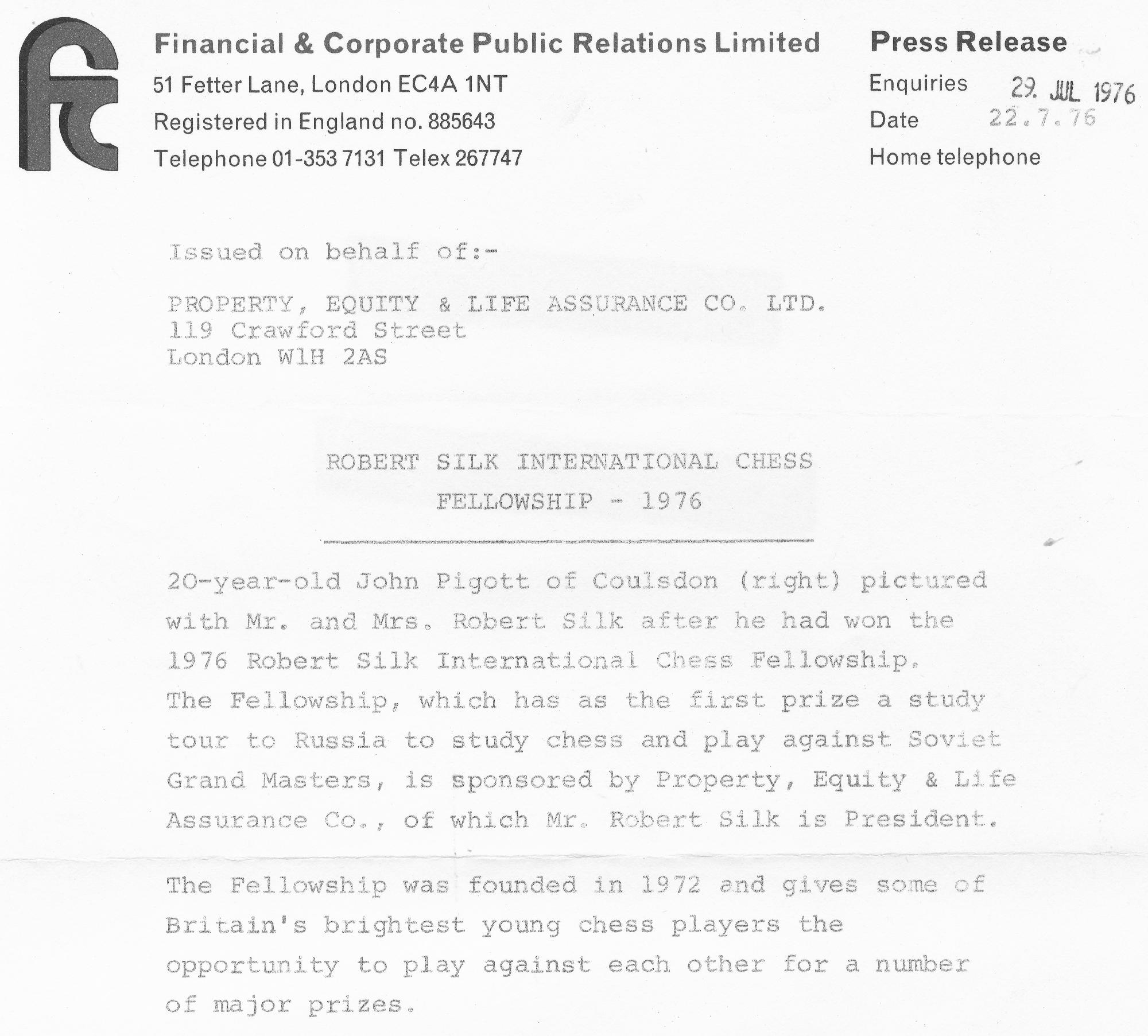
John Christopher Pigott was born in Croydon, Surrey and his mother’s maiden name was Fletcher.

In 1975 John was selected by the BCF junior selectors and travelled with Jonathan Speelman and Peter J Lee (Hampshire) to the 8th Biel International Open in Switzerland. Leonard Barden wrote in the October 1975 British Chess Magazine (the cover was of Geller and Smyslov) :

“17-year-old John Pigott’s 8.5/11 included wins against IM Kluger, IM Messing and the 1975 Budapest Champion Rajna and earned him 2,000 Swiss francs in prize money. The three English juniors who competed, Pigott, Speelman and Lee were chosen by the BCF junior selectors and travelled to Switzerland with the help of grant from the Slater Foundation and the London Chess Club.”

[pgn]
[Event “Biel International Open”]
[Site “?”]
[Date “2020.08.08”]
[Round “?”]
[White “Messing, H”]
[Black “Pigott, John Christopher”]
[Result “0-1”]
[ECO “B67”]
[Annotator “British Chess News”]
[PlyCount “60”]
[EventDate “1975.07.21”]
[EventType “swiss”]
[EventRounds “11”]
[SourceTitle “BCM, 1975, page 447”]

{[%evp 0,24,19,38,40,41,66,77,66,31,42,26,60,60,64,51,66,43,36,29,43,50,33,58,
51,51,143]} 1. e4 c5 2. Nf3 d6 3. d4 cxd4 4. Nxd4 Nf6 5. Nc3 Nc6 6. Bg5 e6 7.
Qd2 a6 8. O-O-O Bd7 9. f4 b5 10. a3 {A fairly rare sideline} ({Much more
popular is} 10. Bxf6 gxf6 11. Kb1 Qb6 12. Nxc6 Bxc6) 10… Rc8 11. Kb1 Be7 12.
Nf3 {threatening e5} b4 $146 (12… h6) 13. axb4 Nxb4 14. e5 $14 dxe5 15. fxe5
({Better is} 15. Nxe5) 15… Nfd5 16. Nxd5 Nxd5 17. Bxe7 Qxe7 18. c4 ({Not} 18.
Bxa6 Nc3+ (18… Rb8 $1) 19. bxc3 Rb8+ 20. Ka2 Ra8 {“Regaining the piece with
advantage : according to Golombek”} 21. Qd6 $1 {is the move Golombek missed.})
18… Nb6 19. Qf4 $6 (19. Qd6) 19… Qb4 20. Ng5 O-O 21. Qe4 g6 22. Qh4 h5 23.
Ne4 ({If} 23. Rd4 Na4 24. Qf2 Bc6 {and Black has the upper hand : Golombek})
23… Nxc4 24. Nf6+ Kh8 25. Bxc4 Rxc4 26. Qf2 (26. Qg5 {does lead to mate :}
Qxb2+ $1 27. Kxb2 Rb8+ 28. Ka3 Ra4#) 26… Rf4 27. Qe3 Bc6 28. Rd2 Be4+ 29. Ka1
({The ending after} 29. Nxe4 Qxe4+ 30. Qxe4 Rxe4 {is hopeless}) 29… Rc8 30.
b3 $2 {white is lost anyway} (30. Rd4 Qa5+ 31. Qa3 Qxe5 $19) 30… Qa5+ {
White resigned} 0-1
[/pgn]

John represented England at the 1975 Anglo-Dutch match (25th and 26th of October) scoring 0.5/2 versus Paul van der Sterren. The game scores appear to either have been lost on not recorded.

[embedyt] https://www.youtube.com/watch?v=sqVMNBdJfkc[/embedyt]

In 1976 John scored 4.5/5 in the Surrey Open and shared the 3rd, 4th and 5th prize.

The caption is in the photograph below
The caption is in the photograph above

John became a FIDE Master in 1984 and an International Master in 2017, a gap of some 33 years!

John plays for Little Heath, 4NCL Barbican, Hon Members LCCL and King’s Head chess clubs.

After a sojourn from chess John returned to the ECF grading list in January 2015 with a grading of 269F attracting some attention.

His highest FIDE rating was 2419 in February 2018 at the age of 61.

With the white pieces John plays the Queen’s Gambit and the Giuoco Piano.

As the second player John enjoys the Sicilian Najdorf and the Nimzo Indian Defence.

Jon Speelman’s Agony Column #40

[embedyt] https://www.youtube.com/watch?v=P2NHfrw_Y5s[/embedyt]

Happy Birthday to FM Andrew Smith (15-viii-1959)

FM Andrew Smith at the 2019 British Championships in Torquay, courtesy of John Upham Photography

BCN wishes Happy Birthday to FM Andrew Smith (15-viii-1959)

Andrew Philip Smith became a FIDE Master in 1994 and is registered with the Irish Chess Union.

His highest FIDE rating was 2310 in July 1994 at the age of 35.

FM Andrew Smith, photographer unknown

He plays for Bourne End Chess Club in the Buckinghamshire League and in the Berkshire League.

Andrew also plays for 4NCL Barnet Knights (he has played for Atticus), Buckinghamshire CCA in the Chiltern League and Hon Members LCCL.

Andrew started his chess aged 6 when his Mother taught him and he joined Lewisham Chess Club aged 13 and then Slough Chess Club (Thames Valley League and 4NCL) in 1988.

He has won the Berks & Bucks Congress in 2018 and 2016 (joint) and he became Berkshire Individual Champion as a direct consequence winning the Cadogan Cup.

With the white pieces Andrew is (almost) exclusively a 1.e4 player favouring the Centre Game

and as the second player Andrew plays the Philidor Defence and the Benoni.

He is known to favour “enterprising” variations such as the Mason Variation of the Philidor, the Haldane Attack versus the French and other such exotica.

British Chess Magazine, Volume CXXXII (132), Number 7 (July) front cover features FM Andrew Smith from the final 4NCL weekend of the 2011-2012 season, courtesy of John Upham Photography

[pgn]
[Event “BCF-chT2b 1112 (4NCL)”]
[Site “England”]
[Date “2012.02.12”]
[Round “6.3”]
[White “Smith, Andrew Philip”]
[Black “Girdlestone, Paul C”]
[Result “1-0”]
[ECO “C22”]
[WhiteElo “2204”]
[BlackElo “2191”]
[Annotator “Andrew P Smith”]
[PlyCount “75”]
[EventDate “2011.11.12”]
[EventType “team-match”]
[EventRounds “7”]
[EventCountry “ENG”]
[SourceTitle “EXT 2013”]
[Source “ChessBase”]
[SourceDate “2012.11.22”]
[SourceVersion “1”]
[SourceVersionDate “2012.11.22”]
[SourceQuality “1”]
[WhiteTeam “Spirit of Atticus”]
[BlackTeam “Brown Jack”]
[WhiteTeamCountry “ENG”]
[BlackTeamCountry “ENG”]

{[%evp 0,75,19,31,34,25,5,-1,-3,-12,-20,-36,-38,-31,-26,-30,-41,-8,1,-59,13,-2,
-2,-222,-254,-322,-193,-225,-133,-160,-85,-149,-83,-101,-80,-80,-69,-43,-41,
-84,21,48,60,-100,-71,-82,65,177,182,136,220,173,273,89,89,57,57,-140,-137,
-128,15,36,333,767,29985,434,394,127,141,105,125,134,245,256,273,237,29999,
-30000]} {My notes are based on my thoughts during the game and have not been
checked by a computer. Going into this game, I felt under pressure both from
team and personal perspectives. I joined Atticus at the beginning of this
(2011) season and my first three appearences had seen me accumulate a very
round zero ! We already suspected that our team would be in the second
division ‘demotion pool’ so we desperately needed points to avert relegation.
This was my fourth game for the team so I was keen to address my shortcomings
and put some sort of score on the board. No easy matter as my opponent was
rated higher than myself and had beaten me the previous year at the Berks &
Bucks Congress.} 1. e4 e5 2. d4 exd4 3. Qxd4 $1 {I have been playing this
“Offbeat” line for over 25 years so I have a great deal of experience with it.
Often scoffed at, but as with many Offbeat lines it is not so easy for Black
to deal with !} Nc6 4. Qe3 Nf6 5. Nc3 Bb4 6. Bd2 O-O 7. O-O-O Re8 8. Bc4 $5 ({
In previous games I have also speculated with Morozevich’s tricky innovation}
8. Qg3 {which he played against Mark Hebden} d6 9. f3 Ne5 10. h4 c6 11. h5 d5
12. Nge2 Nc4 13. h6 {was Morozevich-Hebden, Lloyds Bank, 1994, 1-0, 27.}) (8.
f3) 8… d6 $5 (8… Bxc3 9. Bxc3 Nxe4 (9… Rxe4 $2 {loses} {to} 10. Bxf6 Rxe3
11. Bxd8 $18) 10. Qf4 $1 Qe7 $4 ({Instead of 10…Qe7 he could have played}
10… Nf6 11. Bxf6 Qxf6 (11… gxf6 $16 {just looks too horrible to
contemplate.}) 12. Qxc7 Qxf2 (12… Qg5+ 13. Kb1 Qxg2 14. Qf4 Ne5 15. Bd5 {
again with great attacking chances for the pawn.}) 13. Nf3 $14 {with
tremendous compensation for the pawn}) (10… Nxc3 11. Bxf7+ Kh8 12. Bxe8 Qxe8
13. bxc3 d6 $16 {and I prefer White.}) 11. Re1 $1 $18 {winning as Black will
lose material after 12.f3}) 9. Nf3 $5 Bf5 $5 10. Qf4 Bg6 ({If} 10… Bxe4 {
White has} 11. Bxf7+ Kxf7 12. Ng5+) (10… Bxc3 11. Bxc3 Bxe4 12. Ng5 Bg6 13.
h4 {gives play.}) 11. Ng5 h6 12. h4 Ne5 ({If} 12… hxg5 13. hxg5 Nh7 14. Qh2 {
looks interesting, threatening f4 and f5} {and if} Bxc3 15. bxc3 Bxe4 (15…
Qd7 $1 $19) 16. Bd3 $18 {seemed good.}) 13. Bb3 Nh5 (13… hxg5 14. hxg5 Nh7
15. Qh4 $40 {with f4 and f5 to follow.}) 14. Qe3 Qd7 {I wasn’t sure what Black
would played here.} ({I analysed} 14… hxg5 15. hxg5 {and felt I had good
chances because Black’s knight on h5 is exposed to a White pawn surge.}) 15. f4
Ng4 16. Qf3 {The crisis point of the game is here. White threatens the
crushing 17.f5} hxg5 {Black saw now nothing better. The knight is finaly
captured after being en prise for five moves. I remember looking at the clock
situations and being amazed that we had only played 16 moves !} 17. f5 $1 ({If
} 17. hxg5 $6 {then} Bxc3 18. Bxc3 Bxe4 19. Qh3 Bg6 {and maybe Black is OK?})
17… Ne5 18. Qe3 Bxf5 ({Or} 18… Bc5 19. Qxg5 {is strong} Bxf5) 19. exf5 Nf4
{In a mutual time scramble this is a tricky little move.} 20. Kb1 ({Not
falling for} 20. hxg5 $4 Ned3+ {winning my queen.}) 20… Nc4 21. Qg3 Nxd2+ 22.
Rxd2 Qxf5 23. hxg5 Bxc3 24. bxc3 Re4 $18 {I could feel my opponents sudden
optimism after he played this move. If Black could continue with Rae8 then he
would be OK.} 25. Rf2 $1 {Repositioning my only ineffectual piece. On d2 , this
rook was not doing anything. – now it pins the knight against the queen and
all White’s pieces contribute a threat to Black’s king.} Qe5 ({I’m sure he
would have liked to have played} 25… Rae8 {but} 26. g6 {is still a difficult
reply to meet as} Qxg6 27. Qxg6 Nxg6 28. Bxf7+ Kf8 29. Bxg6+ {wins}) 26. g6 $1
{Fortunately for me Black’s capture on c3 has freed up a flight square on b2
for my king so I don’t have to worry about checks on my back rank.} d5 {
Blocking the diagonal of my strong bishop on b3. His king is about to be
exposed!} 27. gxf7+ Kxf7 {With both of use having a few minutes left and time
control a long way ff at move 40, the tension is palpable as this result is
crucial to the outcome of the match.} 28. Rh4 {To save the knight Black is
forced to expose his king still further.} g5 29. Rh7+ Ke6 30. Qg4+ Kf6 31. Qd7
{Probably winning for White} Qe6 $2 {A blunder – albiet in a lost position. –
but in mutual time trouble I let him get away with it.} 32. Qg7+ ({Now} 32.
Rh6+ {wins the queen and it would have been quite a nice game if it had
finished this way. But, I mistakenly thought he could intercept with the knight
forgettimg it was pinned.}) 32… Kf5 33. Rh6 Qe7 {Now with both flags hanging
and both players blitzing to reach the time control, I decided to bail-out and
win a piece.} 34. Qxe7 Rxe7 35. g3 Kg4 36. gxf4 gxf4 37. Bxd5 Kg3 $4 {three
seconds left !} 38. Rg2# {with about 15 seconds left ! It was big relief to
come away with the full point as the match score, after some heroic defence by
Sheila Jackson in her game with Mike Truran was 4.5 – 3.5 to us (Atticus).} 1-0
[/pgn]

FM Andrew Smith at the 2019 Keith Richardson Memorial, courtesy of John Upham Photography

In 2021 Andrew self-published “Off the Board Chess, The Best Games and Chess Experiences of Andrew Smith (FM)” which has received popular acclaim.

Off the Board Chess, The Best Games and Chess Experiences of Andrew Smith (FM), FM Andrew Smith, Self published, 2021, ISBN 978-1-5272-8572-9

Happy Birthday IM Malcolm Pein (14-viii-1960)

IM Malcolm Pein at the 2019 British Championships in Torquay, courtesy of John Upham Photography
Malcolm Pein signature

BCN sends IM Malcolm Pein best wishes on his 61st birthday.

IM Malcolm Pein at the King's Place Rapidplay 2013, photograph courtesy of John Upham
IM Malcolm Pein at the King’s Place Rapidplay 2013, photograph courtesy of John Upham

Malcolm Bernard Pein was born in Liverpool (South). South Lancashire and his mother’s maiden name is Max. (Gaige, Felice and chessgames.com all incorrectly have Malcolm L. Pein).

Malcolm Pein
Malcolm Pein

This was written about Malcolm aged 19 just prior to the 1979 Spassky vs the BCF Junior Squad simultaneous display :

” London University and Liverpool, Rating 199. British under-18 co-champion, 1977. Currently No.1 player for London University.”

Malcolm hard at work

Malcolm studied Chemical Engineering at University College, London entering in September 1978. He won The University of London championship in February 1979. The runner-up was John Upham also from UCL.

He became an International Master in 1986 and is a FIDE Delegate (for England) and an International Director.

Malcolm’s peak rating was 2450 in January 1992 at the age of 32.

Malcolm Pein (third from right) and a victorious Wood Green team. Trophy presented by Magnus Magnusson

With the white pieces Malcolm prefers the Queen’s Gambit almost exclusively with 1.e4 rarely seeing the light of day scoring 62%

As the second player, Malcolm champions the Pirc, Modern and Grunfeld defences scoring 49% which MegaBase 2020 claims is “above average”.

Malcolm plays for 4NCL Wood Green and Liverpool.

[pgn]
[Event “Manila op”]
[Site “Manila”]
[Date “1992.??.??”]
[Round “?”]
[White “Pein, Malcolm”]
[Black “Valdes, P.”]
[Result “1-0”]
[ECO “E25”]
[WhiteElo “2445”]
[Annotator “Pein,Malcolm”]
[PlyCount “53”]
[EventDate “1992.??.??”]
[EventType “swiss”]
[EventRounds “9”]
[EventCountry “PHI”]
[SourceTitle “CBM 030”]
[Source “ChessBase”]
[SourceDate “1992.10.01”]
[SourceVersion “1”]
[SourceVersionDate “1992.10.01”]
[SourceQuality “1”]

{[%evp 0,53,16,28,27,-16,-9,4,4,-78,-50,-91,-47,-47,-29,-14,41,9,10,8,23,12,34,
27,55,5,-11,12,10,9,9,20,20,32,32,38,147,186,22,66,85,82,123,47,3,-17,-18,-12,
29987,29988,29989,29990,29991,29992,29993,29994]} 1. d4 Nf6 2. c4 e6 3. Nc3 Bb4
4. f3 d5 5. a3 Bxc3+ 6. bxc3 c5 (6… O-O 7. cxd5 Nxd5 8. e4 Nxc3 9. Qb3 Qxd4
10. Bb2 Qe3+ 11. Be2 Nd5 12. Qxe3 Nxe3 13. Kf2 Nd5 14. exd5 exd5 15. Rc1 $16)
7. cxd5 Nxd5 {[#]} 8. Qd2 {According to ECO this move has not been played for
20 years! In comparison with Qd3 the queen is not exposed on a6 f1 diagonal
but the Bc1 is restricted} f5 (8… Qa5 9. e4 $1 Nxc3 (9… Qxc3 10. Rb1 Qxd2+
11. Bxd2 Nc7 12. dxc5 Nd7 13. Bb5 {White is slightly better}) 10. Bb2 cxd4 11.
Ne2 {White regains one pawn and gets an attack} e5 12. Nxc3 dxc3 13. Bxc3 Qc7
14. Bb4 Nc6 15. Bd6 Qd8 (15… Qa5 16. Qxa5 Nxa5 17. Bxe5) 16. Bb5) 9. e3 O-O
10. Nh3 $146 {This is a theoretical novelty the old move was 10.Bd3 intending
Ne2 but after Black plays Nc6 and e5 he stands well.} b6 11. Bb2 cxd4 (11…
Ba6 12. c4 (12. Bxa6 Nxa6 13. O-O Nac7 14. e4 {Is also good}) 12… Nf6 13. Nf4
{With advantage to White so Black switches plans}) 12. cxd4 Nc6 {Now 13..Na5
is going to be annoying so White gets going} 13. e4 $1 (13. Bd3 Na5 14. Rd1 Bd7
{With lots of play on the white squares}) 13… fxe4 14. fxe4 Nf6 (14… Qh4+
15. Nf2 Rxf2 (15… Nf4 16. g3 {Wins}) (15… Nf6 16. g3) 16. Qxf2 Qxe4+ 17.
Qe2 {Black has insufficient compensation}) 15. Nf2 Na5 16. Qe3 Bb7 17. Bd3 Rc8
18. Qh3 $1 {Black finds the only defence} Qe8 19. O-O {Now both e5 and d5 are
threatened} (19. e5 Nh5) 19… Nh5 {It was very tempting to play 20.Ng4 but it
does not quite work} 20. e5 {Threat g4} (20. Ng4 Nf4 21. Rxf4 Rxf4 22. e5 Be4
23. Nh6+ Kh8) 20… Nc4 21. Bc1 h6 {[#]} (21… g6 22. Bh6 Nf4 23. Bxf4 Rxf4
24. Bxc4 Rxc4 25. Ng4 {Nf6+ will win material}) 22. Bxh6 $1 {Winning} gxh6 (
22… Rxf2 23. Rxf2 gxh6 24. Raf1 {Winning}) (22… Qc6 23. Be4) 23. Ng4 {
Threatening 24.Rxf8+} Qc6 (23… Nf4 24. Qxh6 Nxd3 25. Rxf8+ Qxf8 26. Nf6+) (
23… Rc7 24. Nxh6+ Kg7 25. Qg4+ Kxh6 26. Rxf8) (23… Ng7 24. Nxh6+) 24. Nxh6+
Kh8 25. Nf7+ $1 Kg8 26. Bh7+ Kg7 (26… Kxh7 27. Qxh5+ Kg7 28. Qh6+ Kg8 29.
Qh8#) 27. Qg4+ 1-0
[/pgn]

IM Malcolm Pein at the Bristol heat of the British Blitz Qualification event in 2019

In addition to his newspaper column and magazine editorial, Malcolm has written a number of chess books and booklets, including :

Grunfeld Defence (Batsford, 1981) – ISBN 978-0713435948
Blumenfeld Defence [with Jan Przewoznik] (Everyman, 1991) – ISBN 978-0080371337
Daily Telegraph Guide to Chess (Batsford, 1995) – ISBN 978-0713478143

The Exchange Grunfeld [with Adrian Mikhalchishin] (Everyman, 1996) – ISBN 978-1857440560]

Nigel Short's Chess Skills (1989) (was ghost written by Malcolm)
Nigel Short’s Chess Skills (1989)(was ghost written by Malcolm)

Malcolm won the ECF President’s Award in 2017:

“Malcolm Pein’s contribution to English Chess is well known. He is CEO of Chess in Schools and Communities, has been largely involved in the organisation of the London Chess Classic and is currently the ECF’s Delegate to FIDE and International Director. On top of all that he is also an IM, writes the ‘Daily Telegraph’ Chess Column, and edits CHESS Magazine.”

IM Malcolm Pein at the London Chess Classic 2013, photograph courtesy of John Upham

Malcolm is also owner (and a director) of the London Chess Centre (a company incorporated on May 1st 1997) which has relocated to 44, Baker Street, former home of the British Chess Magazine retail premises. This was purchased from Stephen Lowe and Shaun Taulbut in 2010 when the leasehold on the Euston Road premises expired. Another director is Henry Gerald Mutkin who is the main organiser of the annual Varsity match.

Here is his Wikipedia entry

Malcolm has a son, Jonathan who is a strong player and he resides in London, NW7.

In 2021 Malcolm stood as an alternative to Mike Truran in the contested election for CEO. On October 9th 2021 following “detailed and amicable discussions”  with Mike a away forward was agreed and Malcolm agreed to remain as International Director of the ECF and Mike remained as CEO.

Here is his Developing Chess web site.

Jonathan and Malcolm Pein at the 2016 Michael Uriely Memorial Tournament
Malcolm Pein & Dominic Lawson

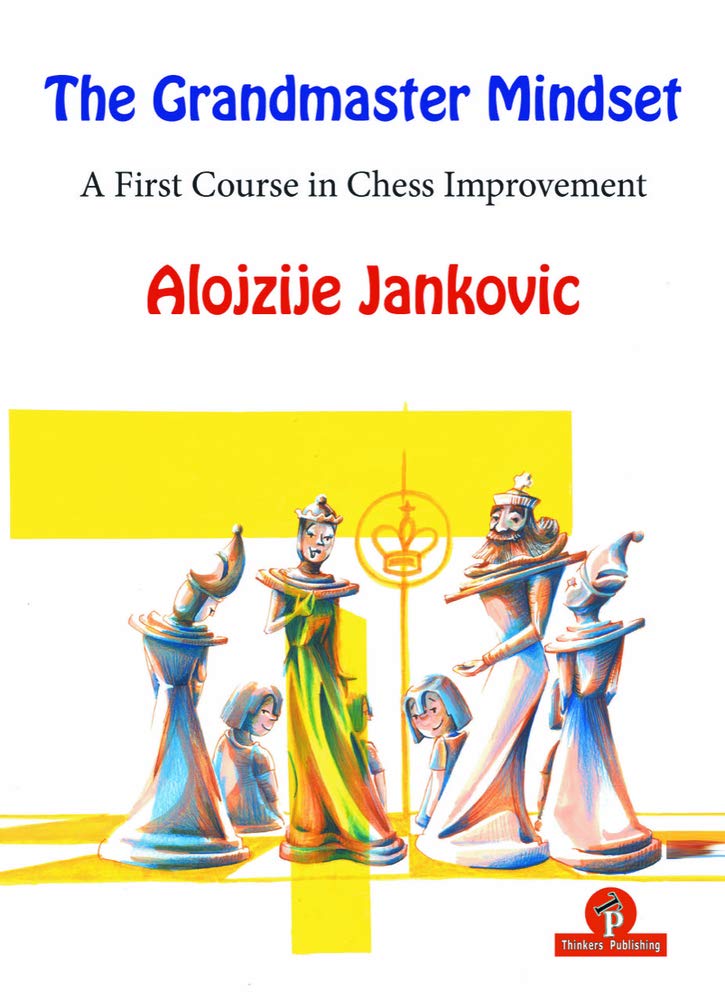
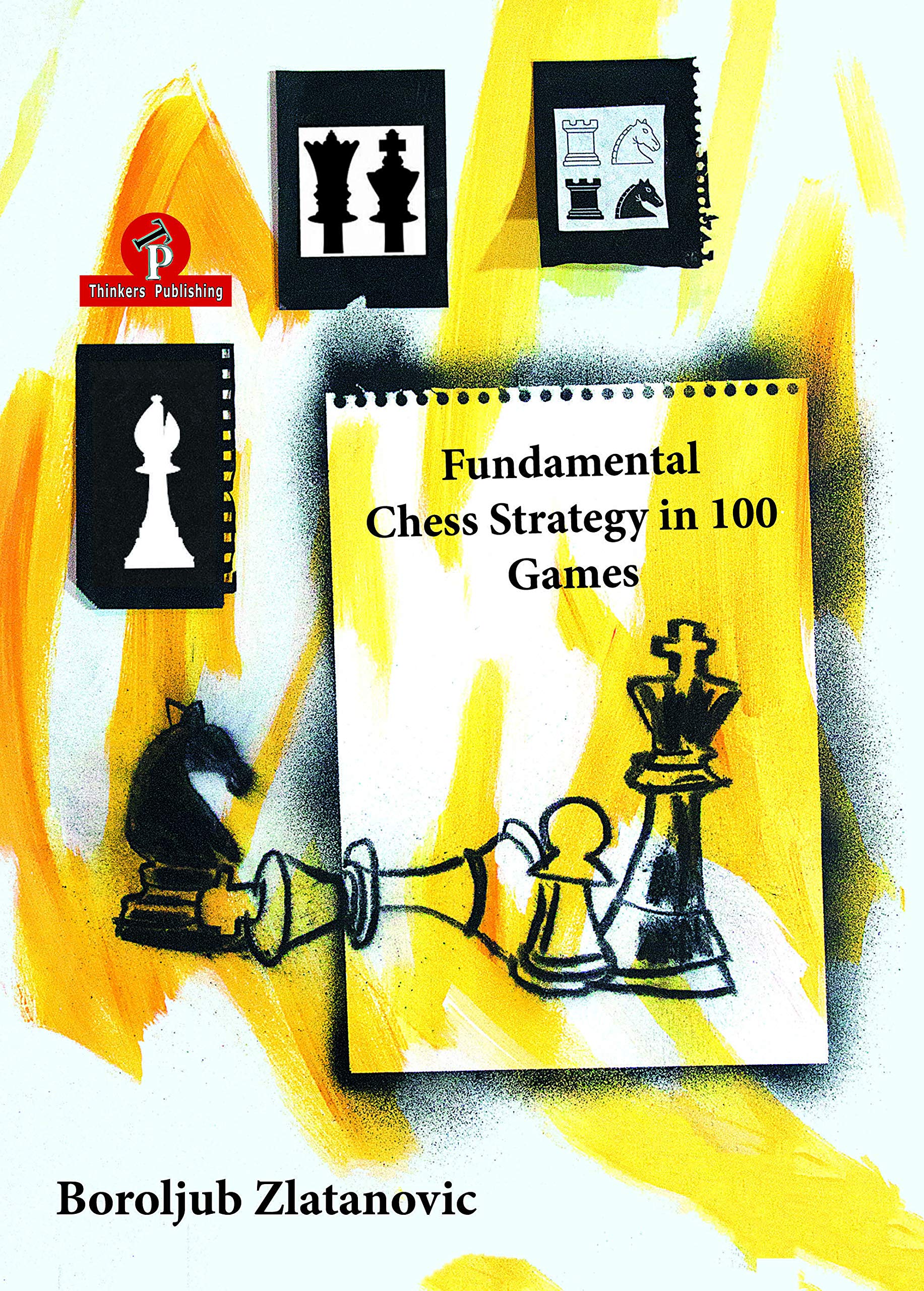
The Grandmaster Mindset

The Grandmaster Mindset

From the book’s rear cover :

“By going through the chapters, you will get acquainted with my way of grandmaster type thinking. I can assure you of one thing: there are better and weaker grandmasters, but you won’t find a GM who is playing without ideas or, let’s say, without his way of thinking! As you will find out, I am basically trying to detect the problem or goal of the position and then I am starting to scan factors which can lead to the solution. That process you will find in many examples in the book. GM Alojzije Jankovic, April 2020.”

“Alojzije Jankovic (1983) is a Grandmaster and FIDE trainer from Croatia. In 2010 he shared first place in the Croatian National Championship, was national champion in 2015, shared third place with Croatia in the European Team Championships 2017 and played for Croatia in the Chess Olympiad. He won several international tournaments and also hosts weekly the broadcast ‘Chess commentary’, Croatian national tv, third channel. This is his second book for Thinkers Publishing, after his successful co-edition with GM Zdenko Kozul on the ‘Richter Rauzer Reborn‘ updated version 2019.”

GM Alojzije Jankovic

As with every recent Thinkers Publishing publication high quality paper is used and the printing is clear. The book can easily be laid flat next to the board and does not require weights to prevent it from “self-closing” (a particular bugbear of ours !). Each diagram is clear and the instructional text is typeset in two column format, which, we find, enables the reader to maintain their place easily. Figurine algebraic notation is used throughout and the diagrams are placed adjacent to the relevant text and each diagram has a “to move” indicator.

A bibliography of sources along with suggestions for further reading would have been helpful.


I was rather confused when I first saw this book. The title, The Grandmaster Mindset, suggests a book for advanced players , while the subtitle A First Course in Chess Improvement suggests a book for novices.

Let’s take a look inside and find out.

The first chapter concerns pins. We start off with Légal’s Mate, which is important for novices but hardly necessary for advanced players.

En passant, we learn what Jankovic means by the Grandmaster Mindset. First, you assess the position, just as recommended by many other authors, such as Silman. Then you look for candidate moves: you consider all checks, captures and threats, as recommended by Kotov and many others, including me, over the past half century or so. Other authors, notably Willy Hendriks, will tell you to ignore protocols of this nature, to use your intuition and ‘move first, think later’.

We soon find ourselves in deeper waters, and by the end of the chapter we’re faced with a beautiful endgame study (M Matouš 1975) which is analysed in depth.

[pgn]

[Event “?”]
[Site “?”]
[Date “????.??.??”]
[Round “?”]
[White “?”]
[Black “?”]
[Result “*”]
[SetUp “0”]
[FEN “n2Bqk2/5p1p/Q4KP1/p7/8/8/8/8 w – – 0 1”]
[PlyCount “25”]

1. Qc8 Kg8 2. Bc7 Qxc8 3. gxf7+ Kh8 4. Be5 Qc5 5. Bb2 Nc7 6. Ba1 a4 7.
Bb2 a3 8. Ba1 a2 9. Bb2 a1=Q 10. Bxa1 Nd5+ 11. Ke6+ Nc3 12. Bxc3+ Qxc3 13.
f8=Q# *

[/pgn]

The second chapter, Candidate Moves, only seems to repeat the lessons from Chapter 1: if you assess the position and look for forcing moves you can find brilliant queen sacrifices.

Chapter 3, the longest in the book, brings with it a change of scenery. Useful endings: we have some pawn endings, rook against pawn, queen against rook, the bishop and knight checkmate explained in some detail, and finally rook against knight, again at length.

We’re back to tactics in Chapter 4, Knight Geometry.

[fen]8/1p1q1pk1/pPpNp2p/2PnPpr1/7Q/R5PP/P4P1K/8 w – – 0 44[/fen]

This is Zvjaginsev-Schwarz (Novi Sad 2016).

White won with the aesthetically pleasing 44. Rxa6!! bxa6 45. b7 Qd8 46. Qxh6+!! Kxh6 47. Nxf7+. Beautiful, to be sure, with symmetrical major piece sacrifices on a6 and h6, but the queen sacrifice wasn’t necessary: 45. f4 Rg6 46. b7 was just as effective. (Note that 44. f4 also worked, but not, in the game, 46. f4? Qa5! and Black has a perpetual.) Perhaps this might have been mentioned.

The tactical ideas continue: Back Rank Mate (Chapter 5), Lure the King (Chapter 6: sacrificing a piece to expose the enemy king to danger), Unexpected Moves (Chapter 7: a collection of fairly random examples which you can discover by looking for Checks, Captures and Threats), Power of the Rooks (Chapter 8), Sudden Attack on the King (Chapter 9).

Chapter 10  is entitled Burying, which is a new one to me. The explanation, that it’s a very important tactical element when attacking the opponent’s king,  didn’t leave me much wiser. It seems to be something to do with taking away the king’s escape squares, but who knows?

[fen]r2q1rk1/pbpn2pp/1p1bp3/5p2/2NP4/1P1BP3/PBQ2PPP/3R1RK1 b – – 0 13[/fen]

In this position (Dizdarevic-Miles Biel 1985) Tony played a classic double bishop sacrifice: 13… Bxh2+! 14. Kxh2 Qh4+ 15. Kg1. Now after the immediate and obvious 15… Bxg2, 16. f3 defends. Instead, 15… Bf3!! (‘Burying!’) 16. Nd2 Bxg2!, and as the queen can no longer defend along the second rank, Black wins in short order.

There’s more to come: Underpromotion to a Knight in Chapter 11, and Different Tactical Motives in Chapter 12, but the whole book seems to me fairly random.

If you want to see some beautiful and spectacular chess, you’ll find a lot of great examples in this book: some hackneyed (the queen sac and knight fork from the 1966 Petrosian-Spassky match must have been in almost every tactics book for the past half century, and the Topalov-Shirov bishops of opposite colours ending for the past 20 years) but many unfamiliar.

Jankovic, by and large, explains his examples well and has an attractively friendly style of writing.

However, for this reviewer at least, the whole is rather less than the sum of its parts. With its mixture of elementary and advanced examples the book’s target market is not clear. The ‘Grandmaster Mindset’ advice (assess the position and consider candidate moves looking at checks, captures and threats) is far from original and, you might think, rather too simplistic. The contents seem fairly random (showy sacrifices, with some technical endings thrown in for good measure) but typical of what appears to pass for chess tuition in some circles. I’ll be writing a lot more about this at some point in the future.

It would require quite a lot of fleshing out, but there were potentially two much more useful books here. A book on finding tactical surprises, using the examples here but with the addition of exercises for the reader to solve. And then a much expanded version of Chapter 3 dealing with technical endings.

A qualified recommendation, then, but perhaps a missed opportunity which would have benefited from a more proactive approach from the publishers.

Richard James, Twickenham 13th August 2020

Richard James
. Richard James

Book Details :

  • Hardcover : 200 pages
  • Publisher:Thinkers Publishing; 1 edition (14 July 2020)
  • Language: English
  • ISBN-10:9492510774
  • ISBN-13:978-9492510778
  • Product Dimensions: 16.8 x 1.8 x 23.4 cm

Official web site of Thinkers Publishing

The Grandmaster Mindset