Remembering FM John Littlewood (25-v-1931 16-ix-2009)

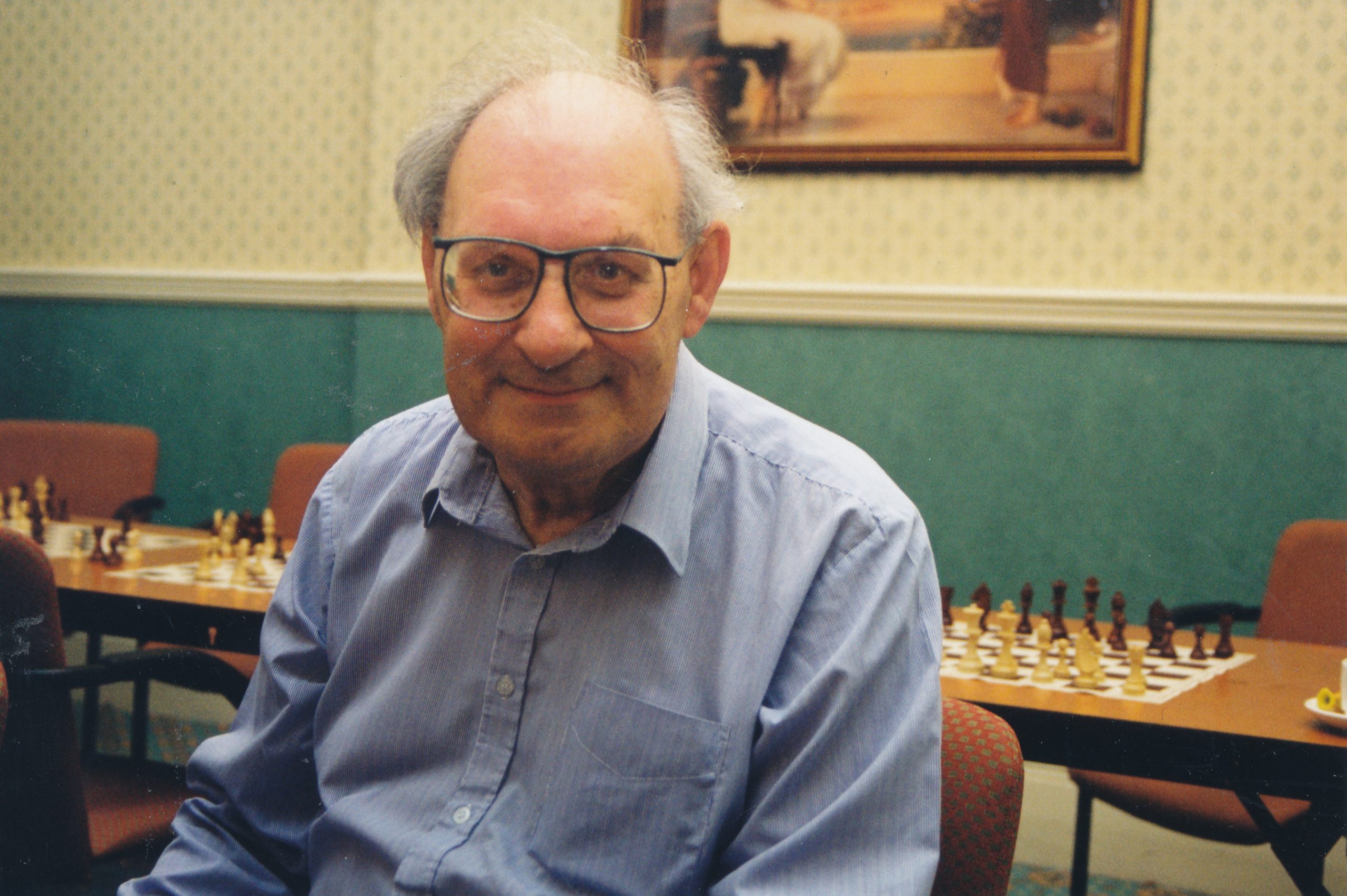
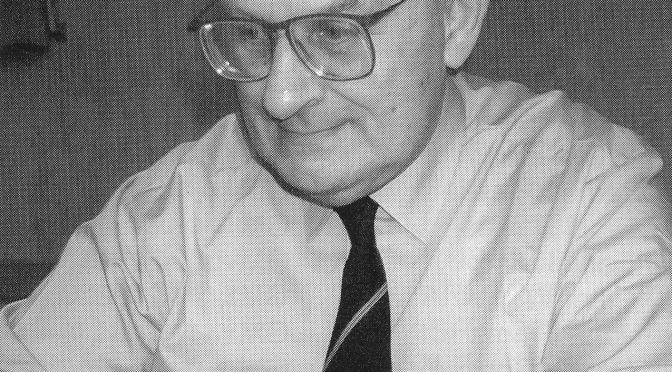
FM John Littlewood (25-v-1931 16-ix-2009) Source : BCM, 2009, October
FM John Littlewood (25-v-1931 16-ix-2009). Source : BCM, 2009, October

John Eric Littlewood was born in Sheffield on Monday, May 25th 1931. His mother’s maiden name was Wheeldon. He last resided in the WN8 postal area of Skelmersdale, West Lancashire.

He became a FIDE Master in 1989 at the age of 58. According to Felice (and ChessBase) his peak FIDE rating was 2395 in January 1980. However, it is certain that it would have been higher than that, in the 1960s and 1970s : more likely 2450 or possibly higher.
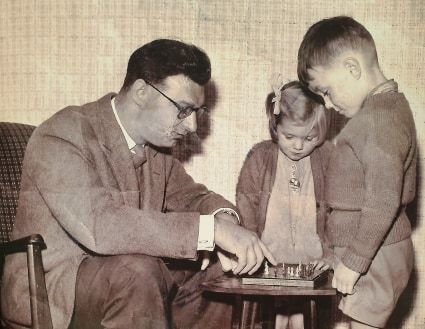
John, Jenny and Paul Littlewood, circa 1962. Kindly supplied by Paul Littlewood.

He coached his son Paul who became British Champion in 1981. His brother Norman was also a very strong player.
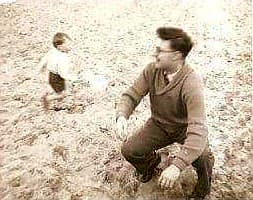
John and Paul on Skegness beach circa 1958. Kindly supplied by Paul Littlewood. George and Ringo are out of shot !

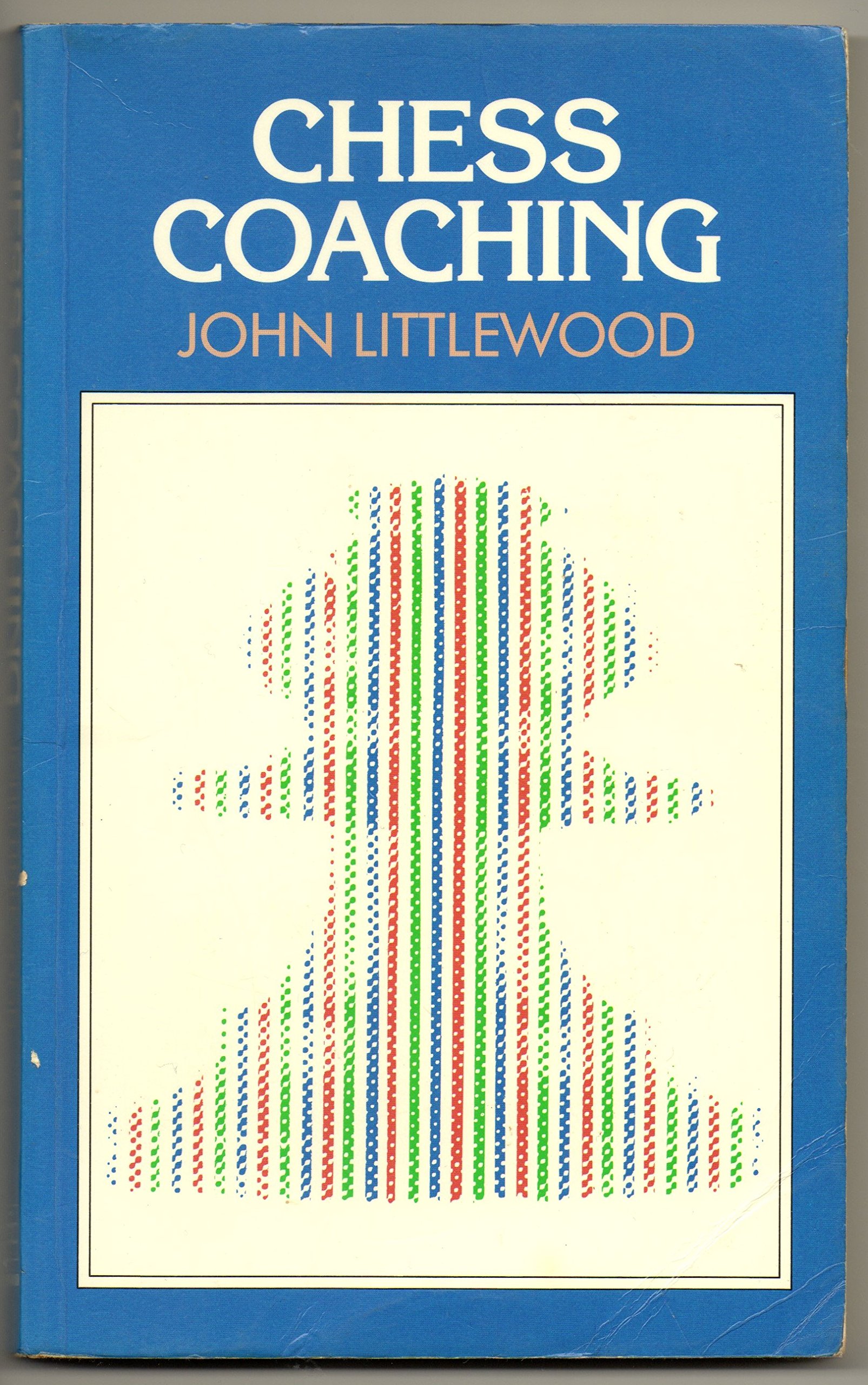
From “Chess Coaching” :

John Littlewood is a National Coach and the Director of Junior Chess to the British Chess Federation. He is a FIDE Master with national and international playing experience, and is an established chess writer, translator and journalist.
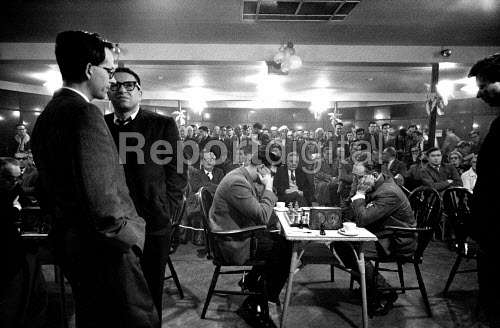
03-01-1962 37th Hastings International Chess Congress, 1962. World Champion Mikhail Botvinnik (R) playing against John Littlewood of England

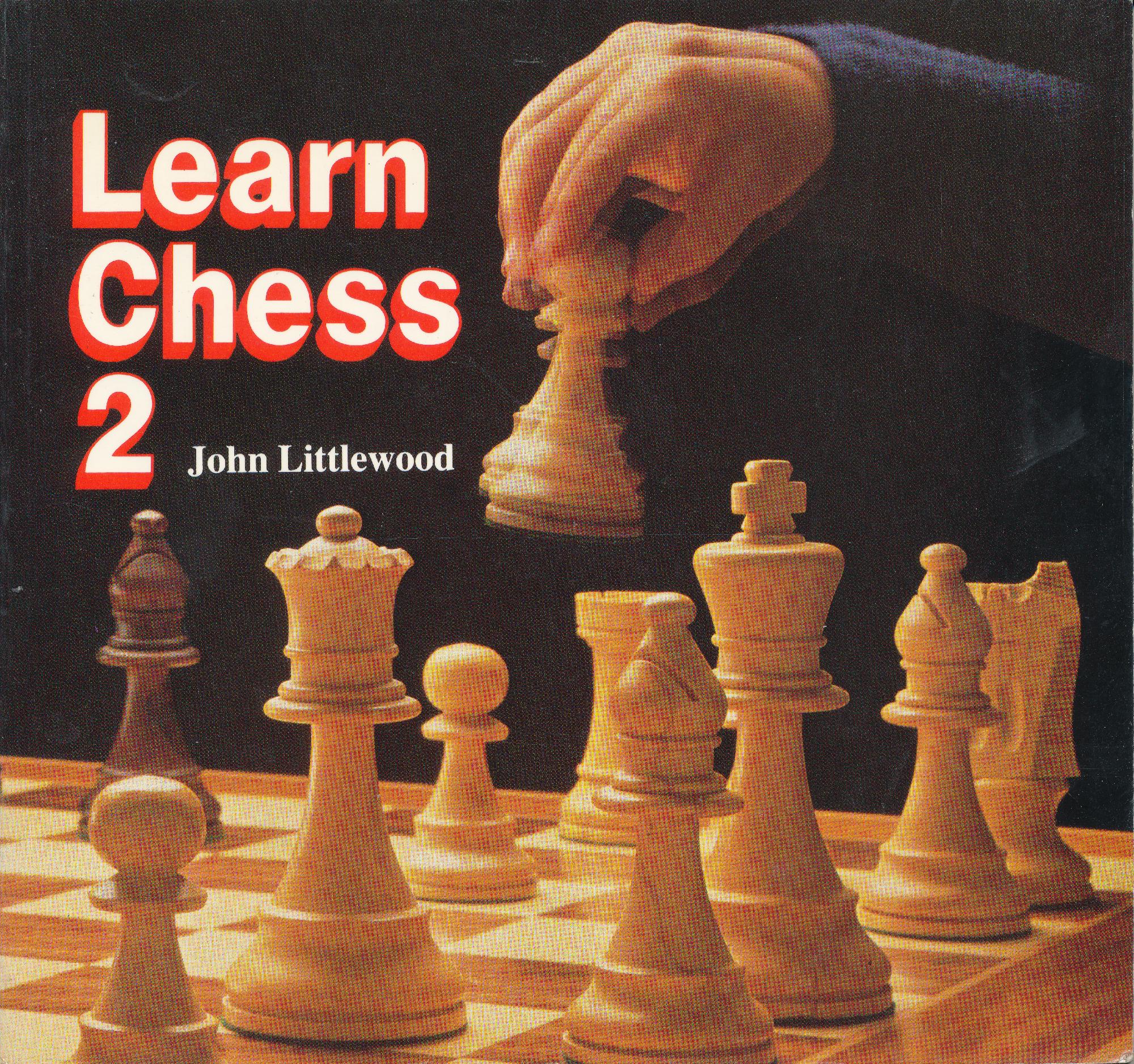
From “Learn Chess 2

“A British Master, formerly Northern Counties Champion and currently (1984) a National Coach for the British Chess Federation. John Littlewood has played for England in several international tournaments, including two Olympiads”
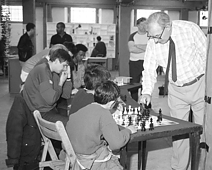
John Littlewood giving a simultaneous display

John wrote the “Test Your Chess” column in British Chess Magazine under the editorship of Murray Chandler

John Was Northern Counties Chess Union (NCCU) Champion in 1971, 1972, 1977, 1978, 1979, 1980 and 1981 : a record seven times !
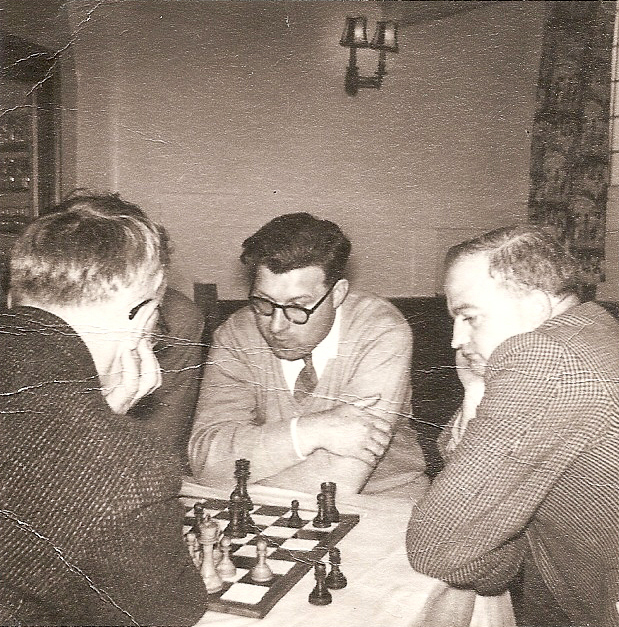
John with chess friends

[pgn]
[Event “Christmas Congress 1961/62-37 Premier”]
[Site “Hastings”]
[Date “1961.12.27”]
[Round “1”]
[White “Littlewood, John Eric”]
[Black “Gligoric, Svetozar”]
[Result “1-0”]
[ECO “C55”]
[Annotator “William Ritson Morry, John Saunders & BCN”]
[PlyCount “95”]
[EventDate “1961.12.27”]
[EventType “tourn”]
[EventRounds “9”]
[EventCountry “ENG”]
[SourceTitle “MCL”]
[Source “ChessBase”]
[SourceDate “1999.07.01”]
[SourceVersion “1”]
[SourceVersionDate “1999.07.01”]
[SourceQuality “1”]

{[%evp 0,95,19,38,25,7,30,29,28,3,36,3,-6,5,6,-11,12,8,22,-11,48,3,18,-3,13,-5,
28,-4,12,7,-3,-89,-57,-116,-74,-75,-2,-2,8,-50,-26,-28,-22,-93,-23,-23,-24,-32,
-20,-19,-23,-21,-20,-27,-15,-26,-13,-7,9,-11,-2,-6,11,-1,0,-7,0,-12,5,0,2,-53,
39,24,204,210,200,210,283,277,290,290,306,302,353,335,348,355,358,370,368,383,
389,361,353,350,405,362]} {This game was from round 1 of the Hastings Premier.
Before the round Tournament Judge (Arbiter) William Ritson Morry jestingly
asked John “How many unsound sacrifices are you going to make this year?” To
this he replied “None at all” So we must assume that all of the offers made to
Gligoric were completely sound despite the uncharitable scepticism of the
“knowledgeable” spectators. First annotated by WRM in February 1962 BCM, page
34 The in October 2009 BCM, page 539 by John Saunders} 1. e4 e5 2. Nf3 Nc6 3.
Bb5 a6 (3… d6 {Steinitz Defence}) 4. Ba4 d6 {Steinitz Defence Deferred} (4…
Nf6 5. O-O d6 {Steinitz Defence Doubly Deferred or Russian Defence}) 5. c3 Nf6
6. d4 Bd7 7. O-O Be7 8. Re1 O-O 9. Nbd2 Re8 10. Bb3 h6 11. Nf1 Bf8 12. Ng3 Bg4
$146 {[#] Not repeated since!} ({More usual is} 12… Na5 13. Bc2 c5) {
Littlewood now offered his Queen’s pawn with} 13. h3 (13. d5 Na5) 13… Bxf3
14. Qxf3 exd4 {and went for the King-side attack with} 15. Nf5 $5 $40 {and
after Gligoric took counter measures in the centre with} d5 (15… dxc3 16. Qg3
Kh8 17. Qh4 $40 {[%cal Gb3f7]}) {he tried to tempt him with a piece by} 16.
Bxh6 {Whether or not the sacrifice can be safely accepted Black preferred to
leave the analysts to decide} {and continued} Nxe4 ({If} 16… gxh6 {then
probably} 17. Qg3+ Kh8 18. exd5 Ne7 (18… Nxd5 $2 19. Rxe8 Qxe8 20. Bxd5) 19.
Nxd4 Nexd5 $17) 17. Bf4 Ne5 (17… dxc3 $142 18. bxc3 Ne5 19. Qd1 c6 $17) 18.
Bxe5 Rxe5 {John develops his last piece.} 19. Rad1 (19. cxd4 Re6) 19… Qd7 {
[%csl Gf5]} 20. Nxd4 Rae8 $15 {WRM : which not only repelled attack but also
obliged White to offer the exchange of queens. JS : Black has eschewed the
proffered material in order to reach a more than playable (arguably better)
position. Black threatens c5 and he takes over the initiative.} 21. Qg4 (21.
Rxe4) (21. a3) 21… Qxg4 ({JS : Here Fritz interjects with} 21… Nf6 22. Rxe5
{(forced)} Nxg4 23. Rxd5 Bd6 24. hxg4 Qxg4 $17 {and concludes the Black is
simply winning. It is perhaps not quite that straightforward, as White seems
to have active pieces.}) 22. hxg4 c6 {WRM : whereupon everyone expected
Gligoric to reach an advantageous ending since his Queen’s side majority was
much more valuable than White’s crippled King side.} 23. f3 Nc5 {[%cal Ge5e1]}
24. Rxe5 Rxe5 25. Bc2 g6 26. Kf2 Bg7 {Let us pause here and consider the
position….} 27. a4 {to stymie the b7 pawn.} Re7 28. a5 Be5 29. b4 Nd7 {
threatening c5 and smashing up White’s structure.} 30. Bb3 $11 Nf8 31. Rd3 (31.
g3) {WRM : and now Black played} 31… Kg7 {quite unconscious of the subtle
trap which was being laid for him.} {After} 32. Ne2 Ne6 33. c4 dxc4 34. Bxc4 {
[#]} {Black was now in time trouble and played} Nc7 {which Ritson Morry
(erroneously) gives a ?? annotation.} ({Better was} 34… Bf6) 35. f4 {Which,
at first sight, appears very strong.} Bb2 (35… Ba1 {WRM : similarly fails} {
against} 36. Ra3 {etc.} {Actually Black is OK after} Re4 37. Bxa6 Nxa6 38. Rxa1
Rxb4 $15) ({However, Black should continue} 35… Bxf4 $1 36. Nxf4 Re4 {
[%cal Ge4f4,Ge4c4]} 37. Ne6+ (37. g3 Rxc4 38. Rd7 Nd5 39. Nxd5 cxd5 40. Rxb7
Kf6 $11 {JS}) 37… Nxe6 38. Bxe6 Rxe6 39. Rd7 {and Black is OK.}) 36. Rb3 {
BCN : and the real blunder was now made by Black} Re4 $2 (36… Ba1 37. Rb1 Re4
38. Bd3 Bd4+ 39. Kf1 Re3 {and Black remains in the game according to BH Wood
in CHESS.}) 37. Bd3 $18 {and Black is lost} Bd4+ 38. Kf1 Re3 39. Nxd4 {WRM :
and “nine more moves ended Black’s misery”} Nd5 40. Kf2 Re7 {BHW : “With
characteristic calmness, Littlewood although he had plenty of time, carried on
playing at full speed. No scurrying for the adjournment!”} 41. g3 Rd7 42. Nc2
Nf6 43. Kf3 Rd5 44. g5 Ne8 45. Ne3 Rd4 46. f5 Nd6 47. Bc2 Ne8 48. f6+ {JS : In
some ways, this game does not conform to the stereotypical image of a John
Littlewood game. Though he initially tried to go for all-out attack., his
sacrificial attempts were rebuffed and it actually seems to have been his calm,
accurate positional play between moves 22 and 34 which lured his illustrious
opponent into trouble.} 1-0
[/pgn]

John won the Appleby-Frodingham Chess Club tournament in 1962 with 3.5/5 :
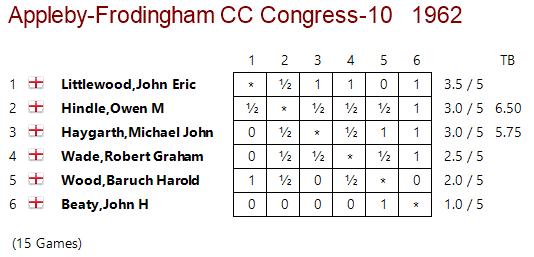
Appleby-Frodingham Tournament of 1962 crosstable

and then, in the same year came 3= in the British Championships with 7.5/11 :
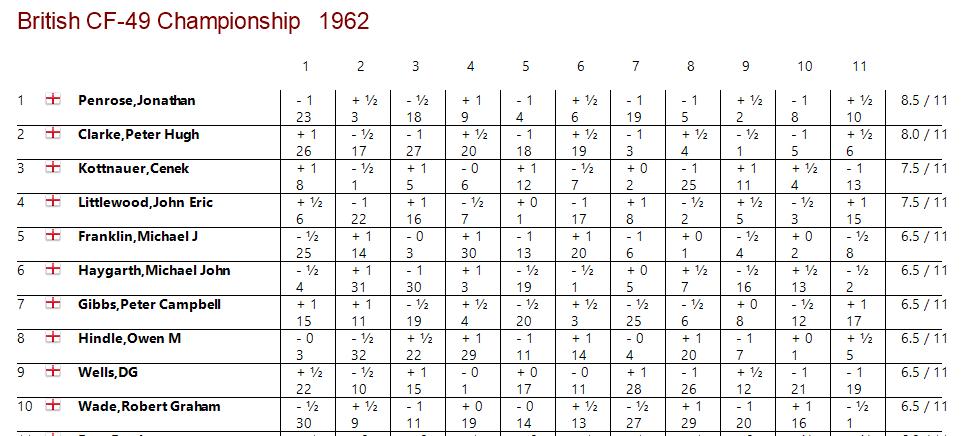
Truncated crosstable from the 1962 British Championship in Whitby

and in 1969 in Rhyl John was unfortunate not to share the title with Dr. Jonathan Penrose after losing to Frank Parr in the final round :
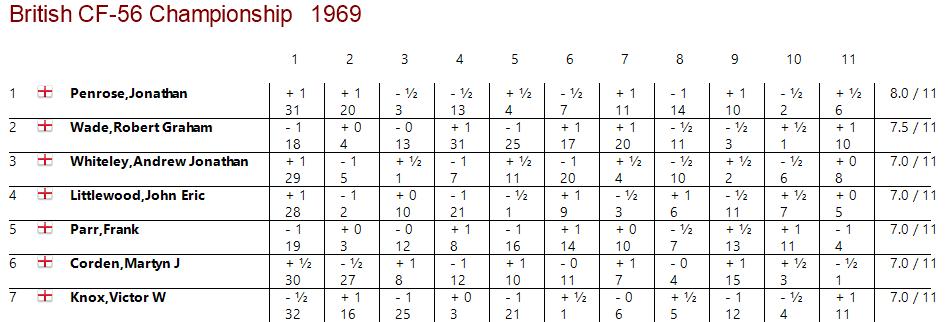
Truncated crosstable of the British Championships of Rhyl 1969
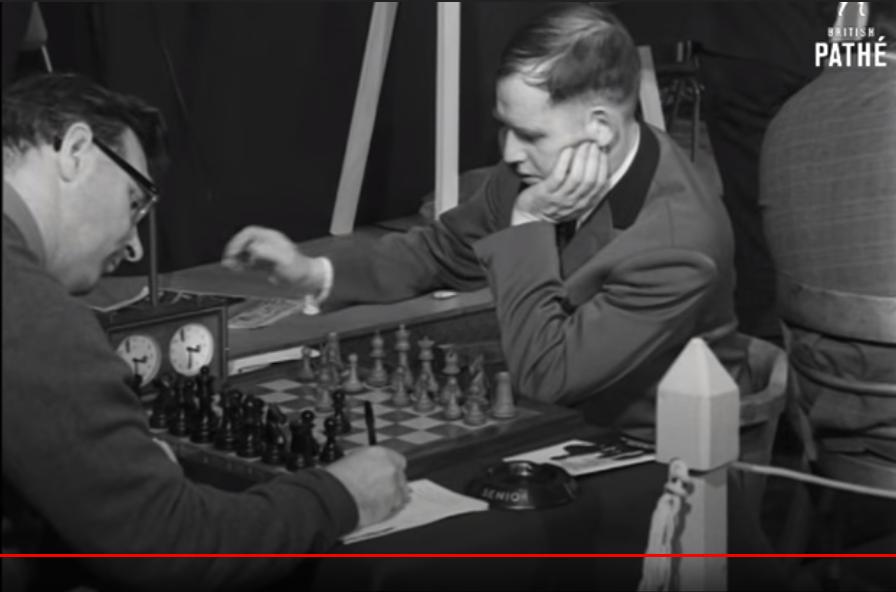
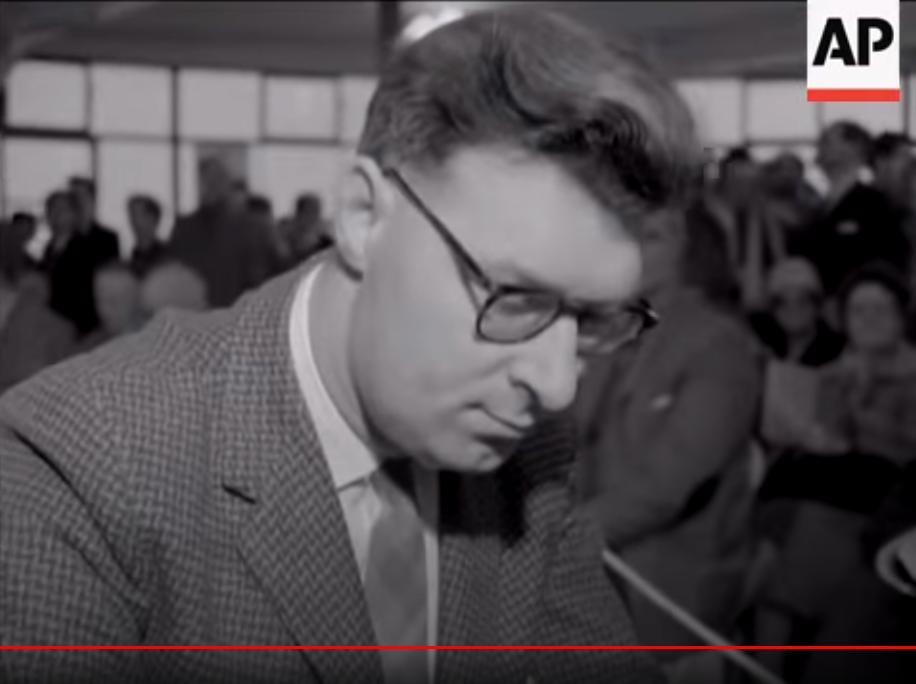
John Littlewood at Hastings 1963-4. Still taken from Pathe news reel footage
John Littlewood playing Wolfgang Unzicker in round one of the 1969-70 Hastings International Congress

John won the Southport Open in 1972 and the picture below was taken shortly afterwards :
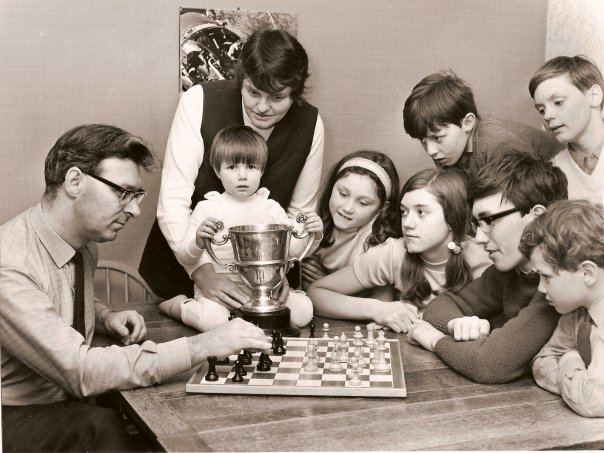
John and family following winning the 1972 Southport Open. See the BCM article below for a full caption

John won the Chorley tournament of 1977 with 7/9
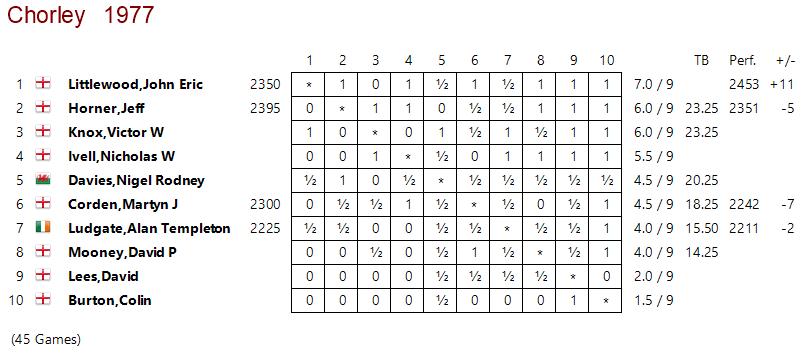
Chorley 1977 tournament crosstable

JEL won the British Chess Federation’s President’s Award in 2000.
[pgn]
[Event “Christmas Congress 1961/62-37 Premier”]
[Site “Hastings”]
[Date “1962.01.03”]
[Round “7”]
[White “Bisguier, Arthur Bernard”]
[Black “Littlewood, John Eric”]
[Result “0-1”]
[ECO “D07”]
[Annotator “John Littlewood, John Saunders, Andrew Martin & BCN”]
[PlyCount “56”]
[EventDate “1961.12.27”]
[EventType “tourn”]
[EventRounds “9”]
[EventCountry “ENG”]
[SourceTitle “MCL”]
[Source “ChessBase”]
[SourceDate “1999.07.01”]
[SourceVersion “1”]
[SourceVersionDate “1999.07.01”]
[SourceQuality “1”]

{[%evp 0,46,20,27,19,16,27,-11,25,19,4,21,21,29,30,33,48,14,18,54,55,52,52,20,
34,22,19,32,40,28,36,-16,-21,-93,-25,-463,-463,-821,-887,-887,-868,-887,-879,
-1206,-1206,-29987,-29988,-29989,-29990]} 1. d4 {Annotations from BCM, 1962,
February, page 59 and BCM, 2009, October, page 540.} d5 2. Nf3 (2. c4 e5 {
was JELs intention.}) 2… Nc6 $1 {JL: Amusingly enough, Bisguier had played
his 2nd move to prevent the Albin Counter Gambit, and he grinned when he
thought I was still intent upon this design, However, on the spur of the
moment I decided to pay a tribute to the other two Russians in the tournament
by adopting the unusual Tchigorin Defence.} 3. c4 Bg4 4. cxd5 {A surprise for
me.} ({I had expected} 4. Qa4 {the move Alekhine had played in two games
against Colle, and I was planning to try out Bronstein’s idea of} {(after} Bxf3
5. exf3 e6 6. Nc3 {)} Nge7 $1 {followed by 7…g6}) 4… Bxf3 (4… Qxd5 5. Nc3
Qd7 6. e3 {is another possibility}) 5. gxf3 (5. dxc6 Bxc6 6. Nc3 e6 7. e4 Bb4
8. f3 f5 {As played by Tchigorin against Pillsbury (St. Petersburg, 1895)} {
then} 9. Bc4 fxe4 10. O-O $1 {JEL : (Karelov – Aronson, Lenningrad, 1958)
seems a strong continuation for White, pointed out to me recently by the young
Sheffield player JE Scholes.}) 5… Qxd5 6. e3 e5 {BCN : Justifying Nc6 and
the main raison d’être of the Chigorin Defence. JEL : I am now committed to
giving up my other Bishop for a Knight, but this sets the stage for an
interesting struggle.} (6… e6 {JEL : on the other hand, and would probably
lose.}) 7. Nc3 Bb4 8. Bd2 Bxc3 {BCN : more or less forced other e4 and d5 will
happen.} 9. bxc3 exd4 {quick development is the order of the day.} ({BCN :
Nowadays Morozevic’s is the preferred idea anticipating d5 and e4.} 9… Qd6
10. Rb1 (10. Rg1 g6 11. Qb3) 10… b6 11. f4 exf4 12. e4 Nge7 13. Qf3 O-O 14.
Bxf4 Qa3) (9… Nge7 {is the older move which is less popular these days.}) (
9… O-O-O) (9… Qd7 {Richard Rapport}) 10. cxd4 Nf6 {[#] JEL : A fascinating
position, White’s two Bishops and three half-open files seem at first sight to
give him an overwhelming advantage, but matter are not so simple. Black
controls the centre and means to increase this control in the next few moves,
thereby restraining White’s weakened “huddle” of pawns. The Bishop’s need room
: it is Black’s job to see that they don’t get it. In my opinion, chances
are even. Theory, however, gives White the preference, although in the only
games I have seen quoted supporting this view, Black (Fichtl and Dückstein)
played the artificial 10…Nge7, a move based on fear.} (10… Nge7 {JEL : A
move based on fear.}) 11. Rb1 {JEL : This move is indicative of White’s
over-confidence in his position.} ({He would be better advised to see to the
centre by} 11. Be2 O-O 12. O-O Rad8 13. Bc3 {threatening e4. Even then,
however, Black can maintain pressure by 14….Qe6! as 15} Qe6 {as} 14. e4 Nxd4
15. Bxd4 c5 {would be obviously bad for White.}) 11… O-O (11… O-O-O {
would be very brave indeed!}) 12. Be2 Rfe8 ({Strangely enough, as I discovered
later, this same position has occurred in a game Tarrasch-Schiffers (Nuremberg,
1896), where Black here played} 12… Qxa2 {and the game continued} 13. Rxb7
Rab8 14. Rb5 Rxb5 15. Bxb5 Rb8 16. Bd3 Rb2 17. Qc1 g6 18. Bc4 {with better
end-game prospects for White. It seems more logical to complete development
before “mixing it” in this way.}) 13. O-O ({If now} 13. Rxb7 {then} Nxd4 {
is good for Black}) (13. Rg1 Qxa2 14. Rxb7 Nxd4 15. exd4 Rxe2+ 16. Kxe2 (16.
Qxe2 Qa1+ 17. Qd1 Re8+ 18. Be3 Qa5+ 19. Qd2 Qa1+ 20. Qd1 Qa5+ 21. Kf1 Qa6+ 22.
Qe2 Qxb7 $17) 16… Qa6+) 13… Rad8 {Black has now completed his development
and is ready to gobble up White’s Queen’s Rook’s pawn} 14. a4 {[%cal Gb1b5]
taking the pawn off prise and setting up ideas of Rb5.} (14. Rxb7 {would lose
to} Nxd4) 14… Rd6 15. e4 $5 {Bisguier now realises he is drifting into a
lost postion, so he courageously takes the bull by the horns.At the costs of a
pawn , he hopes to exploit the end game advanatge of the two Bishops.} (15. Rb5
Qe6 {[%cal Ge6h3]} 16. Rxb7 $2 Qh3 $19 17. f4 Nd5 {[%cal Gd6g6]}) {Fortunately
I have better than taking the d-pawn.} 15… Qh5 $1 {This strong move reveals
just how weak White’s centre pawns are.} (15… Qxd4 {Indeed, after} 16. Bf4 {
Black’s initiative is snuffed out.} Qxd1 17. Bxd1 Rd7 18. Rxb7 {I prefer
White’s game.}) 16. d5 ({If now} 16. f4 Qg6+ {and} 17. Kh1 Qxe4+) ({If} 16. e5
Rxd4 17. exf6 Red8 18. Rb2 Rxd2 $1 19. Rxd2 Qg5+ 20. Kh1 Qxd2) ({After the
game Bisguier queried his 16th move and suggested the line} 16. Be3 Nxd4 17.
Bxd4 c5 18. Rxb7 cxd4 19. Bc4 {but after} Nd7 20. Qb3 Ne5 {Black stands far
better with mate in the offing.}) (16. Rb5 Qh3) 16… Nd4 (16… Nxd5 17. exd5
Rg6+ 18. Kh1 Nd4 $19 {[%cal Ge8e2]}) 17. Rxb7 {[#] What else?.} Nxe4 $1 ({
White is lost now, whatever he plays, so he sets a little trap. If} 17… Nxd5
$2 18. exd5 Nxe2+ 19. Qxe2 Rxe2 20. Rb8+ {is mating}) {White could now resign
but sportingly decides to give the spectators their money’s worth.} 18. Bf4 ({
If} 18. fxe4 Nxe2+ 19. Kg2 Qg4+ 20. Kh1 Qf3#) ({If} 18. Rb4 Rg6+ 19. Kh1 Qh3
20. Rg1 Nxf2#) 18… Rg6+ 19. Bg3 ({If} 19. Kh1 Qh3 20. Bg3 Rxg3 21. fxg3 Nxg3+
22. Kg1 Ndxe2+ 23. Kf2 Qxh2+ 24. Ke1 Nc3+ 25. Qe2 Rxe2#) 19… Nc3 20. Qd3
Ncxe2+ 21. Kh1 Qh3 {[%cal Gh3f1]} 22. Rfb1 Rxg3 23. fxg3 Nxg3+ {and White
resigned as it is mate in 5} {For example :} 24. Kg1 Nde2+ 25. Kf2 Qxh2+ 26.
Ke1 Nc3+ 27. Qe4 Qe2+ 28. Qxe2 Rxe2# {[%csl Gc3,Ge2,Gg3] Undoubtedly this was
my best game at Hastings. At the end of the game Bisguier asked “What do you
feed this guy on : raw meat !”} 0-1
[/pgn]

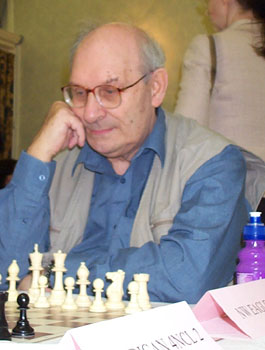
FM John Littlewood at 4NCL courtesy of Helen Milligan

In 2006 John won the BCF Veterans / Seniors title for the first time repeating the feat in 2008 sharing with George Dickson.

With the White pieces John almost exclusively played 1.e4 favouring the Wormald Attack, Open Sicilians and the Rossolimo variation.

As the second player John played the Closed Ruy Lopez, the Sicilian Dragon and the Grünfeld defence.

In the following video IM Andrew Martin discusses the game Bisguier – Littlewood, 1962.

[embedyt] https://www.youtube.com/watch?v=bXEc2gmBbRA[/embedyt]

[pgn]
[Event “Christmas Congress 1969/70-45 Premier”]
[Site “Hastings”]
[Date “1970.01.05”]
[Round “7”]
[White “Corden, Martyn J”]
[Black “Littlewood, John Eric”]
[Result “0-1”]
[ECO “C50”]
[Annotator “British Chess News”]
[PlyCount “104”]
[EventDate “1969.12.29”]
[EventType “tourn”]
[EventRounds “9”]
[EventCountry “ENG”]
[SourceTitle “MCL”]
[Source “ChessBase”]
[SourceDate “1999.07.01”]
[SourceVersion “1”]
[SourceVersionDate “1999.07.01”]
[SourceQuality “1”]

{[%evp 0,104,19,38,25,7,30,26,23,-33,34,48,56,61,39,46,37,32,32,35,46,38,13,
-137,-134,-125,-125,-134,-134,-134,-114,-105,-127,-107,-150,-128,-110,-110,
-102,-96,-96,-121,-121,-104,-101,-98,-119,-163,-164,-142,-165,-151,-158,-177,
-128,-140,-103,-99,-77,-68,-49,-25,55,46,70,35,0,0,0,0,0,0,0,0,0,0,0,0,0,0,
-228,-182,-461,-461,-395,-420,-437,-437,-437,-450,2267,-437,-437,-437,-294,
-437,-437,-437,-437,-706,-952,-960,-437,-1088,-1145,-1150,-1150]} 1. e4 e5 2.
Nf3 Nc6 3. d4 exd4 4. Bc4 d6 5. Nxd4 g6 6. Nc3 Bg7 7. Be3 Nf6 8. f3 O-O 9. Qd2
Ne5 10. Be2 d5 11. f4 Neg4 12. e5 Nxe3 13. Qxe3 c5 14. exf6 cxd4 15. Qxd4 Bxf6
16. Qd2 Be6 17. O-O Qb6+ 18. Kh1 Qxb2 19. Nxd5 Bxd5 20. Qxd5 Rad8 21. Qf3 Qxc2
22. Rac1 Qxa2 23. Bc4 Qb2 24. f5 g5 25. Rb1 Qd4 26. Rb4 Kg7 27. Qb3 b6 28. Bxf7
Qd2 29. Be6 Rd3 30. Qa4 Qe2 31. Qxa7+ Kh8 32. Rbb1 Rh3 33. Rbe1 Rxh2+ 34. Kxh2
Be5+ 35. Kg1 Bd4+ 36. Kh2 Qh5+ 37. Kg3 Qh4+ 38. Kf3 Qf4+ 39. Ke2 Qe3+ 40. Kd1
Qd3+ 41. Kc1 Qc3+ 42. Kd1 Rd8 43. Bd7 Qb3+ 44. Kd2 Qe3+ 45. Kd1 Qd3+ 46. Kc1
Be3+ 47. Kb2 Qd4+ 48. Kb3 Qd5+ 49. Kc2 Qc4+ 50. Kb2 Qd4+ 51. Ka3 Qc3+ 52. Ka4
b5+ 0-1
[/pgn]

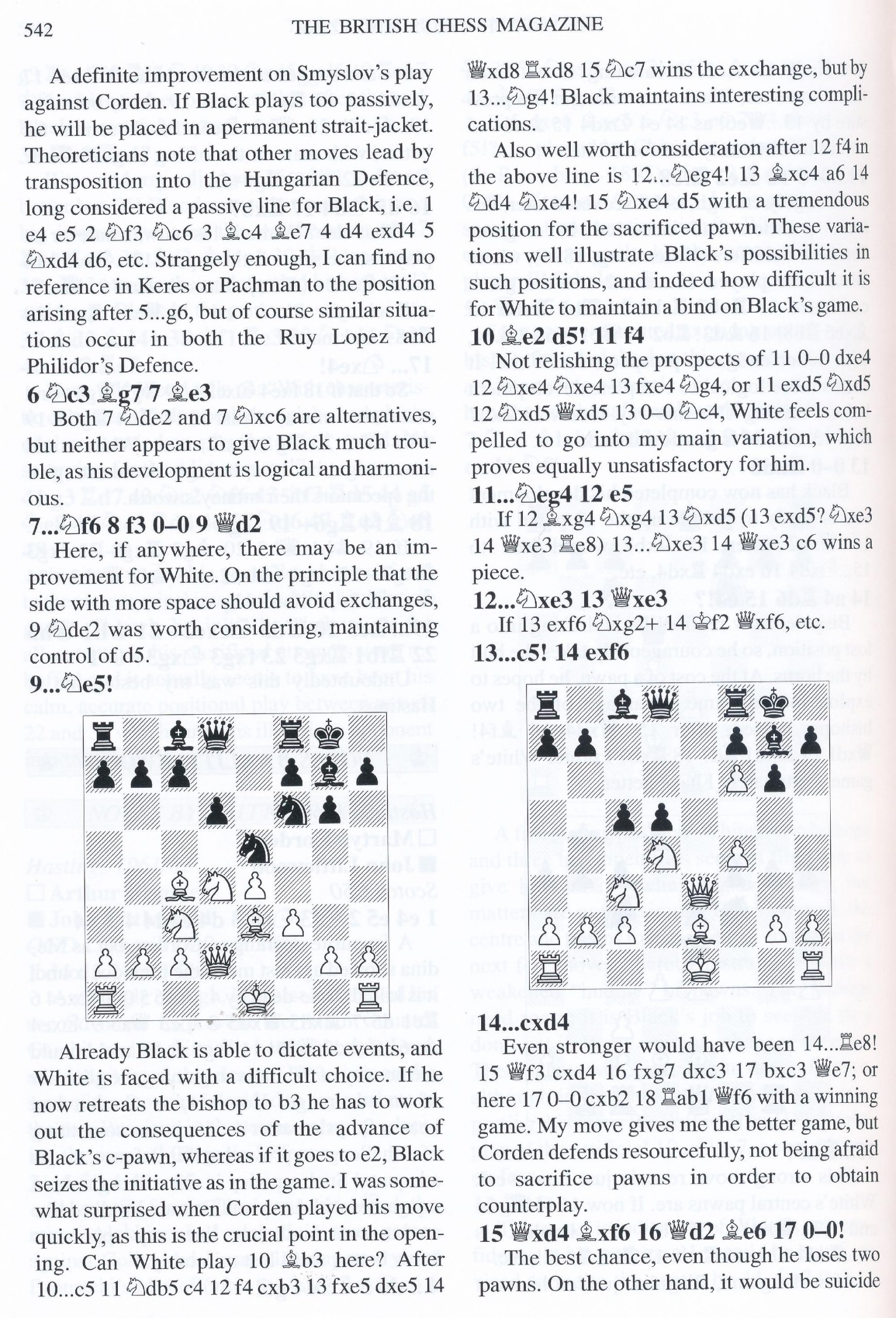
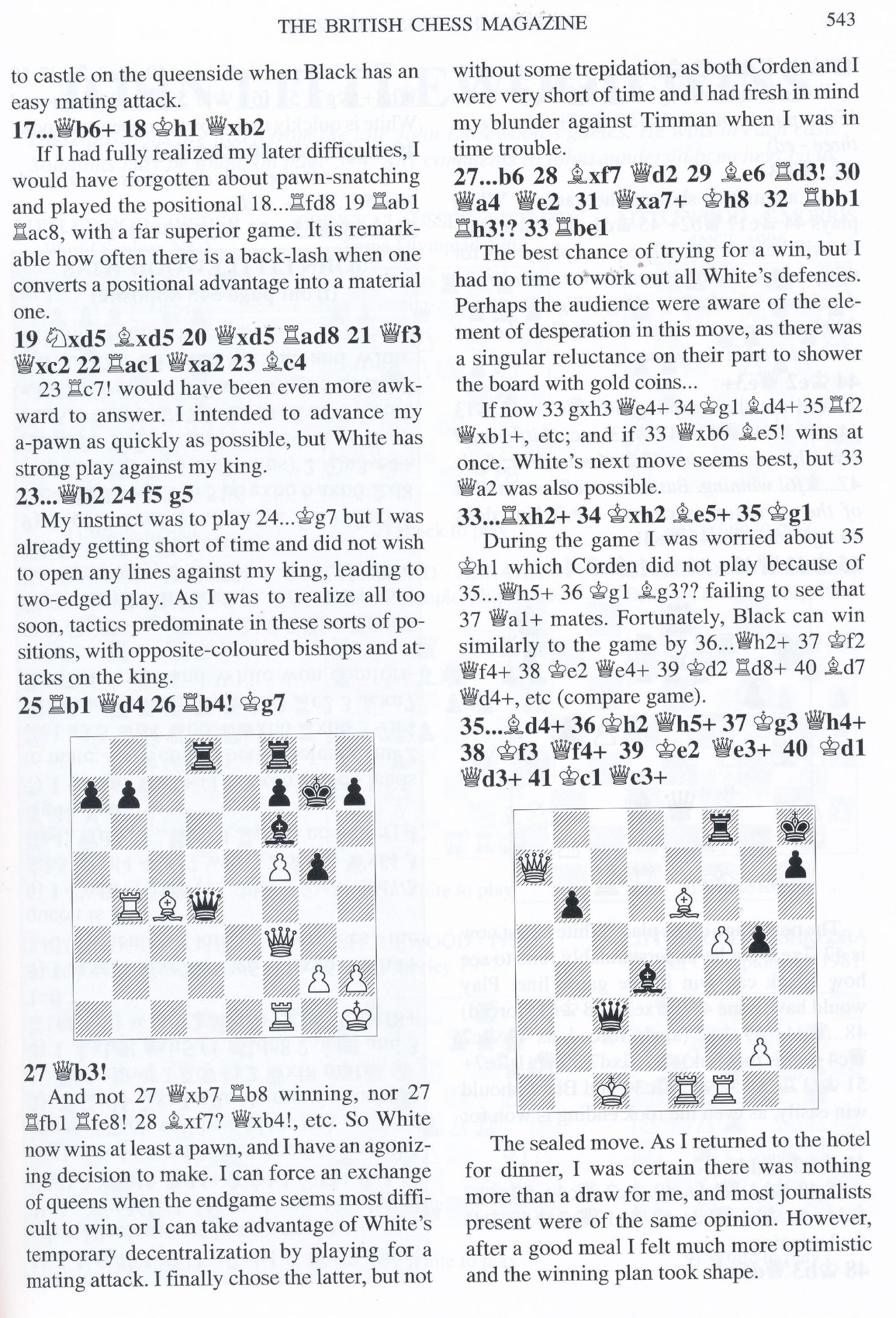
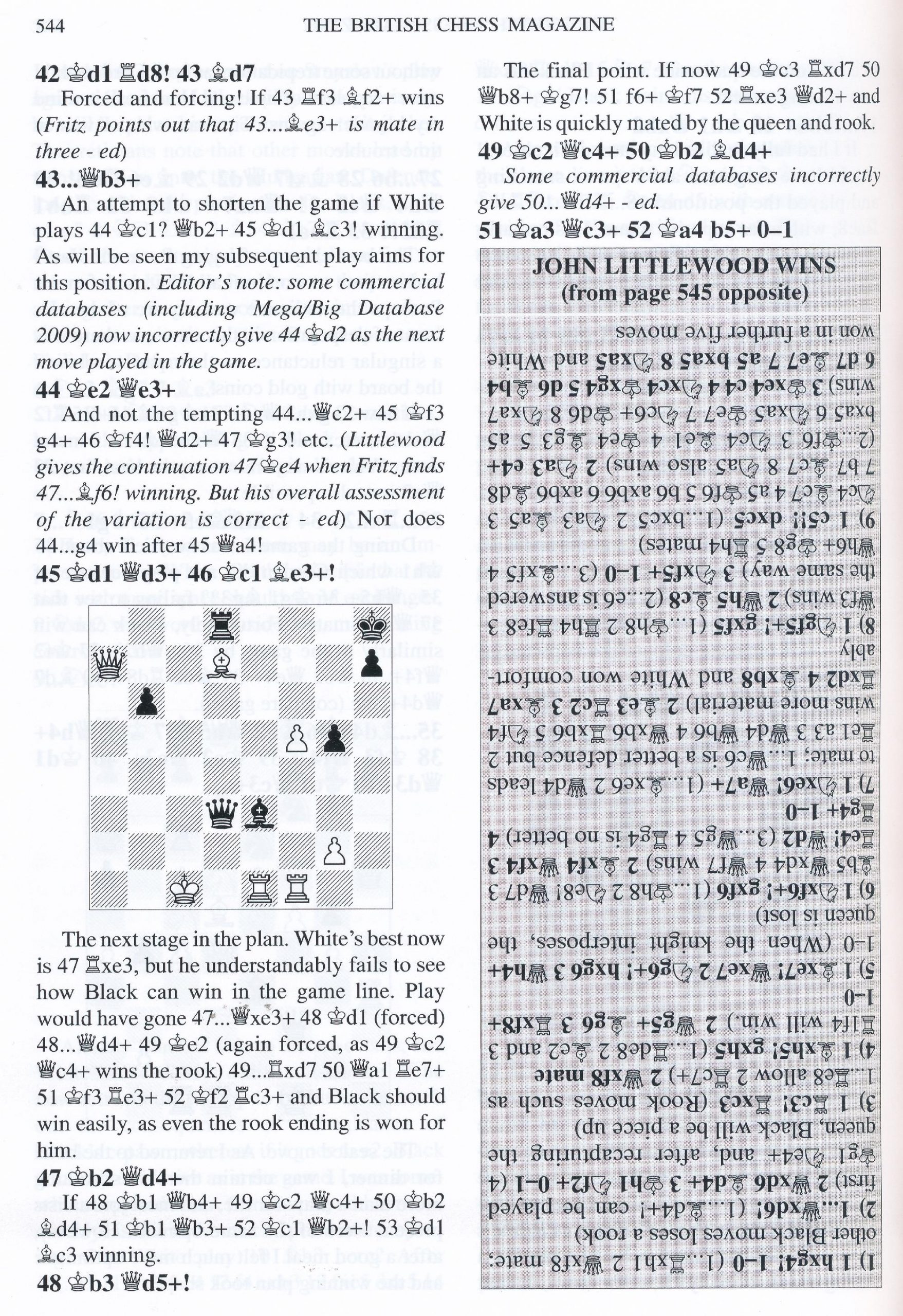
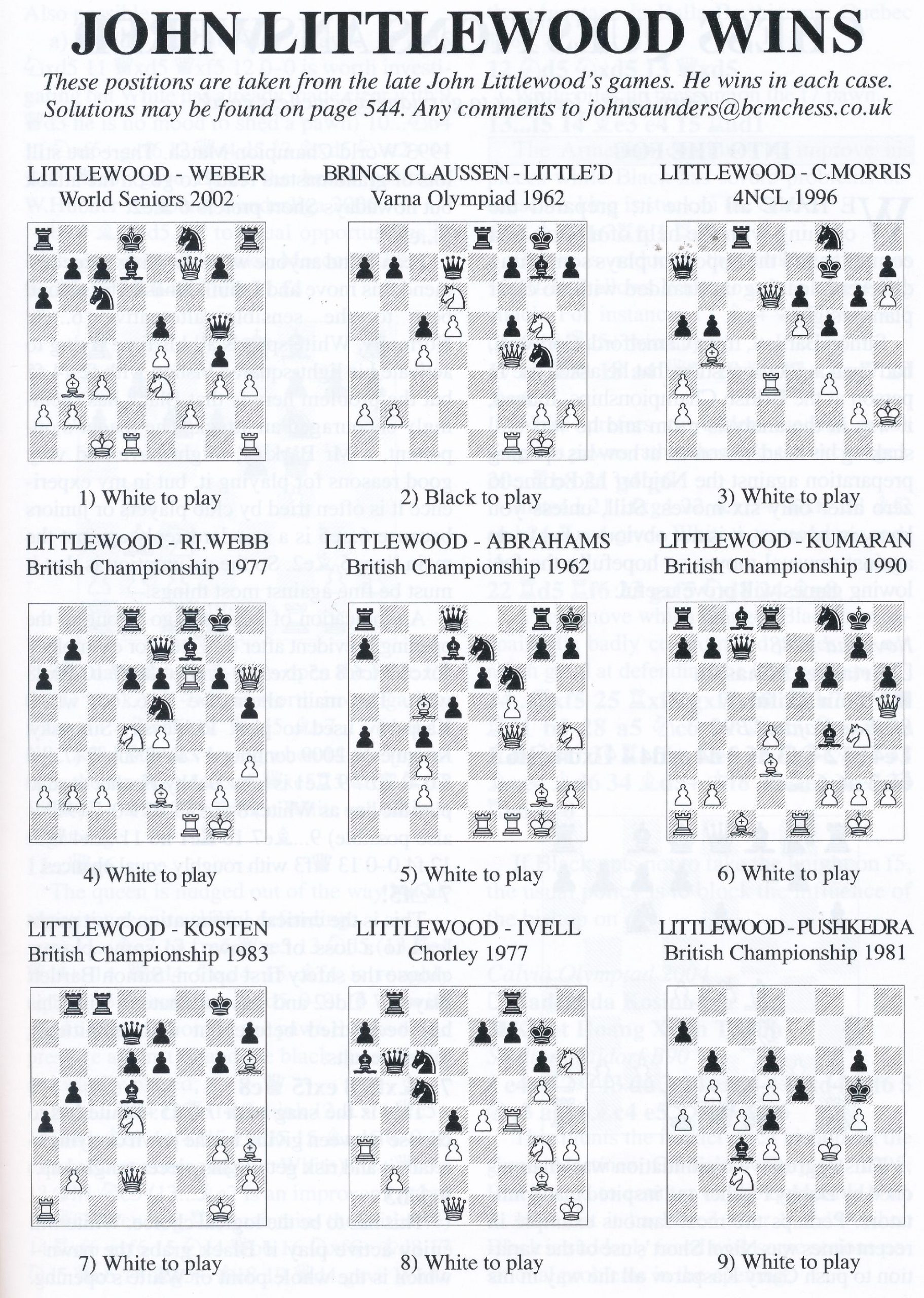
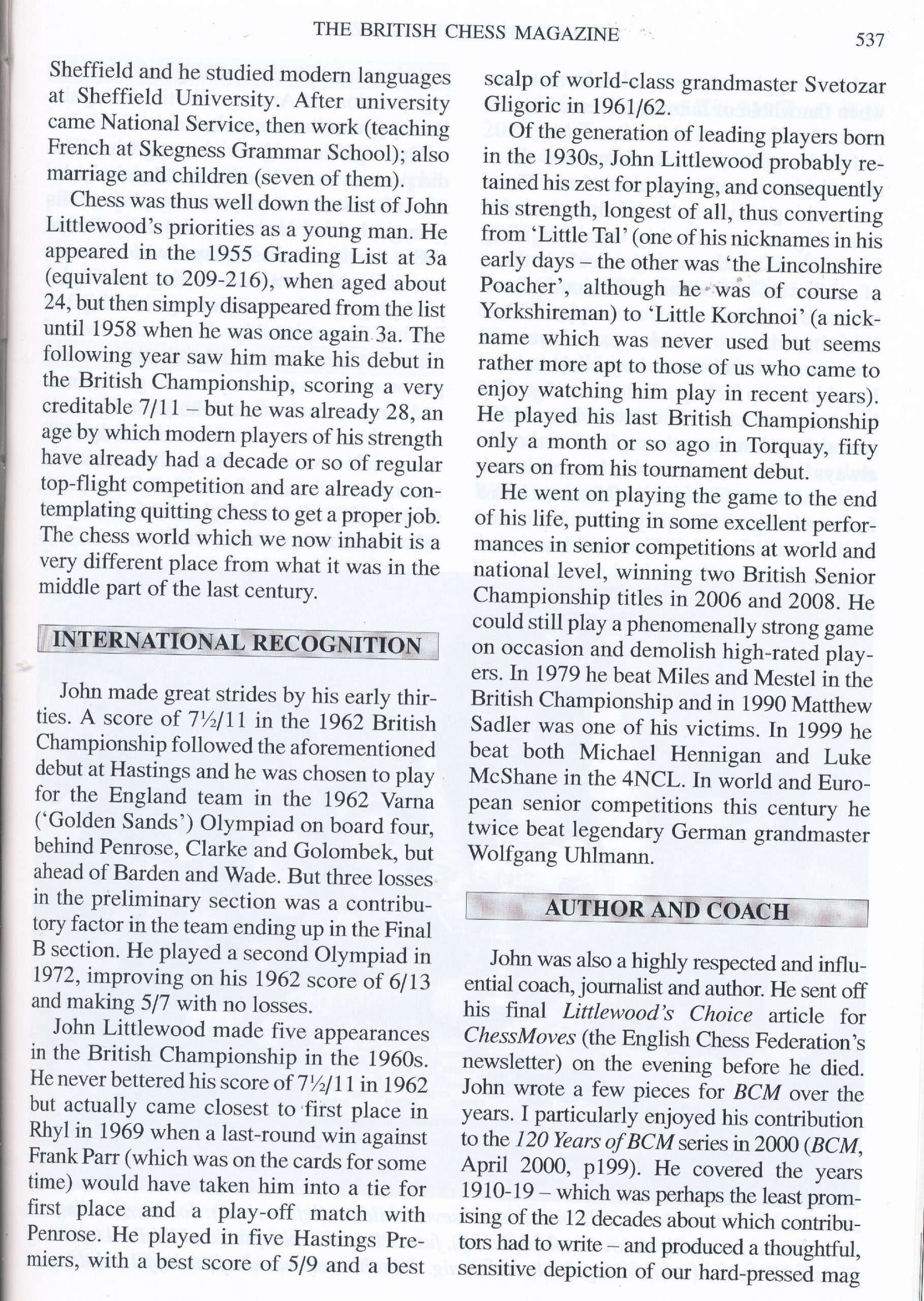
Rather than reinventing an already round wheel we reproduce the following ten page tribute in the October 2009 issue of British Chess Magazine. The tribute is by John Saunders :
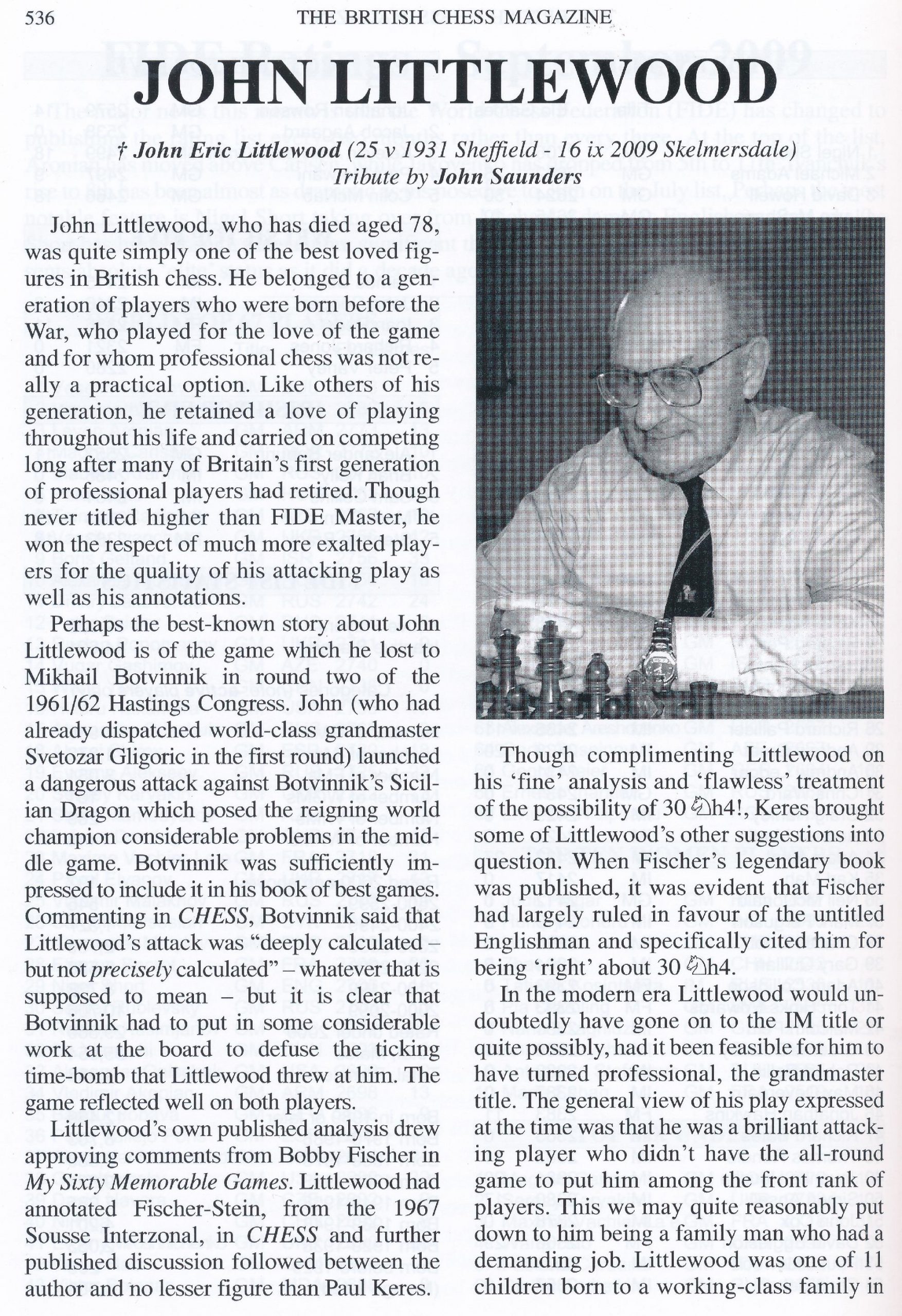
British Chess Magazine, Volume CXXIV (129), 2009, Number 10, October, page 536
British Chess Magazine, Volume CXXIV (129), 2009, Number 10, October, page 537
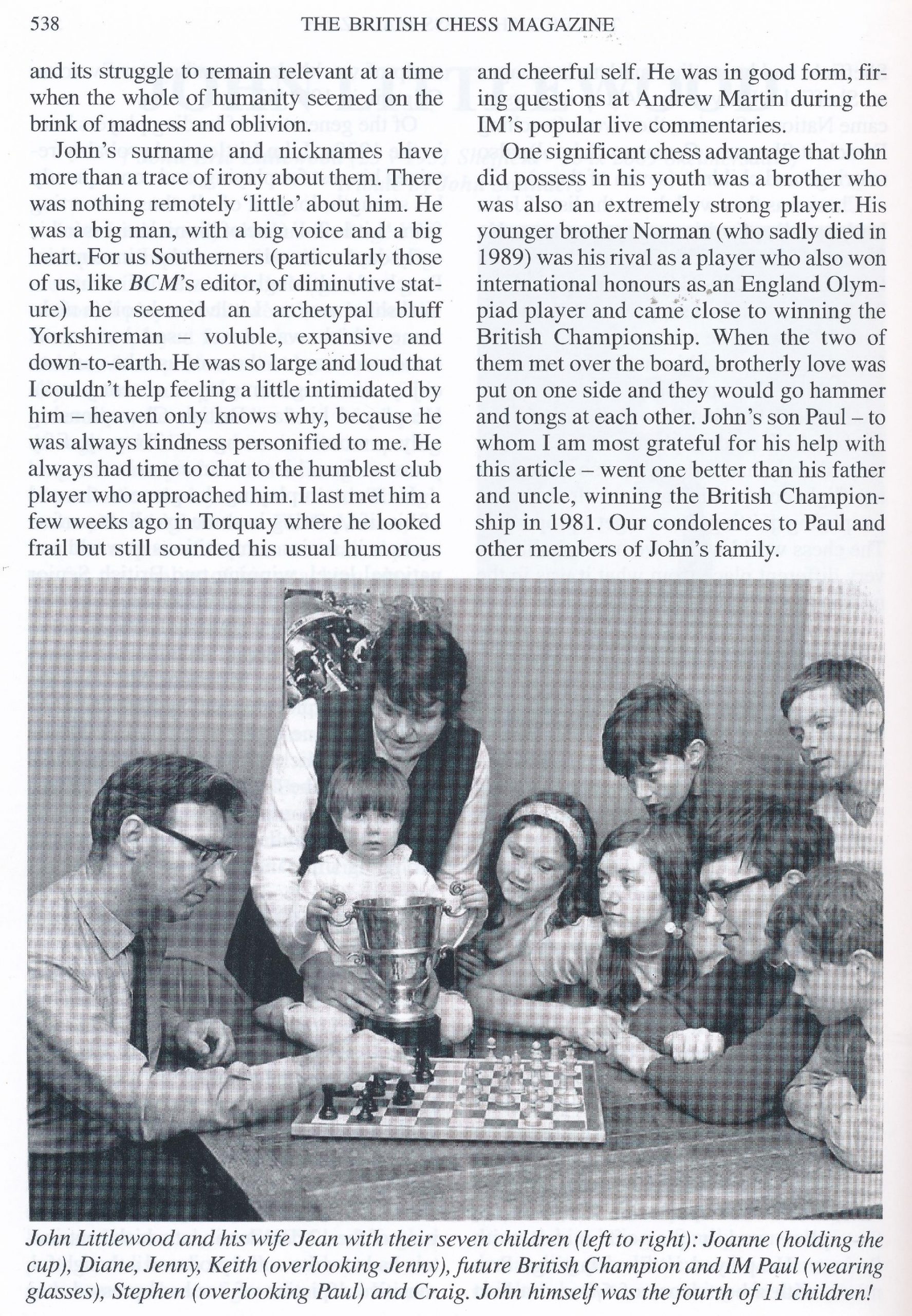
British Chess Magazine, Volume CXXIV (129), 2009, Number 10, October, page 538
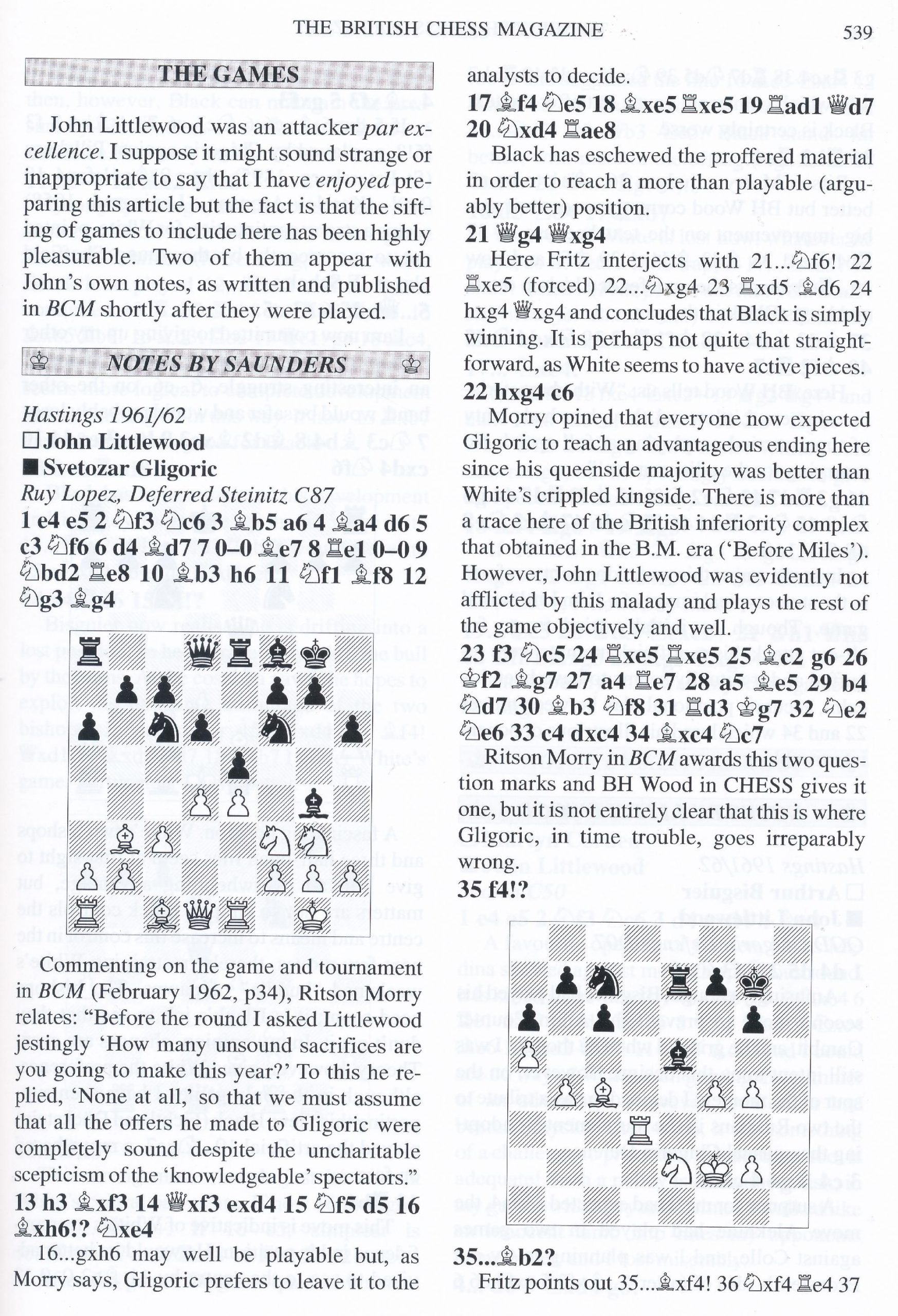
British Chess Magazine, Volume CXXIV (129), 2009, Number 10, October, page 539
British Chess Magazine, Volume CXXIV (129), 2009, Number 10, October, page 540
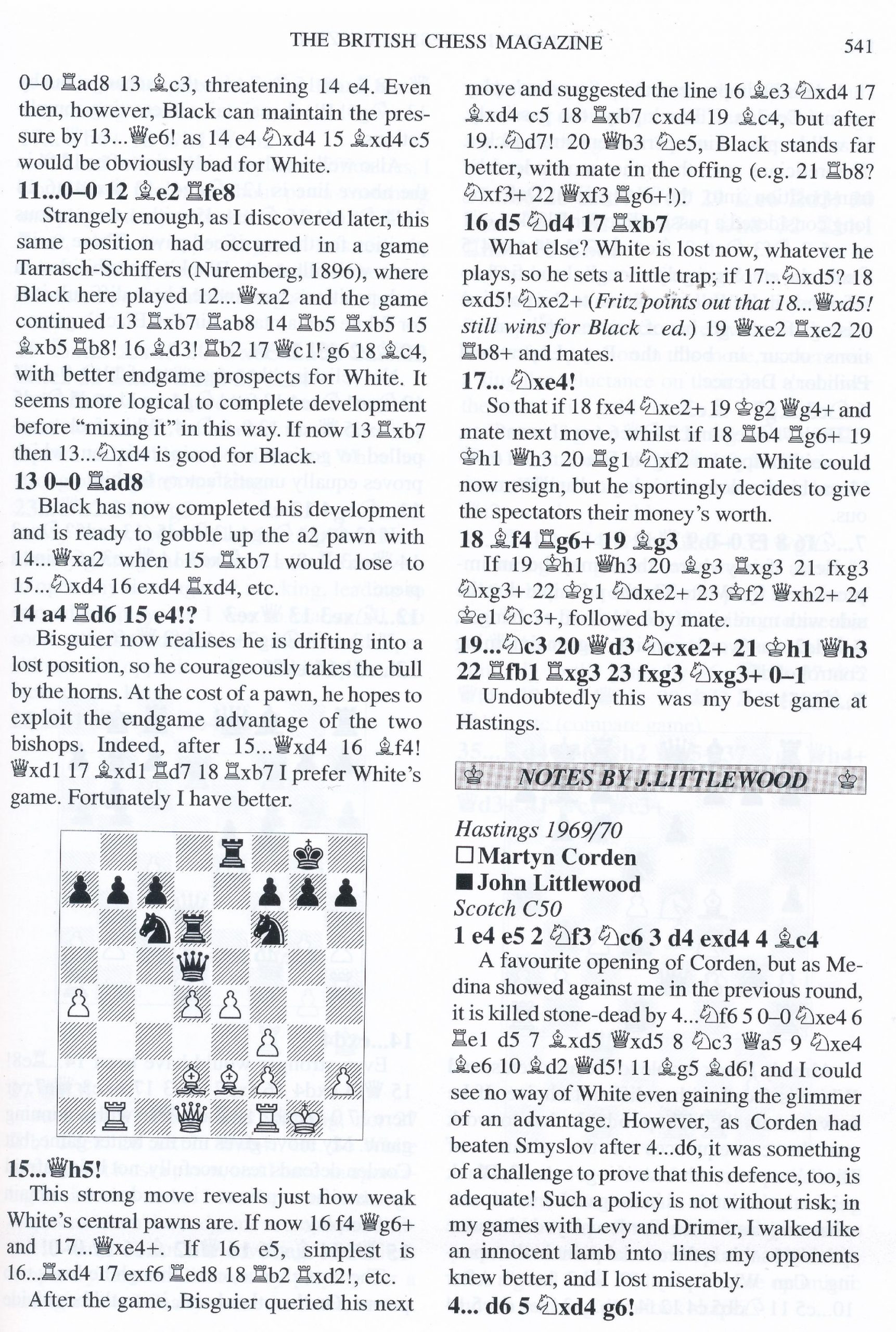
British Chess Magazine, Volume CXXIV (129), 2009, Number 10, October, page 541
British Chess Magazine, Volume CXXIV (129), 2009, Number 10, October, page 542
British Chess Magazine, Volume CXXIV (129), 2009, Number 10, October, page 543
British Chess Magazine, Volume CXXIV (129), 2009, Number 10, October, page 544
British Chess Magazine, Volume CXXIV (129), 2009, Number 10, October, page 545

A rather detailed article from Tartajubow on Chess II

Here is how news of his passing was received on the English Chess Forum

Here is an obituary from Leonard Barden in The Guardian

Here is an obituary published in The Times of London

Farewell to John Littlewood : The Lincolnshire Poacher

and, finally a history of JEL from the Yorkshire Chess Archives
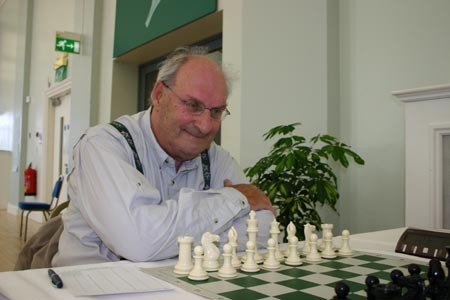
FM John Littlewood (25-v-1931 16-ix-2009)

Here is John’s Wikipedia entry

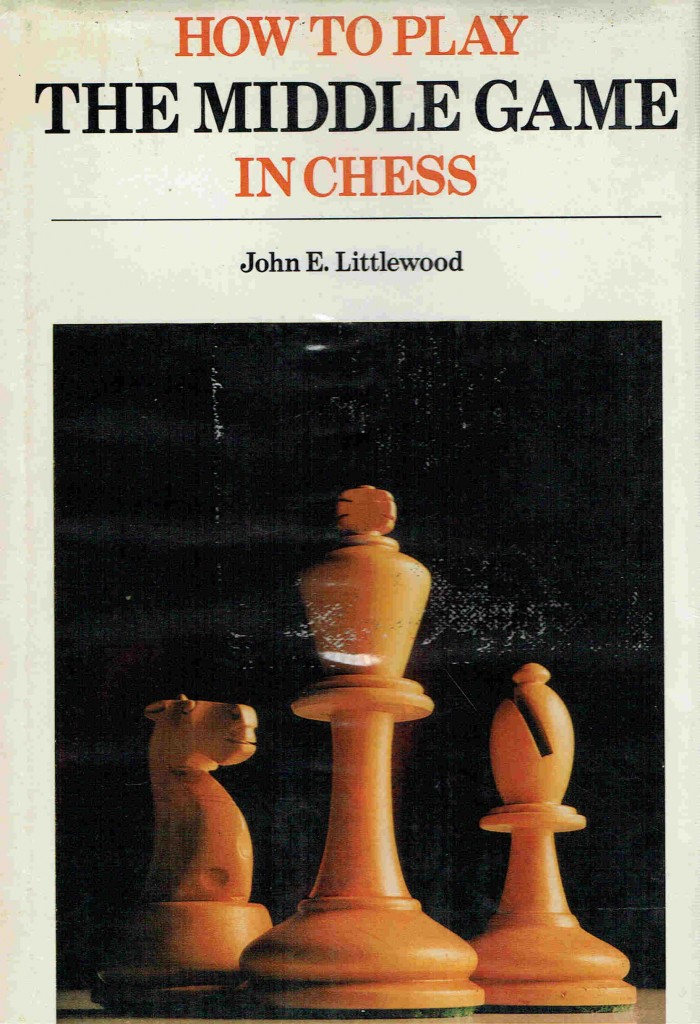
How to Play the Middle Game in Chess by John Littlewood, Collins, 1974
Chess Coaching by John Littlewood, The Crowood Press, 1991
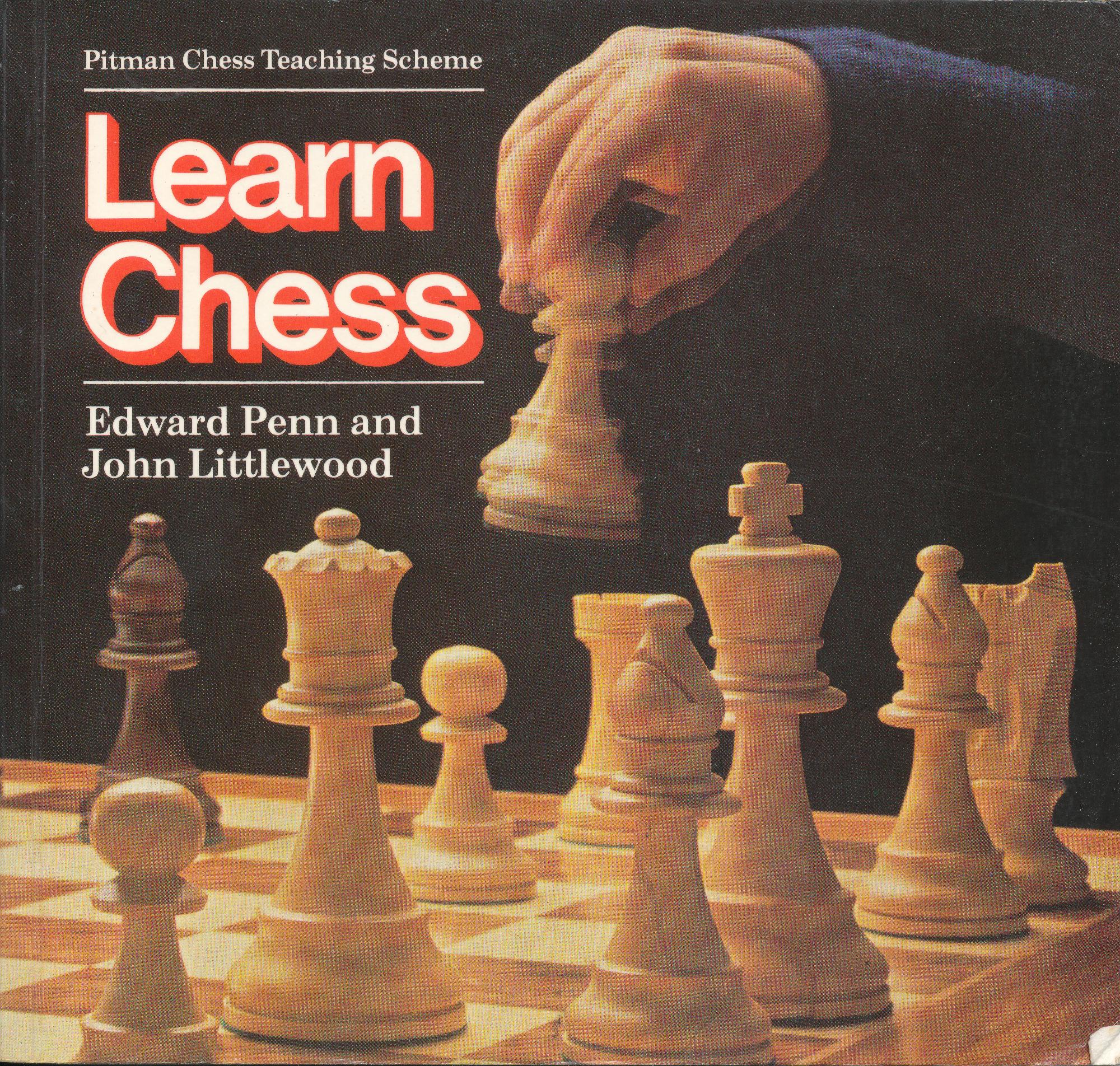
Learn Chess by Edward Penn and John Littlewood, Pitman House, 1980
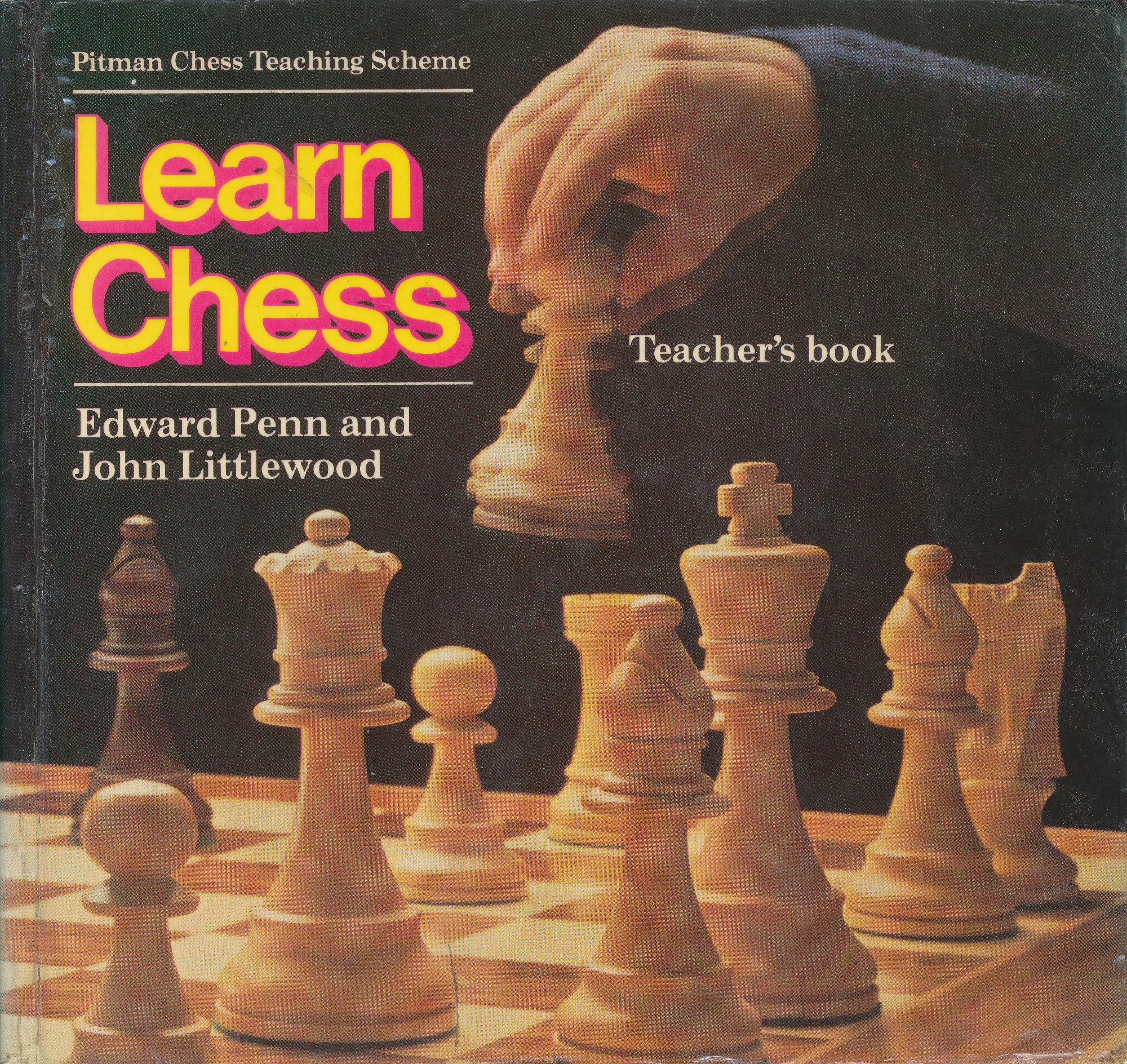
Learn Chess : Teacher's Book,  by Edward Penn & John Littlewood, Pitman House, 1980
Learn Chess : Teacher’s Book, by Edward Penn & John Littlewood, Pitman House, 1980
Learn Chess 2 by John Littlewood, Adam & Charles Black, 1984
FM John Littlewood (25-v-1931 16-ix-2009)