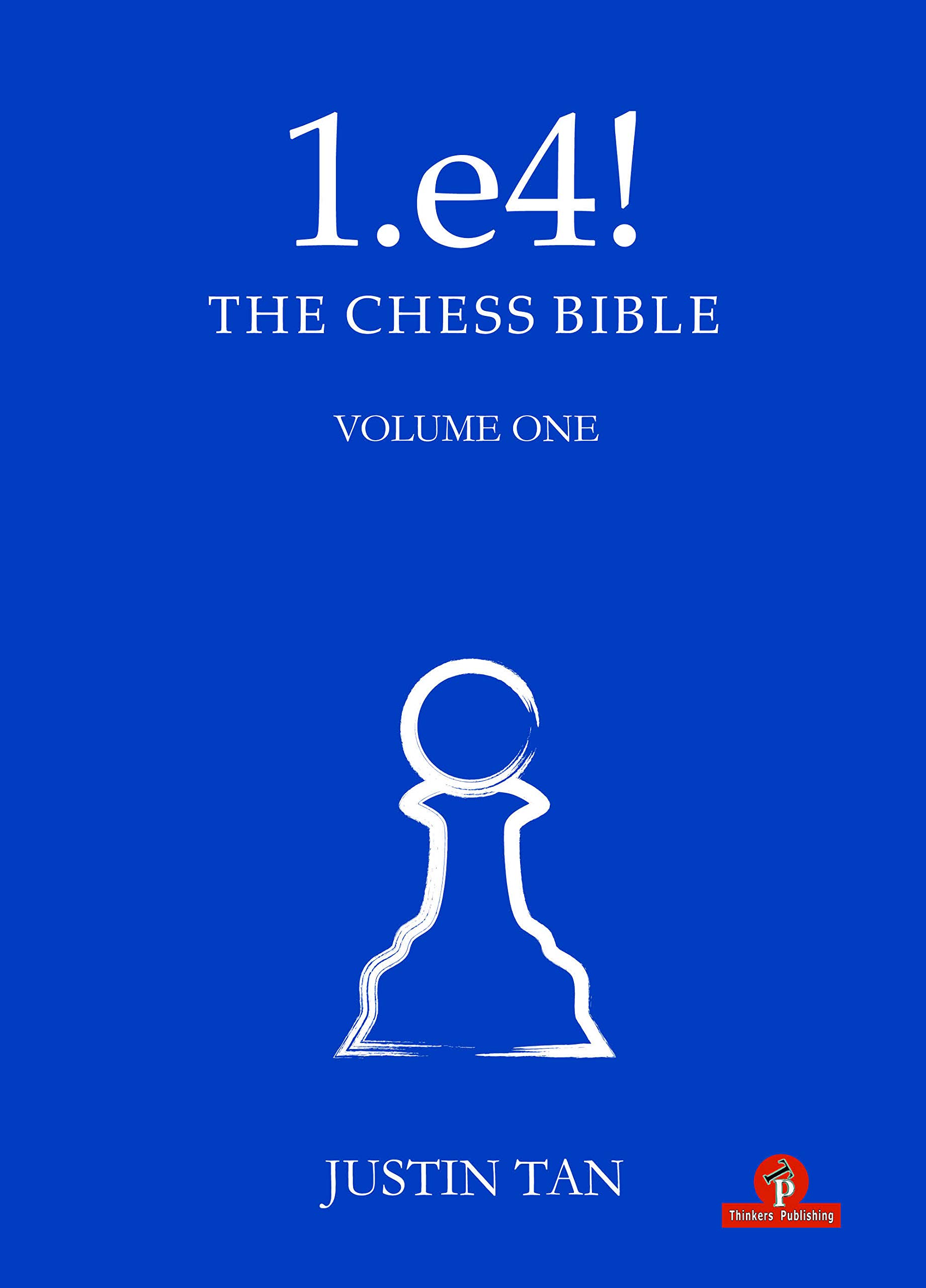
“Justin Tan is an International Grandmaster who has represented Australia in numerous international events. He is currently based in the UK and was previously British under-21 champion, British blitz champion and joint second runner-up at the British Championship. Justin has been a 1.e4 specialist throughout his playing career and is recognised for his deep opening preparation, especially in the open games. He is a monthly columnist for ChessPublishing’s section on 1.e4, where he publishes his analyses of key 1.e4 games and the latest trends.”

From the publisher via Amazon we have this blurb:
“‘1.e4! The Chess Bible’ (in three volumes) is a complete and authoritative repertoire for White based on sound main lines and the latest cutting-edge analysis. Existing theory is revisited and expanded with several fresh ideas, novelties and refutations which will appeal to dedicated 1.e4 players and theoreticians alike. However, each section is also carefully designed to be easily digested by players of all standards, with an opening overview, illustrated diagrams of key concepts, and instructive and annotated games.This book is an essential practical resource for any 1.e4 player and will greatly reward those who are looking to master their understanding of the open games.The openings covered in this volume are: The Scandinavian Defence, The Alekhine’s Defence, The Nimzowitsch Defence, The Pirc & Modern Defences and The Philidor Defence. ”
End of blurb…
and IM John Donaldson provided this review:
“Judging from the first volume of GM Justin Tan’s intended trilogy, there will be no such omissions in his 1.e4! The Chess Bible series. This massive 460-page volume covers the Alekhine, Nimzowitsch, Scandinavian, Pirc, Modern and Philidor in detail from White’s perspective.
While this is a big and detailed book there is plenty of prose to accompany the analysis, making this it accessible to players 2000 on up. Do note the suggested lines run the gamut from positional to aggressive, from the Classical variation versus the Pirc (1.e4 d6 2.d4 Nf6 3.Nc3 g6 4.Nf3 Bg7 5.Be2) to the Four Pawns Attack against the Alekhine (1.e4 Nf6 2.e5 Nd5 3.d4 d6 4.c4 Nb6 5.f4).
Tan has used all the existing tools to him, including strong engines, but his voice is always front and centre. This leads to advocacy for a number of previously unknown ideas. One example is his recommendation that 1.e4 Nc6 be met by 2.Nf3. One might think this purely a practical suggestion to sidestep learning extra theory, but they would be wrong. Tan believes 2.Nf3 to be the most principled to meet the Nimzowitsch as he is of the opinion that 1.e4 Nc6 2.d4 d5 3.e5 Bf5 4.c3 e6 5.f4 f6 6.Nd2 g5! leads to astounding complications not unfavourable for the second player.
The main line of the Classical Pirc (1.e4 d6 2.d4 Nf6 3.Nc3 g6 4.Nf3 Bg7 5.Be2 0-0 6.0-0 Bg4 7.Be3 Nc6 8.Qd2 e5) has always enjoyed a reputation as a solid equalizer after 9.d5 and 9.dxe5. Tan proposes to sidestep this variation with 7.h3 Bxf3 8.Bxf3 e5 9.d5 Nbd7 10.g3!? with his main line continuing 10…Ne8 11.Kg2 f5 12.h4 f4 13.h5 g5 14.Rh1 Bh6 15.g4 with a slight but very pleasant edge as White has long-term prospects on the queenside and Black limited counterplay.
1.e4! The Chess Bible is a first-rate effort that even titled players will find of interest and can be recommended without reservation for players of expert strength and above.”
end of JD review
Justin in an Australian Grandmaster who is an 1.e4 specialist and known for his deep opening preparation. In this large book he looks at six popular defences to 1.e4 viz:
- The Alekhine
- The Nimzowitsch
- The Scandinavian
- The Pirc
- The Modern
- The Philidor
with 1…e5, 1…c5, 1..c6 and 1…e6 all being deferred for (a) separate volume(s).
Each chapter starts with an overview which serves to give the reader some basic foundations and highlights the general concepts of each of the above.
We will examine his choices one at a time.
Against the Alekhine Defence the author prefers the dangerous Four pawns attack 1 e4 Nf6 2 e5 Nd5 3 d4 d6 4 c4 Nb6 5 f4
Several model games are given such as Kotronias v Short, Gibraltar, 2003. It is not often that Nigel has played the Alekhine as he usually plays 1…e5 or 1…e6 and here he is the runner-up.
Since this book is written from the White side the choice of these games is naturally designed to show how to play the White side.
The lines looked at in the Alekhine include the Fianchetto Variation 5…g6 The Alekhine Benoni 5…de5 6.fe5 c5 and the Main Line 6…Nc6.
Against the rarely played but interesting Nimzowitsch Defence 1…Nc6 Justin suggests 2.Nf3 when Black can go into the open game with 2…e5 (but, of course, this is not really in the spirit of this defence) which is not shown in this volume but will I expect to be covered in a subsequent volume.
Justin takes a look at the unusual move 2…f5 which has been played against myself on a few online occasions.
In Tony Miles favourite(!) openings book, author FM Eric Schiller dubs 2…f5 the Lean Variation or Colorado Counter: as Maurice Micklewhite famously never said: “And not many people know that!
The two main moves are, of course, 2…d5 which leads to a tricky line in the Scandinavian and the Main Line of 2…d6.
(Keen students of this web site will know I reviewed a specialist monograph on 1…Nc6 recently.)
Moving to colder climes we examine The Scandinavian Defence and Justin kicks-off by looking at 1.e4 d5 2.ed5 Nf6 3.d4 Bg4 which is the interesting Portuguese Variation but 4.f3 is the suggested test of Black’s play.
Justin is not impressed with this line showing that White remains in command. He then looks at the main line 3…Nd5 but 4.c4 Nb6 5.Nf3 is good for White.
The more popular 2…Qd5 3.Nc3 has analysis on 3…Qd8 considered inferior by Justin and then the popular Pytel-Wade (3…Qd6) Variation often played by Magnus Carlsen in banter blitz. It seems that Black is worse after 5…Bg4 6.h3
or 5…g6 6.Nb5 Qb6 7.a4.
More common is 5…c6 or 5…a6 but 6.g3 is a tricky line where both players need to know their theory in detail.
Justin next considers the Mieses Variation (3…Qa5) and best after 4.d4 Nf6 is 5.Bd2 which is a move that will make Black players think as it is unusual.
If the game continues 5…c6 6.Bc4 Bf5 7.Nf3 e6 8.Nd5 which has been played by Shirov.
If 5…Bg4 White can play 6.f3 where we see why Nf3 has been delayed.
The Modern 1..g6 2.d4 Bg7 3.Nf3 here the Gurgenidze System is Black’s most interesting reply of 3…c6 4.Nc3 d5 5.h3.
David Navara shows how to play if 5 de4 is played.
The Pribyl or Czech System 1..d6 2.d4 Nf6 3.Nc3 c6 4.f4 Qa5 where 5.Bd3 the move I play leads to interesting play.
I once beat John Hickman in a game at Paignton in this line in 1998 and was surprised to win the best game prize.
In the Pirc 1…d6 2.d4 Nf6 3.Nc3 g6 4.Nf3 bg7 a move that was popular with Anatoly Karpov is given.
After 5.Be2 00 6.00
and now 6…c6 6…a6 6…bg4 and 6…Nc6 are all analysed but White has a space advantage making life more easy for him to play.
Finally, the modern Philidor is examined. I was surprised to note that Justin does not look at the “old” Philidor 1…e5 2.Nf3 d6 but I expect this will appear in a later volume when he considers 1…e5 lines. The Modern Philidor is 1…d6 2.d4 Nf6 3.Nc3 e5 when Black does not mind an exchange of pawns on e5 and a Queen exchange. It is now seen as better to try 4.Nf3 Nbd7 5.Bc4 when 5…Be7 is analysed. Now 6.a4 is regarded as best.
White is likely to follow-up with 00, h3 and Re1.
In summary, an interesting book for 1.e4 players with many original ideas. I’m looking to future volumes to learn what Justin recommends against Blacks two most popular moves 1…e5 and 1…c5 plus the Caro-Kann and the French.
Colin Lyne, Farnborough, Hampshire, 19th July, 2021
Book Details :
- Paperback : 464 pages
- Publisher: Thinkers Publishing; 1st edition (13 April 2021)
- Language: English
- ISBN-10: 9464201126
- ISBN-13: 978-9464201123
- Product Dimensions: 17.02 x 2.79 x 23.37 cm
Official web site of Thinkers Publishing