Here’s some hot news from Redhill Chess Club, just 120 years ago.
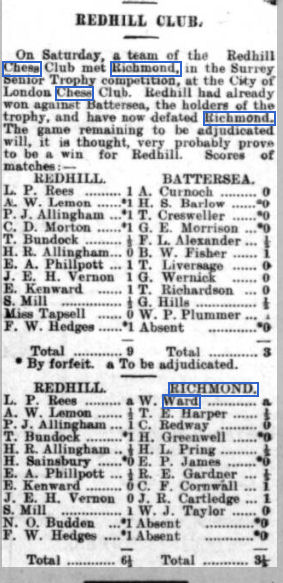
There are a few interesting things to note here. At this time, Surrey League matches, just like the London League today, took place at central London venues, rather than on a home and away basis.
You’ll also spot that, as so often in their matches at this time, Richmond failed to field a full team. They frequently either had a couple of absentees at the bottom or a couple of nominated players who failed to turn up.
The impression I get is that the club was very ambitious, choosing to play in the Surrey Trophy against stronger opposition rather than the calmer waters of the Beaumont Cup. Their administrative skills, though, didn’t seem to match their ambitions. Chess clubs (and, no doubt most other clubs as well) are as good as their organisers, not as good as their players.
Regular readers will already have met Thomas Etheridge Harper and Charles Redway, and heard a brief mention of club founder Horace Lyddon Pring, but there are other members of this team who are of interest.
In particular, there’s a new name playing on top board, although he was probably losing his game against Leonard Percy Rees, one of the most important figures in early 20th century English chess and one well worth a future Minor Piece.
In the first decade of the 20th century there were a lot of strong British amateurs with retrospective ratings round about 2300-2400, so, by today’s standards, FM to IM strength. They rarely if ever played in major international tournaments so, except for those of us who spend much of our time in the dusty recesses of old books and magazines, or perhaps visiting BritBase, their names are largely forgotten today.
As it happens, many of these players had links with our area, West and South West London. You’ve already met George Edward Wainwright here, here, here and here. Now I must introduce you to William Ward.
Researching him isn’t so easy. Cursed with one of the most popular male first names of his day, no middle names and a very common surname, any search for W Ward will turn up much of no relevance. In addition he came from a small family which has been little researched by genealogists: the few online trees I’ve been able to find don’t mention any chess connection and, if they give it at all, get his mother’s maiden name wrong.
Our William, 35 years old at the time of the above match, was born on 3 March 1867 in Abbots Langley, Hertfordshire, just north of Watford and now a large commuter village, and baptised there on 18 April the same year.
The 1871 census finds the Ward family there. William Ward senior is aged 27, a farmer of 184 acres employing 4 men and a boy, Ann (née Barford) is aged 26 and their two sons are William (4) and Mark (1). The family also have two servants. The parents were both born in Hatfield (the enumerator incorrectly recorded their sons as having been born there as well) and must have moved to Abbots Langley after their marriage. A third son, George Langton Ward, would be born early the following year. The family would later move to the Luton area, first to the small village of King’s Walden, and then to Lewsey, now a Luton suburb alongside the M1.
By 1881 young William is at boarding school in London: he’s recorded at 7 Highgate Road Kentish Town along with a Schoolmaster and a lot of other boys, including, exotically, three brothers from Quito (none of them, sadly, named Amos).
While his brothers followed in their father’s footsteps, pursuing a career in farming, William took a different route. The 1891 census finds him, now aged 24, living in a boarding house at 50 Finsbury Park Road in North London, not all that far from Kentish Town, and working as a solicitor.
At some point in the mid 1880s, then, he must have studied Law, and perhaps, at the same time, taken up the game of chess. We first find him in 1890 playing in the 3rd class in a handicap tournament at Simpson’s Divan, which tells us he wasn’t a strong player. No child prodigy, then, but a young man who was attracted to the game, and, over the next few years, would discover a real talent.
Ward made rapid strides during the 1890s, soon playing matches for the famous City of London club (in their 1894-5 championship he reached the final stages) and taking part in representative matches for the South of England against the North.
His first external tournament was the Southern Counties Chess Union (SCCU) Championship in Southampton in 1897. Henry Ernest Atkins was a convincing winner on 8½/10, while William’s score of 4/10 was relatively modest, but no disgrace for a newcomer to chess at this level.
In the 1897-8 edition of the City of London Championship Ward finished in third place behind Thomas Francis Lawrence and Lucien Serraillier: by now he was clearly one of the capital’s strongest players.
In this game he demonstrates excellent opening knowledge, capping a fine performance with some sparkling tactics to force through a passed pawn. (If you click on any move in any game in this article a pop-up board will magically appear, enabling you to play through the game.)
The following year, the SCCU Championship in Salisbury was a very different story from the previous year. William shared 1st place with Joseph Henry Blake on 7½/10, with strong players such as Gunston, Bellingham, Loman and Sherrard trailing in their wake.
In this exciting drawn game, against the Dutch organist Rudolf Loman, both players displayed extensive awareness of contemporary theory in the very sharp Max Lange Attack. Ward had the better of the early exchanges but, in a very complex middlegame failed to make the most of his chances. The knight ending was still difficult for both players, and here Loman missed an opportunity.
The 1898-9 City of London Championship proved a slight disappointment when he narrowly failed to make the final pool, but the 1899-1900 edition, held again as an all-play-all, was a different story. Lawrence was the winner on 14½/17, with Ward just half a point behind and the rest nowhere.
In 1900 William made his international debut, being selected to play in the 5th Anglo-American Cable Match, where he drew his game against Charles John Newman.
Rod Edwards’ retrospective ratings for 1900 put him on 2397, ranked 74th in the world.
A few days later he took part in an invitation tournament run by the City of London club, in which their members took on a bunch of international players based in London at the time. As you’ll see here, he scored an outstanding 8½/12, just behind Teichmann (9½), Mason and Gunsberg (9). While the winner hadn’t yet reached his peak and the runners-up were past their best, they were all genuine grandmasterly players. He was particularly devastating against the weaker competitors.
By now he was using the increasingly popular Queen’s Gambit with the white pieces, an opening which suited his style of controlled aggression perfectly.
Here he found himself with an IQP position out of the opening: understanding this pawn formation is still of vital importance to all serious competitive players today.
Against the artist and pianist Thomas Physick (from a family of sculptors) he chose a delayed exchange variation: another pawn formation which still plays a critical role in 21st century chess.
William Ward was again amongst the medals in the 1900-01 City of London Championship. Lawrence won again, with Herbert Levi Jacobs taking the silver and Ward the bronze. Edward Bagehot Schwann, coming to the end of his short life, was among the also-rans.
By now it was time for the census enumerator to call again. What we find is rather intriguing. William was in Kenley, Surrey, east of Coulsdon and south of Purley, visiting Isidore Wiener, a 41-year-old unmarried Hide Merchant’s Factor born in Holland but a British Subject. Also in the household were a housekeeper and a servant.
I’ve recently become interested in the significance of the word ‘visitor’ in census returns. Your census address is where you’re staying overnight. If you’re being paid to be there you’ll be described as a ‘servant’ or something similar. If you’re paying to be there you’ll be a ‘boarder’ or a ‘lodger’. A ‘visitor’ will often be a family member, but there might be other reasons. I can find no evidence that Isidore was a chess player, so perhaps he had some complicated legal business which required his solicitor to stay overnight. Perhaps they were just good friends. Who knows?
Anyway, in 1906 Isidore married 40-year-old Annie Sonnex (interesting surname) from Lancashire, continuing to live, now with his wife, in Kenley. A very late first marriage for both partners. They had their only child, a daughter named Albertine, a year later. In 1918, like many families with Germanic surnames at the time, they changed their name from Wiener to Winner. Albertine became a Winner in more ways than one, as you’ll see here.
And then we reach 1902, when we find William playing for Richmond Chess Club against Redhill. Had he moved to the Richmond area? Or did he have friends in the club who invited him to join and play in matches in central London? At present I don’t know.
It looks like he never owned his own property, living in lodgings and moving round various parts of London. I can find no further reference to Ward in association with Richmond Chess Club, but it’s quite possible that there may be more information online once the Richmond & Twickenham Times is digitised.
You’ll find out what happened to William Ward after 1902 in my next Minor Piece.
Sources:
ancestry.co.uk
findmypast.co.uk
MegaBase 2022 (analysis by Stockfish 15)
Britbase
EdoChess (William Ward’s page here.)
The City of London Chess Club Championship (Roger Leslie Paige 2005)
Other websites referenced in the text.