Category Archives: 2020

My Chess World

My Chess World
My Chess World

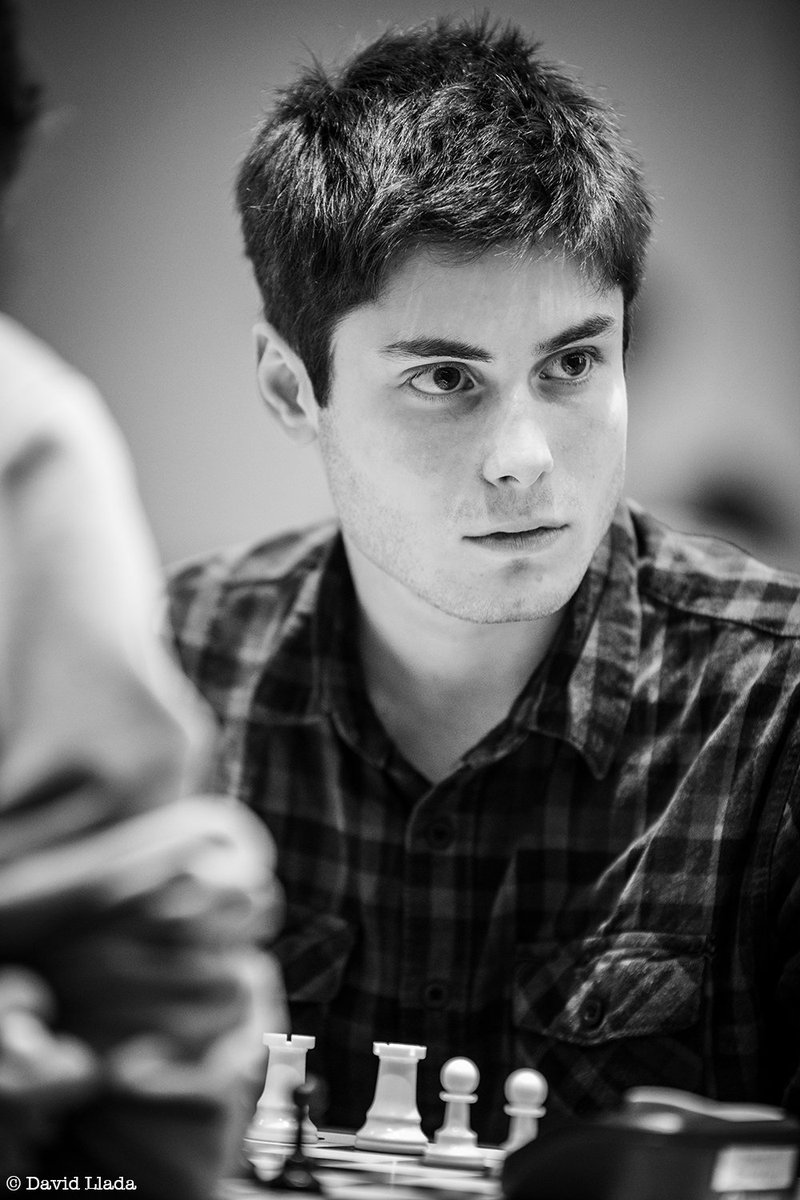
“Nine-time Czech champion David Navara, 35, became a grandmaster in 2002 at the age of sixteen. Amongst his many achievements are: 1st at the Ordix Open rapid tournament in Mainz, Germany, in 2007. World Cup quarterfinalist in 2011. Gold medal winner on 2nd board at the 2012 Chess Olympiad in Istanbul. Gold medallist with the Nový Bor team at the 2013 European Club Cup in Rhodes, Greece. Winner of the European Blitz Championship in Wrocław, Poland, in 2014. Silver medallist in the European Individual Championship in Jerusalem in 2015.”

GM David Navara
GM David Navara

From the rear cover :

“This book is not a pure (auto)biography, rather a games collection. It consists mainly of interesting high-class games played by me, including many losses. Most of the games are preceded by accompanying texts, which vary from essays to tournament reports. The title of the book might seem presumptuous, but I wanted to show how I see or experience the competitions without denying the chess worlds of others. While the texts are mostly light and subjective, at the same time I tried hard to stick to the facts and provide some food for thought. GM David Navara May 2020.”

David Navara is one of the most distinctive and popular personalities on the contemporary chess scene, renowned for his uncompromising play, for his politeness and friendliness, and, most of all, for his eccentricities. He’s been just below the world elite for the past 15 years or so, usually rated between 2700 and 2750.

In this chunky 600+ page book he offers us a collection of 64 (for Navara it could be no other number) games, chosen for their interest rather than the result, so you’ll find draws and losses as well as wins here. His opponents include many of today’s top grandmasters and a wide range of openings is represented.

Authors have a difficult decision to make about how detailed their analysis should be. Navara explains the dilemma nicely in what he calls the Navara Antinomy:

  1. Substantial games are interesting.
  2. Substantial games require extensive annotations.
  3. Extensive annotations are boring.

Yes, the annotations are pretty extensive, but the games are interesting enough to merit this. There are plenty of variations and sub-variations which, if you’re playing through the games, might be confusing unless you’re making use of a second board. You’ll discover a host of exciting middle games and, in particular, some fascinating endings.

One game that particularly drew my attention was his game with White against Radoslaw Wojtaszek from Biel 2015.

Not all games with early queen exchanges are dull. The moves up to 25. Kf6 were pre-game preparation, and by move 30 the white monarch reaches h8, which must be some sort of record for a top level game.

If you want to find out what was really happening in this game you’ll need to buy the book.

Navara likes to categorise chess games as either porridge (good for you but boring) or ice cream (tasty but not so healthy) and tells us both types are featured in the book. I think he’s, very typically, being too modest. Most of the games, like the one above, seem to me to be both tasty and good for you. A delicious main course of salmon, perhaps (Navara likes fish, especially Stockfish), or a refreshing fruit salad.

There’s no better way to end a meal than with a light sorbet. Here’s the conclusion of the last game of the book, against Vojtech Zwardon (Ostrava 2019).

How would you continue with White?

Full credit for 1. Qxg7+  Kxg7 2. Bf6+ and 3. Rh8#, but Navara preferred the cuter 1. Qh8+ Bxh8 2. Rxh8+ Kg7 3. Bf6#.

If you’re looking for a collection of top level games with excellent annotations, you won’t be disappointed with this book.

You get a lot more for your money, though. Most games are preceded by essays originally published on Navara’s chess blog (‘a blog past its sell-by date’) covering a wide variety of subjects: part travelogue, part tournament report, part meditation on chess and life.

You’ll find out a lot about the life of a chess player travelling round Europe, and occasionally further afield (Cuba, China) taking part in national and international team competitions as well as individual matches and tournaments.

There’s much more besides. As well as ‘Porridge and ice cream in Barcelona’ you’ll encounter ‘Sea hedgehogs’, ‘Swans on the top floor’ and ‘On Karl Marx and locking a bishop’.

The book is also full of humour, particularly verbal humour, which the translator has done well to render into English successfully. Humour is something very personal, and, I guess, you might find this aspect of the book either endearing or annoying. As for me, I love it. It’s great to meet someone who uses exactly the same jokes as I do.

Beyond the moves, then, this is, in many ways, a very personal book. The first few pages offer some biographical background. ‘I have no recollection of it, but according to reliable sources, I was born on 27 March 1985.’

He concludes this section: ‘I can’t drive or dance, and my knowledge of films and TV series is minimal.’ (Me too, David.) … ‘Chess is my choice. It has given me a lot: fun, success, friends, self-realisation, money, popularity, the chance to travel.’

At the end of the book he returns to the same theme, offering us a chess poem:

‘But still I remain like a child, who finds the outside world so wild. I still so much like to play chess, that it looks like both curse and bless.’

He concludes:

‘Chess has given me a lot. It can unite people of various nations, different ages, gender, political views, social and economic background or health conditions. It contains elements of art and some chess games are real masterpieces. (Of course they are rare, as masterpieces tend to be.) Chess might relieve the worries of everyday life, bring one good friends and uplift one’s spirit.

‘What more can you expect from a board game with seemingly simple rules?’

I think we can all, whatever our rating, agree with David Navara’s sentiments.

The book is well produced and enhanced with photographs of our hero. My one complaint, as so often, is the lack of an index. Perhaps I’m old-fashioned, but if I’m reading a games collection I’d like to be able to look up the games where Navara played Carlsen, or where he was on the black side of a Sicilian Defence.

What you do get is an excellently annotated games collection as well as an insight into the life and mind of a charming and unusual personality, who perceives the world with a mixture of child-like wonder and self-deprecating amusement. For me, it also provides the opportunity to meet someone who seems, in some respects, a kindred spirit.

I really enjoyed reading this book and finding out more about David Navara, both as a chess player and as a person. Very highly recommended.


Richard James, Twickenham, 13th July 2020

Richard James
Richard James

Book Details :

  • Paperback : 616 pages
  • Publisher: Thinkers Publishing; 1 edition (28 July 2020)
  • Language: English
  • ISBN-10: 9492510804
  • ISBN-13:  978-9492510808
  • Product Dimensions: 17 x 23.5 cm

Official web site of Thinkers Publishing

My Chess World
My Chess World

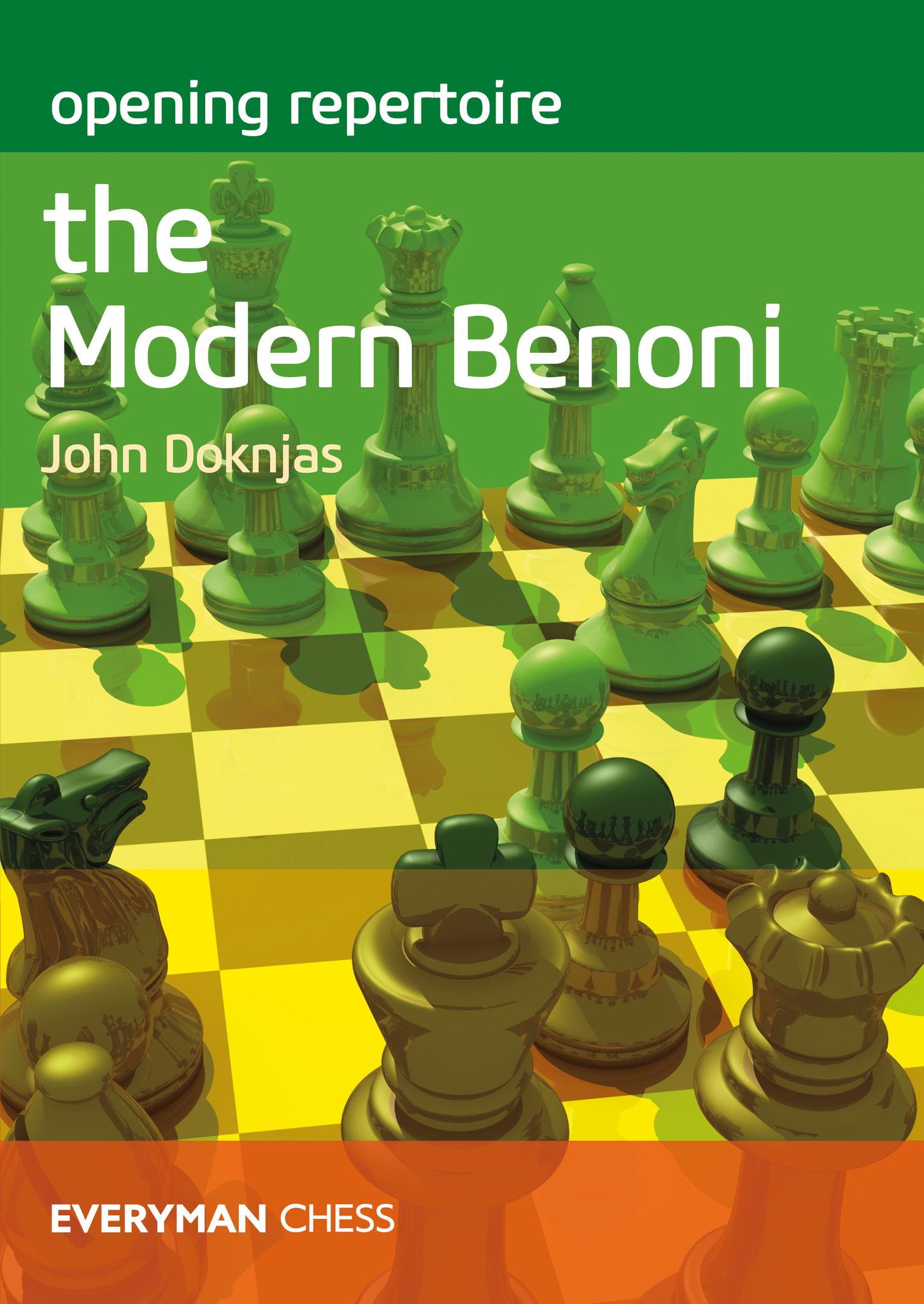
Opening Repertoire : The Modern Benoni

Opening Repertoire : The Modern Benoni

John Doknjas is a FIDE Master from Canada who has enjoyed success competing internationally. He has won seven national titles for his age and tied for 1st in the 2019 U18 North American Youth Chess Championship. This is his third book for Everyman Chess.

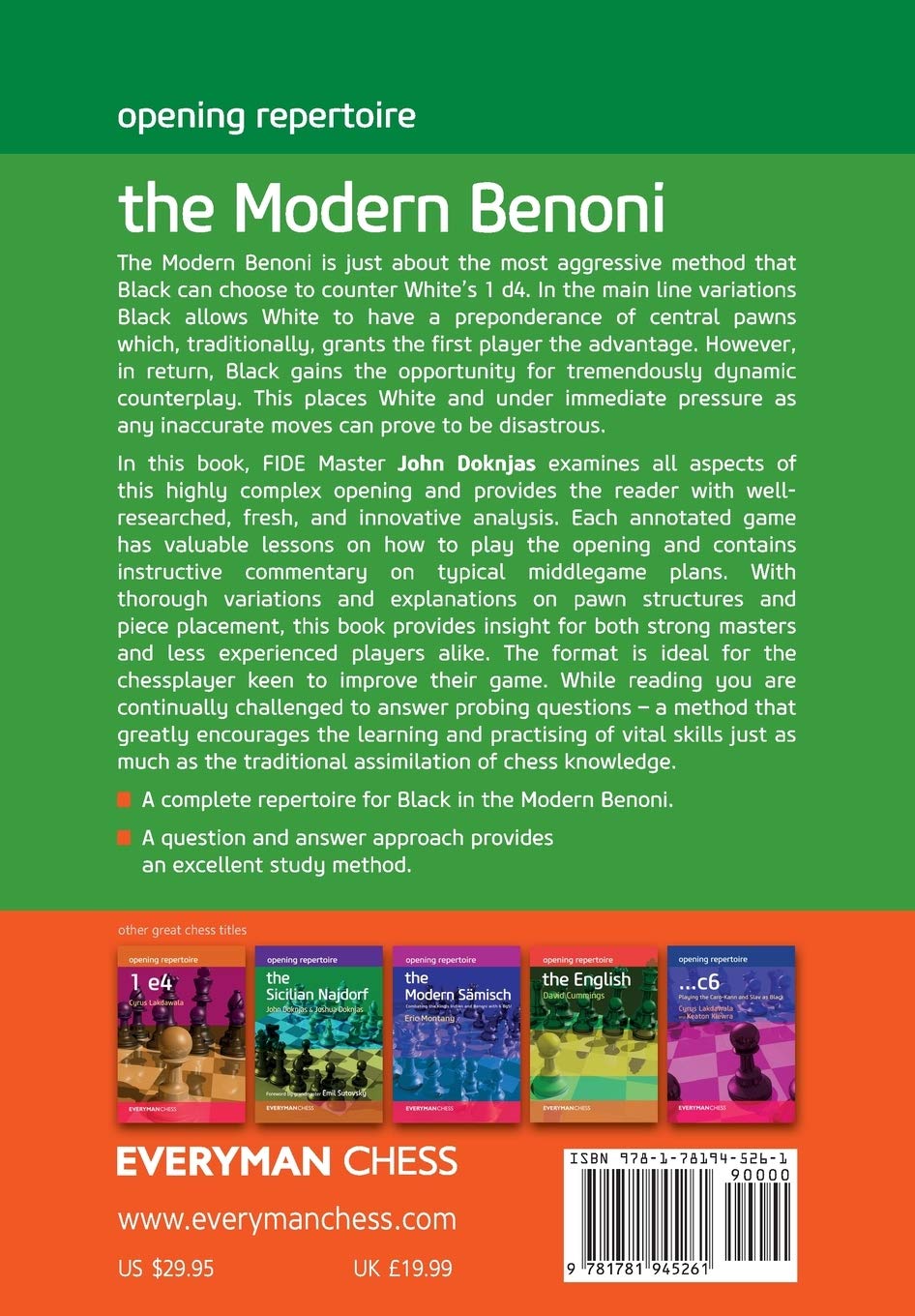
From the book’s rear cover we have :

“The Modern Benoni is just about the most aggressive method that Black can choose to counter White’s 1 d4. In the main line variations Black allows White to have a preponderance of central pawns which, traditionally, grants the first player the advantage. However, in return, Black gains the opportunity for tremendously dynamic counterplay. This places White and under immediate pressure as any inaccurate moves can prove to be disastrous.

In this book, FIDE Master John Doknjas examines all aspects of this highly complex opening and provides the reader with well-researched, fresh, and innovative analysis. Each annotated game has valuable lessons on how to play the opening and contains instructive commentary on typical middlegame plans. With thorough variations and explanations on pawn structures and piece placement, this book provides insight for both strong masters and less experienced players alike. The format is ideal for the chessplayer keen to improve their game. While reading you are continually challenged to answer probing questions – a method that greatly encourages the learning and practising of vital skills just as much as the traditional assimilation of chess knowledge.”

The Modern Benoni, by John Doknjas, is another book in Everyman’s “Opening Repertoire” series. As that implies, the book aims to provide Black with a repertoire against all lines that White can employ against the Modern Benoni, rather than an exhaustive analysis of all lines by both sides.

The Benoni has long been a choice of aggressive players who are willing to take a bit of a risk as Black in order to get a complex fight against White’s 1 d4 (and 2 c4). The resulting middlegame positions are usually double-edged and can be complex both positionally and tactically.

The theory is contained in 31 complete games broken down into nine chapters for the major systems, such as the Flick-Knife attack (aka the Taimanov variation), The Fianchetto Variation, the Knight’s Tour and so on. Major variations within each system are given new games, and (usually) minor variations within those are handled within the notes. Occasionally there are a lot of variations in the notes and this can make it a bit awkward to follow where you are in the main game, but this is probably an unavoidable feature of the complete game approach and I do not mention this as a criticism of the author or the book. Indeed, the book mitigates greatly against this by providing an excellent Index of Variations which tells you if a variation is covered in a main game, or within the notes to one, which makes future reference to a line much easier. The advantages of the complete game approach are that the annotations tell the reader the middlegame plans, and the reader gets to see how masters play out the positions.

The book also contains a nice introductory chapter in which Doknjas provides an excellent overview of plans and piece placement ideas from the perspective of both White and Black. Each chapter also includes a short introductory section, and a summary section, in which the differences between the systems covered by the various games in the chapter are explained.

The repertoire in the book steers Black to positions which appear theoretically sound, and provide Black at least a position with balanced counterplay. There aren’t many lines which offer safe equality, but this of course is the nature of the opening and is to be expected.

I have to say that I regard this as an excellent opening book.
Doknjas provides excellent explanations, both wordy and in concrete lines, and his Q&A and Exercises are always relevant to the material. When he feels appropriate, he is not afraid to recommend lesser-played lines and he backs up his choices with solid analysis and reasoning. His recommendations appear sound and those lines I have tested with an engine do not fall foul of computer analysis.

As an example of his style, here is an excerpt from the game in which he recommends 12 …Rd8 in the Mikenas Attack:

Question: What are some of this moves pluses?

Answer: 12 …Rd8 has only been chosen around 4% of the time OTB, but I really like it for a few reasons:
1. Black threatens to round up the d5-pawn with …Nb6. This doesn’t give White time to attack effectively with f4-f5.
2. The rook could prove very useful on d6, where it will control the f6-square. If black plays …f6 then the pawn will enjoy support, and in some lines Black could even use the rook for direct defence with with …Rf6. Another purpose for the rook being on d6 is to blockade the d5-pawn, which could be important if White’s light-squared bishop comes to c4.
3. The move has a fair amount of surprise value and its subtleties aren’t immediately obvious.
12 …Re8 is the main move but 13 f5! may give White strong play along the f-file (Ng5, Bc4, Qf3, 0-0 etc). The game remain objectively equal but it seems like Black is the one who has to be more careful. Se Feller-C Marzolo continued 13 …Kf8 14 Ng5 e4 15 fxg6 hxg6 16 Be2 Bd4 17 Rf1 with a messy position.
13  fxe5
Others:
a) Be2?! Nb6 14 fxe5 Rxd5 15 Qb3 Kf8 16 Be3 Kg8 gives Black an advantage.
b) …etc
(The book actually uses figurine pieces rather than letters.)

I recommend this book to anyone who is already playing the Modern Benoni or who is looking to take it up. Even players who face the Benoni from the White side will get benefit from this book, at least an idea of the current state of theory of this opening, but obviously bear in mind that it is a repertoire book from Black’s viewpoint.

John Doknjas was not known to me before reading this book, I look forward to future books by him.

Colin Purdon, Crowthorne, Berkshire, 13th July, 2020
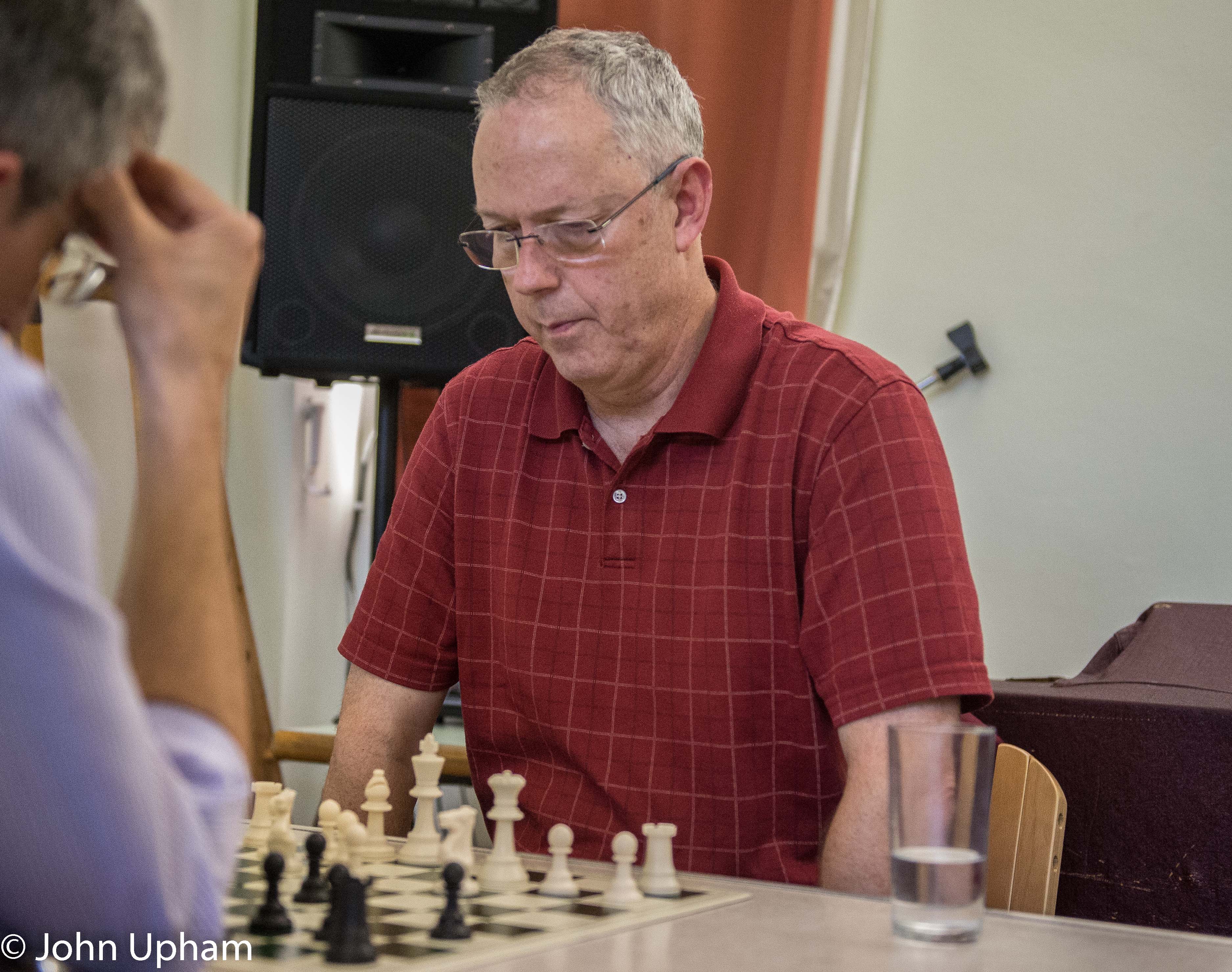
Colin Purdon
Colin Purdon

Book Details :

  • Paperback : 450 pages
  • Publisher:Everyman Chess (1 May 2020)
  • Language: English
  • ISBN-10:1781945268
  • ISBN-13: 978-1781945261
  • Product Dimensions: 17.2 x 2.5 x 24.2 cm

Official web site of Everyman Chess
Opening Repertoire : Modern Benoni

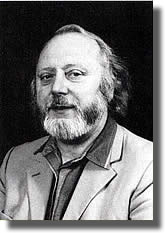
Ken Whyld Remembered (06-iii-1926 11-vii-2003)

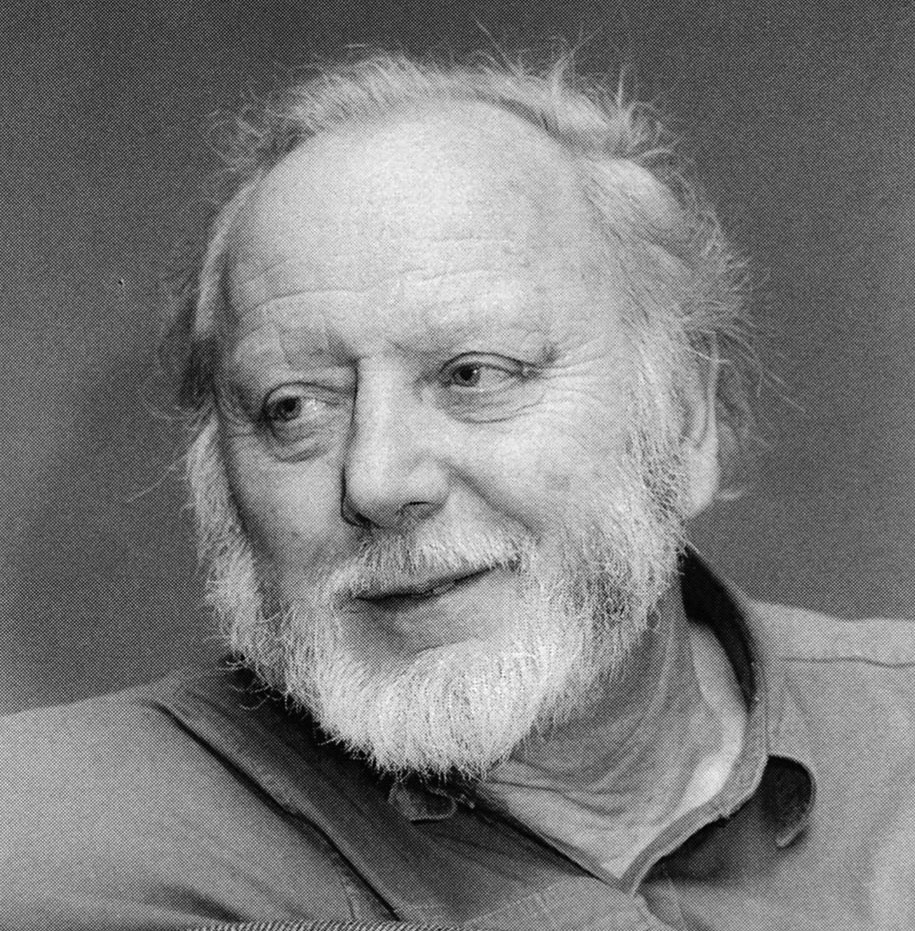
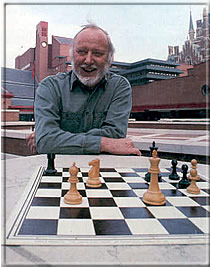
Ken Whyld (06-iii-1926 11-vii-2003)

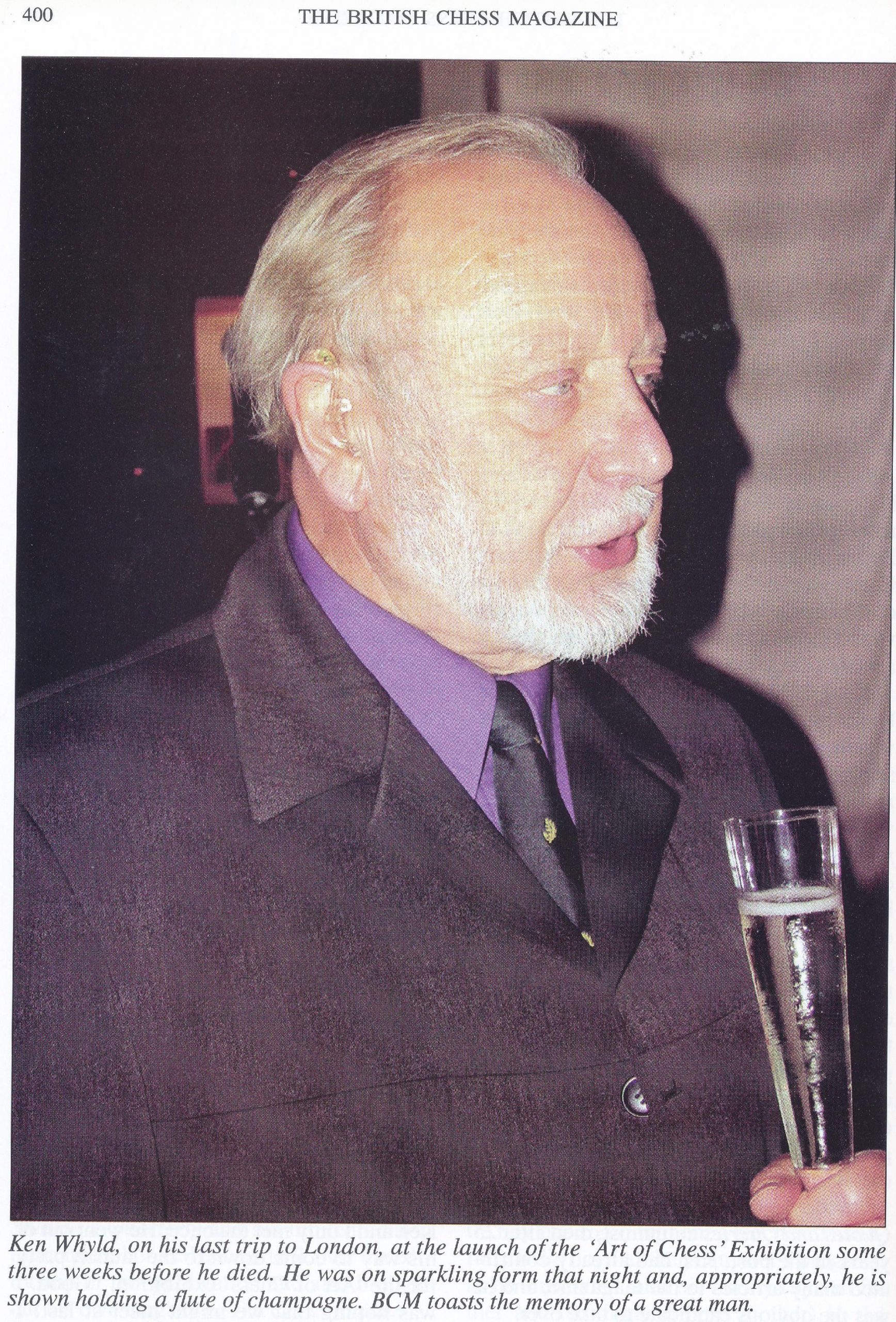
BCN remembers much loved Ken Whyld who passed away on July 11th 2003 in Lincolnshire.

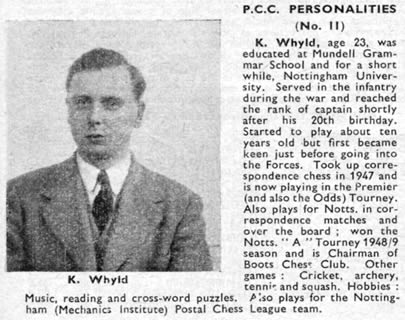
Ken Whyld from CHESS magazine, January 1950. courtesy of the Ken Whyld Association

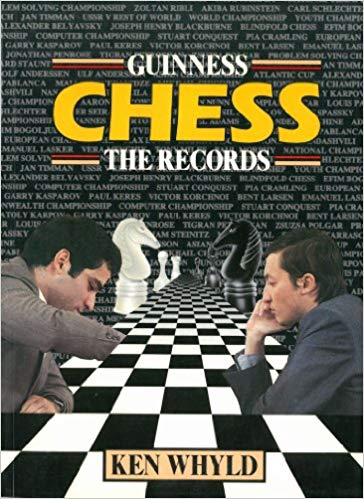
From Chess : The Records :

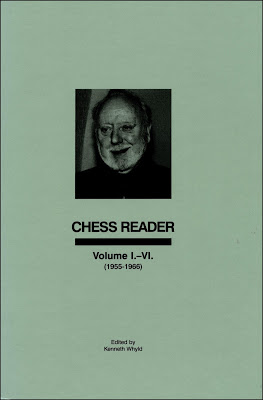
“Ken Whyld was the editor of Chess Students Quarterly in the early 1950s and from 1955-63, Chess Reader, in which he reviewed more than 500 chess books. He has written seven tournament books and one match book.

Ken Whyld (06-iii-1926 11-vii-2003)

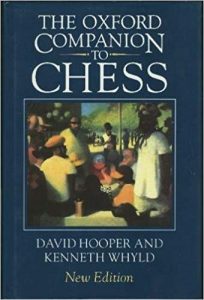
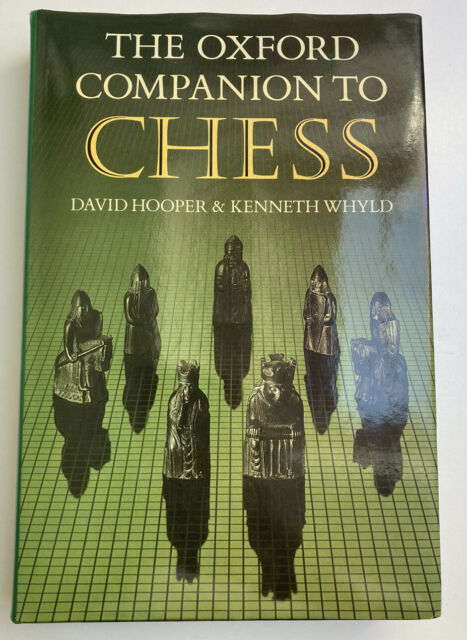
With J. Gilchrist he wrote a three-volume anthology of Lasker’s games, and with David Hooper, The Oxford Companion to Chess.

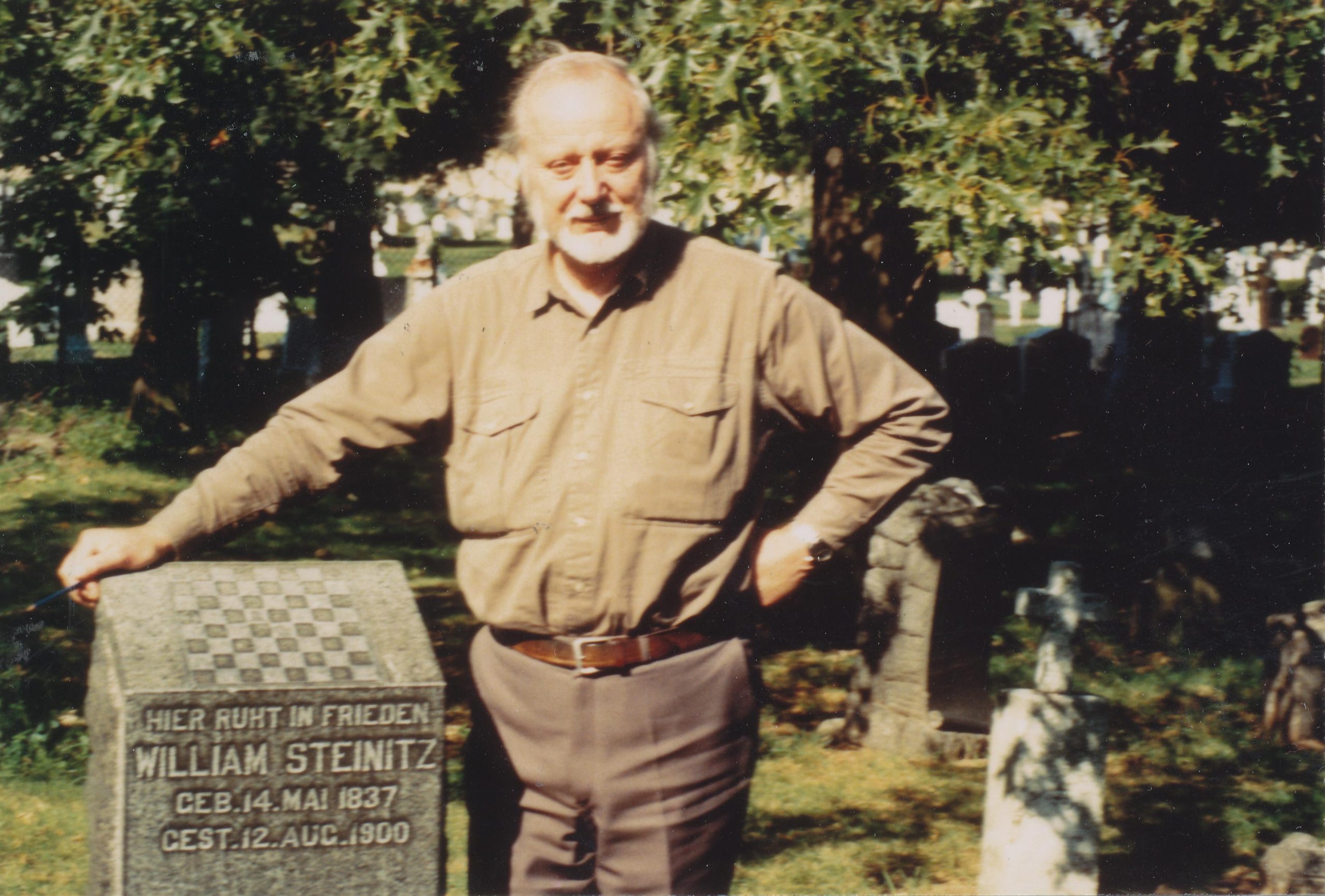
Ken at the gravestone of "William" Steinitz
Ken at the gravestone of “William” Steinitz

For the book World Chess Champions he wrote the chapters on Lasker and Smyslov. In his playing days he was champion of his county (Nottinghamshire) many times and played in the British Championship as well as international tournaments.”

Ken Whyld  (06-iii-1926 11-vii-2003)
Ken Whyld (06-iii-1926 11-vii-2003)

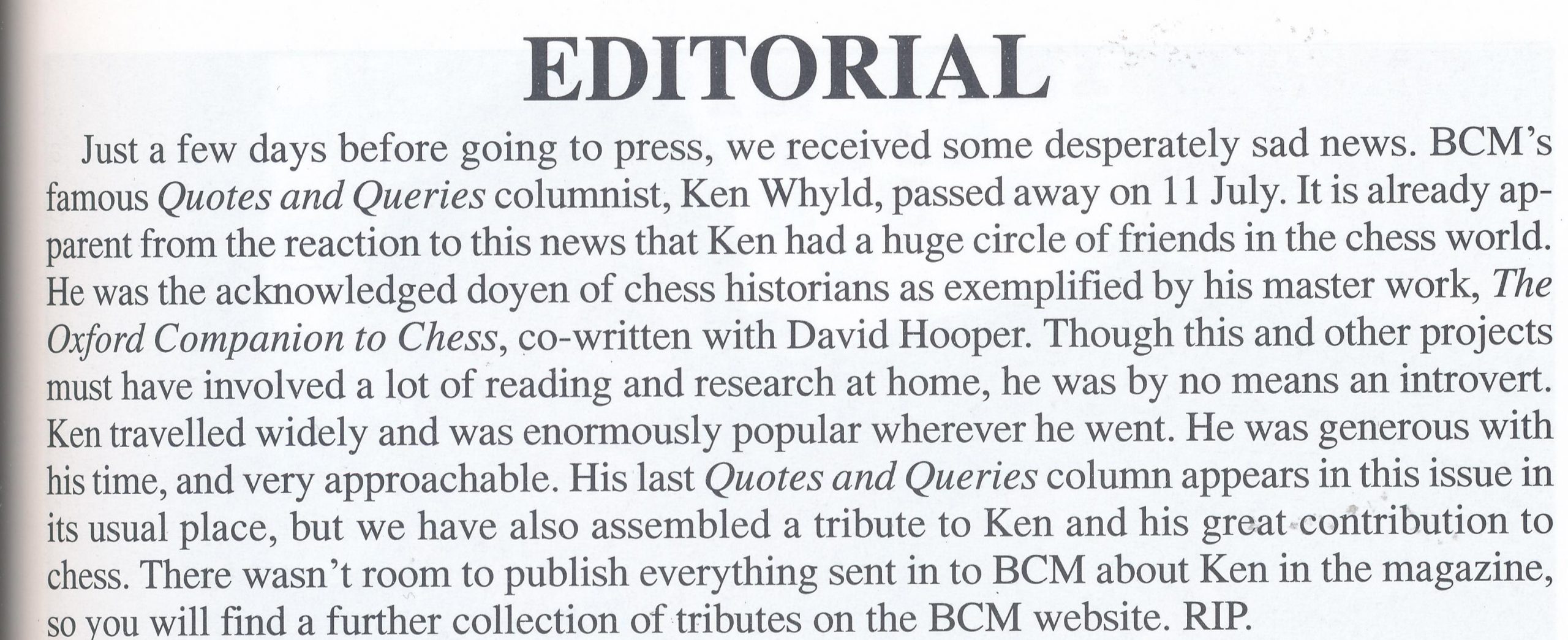
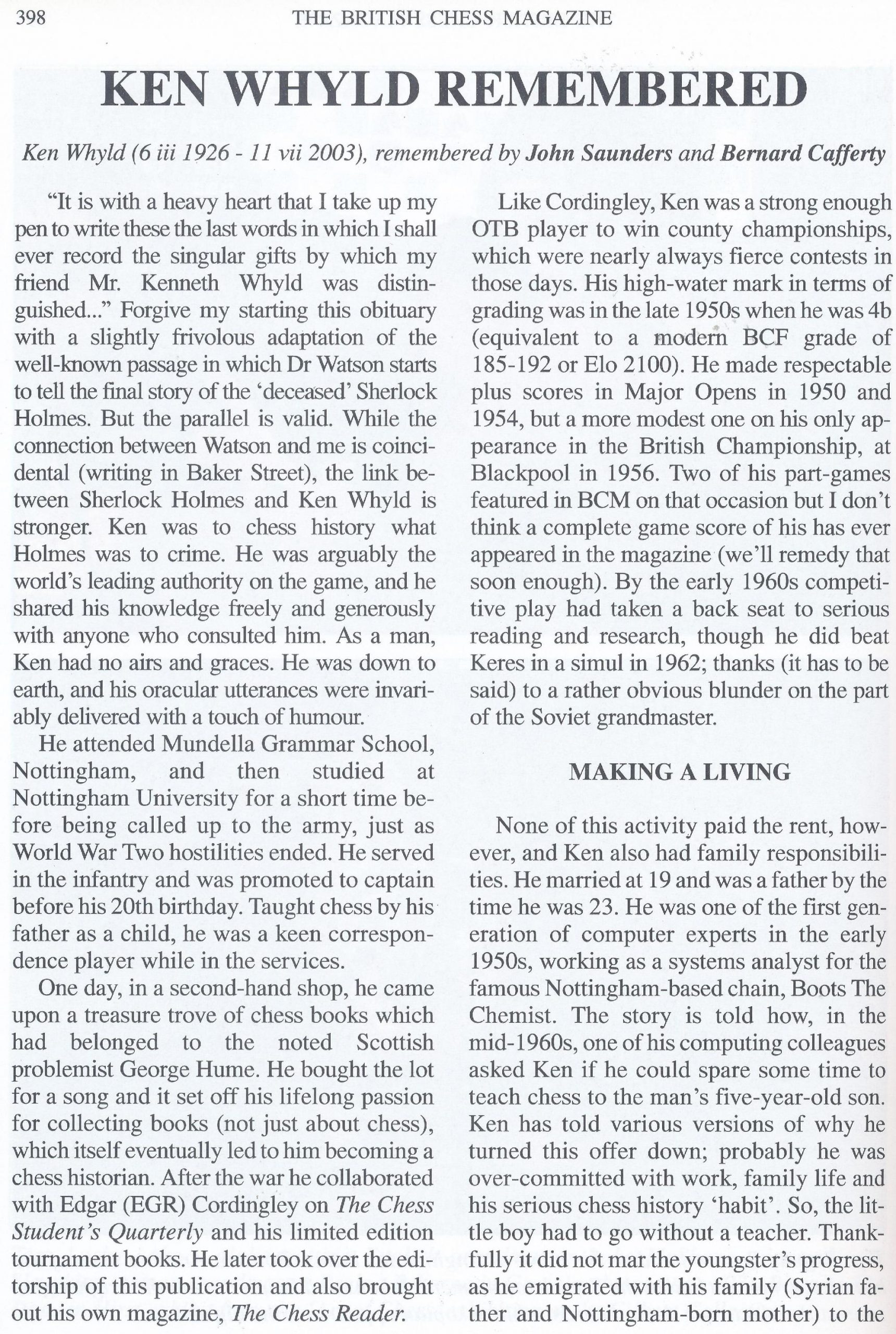
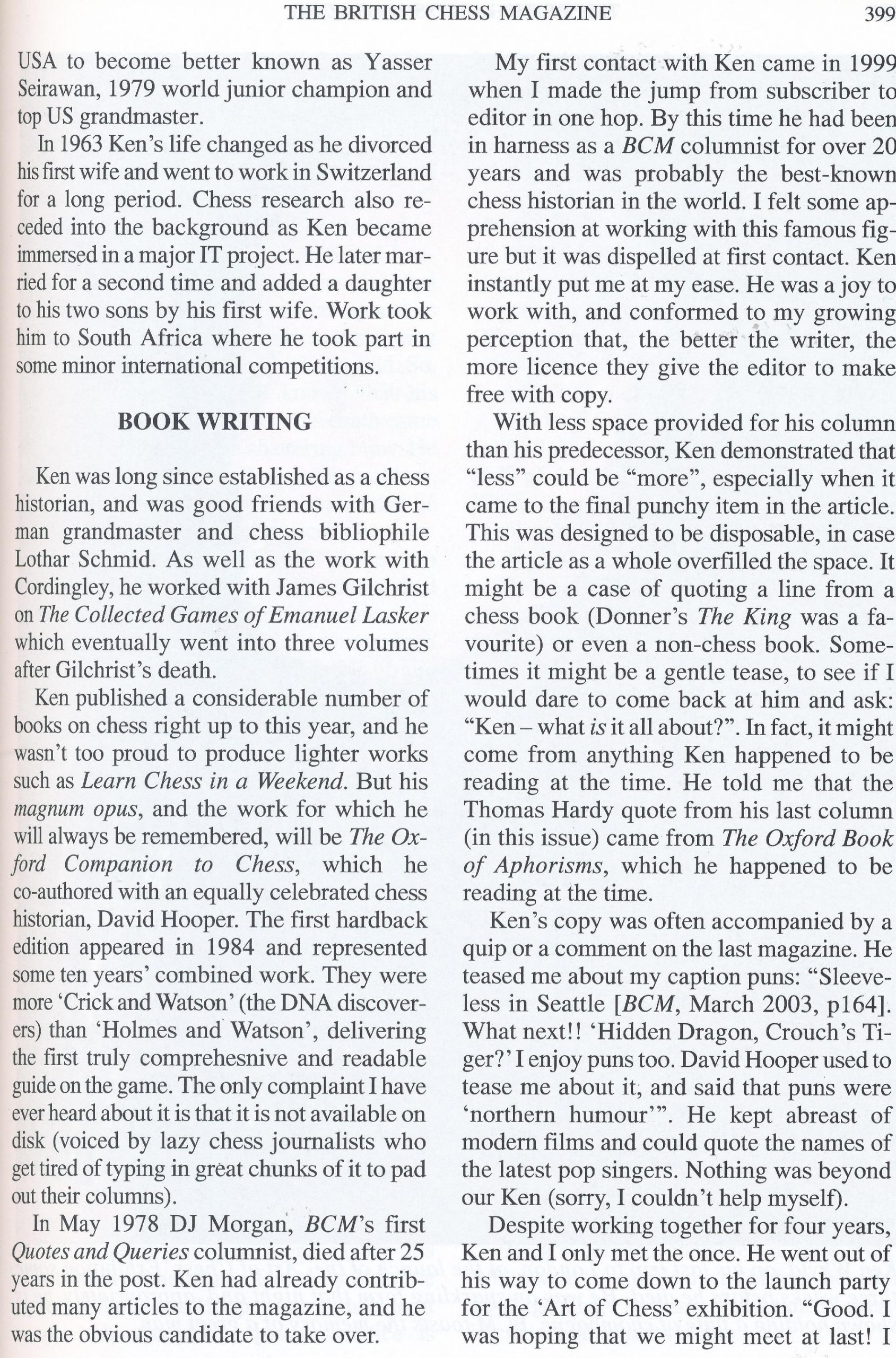
Possibly the best tribute to Ken was written by John Saunders and Bernard Cafferty in the August 2003 issue of British Chess Magazine, pages 398 – 402.

Editorial from British Chess Magazine, Volume CXXIII (123), Number 8 (August), page 395 by Editor, John Saunders
Ken Whyld Remembered from British Chess Magazine, Volume CXXIII (123), Number 8 (August), page 398 by Editor, John Saunders and Bernard Cafferty
Ken Whyld Remembered from British Chess Magazine, Volume CXXIII (123), Number 8 (August), page 399 by Editor, John Saunders and Bernard Cafferty
Ken Whyld Remembered from British Chess Magazine, Volume CXXIII (123), Number 8 (August), page 400 by Editor, John Saunders and Bernard Cafferty
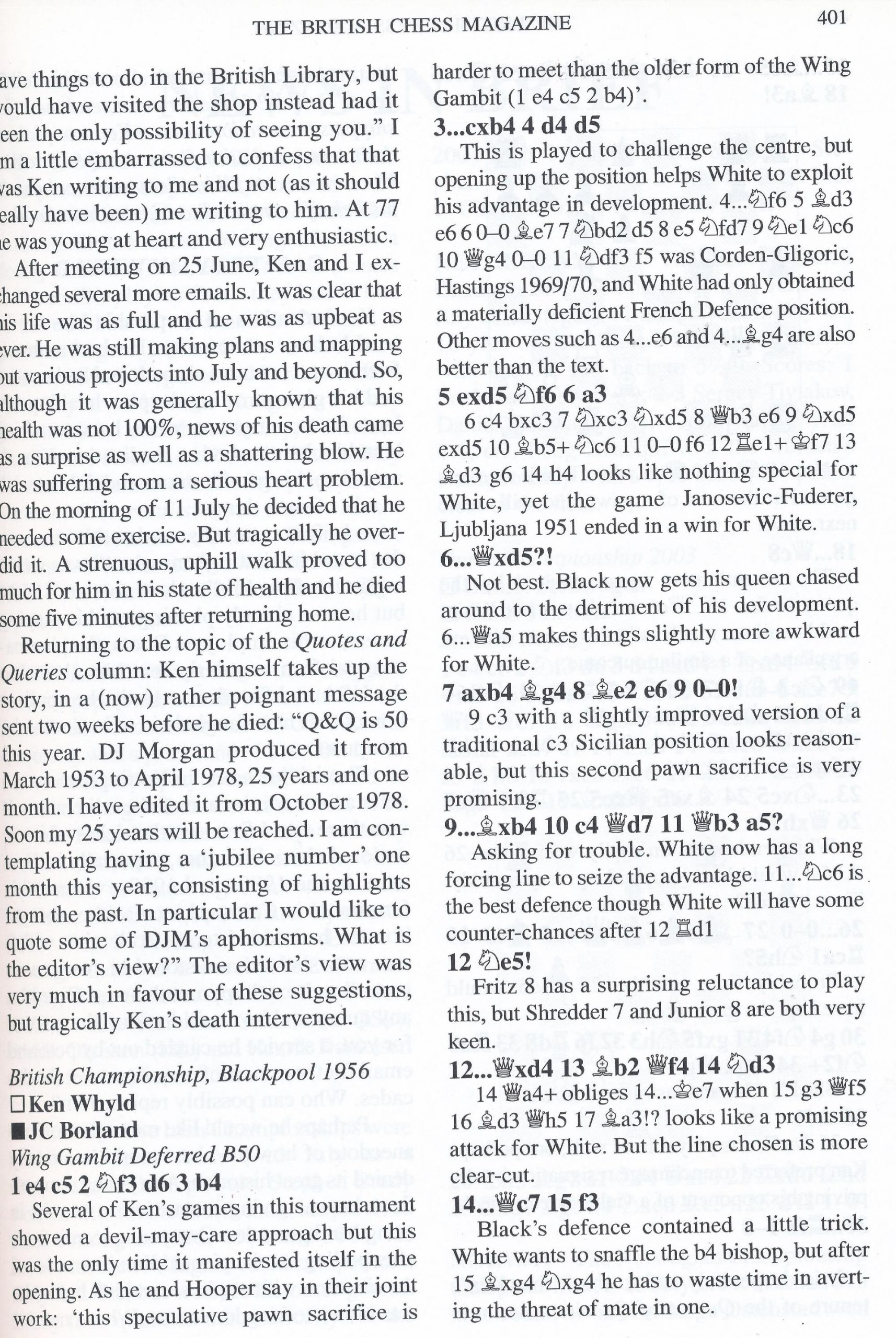
Ken Whyld Remembered from British Chess Magazine, Volume CXXIII (123), Number 8 (August), page 401 by Editor, John Saunders and Bernard Cafferty
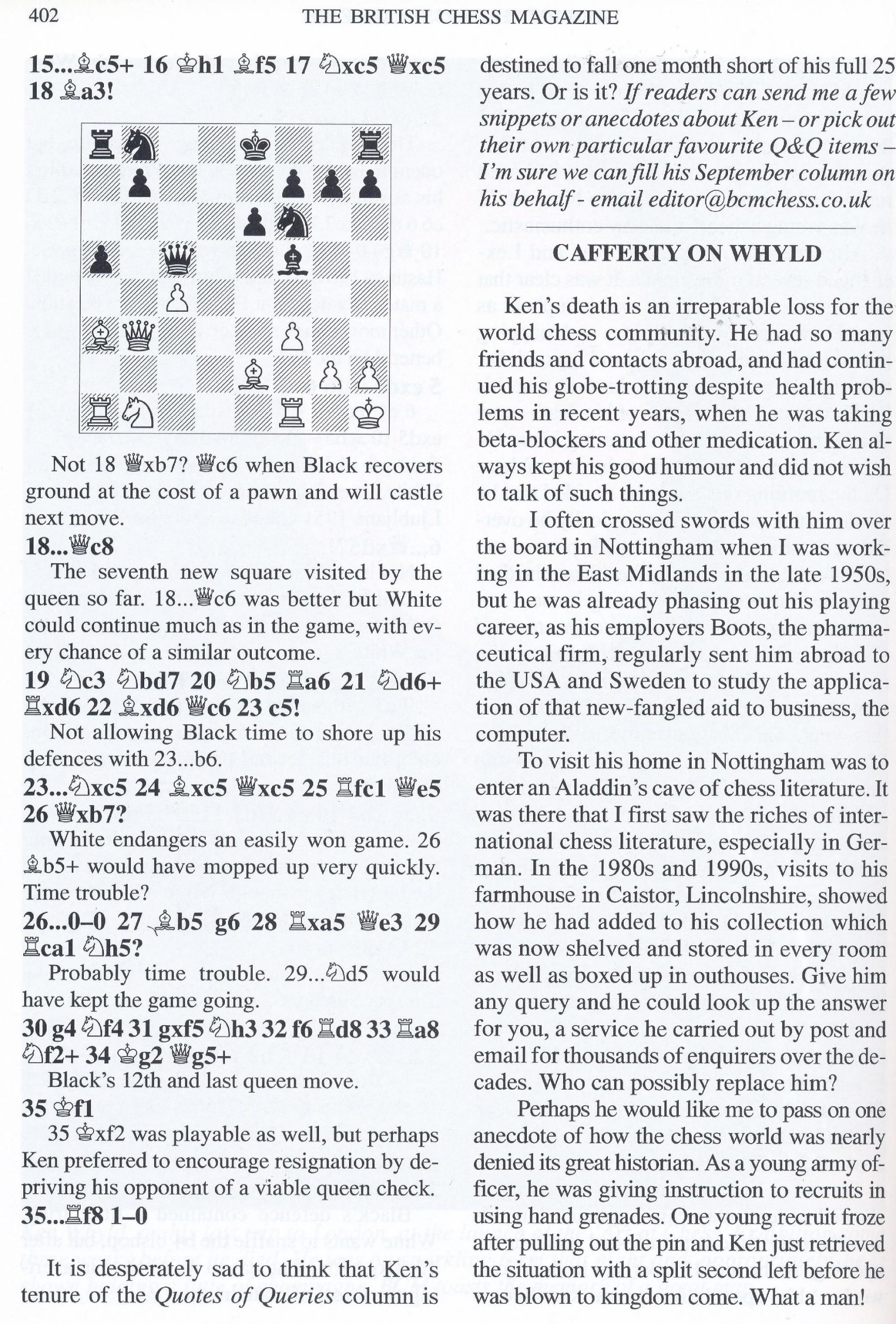
Ken Whyld Remembered from British Chess Magazine, Volume CXXIII (123), Number 8 (August), page 402 by Editor, John Saunders and Bernard Cafferty
Ken Whyld
Ken Whyld

Here is his Wikipedia entry

See more details from the Ken Whyld Association

The Collected Games of Emanuel Lasker
The Oxford Companion to Chess
Chess : The Records, Guinness, 1986, SBN 10: 0851124550ISBN 13: 9780851124551
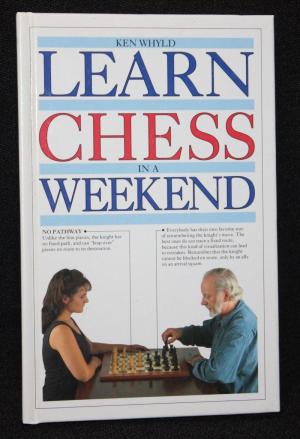
Learn Chess in a Weekend
Chess Columns : A List
Chess Reader
Chess Reader
Chess Stalker Quarterly
The Oxford Companion to Chess, 1st Edition
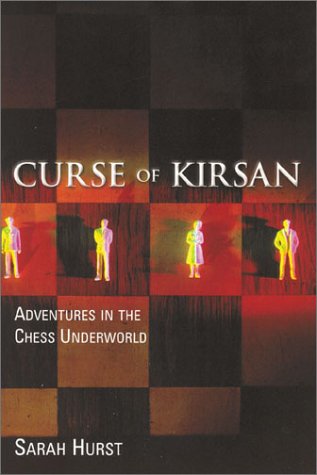
Curse of Kirsan by Sarah Hurst, Ken wrote the Foreword.

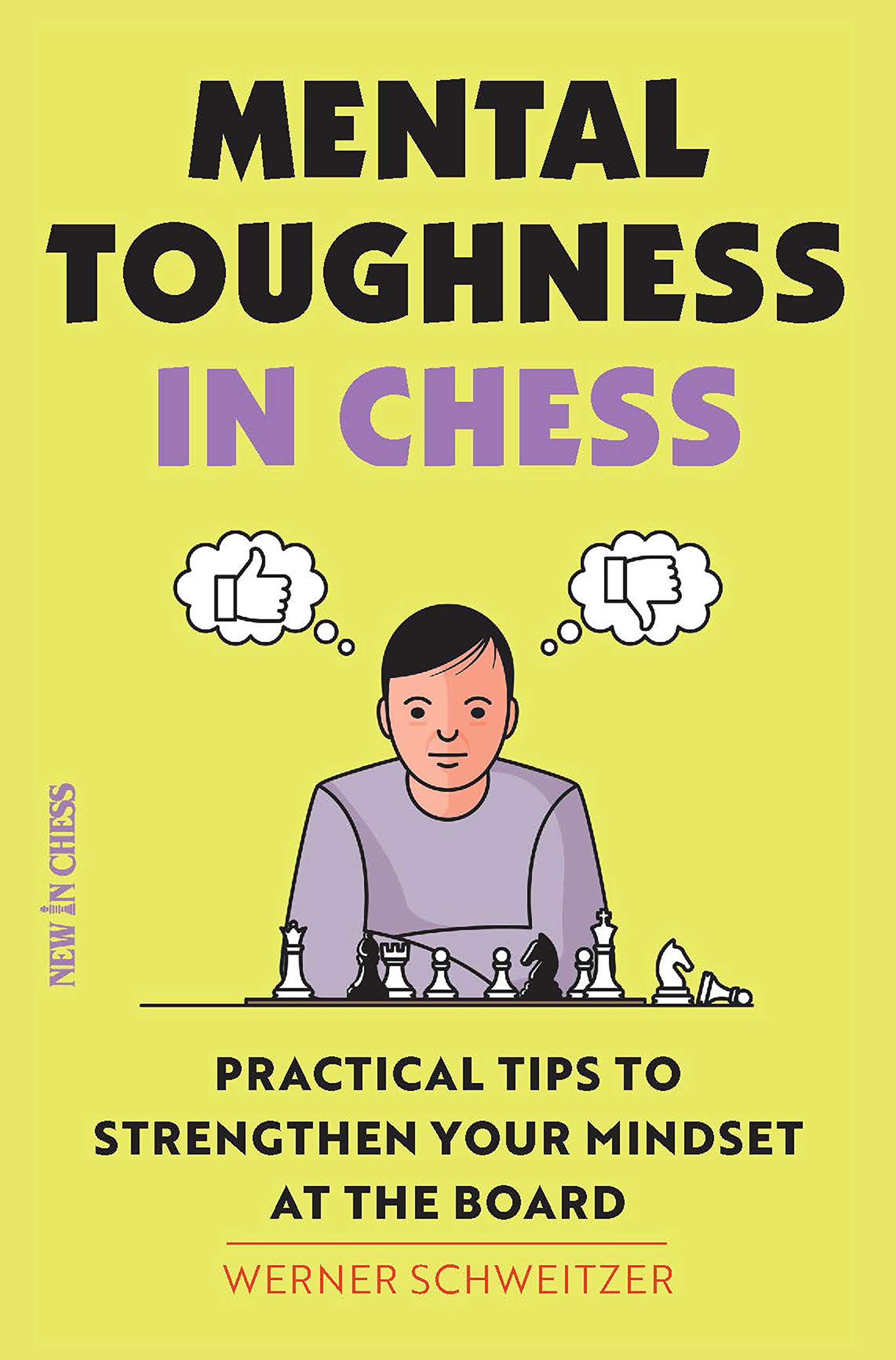
Mental Toughness in Chess : Practical Tips to Strengthen Your Mindset at the Board

Mental Toughness in Chess

Mental Toughness in Chess : Practical Tips to Strengthen Your Mindset at the Board : Werner Schweitzer

“Werner Schweitzer graduated as a mental coach at the University of Salzburg, Austria. He knows from experience which mental factors have impact on a chess players performance. Schweitzer has been coaching players and teams for many years.”

[embedyt] https://www.youtube.com/watch?v=B1Q3i7VAvEY[/embedyt]

From the rear cover :

“Your performance at the board does not only depend on your pure chess skills. Being a winner also requires a mindset that is able to cope with lots of stress and setbacks during hours of uninterrupted concentration. Just like technical chess skills, mental toughness can be trained. There are simple steps you can take that will help you to better realize your potential. Professional mental coach and chess player Werner Schweitzer has been working with chess teams and individual players for many years.

In this book Schweitzer presents practical tips and tools that will help you to improve your mental power during a game. You will learn how to: increase your concentration and stamina; recognize your own strengths and weaknesses; cope with losses as well as victories; increase your self-discipline when studying; handle disturbing thoughts and feelings during a game; boost your self-confidence; avoid underestimating (and overestimating!) your opponent; make better decisions while under pressure and other mental skills. These lessons and simple mental workouts will help players of all levels to unlock the full power of their brain and win more games.”

I enjoyed this book, but to be honest, it looks and reads like something you would pick up in a station or airport, when you have nothing to read on the journey.

There is a lot of white paper, only 144 pages , which could have been condensed to 120 or so with a more economical use of space and thus at £17.99 it is overpriced.

The book reads as though it has been hastily adapted to chess. The book could easily be rebranded as “Mental Toughness and the art of Man Management” or “Mental Toughness in the Boardroom” ; you get the idea.

This is a self-help manual , which assists you to get your brain and character into better order. The author admits in the very first chapter , that as his rating is just short of 2100, mental toughness is but only one of the factors that make a good chess player. His tips can only take you so far. With this admission, the limitations of the book are shown.

As stated , I got something out of the book and you will too. You will learn how to become a more disciplined thinker. If that’s what you feel you need, then this could be a good buy.

IM Andrew Martin, Bramley, Surrey 8th July 2020

IM Andrew Martin
IM Andrew Martin

Book Details :

  • Paperback : 144 pages
  • Publisher: New in Chess (1 January 2020)
  • Language: English
  • ISBN-10: 9056918583
  • ISBN-13: 978-9056918583
  • Product Dimensions: 14.9 x 0.9 x 22.2 cm

Official web site of New in Chess

Mental Toughness in Chess

Remembering IM Andrew Whiteley (09-vi-1947 07-vii-2014)

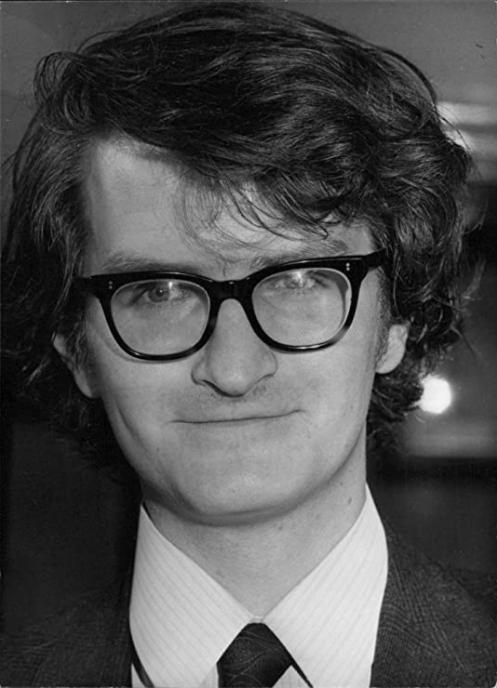
Andrew Whiteley circa 1965 ?, photographer is Colin Davey of Camera Press

BCN remembers IM Andrew Jonathan Whiteley (09-vi-1947 07-vii-2014)

Andrew Whiteley
Andrew Whiteley

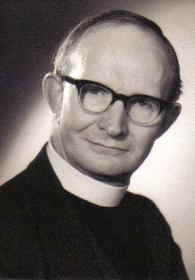
Andrew was born on Monday, June 9th, 1947 in Birmingham, West Midlands to Denys Edward Hugh Whiteley (1914 – 1987) and Muriel Sutton (1919 – 1967). Andrew had two siblings, Robert N (Birmingham, 1944) and Angela M (Oxford 1952).

Denys Edward Hugh Whiteley (1914 - 1987, from Ancestry.co.uk
Denys Edward Hugh Whiteley (1914 – 1987, from Ancestry.co.uk

Andrew completed his education at Magdalen College School, Oxford and then in law at Pembroke College, Oxford.

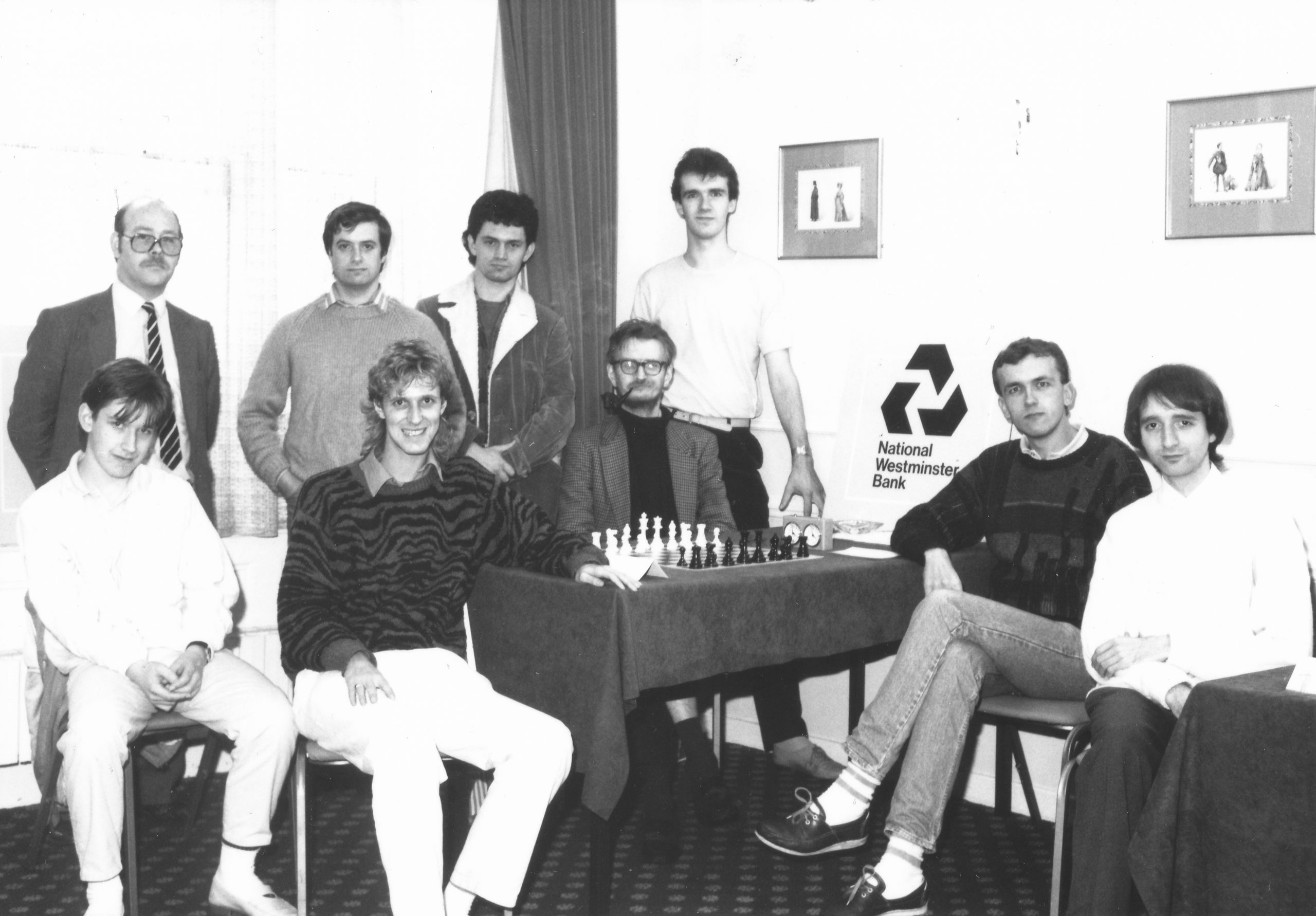
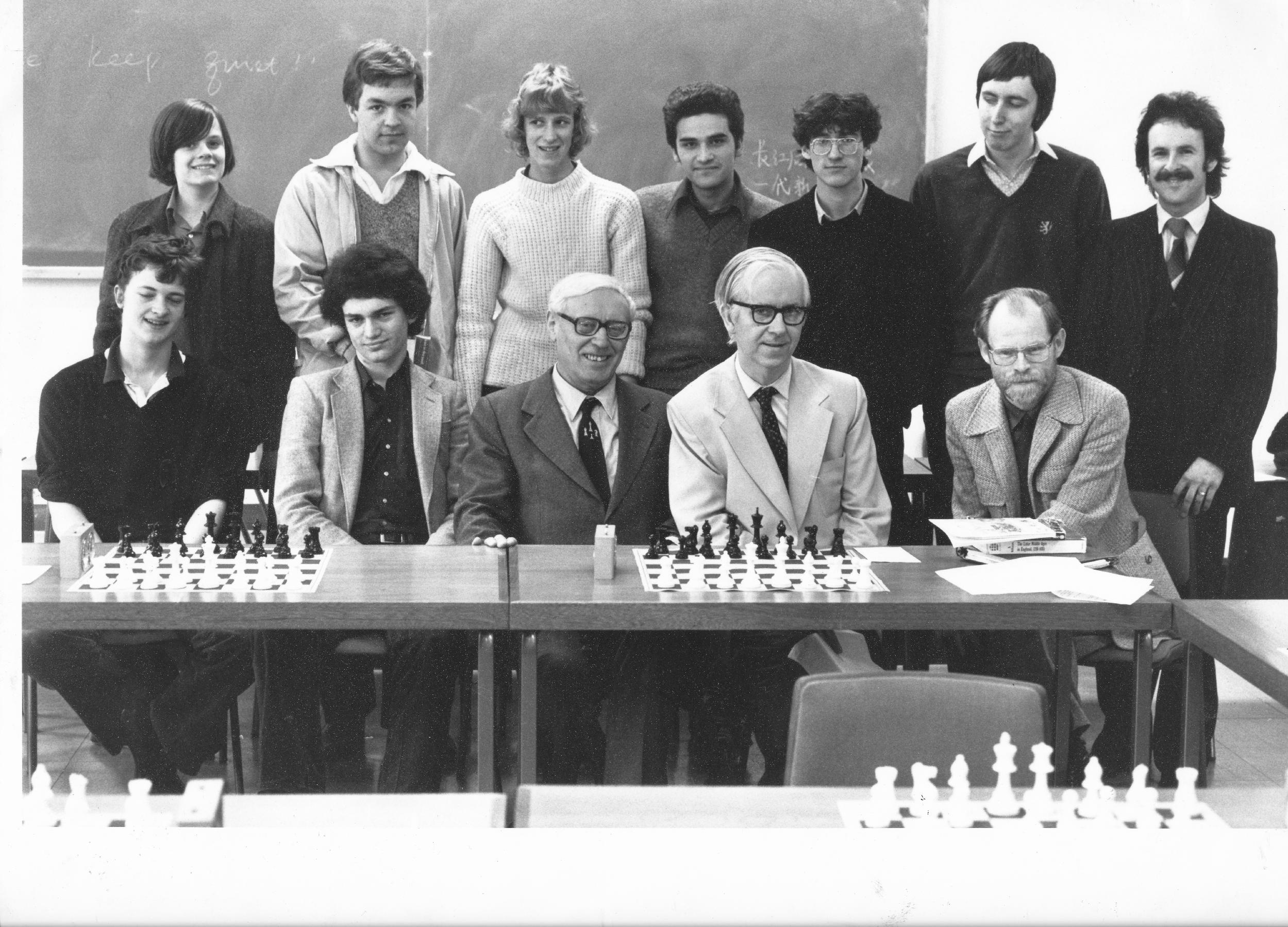
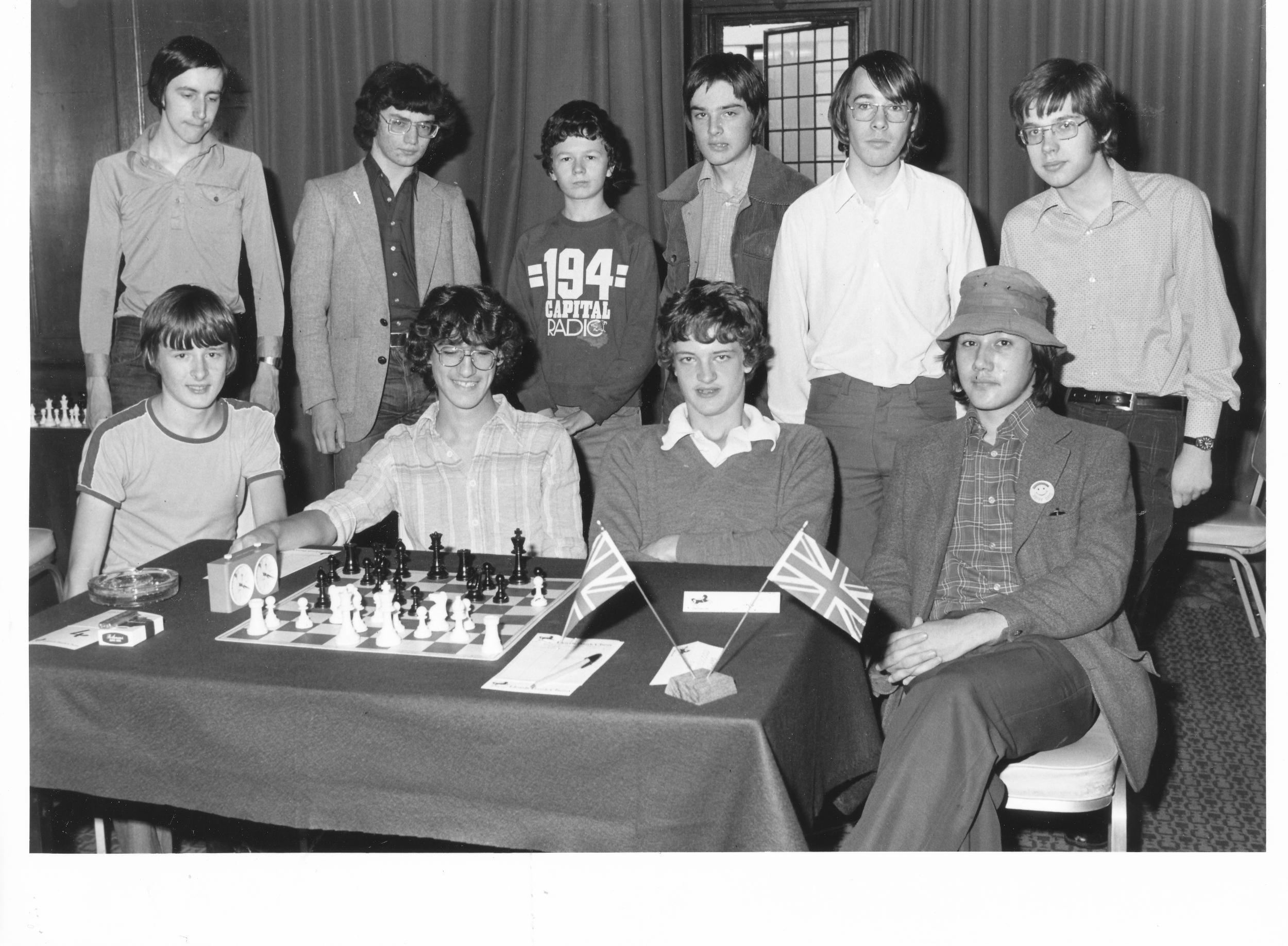
Andrew and friends at the NatWest Bank Young Masters

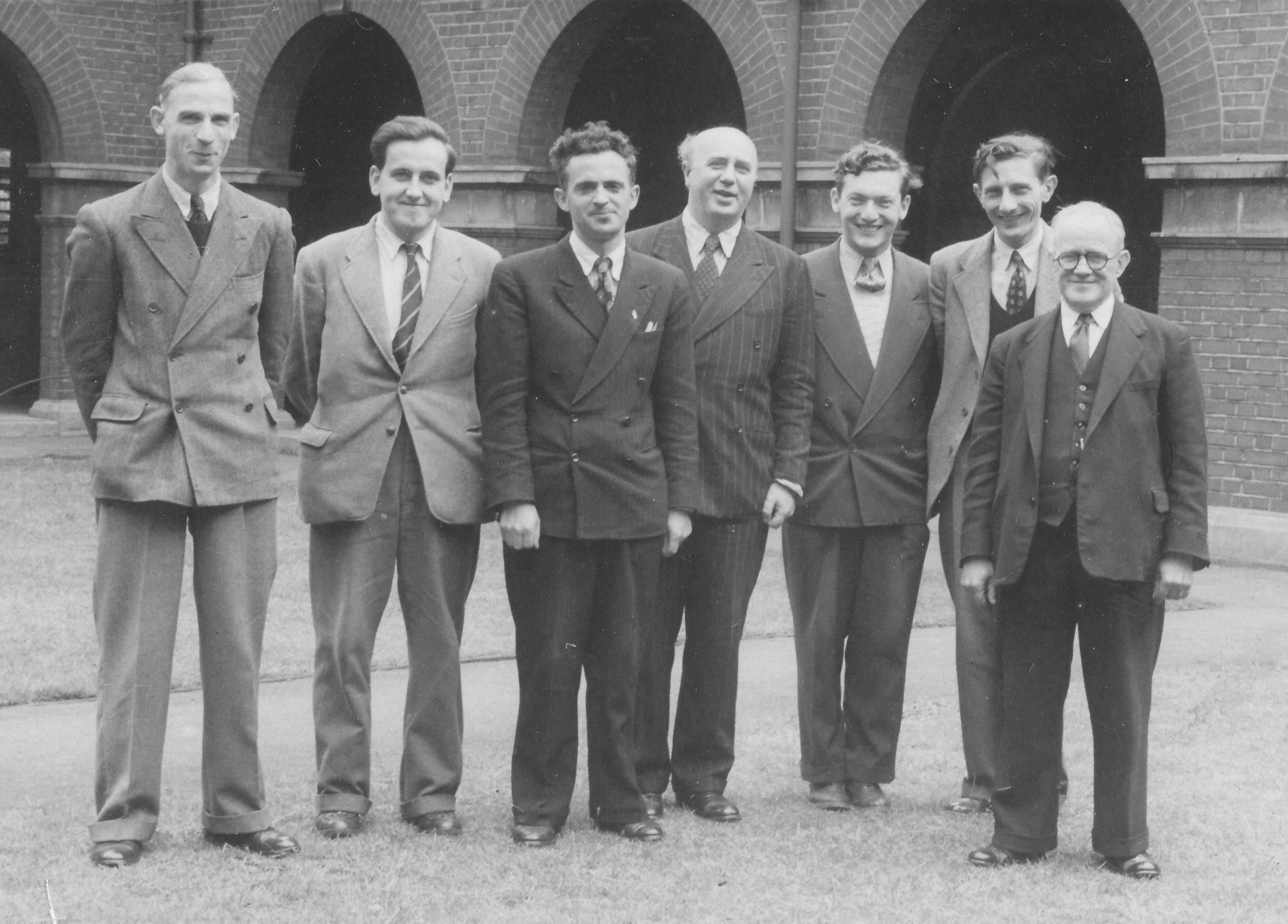
“Whiteley’s school chess record is an outstanding 63/65: Andrew Whiteley is captain and top board of a very strong U18 team of: A Whiteley, H Morphy, MN Crombie, MM Daube, A Hawkins and AH Smith.”

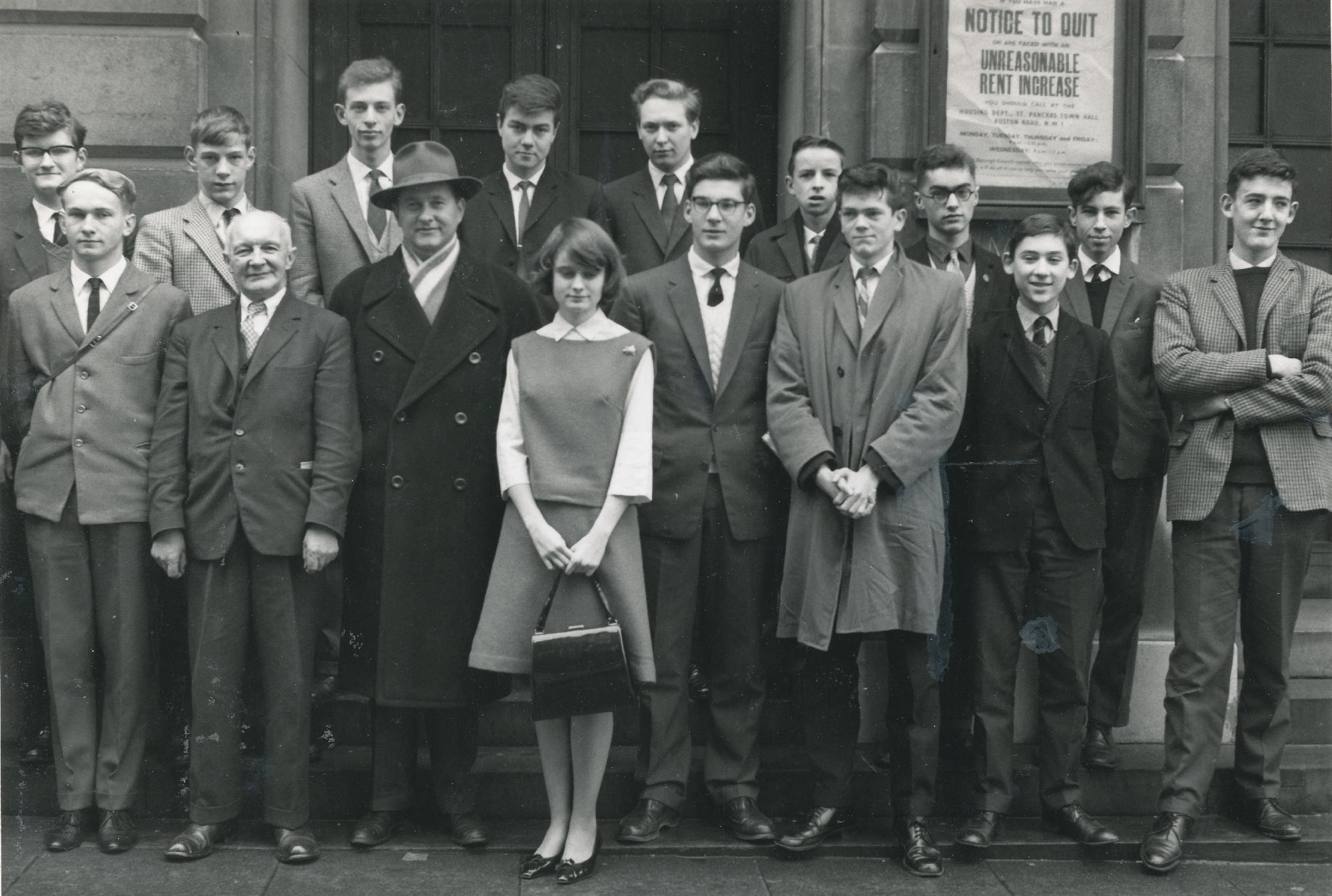
Some of the participants in the Paul Keres display on November 25th, 1962, at St Pancras Town Hall, London WC1. Back row : AJ. Whiteley, D, Floyer, PJ Collins, PJ Adams, RC Vaughan, KB Harman, D. Parr, DNL Levy, Front row : MV Lambshire, AE Hopkins (selector) Paul Keres, Miss D. Dobson, RE Hartley, BC Gillman, WR Hartston and PN Lee. Photograph by AM Reilly. Source : BCM, 1963, page 13

Andrew was joint (with WR Hartston) Southern Counties (SCCU) champion in the 1967-68 season.

His highest Elo rating was 2395 in January 1977 at the age of 29 and played for King’s Head in the Four Nations Chess League (4NCL).

Andrew was former President of the Middlesex County Chess Association (1985-87) and Deputy (1984-85 & 1987-88).

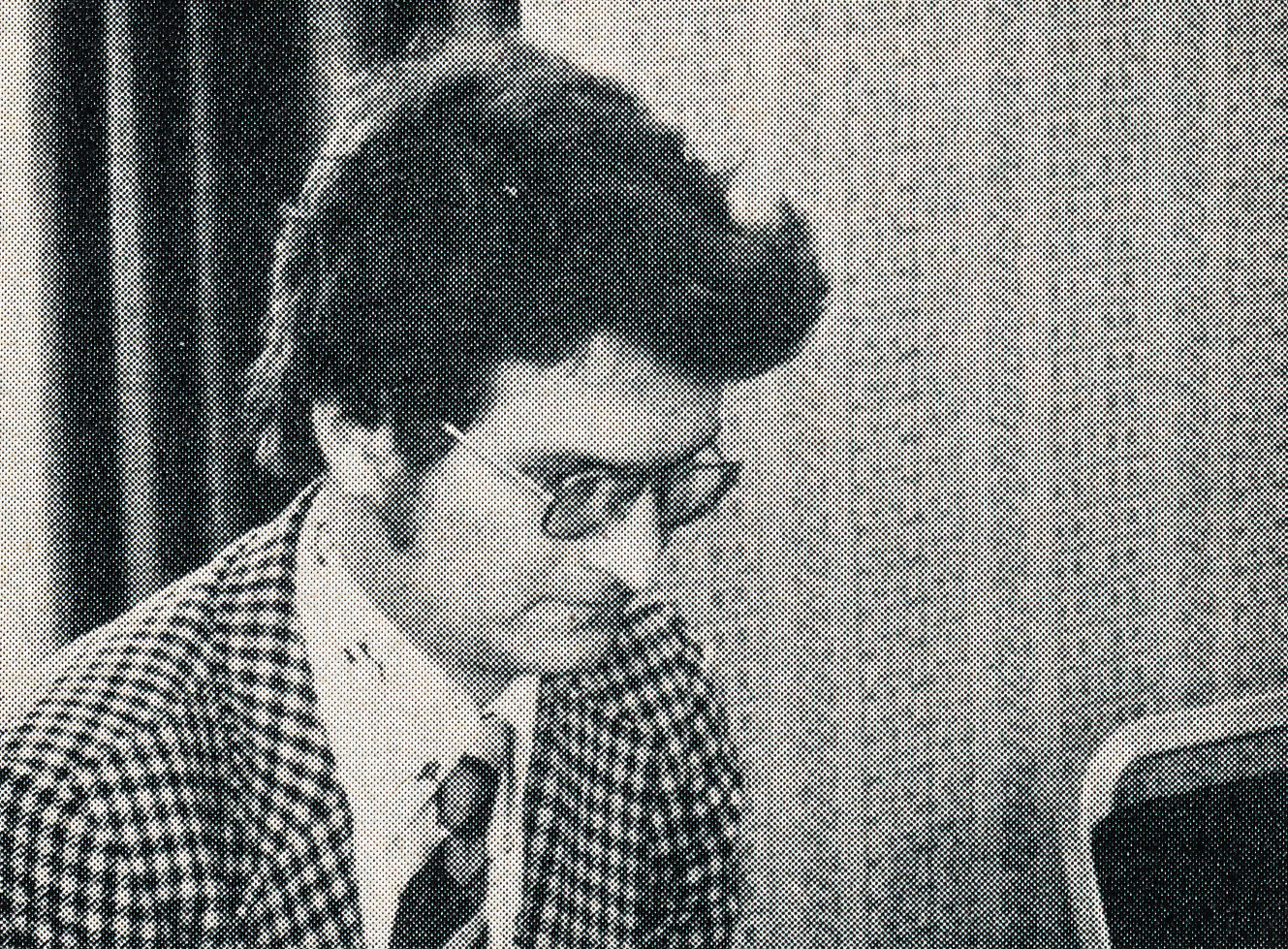
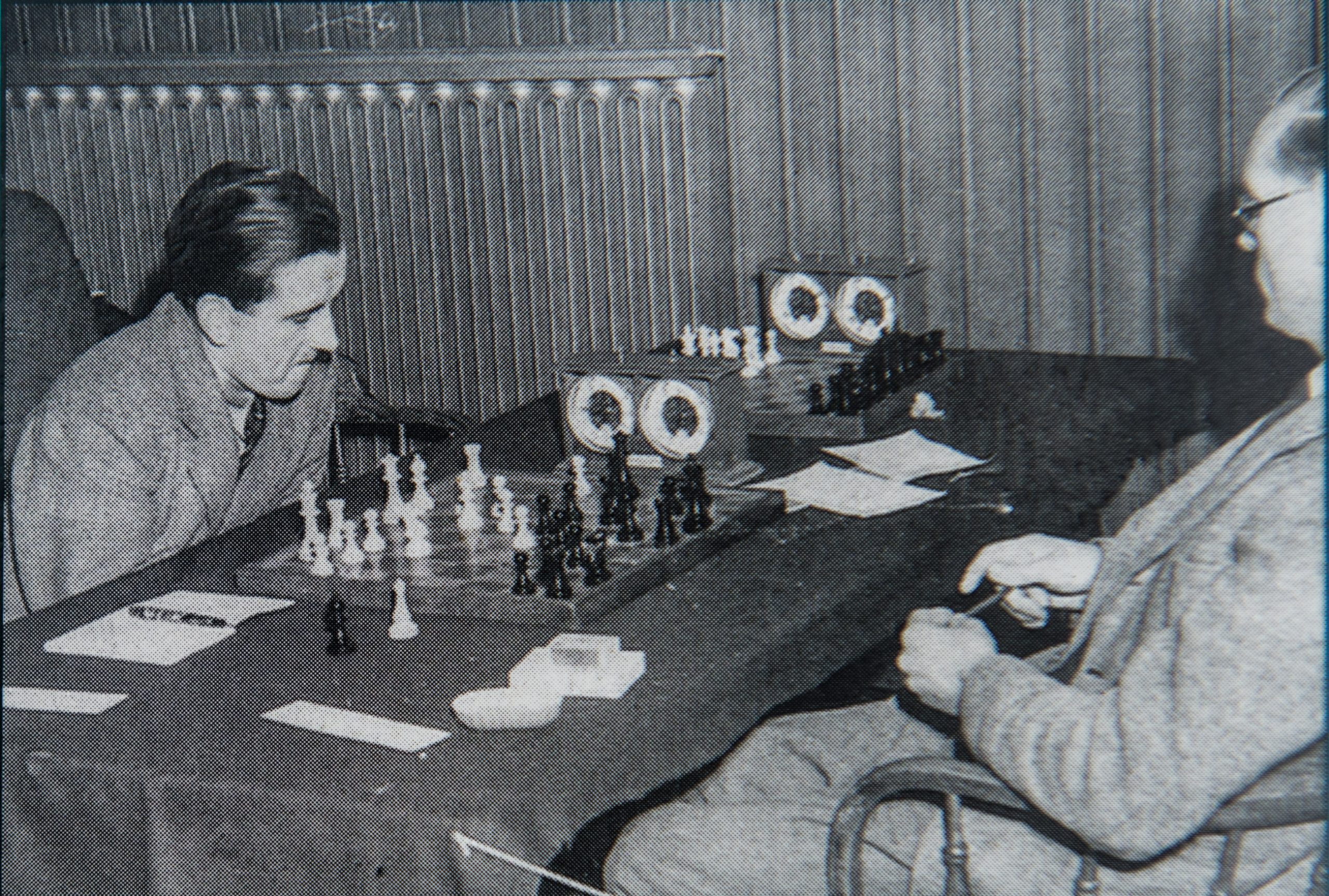
Andrew Whiteley playing board two in the London - Belgrade Telex Match on April 3rd, 1976 from the St. James Hotel, Buckingham Gate. Sourced from BCM, Volume XCVI (96), Number 5, page 192. Photographer probably Freddy Reilly.
Andrew Whiteley playing board two in the London – Belgrade Telex Match on April 3rd, 1976 from the St. James Hotel, Buckingham Gate. Sourced from BCM, Volume XCVI (96), Number 5, page 192. Photographer probably Freddy Reilly.

He became a FIDE Master in 1980 at the age of 33. His last major tournament was Cappelle Le Grand in 1988 (see photograph below).

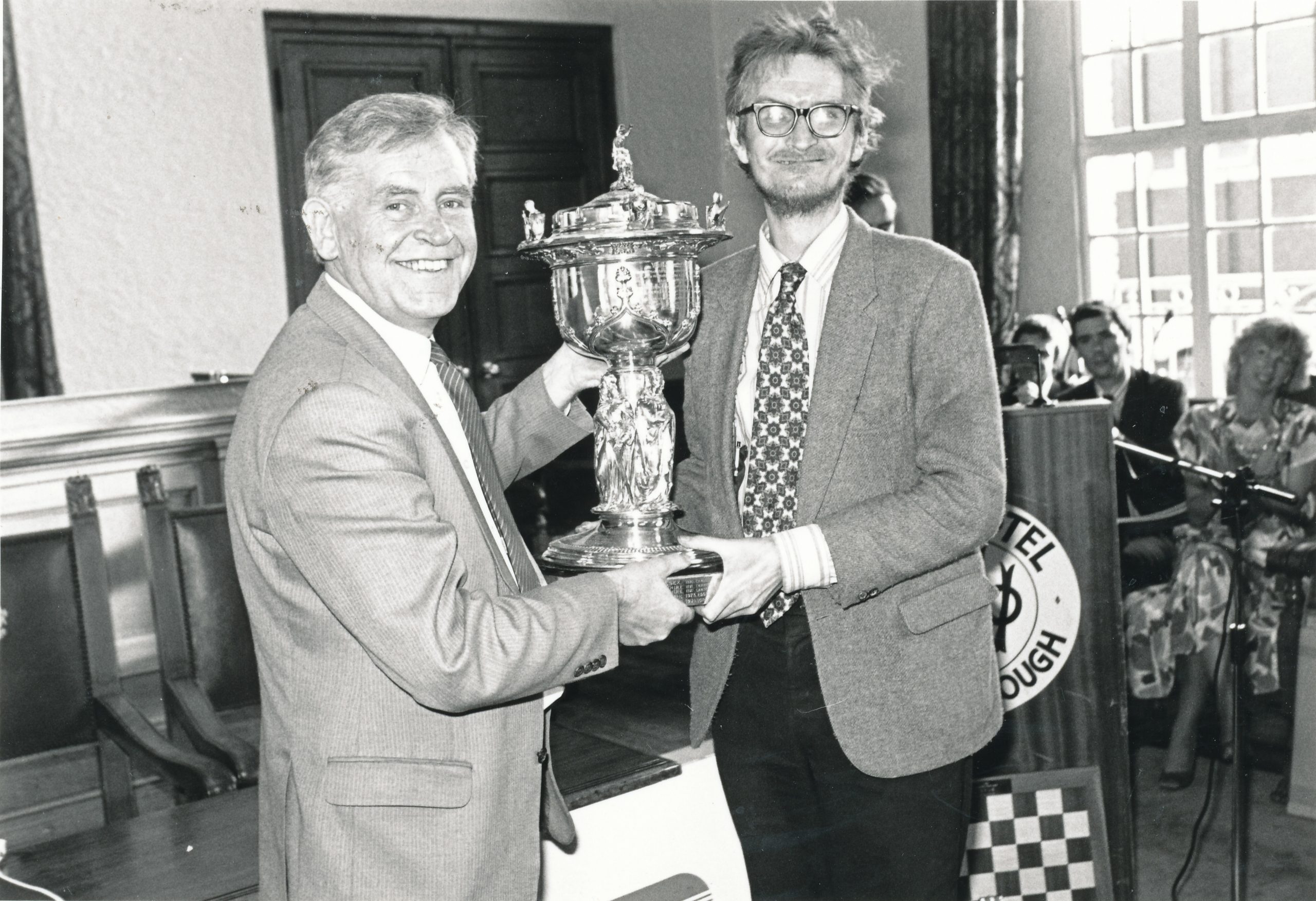
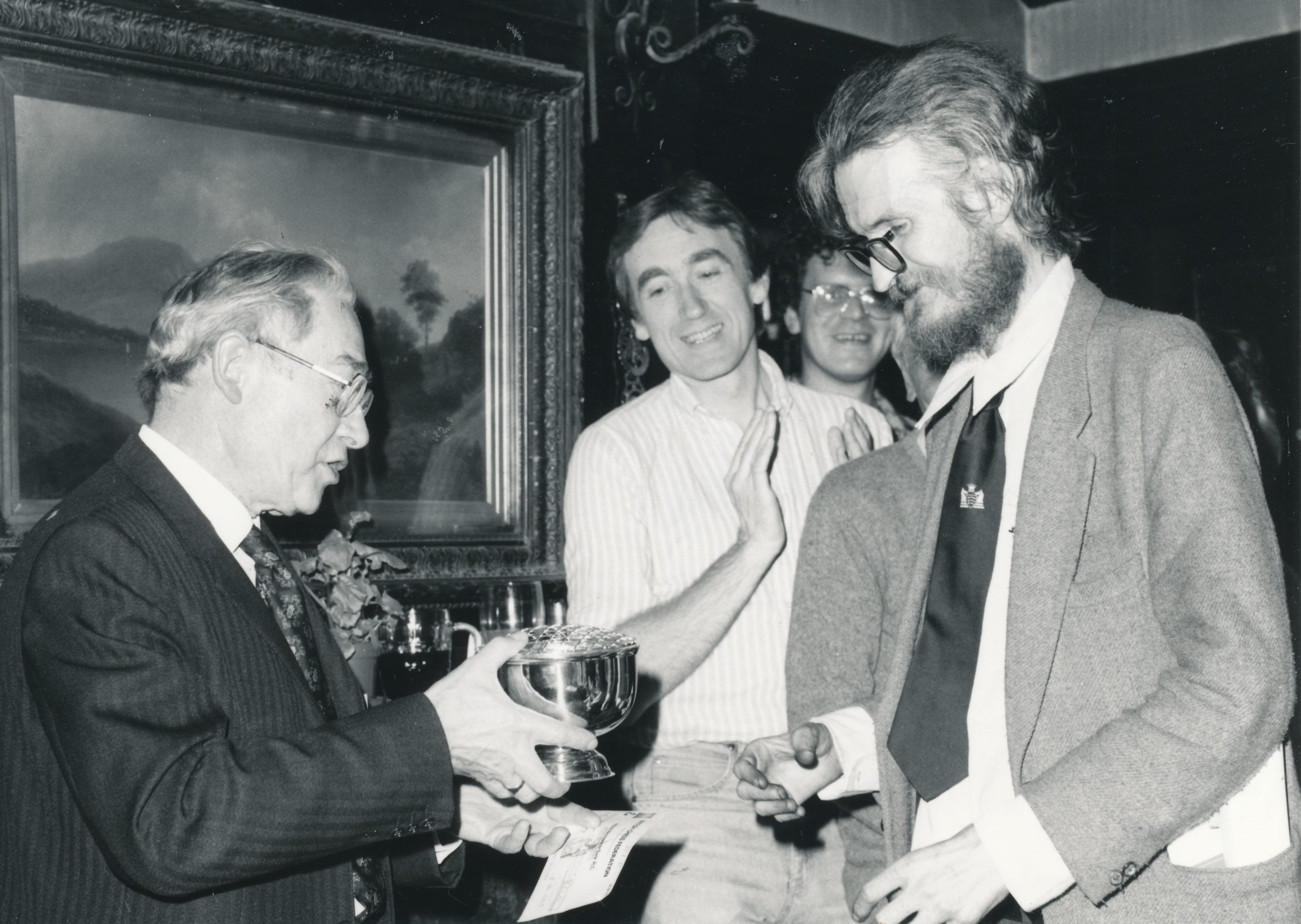
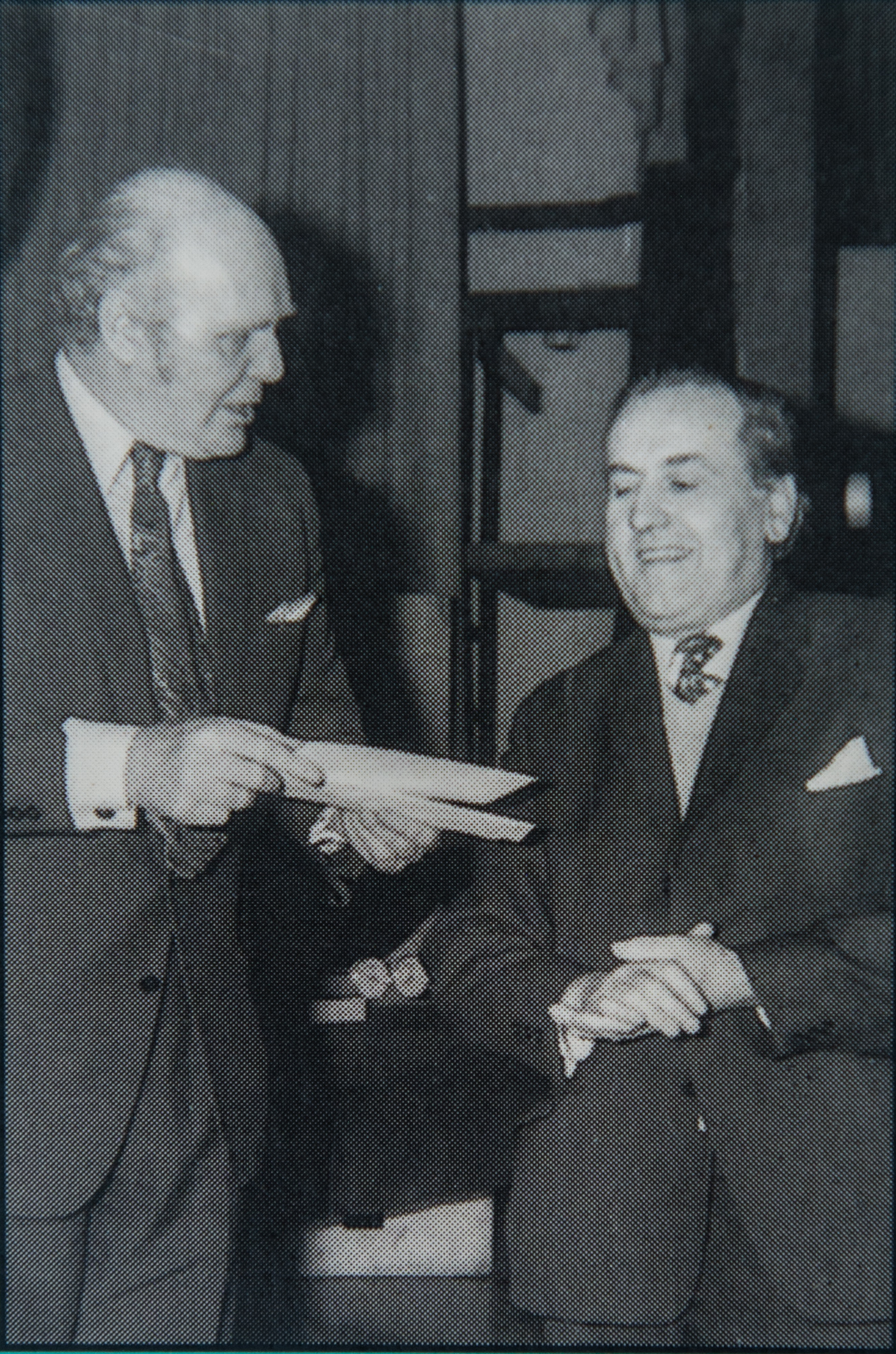
Magnus Magnusson presents Andrew Whiteley (right) with the BCF County Championship trophy as Captain of the Middlesex team in 1986.
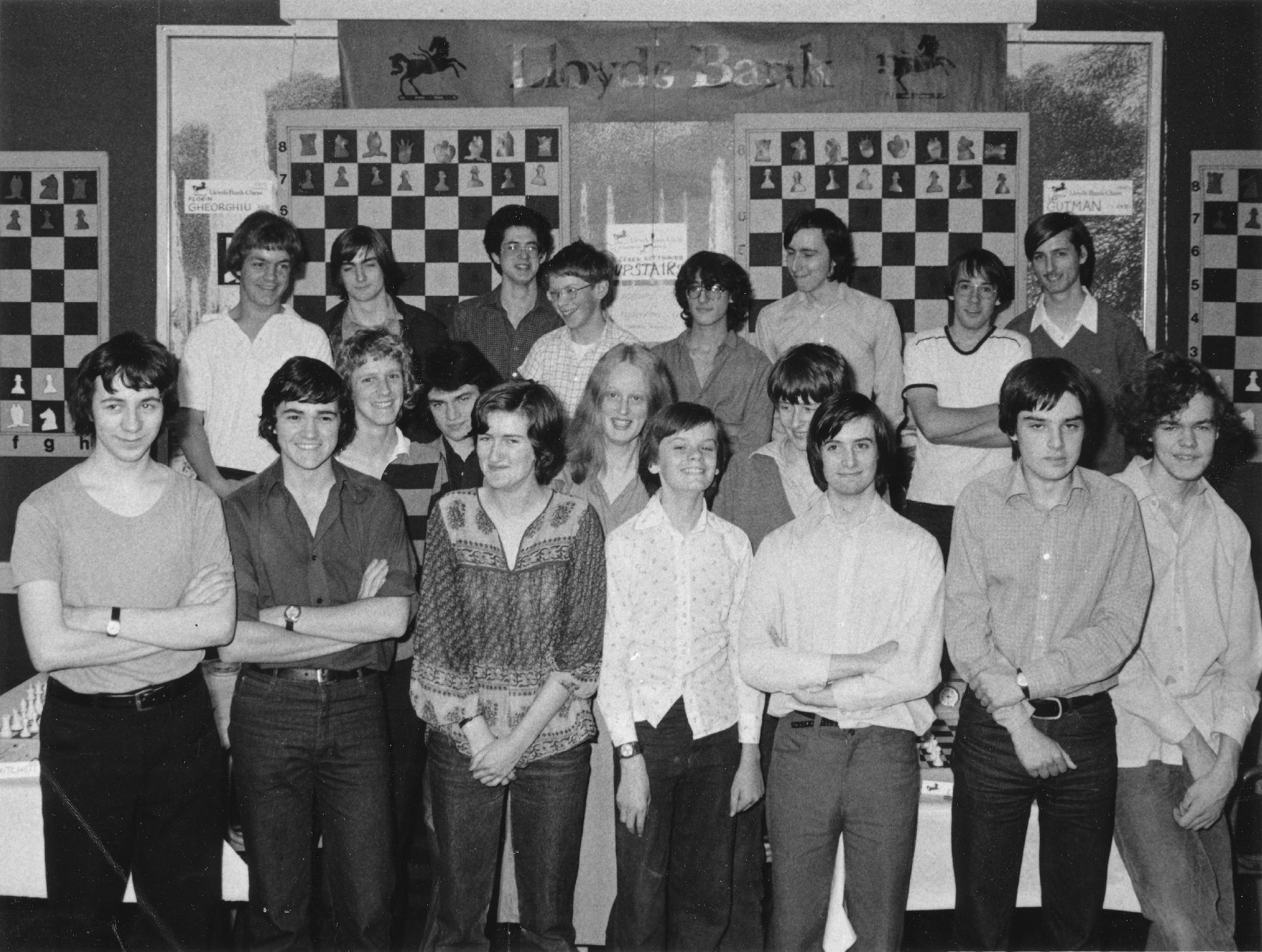

Below was written by BCM editor James Pratt in Volume CXXXIV (134), Number 8 (August) page 417-8 :

“Unfailingly courteous, formally dressed, retired London solicitor, British Master, Andrew Jonathan Whiteley (9 vi 1946 Birmingham – 8 vii 2014) has died. The son of an Oxford professor, AJW was British U21 Champion of 1965. He tied, with Hans Ree, for first in the European Junior in 1965/6.

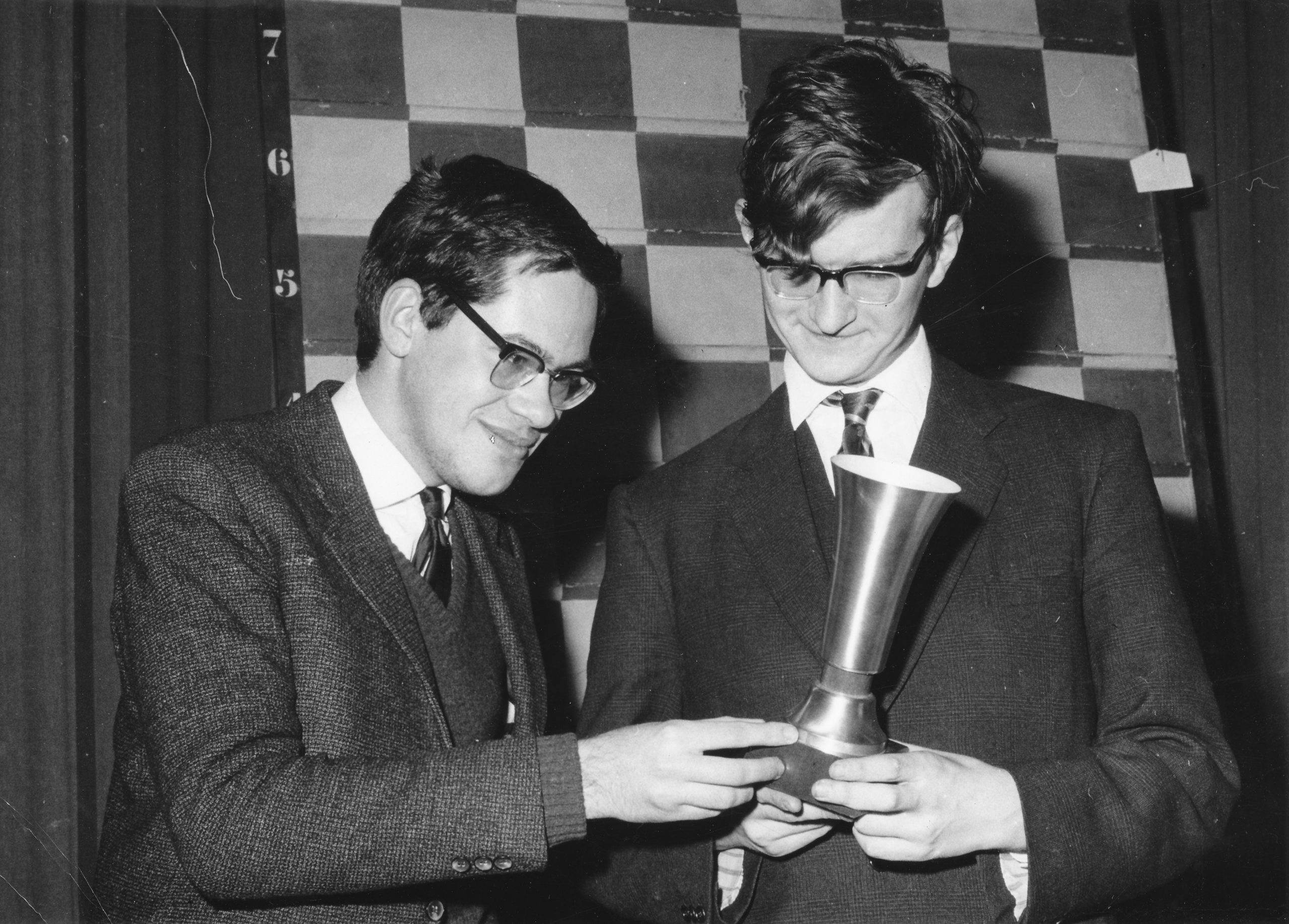
Hans Ree (left) and Andrew Whiteley (right) examine the European Junior Trophy for 1965/6 in which they tied for first.

The following game first appeared in the Games Department column of Harry Golombek in British Chess Magazine, Volume LXXXVI (1966), Number 3 (March), page 148. It was game #14,118.

He scooped the Silver medal at the British in 1971 and in 1976. Andrew often worked selflessly at his office in the mornings, commuting to key games after lunch. He rose to be No. 3 or 4 in England and, always a loyal team man, shone in Olympiads. Belatedly, having turned his back on the law, in 1988, he became an IM. He was also a BCF Arbiter and Middlesex County organiser. In 2008, he won the English Senior Championships aged 61.

His was a classical chess style. RIP.”

Andrew Whiteley at the Nice Olympiad of 1974.

Here is his Wikipedia entry

Andrew Whiteley commentating on Kasparov vs Karpov

Here is a excellent obituary from his old school, Magdalen College.

FM Andrew Whiteley, IM Julian Hodgson and FM Byron Jacobs at Cappelle Le Grand, 1988. Photograph by Caroline Winkler

Here is an obituary from Stewart Reuben on behalf of the English Chess Federation

Andrew Whiteley receives the Rosebowl trophy from John Poole

Since 2014 King’s Head Chess Club has held an annual blitz tournament in memory of Andrew featuring many of England’s top players.

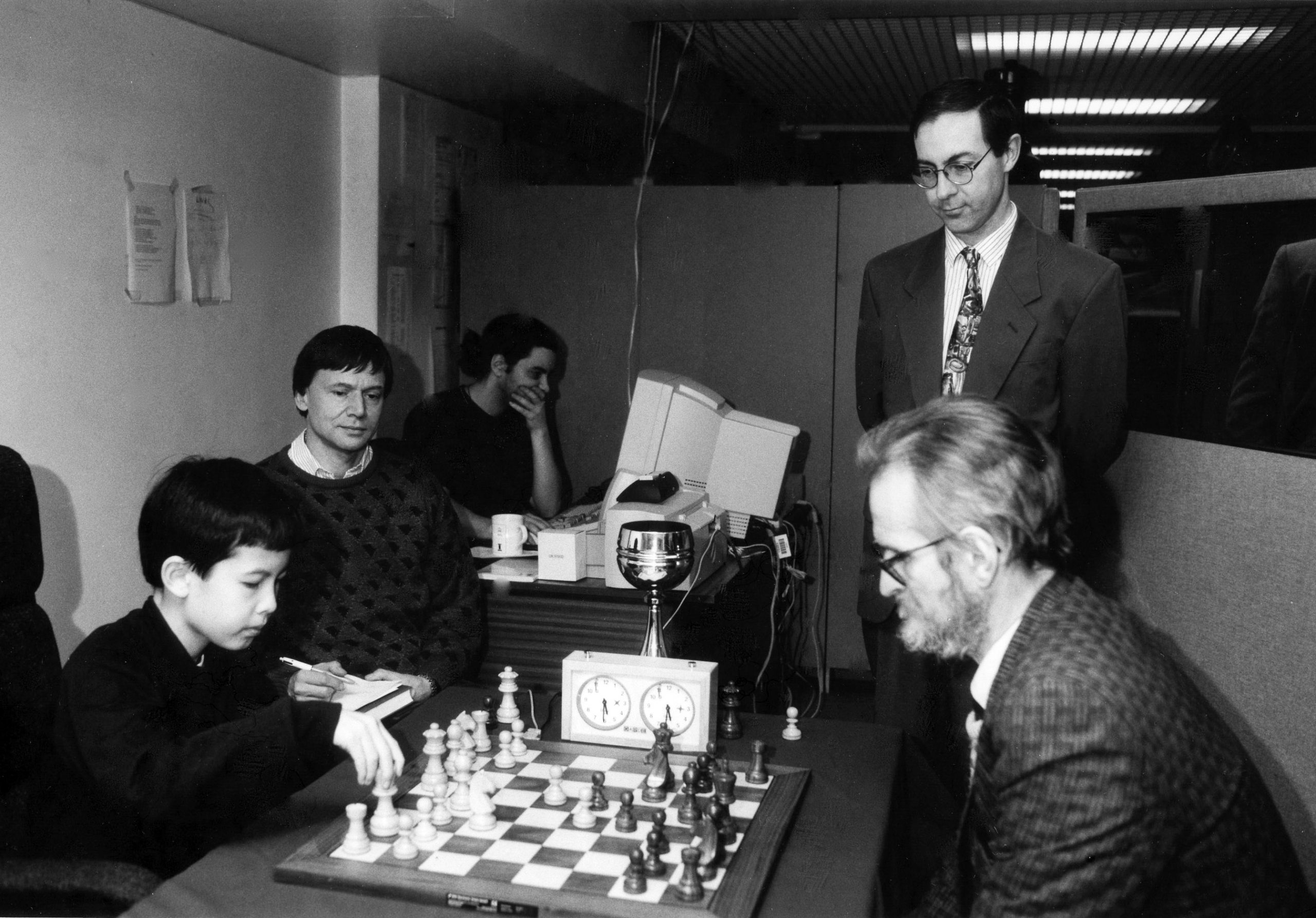
Andrew Whiteley faces David Howell whilst Jimmy Adams records the moves, photograph courtesy of Mark Huba

Here is a discussion of Andrew on the English Chess Forum

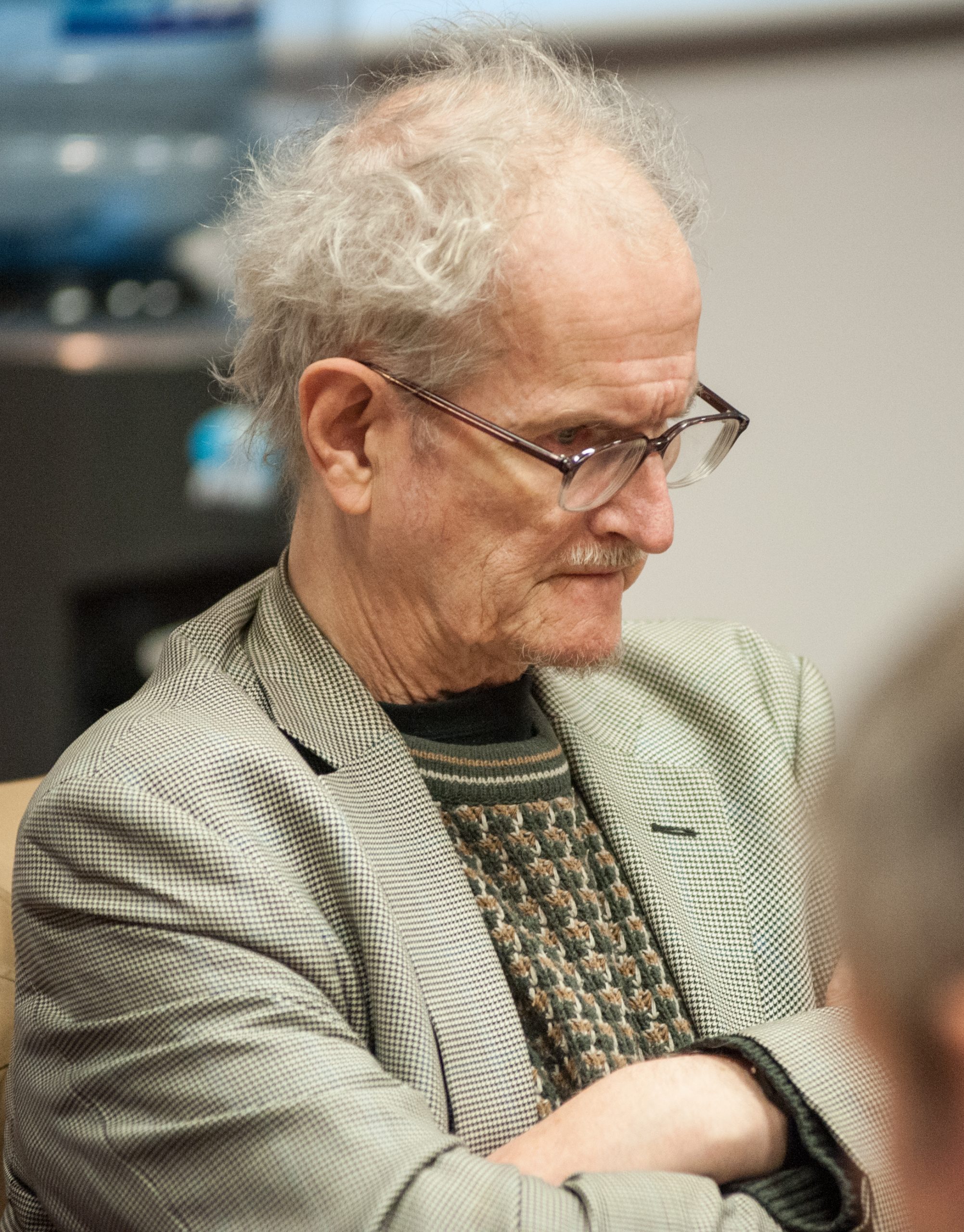
IM Andrew Whiteley at the first 4NCL weekend of 2012 in November.

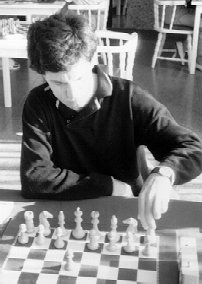
Happy Birthday IM Byron Jacobs (25-vi-1963)

IM Byron Jacobs
IM Byron Jacobs

BCN wishes Happy Birthday to IM Byron Anthony Jacobs (25-vi-1963)

Byron originates from Sir John Betjeman’s favourite town (Slough) and attended Slough Grammar and then The University of Sussex (Falmer).

He was Standard London under-16 champion in 1979. He was 3rd= in the 1982 Danish U-18 International. He was 3rd= in the 1988 Guernsey Open. His last recorded event in Megabase 2020 was in 1998.

Byron was Southern Counties (SCCU) champion for the 1982-83 season.

Byron became a FIDE Master in 1983 and an International Master and in 1988 achieved a peak rating of 2390 in July 1987 at the age of 24.

Byron Jacobs
Byron Jacobs

Having given up competitive chess Byron became a successful poker player and commentator and has written on the subject.

FM Andrew Whiteley, IM Julian Hodgson and FM Byron Jacobs at Cappelle Le Grand, 1988. Photograph by Caroline Winkler

Byron is a director of Brighton based First Rank Publishing and is a specialist chess typesetter and Chief Advisor for Everyman Publishing and others and was pivotal in Brighton based, Chess Press.

Byron and friends at the NatWest Bank Young Masters

Byron was the typesetter for British Chess Magazine from 2011 – 2012 and was Deputy Editor for CHESS during the time of Murray Chandler and Bernard Cafferty

IM Byron Jacobs (front, fourth from left) at a Lloyds Bank event
IM Byron Jacobs (seated, second from left)
IM Byron Jacobs (standing, second from left)) at a Lloyds Bank Masters
Byron Jacobs (second from left) at the National Film Theatre. Also present is Aaron B, Rose, JJ Ady and Andrew Martin. Photographer : John Upham

Byron is an accomplished chess author with many titles to his name :

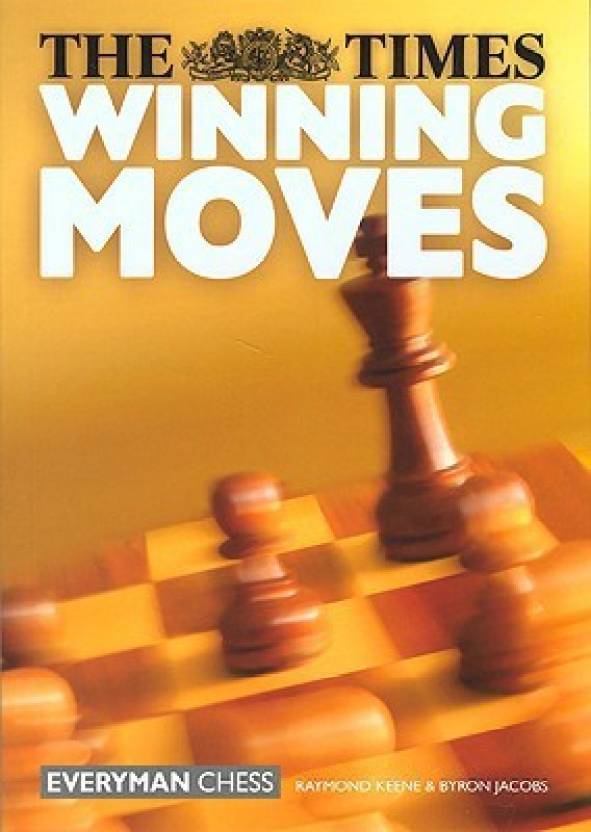
The Times Winning Moves (1991 with Ray Keene)
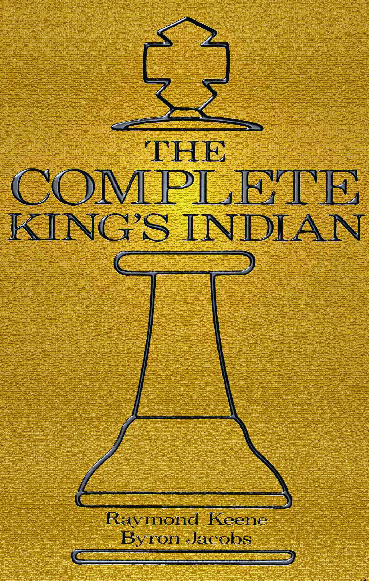
The Complete King's Indian (1992 with Ray Keene)
The Complete King’s Indian (1992 with Ray Keene)
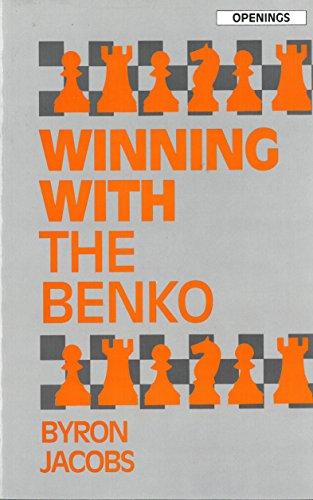
Winning with the Benko (1995)
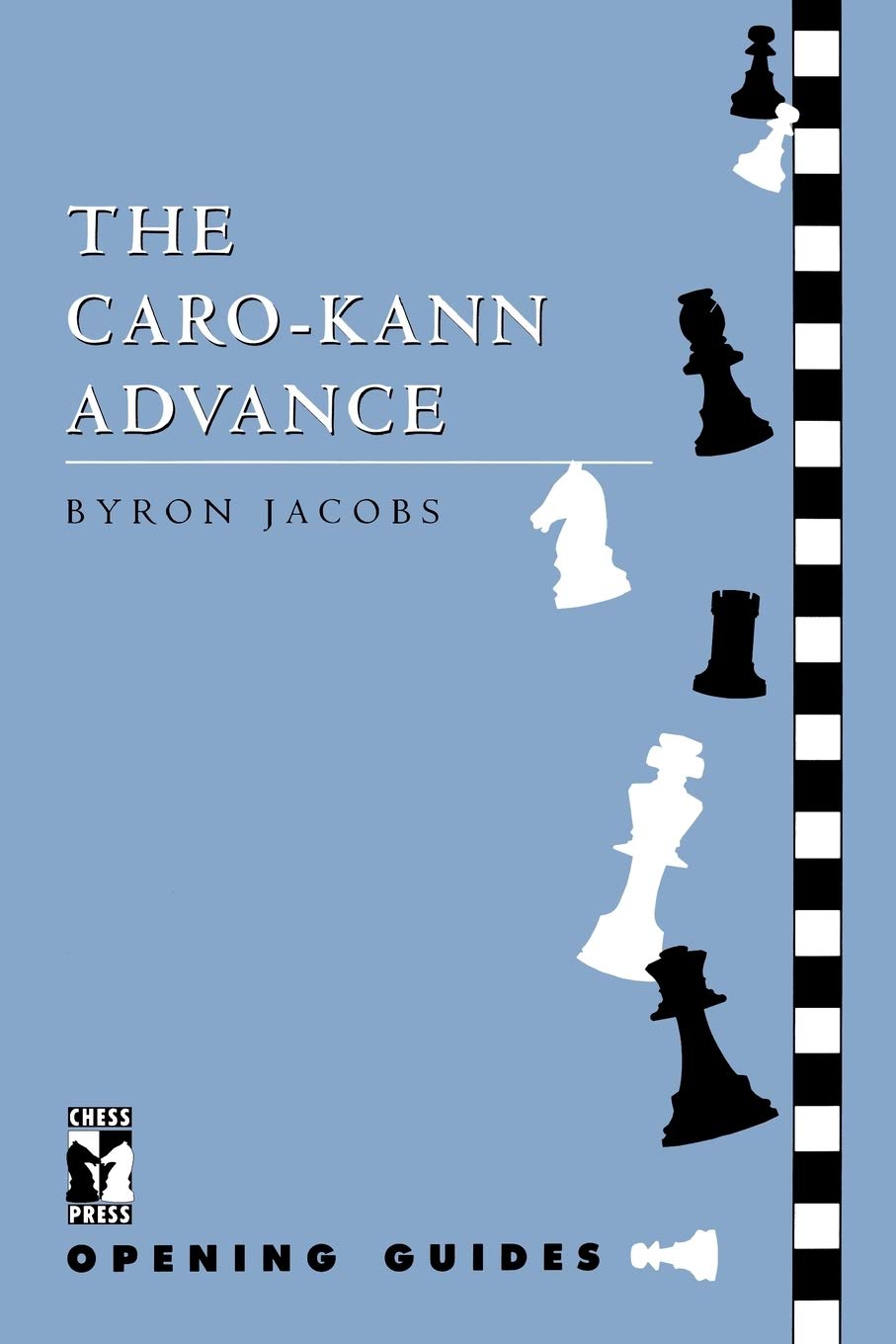
The Caro-Kann Advance (1997)
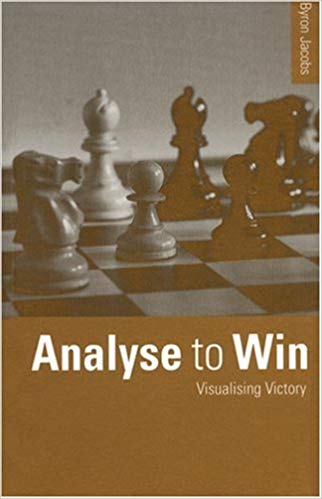
Analyse to Win (1997)
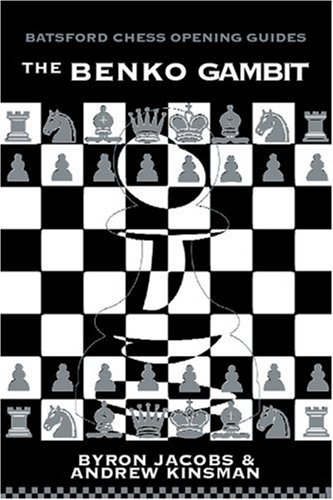
The Benko Gambit by Andrew Kinsman & Byron Jacobs (1999)
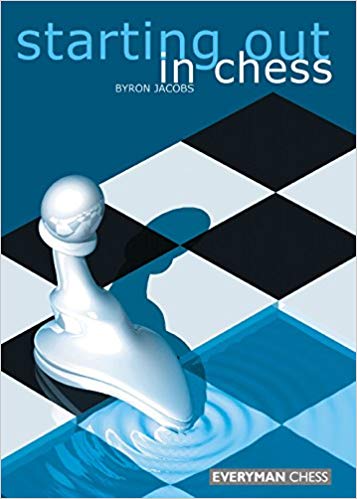
Starting Out in Chess (1999)
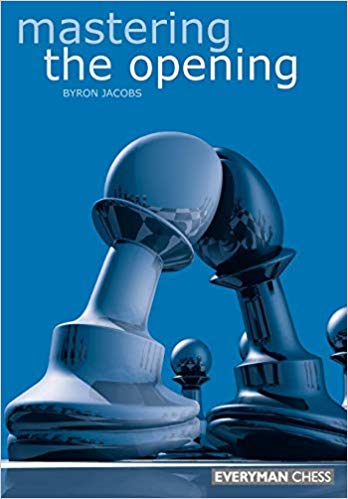
Mastering the Opening (2001)
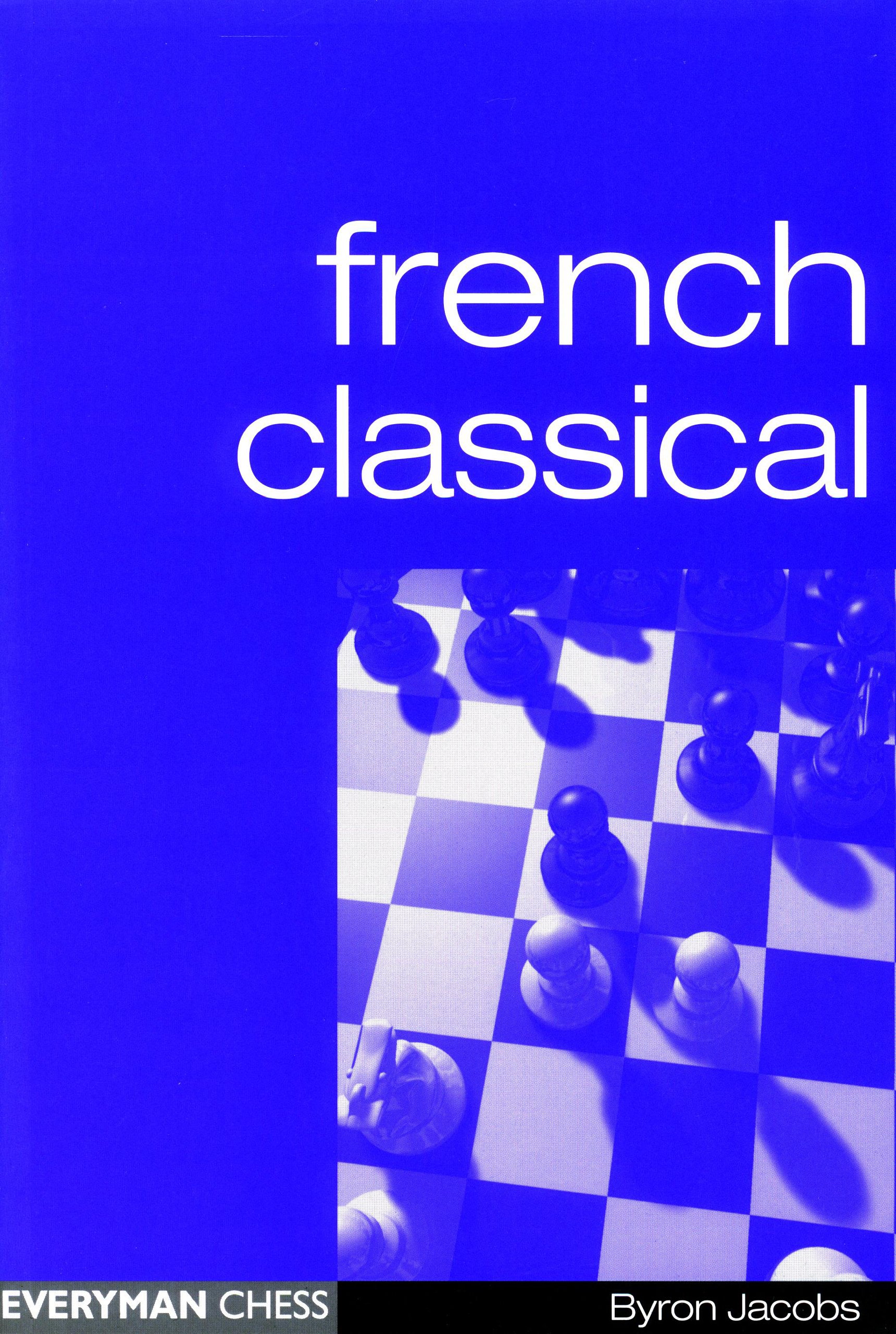
French Classical (2001)
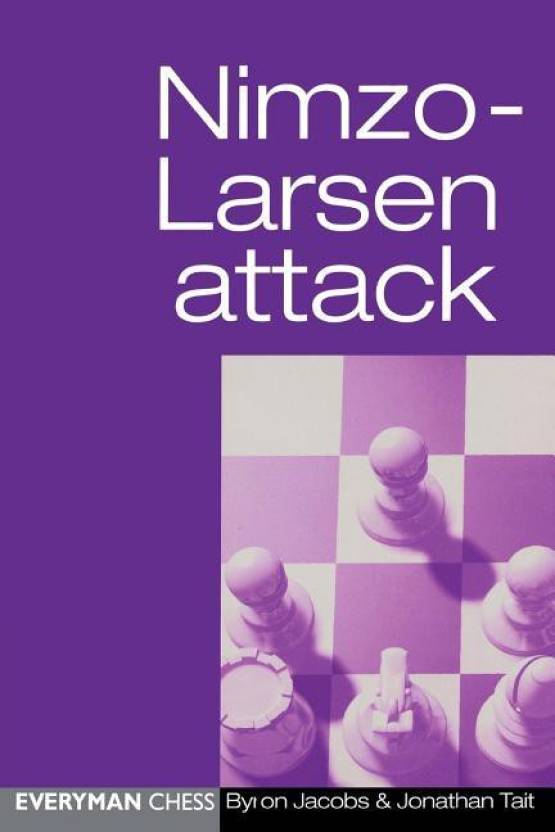
Nimzo-Larsen Attack (2001)
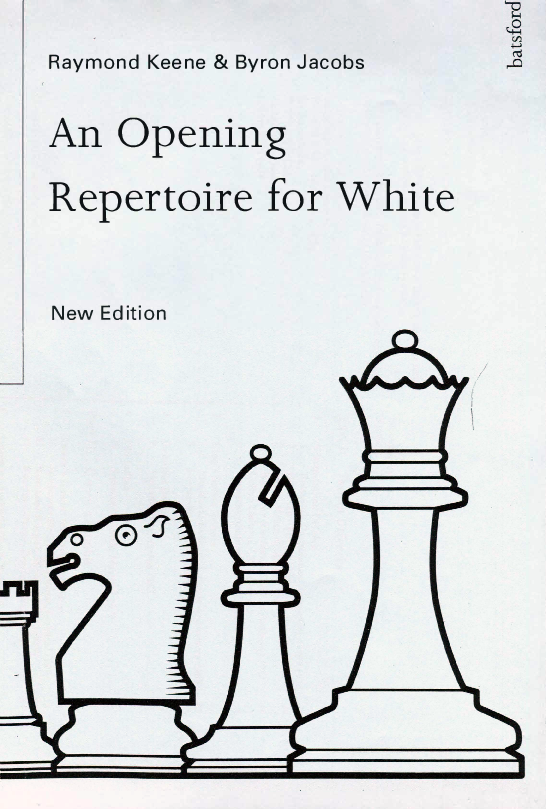
An Opening Repertoire for White (2003)

Remembering Marmaduke Wyvill (22-xii-1815 25-vi-1896)

Marmaduke Wyvill
Marmaduke Wyvill

Remembering Marmaduke Wyvill (22-xii-1815 25-vi-1896)

Here is his Wikipedia entry

Here is an excellent article from the superb Yorkshire Chess History web site.

Interesting article from The Northern Echo

From The Oxford Companion to Chess by Hooper & Whyld :

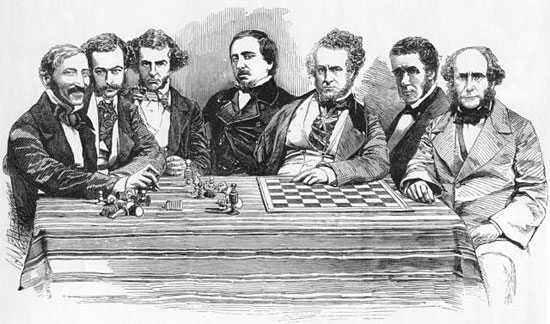
He was winner of second prize in the first international tournament, London 1851. He developed his chess skill in the 1840s, meeting Dubois in Rome, Kieseritzky in Paris, and many players, including Buckle, in London, His style was that of the English school, and he understood well the positional ideas of the English opening and the Sicilian Defence. In 1847 he was elected Member of Parliament for Richmond, Yorkshire, a seat he held until 1868 except for a break of two years. The London 1851 tournament consisted of a series of knock-out matches. After defeating Williams (+4-3) in the third round and losing to Anderssen ( + 2=1-4) in
the fourth and final round, Wyvill was placed second. His score against Anderssen was better than that made by other players (Kieseritzky
“1—2, Szen +2—4, Staunton +1—4), Wyvill had
proved himself one of the leading players of his time. Although he played in no more tournaments he retained an interest in the game throughout his
life.

From The Encyclopedia of Chess by Harry Golombek :

Regarded by Staunton as “one of the finest players in England”. Wyvill was primarily an enthusiastic amateur of chess, yet in his sole tournament appearance at London 1851 he took second prize behind Anderssen, but ahead of Williams, Staunton, Horwitz, Szen, etc.

In the course of this event Wyvill defeated Lowe by +2-0, Kennedy by +4-3=1 and Williams by +4-3. In the final he succumbed to Anderssen by the honourable score of +2-4=1. At the time of the tournament Wyvill was Member of Parliament for Richmond, Yorkshire.

An adherent of the same playing style as Staunton and Williams, Wyvill possessed a fine appreciation of the English Opening and the Sicilian Defence, both of which he employed to deadly effect in the London tournament.

Long after he had retired from competitive play he retained a great interest in the game and his name appears as one of the members of the General Committee in the book of the London 1883 tournament, together with his contribution to the tournament funds of the sum of £100. £100 in 1883 would be worth £2,500 today.

Here is an example of the Wyvill pawn formation :

The Wyvill formation is a name given by Tarrasch to a pawn formation with doubled pawns as shown above. This formation was not unfamiliar to Wyvill but could with more justification have
been named after Winawer who so frequently doubled his opponent’s c-pawns that this and similar formations became known as his trademark. The technique for attacking the Wyvill formation was also understood by Neumann and before him by Carl Hamppe (1814-76), the leading
Viennese player of the 1850s.

Marmaduke Wyvill at Leamington Spa, seated third from left.

Remembering Alan Phillips (28-x-1923 24-vi-2009)

Alan Phillips (riight) receives his prize from television celebrity and magician David Nixon for his equal second placing at the 1973 Islington Open, photographer unknown

BCN remembers Alan Phillips (28-x-1923 24-vi-2009)

Here is his far too brief Wikipedia entry

From Chessgames.com :

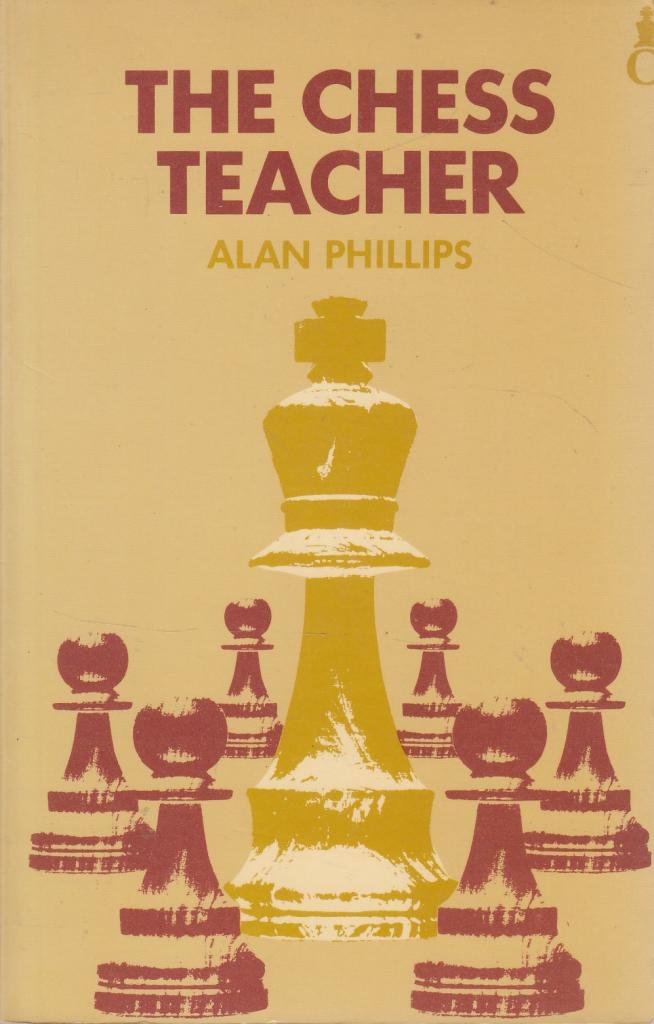
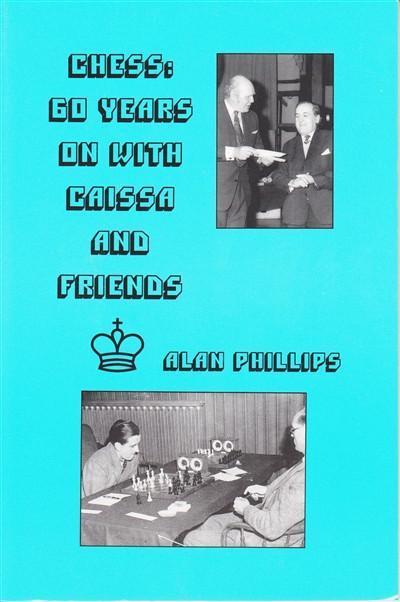
“Alan Phillips, joint British Champion in 1954, was born in England in 1923. He was the author of Chess: 60 Years on with Caissa and Friends (Caissa Editions, 2003) and The Chess Teacher (Cadogan, 1995).”

Here is an item from the Shropshire Chess web site

Here is Alan Phillips autobiography from his own book, Chess: Sixty years on with Caissa & Friends

“Born in Stockport in 1923,I was playing pontoon in an air-raid shelter in the autumn of 1940 with a friend from our school, Stockport Grammar, when he suddenly announced that he knew a better game, being the school chess champion. Ostensibly studying for a Cambridge Scholarship with a view to reading Classics, I played about 200 games with Norman Stephens, emerging the victor perhaps because I studied Alekhine’s and Euwe’s games, obtained from the Public Library, whence I had been borrowing difficult piano works for the previous two years. When I got up to Magdalene in 1941, I found standing next to me in the University Chess Club Wykehamist James Lighthill, destined to become, arguably, our greatest applied mathematician of the second half of the last century; I played chess with him one evening a week and piano duets another, and as Match Captain and Hon.Sec. in my second year – shared top board, while now supposedly reading Italian, as a War Office scheme, and French, languages I unfortunately then considered beneath contempt, compared with the glory that was Greek.

Alan Phillips plays David Hooper on August 20th 1954 in round five of the British Championships in Nottingham, photographer unknown

Enrolled but not commissioned – the War Office having ratted on its promise to a large bunch of first-class linguists – in the Army Intelligence Corps from August 1943 to October 1946,I spent nearly three years abroad in Sicily and Palestine, riding a motor-bike – our American equivalents in the CIC were mostly majors or colonels and rode in Cadillacs – and playing, when stationary, much music with singers and violinists, especially in Palestine, and chess with the Captain of the Harbour in Sicily, a charming moustached Neapolitan who got about three draws in 300 games, and then in Haifa, Hadera and Jerusalem chess clubs, beating the youth champion of Palestine and Aloni when he played simultaneously, but losing to Porath, and enjoying ‘skittles’ in cafes with many other players of near-master rank. Demobilised and put, like the Goons, on the Z-reserve in autumn 1946, I went back to Cambridge to read Classics Pt II and found Peter Swinnerton-Dyer, as far as I know our best number theorist of the past fifty years, waiting for me – we tied for the University Championship having begun a series of trips to Hastings with Alan Truscott, and later continued to Birmingham for the Midland Championship, which I won in 1951.

From the 1952 Ilford Congress (30 May - 2 June) and originally published in BCM, July 1952, page 187. (l-r)  : Harold Israel, Alan Phillips, Bob Wade, Otto Friedman, Abe Yanofsky, Alfred William Bowen and Harold Meek. Thanks to John Saunders and Leonard Barden
From the 1952 Ilford Congress (30 May – 2 June) and originally published in BCM, July 1952, page 187. (l-r) : Harold Israel, Alan Phillips, Bob Wade, Otto Friedman, Abe Yanofsky, Alfred William Bowen and Harold Meek. Thanks to John Saunders and Leonard Barden

I usually won prizes in increasingly strong sections at Hastings except in two Premiers, 1950-1 and 1954-5, when my emotions were otherwise engaged, as happened in the British Championship in 1952, when, after I had beaten all the best players and scored 7/8 with three rounds to go, a girl-friend turned up and I lost my last three games, refusing a draw in round nine in a not superior position, not out of arrogance, but in order to clinch the title.

Alan Phillips and Leonard Barden are joint British Champions of 1954 in Nottingham, photographer unknown

Otherwise, with one or two exceptions, I only lost to the strongest players in the British Championships I played in, i.e. 1949-55 and 1961, tying for first place at Nottingham 1954 and coming third equal in a very strong Championship at Aberystwyth 1955, which earned me a place as Board 6 on the English team at the Moscow Olympiad in 1956, where I only drew against Luxembourg, and lost to Geller, but drew in two cases from bad positions with Johner, Sanguinetti and Ghitescu.

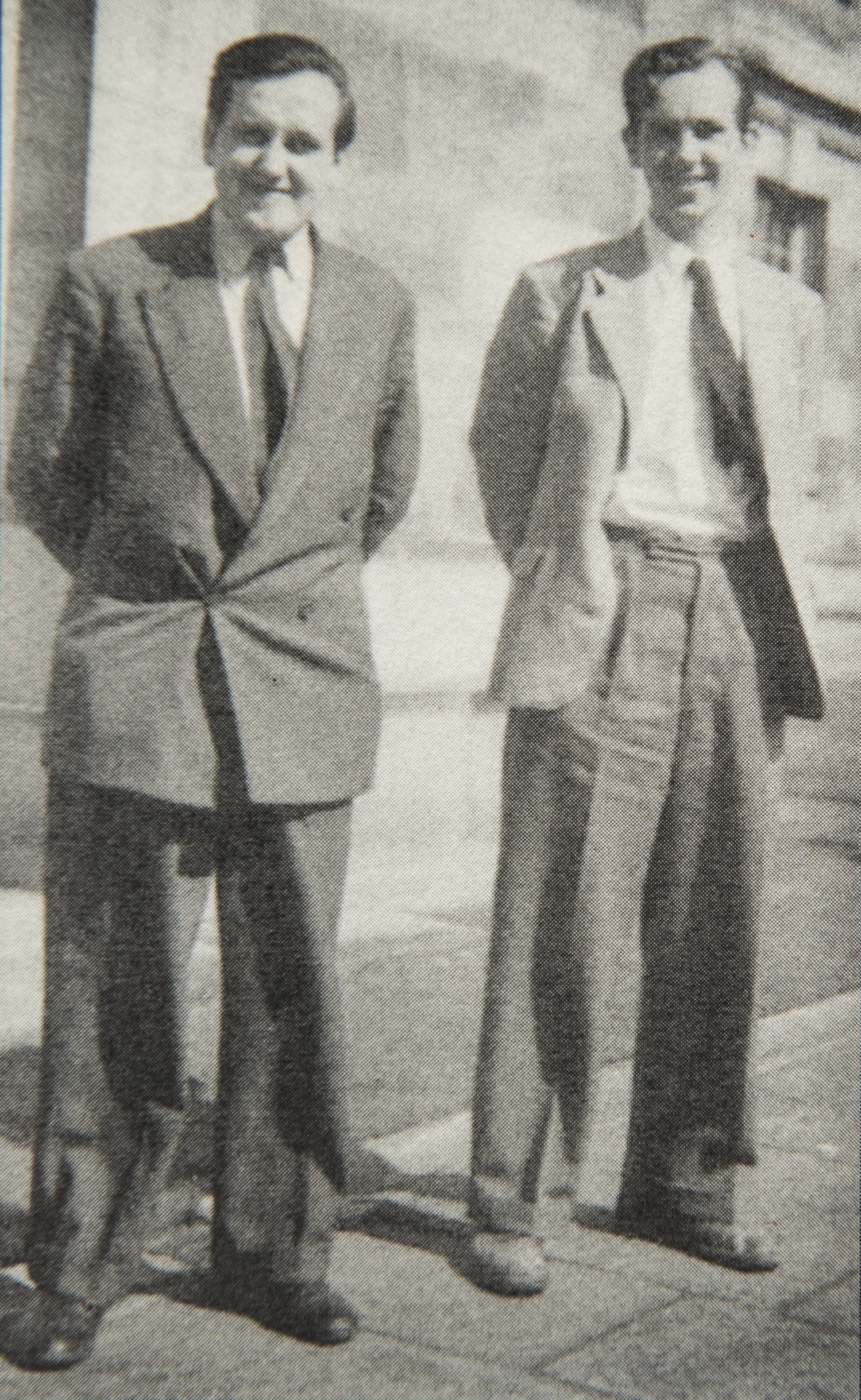
David Hooper (left) in conversation with Alan Phillips. Location and photographer unknown.

In l96l I moved up to Derbyshire, where – though playing top board for Manchester as well as the county – having switched to Maths teaching after several years part-time study at Birkbeck and acquired offspring as well as promotion, I also started annual visits to Dartington Summer School of Music, now totalling 38 out of a possible 40, all of which made it virtually impossible for me to play in tournaments, apart from the odd visit to Hastings or fairly strong week-end tournaments, e.g. Ilford, which I won for the second time in 1973, beating Basman. My responsibilities on my return to London as Head of Charlton School in 1967, where I got Bob Wade to teach chess as part of mathematics in the Lower School, and then of Forest Hill School, where we organised many tournaments, although I played generally as top board for Kent, whom I led twice to victory in the County Championship in 1975 and 1976, meant that I had even less time for tournament chess, except at Islington and in the Challengers, so that my real heyday ended there, with a final move to a ‘quiet’ county, Shropshire – as far as chess was concerned – as Adviser for Secondary Education and Area Adviser, 1976-82, in which capacity I avoided as much paper-work as I could and taught chess in the lunch-hour to all the primary and handicapped pupils I visited. I should say most of my successes at chess have been at County Level, where I played top board for Cambridgeshire and London University, as well as the counties mentioned, and in the very strong London League, as far as I can estimate I had a success rate of some 70% in those contests. In general the games in this book, with one or two exceptions for historical or anecdotal reasons, were played at high levels, and won by the right player, not suddenly lost by a blunder, like some games published nowadays because the blunder is perpetrated by a famous player.

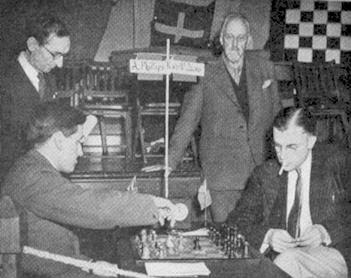
Photograph taken in Hastings on 28 December 1950. Lord Dunsany (standing on the right) is watching the first-round game between Alan Phillips and Weaver Adams, source : http://boylston-chess-club.blogspot.com/

With regard to the general assessment of players and tournaments, I have only one comment “Look at the games!” When even, or especially, David Bronstein wails “They give me a number”, I think it time to end a spuriously precise system and revert to the earlier English practice or the traditional Soviet one of putting players in classes, preferably according to a sufficiently large number of results in tournaments or strong club or county matches. And when players are inhibited, when the match is won, from offering an opponent, who has played well, a draw, that is a diminution of sportsmanship, so a draw, even with Kasparov, should not count in grading. Finally the use of seconds or computers once a game is started should be
regarded as totally unsporting, and players should be put on their honour, as bridge-players are in matters of cheating, not to use them.

I should like to dedicate this book to the memory of my good friends, David Hooper, Stuart Milner-Barry, and A.R.B.Thomas, men of integrity, humour, and many other talents, who brought to their chess the same qualities of courage and sportsmanship they showed in the rest of their lives.

Alan Phillips (28-x-1923 24-vi-2009) : Source : https://www.shropshirechess.org/History/1970s.htm

Alan Phillips
British Master, Joint British Champion 1954
Thorn Cottage, Appleton Thorn, Warrington, Cheshire
September 2003″

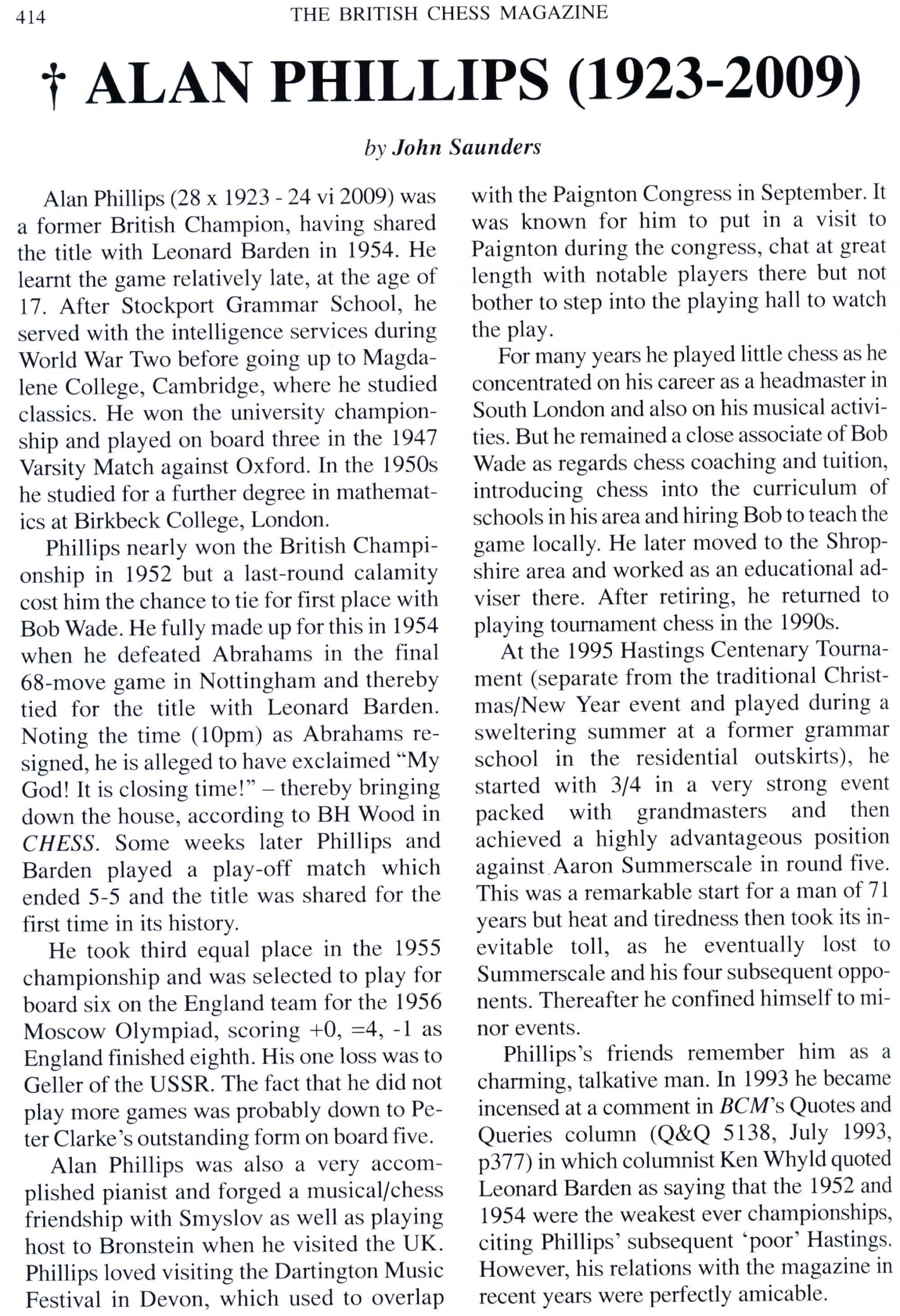
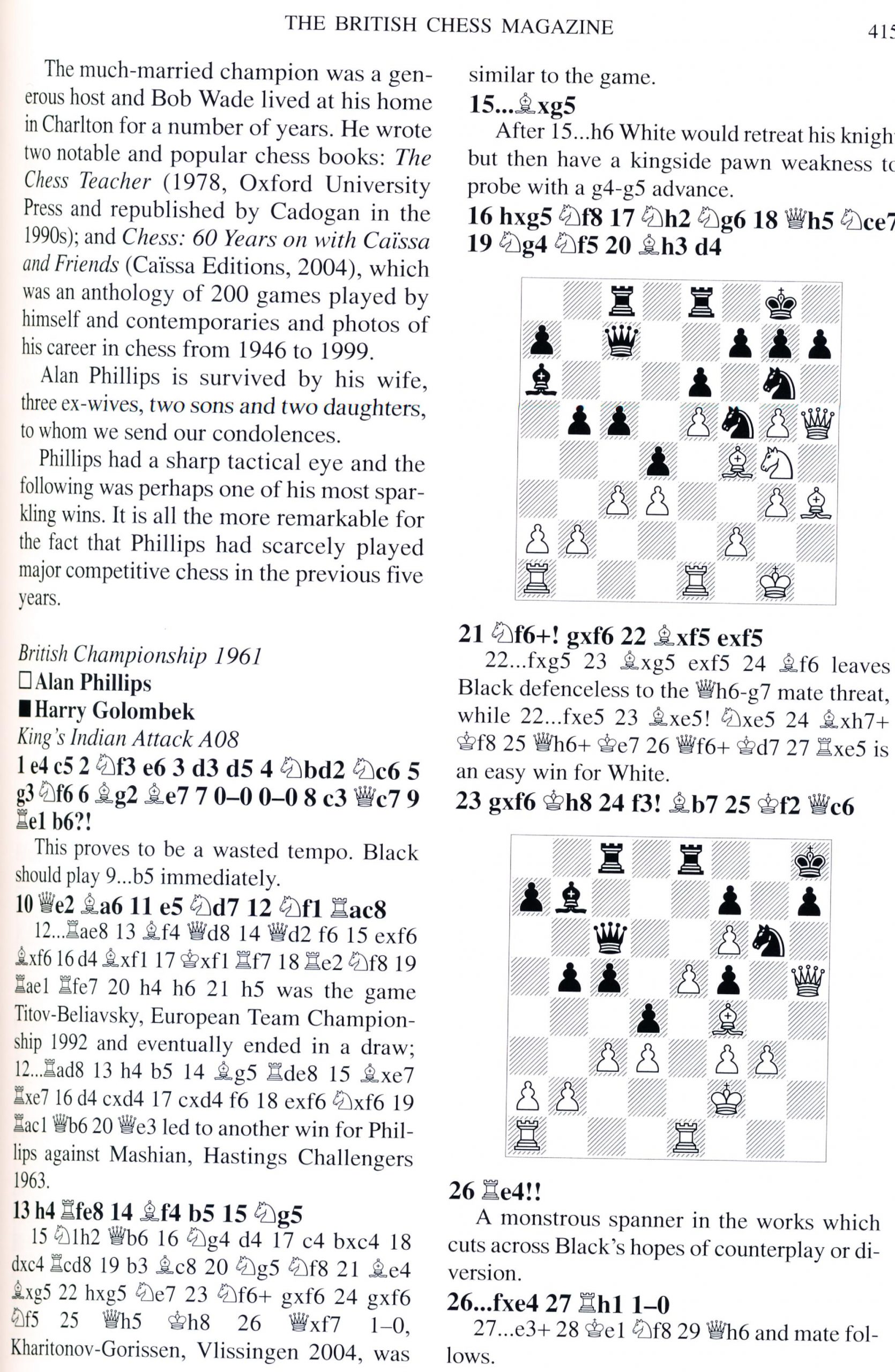
Obituary of Alan Phillips by John Saunders from British Chess Magazine, 2009. Part One
Obituary of Alan Phillips by John Saunders from British Chess Magazine, 2009. Part Two

Here is his obituary from The Times of London

The Chess Teacher
The Chess Teacher
Chess: Sixty years on with Caissa & Friends

Happy Birthday FM Terence PD Chapman (19-vi-1956)

FM Terence PD Chapman (19-vi-1956)

BCN wishes Happy Birthday to FM Terence PD Chapman (19-vi-1956)

Terry became a FIDE Master in 2013. His peak rating was 2331 in October 2013.

The ever youthful Terry represents Barbican Youth in 4NCL.

[embedyt] https://www.youtube.com/watch?v=XCYXV_dG2GA[/embedyt]

FM Terence PD Chapman (19-vi-1956)

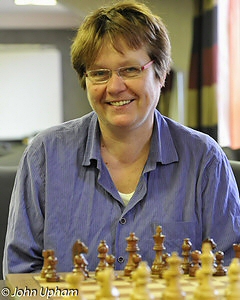
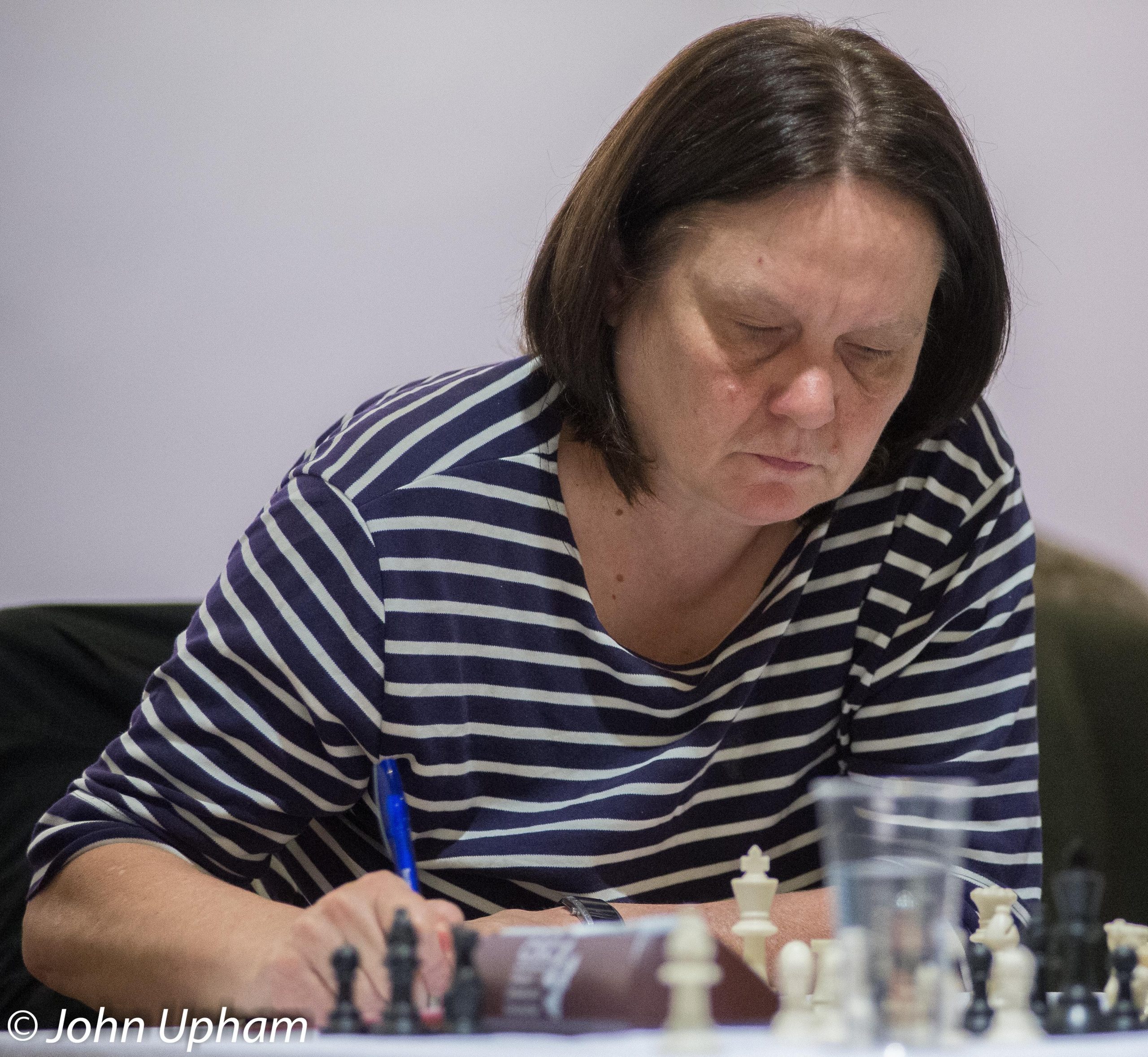
Happy Birthday WIM Ingrid Lauterbach (06-vi-1960)

WIM Ingrid Lauterbach, 4NCL 2012, courtesy of John Upham Photography

Here is Ingrid’s German Wikipedia entry

BCN wishes Happy Birthday to WIM Ingrid Lauterbach (06-vi-1960)

Ingrid became a WIM in 1987 and her peak rating was 2205 in July of 2000.

Ingrid plays for 4NCL Barbican.

WIM Ingrid Lauterbach, 4NCL 2014, courtesy of John Upham Photography

WIM Ingrid Lauterbach, 4NCL 2012, courtesy of John Upham Photography