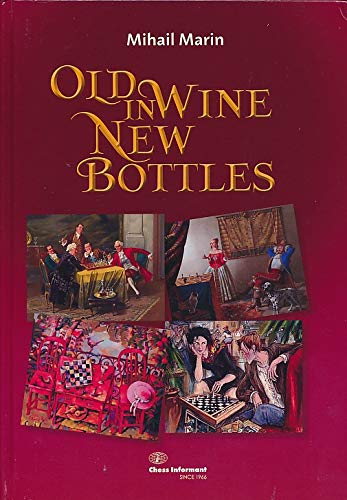
Old Wine In New Bottles : Mihail Marin

From Wikipedia :
“Mihail Marin (born 21 April 1965) is a Romanian chess player and writer. He was awarded the title of Grandmaster by FIDE. Marin’s first major success in international chess was in qualifying for the Interzonal in 1987. He has won three Romanian Championships and has played in the Chess Olympiads ten times, winning a bronze individual medal in 1988. For several years he was editor of the magazine Chess Extrapress.”
From the book’s rear cover :
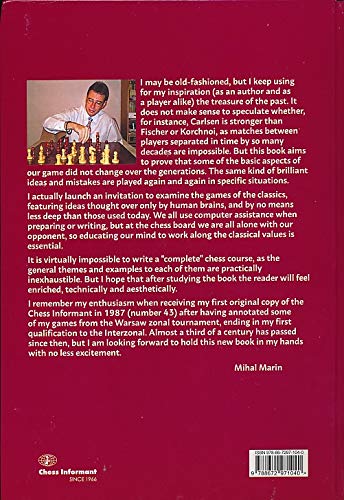
“I may be old-fashioned, but I keep using for my inspiration the treasure of the past. It does not make sense to speculate whether, for instance, Carlsen is stronger than Fischer or Korchnoi, as matches between players separated in time by so many decades are impossible. But this book aims to prove that some of the basic aspects of our game did not change over the generations. The same kind of brilliant ideas and mistakes are played again and again in specific situations.
I actually launch an invitation to examine the games of the classics, featuring ideas thought over only by human brains, and by no means less deep than those used today. We all use computer assistance when preparing or writing, but at the chess board we are all alone with our opponent, so educating our mind to work along the classical values is essential.It is virtually impossible to write a “complete” chess course, as the general themes and examples to each of them are practically inexhaustible. But I hope that after studying the book the reader will feel enriched, technically and aesthetically.
I remember my enthusiasm when receiving my first original copy of the Chess informant in 1987 (number 43) after having annotated some of my games from the Warsaw zonal tournament, ending in my first qualification to the Interzonal. Almost a third of a century has passed since then, but I am looking forward to hold this new book in my hands with no less excitement.”
You probably know how it is when your favourite singer releases a Greatest Hits compilation. As a big fan you have them all already, but there are always a couple of new songs, so, not wanting to miss out, you have to pay for the full album.
It’s been many years since I last read an Informant, but for some time now GM Mihail Marin, one of the best annotators around, has been publishing articles under the title Old Wine in New Bottles, in which he takes a recent game and compares it with games from the past which resemble it in some way. This might be, for example, a similar opening, a similar tactical idea, the same pawn formation, a comparable ending. Sometimes the comparison is very precise, but, on other occasions, rather tenuous.
What we have here is a collection of his articles, with some new ones added to tempt regular readers who will have seen most of the material before, along with some introductory comments.
There are 25 articles, or rather chapters, in total, grouped according to the general theme: Basic Principles, Tactics, Strategy, The Attack, Middlegame Plans of Specific Openings, and, finally, The Individual and Joined Abilities of the Pieces (some, but not all of which, feature endings).
You might assume from this, and you’d be correct, that the translation into English isn’t always idiomatic. There’s also an unacceptably large number of typos.
The publishers have also made some rather strange production decisions. They’ve chosen a non-standard diagram font with a defective symbol for a black rook on a white square, which makes a rather ugly impression. They’ve also chosen to use a sans-serif font throughout.
This is a handsome hardback, complete with a useful bookmark, which will look good on your bookshelf: it’s a pity that, internally, it doesn’t make such a good impression.
The text is punctuated by a lot of chess art, reproduced in black and white, from the Hereford Chess Club in 1814 up to the present day. All very attractive, if not especially relevant, but I can’t find any copyright information anywhere.
None of this may bother you, as long as the content is good, and, with reservations, it is.
To give you some idea, let’s take a fairly random chapter. Chapter 4 in the section on Attack deals with sacrificial attacks beginning with the move e5xf6, taking as its starting point this game from the 2017 Sinquefield Cup, where you will observe Vishy’s 22nd move. Marin doesn’t give us the first 21 moves, which presumably appeared elsewhere.
This game brought to mind a brilliant Tal victory from the 1962 Olympiad, where the sacrificial attack started on move 19.
Tal admitted that his 19th move was inspired by a Famous Game which observant readers will have seen before.
It’s, of course, a very well known game, but observant readers will recall encountering it with different annotations in an earlier chapter on positional queen sacrifices to obtain a passed pawn. Here, the annotations are in part based on Lilienthal’s autobiography, which are, along with Hecht’s comments on his loss to Tal, readily found on MegaBase. (It’s always fun to try to identify an author’s sources!)
There are three more games in this chapter, including another Tal brilliancy, but the repetition of the Lilienthal game confirms the impression that it’s really a collection of articles rather than a particularly coherent book.
Not all the annotations are by Marin himself: in many cases they are largely taken from earlier Informants, with occasional authorial interjections. You might not mind this, but I guess you might also feel you’ve been cheated.
Nevertheless, the concept of comparing contemporary games with those from the past is a great idea. If the idea attracts you, or if you’re an admirer of Marin’s books and haven’t seen most of the articles before, you’ll find a lot to interest, inform and stimulate. As the book covers all aspects of the game, there are lessons to be learnt here about both tactics and strategy, about openings and endings.
Although I have significant reservations about various aspects of the book, there is still much of value here, and anything Marin writes is always worth reading. Recommended, especially for serious students of the game of, say, 1800+ strength.
Richard James, Twickenham 7th October 2020

Book Details :
- Hardback : 384 pages
- Publisher: Sahovski Chess (aka Chess Informant or Informator) (December 27, 2019)
- Language: English
- ISBN-10: 8672971043
- ISBN-13: 978-8672971040
- Product Mass : 1.7 pounds
Official web site of Sahovski Chess