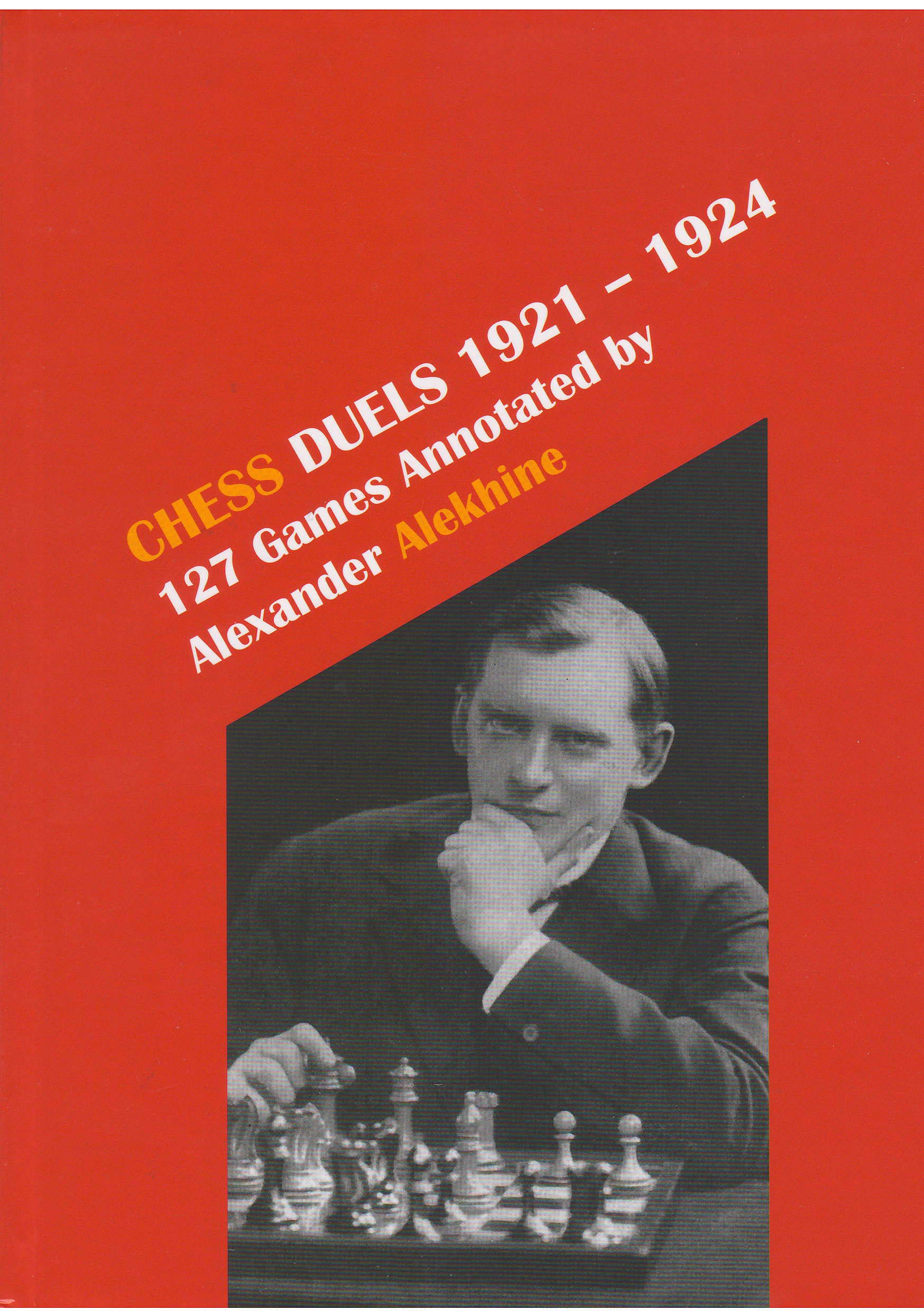
Chess Duels 1921 – 1924 : 127 Games Annotated by Alexander Alekhine
From the publisher:
The publication is a continuation of the project to publish all the available games annotated by the Fourth world chess champion Alexander Alekhine. These are not only his own games but also games played by other players for which he contributed notes in various publications. Covered here are several international tournaments in Europe from 1921-1923, as well as exhibition games in Britain and North America from 1923 and early 1924. An additional chapter gives a few early game annotations which were not included in the first volume. 312 pp. Researched by Vlastimil Fiala, translated and edited by Ken Neat.
Vlastimil Fiala is a professor of Political Science and distinguished academic and the main driving force behind the publishing house, Moravian Chess based in Olomouc in the Czech Republic. Fiala’s second love is chess history which he treats as a science. His publication portfolio is impressive : the web site of Moravian Chess provides a listing.

Durham based Dr. Kenneth P. Neat (an expert on cosmic rays which he studied whilst at Moscow State University between 1968 and 1970) is one of the most experienced chess translators with a back-catalogue extending to almost fifty years. His earliest work was for BT Batsford and, by a pleasurable coincidence, was “Alexander Alekhine” by Alexander Kotov published in 1973. Ken translated many titles for Batsford and then became the in-house translator for Robert Maxwell and Pergamon Publishing with many works to his credit. Since then Ken has translated further titles for Moravian Chess.
This is the second book in a series (“Chess Duels”) to collect together all games annotated by Alekhine regardless of who the players were. The first book by this team covered the period 1893 – 1920 and this book continues by covering the years 1921 – 1924.
The book is produced as a hardback of almost exactly A5 dimensions. The binding appears to be well executed and the cover hard wearing. There is a generous quantity of diagrams per game using figurine algebraic notation throughout. The book requires no weights to keep it open and the pages are printed in a double column format. The book even has a charming aroma and feel when flicking through the pages!
For each game we are given the original source of the annotations plus the details of the players, the event type and name and a basic modern description of the opening and its Rabar Index / ECO code.
The content of the book is divided into four parts, one for each year. Each Part is then further subdivided, for example:
- Part One : Games Played in Europe I (1921)
- Games played in Germany
- Budapest 1921
- The Hague 1921
- Two Knights Opening
- Staunton Gambit
- Part Two : Games Played in Europe II (1922)
- Bad Pistyan 1922
- London 1922
- Hastings 1922
- Vienna 1922
- Other Games 1922
- Part Three : Games Played in Europe III (1923)
- Karlsbad 1923
- Margate and Portsmouth
- Other Games 1923
- Part Four : Games Played in Canada and USA (November 1923 – February 1924)
- Supplement to First Volume, Early Games (1861 – 1920)
- Appendices
- Translator’s notes
- Index of Sources
- Index of Alekhine’s Opponents
- Index of other Players
- Index of Openings
So, the layout of material is clear and logical with a strong academic approach. One gets an impression of rigour and attention to detail. One detail missing that could have easily have been included was the exact date (where known) for each of the games. We found it interesting to compare the notes for games from a variety of sources and annotators and the date would have made these comparisons easier.
As stated, we have 127 complete games all with annotations from Alekhine himself. Of these 22 do not feature Alekhine but they are all top players of the period such such Rubinstein, Tarrasch, Yates, Thomas, Mieses etc.
One of the games that caught our eye was this lively encounter between Alekhine and Yates from Hastings in 1922:
The items titled “Two Knights Opening” and “Staunton Gambit” are theoretical articles written by Alekhine from the tournament book.
Of course, most (if not all) of the Alekhine games feature in previous games collections (nobody should be surprised by this). We compared the translation of the original annotations and the “feel” of the annotation has been retained. For example, from the well-known brilliancy prize winning game Tarrasch – Alekhine, Bad Pistyan, 1922, round one we have this translation by Julius du Mont and M. E. Goldstein (“My Best Games of Chess 1908 – 1923“, Alexander Alekhine, George Bell and Sons Ltd., London, 1927) of the note to after 1. d4 Nf6;2.Nf3 e6;3.c4 c5;
With the intention of investigating, on the next move, the gambit discovered by the Moscow amateur, Blumenfeld. Since then it has been shown that this Gambit is not favourable for Black if White should decline it
and our review book has
With the intention of introducing into international practise an interesting gambit, suggested by V.M. Blumenfeld. However it has now been shown that this continuation is more advantageous to White, if he does not accept the pawn sacrifice.
You might be worried that his book has been ruined with pages of modern analysis dumps from BabelFish XX (substitute the current, trendy engine of your choice). Have no fear : this book is choc full of pearls of wisdom from one of the greatest players to annotate games. No doubt there will be unfortunate souls who lives are brightened when “their engine” is able pick holes in analysis from a legend. Perhaps this is not the right book for them.
However…any serious student of chess will be delighted with this work and be able to relive these games through Alekhine’s eyes with much pleasure. The games annotated by Alekhine but not played by him are probably the icing on the cake.
We strongly recommend this and look forward to the next in the series.
John Upham, Cove, Hampshire, 7th April, 2021

Book Details :
- Hardback : 312 pages
- Publisher: Publishing House Moravian Chess; 1st edition (1 Jan. 2020)
- Language: English
- ISBN-10: 8071890219
- ISBN-13: 978-8071890218
- Product Mass : 1.5 pounds
Official web site of Moravian Chess