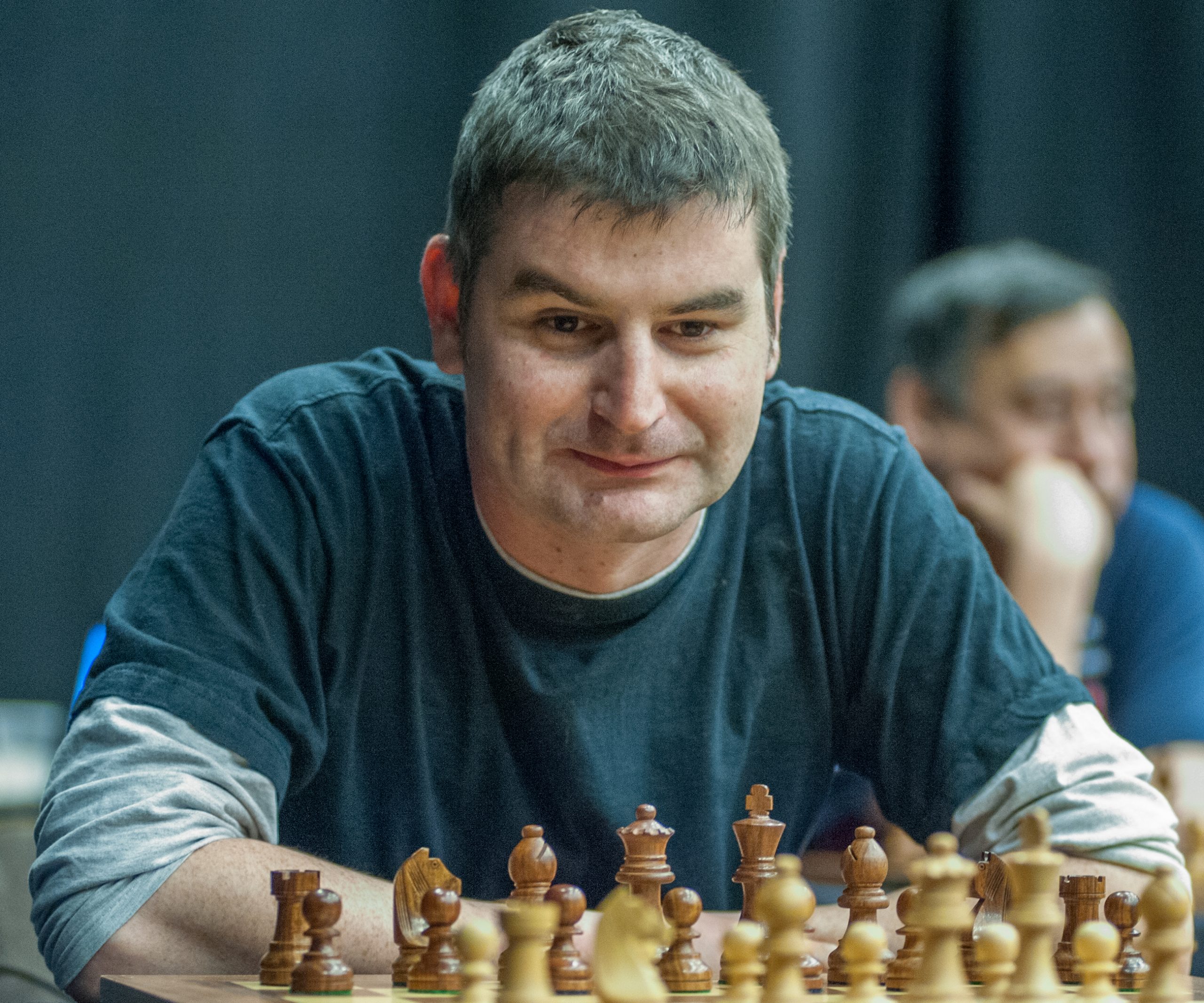
Happy Birthday IM Simon Ansell (11-ii-1975)
 Save as PDF
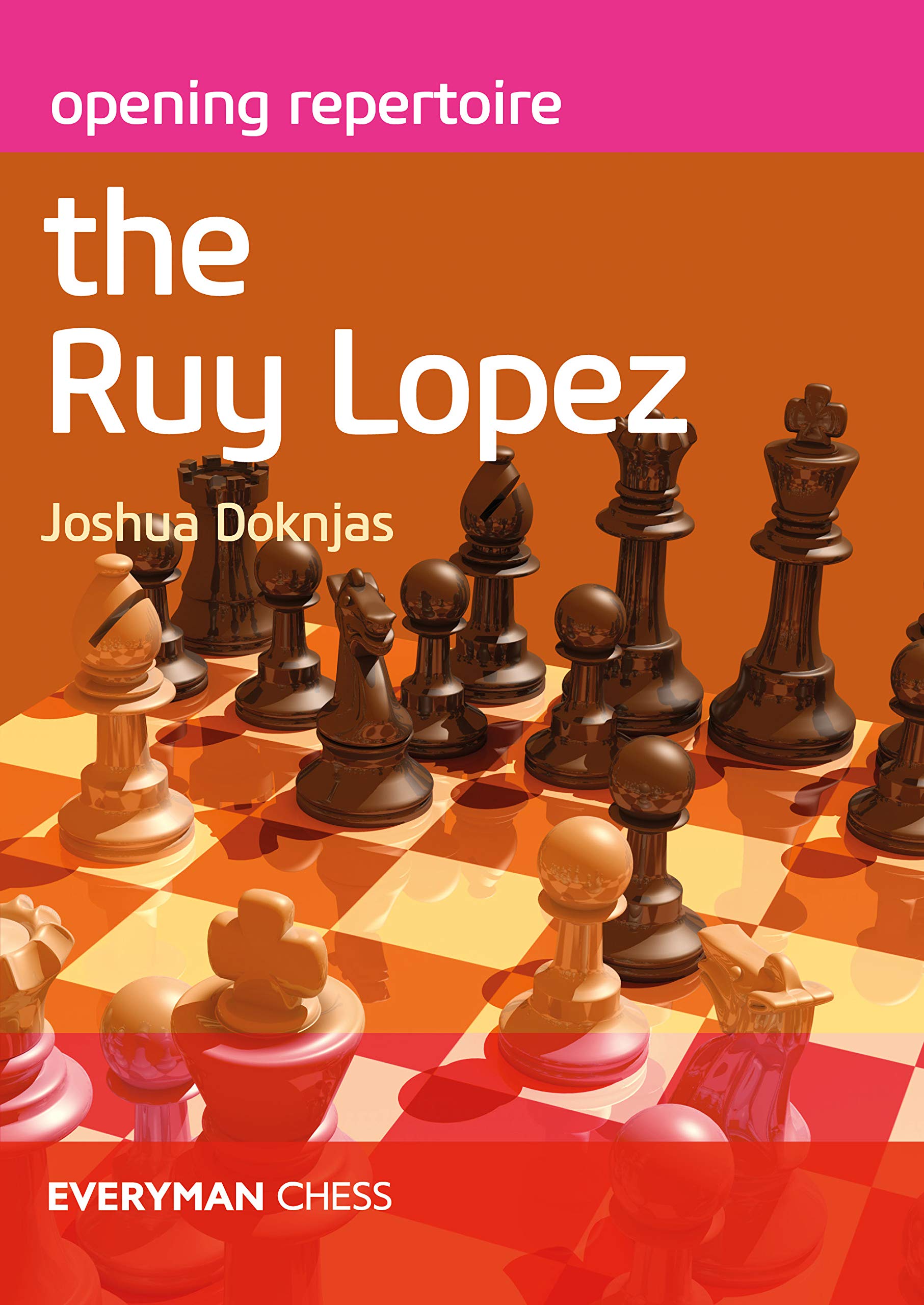
Joshua Doknjas is a FIDE Master from Canada who has enjoyed success competing internationally. He has won seven national titles for his age and tied for 1st in the 2019 U18 North American Youth Chess Championship. This is his second book for Everyman Chess.
From the book’s rear cover we have :
“The Ruy Lopez is perhaps the most classical of all chess openings. It dates back to the 16th century and has featured in the opening repertoire of every modern world champion. It is a highly flexible variation: Bobby Fischer used it to create numerous powerful strategic masterpieces. In the hands of Anatoly Karpov it led to many of his trademark positional squeezes, whereas Garry Kasparov often used it as a springboard for his typically powerful attacks.
Opening Repertoire: The Ruy Lopez is a modern examination of this perennial favourite. Joshua Doknjas has put together a repertoire for White based firmly around contemporary trends in the Lopez. He examines all aspects of this highly complex opening and provides the reader with well-researched, fresh, and innovative analysis. Each annotated game has valuable lessons on how to play the opening and contains instructive commentary on typical middlegame plans.
Everyman Chess have already produced several books of high quality on chess openings and have now added another one.
Here is a sample pdf
The book is divided into ten main chapters as follows :
The Ruy Lopez has been called the mother of chess openings and is undoubtedly the most challenging for anyone who plays the open game with the black pieces.
The book is divided into 3 parts. Part 1 is solely dedicated to the closed Lopez : a great favourite of Lev Aronian. Three main variations are looked at after 5…Be7 6.d4 b5 7.Bb3 d6 8.c3 00 9.h3 when 9…Bb7; the Zaitzev 9…Na5 the Chigorin; a great favourite of Paul Keres and 9…Nb8 favoured by Anatoly Karpov are each considered in detail.
The lines are investigated by examining games played by those of at least 2500 Elo with lots of discussion of other possibilities and questions giving the reader the chance to see if they can work out the correct path.
A Grischuk win against the Ziatzev is analysed, Alexei Shirov shows us how to face the Chigorin with nice wins by Ray Robson with Grischuk and Maxime Vachier-Legarve dismanting the Breyer Variation.
Part2 starts by looking at the notorious Berlin Defence and recommends that White plays 4.d3 which has been the move favoured By Magnus Carlsen and Fabiano Caruana in recent years.
Both 4…d6 and 4…Bc5 are studied the latter in some depth.
The Open variation with 5…Nxe4 by black is analysed in Chapter 5.
The main line 6.d4 b5 7.Bb3 d5 8.d4xe5 Be6 9.c3 is chosen as surprise recommendation as I have played the Open Variation for about 30 years and always thought 9.Nbd2 chosen by Karpov in many games to be the strongest continuation. After 9…Bc5 10 Qd3 is Doknjas suggestion probably chosen to avoid the dangerous Dilworth Attack.
The top game here is a rapid game between heavyweight giants Anish Giri and Vishy Anand and, as usual, White wins.
There is no analysis of the Marshall Defence as 8.a4 avoiding it is the repertoire recommendation.
This was Kasparov’s choice in game 1 of his 1993 PCA world championship match versus Nigel Short. Again, games by Giri and Vachier-Legarve are given as examples for White players. Unusually there is a draw for Black when Ding Liren defends the black side : unusual for this book which has a heavy white bias.
The Arkhangelsk with both 6…Bb7 and the very modern 6…Bc5 often favoured by Shirov is discussed with 7.d3 recommended against the former and 7.c3 against the latter.
The closing chapters in Part 3 look at the rarer moves 3…Nge7 3…g6 3…Nd4 and 3..d6 lines are covered next.
For completeness, there is a chapter on the 3…f5 Schliemann and 4.d3 is the recommended way forward when white intends to snatch a pawn and challenge black to prove he has compensation.
This book is aimed at players from about 120 ECF and upwards though promising juniors who play 1.e4 and are wondering what to choose against the open game are likely to benefit.
The book is nicely presented with good clear print and many diagrams as well as lots of good games.
Colin Lyne, Farnborough, Hampshire, 8th February, 2020
Book Details :
Official web site of Everyman Chess
Save as PDF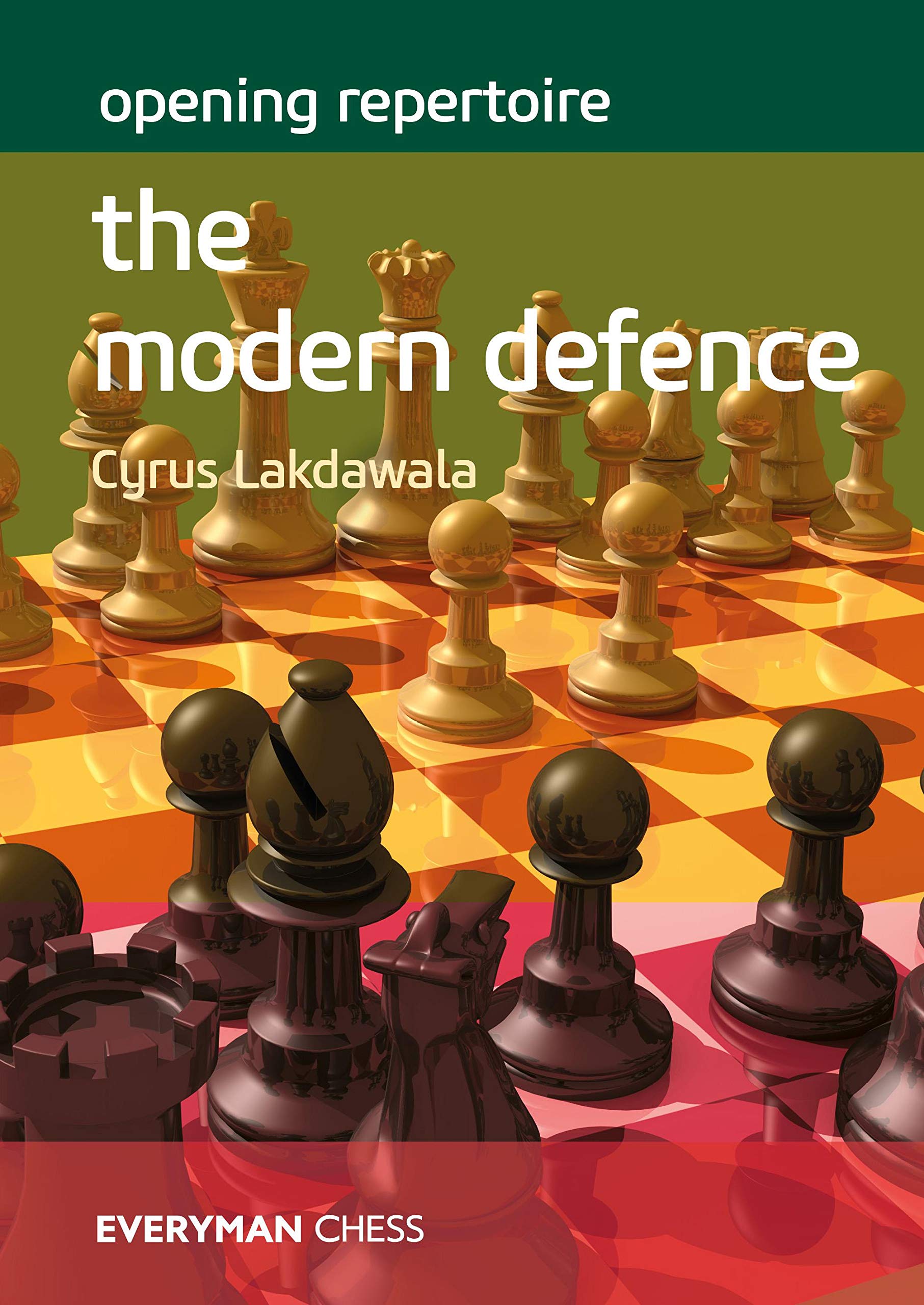
Cyrus Lakdawala is an IM and former US Open Champion who teaches chess and has written over 25 books on chess openings.
As a treat for our readers we allow you to download this review in Portable Game Notation (pgn) format. We suggest ChessBase Reader as a means of opening the file.
You may also download this review in ChessBase (.cbv) format.
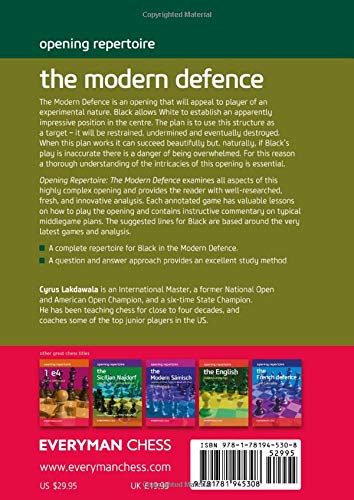
This is the Modern Defence, which has been described both as a fighting opening, based on counterattack and a masochistic paradise, where Black has to sit with less space for the whole game and then loses.
Having played the Modern for some 40 years now, I can testify that the truth is somewhere between the two views.
You either like the Modern or you don’t and you have to get into the right frame of mind in order to play it properly. Black has to suck up early pressure and time his counterattack to perfection to break up the enemy position. If this is your thing and you have an independent character, you will find what you want after 1…g6.
I think I have most of the Modern Defence books in my library, stretching back to Keene and Botterill, through Norwood and Tiger Hillarp Persson and now complimented by the latest work from Cyrus Lakdawala : ‘ Opening Repertoire’ The Modern Defence.
Lakdawala’s book is comprehensive, brimming with ideas and gives lines for Black after all sensible opening first moves, based on complete games.
His suggestions differ from Hillarp Persson, in that whereas the Swedish GM recommends that Black plays an early …-a7-a6 in most lines, Lakdawala goes back to the Norwood repertoire of old, where 1 e4 g6 2 d4 d6 3 Nc3 c6!? was one of the key pillars of the Black counterattacking reply.
It’s an approach which seems to stand up in the present day.
Let’s dive in and take a look at a few recent games that are not in the book, but which align with the recommendations therein.
I enjoyed the book and I think you will too. Focus on the ideas and the originality of Lakdawala’s thought and you will get a lot from it. I guess the book could have been shortened by 20/30 pages with a more economical writing style, but that is the way he does things and you like it or lump it.
Lakdawala’s book is an important addition to the available chess literature on the Modern. As such, it comes with my strong recommendation.
Andrew Martin, Bramley, Surrey, 6th February, 2020

Book Details :
The book is available as a physical book and as a Kindle version.
Official web site of Everyman Chess
 Save as PDF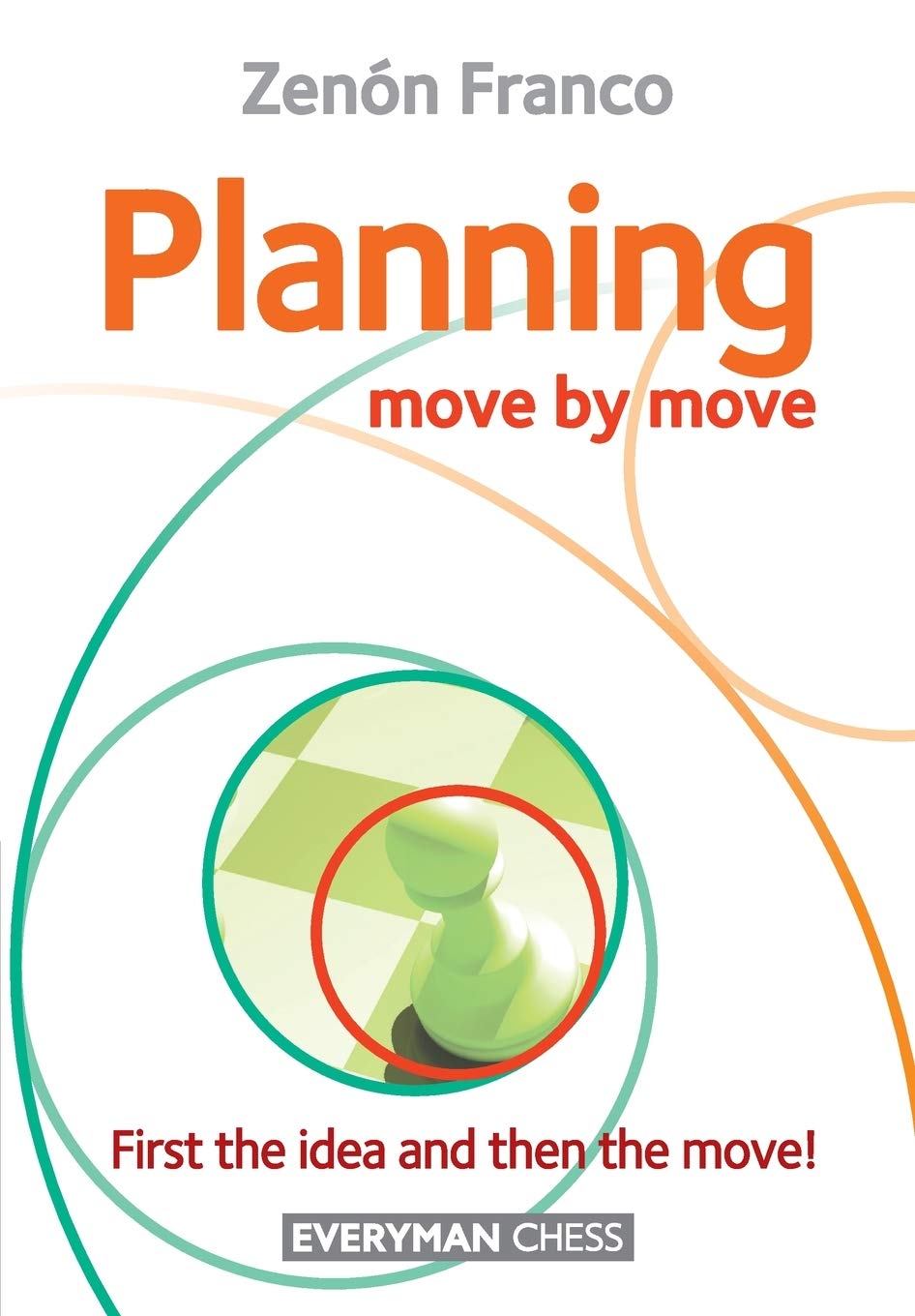
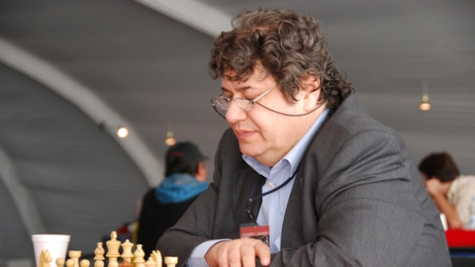
According to Wikipedia :
Zenón Franco Ocampos (American Spanish: [seˈnoɱ ˈfɾaŋko oˈkampos];[a] born 12 May 1956, Paraguay) is a chess grandmaster (GM) from Paraguay. In the 1982 Chess Olympiad at Lucerne, he won the gold medal at board one by scoring 11 of 13. In the 1990 Chess Olympiad at Novi Sad, he shared first place at board one with 9 points in 12 games. As of 2007, Ocampos is the top-ranked player and only GM in Paraguay (now, there are three GMs: Zenon Franco, Axel Bachmann and Jose Cubas). He has written several books on chess for Gambit Publications under the name Zenon Franco.
A few days ago my friend Paul Barasi asked me a question on Twitter: “Does planning play a distinctive & important role in deciding inter-club chess match games? I don’t hear players saying: I lost because I picked the wrong plan or failed to change plan, or won by having the better plan. Actually, they never even mention the subject.”
I replied: “It does for me. I usually lose because my opponent finds a better plan than me after the opening. But you’re right: nobody (except me) ever mentions this.”
I can usually succeed in putting my pieces on reasonable squares at the start of the game, but somewhere round about move 15 I have to decide what to do next. If I’m playing someone 150 or so Elo points above me (as I usually am at the moment), I’ll choose the wrong plan and find out, some 20 moves later I’m stuck with a pawn weakness I can’t defend and eventually lose the ending.
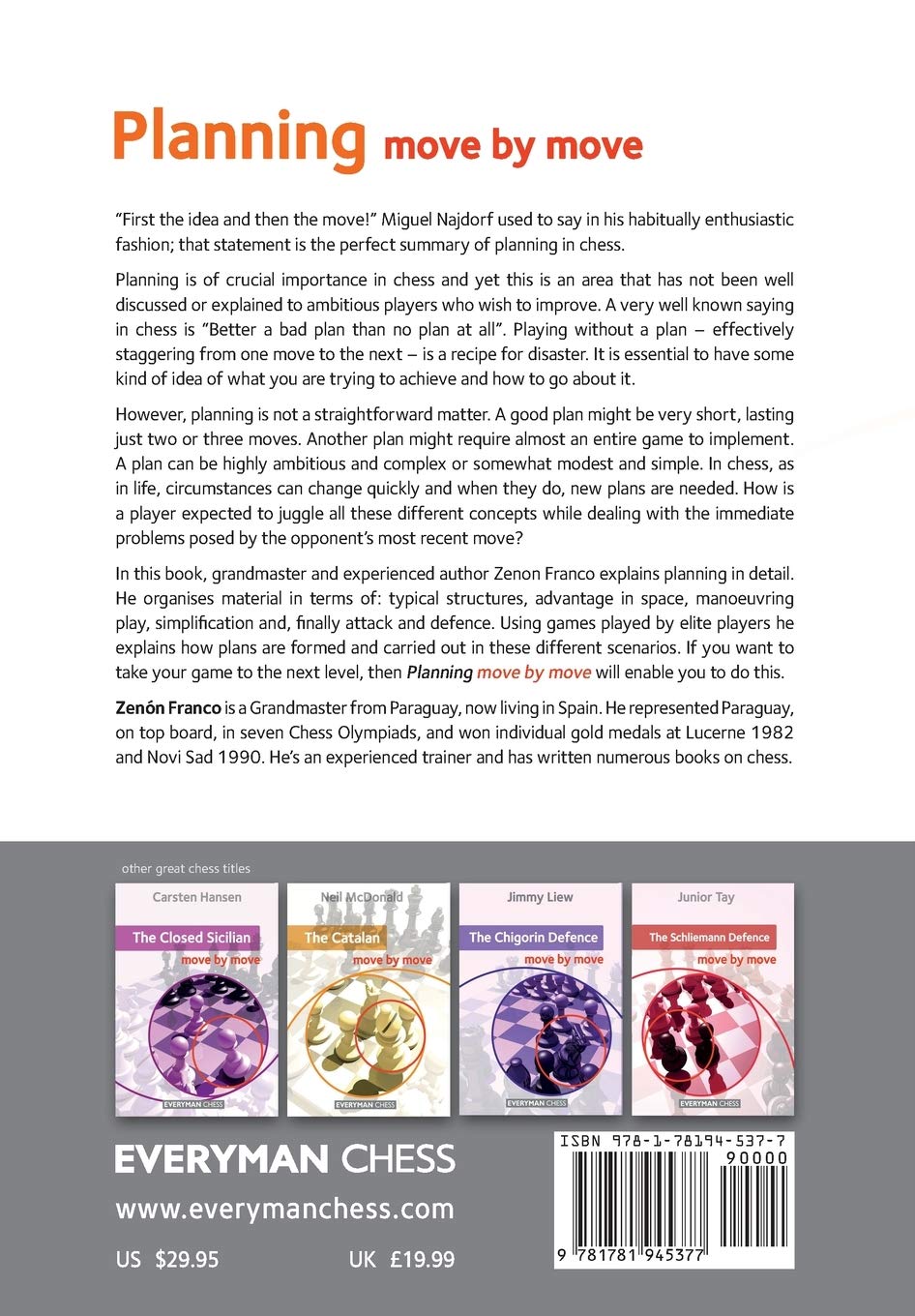
Perhaps Zenón Franco’s book Planning Move by Move will be the book to, as the blurb on the back suggests, take my game to the next level.
There are five chapters: Typical Structures, Space Advantage, The Manoeuvring Game, Simplification and Attack and Defence, with a total of 74 games or extracts. Although most of the games are from recent elite grandmaster practice, there are also some older games, dating back as far as Lasker-Capablanca from 1921. Three masters of strategy, Karpov, Carlsen and Caruana, make regular appearances.
Each game is interspersed with exercises (where the author is asking you to answer his question) and questions (which you might ask the author).
Compared to the Kislik book I reviewed last week which covers fairly similar territory, Franco’s book is more user friendly for this reason. It’s the difference, if you like, between a teacher and a lecturer. Kislik is talking to you from the demo board without giving you a chance to interact, while Franco is answering your questions and asking you questions in turn.
Let’s take as an example from the book Game 31, which is Caruana-Ponomariov Dortmund 2014
In this position, with Caruana, white, to play, you’re given an exercise.
“A decision must be taken. What would you play?”
White played 20. Rde1!
Answer: “Seeking the favourable exchange of dark-squared bishops and preventing 20… f6 for tactical reasons. Caruana didn’t see a favourable way of continuing after 20. h4 f6 and he commented that he wasn’t happy about allowing … h4, but he thought it was more important to prevent … f6.”
You might then ask the question: “But how did 20. Rde1 prevent 20… f6?”
Answer: “I’ll answer that with an ….”
Exercise: “How can 20… f6 be punished?”
Answer: “White can gain a positional advantage by exchanging the bishops with 21. Be5, but even better is 21. exf6 Bxf6 and now 22. Bxc7! Kxc7 23. Qf4+ wins a pawn.”
Taking you through to the end of the game, we reach this position with Caruana to play his 39th move.
“Exercise: Test position: ‘White to play and win’.”
You might want to solve this exercise yourself before reading on.
With any luck you’ll have spotted the lovely deflection 39. Re7!!
“Exercise: “What’s the key move now for solving the problem I set you?”
If you found the previous move you’ll have no problem finding the second deflection 40. Ba6 Kxa6 41. Qa8#
You’ll see from this example that the book is far from just a guide to chess strategy. At this level tactics and strategy are inseparable, and in order to solve Franco’s exercises you’ll have to calculate sharply and accurately both to justify your chosen plan and to finish your opponent off at the end of the game.
What we have, then, is a collection of top class games and extracts with annotations which are among the best I’ve seen. Copious use is made of other sources: the notes on the above game incorporate, with acknowledgement, Caruana’s own notes which can be found, amongst other places, on MegaBase. Franco also refers to computer analysis, in places making interesting comparisons between modern (early 2019) and older engines, and frequently comments on the difference between human and computer moves.
Having said that, the games are not easy, and, although all readers will enjoy a collection of great games instructively analysed, I would suggest that, to gain full benefit from the book, you’d probably need to be about 1800+ strength and prepared to take the book seriously, reading it with a chessboard at your side, covering up the text and attempting to solve the exercises yourself.
We’ve all seen games where Capablanca, for example, wins without having to resort to complex tactics, because his opponents are far too late to catch onto what’s happening. I could well imagine a book written for players of, say, 1400-1800 strength featuring this type of game, perhaps with some more recent examples. There must be many games from Swiss tournaments where GMs beat amateurs in this way.
I have a few minor criticisms:
In spite of these resservations I can recommend the book very highly as a collection of excellent and often beautiful top level games with first rate annotations. Stronger club standard players, in particular, will find it helpful in improving not just their planning skills but their tactical skills as well.
I really enjoyed reading it and I’m sure you will as well.
Richard James, Twickenham, 20th January, 2020
Book Details :
Official web site of Everyman Chess
 Save as PDF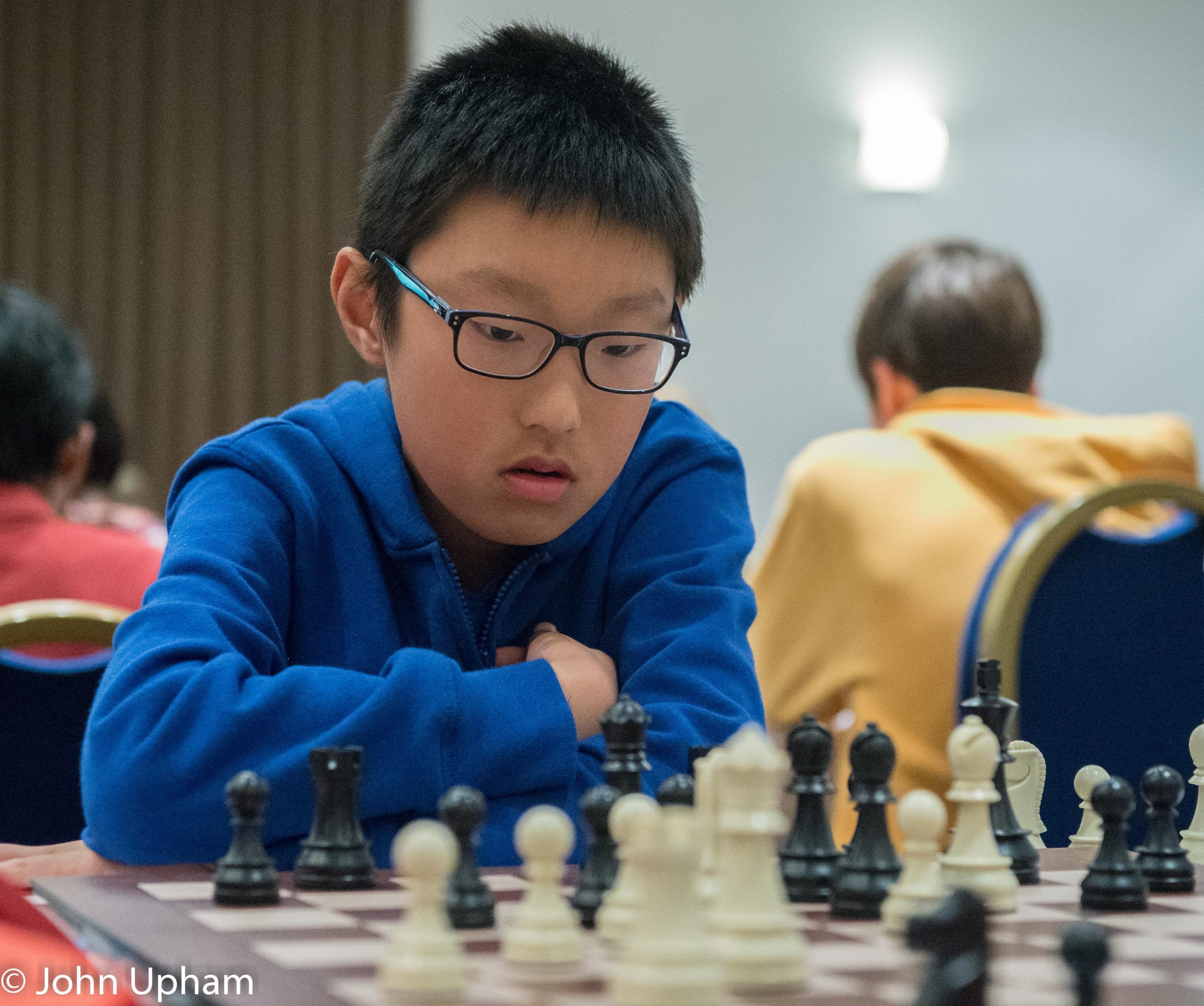
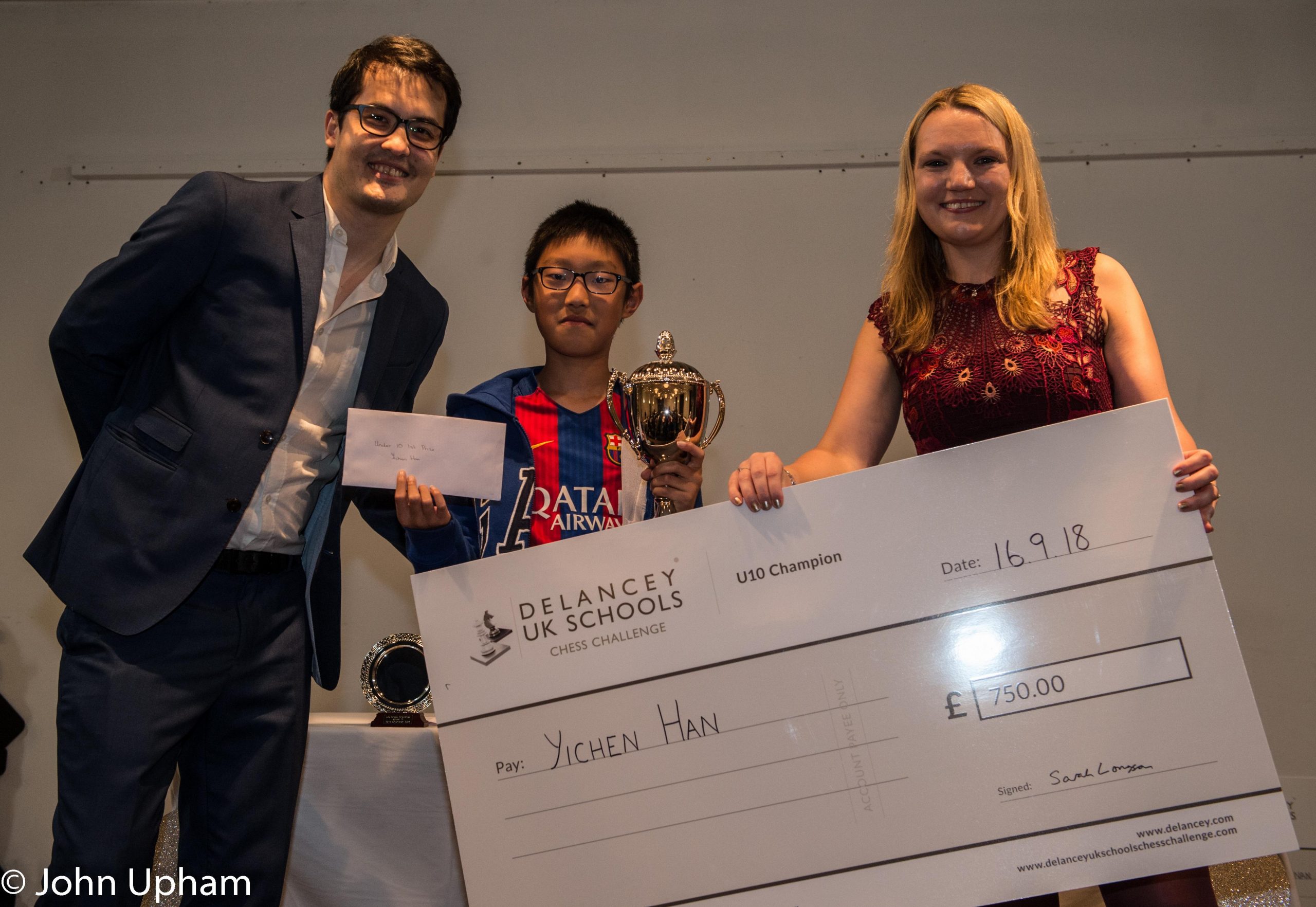
Newcastle Upon Tyne resident Yichen Han became the youngest Dutch holder of the FIDE Master (FM) title at the age of twelve years and two months.
Yichen was born in Eindhoven, Noord-Brabant, The Netherlands.
The games required to complete the FM title were played at the recent 4NCL Harrogate Congress . The final game was a win versus Robert Starley of Crowthorne Chess Club having started with a win versus CM Peter Ackley.
Yichen plays for Forest Hall and is a student at RGS Newcastle.
He currently has a FIDE rating of 2257 for standard play and an ECF grading of 215.
 Save as PDF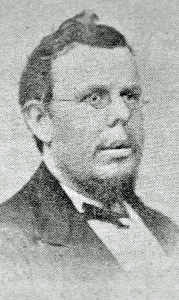
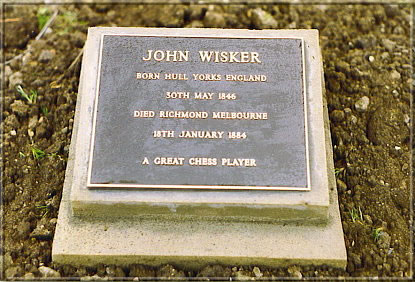
We remember John Wisker who passed away on this day, 18th January, 1884.
According to Wikipedia :
John Wisker (30 May 1846 in Kingston upon Hull, England – 18 January 1884 in Richmond, Victoria) was an English chess player and journalist. By 1870, he was one of the world’s ten best chess players, and the second-best English-born player, behind only Joseph Henry Blackburne.
Wisker moved to London in 1866 to become a reporter for the City Press and befriended Howard Staunton. His proficiency at chess improved rapidly, and he won the 1870 British Chess Championship after a play-off against Amos Burn, ahead of Blackburne, the defending champion. He won again in 1872 after a play-off against the first British champion, Cecil Valentine De Vere. After this second victory, the British championship was not resumed until 1904. Wisker edited chess columns for The Sporting Times and Land and Water. From 1872 to 1876, Wisker was Secretary of the British Chess Association and co-editor of The Chess Player’s Chronicle. After learning that he had contracted tuberculosis, Wisker emigrated to Australia in the autumn of 1876 to try to regain his health. In Australia, he wrote a chess column for the Australasian. In 1884, Wisker died from bronchitis and tuberculosis.
Here is a short item from the Ken Whyld Association web site :
and here is a more detailed article from chess.com
From The Oxford Companion to Chess by David Hooper & Ken Whyld :
John Wisker was an English player and journalist. After moving from Yorkshire to London in 1866 Wisker improved rapidly, so that in the early 1870s he could be ranked among the world’s best ten and second only to Blackburne among English-born players. In 1870 Wisker won the British Championship ahead of Blackburne (the holder) after a play-oil against Burn, and in 1872 he again won the title after a play-off against De Vere. (winner of the first British Championship). By winning twice in succession Wisker retained the trophy and the contests ceased until 1904 (when
Napier won). Against two of his contemporaries Wisker played six matches: Bird in 1873 (+6 =1 -6 and +4 =3 -7) and again in 1874 (+10 =3 -8 and +3 =1 -5); and MacDonnell in 1873 ( = 1 -3) and 1875 ( + 7 =4 -4), Discovering that he had tuberculosis, Wisker emigrated to Australia in the autumn of 1876, hoping to improve his health. In England he edited excellent chess columns in The Sporting Times and Land and Water, and was co-editor of the Chess Player’s Chronicle from 1872 to 1876; in
Australia he edited a chess column in the Australasian.
From The Encyclopedia of Chess by Anne Sunnucks :
British Champion in 1879 and 1872 and Hon. Secretary of the British Chess Association from 1872 – 1877. Wisker was born in Hull. His parents were poor and, he received little schooling, but by his own efforts educated himself and by the time he was 19 was contributing articles to the Fortnightly Review. In 1866 he came to London to report for the City Press and was introduced to London chess circles by Howard Staunton. His play rapidly improved, and his victory in the British Championship in 1870 was achieved after a ply-off against Burn, ahead of Blackburne. In 1872, by successfully defending his title, he won the BCA Challenge Cup outright. On this occasion he won a play-off against De Vere. In 1872 Wisker became co-editor with Skipworth of the Chess Player’s Chronicle.
in 1875, Wisker was found to have consumption, and two years later. on medical advice, he emigrated to Australia. He became chess editor of The Australian, an appointment which he held at the time of his death. He died on 18th January 1884 from bronchitis on top of consumption.
From The Encyclopedia of Chess by Harry Golombek :
A prominent British player and chess administrator. Wisker won the BCA Challenge Cup in 1870 after a play-off with Burn. In 1871 he narrowly lost (+2 -3 =4)a match to the French master Rosenthal, who had fled to London to avoid the rigours of war. Wisker retained the Challenge Cup in 1872, this time after a play-off with De Vere. In the following year Wisker played a series of matches against Bird, drawing the first (+6 -6 =1) losing the second (+4 -6 =2) and winning the third (+10 -8 = 3).
From 1872 to 1877 Wisker was secretary of the BCA and jointly edited the Chess Player’s Chronicle. wisker suffered from consumption and in 1877 under doctor’s orders emigrated to Australia where he died (H.G.)
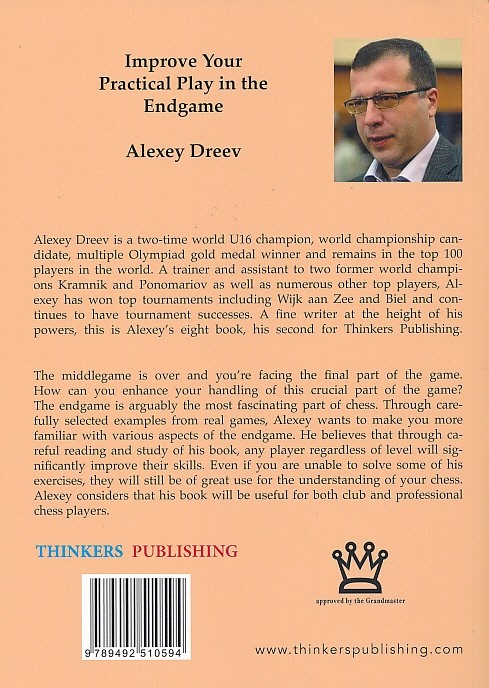
Save as PDFImprove Your Practical Play in the Endgame : Alexey Dreev
“After a bad opening, there is hope for the middle game. After a bad middle game, there is hope for the endgame. But once you are in the endgame, the moment of truth has arrived.” – Edmar Mednis
From Wikipedia :
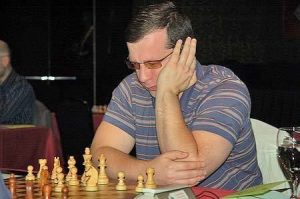
Alexey Sergeyevich Dreev (Russian: Алексей Сергеевич Дреев; born 30 January 1969[1]) is a Russian chess player. He was awarded the title Grandmaster by FIDE in 1989.
While being a promising young chess talent, he was for a period coached by the world-class chess trainer Mark Dvoretsky.
As with every recent Thinkers Publishing publication high quality paper is used and the printing is clear. The book can easily be laid flat next to the board and does not require weights to prevent it from “self-closing” (a particular bugbear of ours !). Each diagram is clear and the instructional text is typeset in two column format, which, we find, enables the reader to maintain their place easily. Figurine algebraic notation is used throughout and the diagrams are placed adjacent to the relevant text and each diagram has a “to move” indicator.
There is no index which, unfortunately, is a standard feature of Thinkers Publishing books. Also missing is a bibliography.
This author of this book is Alexey Dreev, super GM who reached the quarter finals of the candidates in 1991.
This excellent book is packed full of instructive, exciting endgames, taken from top level games, including many of Dreev’s own games
extensively analysed with short pithy didactic comments.
Many of the examples are complex and require serious study to really gain the understanding of practical endgames.
This book is a pleasure to read with an excellent layout and plenty of diagrams making it easy to peruse anywhere.
The book is divided up into six chapters, but not on piece configurations (except for chapter 5) but on aspects of play:
Each chapter has eight or nine examples analysed in depth followed by a similar number of exercises which will really test the reader;
I did get a few right without moving any pieces.
One of favourite chapters is Particular Endgames which mostly covers positions with material imbalance such as Q v pieces
which the vast majority of players would find fascinating. There is an excellent example no 3 showing the use of a space advantage in B+2Ns endgame.
Following is the first example in the Chapter on Defence and a new perspective on a famous game.
My other favourite chapter is Pawn Endgames and Transitioning into Pawn Endgames which shows the rich complexity of king and pawn endgames
and the crucial importance of this topic.
In my experience, this transition is commonly mishandled by players of all standards: I have spoiled winning endgames in this area and I have seen countless games spoiled by poor play in pawn endgames, so study of this chapter will reap rich rewards for a reader.
FM Richard Webb, Chineham, Hampshire, 17th January 2020
Book Details :
Official web site of Thinkers Publishing
 Save as PDF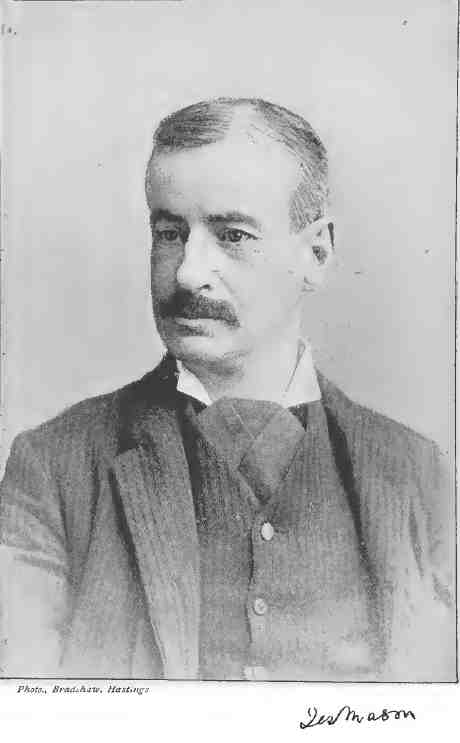
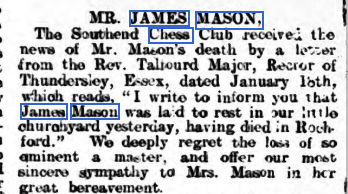
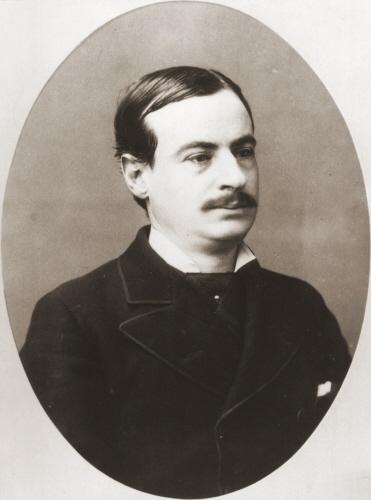
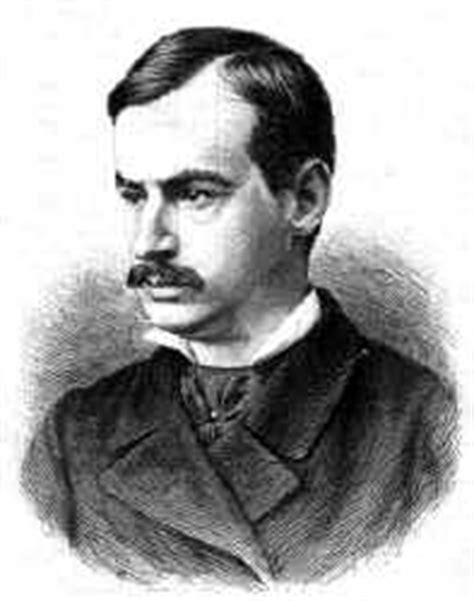
We remember James Mason who passed away on this day, January 15th, 1909.
Here is his Wikipedia entry
From The Oxford Companion to Chess by David Hooper & Ken Whyld :
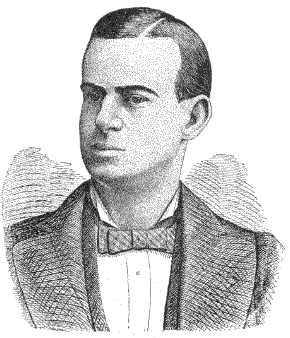
One of the world’s best half-dozen players in the early 1880s, journalist. He was born in Kilkenny, Ireland, and adopted the name James Mason (his real name is not known) when he and his family emigrated to the USA in 1861. He became a boot-black in New York, frequenting a Hungarian cafe where he learned chess. Coming to the notice of J. G. Bennett of the New York Herald he was given a job in the newspaper’s offices, a start in life that both suited his literary aspirations and gave him the chance to study the game; and in 1876 he made his mark, winning first prizes at the fourth American Chess Congress, Philadelphia, and in the New York Clipper tournament, and defeating the visiting master Bird in match play (411=4-4), Settling in England In 1878 he drew a match with Potter (+5=11— 5) in 1879, and at Vienna 1882, the strongest tournament held up to that time, he took third prize (+17=12-5) after the joint winners Steinitz and Winawer.
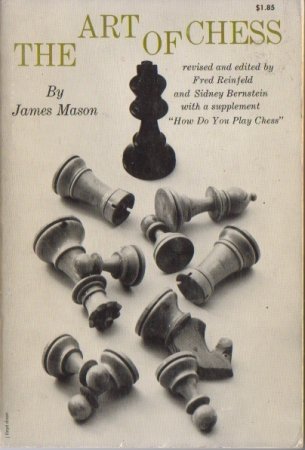
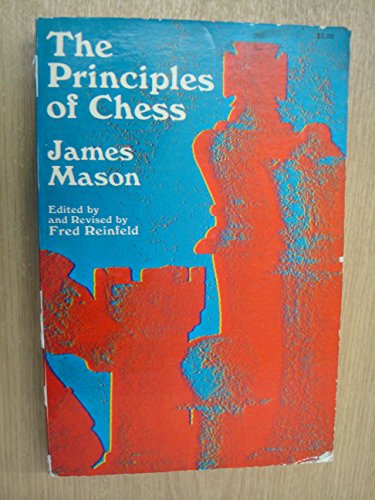
This was his finest achievement, but he had some other good tournament results; London 1883 (won by Zukertort), equal fifth; Nuremberg 1883, third after Winawer and Blackburne; Hamburg 1885, second equal with Blackburne, Englisch, Tarrasch, and Weiss after Gunsberg; Manchester 1890 (won by Tarrasch), equal fifth; and Belfast 1892, first equal with Blackburne. Fond of drink, Mason is alleged to have lost many games when in a ‘hilarious condition’. ‘A jolly good fellow first and a chess-player afterwards’ he never fulfilled the promise of his first years in England, Instead he wrote books on the game, in excellent style, notably two popular textbooks. The Principles of Chess in Theory and Practice (1894) and The Art of Chess (1895): both ran to several editions. Another of his books. Social Chess (1900), contains many short and brilliant games.
From The Encyclopedia of Chess by Harry Golombek :
A British master of Irish birth, Mason emigrated in early youth to the USA before settling in England in 1878. In America he won matches against Delmar, Martinez, Bird etc, ; In England he beat Mackenzie and drew with Potter, remaining unbeaten in match-play. He played in most of the important tournaments of the eighties and nineties, but the first prize he won on his début at the Philadelphia congress 1876 remained his only victory.
His best results were the third prizes at Vienna 1882 (behind Steinitz and Winawer), Nuremberg 1883 and Amsterdam 1889; =2nd at Hamburg 1885 and =3rd at Bradford 1888; also his 7th place in the great New York 1889 tournament. He wrote The Principles of Chess, London 1894, The Art of Chess, London 1895, compiled a collection of brilliancies in a series Social Chess, London 1900, and was co-author with Pollock of the 1895/6 tournament book. (Article by William Hartston).
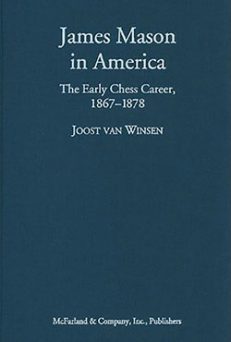
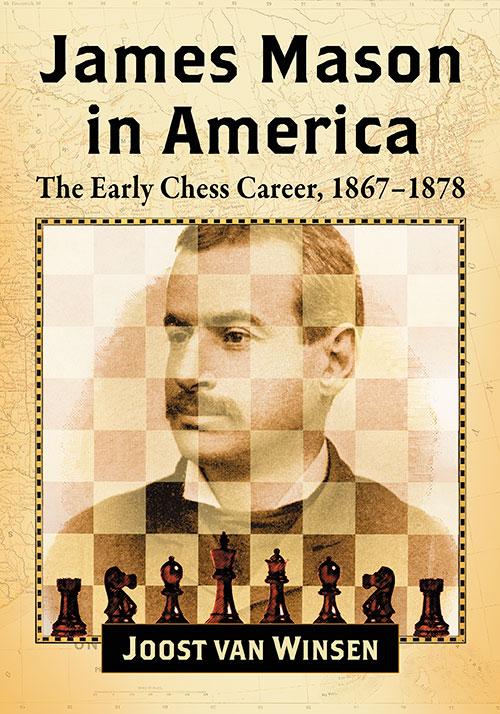
We reviewed the most recent book about James Mason here
 Save as PDF
Chess Logic in Practice : Erik Kislik
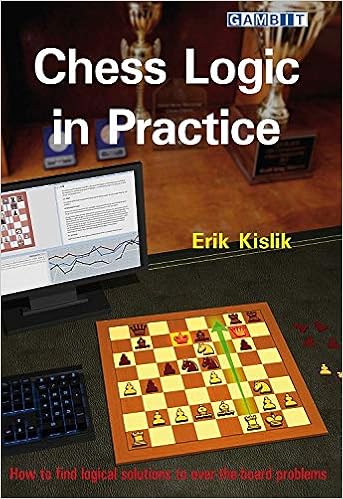
Erik Kislik is an American IM and chess coach who has been based in Hungary for some years.
This is his second book, a successor to Applying Logic in Chess, which proved rather controversial, containing rather more words and less chess than you might expect. John Hartmann’s review proved even more controversial than Kislik’s book, and was subjected to some rather aggressive online responses by the author’s friends and supporters.
As someone who likes chess books with lots of words and has a specific interest in logic, I was sufficiently intrigued to buy the book myself and find out what all the fuss was about. While agreeing with Hartmann’s reservations, I enjoyed the book and was looking forward to the sequel.
Kislik’s premise is that, by using logical thought processes, we can eliminate bias from our thinking and improve our choice of candidate moves. According to the introduction: “I decided to write this book to lay out straightforward problem-solving approaches to the tough decisions we face in practical games. We have all sorts of biases that get in our way and stop us from finding, considering and calculating strong moves.”
Unlike his previous book, you’ll find a lot more chess than verbiage here. The book is full of interesting extracts from top GM games, games by the author and his students, and positions from opening theory.
Kislik splits his material into two parts. The first part, Thinking Concepts, concerns identifying specific cognitive biases which might prevent us finding the best moves. The second part, Positional Concepts, looks at more directly chess-related ideas.
You can find a contents list and sample pages on the publisher’s website.
I guess I’m not really part of the target market as I have had no particular interest in improving my own chess for several decades now and am gradually winding down my playing career.
For reference, my ECF grade is, at the time of writing, 167, which would be round about 1900 Elo.
What did I make of the material? Does it succeed in its aim? What level of player is it aimed at?
Chapter 3, The Method of Elimination, tells us that we can simplify our choices if there’s only one move that meets our opponent’s threat or, in some other way, reacts to the demands of the position. Sure, but I’ve certainly played games where I’ve done just that only to find that the one move to meet my opponent’s threat, which I’ve played without too much thought, allows something much worse. There seems to be an assumption here that the reader calculates much more accurately and quickly than I do.
This position is from Harikrishna-Dominguez (Wijk aan Zee 2014) with Black to play.
Black’s a pawn down, so he has no choice but to play Qg6, which, as you will see, regains the pawn with equality. Not so hard, even for me, but I was more interested in the position a couple of moves earlier where he chose to free his position by a temporary sacrifice of his e-pawn.
A few moves later they reached this position:
Here Dominguez played a5. Kislik: “This very unnecessary defensive move allows White to make a lot of progress and set some awkward problems. 32… Ke7 is a move I would have chosen by a process of elimination. Black improves his worst-placed piece and White has no threats anyway.” The position should still be within the bounds of a draw, but Harikrishna gave a textbook example of how to maintain the pressure and eventually brought home the full point.
Yes, but you might equally well say that Black would have been following general principles: bringing his king up for the ending and not creating unnecessary pawn weaknesses.
This is from Chapter 12: Painfully Slow Moves: Kislik-Szalanczy Budapest 2009 with White to play.
Looking at what I’d learnt from Chapter 3, I’d quickly eliminate everything except gxf7+ and Rxf7 as I don’t want to lose the g6 pawn for nothing. In fact both moves give White a slight plus. Kislik chose gxf7+ and a few moves later allowed a perpetual.
As he explains, he missed a Painfully Slow Move: “33. Rf4!! wins by threatening the very modest Qxe7.” Wait a minute. Why does Rf4 threaten Qxe7? Why can’t I play Qxe7 at once? He analyses various other lines but doesn’t answer my questions. I asked Stockfish 10, who told me that 33. Qxe7 Qg1+ 34. Kc2 Qxg2+ 35. Nd2 fxg6 is equal, but if the white rook was on f4 rather than f5 White would be mating with Qe6+ followed by Rh4+. All rather too deep for me, I’m afraid.
I believe there have been several recent books based on the opposite premise: that to play at a high level you need to use creativity, imagination and intuition rather than just pure logic. At my level, at any rate, I’d need to go beyond pure logic to find Rf4.
I get the feeling from this example that the book is really aimed at stronger players than me. The book is full of punctuation marks and assessments without further comment. From my perspective I’d have preferred fewer examples and more explanation.
I wonder also if the author might have had a database of instructive positions and a list of interesting chapter headings and tried to shoehorn everything in somehow and somewhere.
The other quibble I have is with the layout. It’s all rather breathless, with one position being followed by another without a pause, I’d have liked a gap, or even a horizontal line, to separate examples, so that my brain could take a break.
In spite of my reservations, I’m sure that a player of, say, 2000+ strength prepared to work hard will get a lot out of this book. Kislik’s theories are thought provoking and his examples fascinating. Slightly lower rated players will, as I did, get a lot of pleasure out of reading this book and enjoying some excellent chess.
Richard James, Twickenham, January 14th 2020
Book Details :
Official web site of Gambit Publications Ltd.
Save as PDF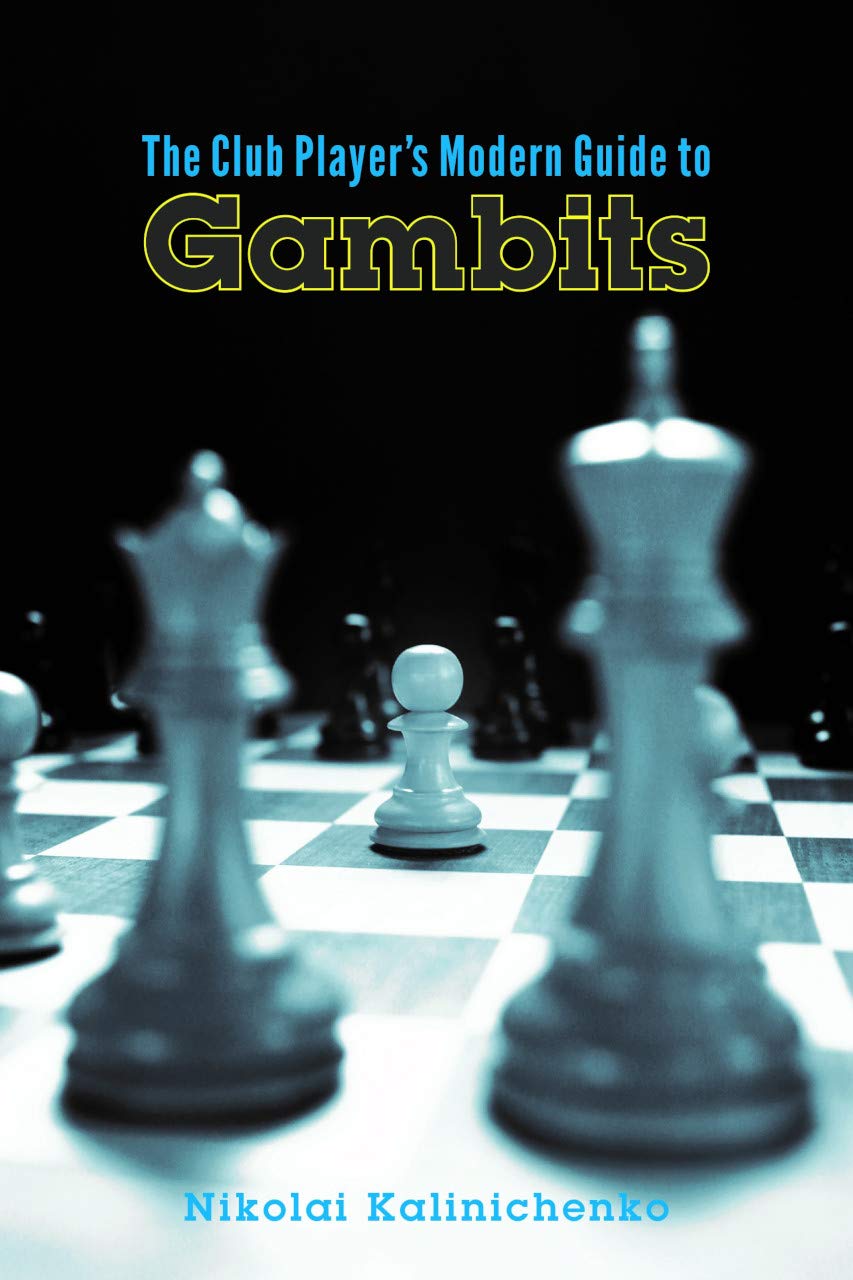
The Club Player’s Modern Guide to Gambits : Nikolai Kalinichenko
Nikolai Kalinichenko is an ICCF (correspondence) grandmaster and renowned theoretician.He has published no less than 50 books on various chess aspects in Russia, Germany, France, Spain, the U.K., USA, China and other countries. His most acclaimed English-language titles include “Vassily Ivanchuk: 100 Selected Games”; “A Positional Opening Repertoire for the Club Player”; “An Aggressive Opening Repertoire for the Club Player”; and “King’s Gambit”
This is an unusual book : the theme is sacrificing a pawn (or more) in the opening for various types of compensation such as initiative, development, control of squares or perhaps simply surprise !
Those with long memories will recall the diminutive Counter Gambits by Tim Harding published by British Chess Magazine in 1974.
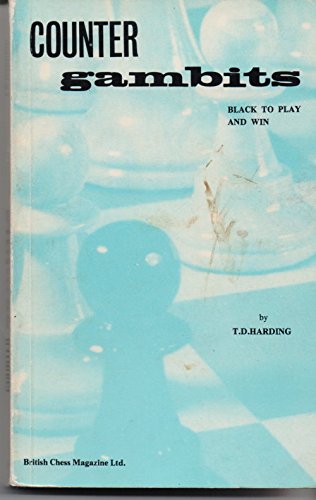
This new book could be seen (to some extent) as a successor to the above and details forty eight or so opening pawn sacrifices for both Black and White organised along the following lines :
Here is an excerpt from the publisher, Russell Enterprises, Inc. :
This is no ordinary opening book. This practical guide describes only such openings in which White or Black sacrifices material at an early stage of the game. They are called gambits (in Old Italian, gambetto means tripping).
The justification for such sacrifices can differ quite a lot. In most cases, the side that sacrifices material tends to get ahead of the opponent in development and/or opens lines to attack the enemy king. However, there are also gambits aimed at the occupation of the center (Blumenfeld Gambit), depriving the opponent of castling (Cochrane Gambit or Traxler Variation), weakening the opponent’s pawn structure (Anti-Moscow Variation), luring an opponent’s piece to an unfavorable position (sacrificing the b2-pawn), obtaining a certain positional compensation (Volga Gambit), etc.
Gambits are often associated with the romantic chess of the 19th century. Indeed, that was the heyday of such sharp openings as the King’s Gambit or Evans Gambit, but even nowadays, many games begin with one of the well-known or even innovative gambits. This should come as no surprise: gambits help to reveal the true essence of chess, “the triumph of spirit over matter.”
The concept of this book is to examine practical games and give theoretical insights in the notes rather than in stand-alone articles. Practice has shown this to be the most effective way of mastering new material. More often than not, recent games by the world’s top players have been chosen as an illustration, played in the last few years in particular. However, the most important classic games are mentioned as well. The present book analyzes almost 50 of the major gambit lines and systems. Almost 140 games are given in full, with many game fragments selected to illustrate the important deviations. And there is a special section about types of sacrificial themes, such as sacrificing the b2-pawn, sacrificing on f7, etc.
Readers who may wish to employ one of the examined gambit variations on a regular basis should, no doubt, study the specific books on that very opening, although in most cases the lines and ideas given are sufficient for a beginner or club player to include the system in his or her opening repertoire and give it a try.
One of the features of this book (which is a little unsual these days) is a potted history of each gambit, how it got its name and some idea of early adopters. This is most welcome.
For each gambit the author provides detailed analysis (which has been engine checked) plus from two to five illustrative games (usually) between strong players with copious notes.
Almost all (probably 90%) of the gambits are lines played at serious tournament level, possibly more likely in games with shorter times control and on-line where anything goes. Of the 48 probably only perhaps 3-4 would be considered suitable for the coffee-house or following a visit to the bar! These might be the Englund Gambit, The Latvian Gambit and the Blackmar-Deimer Gambit but don’t tell Tim Sawyer or any other BDG fan !
Amongst the most sound we have :
The Geller, Morra, Evans, Marshall (in the Ruy Lopez), Marshall (in the Semi Slav), Icelandic, Benko, Blumenfeld, Volga, From, Winawer Counter, Staunton, Albin Counter, Budapest, von Hennig-Schara, Krause (in the Slav) and Botvinnik gambits with the balance falling somewhere in between.
We were surprised not to find coverage of the Elephant (Queen’s Pawn Counter) gambit in the open games section but maybe the author considers it unsound :
We learnt a new name (The Been-Koomen Variation) for a familiar gambit :
that you might not have encountered previously.
Here is an example game that is analysed by the author but here analysed by Michael Kransekow :
So, in summary we have a book that is most suitable for club players and those perhaps looking for ideas for rapidplay or blitz games. Almost all of these gambits are considered to be “sound” (whatever this means in these engine dominated days) and most definitely practical and playable.
Snooty theoreticians might look down their noses at some choices forgetting that chess is a game (for most people) and to be enjoyed. This book is certainly not a rehash of “Unorthodox Chess Openings” by the late Eric Schiller and many of these gambit suggestions will liven up a dull repertoire.
John Upham, Cove, Hampshire 11th January 2020
Book Details :
Official web site of Russell Enterprises
Save as PDF