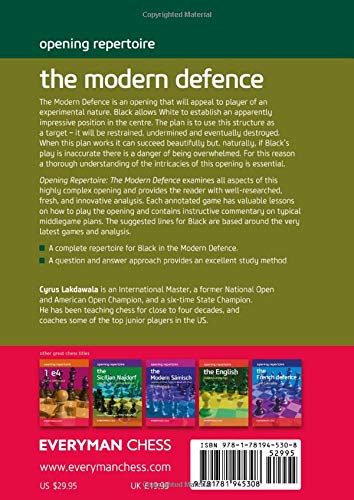
Cyrus Lakdawala is an IM and former US Open Champion who teaches chess and has written over 25 books on chess openings.
As a treat for our readers we allow you to download this review in Portable Game Notation (pgn) format. We suggest ChessBase Reader as a means of opening the file.
You may also download this review in ChessBase (.cbv) format.
[fen]rnbqkbnr/pppppp1p/6p1/8/4P3/8/PPPP1PPP/RNBQKBNR w KQkq – 0 1[/fen]
This is the Modern Defence, which has been described both as a fighting opening, based on counterattack and a masochistic paradise, where Black has to sit with less space for the whole game and then loses.
Having played the Modern for some 40 years now, I can testify that the truth is somewhere between the two views.
You either like the Modern or you don’t and you have to get into the right frame of mind in order to play it properly. Black has to suck up early pressure and time his counterattack to perfection to break up the enemy position. If this is your thing and you have an independent character, you will find what you want after 1…g6.
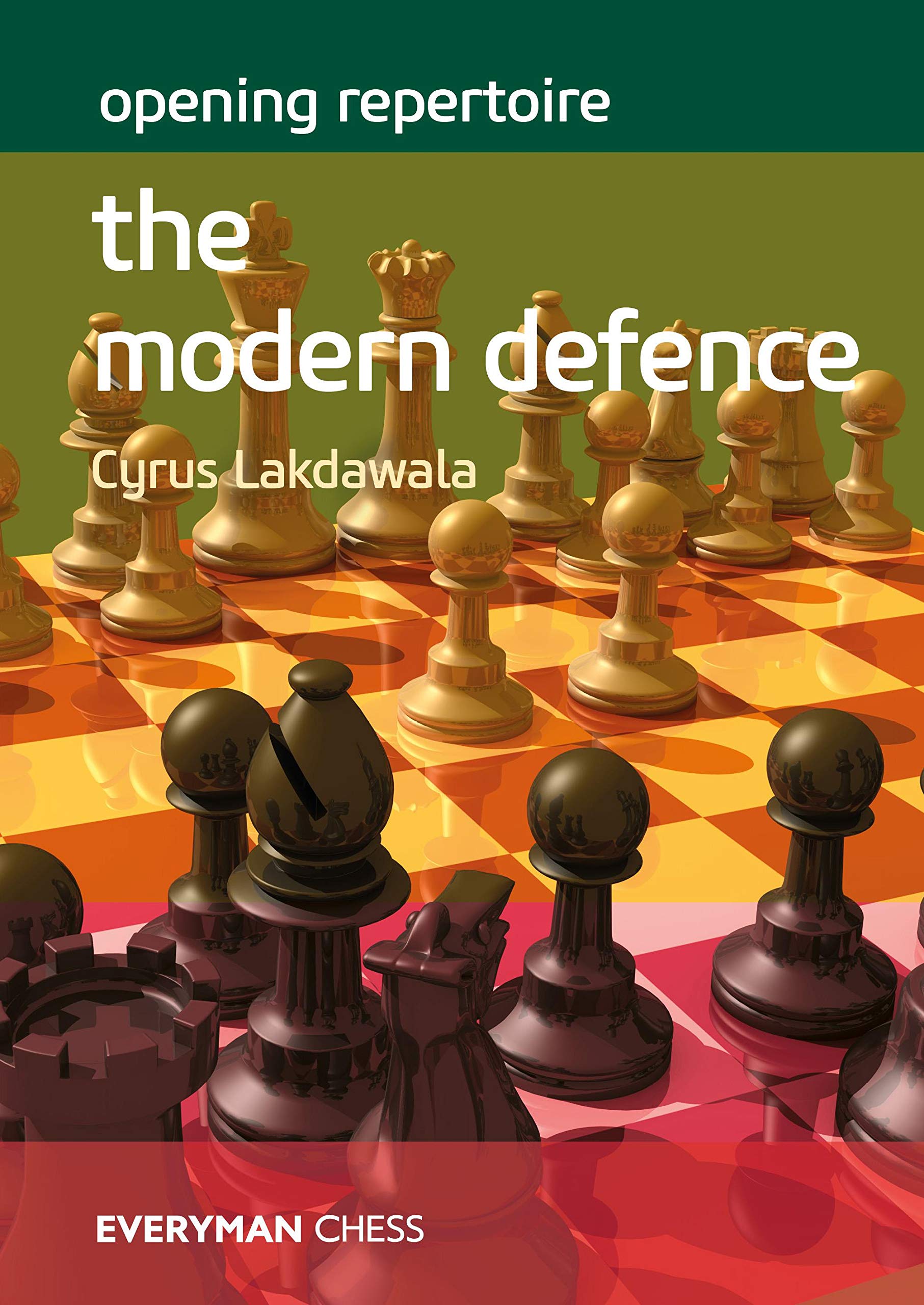
I think I have most of the Modern Defence books in my library, stretching back to Keene and Botterill, through Norwood and Tiger Hillarp Persson and now complimented by the latest work from Cyrus Lakdawala : ‘ Opening Repertoire’ The Modern Defence.
Lakdawala’s book is comprehensive, brimming with ideas and gives lines for Black after all sensible opening first moves, based on complete games.
His suggestions differ from Hillarp Persson, in that whereas the Swedish GM recommends that Black plays an early …-a7-a6 in most lines, Lakdawala goes back to the Norwood repertoire of old, where 1 e4 g6 2 d4 d6 3 Nc3 c6!? was one of the key pillars of the Black counterattacking reply.
It’s an approach which seems to stand up in the present day.
Let’s dive in and take a look at a few recent games that are not in the book, but which align with the recommendations therein.
[pgn]
[Event “Gujarat op 2nd”]
[Site “Ahmedabad”]
[Date “2019.09.25”]
[Round “6”]
[White “Srija, Seshadri”]
[Black “Thanki, Hemal Karsanji”]
[Result “0-1”]
[ECO “B06”]
[WhiteElo “2270”]
[BlackElo “2098”]
[Annotator “IM Andrew Martin”]
[PlyCount “120”]
[EventDate “2019.09.22”]
[EventType “swiss”]
[EventRounds “10”]
[EventCountry “IND”]
[SourceTitle “EXT 2020”]
[Source “ChessBase”]
[SourceDate “2019.10.17”]
[SourceVersion “1”]
[SourceVersionDate “2019.10.17”]
[SourceQuality “1”]
{[%evp 0,120,24,23,78,60,79,61,82,45,60,46,47,52,42,35,35,39,35,30,41,29,31,8,
27,10,47,10,16,18,9,3,11,-1,2,-37,-37,-44,-46,-46,-42,-43,-41,-47,-46,-34,-13,
-70,-52,-46,-56,-56,-64,-74,-74,-73,-76,-97,-99,-124,-108,-108,-101,-112,-120,
-105,-104,-191,-168,-190,-182,-202,-186,-371,-359,-370,-370,-378,-362,-375,
-392,-411,-308,-319,-340,-327,-370,-358,-361,-378,-341,-349,-349,-341,-338,
-392,-333,-344,-307,-345,-338,-335,-303,-313,-292,-344,-296,-330,-329,-333,
-340,-385,-396,-389,-401,-409,-416,-414,-395,-403,-403,-413,-419]} {The first
key point to make is that the Black opening move-order is good against the
Austrian Attack. By delaying or even omitting …Bf8-g7, Black sets up an
improved Gurganidze System, where the Bishop on f8 is usefully placed, maybe
to support …c6-c5 later on.. Here is a recent game in the line, which bears
out Lakdawala’s opinion that Black is OK in this variation.} 1. e4 c6 2. d4 g6
3. Nc3 d6 4. f4 d5 {Black loses an opening tempo, but the blocked center means
that this does not matter at all.} 5. e5 h5 6. Nf3 Nh6 7. Be3 Qb6 8. Na4 Qa5+
9. c3 Bg4 10. Be2 e6 11. Nc5 Nf5 12. Bf2 Nd7 13. b4 Qc7 14. h3 Bxf3 15. Bxf3 h4
16. O-O Nxc5 17. dxc5 Bh6 18. Qc1 f6 $1 {[#] This may not be the greatest game
ever seen, but the way Black obtains counterplay is very thematic and
interesting.} 19. Bd4 fxe5 20. Bxe5 Qxe5 21. fxe5 Bxc1 22. Raxc1 a5 23. a3 Kd7
24. Bg4 axb4 25. axb4 Rhf8 26. Rfe1 Ra2 27. c4 Rb2 28. b5 Ra8 29. cxd5 exd5 30.
bxc6+ bxc6 31. Ra1 Rxa1 32. Rxa1 Rc2 33. Ra7+ Ke6 34. Rg7 Kxe5 35. Rxg6 Ng3 36.
Rxc6 Kd4 37. Bd1 Rc1 38. Kf2 Rxd1 39. Kf3 Ne4 40. Rh6 Rd3+ 41. Kf4 Rg3 42. Rxh4
Rxg2 43. c6 Rf2+ 44. Kg4 Rc2 45. Rh6 Ke5 46. Rh5+ Ke6 47. Rh6+ Ke5 48. Rh5+ Kd6
49. Rh6+ Kc7 50. Kf4 Rxc6 51. Rh8 Re6 52. h4 Nd6 53. h5 Re4+ 54. Kf3 Kd7 55. h6
Nf7 56. Ra8 Rh4 57. Kg3 Rxh6 58. Kf4 Rf6+ 59. Ke3 Kd6 60. Ra7 Ne5 0-1
[/pgn]
[pgn]
[Event “Katowice POL-HUN 7th”]
[Site “Katowice”]
[Date “2019.04.14”]
[Round “6”]
[White “Przybylski, Wojciech”]
[Black “Krasenkow, Michal”]
[Result “0-1”]
[ECO “B08”]
[WhiteElo “2320”]
[BlackElo “2623”]
[Annotator “IM Andrew Martin”]
[PlyCount “104”]
[EventDate “2019.04.13”]
[EventType “swiss (rapid)”]
[EventRounds “9”]
[EventCountry “POL”]
[SourceTitle “CBM 189 Extra”]
[Source “ChessBase”]
[SourceDate “2019.06.03”]
[SourceVersion “1”]
[SourceVersionDate “2019.06.03”]
[SourceQuality “1”]
{[%evp 0,104,25,20,85,78,78,72,78,99,99,69,103,85,79,66,61,58,58,58,43,36,66,
67,65,62,67,56,56,56,79,70,89,72,107,71,91,74,105,100,70,83,83,62,62,85,85,89,
67,64,67,67,72,68,57,37,59,66,66,22,48,48,48,41,41,4,4,18,37,-4,55,60,60,61,82,
-25,82,38,62,60,60,38,33,-295,-304,-307,-298,-538,-533,-546,-546,-552,-560,
-564,-547,-633,-633,-761,-795,-795,-713,-713,-685,-685,-713,-806,-806]} {
The Classical Variation never felt threatening to me when I played the Modern,
but I get the impression that if you are facing someone really good, you can
get squeezed in this line if you get it even slightly wrong. Lakdawala sticks
to his idea of an early…c7-c6, usually going back into a Classical Pirc and
this is a solid enough response. Here are two games from 2019.} 1. e4 g6 2.
d4 Bg7 3. Nc3 c6 4. Nf3 d6 5. a4 a5 6. Be2 Nf6 7. h3 O-O 8. O-O Na6 9. Be3 (9.
Re1 Nb4 10. Bc4 d5 11. Bb3 Nxe4 12. Nxe4 dxe4 13. Rxe4 Bf5 14. Re2 Qd6 15. Bg5
Bf6 16. Bh6 Rfd8 17. Ng5 Nd5 18. Rd2 Bg7 19. Bxg7 Kxg7 20. c4 f6 {[#]} 21. cxd5
fxg5 22. dxc6 bxc6 23. Qe2 Qf6 24. Rc1 Rab8 25. Bc4 h5 26. Re1 Rb7 27. Qe5 g4
28. hxg4 hxg4 29. Qxa5 Rxd4 30. Rxd4 Qxd4 31. Qe5+ Qxe5 32. Rxe5 Rxb2 33. Rxe7+
Kf6 34. Rc7 Be4 35. f3 gxf3 36. gxf3 Bd5 37. Bxd5 cxd5 38. Rc6+ Kf5 39. Rd6 Ke5
40. Rxg6 Kf4 41. Rg2 Rb3 42. Rd2 Kg3 43. Rd1 d4 44. f4 d3 45. f5 Kf3 46. Rf1+
Ke2 47. Rf2+ Ke3 48. Kg2 d2 49. Rf3+ Ke2 50. Rf2+ Kd3 51. Rf1 Kc2 52. f6 d1=Q
53. Rxd1 Kxd1 54. a5 Ke2 55. a6 Rb8 56. Kg3 Ke3 57. Kg4 Ke4 58. Kg5 Ke5 59. Kg6
Rb6 {0-1 Ni,S (2409)-Akopian,V (2650) Abu Dhabi 2019}) 9… Nb4 10. Re1 Qc7 11.
Qd2 e5 12. dxe5 dxe5 13. Bc4 Rd8 14. Qe2 Bd7 15. Rad1 Be8 16. Bb3 Bf8 17. Qc4
Rxd1 18. Rxd1 Qe7 19. Bb6 Nd7 20. Bc7 Qf6 21. Ne2 Na6 22. Bxa5 Nac5 23. Bc3 Nb6
24. Bxe5 Qxe5 25. Nxe5 Nxc4 26. Bxc4 Nxe4 27. b3 Bg7 28. Nf3 Kf8 29. Nf4 Nc3
30. Re1 b5 31. axb5 cxb5 32. Bd3 Bc6 33. Ne2 b4 34. Nfd4 Bd5 35. Nxc3 bxc3 36.
Ne2 Rd8 37. Nf4 Bc6 38. h4 Bh6 39. Ne2 Bd2 40. Rd1 Ke7 41. Ng3 Rxd3 42. cxd3 c2
43. Rxd2 c1=Q+ 44. Nf1 Qb1 45. f3 Bb5 46. Kf2 Bxd3 47. Ng3 Qxb3 48. Ne4 Qb6+
49. Kg3 Bxe4 50. Re2 Qd6+ 51. Kf2 Qd4+ 52. Kg3 f5 0-1
[/pgn]
[pgn]
[Event “La Palma Island op”]
[Site “Santa Cruz de La Palma”]
[Date “2019.08.14”]
[Round “7”]
[White “Bressac, Stephane”]
[Black “Alonso Bouza, Julio Javier”]
[Result “0-1”]
[ECO “B07”]
[WhiteElo “2348”]
[BlackElo “2395”]
[Annotator “IM Andrew Martin”]
[PlyCount “68”]
[EventDate “2019.08.09”]
[EventType “swiss”]
[EventRounds “10”]
[EventCountry “ESP”]
[SourceTitle “CBM 191 Extra”]
[Source “ChessBase”]
[SourceDate “2019.09.30”]
[SourceVersion “1”]
[SourceVersionDate “2019.09.30”]
[SourceQuality “1”]
{[%evp 0,68,18,15,77,73,73,73,77,42,36,40,20,14,21,-7,33,19,40,40,55,38,38,31,
62,1,17,-28,-27,-27,-21,-82,-57,-55,-65,-110,-15,-39,-54,-54,-54,-57,-100,-95,
-43,-58,-74,-296,-80,-116,-101,-440,-444,-452,-452,-450,-452,-429,-449,-457,
-453,-472,-437,-458,-494,-503,-449,-519,-503,-503,-437]} {The Fianchetto
Variation is a line I have always recommended to my students when they have
asked me what to play against the Pirc/Modern. White sets up a logical
formation, concentrating first on development and the prevention of black pawn
breaks and then goes for a kingside pawn storm once preparations are complete.
Yet the approach with …c7-c6 seems very valid as a reply. As shown in the
coming game, Black can obtain serious counterplay.} 1. e4 d6 2. d4 Nf6 3. Nc3
g6 4. g3 Bg7 5. Bg2 O-O 6. Nge2 e5 7. h3 c6 8. a4 a5 {Cyrus mentions both 8…
Na6 and 8..a5 in the book.} 9. Be3 Na6 10. O-O Nb4 11. f4 Be6 12. f5 Bc4 {[#]}
13. g4 exd4 14. Bxd4 Re8 15. g5 Bxe2 16. Nxe2 (16. Qxe2 Nxe4 $1 17. Bxg7 Nxc3)
16… Nxe4 17. fxg6 hxg6 18. Bxg7 Kxg7 19. Qd4+ Kg8 20. Bxe4 Qxg5+ 21. Kh1 Nxc2
22. Bxc2 Rxe2 23. Rf2 Rae8 24. Raf1 Qg3 25. Bd3 Qxh3+ 26. Kg1 Qg3+ 27. Kh1 Qh3+
28. Kg1 R2e3 29. Rh2 Rxd3 30. Qf6 Qg4+ 31. Kh1 Qe4+ 32. Rg2 Qe6 33. Qg5 Qh3+
34. Kg1 Qe3+ 0-1
[/pgn]
[pgn]
[Event “Tbilisi Maia Cup rapid”]
[Site “Tbilisi”]
[Date “2019.09.05”]
[Round “4”]
[White “Arabidze, Meri”]
[Black “Jojua, Davit”]
[Result “0-1”]
[ECO “A43”]
[WhiteElo “2398”]
[BlackElo “2563”]
[Annotator “IM Andrew Martin”]
[PlyCount “94”]
[EventDate “2019.09.05”]
[EventType “swiss (rapid)”]
[EventRounds “9”]
[EventCountry “GEO”]
[SourceTitle “EXT 2020”]
[Source “ChessBase”]
[SourceDate “2019.10.17”]
[SourceVersion “1”]
[SourceVersionDate “2019.10.17”]
[SourceQuality “1”]
{[%evp 0,94,19,21,56,51,51,33,21,37,34,36,105,56,67,54,51,49,43,3,14,18,-24,
-17,0,-70,-87,-91,-85,-66,-66,-65,-75,-79,-71,-75,-75,-75,-70,-70,-57,-34,-44,
-70,-63,-57,-84,-74,-78,-93,-80,-91,-13,-8,-37,-37,-47,-47,-48,-60,-50,-47,-28,
-32,29,29,7,0,0,0,0,-92,-112,-301,-205,-940,-28,-276,-654,-871,-84,-101,0,-320,
-327,-326,-427,-434,-464,-992,-1012,-1017,-1060,-1062,-1072,-1084,-1088]} {
There is some experimental stuff called the ‘Maybe Benoni’, which we can
unleash should White try to turn the game into an Averbakh System or a King’s
Indian. I like the look of this idea.} 1. d4 g6 2. c4 Bg7 3. Nc3 c5 4. d5 d6 5.
e4 e6 6. dxe6 ({Clearly, White does not need to take on e6 and most will
prefer a solid move such as 6 Nf3 or 6 Bd3.. After that, 6…Ne7!? is
recommended.} 6. Nf3 Ne7 7. Be2 a6 8. a4 h6 9. O-O O-O 10. Be3 exd5 11. cxd5 g5
12. Nd2 Nd7 13. Nc4 Nb6 14. f4 Nxc4 15. Bxc4 gxf4 16. Bxf4 Ng6 17. Be3 Qh4 18.
Qe1 Qxe1 19. Raxe1 Bd7 20. a5 Rfe8 21. Bd2 Rab8 22. Nd1 Re7 23. b4 Bd4+ 24. Kh1
Bb5 25. Bxb5 axb5 26. Ne3 Bxe3 27. Bxe3 c4 28. Bxh6 Rbe8 29. Bf4 Rxe4 30. Rxe4
Rxe4 31. Bxd6 Rd4 32. Bc5 Rxd5 33. h3 Ne5 34. Rf5 Rxc5 35. bxc5 Nc6 36. Kg1 c3
37. Rf1 Nxa5 {0-1 Vasiliev,G (2172)-Khegay,D (2509) St Petersburg 2019}) 6…
Bxc3+ $1 7. bxc3 Bxe6 8. Bd3 Nc6 9. f4 Qa5 {[#]} 10. Ne2 Qa6 11. Rb1 O-O-O 12.
Qb3 Na5 13. Qa4 Bxc4 14. Bxc4 Nxc4 15. Qxa6 bxa6 16. f5 Nf6 17. Bg5 Nxe4 18.
Bxd8 Rxd8 19. fxg6 fxg6 20. Ng3 Nxc3 21. Rc1 Re8+ 22. Kf2 Ne4+ 23. Nxe4 Rxe4
24. Rhe1 Rxe1 25. Rxe1 Kd7 26. Re4 d5 27. Rh4 h5 28. g4 hxg4 29. Rxg4 Ne5 30.
Ra4 c4 31. Rxa6 c3 32. Rxa7+ Kd6 33. Ke2 d4 34. Ra8 Kd5 35. a4 d3+ 36. Ke3 c2
37. Kd2 Nf3+ 38. Kc1 Nd4 39. Rd8+ Kc4 40. Rc8+ Kd5 41. a5 Nb3+ 42. Kb2 Nxa5 43.
Rd8+ Ke4 44. Re8+ Kd4 45. Rd8+ Ke3 46. Rc8 Kd2 47. Rc7 Nb3 {The possibility of
examining this line and using it, justifies buying the book on its own.} 0-1
[/pgn]
[pgn]
[Event “Wch Blitz”]
[Site “Riadh”]
[Date “2017.12.29”]
[Round “7”]
[White “Short, Nigel D”]
[Black “McShane, Luke J”]
[Result “0-1”]
[ECO “A21”]
[WhiteElo “2678”]
[BlackElo “2640”]
[Annotator “IM Andrew Martin”]
[PlyCount “74”]
[EventDate “2017.12.29”]
[EventType “swiss (blitz)”]
[EventRounds “21”]
[EventCountry “SAU”]
[SourceTitle “CBM 182 Extra”]
[Source “ChessBase”]
[SourceDate “2018.02.23”]
[SourceVersion “1”]
[SourceVersionDate “2018.02.23”]
[SourceQuality “1”]
{[%evp 0,74,31,-10,44,21,25,14,65,51,53,12,23,21,16,8,9,19,33,3,14,-11,3,-36,
-27,-44,-51,-43,3,-23,0,3,10,-1,4,-72,-53,-76,-83,-67,-64,-57,-53,-52,-46,-57,
-25,-46,-11,-92,-41,-92,-97,-88,-88,-90,-87,-87,-87,-112,-75,-141,-123,-146,
-146,-207,-202,-334,-331,-312,-291,-470,-482,-595,-595,-595,-626]} {Finally,
to the English and play becomes more mainstream, with a reversed Closed
Sicilian on the board and Black still managing to play his favourite …c7-c6
in most of the lines.} 1. c4 g6 2. g3 Bg7 3. Bg2 f5 4. Nc3 Nf6 5. e3 O-O 6.
Nge2 e5 7. d3 d6 8. O-O c6 9. f4 a5 10. Rb1 Be6 11. a3 Nbd7 12. b4 axb4 13.
axb4 d5 14. cxd5 cxd5 15. Qd2 Bf7 16. Bb2 Re8 17. Rfe1 Qb6 18. d4 e4 19. b5 Bf8
20. Ra1 Qe6 21. Na4 Rec8 22. Bf1 Ne8 23. Nc5 Qe7 24. Rec1 Nd6 25. Nc3 Nb6 26.
Rxa8 Rxa8 27. Ra1 Nbc4 {[#]} 28. Qc1 Rxa1 29. Bxa1 b6 30. N5a4 Qa7 31. Bb2 Nxb5
32. Bxc4 dxc4 33. d5 Nd6 34. Ba3 Be8 35. Qa1 b5 36. Nc5 b4 37. Ne6 Qxa3 {
As this Black system has been used by Kasparov and many other top GM’s, we can
guarantee that it is reliable.} 0-1
[/pgn]
I enjoyed the book and I think you will too. Focus on the ideas and the originality of Lakdawala’s thought and you will get a lot from it. I guess the book could have been shortened by 20/30 pages with a more economical writing style, but that is the way he does things and you like it or lump it.
Lakdawala’s book is an important addition to the available chess literature on the Modern. As such, it comes with my strong recommendation.
Andrew Martin, Bramley, Surrey, 6th February, 2020

Book Details :
- Paperback : 416 pages
- Publisher: Everyman Chess (22 Oct. 2019)
- Language: English
- ISBN-10: 1781945306
- ISBN-13: 978-1781945308
- Product Dimensions: 17 x 7.5 x 24 cm
The book is available as a physical book and as a Kindle version.
Official web site of Everyman Chess