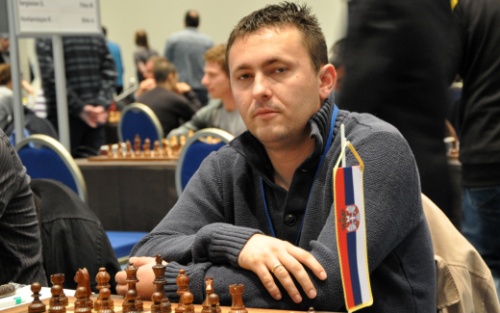
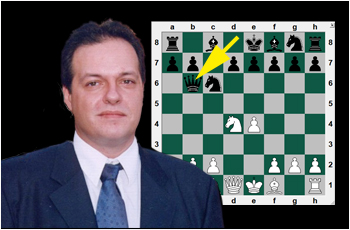
Ivan Ivanisevic, born in 1977, started playing chess when he was 5 years old, while watching his grandfather and father play. At the age of 10 he started working with IM Petar Smederevac, the coach of the national team of former Yugoslavia, who is probably the real reason why he started playing professionally. Before he reached the age of 20 years old, he shared 1st place in the Championship of the former Yugoslavia. In 1999 he won the title of Grandmaster. Since 1998 he is a member of the national team, and since 2007 continually playing on the first board. Four times he was the Champion of Serbia. He won many tournaments, from which we remember mostly following: Saint Petersburg 2014, Skopje 2015, sharing 1-5 place in Dubai 2015, Vršac, the Bora Kostić Memorial, 2006, Nova Gorica 2007, Bergamo 2014, Kavala 2007, Podgorica, 2011 becoming the Balkan champion and Kozloduy, the rapid championship of Danube 2012. He was also participant of the World Cup in 2011. This this second book for Thinkers Published, after he co-authored the most acclaimed ‘Taimanov Bible’ from 2017.
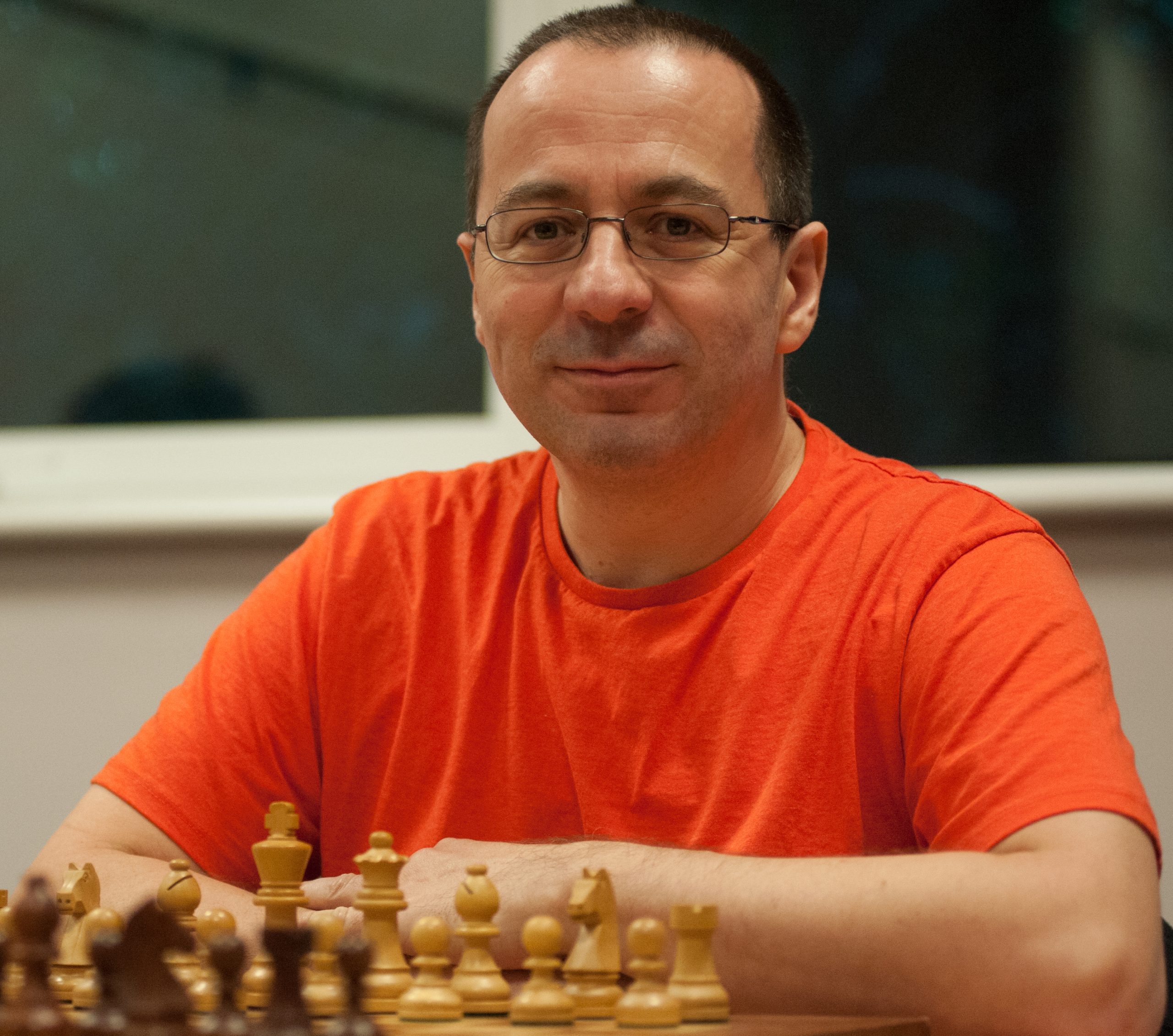
GM Ivan Ivanisevic
From the rear cover :
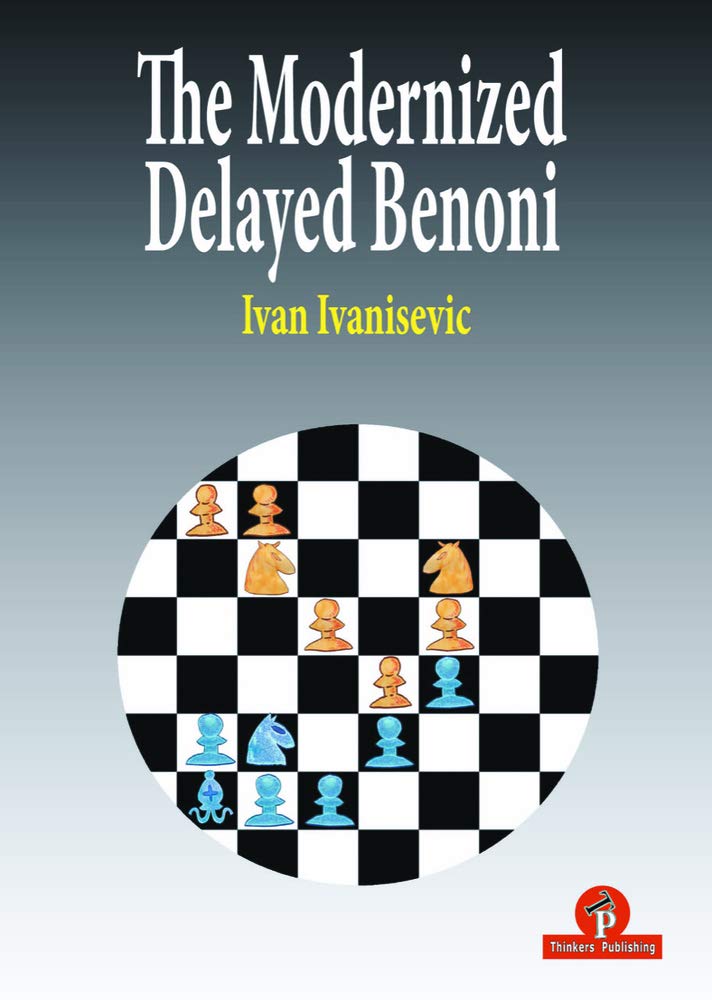
“The Modernized Delayed Benoni is much more than the title makes you think! I like the author’s approach very much: it is a mixture of a personal journey and a theoretical manual. The author has been probably the main exponent of this line for the past ten years and he uses many of his games to illustrate the variations he has recommended. Although the book is again extremely detailed, there is careful attention to move orders and enough passages of explanations to make much of it understandable for non-experts. An excellent effort. GM Matthew Sadler, NIC Magazine 2020/4.
My aim in this book is to show that the Delayed Benoni is equally as attractive as its cousin, the Modern Benoni. For some reason – perhaps because “Modern” sounds more exciting than “Delayed”? – my favorite Benoni has been neglected for years, receiving scant coverage in chess publications.”
As with every recent Thinkers Publishing publication high quality paper is used and the printing is clear. The book can easily be laid flat next to the board and does not require weights to prevent it from “self-closing” (a particular bugbear of ours !). Each diagram is clear and the instructional text is typeset in two column format, which, we find, enables the reader to maintain their place easily. Figurine algebraic notation is used throughout and the diagrams are placed adjacent to the relevant text and each diagram has a “to move” indicator.
There is no index which, unfortunately, is a standard omission of Thinkers Publishing books. Also missing is a bibliography.
The Modernized Delayed Benoni is written by Grandmaster Ivan Ivanisevic, with an important contribution by GM Ivan Sokolov. It is an excellent 240 page book, produced by Thinkers Publishing.
There is a lot of detailed analysis here, complimented by plenty of relevant text. The book revives a system in the Benoni which has not been given the respect it deserves over the years.
This is not a beginner’s manual and strong players will get the most out of it.
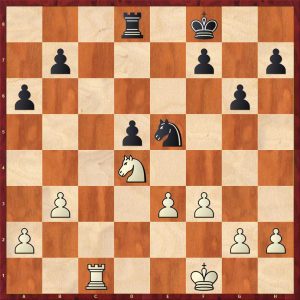
The book focuses on the move order 1 d4 Nf6 2 c4 c5 3 d5 g6!
as a way of getting to positions which are dynamic, relatively unexplored and suitable for playing for the win as Black.
Let’s take a look at some of these ideas…
Having digested a lot of this book, I’ve been trying the Black system online. Virtually all strong players meet it in the same way :
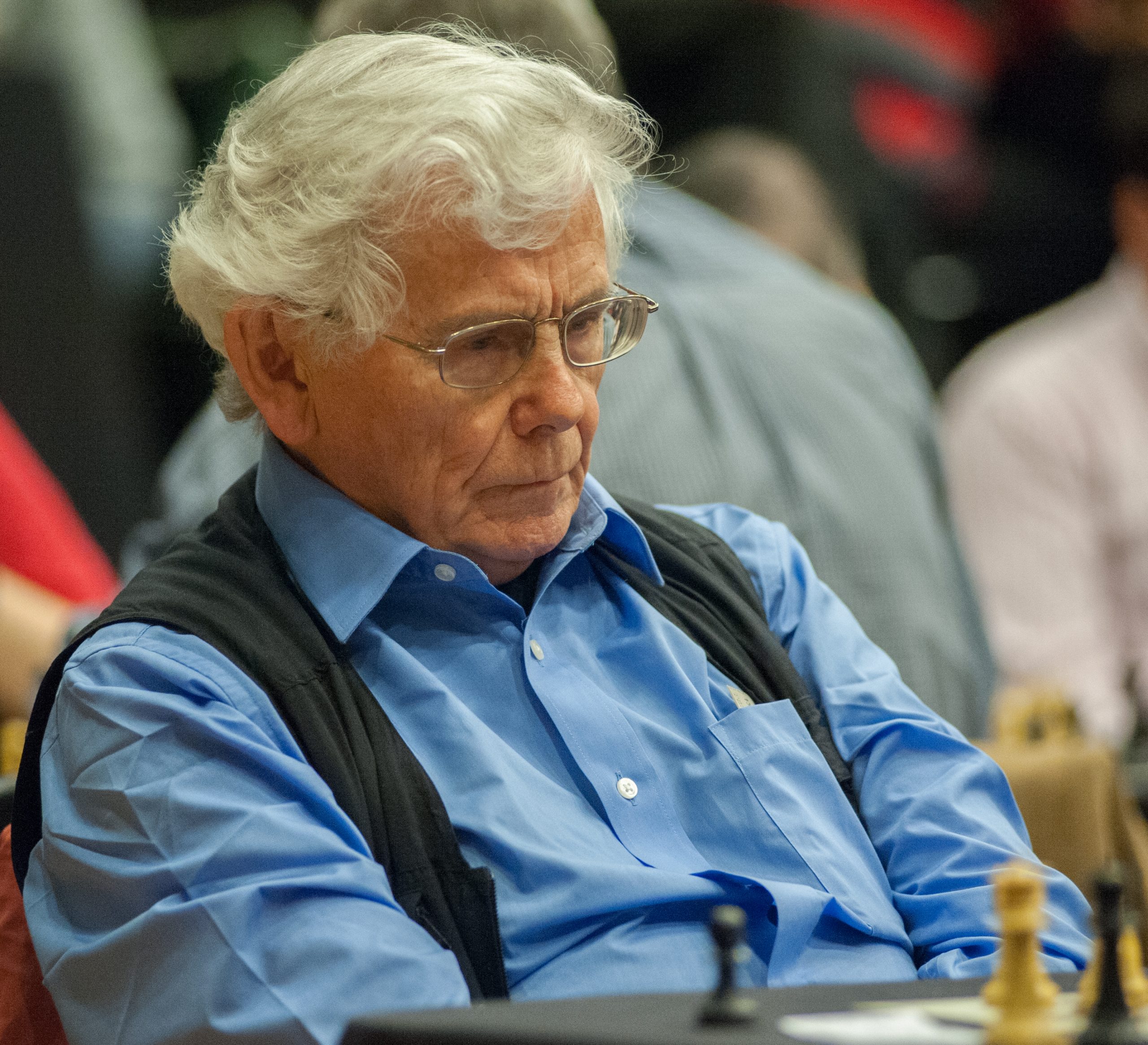
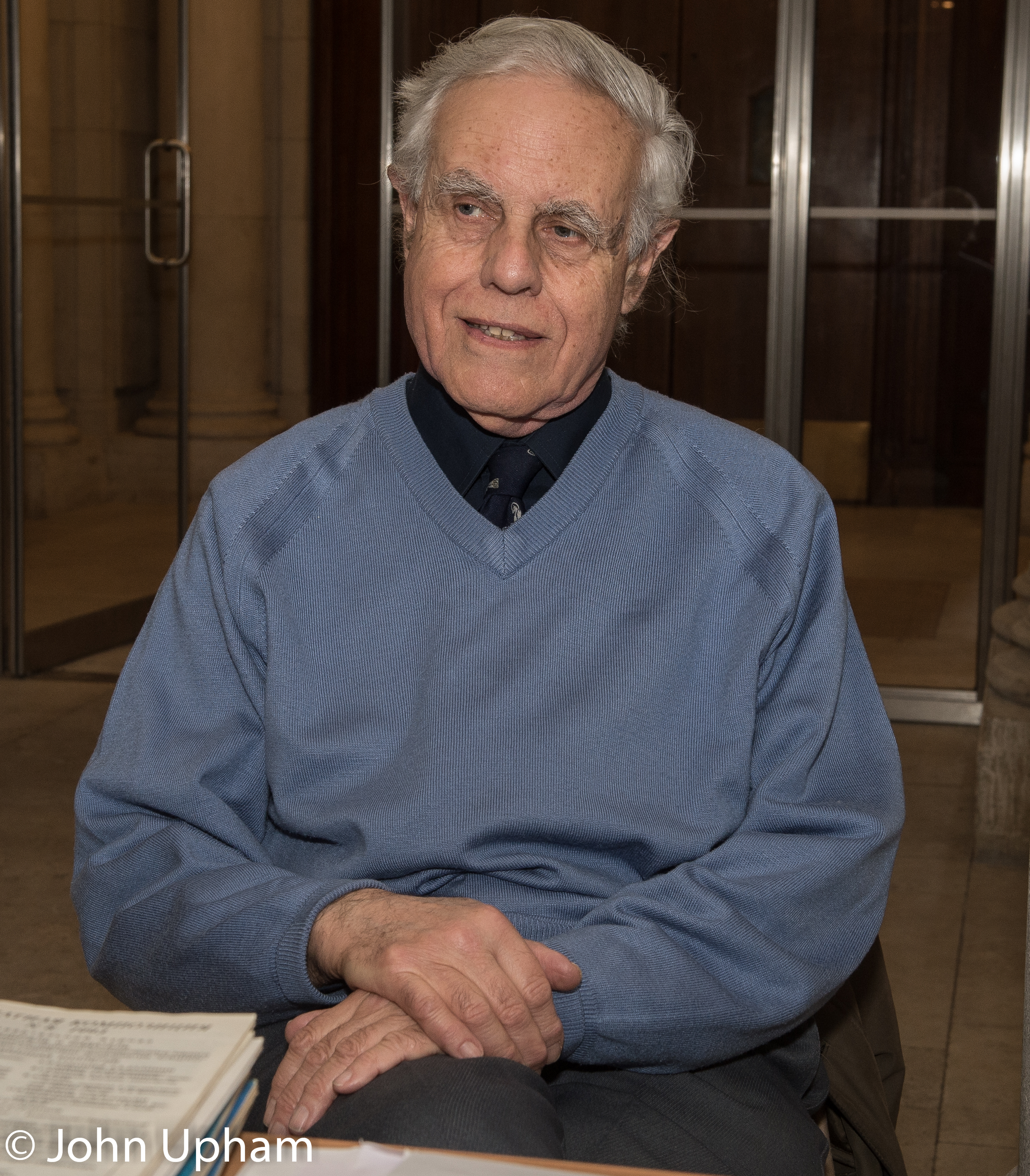
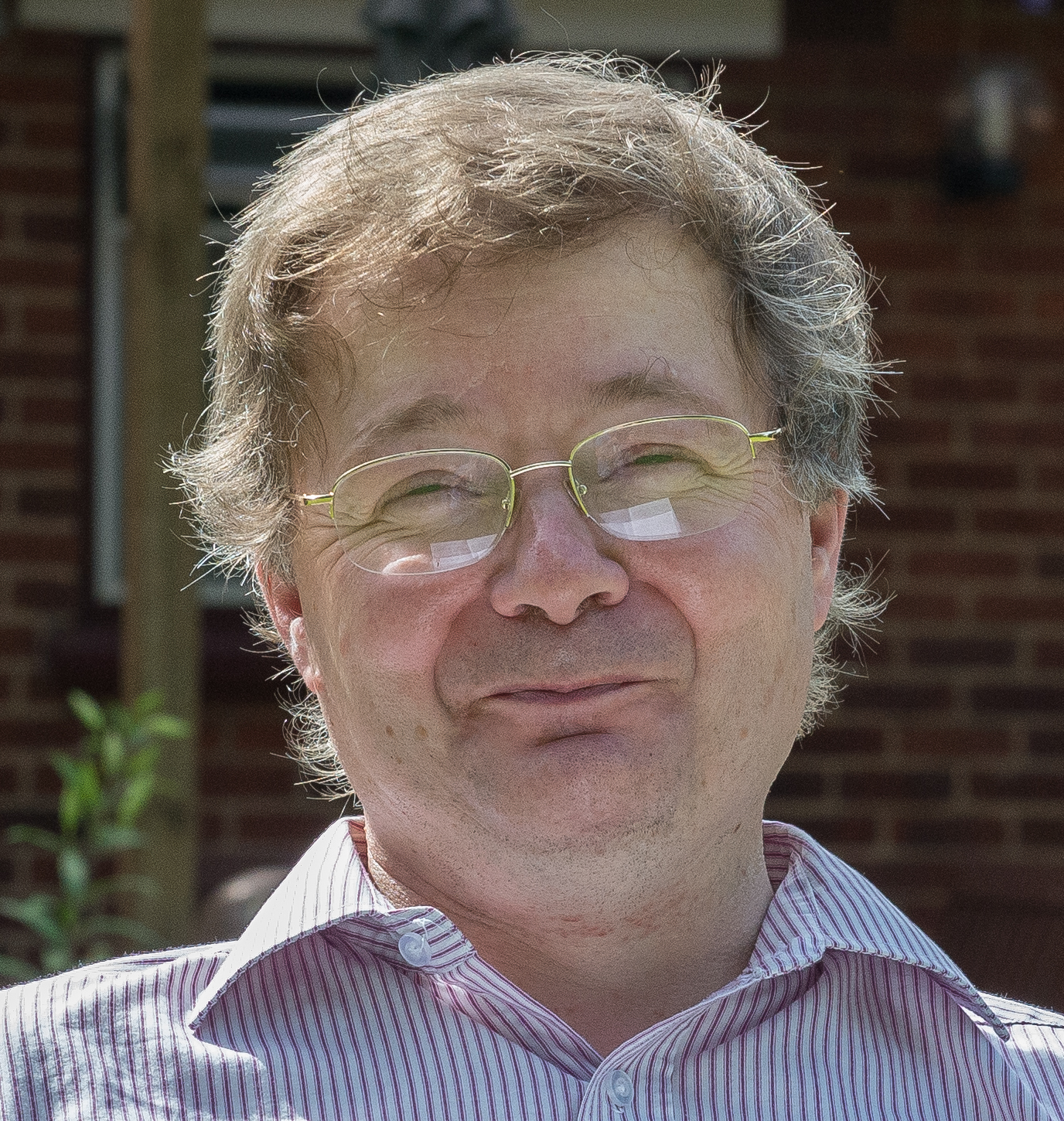
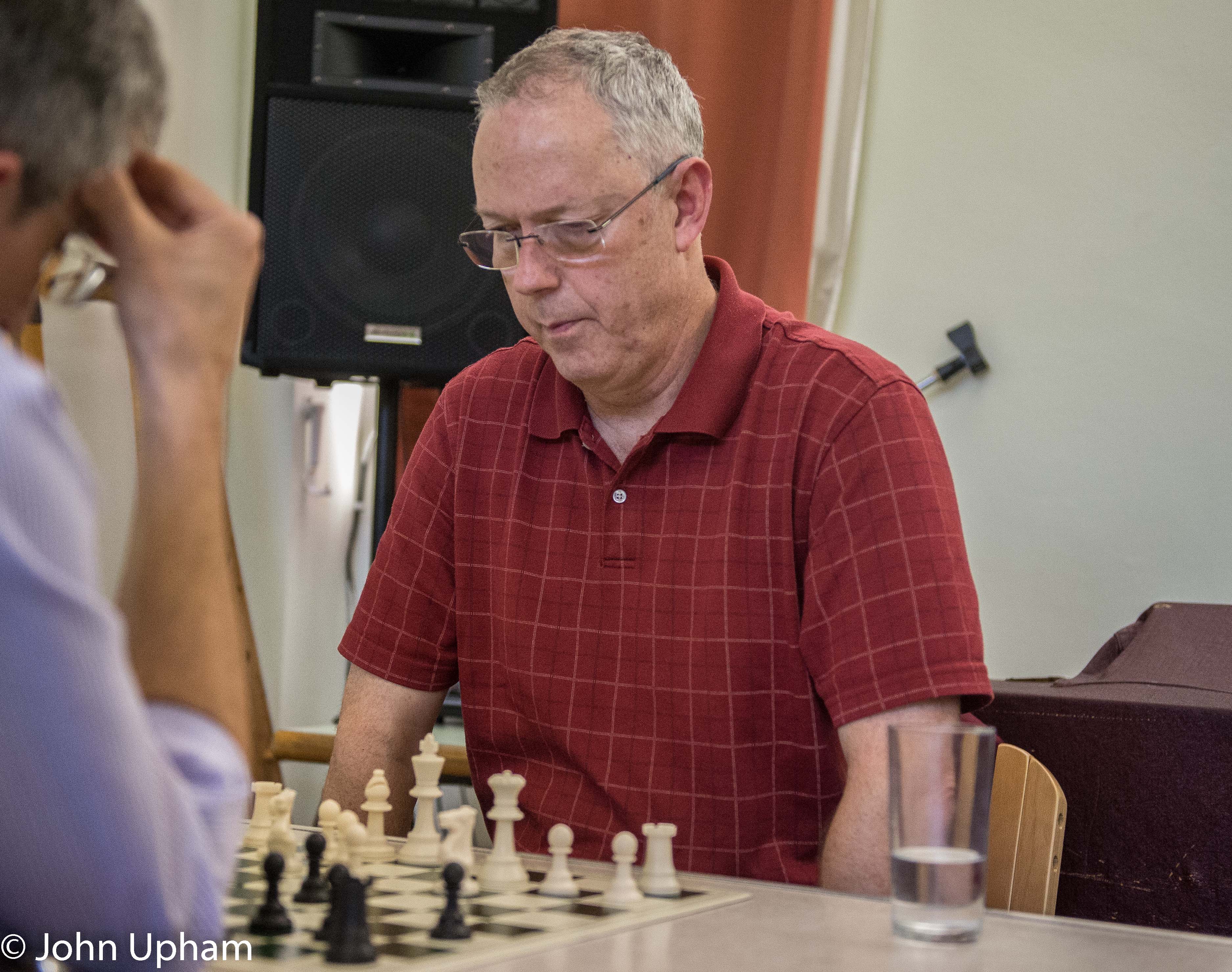
Prof. Julian Farrand at the King’s Place Rapidplay, 2013, courtesy of John Upham Photography
BCN mourns the passing of Dr. Julian Farrand (13-viii-1935 17-vii-2020). He was 84 years of age.
Julian Thomas Farrand was born August 13th, 1935 in Doncaster in the West Riding of Yorkshire.
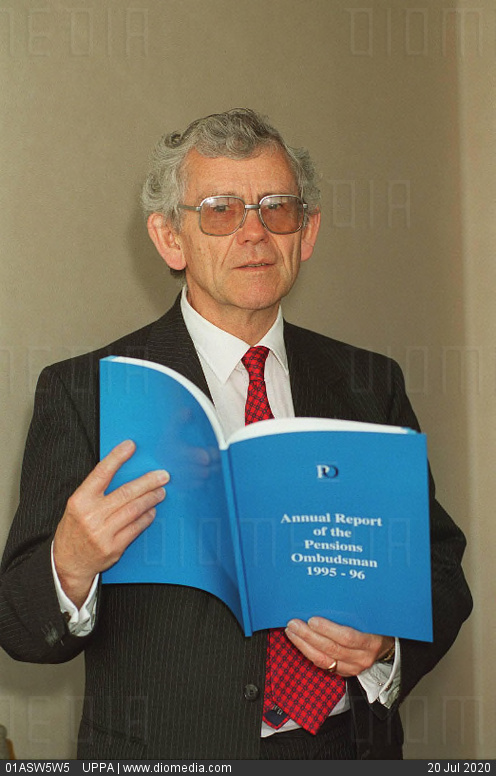
Dr. Farrand QC(Hon), formerly the Insurance Ombudsman, became the Pensions Ombudsman, and he had been a Law Commissioner and a University Professor of Law at the University of Manchester where he was Dean of the faculty.
His first recorded game in Megabase 2020 was white at the 1968 British Championships in Bristol against life-long friend CGM Keith Bevan Richardson. Together with Raymond Brunton Edwards, Julian and Keith were long-time trustees of the BCFs Permanent Invested Fund (PIF).
Julian played for Pimlico, Cavendish and Insurance in the London League and he maintained a standard play grading of 172A in 2020 as well as a FIDE rating of 1943 for standard play. He also played in the London Public Services League, the Central London League and the City Chess Association League. He made regular appearances in the Bronowski Trophy competition and the World Senior’s Team Tournament.
His (according to Megabase 2020) peak Elo rating was 2238 in April, 2004 aged 69. It is likely to have been higher than that if it was measured.
Julian joined Barbican following its merger with Perception Youth to become Barbican Youth in the Four Nations Chess League (4NCL).
His favourite openings with white were : The Richter-Veresov Opening in later years and the English/Barcza Opening in earlier times.
With Black he enjoyed the Czech System and the Lenningrad Dutch.
His son, Tom, is a strong player and a successful barrister with expertise in Intellectual Property Rights, Trademarks and Copyright law.
His wife (married in 1992), Baroness Hale of Richmond, served as President of the Supreme Court of the United Kingdom from 2017 to 2020, and serves as a member of the House of Lords as a Lord Temporal.
Julian Farrand with Lady Hale at a Buckingham Palace reception. Photo : Press Association
Memorial messages have been posted on the English Chess Forum and many will, no doubt, follow. Included are older games from John Saunders not found in the online databases.
In 2015 Julian (together with fellow trustees Keith Richardson and Ray Edwards) received the ECF President’s Award for services to the Permanent Invested Fund.
Here is the citation from the 2015 award :
“Julian is best known as the first-ever English ombudsman (in insurance). He is the husband of law lord Baroness Hale. I (SR) first met him at about the age of 12 year old when playing for my school. He is about four years older. Both Ray and Julian are members of the Book of the Year Committee and have been reviewing books for this purpose for many years. Both are quite strong chess players, indeed playing for England in the same team in the European 60+ Team Championship in Vienna 11-20 July 2015. Keith was to have been a member of the same team, but his wife’s ill-health forced him to withdraw.”
Your Jungle Guide to Rook Endings : Efstratios Grivas
“After a bad opening, there is hope for the middle game. After a bad middle game, there is hope for the endgame. But once you are in the endgame, the moment of truth has arrived.” – Edmar Mednis
GM Efstratios Grivas
“Efstratios Grivas (30.03.1966) is a highly experienced chess trainer and chess author. He has been awarded by the International Chess Federation (FIDE) the titles of International Chess Grandmaster, FIDE Senior Trainer, International Chess Arbiter and International Chess Organiser.
His main successes over the board are the Silver Medal Olympiad 1998 (3rd Board), the Gold Medal European Team Championship 1989 (3rd Board) and the 4th Position World Junior Championship U.20 1985. He has also won 5 Balkan Medals (2 Gold – 1 Silver – 2 Bronze) and he was 3 times Winner of the International ‘Acropolis’ Tournament. He has also in his credit the 28 times first position in Greek Individual & Team Championships and he has won various international tournaments as well. He has been awarded five FIDE Medals in the Annual FIDE Awards (Winner of the FIDE Boleslavsky Medal 2009 & 2015 (best author) – Winner of the FIDE Euwe Medal 2011 & 2012 (best junior trainer) – Winner of the FIDE Razuvaev Medal 2014 (Trainers’ education) and has been a professional Lecturer at FIDE Seminars for Training & Certifying Trainers.
He has written more than 100 Books in Arabic, English, Greek, Italian, Spanish & Turkish. Since 2009 he is the Secretary of the FIDE Trainers’ Commission and since 2012 the Director of the FIDE Grivas Chess International Academy (Athens).”
From the rear cover :
“To learn and to play endgames well the chess player must love endgames’ – Lev Psakhis. Different kinds of endgames have specific characteristics and rules. Every serious player must know many typical positions and main principles of all types of endings. That knowledge should help us during the game, but it is not enough to become a good player, not yet. There just too many different endings, some of them with two or more pieces, some are very complex. To be comfortable and play well those complex endings require specific knowledge and specific ways of thinking. We will call it ‘endgame thinking’.
I chose to write a book on advanced rook endings as I simply did not wish to write another book that would be like the many already available. I have done my best to present analysis and articles I have written over the past 10-15 years. Th is work has been presented in my daily coaching sessions, seminars, workshops, etc. The material has helped a lot of trainees to develop into quite strong players gaining international titles and championships. Now, it is your turn to taste and enjoy it!”
As with every recent Thinkers Publishing publication high quality paper is used and the printing is clear. The book can easily be laid flat next to the board and does not require weights to prevent it from “self-closing” (a particular bugbear of ours !). Each diagram is clear and the instructional text is typeset in two column format, which, we find, enables the reader to maintain their place easily. Figurine algebraic notation is used throughout and the diagrams are placed adjacent to the relevant text and each diagram has a “to move” indicator.
This is a superb book packed full of instructive examples which I cannot praise enough. The book has clearly been extensively researched with Efstratios Grivas showcasing his credentials as a world class trainer.
The book starts off with four well thought out introductory sections: 1. The Endgame which briefly discusses the historical literature and computer evolution of the endgames. In this section, the author introduces his useful boxed SOS Tips which remind the reader of the salient points of a particular lesson or section.
2. The Golden Rules Of the Endgame which every player should know. I like the way that Grivas acknowledges other authors’ contributions to the evolution of our endgame understanding and this is clearly shown here and in Chapter 4 Extra Passed Pawn.
3. Rook Endgame Principles which lists the five main rules of rook endgames which is particularly useful for less experienced players.
4.Evaluation – Plan – Execution which discusses the role of planning followed by an excellent seven point SOS tip box.
Now we come to the meat of the book which is divided into nine chapters:
Chapter 1 – basic knowledge which covers the Lucena, Philidor and Vancura positions and their offshoots. If you only read one chapter of any book on rook endgames, I suggest this one.
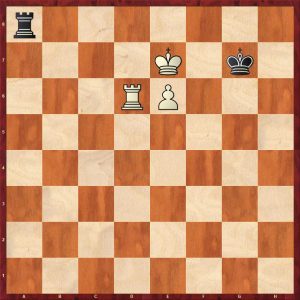
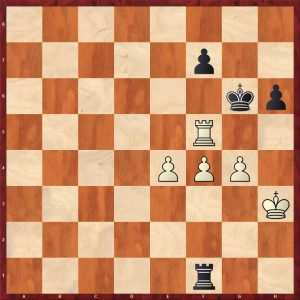
Diagram 13 shows that even a future current world champion can blunder in a basic position:
Levon Aronian v Magnus Carlsen
This is a drawn ending as black’s king is on the short side and his rook has sufficient checking distance.
Aronian’s last move was the cunning waiting move 73.Rd7-d6!
The only drawing move here is 73… Kg6! for example, if 74.Rd7 Kg7 75.Kd6+ Kf6 76. e7 Kf7=
Carlsen replied with the “obvious” check 73… Ra7+ and resigned instantly after 74. Ke8. He resigned because of 74… Ra8+ 75.Rd8 Ra6 76.e7
The reviewer can say that he knew this trap from Levenfish & Smyslov and admits to feeling slightly smug!
Chapter 2 is entitled Extraordinary endings and covers three interesting and diverse areas:
Rook and A + H pawns v Rook
Rook vs 3 connected pawns
2 Rooks v R + 3 connected pawns
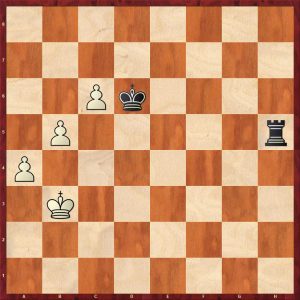
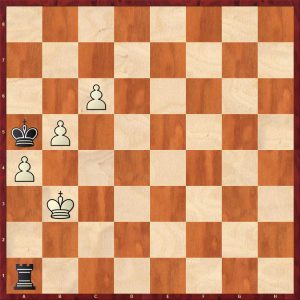
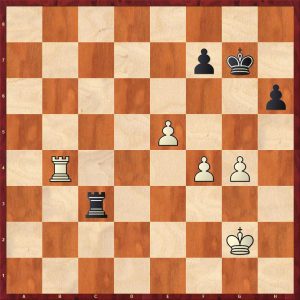
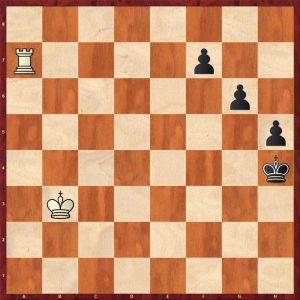
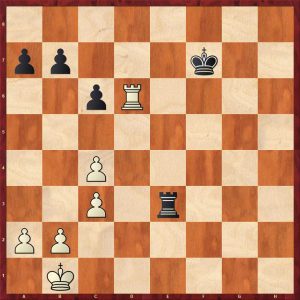
My preference would have been to restructure this chapter as Rook v Pawns and put the other two sections into later separate chapters. Nevertheless all the material is extremely useful. The ending of Rook v 3 pawns is fairly common and the diagram below shows a typical occurrence:
Colin Crouch – Luke McShane England 1999
This is an “optimal drawn position” (Grivas). White must prevent the rook from getting behind the pawns which wins for black.
White played 68.Kb4? which loses, keeping the king on the second or third rank was fine. 68… Rh4+? (68…Rh3 or Rh1 wins) 69. Kb3 Kc5 70. Ka3! Kb6 71. Kb3 Kc5 72. Ka3! Rh3+ 73. Kb2 Kb6 74. Ka2! (only move) Ka5 75. Kb2 Rg3 76. Kc2? (76.Ka2! Kc4 77.c7 Ra3+ 78.Kb2 Rb3+ 79.Ka2 with a perpetual check) Rg4? (76…Kb4 wins 77.Kd2 Rg8! 78.Kd3 Kxa4 79. Kc4 Ka5 8-.Kc5 Rg5+ wins) 77. Kb3 Rb4+ 78. Kc3! Rb1 79. Kc2 Rf1 80. Kb3? (80.Kb2 draws) Ra1! winning
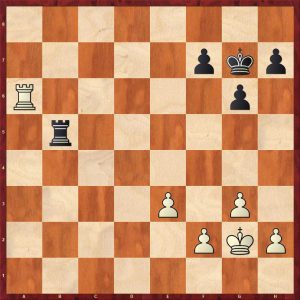
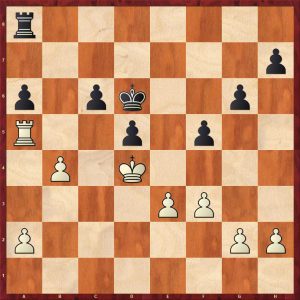
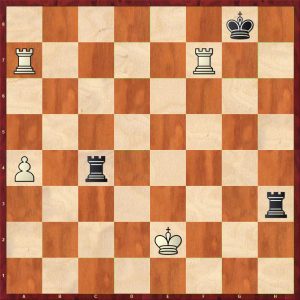
Chapter 3 Same Side is one of the core chapters which deals with pawn up positions when all the pawns are on one side. These positions occur very frequently and are sometimes misplayed by world class players. I like the way the author systematically discusses the different structures with drawing and winning mechanisms and then shows pertintent examples from real games. Diagram 51 discusses the famous endgame Capablanca – Yates Hastings 1930 in great depth which shows that even the great Cuban player made several mistakes after achieving a winning game from a drawn 4 v 3 endgame shown below. A quick flavour of the coverage is given below.
Capablanca – Yates Hastings 1930
The game continued 38…Rb4, 39.Ra5 Rc4 (39…h5! is the standard move to ease the defence.) 40.g4! squeezing, but black can still hold 40… h6 41. Kg3 Rc1 42. Kg2 Rc4 43. Rd5 Ra4 44. f4 Ra2+ 45. Kg3 Re2 46.Re5 Re1 47. Kf2 Rh1 48. Kg2 Re1 49. h4 Kf6?! (49…f6 is more precise reaching a known drawn position) 50.h5 Re2+ 51. Kf3 Re1 Re1 52. Ra5 Kg7 53. hxg6 Kxg6! (53…fxg6? loses 54. Ra7+ Kg8 55. e4 Rf1+ 56.Ke3 Rg1 57.f5! Rxg4 58.f6 winning with two passed pawns) 54. e4 Rf1+ 55.Kg3 Rg1+ 56. Kh3 Rf1 57. Rf5 reaching the diagram below:
Capablanca Yates Hastings 1930
57… Re1? (black must play 57…f6 to draw) 58. e5! Re3+ 59.Kg2! Ra3 60.Rf6+ Kg7 reaching a well lnown won position 61. Rb6? (61.Rd6 wins protecting the king from side checks) Re3? 61…Ra4! leads to a complex draw 62. Rb4? (62. Rb1 still wins but Rb8 does not win) Rc3 reaching the position below:
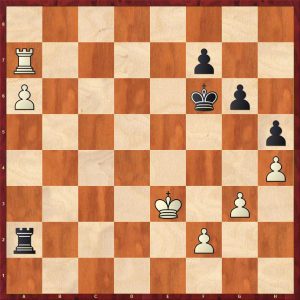
Chpater 4 Extra Passed Pawn is the second core chapter of the book and is easily the longest and most complex chapter. Despite this, detailed study of this section will reap rich rewards. The theory of these endings has evolved significantly since the books by Fine and Levenfish/Smyslov. Diagram 78 shows a typical position with a extra rook’s pawn with the stronger side having the rook in front of the pawn. This position looks to be an easy draw but beware: it is a draw but the position is complex and the drawing lines are complex! One slip and the game slips away.
Bacrot – Robson, Khanty-Mansiysk, 2011
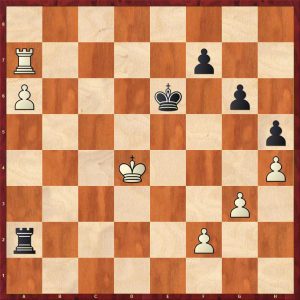
Black played a waiting move which is fatal 59…Ke6? (59…Ra4! or 59…g5! draws) White blundered in turn playing 60.Ra8? ( White could have won with a beautiful and instructive variation starting with 60. Kd4! see diagram below):
Bacrot – Robson, Khanty-Mansiysk, 2011
60…Rxf2 (looks as though it draws, but it does not) 61. Rc7 Ra2 62. a7 Kf5 63. Kc4!! Kg4 64. Kb3! Ra6 65. Rc4+ Kxg3 66. Ra4 Rxa7 67. Rxa7 Kxh4 reaching a key position shown below:
Bacrot – Robson, Khanty-Mansiysk, 2011
White wins with the amazing 68. Kc3!! (68.Rxf7 only draws 68…Kg3 holds) 68…Kg3 (68…f5 69. Kd3 g5 70.Rf7 f4 71.Rf5!! Kg4 72. Ra5 h4 73. Ke2 wins) 69. Kd3 h4 70. Ke2! wins
After 60. Ra8 the game was eventually won by white after many errors by both sides.
Chapter 5 Shattering covers endings where one side has a positional advantage consisting of the better pawn structure. A typical position is diagram 118 which is from the famous game Flohr – Vidmar Nottingham 1936.
Flohr – Vidmar, Nottingham, 1936
Black rather injudiciously exchanged knights with 29…Nc6? 30. Nxc6 Rc8 31. Rc5? (better is 31.Ke2 bxc6 (31…Rxc6 loses the king and pawn ending after 32.Rxc6 bxc6 33.b4!) 32.Rc5) 31…bxc6? (31…Rxc6! 32. Rxd5 Rc2 probably draws) 32. Ke2! Ke7 33.Kd3 Kd6 34. Ra5! Ra8 35. Kd4 f5 36. b4 reaching the position below:
Flohr-Vidmar, Nottingham, 1936
36…Rb8? and Flohr won a brilliant ending. However as Grivas shows, black could have drawn by executing a better plan on move 36 by defending his weak a6 pawn with his king 36…Kc7! 37. Kc5 Kb7 38. Kd6 Re8 39.Ra3 g5! for example 40.Rc3 f4! 41. exf4 gxf4 42. Rxc6 Rd8+ 43. Kc5 d4 44. Re6 d3 45. Re1 Rg8=
Chapter 6 Isolani covers the handling of rook endings playing against isolated central pawns. Diagram 132 covers the game Szabo Penrose from the European Team Championship in Bath 1973.
Szabo – Penrose, Bath, 1973
This is a superbly handled ending by Szabo who probes carefully and forces resignation within twenty moves – a textbook example with excellent notes by the author.
Chapter 7 Drawn Endings covers the reasons for losing drawn positions which happens to very strong players. An excellent example is diagram 140.
Topalov-Gelfand, Linares, 2010
It is hard to believe that a world class player of Gelfand’s standard could lose such a position but Grivas shows how with his usual exemplary commentary.
Chapter 8 Four Rooks is one of the chapters that makes this book stand out – few authors have covered this topic in any depth although Fine in BCE does give some examples. Grivas starts the chapter with five sets of educational SOS tips which the reviewer really likes. Diagram 143 shows a example of good defence in a position that looks diffcult with black’s king trapped on the back rank:
Miljanic – Grivas, 1983
The author conducts an almost flawless defence to hold this difficult position – buy the book to find out how.
The final chapter 9 Various Concepts discusses Lasker’s steps, trapped rooks and the Loman move. If you don’t know about Lasker’s steps or the Loman move – buy the book to learn more!
FM Richard Webb, Chineham, Hampshire, 20th July 2020
FM Richard Webb
Book Details :
Paperback : 400 pages
Publisher: Thinkers Publishing; 01 edition (19 May 2020)
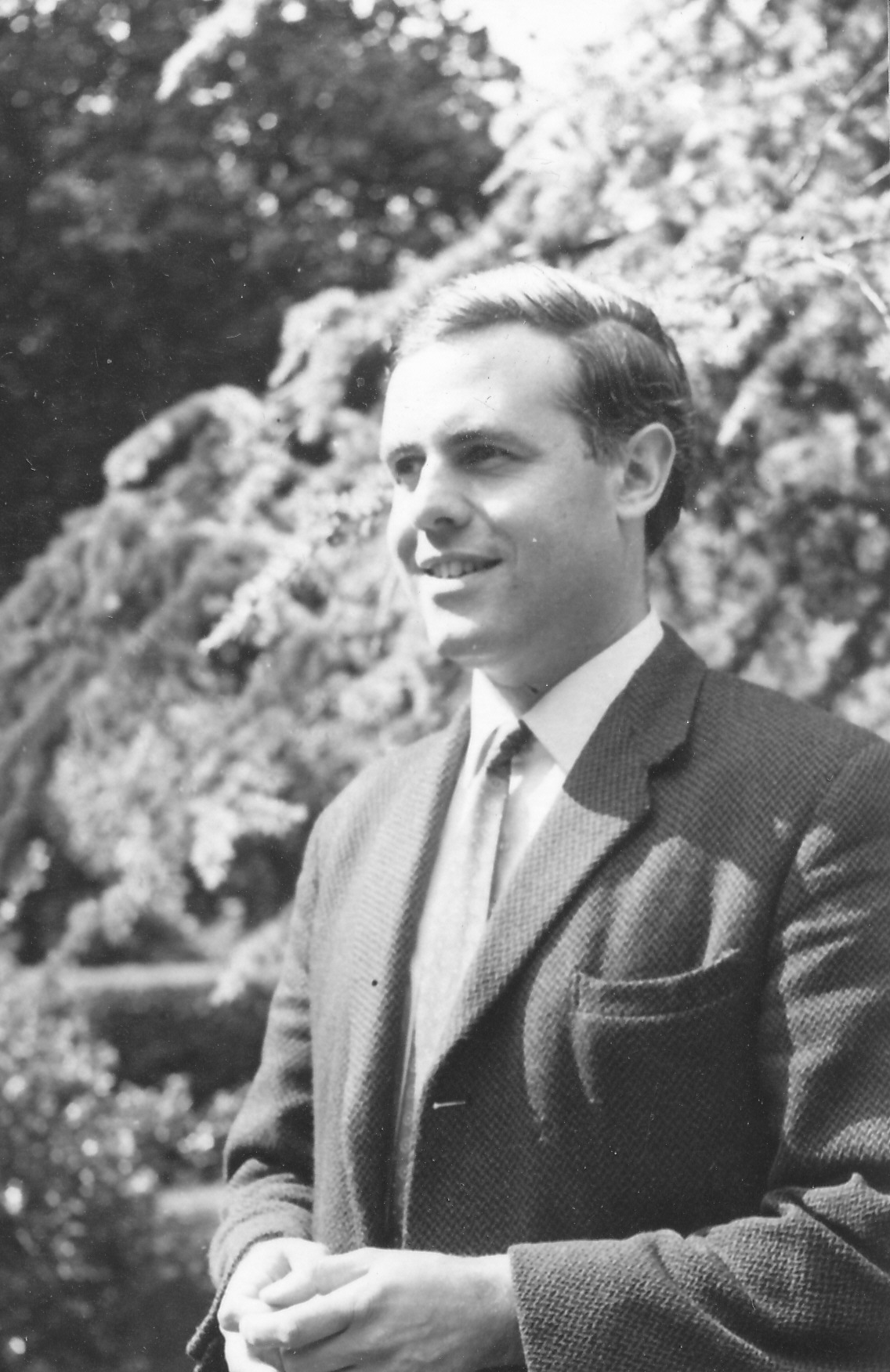
BCN sends best wishes to John Rice on his birthday, July 19th in 1937.
John Michael Rice was born in Scarborough, Yorkshire, North Riding, his mother’s maiden name was Blake. John lives in Surbiton, Surrey and teaches Modern Languages at Tiffin School, Kingston-Upon-Thames.
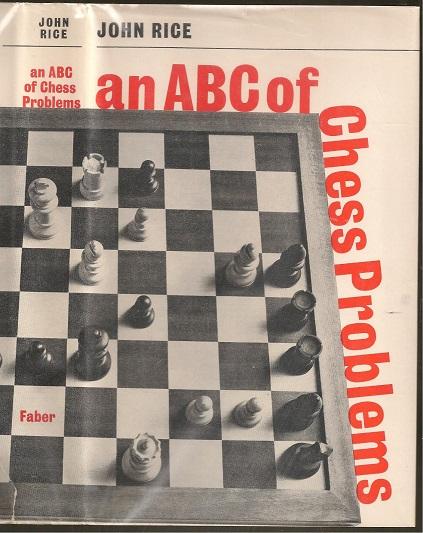
An ABC of Chess Problems
From An ABC of Chess Problems :
“The author is one of the country’s most prolific foremost composers and problem critics. He has gained mainly tourney honours, both at home and abroad, and since 1961 has been editor of a flourishing problem section in the British Chess Magazine, the country’s leading chess periodical. He lives in London and teaches Modern Languages at Tiffin School, Kingston-Upon-Thames.”
From chesscomposers.blogspot.com :
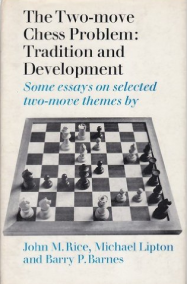
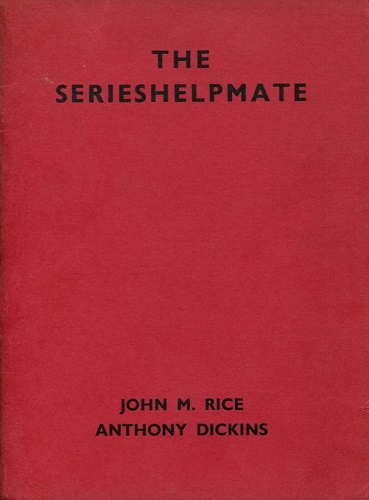
John Rice was the chief editor of the problems section of the “British Chess Magazine” from 1961 until 1974 and is a faithful collaborator of “The Problemist“. He has written “Chess Problem: Introduction to an Art” (1963) together with Robin Matthews and Michael Lipton and “The Two-Move Chess Problem” (1966), “Serieshelpmates” (1978) with Anthony Dickins or “Chess Wizardry: The New ABC of Chess Problems” (1996).
Translated from https://peoplepill.com/people/john-michael-rice/ :
“Since the mid-fifties he has composed problems of all kinds, but above all in two moves. In the 1960s he was editor of the problems section of the British Chess Magazine. Since 1999 he has been editor of The Problemist magazine.
International Master of Composition since 1969 and International Judge for Composition since 1972.
President of the PCCC (Permanent Commission for Chess Composition) from 2002 to 2006.
He worked as a teacher of modern languages in a school in Kingston-upon-Thames.
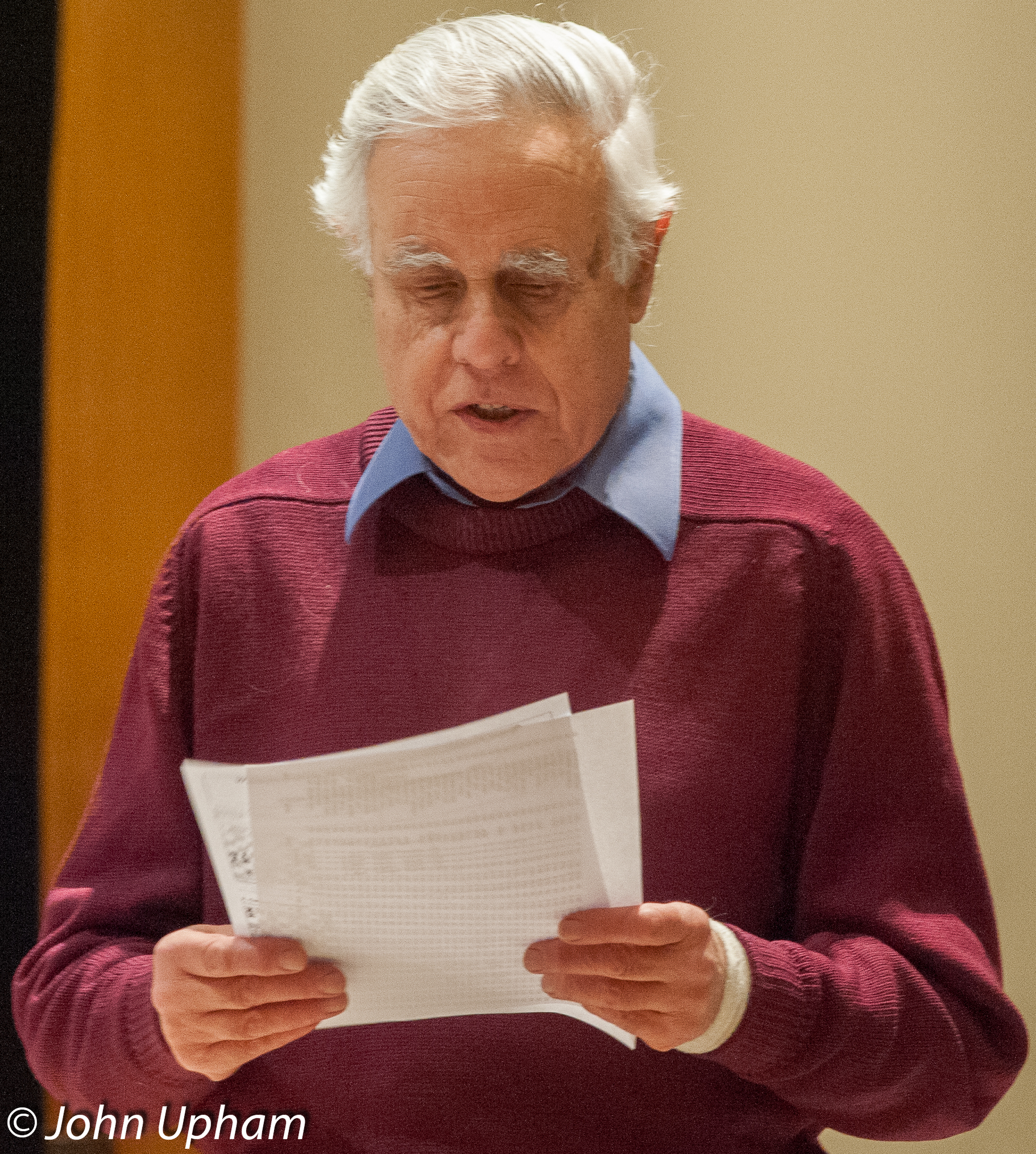
Winton Capital British Chess Problem Solving Championships 2016
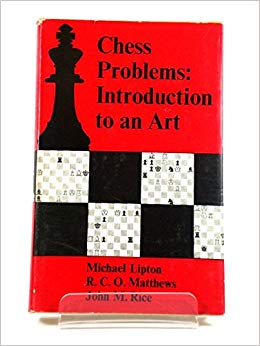
Together with Barry Barnes and Michael Lipton he wrote the book Chess Problems: Introduction to an Art (Faber & Faber, London 1963).
Chess Problems : Introduction to an Art
He composes mostly direct mates, but can composes as well in other genres, including fairies. He is an International Judge for twomovers, helpmates and fairy problems and the former President of the PCCC from 2004 until 2006.
John was awarded the title of “International Grandmaster for chess compositions” in 2015.
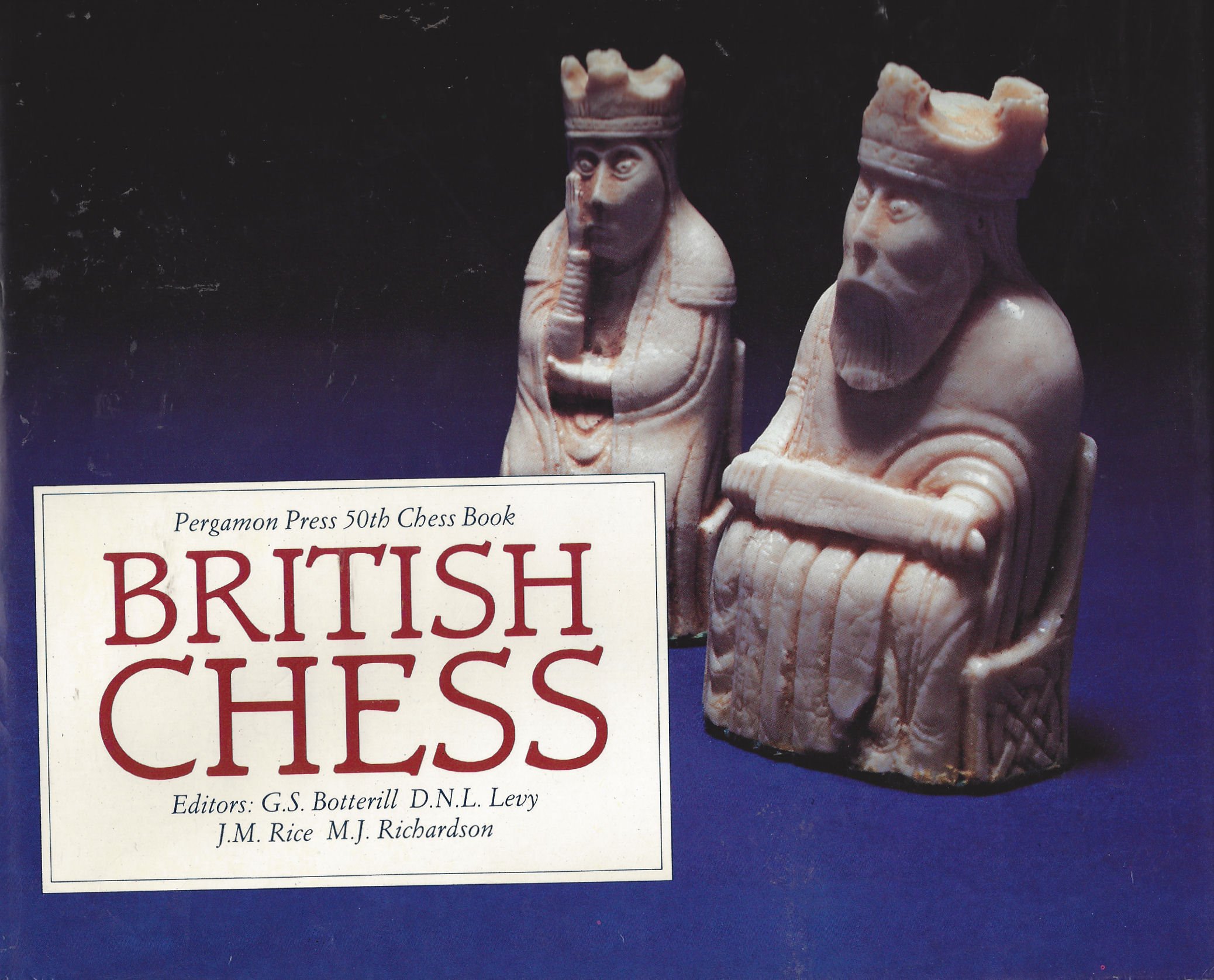
From British Chess, Pergamon Press, 1983 by GS Botterill, DNL Levy, JM Rice and MJ Richardson :
“I was taught the moves of chess in 1947 at the age of ten and quickly realised that I liked the game no more than Ludo or Snakes and Ladders where the chances of losing seemed to me unfairly high. But the chess pieces and their moves fascinated me, so it is hardly surprising that before long I had turned to problems and become an ardent fan of Brian Harley in his Observer column, especially as I had come across and paid two shillings (!) for his Mate in Two Moves in a second-hand bookshop in Reigate. Harley, together with T. R. Dawson in the British Chess Magazine and C. S. Kipping in CHESS, provided the sources of my first solving pleasure and the inspiration for my first efforts at composition. Among my early successes was problem l, heavily constructed but strategically rich, a first prize winner in a tournament for composers under 21, one of a series organised by the British Chess Problem Society.
I had grown up in Scarborough (Yorkshire), out of contact with other problem enthusiasts, and a chance meeting in December, 1954 with Michael Lipton in Cambridge, where we were both taking Scholarship examinations, brought the realisation that there was far more to the two-move chess problem than the solidly entrenched traditionalism espoused in those days by the columns of The Problemist and CHESS. Very soon the bulk of my output was in the modern style (with set and try-play) and published abroad, notably in Die Schwalbe, whose two-move editor, Hermann Albrecht, did much to stimulate my interest. Problem 2 gained a coveted prize in an extremely strong formal tournament judged by Michael
Lipton, following an article of his on the potentialities of the half-battery theme (illustrated here by the arrangement on the c-file).
2
5th prize, 133rd Theme Tournament, Die Schwalbe, 1961.
The half-battery is only one of several themes which have commanded my attention over the past 20 years, others being white self-pin in try and key (illustrated by problem 3), Grimshaw and Nowotny (problem 4), reciprocal and cyclic play (problem V, the first published example of cyclic mates in three phases), pawn-promotion effects, and tasks of various types, especially open gates. My total problem output numbers about 600.
3
The Tablet, Commended, BCPS Ring Tournament 1958; Brian Harley Award
In 1961 I took over from S. Sedgwick the editorship of the problem section of the British Chess Magazine, which post I held until December, 1974. It was a source of pride to me that I was now doing the job once done by the great T. R Dawson, though I knew that I could never bring to it the same tireless energy and all-round expertise which he had displayed so impressively. At about the same time I embarked with Michael Lipton and Robin Matthews on a venture which was to have repercussions throughout the entire problem world,
namely a series of books on problems published by Faber and Faber. The first, Chess Problems: Introduction to an Art (Lipton, Matthews and Rice), appeared in 1963, and was followed three years later by The Two-move Chess Problem: Tradition and Development, also with Michael Lipton, but this time the third collaborator was Barry Barnes, who has long been a close friend and influence. The third book in the series, An ABC of Chess Problems (1970), was a solo effort.
My interest in Fairy Chess dates from a meeting in the mid-1960s with the late John Driver, whose enthusiasm for the pleasures to be derived from non-orthodox forms I found highly infectious. Fairy problems soon began to appear in the BCM column and were favourably received. The serieshelpmate, where White remains stationary while Black plays a sequence of moves to reach a position where White can mate in one, has perhaps interested me more than any other non-orthodox form (see problem Vl), and in 1971 I collaborated with Anthony Dickins to produce a book on the subject, The Serieshelpmate (published by the Q Press, first edition 1971, second edition 1978).
5
1st Prize, Problem 37th Theme Tournament, 1961-62
White mates in 2
Set: 1…Kc6; 2. Qe8 (A)
1…Ke6; 2. Qc8 (B)
Try: 1.Nb6+?, Kc6;2.Qc8 (B)
Ke6;2.Qd6 (C)
Ke7!
Key : 1.Nf6+! Kc6;2.Qd6 (C)
Ke6;2.Qe8 (A)
Since 1974 my problem activities have necessarily been restricted by the demands of family life (wife and two sons, none of them much interested in chess) and my career (schoolmaster, formerly Head of Modern Languages Department and now Director of Studies at Tiffin School, Kingston Upon Thames. Other leisure-time interests (not that there is much leisure time) include cricket and classical music.”
From The Encyclopaedia of Chess (Batsford, 1977), Harry Golombek OBE, John Rice write about himself:
“British problem composer, output about 500, mainly modern-style two-movers but also several helpmates, serieshelpmates and fairy problems. Editing: problem section of British Chess Magazine (1961-1974). Author of An ABC of Chess Problems(1970), and co-author of Chess Problems: Introduction to an Art (1963), The Two-move Chess Problem: Tradition and Development (1966) and The Serieshelpmate (1971). International master (1969): International Judge (1972).”
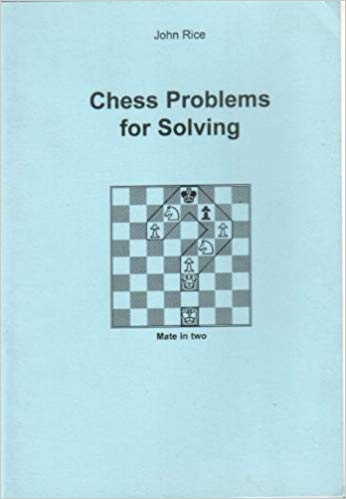
The Two Move Chess Problem : Tradition and DevelopmentJohn Rice at a Winton Capital BCPS Problem Solving event at Eton CollegeChess Problems for SolvingThe SerieshelpmateBritish Chess, Pergamon Press, 1983. Editors : GS Botterill, DNL Levy, JM Rice and MJ Richardson
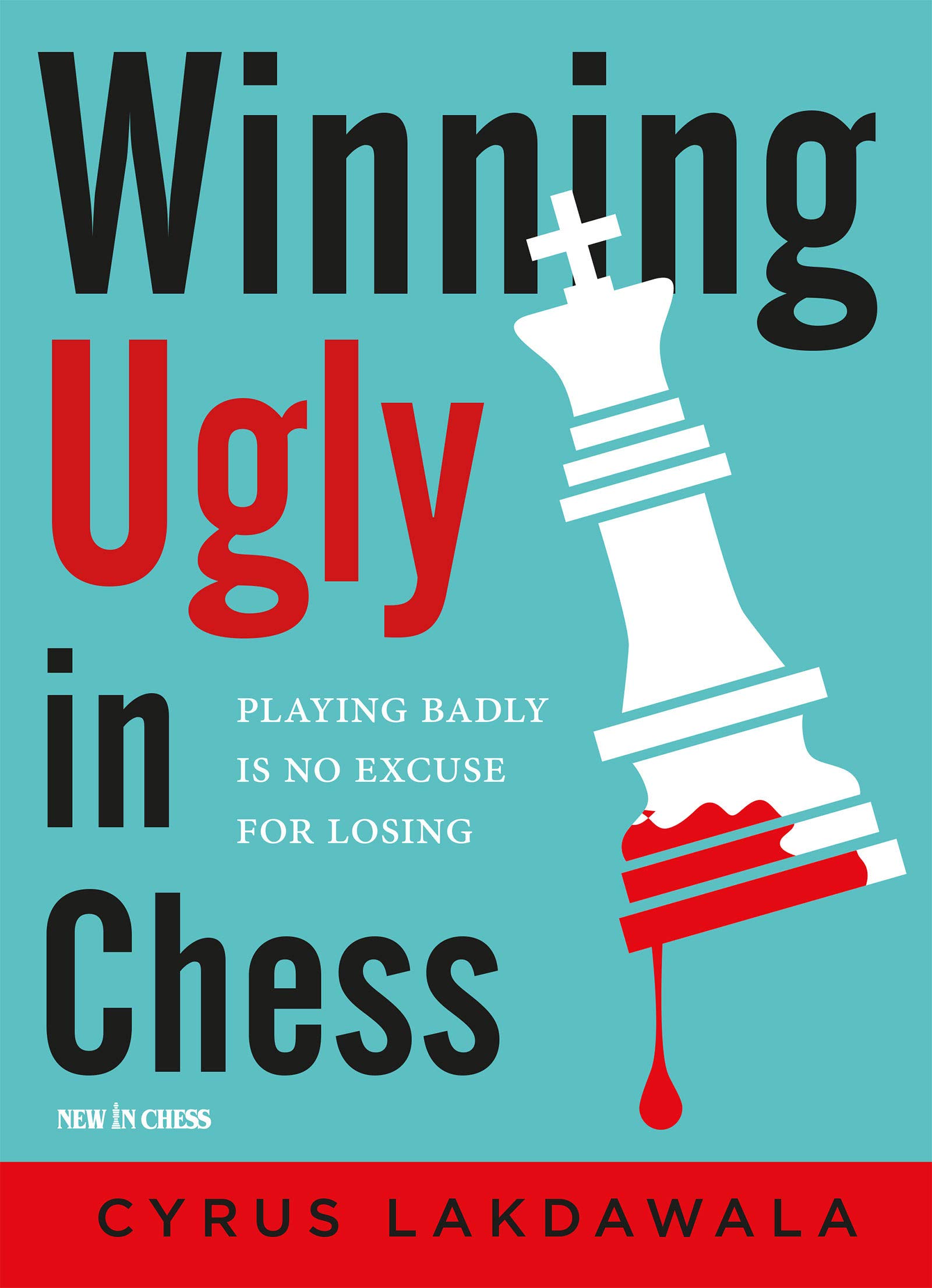
Winning Ugly in Chess: Playing Badly is No Excuse for Losing Paperback
Cyrus Lakdawala is a former American Open Champion. He has been teaching chess for four decades and is a prolific and widely read author. His ‘Chess for Hawks’ won the Best Instructional Book Award of the Chess Journalists of America (CJA). Other much acclaimed books include ‘How Ulf Beats Black’, a study of Swede Ulf Andersson, and ‘Clinch It! How to Convert an Advantage into a Win‘. He has become one of the most controversial writers around today!
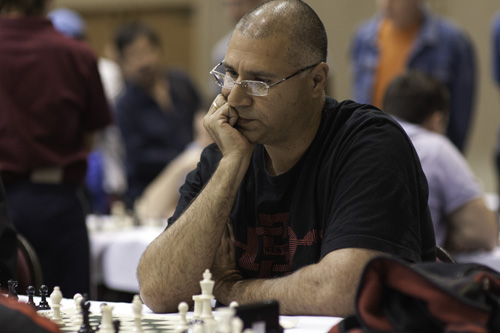
IM Cyrus Lakdawala
From the cover : Welcome to the world of imperfection! Chess books usually feature superbly played games. In this book you will see games where weird moves are rewarded. Cyrus Lakdawala knows that playing good chess is all very well, but that beating your opponent is better. A paradox? He demonstrates the fine art of winning undeserved victories by: miraculously surviving chaos; throwing vile cheapos; refusing to resign in lost positions; getting lucky breaks; provoking unforced errors, and other ways to land on your feet after a roller-coaster ride. Lakdawala shows how you can make sure that it is your opponent, not you, who makes the last blunder. If you’d rather win a bad game than lose a good one, then this your ideal guide. The next time the wrong player wins, you will be that player!”
We have an Index of openings (rich in Sicilians and King’s Indians), an Index of Players, 10 chapters and 336 pages. Many games from all eras from Anderssen to recent Swisses. Subtitled ‘Playing badly is No Excuse for Losing’. Paperback, no use of Rabar codes, no photos but exercises scattered throughout. This exceptional book is offered for sale at the Chess & Bridge Shop in Baker Street for £20.95. Good value!
So, enquires the author, when was the last time you won a perfect game? A game that wasn’t tainted by inferior moves?
Every player knows that smooth wins are the exception and that play is often chaotic and positions are frequently irrational. The road to victory is generally full of bumps and misadventures.
Books supposedly feature superbly played games. In ‘Winning Ugly in Chess’ you will see games, usually quoted in full, where weird moves are rewarded. The prolific author (has he written 43 books?-Ed.) knows that playing good chess is all very well, but that beating your opponent is better, that these are not two heads on the same coin. He shows that this is no paradox or contradiction. It is a fact of life – of chess life, anyway – and he demonstrates the fine art of winning undeserved victories by:
miraculously surviving chaos
throwing (setting up- Ed) vile cheapos (swindles)
refusing to resign in lost positions
getting lucky breaks
provoking unforced errors
finding other ways to land on your feet after a roller-coaster ride.
Lakdawala shows how you can make sure that it is your opponent, not you, who makes the last blunder. he calls it ‘flip-flop a result’. (What would Tartakower have said? Actually, towards the end of his life Tartakower was largely inaudible-Ed.). If you’d rather win a bad game than lose a good one, then this your ideal guide.
The next time the, supposedly, wrong player wins, you could be that player. Welcome to the fine art of winning undeserved victories.
A short review in CHESS 08/19 welcomes this title, adding that it is largely based on Lakdawala’s games and those of his students. This really is a book to be enjoyed on so many levels.
Random thought: I wonder why the book calls 1.e4 e5 2. Nf3 Nf6 – as well as the Petroff’s, naturally – the Russian Game? Unusual!
The author is an International Master.
James Pratt
James Pratt, Basingstoke, Hampshire, July 18th, 2020
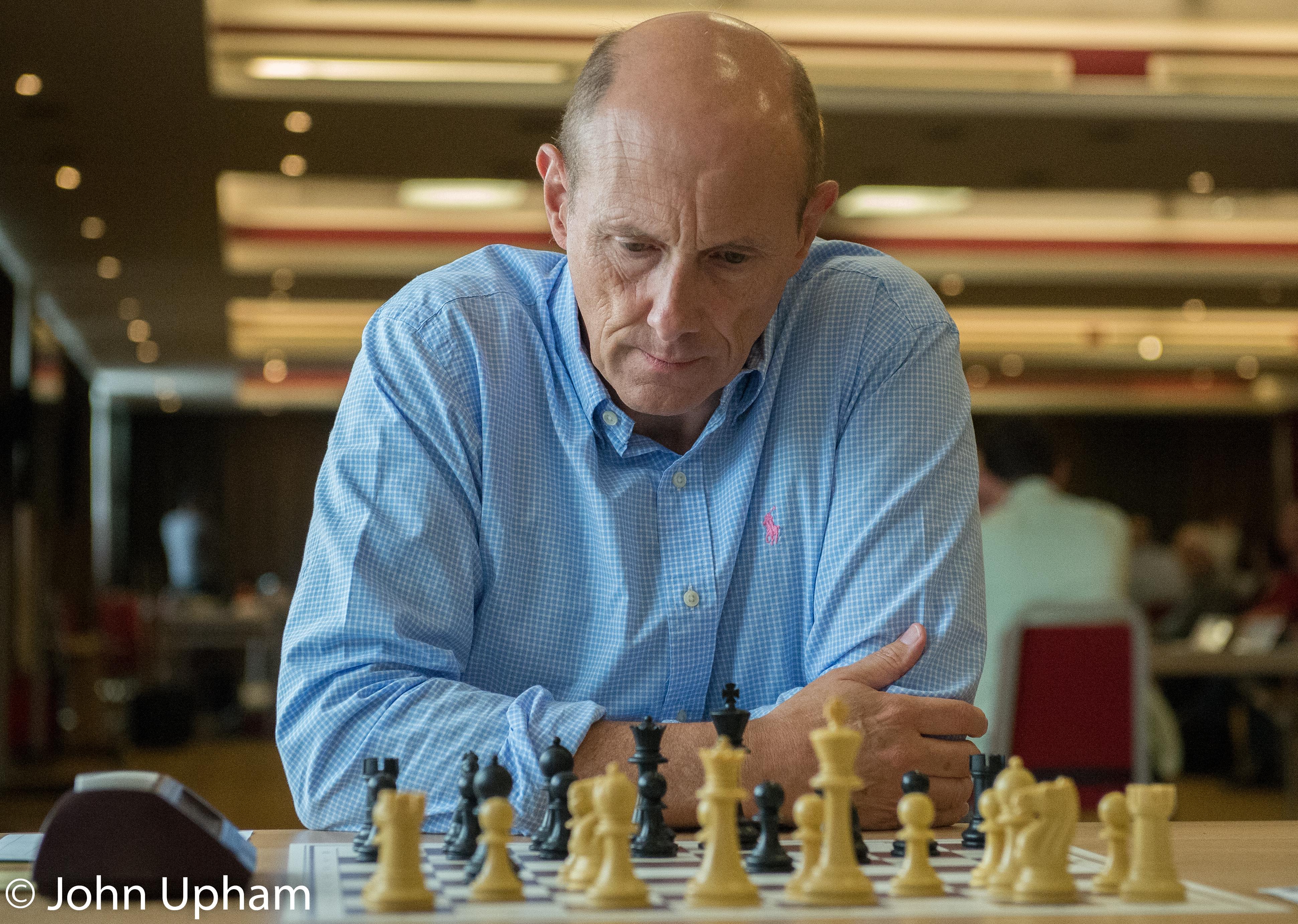
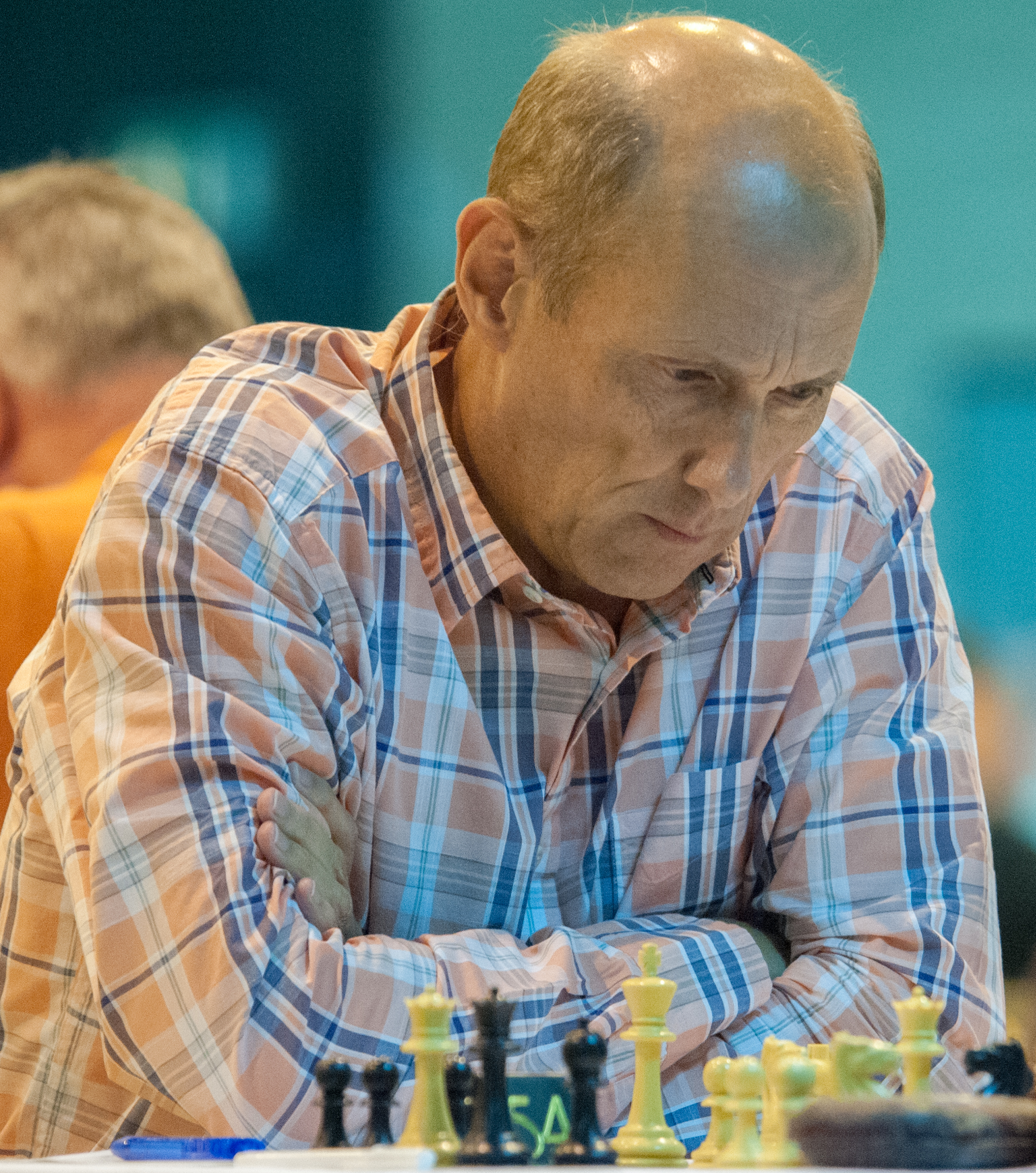
IM Nigel Povah, courtesy of John Upham Photography
BCN wishes IM Nigel Edward Povah all the best on his birthday, July 17th in 1952.
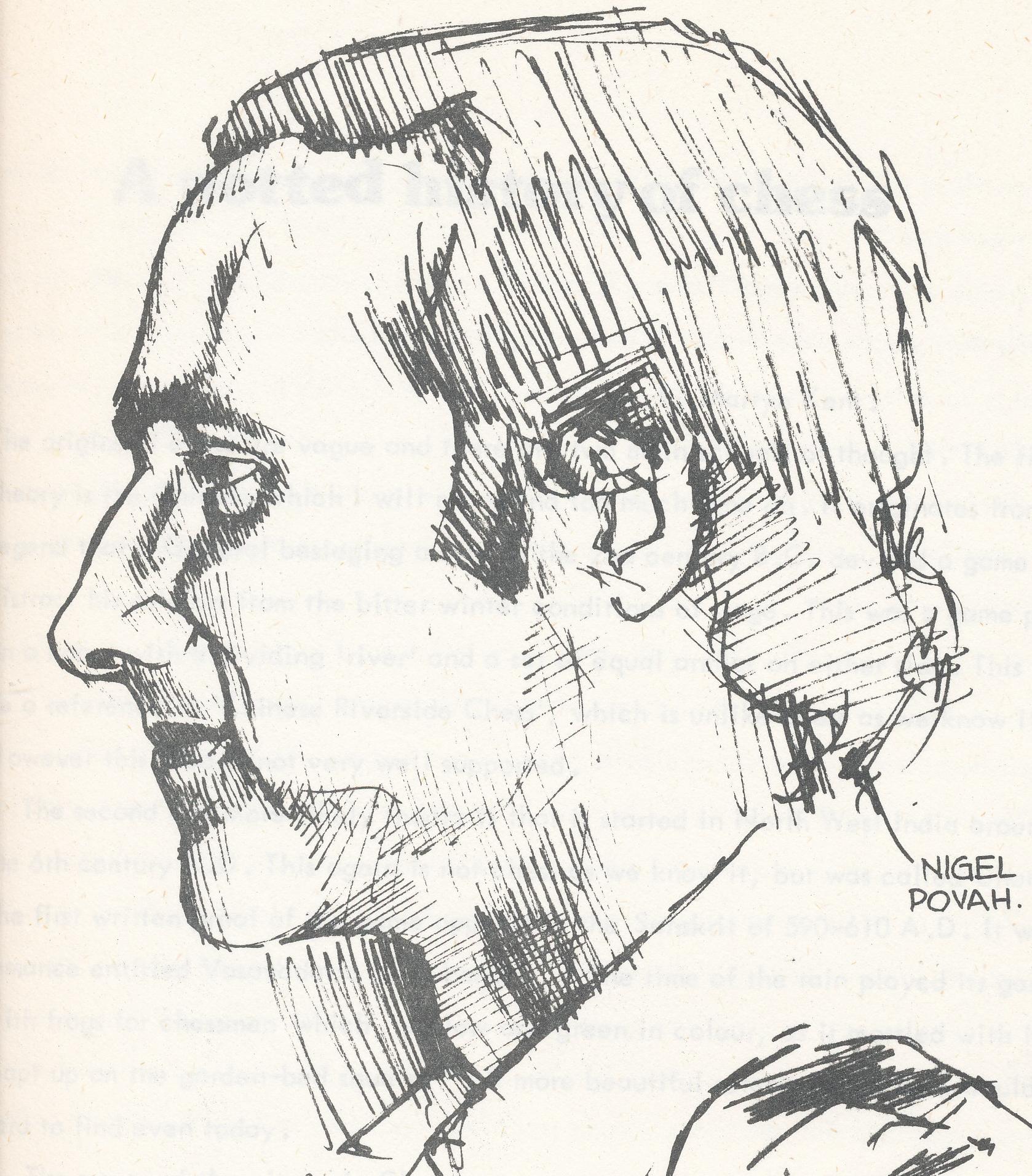
Nigel Povah, from Knightmare, Volume 2 (1976-77) drawn by Chris Jones.
Nigel was born in Wandsworth, London.
He became a FIDE Master in 1980, an International Master in 1983 and an International Correspondence Master in 1983. He became England’s 7th ICCF GM in 1989. His predecessors were :
210048 Markland, Peter Richard ENG GM 1984
210060 Penrose, Dr. Jonathan ENG GM 1983
210178 Webb, Simon ENG GM 1983
210011 Clarke, Peter Hugh ENG GM 1980
210029 Hollis, Adrian Swayne ENG GM 1976
210062 Richardson, Keith Bevin ENG GM 1975
Nigel has been Southern Counties (SCCU) champion for the 1974-75 and 1975-76 seasons.
Nigel Povah, circa 1979
Nigel has played for Streatham & Brixton Club (see the Andrew Martin video below) and was part of this very strong London club which developed many original opening ideas.
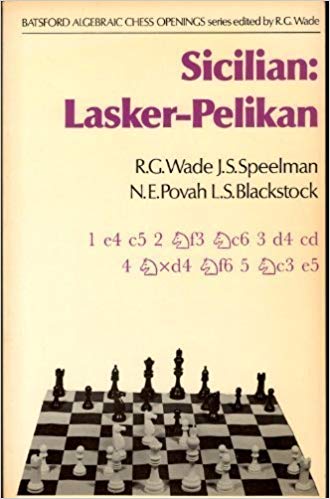
Nigel was a strong opening theoretician and developed ideas in the Sicilian Lasker-Pelikan, Sveshnikov and English Openings amongst others.
Knightmare magazines are a valuable source of information about the club and it’s members.
Below we have the game Berg-Povah, Wijk aan Zee, 1979 annotated by Streatham & Brixton team mate, IM Andrew Martin :
and here is the game in full:
Nigel continues to play for Guildford in the Surrey League and in the Surrey Border League as well as Guildford in the Four Nations Chess League (4NCL).
Nigel started the highly successful 4NCL teams sponsored by his company Guildford A&DC (Assessment & Development Consultants) and the 4NCL team(s) are now run by Roger Emerson and Julien Shepley having taken a back seat since June 2017.
His peak rating was 2385 in January 1980 aged 28.
Nigel is married to Gill and has a daughter Lucy and a son, Jonathan.
In recent times Nigel has been playing more nationally and internationally and and has become a specialist in the Accelerated London System (with 2.Lf4) and is a regular on the International veterans circuit.
Here is an article written by Richard W. O’Brien from British Chess, Pergamon Press, 1983 :
“Nigel Povah was for the majority of the seventies a chess professional. He mixed playing with teaching in various schools and also coached individuals. He is a BCF qualified coach. Danny King (our second youngest international master) and the late Ian Wells were two who clearly benefited from his teachings.
On the playing front he won numerous congresses including Hammersmith 1970, Paignton 1974, LARA 1974, Evening Standard 1974, LARA(again) 1978 and Charlton 1979. In 1975 he won the SCCU Championship and again in 1976. He first played in international tournaments in 1973 when as one of the weaker players in the tournament he produced excellent annotations for the bulletin, even for the games he lost. These were the first signs of becoming a chess writer. To date he has shared first place in four international tournaments Robert Silk 1976, Malta 1976, Malta(again) 1979 and Wijk aan Zee Master Reserves 1979. It can be seen that 1979 was a good year. He also shared 4th place in the British Championship and represented
England at senior level against Denmark in the same year.
His road to the lM title has been long and hard. On several occasions he got close to the norm requirement just to fail. At Lloyds Bank in 1978 and 1980 and Lewisham 1981 he got the necessary three norms. Had he then ceased playing (with an Elo of 23751 he would automatically have had the lM title confirmed at Lucerne in 1982. He however continued playing and became the victim of some complicated and, with respect, unfair FIDE regulations, and his title was delayed until 1983. Clearly had the General Assembly met between January 1982 and June 1982 he would have been awarded the title at least a year earlier!
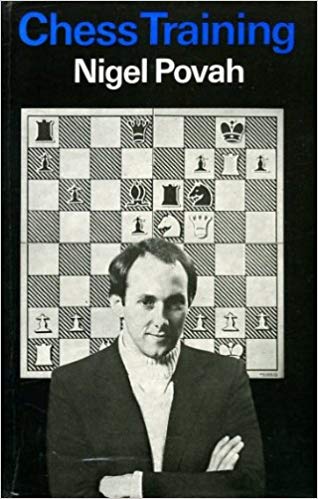
He has written several books-Chess Training published by Faber, English:Four Knights Batsford, How to Play the English Batsford and was co-author of Sicilian: Lasker-Pelikan Batsford. These last three Batsford publications indicate his interest in current theory. Two of the games which follow- v Berg (see 16…Rb8) and v Speelman (see 12 NgS)certainly confirm this. The Streatham and Brixton club owe much to Nigel Povah in becoming one of the strongest clubs in the country. At one time an average second division side (London league) they have since won the league and been in contention more than once. For several years he was one of the main three organisers at the club and even today still continues to play for them and is currently their National Club match-captain although he now lives some twenty miles away in Guildford.
In 1979 he organised the First Regency International at Ramsgate. In conjunction with Ian Josephs (sponsor) and Bob Wade (controller) this has become a highly successful annual event.
Now married, his wife Gill presented him with a daughter Lucy shortly after the completion of the Regency International in 1982.
He now works for ICL as training consultant and limits his over the board chess to club chess for Streatham.
He has recently taken up postal chess and in 1983 after competing in the BPCF Jubilee he became a correspondence International Master.
He has a BSc in Psychology and an MSc in Occupational Psychology.”
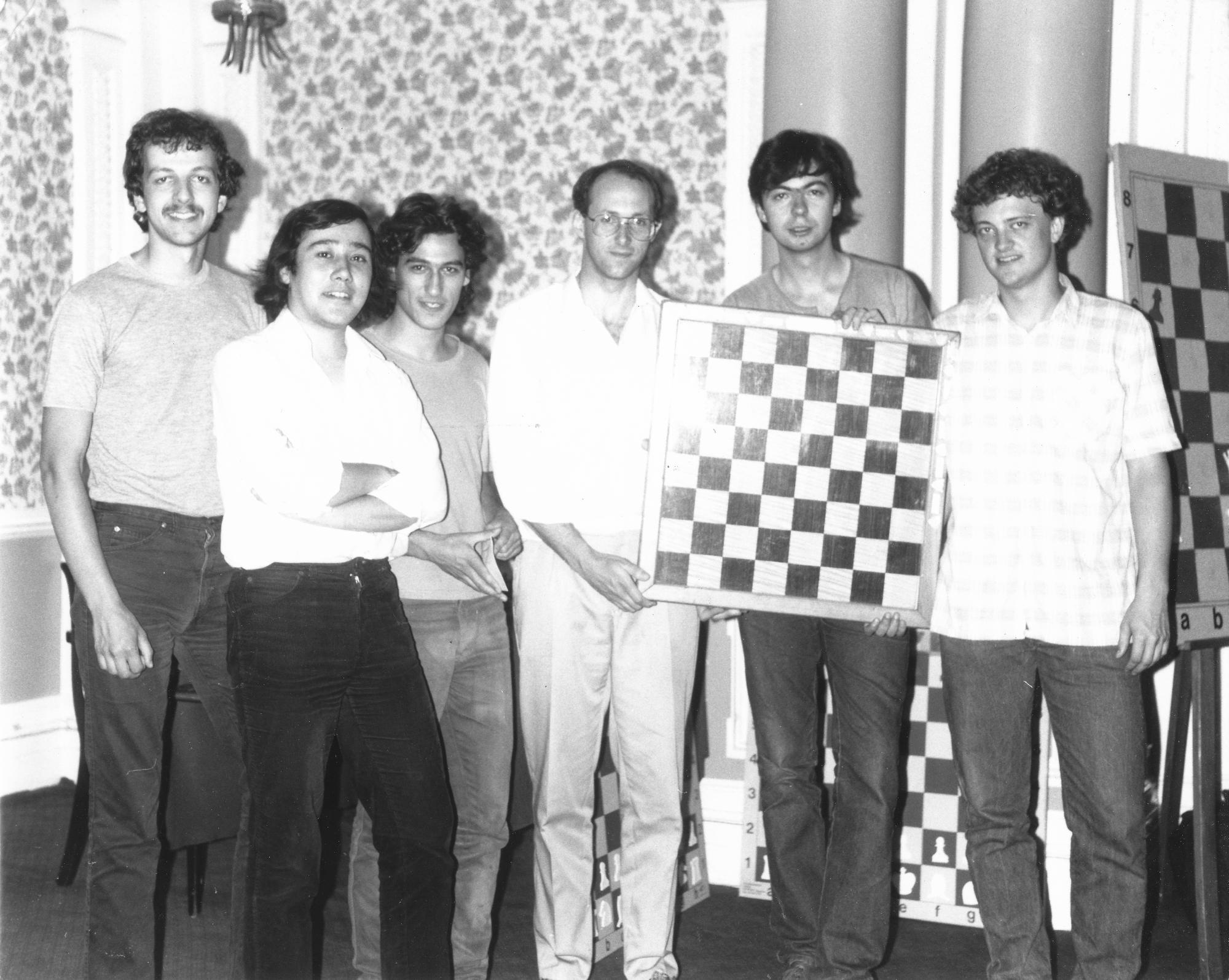
Streatham & Brixton becoming BCF National Club Champions in 1989. The team was Tony Kosten, Mark Hedben, Daniel King, Nigel Povah (Captain), Joe Gallagher and Julian Hodgson : quite a strong team
According to Chess Training : “Two of his pupils were members of England’s victorious 4-man team in the World Under-16 team event.”
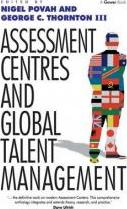
Sicilian Lasker-PelikanChess Training : Nigel PovahEnglish : Four KnightsHow to play the English OpeningAssessment Centres and Global Talent ManagementIM Nigel Povah, courtesy of John Upham Photography
‘Winning Ugly in Chess’ by Cyrus Lakdawala (New in Chess 2019). Index of openings (rich in Sicilians and King’s Indians), Index of Players, 10 chapters, 336 pages. Many games from all eras from Anderssen to recent Swisses. Subtitled ‘Playing badly is No Excuse for Losing’. Paperback, no use of Rabars, no photos but exercises scattered throughout. www.newinchess.com. Cover price $24.95. This exceptional book is offered for sale at the Chess & Bridge Shop in Baker Street for £20.95. Good value!
So, enquires the author, when was the last time you won a perfect game? A game that wasn’t tainted by inferior moves?
Every player knows that smooth wins are the exception and that play is often chaotic and positions are frequently irrational. The road to victory is generally full of bumps and misadventures.
Books supposedly feature superbly played games. In ‘Winning Ugly in Chess’ you will see games, usually quoted in full, where weird moves are rewarded. The prolific author (has he written 43 books?-Ed.) knows that playing good chess is all very well, but that beating your opponent is better, that these are not two heads on the same coin. He shows that this is no paradox or contradiction. It is a fact of life – of chess life, anyway – and he demonstrates the fine art of winning undeserved victories by:
* miraculously surviving chaos * throwing vile cheapos (swindles) * refusing to resign in lost positions * getting lucky breaks * provoking unforced errors * finding other ways to land on your feet after a roller-coaster ride.
Lakdawala shows how you can make sure that it is your opponent, not you, who makes the last blunder. he calls it ‘flip-flop a result’. (What would Tartakower have said? Actually, towards the end of his life Tartakower was largely inaudible-Ed.). If you’d rather win a bad game than lose a good one, then this your ideal guide.
The next time the, supposedly, wrong player wins, you could be that player. Welcome to the fine art of winning undeserved victories.
A short review in CHESS 08/19 welcomes this title, adding that it is largely based on Lakdawala’s games and those of his students. This really is a book to be enjoyed on so many levels. Random thought: I wonder why the book calls 1.e4 e5 2. Nf3 Nf6 – as well as the Petroff’s, naturally – the Russian Game? Unusual! The author is an International Master.
IM Lawrence Hugh Cooper, photograph from Cathy Rogers
BCN wishes Happy Birthday to IM Lawrence Cooper (16-vii-1970)
Lawrence was born in Stone, Staffordshire and attend Walton High School, Stafford.
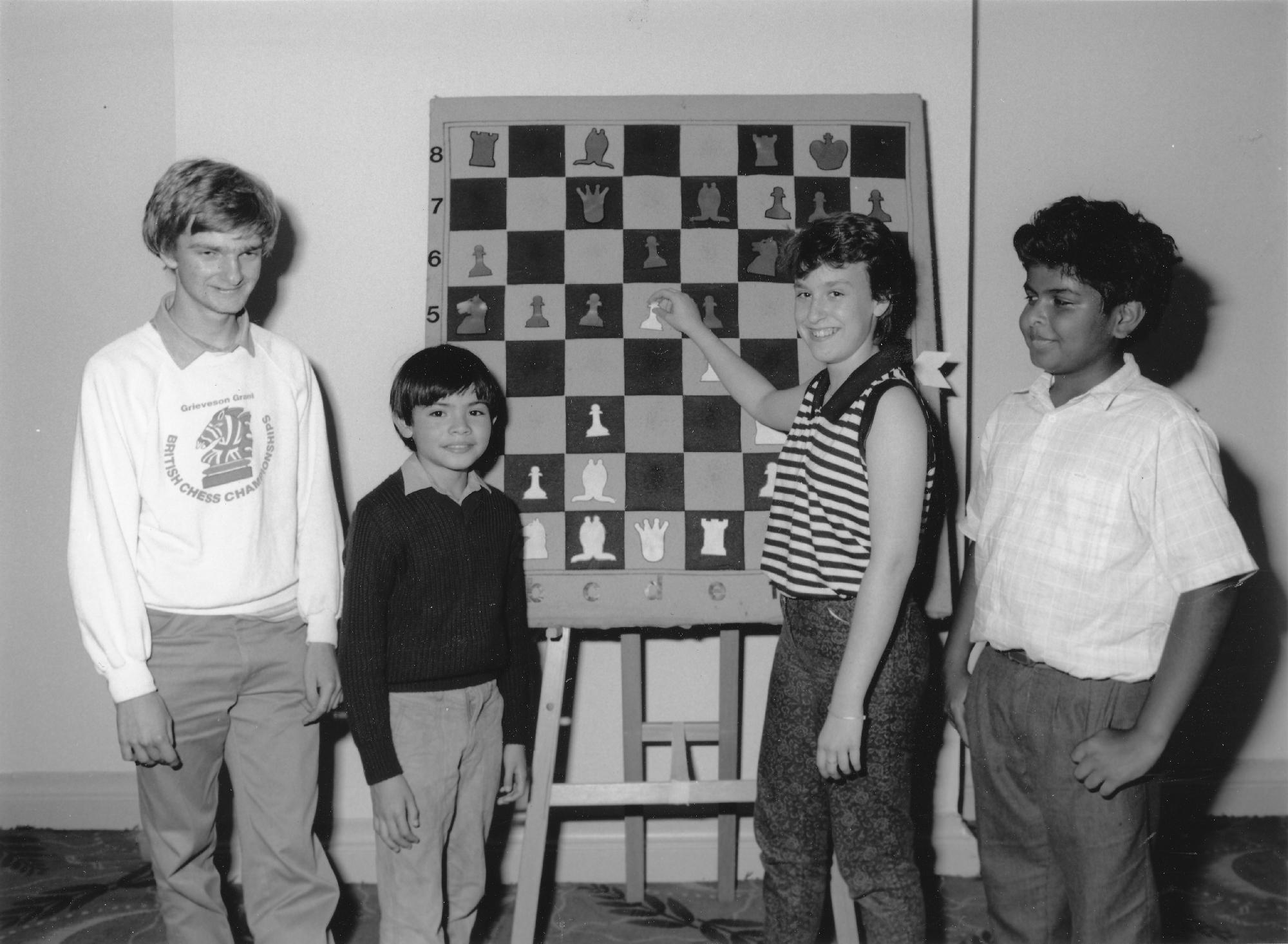
Lawrence Cooper, Demis Hassabis, Cathy Haslinger and Dharshan Kumaran in around 1986. Possibly at a Lloyds Bank event.
He became a FIDE Master in 1989 and then an International Master in 2001.
Lawrence was awarded the FIDE International Organiser title in 2011 and the FIDE Arbiter title in 2016.
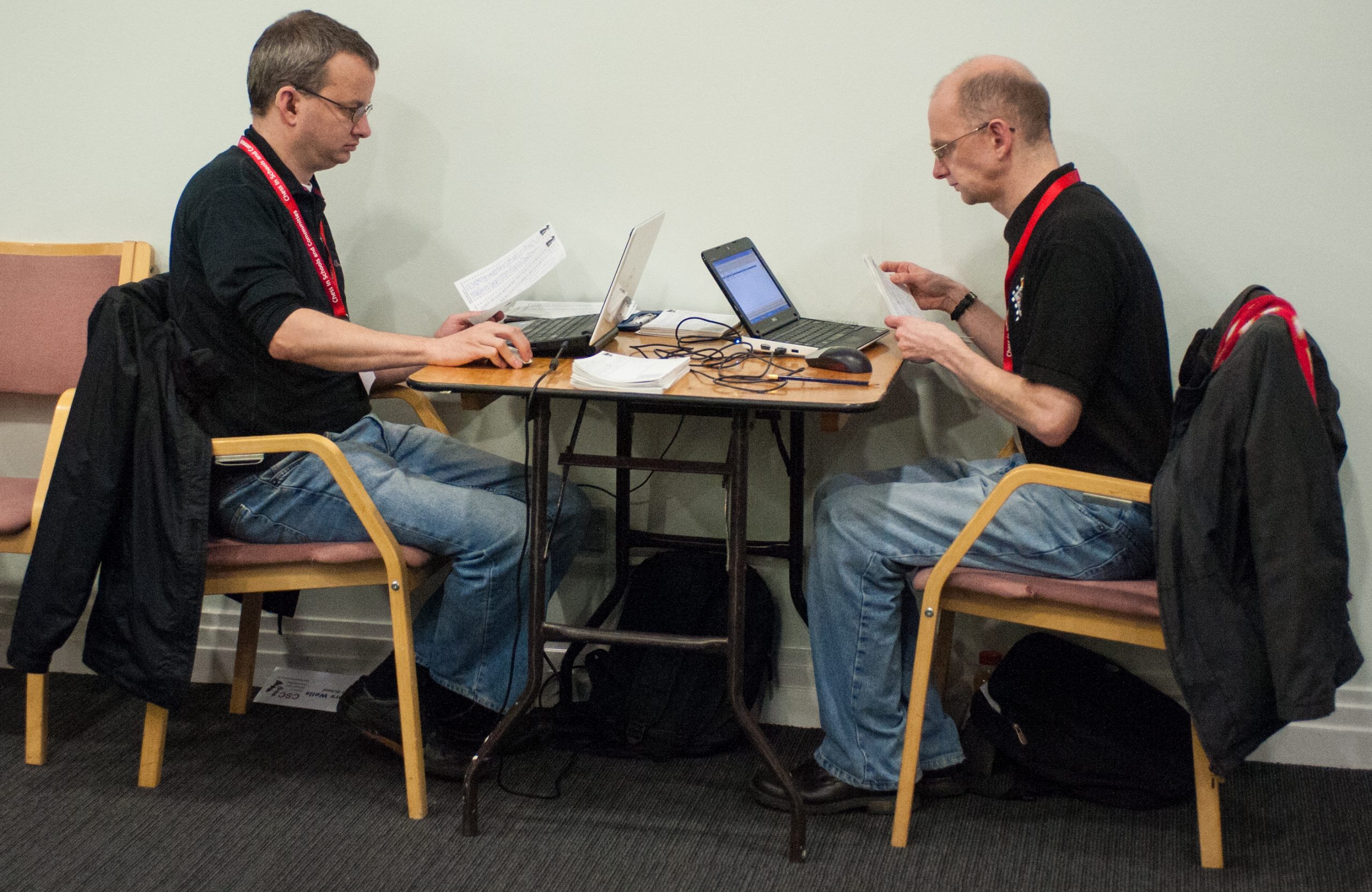
Tim Dickinson and Lawrence Cooper at the 2012 London Chess Classic, Olympia
His peak rating was 2430 in January 1988.
Lawrence plays for Wood Green in the Four Nations Chess League (4NCL) plus Newport (Shropshire), Stafford, Bushbury and Worcestershire CCA in other competitions.
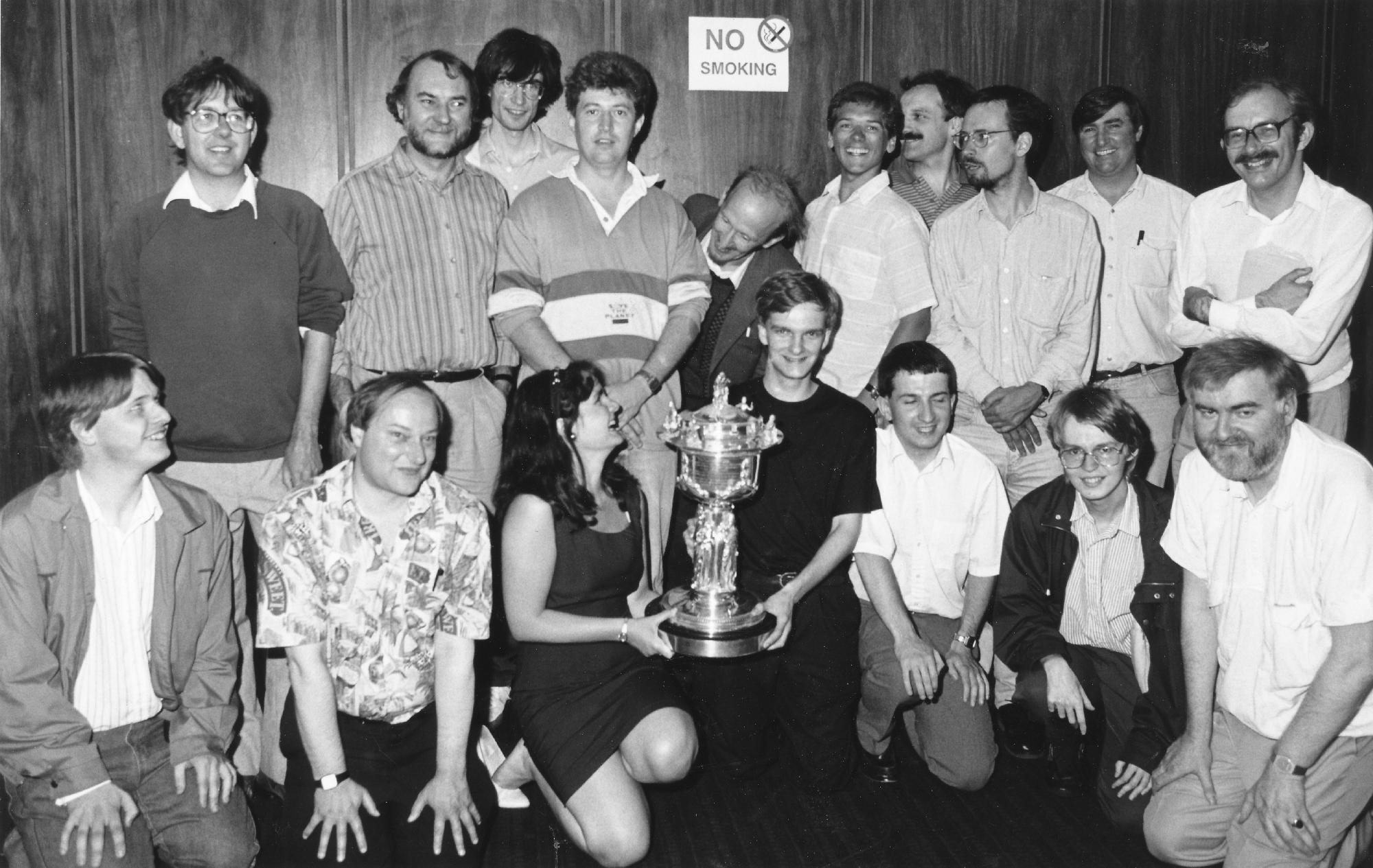
Lawrence Cooper (centre with trophy) being presented with 1992 BCF Counties Championship trophy by WIM Cathy Forbes. Others in the group include Michael Gough, Alan A Smith, Gerald Acey, Mike P Townsend, Malcolm Armstrong, Martin Costley, Alan Crombleholme, Graeme N Buckley, Paul Wallace, Mark A . Wheeler, Dave Carless, Darren P Wheeler, Keith Thompson, Ralph MA Allen and Graham Smith
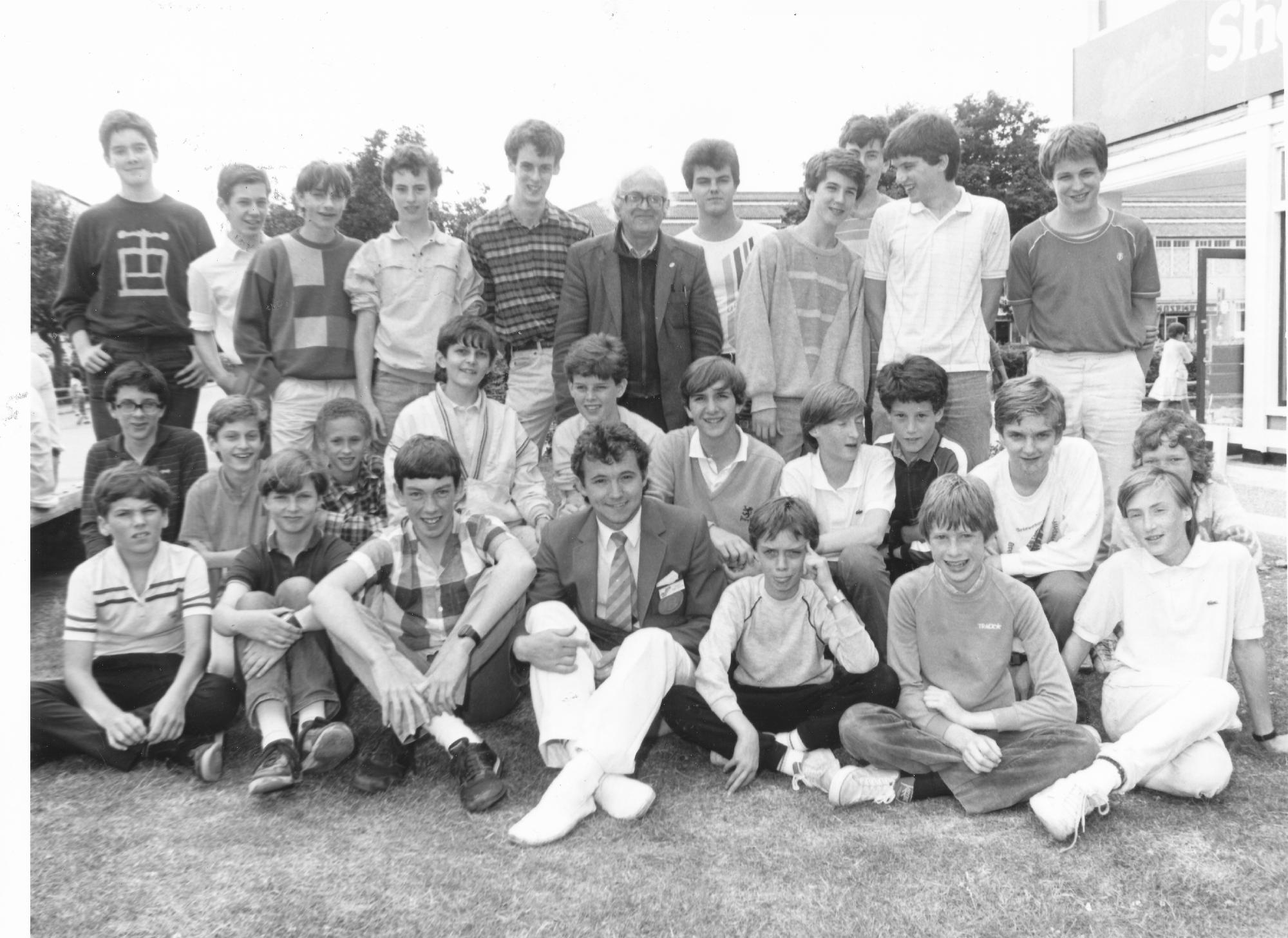
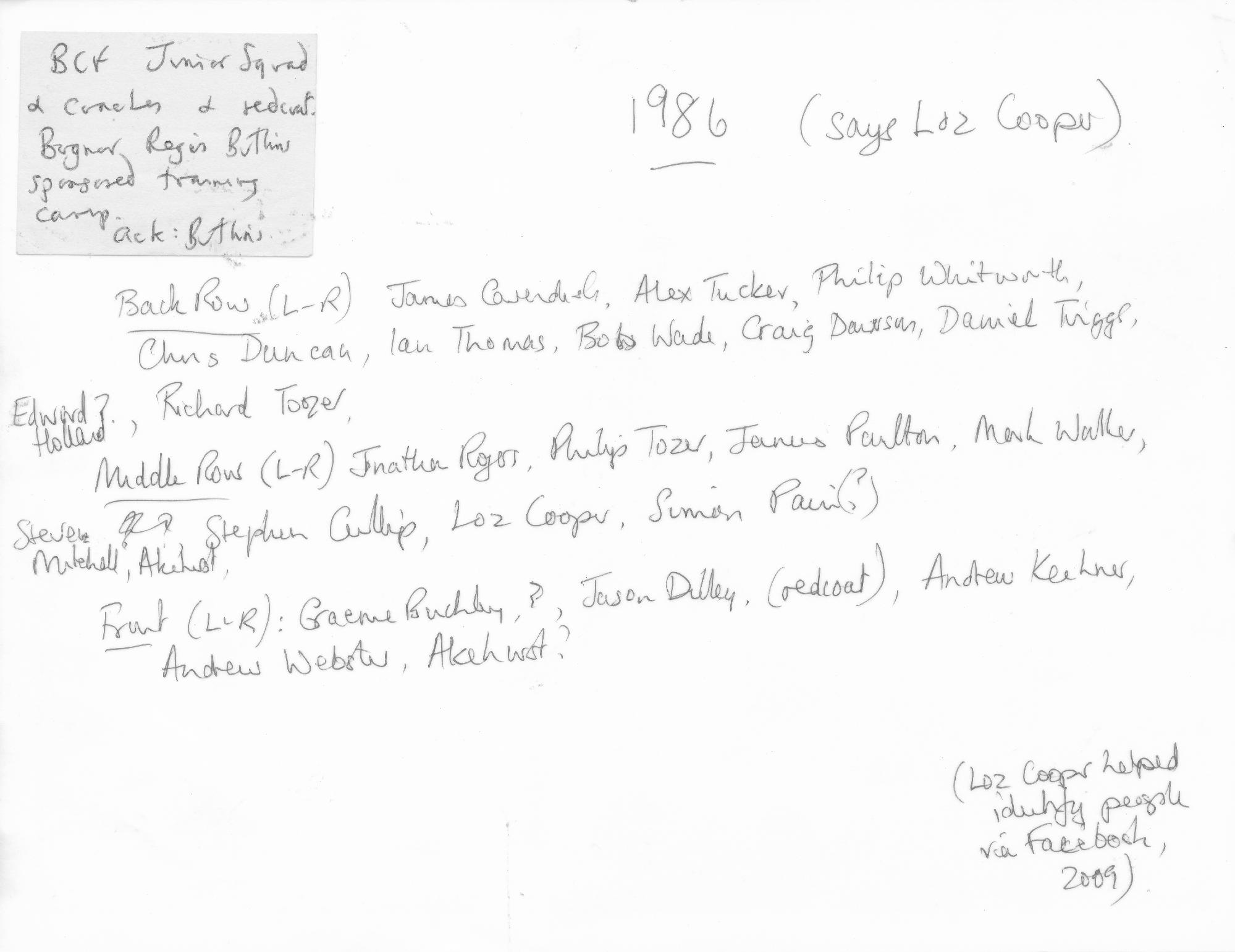
Full caption in image below
Full caption for above 1986 BCF Junior Squad group photograph
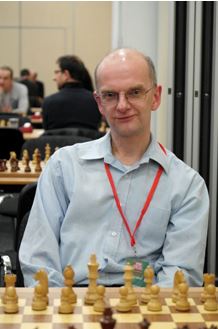
IM Lawrence Cooper, photography by Fiona Steil-Antoni
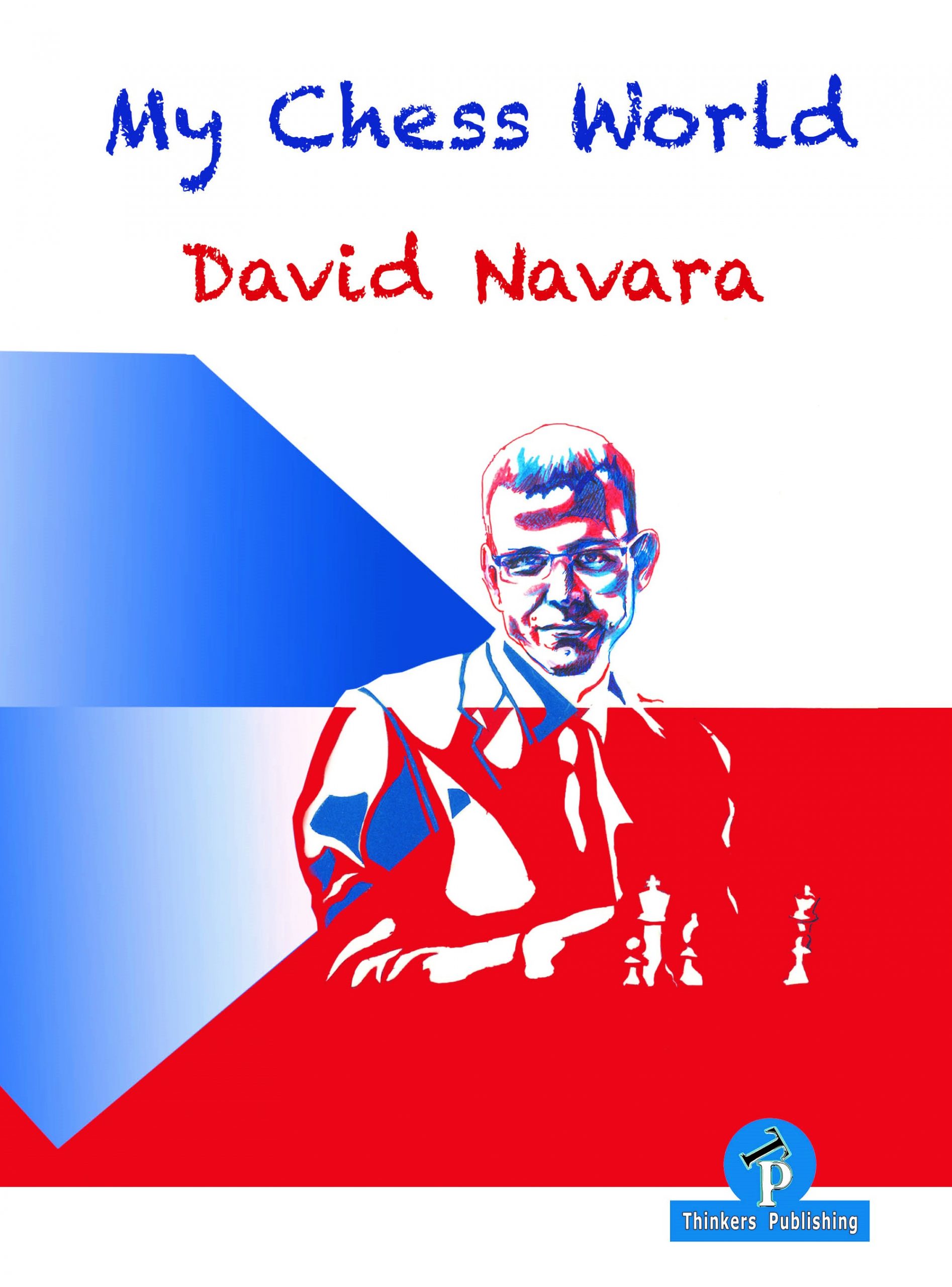
“Nine-time Czech champion David Navara, 35, became a grandmaster in 2002 at the age of sixteen. Amongst his many achievements are: 1st at the Ordix Open rapid tournament in Mainz, Germany, in 2007. World Cup quarterfinalist in 2011. Gold medal winner on 2nd board at the 2012 Chess Olympiad in Istanbul. Gold medallist with the Nový Bor team at the 2013 European Club Cup in Rhodes, Greece. Winner of the European Blitz Championship in Wrocław, Poland, in 2014. Silver medallist in the European Individual Championship in Jerusalem in 2015.”
GM David Navara
From the rear cover :
“This book is not a pure (auto)biography, rather a games collection. It consists mainly of interesting high-class games played by me, including many losses. Most of the games are preceded by accompanying texts, which vary from essays to tournament reports. The title of the book might seem presumptuous, but I wanted to show how I see or experience the competitions without denying the chess worlds of others. While the texts are mostly light and subjective, at the same time I tried hard to stick to the facts and provide some food for thought. GM David Navara May 2020.”
David Navara is one of the most distinctive and popular personalities on the contemporary chess scene, renowned for his uncompromising play, for his politeness and friendliness, and, most of all, for his eccentricities. He’s been just below the world elite for the past 15 years or so, usually rated between 2700 and 2750.
In this chunky 600+ page book he offers us a collection of 64 (for Navara it could be no other number) games, chosen for their interest rather than the result, so you’ll find draws and losses as well as wins here. His opponents include many of today’s top grandmasters and a wide range of openings is represented.
Authors have a difficult decision to make about how detailed their analysis should be. Navara explains the dilemma nicely in what he calls the Navara Antinomy:
Substantial games are interesting.
Substantial games require extensive annotations.
Extensive annotations are boring.
Yes, the annotations are pretty extensive, but the games are interesting enough to merit this. There are plenty of variations and sub-variations which, if you’re playing through the games, might be confusing unless you’re making use of a second board. You’ll discover a host of exciting middle games and, in particular, some fascinating endings.
One game that particularly drew my attention was his game with White against Radoslaw Wojtaszek from Biel 2015.
Not all games with early queen exchanges are dull. The moves up to 25. Kf6 were pre-game preparation, and by move 30 the white monarch reaches h8, which must be some sort of record for a top level game.
If you want to find out what was really happening in this game you’ll need to buy the book.
Navara likes to categorise chess games as either porridge (good for you but boring) or ice cream (tasty but not so healthy) and tells us both types are featured in the book. I think he’s, very typically, being too modest. Most of the games, like the one above, seem to me to be both tasty and good for you. A delicious main course of salmon, perhaps (Navara likes fish, especially Stockfish), or a refreshing fruit salad.
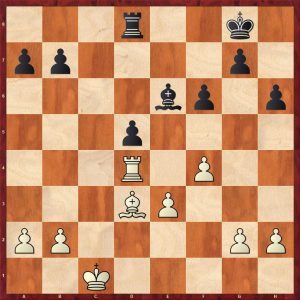
There’s no better way to end a meal than with a light sorbet. Here’s the conclusion of the last game of the book, against Vojtech Zwardon (Ostrava 2019).
How would you continue with White?
Full credit for 1. Qxg7+ Kxg7 2. Bf6+ and 3. Rh8#, but Navara preferred the cuter 1. Qh8+ Bxh8 2. Rxh8+ Kg7 3. Bf6#.
If you’re looking for a collection of top level games with excellent annotations, you won’t be disappointed with this book.
You get a lot more for your money, though. Most games are preceded by essays originally published on Navara’s chess blog (‘a blog past its sell-by date’) covering a wide variety of subjects: part travelogue, part tournament report, part meditation on chess and life.
You’ll find out a lot about the life of a chess player travelling round Europe, and occasionally further afield (Cuba, China) taking part in national and international team competitions as well as individual matches and tournaments.
There’s much more besides. As well as ‘Porridge and ice cream in Barcelona’ you’ll encounter ‘Sea hedgehogs’, ‘Swans on the top floor’ and ‘On Karl Marx and locking a bishop’.
The book is also full of humour, particularly verbal humour, which the translator has done well to render into English successfully. Humour is something very personal, and, I guess, you might find this aspect of the book either endearing or annoying. As for me, I love it. It’s great to meet someone who uses exactly the same jokes as I do.
Beyond the moves, then, this is, in many ways, a very personal book. The first few pages offer some biographical background. ‘I have no recollection of it, but according to reliable sources, I was born on 27 March 1985.’
He concludes this section: ‘I can’t drive or dance, and my knowledge of films and TV series is minimal.’ (Me too, David.) … ‘Chess is my choice. It has given me a lot: fun, success, friends, self-realisation, money, popularity, the chance to travel.’
At the end of the book he returns to the same theme, offering us a chess poem:
‘But still I remain like a child, who finds the outside world so wild. I still so much like to play chess, that it looks like both curse and bless.’
He concludes:
‘Chess has given me a lot. It can unite people of various nations, different ages, gender, political views, social and economic background or health conditions. It contains elements of art and some chess games are real masterpieces. (Of course they are rare, as masterpieces tend to be.) Chess might relieve the worries of everyday life, bring one good friends and uplift one’s spirit.
‘What more can you expect from a board game with seemingly simple rules?’
I think we can all, whatever our rating, agree with David Navara’s sentiments.
The book is well produced and enhanced with photographs of our hero. My one complaint, as so often, is the lack of an index. Perhaps I’m old-fashioned, but if I’m reading a games collection I’d like to be able to look up the games where Navara played Carlsen, or where he was on the black side of a Sicilian Defence.
What you do get is an excellently annotated games collection as well as an insight into the life and mind of a charming and unusual personality, who perceives the world with a mixture of child-like wonder and self-deprecating amusement. For me, it also provides the opportunity to meet someone who seems, in some respects, a kindred spirit.
I really enjoyed reading this book and finding out more about David Navara, both as a chess player and as a person. Very highly recommended.
Richard James, Twickenham, 13th July 2020
Richard James
Book Details :
Paperback : 616 pages
Publisher: Thinkers Publishing; 1 edition (28 July 2020)
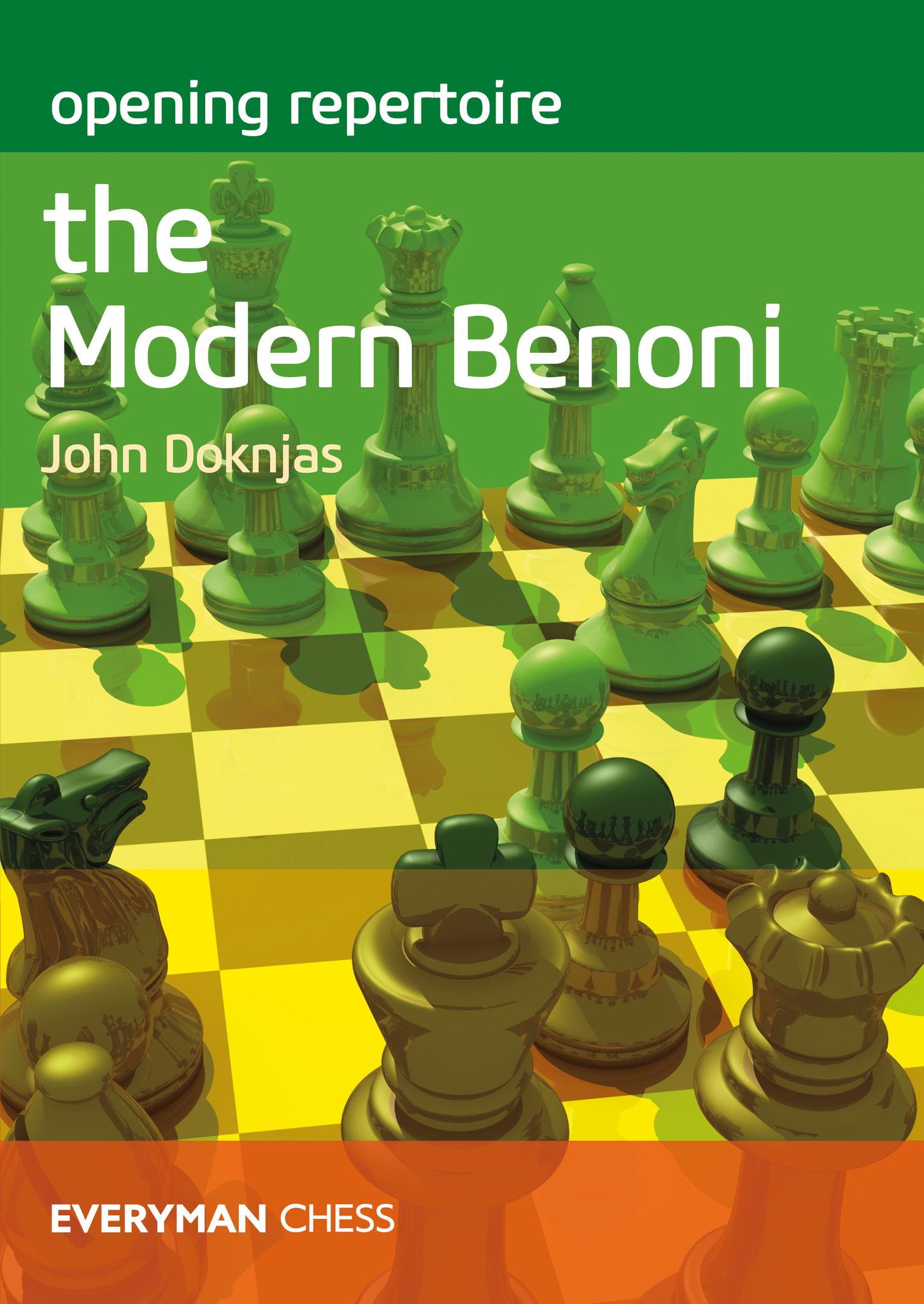
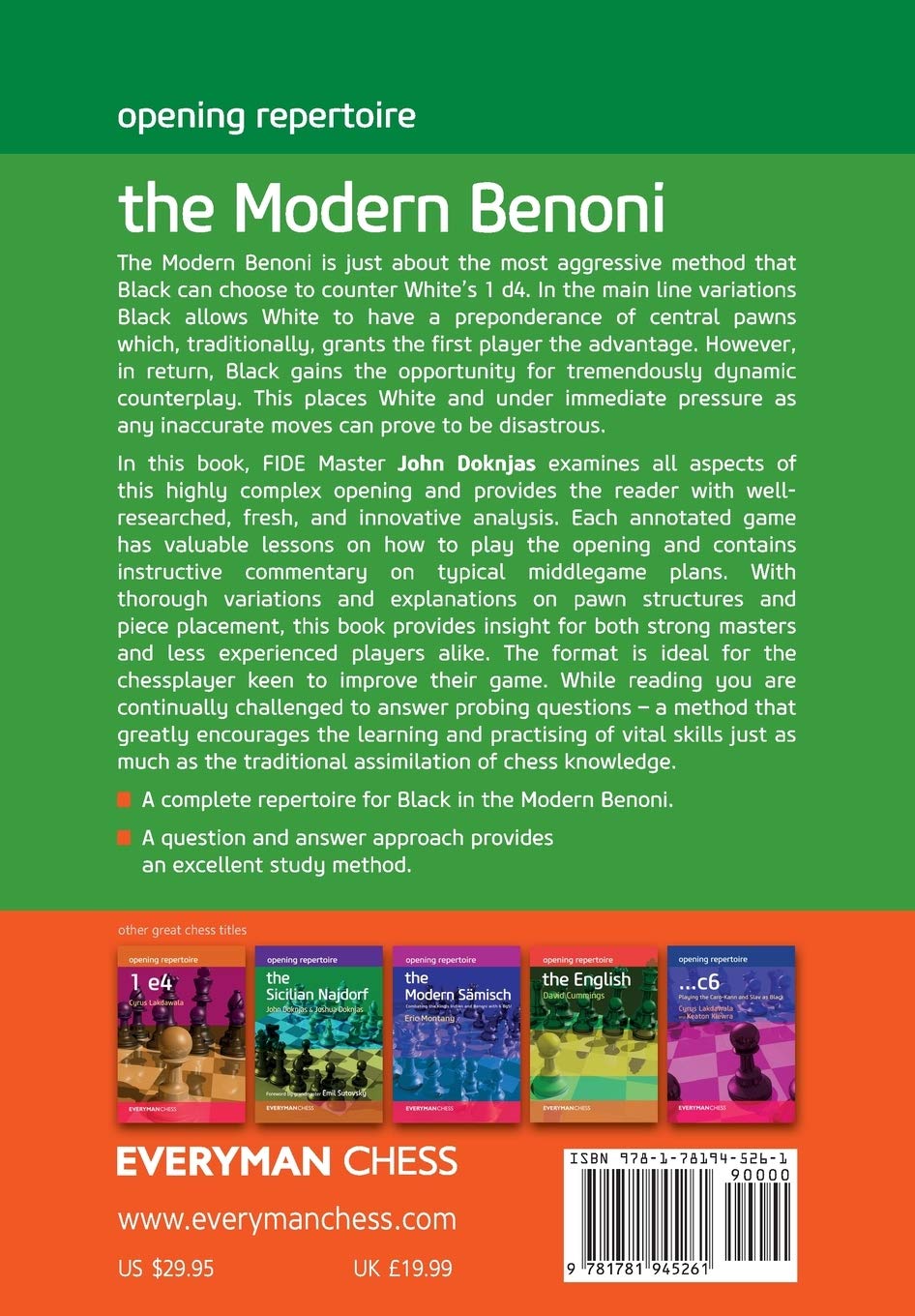
John Doknjas is a FIDE Master from Canada who has enjoyed success competing internationally. He has won seven national titles for his age and tied for 1st in the 2019 U18 North American Youth Chess Championship. This is his third book for Everyman Chess.
From the book’s rear cover we have :
“The Modern Benoni is just about the most aggressive method that Black can choose to counter White’s 1 d4. In the main line variations Black allows White to have a preponderance of central pawns which, traditionally, grants the first player the advantage. However, in return, Black gains the opportunity for tremendously dynamic counterplay. This places White and under immediate pressure as any inaccurate moves can prove to be disastrous.
In this book, FIDE Master John Doknjas examines all aspects of this highly complex opening and provides the reader with well-researched, fresh, and innovative analysis. Each annotated game has valuable lessons on how to play the opening and contains instructive commentary on typical middlegame plans. With thorough variations and explanations on pawn structures and piece placement, this book provides insight for both strong masters and less experienced players alike. The format is ideal for the chessplayer keen to improve their game. While reading you are continually challenged to answer probing questions – a method that greatly encourages the learning and practising of vital skills just as much as the traditional assimilation of chess knowledge.”
The Modern Benoni, by John Doknjas, is another book in Everyman’s “Opening Repertoire” series. As that implies, the book aims to provide Black with a repertoire against all lines that White can employ against the Modern Benoni, rather than an exhaustive analysis of all lines by both sides.
The Benoni has long been a choice of aggressive players who are willing to take a bit of a risk as Black in order to get a complex fight against White’s 1 d4 (and 2 c4). The resulting middlegame positions are usually double-edged and can be complex both positionally and tactically.
The theory is contained in 31 complete games broken down into nine chapters for the major systems, such as the Flick-Knife attack (aka the Taimanov variation), The Fianchetto Variation, the Knight’s Tour and so on. Major variations within each system are given new games, and (usually) minor variations within those are handled within the notes. Occasionally there are a lot of variations in the notes and this can make it a bit awkward to follow where you are in the main game, but this is probably an unavoidable feature of the complete game approach and I do not mention this as a criticism of the author or the book. Indeed, the book mitigates greatly against this by providing an excellent Index of Variations which tells you if a variation is covered in a main game, or within the notes to one, which makes future reference to a line much easier. The advantages of the complete game approach are that the annotations tell the reader the middlegame plans, and the reader gets to see how masters play out the positions.
The book also contains a nice introductory chapter in which Doknjas provides an excellent overview of plans and piece placement ideas from the perspective of both White and Black. Each chapter also includes a short introductory section, and a summary section, in which the differences between the systems covered by the various games in the chapter are explained.
The repertoire in the book steers Black to positions which appear theoretically sound, and provide Black at least a position with balanced counterplay. There aren’t many lines which offer safe equality, but this of course is the nature of the opening and is to be expected.
I have to say that I regard this as an excellent opening book.
Doknjas provides excellent explanations, both wordy and in concrete lines, and his Q&A and Exercises are always relevant to the material. When he feels appropriate, he is not afraid to recommend lesser-played lines and he backs up his choices with solid analysis and reasoning. His recommendations appear sound and those lines I have tested with an engine do not fall foul of computer analysis.
As an example of his style, here is an excerpt from the game in which he recommends 12 …Rd8 in the Mikenas Attack:
Question: What are some of this moves pluses?
Answer: 12 …Rd8 has only been chosen around 4% of the time OTB, but I really like it for a few reasons:
1. Black threatens to round up the d5-pawn with …Nb6. This doesn’t give White time to attack effectively with f4-f5.
2. The rook could prove very useful on d6, where it will control the f6-square. If black plays …f6 then the pawn will enjoy support, and in some lines Black could even use the rook for direct defence with with …Rf6. Another purpose for the rook being on d6 is to blockade the d5-pawn, which could be important if White’s light-squared bishop comes to c4.
3. The move has a fair amount of surprise value and its subtleties aren’t immediately obvious.
12 …Re8 is the main move but 13 f5! may give White strong play along the f-file (Ng5, Bc4, Qf3, 0-0 etc). The game remain objectively equal but it seems like Black is the one who has to be more careful. Se Feller-C Marzolo continued 13 …Kf8 14 Ng5 e4 15 fxg6 hxg6 16 Be2 Bd4 17 Rf1 with a messy position. 13 fxe5
Others:
a) Be2?! Nb6 14 fxe5 Rxd5 15 Qb3 Kf8 16 Be3 Kg8 gives Black an advantage.
b) …etc (The book actually uses figurine pieces rather than letters.)
I recommend this book to anyone who is already playing the Modern Benoni or who is looking to take it up. Even players who face the Benoni from the White side will get benefit from this book, at least an idea of the current state of theory of this opening, but obviously bear in mind that it is a repertoire book from Black’s viewpoint.
John Doknjas was not known to me before reading this book, I look forward to future books by him.
Colin Purdon, Crowthorne, Berkshire, 13th July, 2020
We focus on the British Chess Scene Past & Present!
This website uses cookies to improve your experience. We'll assume you're ok with this, but you can opt-out if you wish. Cookie settingsACCEPT
Privacy & Cookies Policy
Privacy Overview
This website uses cookies to improve your experience while you navigate through the website. Out of these cookies, the cookies that are categorized as necessary are stored on your browser as they are as essential for the working of basic functionalities of the website. We also use third-party cookies that help us analyze and understand how you use this website. These cookies will be stored in your browser only with your consent. You also have the option to opt-out of these cookies. But opting out of some of these cookies may have an effect on your browsing experience.
Necessary cookies are absolutely essential for the website to function properly. This category only includes cookies that ensures basic functionalities and security features of the website. These cookies do not store any personal information.